MCQ 11 Mark
Two different species cannot live for long duration in the same niche or habitat. This law is.
MCQ 21 Mark
The primary succession in a sere is a:
MCQ 31 Mark
Which of the following is free$-$living aerobic non$-$photosynthetic nitrogen$-$fixing bacte$-$ rium?
View full question & answer→MCQ 41 Mark
Second most important trophic level in a lake:
MCQ 51 Mark
- A
Group of components that interact with one another.
- B
Group of interacting species in one place at one time.
- ✓
Biological community and component of the physical environment with which the community interacts.
- D
Group of interacting chemicals and their cycles.
AnswerCorrect option: C. Biological community and component of the physical environment with which the community interacts.
View full question & answer→MCQ 61 Mark
Plant succession is a $.............$ process.
View full question & answer→MCQ 71 Mark
Plant community development is termed as:
MCQ 81 Mark
In a pond ecosystem, the food chain starts with:
MCQ 91 Mark
Each trophic level has a certain mass of living material at a particular time is known as:
MCQ 101 Mark
Decomposers like fungi and bacteria are:
- Autotrophs.
- Heterotrophs.
- Saprotrophs.
- Chemo$-$autotrophs.
- Choose the correct answer.
- ✓
$ii$ and $iii.$
- B
$i$ and $ii.$
- C
$i$ and $iv.$
- D
$i$ and $iii.$
AnswerCorrect option: A. $ii$ and $iii.$
View full question & answer→MCQ 111 Mark
- A
Species belonging to same period
- ✓
Species that determine structure of biotic community
- C
Species reproducing sexually
- D
Species recorded only in the fossil state
AnswerCorrect option: B. Species that determine structure of biotic community
View full question & answer→MCQ 121 Mark
Which type of association is found in be$-$tween entomophilous flower and pollinat$-$ing agent?
View full question & answer→MCQ 131 Mark
Which one of the following is one of the characteristics of a biological community?
MCQ 141 Mark
In which condition, the gene ratio remains constant for any species?
MCQ 151 Mark
The greatest biomass of autotrophs in the world’s oceans is that of:
AnswerCorrect option: D. Free$-$floating micro$-$algae, cyanobacteria and nanoplankton.
View full question & answer→MCQ 161 Mark
What is the annual net primary productivity of whole biosphere?
- ✓
$170$ billion tons $($dry weight$)$ of organic matter.
- B
$165$ billion tons $($dry weight$)$ of organic matter.
- C
$160$ billion tons $($dry weight$)$ of organic matter.
- D
$155$ billion tons $($dry weight$)$ of organic matter.
AnswerCorrect option: A. $170$ billion tons $($dry weight$)$ of organic matter.
View full question & answer→MCQ 171 Mark
Last stable community is succession which depends on climate is:
AnswerThe gradual change in the species structure of an ecological community is known as ecological succession. A climax community is the final community formed when the ecological succession becomes stable. It remains relatively unchanged until destroyed by an event such as fire or human interference. It is also known as a stable biological community.
View full question & answer→MCQ 181 Mark
The sphere of living matter together with water, air, and soil on the surface of the earth is called $.........$
View full question & answer→MCQ 191 Mark
A progressive series of changes in plant and animal life of an area from initial colonization is known as:
MCQ 201 Mark
The pyramid of energy in a forest ecosystem is:
- ✓
- B
- C
Both upright and inverted
- D
AnswerEcological pyramid is the graphic representation of an ecological parameter $($number, biomass or energy$).$
The ecological pyramid can be upright, inverted or spindle shaped. The pyramid of energy gives graphic representation of flow of energy in different trophic levels. It is always upright because only $10$ percent of energy is transferred from one trophic level to the next.
View full question & answer→MCQ 211 Mark
The total energy fixed by a gram plant $($Cicer arietinum$)$ in an ecosystem as a whole is called:
View full question & answer→MCQ 221 Mark
Energy flow in ecosystem is:
MCQ 231 Mark
If the carbon atoms fixed by producers already have passed through three species, the trophic level of the last species would be:
MCQ 241 Mark
Which one of the following pairs is mis$-$matched?
AnswerCorrect option: B. Prairie $-$ Epiphytes.
View full question & answer→MCQ 251 Mark
The final stable community in ecological succession is:
AnswerThe climax community is stable, self$-$perpetuating and final community appearing in an area at the end of biotic succession, which is in perfect harmony with the climate of the area.
The vegetation in that particular area has been reached to a stable condition after ecological succession.
View full question & answer→MCQ 261 Mark
Who coined the term ecosystem?
MCQ 271 Mark
Which one of these is a sedimentary cycle ?
MCQ 281 Mark
A mutually beneficial association necessary for survival of both partners are:
- ✓
Mutualism$/$ symbiosis.
- B
- C
- D
Both $(a)$ and $(b).$
AnswerCorrect option: A. Mutualism$/$ symbiosis.
View full question & answer→MCQ 291 Mark
In a biotic community, the most important factor for survival of an animal is:
MCQ 301 Mark
Ecosystem may be defined as $..........?$
- A
Group of plants which act as the energy suppliers
- B
Group of organisms which form population
- ✓
Functional unit of environment
- D
AnswerCorrect option: C. Functional unit of environment
The ecosystem is a segment of nature or biosphere consisting of a community of living beings and the abiotic or physical environment both interacting and exchanging materials between them. The ecosystem is defined as a functional unit of environment, which is independent and self$-$sustaining due to various interactions between abiotic and biotic components and different organisms among themselves.
View full question & answer→MCQ 311 Mark
Pyramid of energy in a forest ecosystem is:
- A
- ✓
- C
Both upright and inverted depending on ecosystem
- D
First upright then inverted
View full question & answer→MCQ 321 Mark
Zooplanktons represent which trophic level in an aquatic ecosystem?
- A
$T_1$ level.
- ✓
$T_2$ level.
- C
$T_4$ level.
- D
$T_3$ level.
AnswerCorrect option: B. $T_2$ level.
View full question & answer→MCQ 331 Mark
The zone at the edge of a lake or ocean which is alternatively exposed to air and immersed in water is called:
MCQ 341 Mark
The natural process by which different groups or communities colonize the same area over a period of time in a definite sequence is called:
AnswerThe transition in the species composition of a given area is called ecological succession.
This takes place due to the change in the environmental conditions in a geographical area.
During succession, some species colonise an area and their populations become more numerous, whereas populations of other species decline and even disappear.
The time scale can be decades $($for example, after a wildfire$),$ or even millions of years after a mass extinction.
View full question & answer→MCQ 351 Mark
Which one of the following statements is correct for secondary succession?
- A
It is similar to primary succession, except that it has a relatively fast pace.
- B
It begins on a bare rock.
- ✓
It occurs on a deforested site.
- D
It follows primary succession.
AnswerCorrect option: C. It occurs on a deforested site.
View full question & answer→MCQ 361 Mark
Climax community is in a state of:
AnswerClimax community is in a state of equilibrium.
View full question & answer→MCQ 371 Mark
Which of the following habitats is most unsuitable for primary productivity?
AnswerThe plants or the other autotrophic organisms which can prepare food require sunlight. In a cave, there will be very less availability of sunlight and hence primary productivity due to photosynthesis by green plants will be very low. Hence, a cave ecosystem is most unsuitable for primary productivity.
View full question & answer→MCQ 381 Mark
Succession showing changes in communities at a place is called:
MCQ 391 Mark
Which of the following is an ecosystem service provided by a natural ecosystem?
- A
Pollutant absorption and reduction of the threat of global warming.
- B
Prevention of soil erosion.
- C
- ✓
View full question & answer→MCQ 401 Mark
Among the following bio$-$geo$-$chemical cycles which one does not have losses due to respiration?
View full question & answer→MCQ 411 Mark
Which of the following statements is correct for secondary succession?
- A
It begins on a bare rock.
- B
It occurs on a deforested area.
- C
It follows primary succession.
- ✓
It is similar to primary succession, but has arelatively fast pace.
AnswerCorrect option: D. It is similar to primary succession, but has arelatively fast pace.
View full question & answer→MCQ 421 Mark
Which of the following event does not lead into secondary succession?
- A
All organisms that existed are lost
- ✓
Where no living organisms ever existed
- C
- D
AnswerCorrect option: B. Where no living organisms ever existed
The appearance of living organisms on disturbed or damaged habitat is referred to as secondary succession.
Primary succession occurs in a barren land where no life existed before.
So, flooded land abandoned croplands and the area where organisms existed before exhibit the secondary succession.
View full question & answer→MCQ 431 Mark
Presence of plants arranged into well defined vertical layers depending on their height can be seen best in:
MCQ 441 Mark
Which one of the following pairs in mismatched?
AnswerCorrect option: B. Prairie $-$ epiphytes.
View full question & answer→MCQ 451 Mark
Among the following, where do you think the process of decomposition would be the fastest?
AnswerIn tropical rain forest, there is ambient temperature, good moisture and plenty of sugar in detritus. Due to this, rate of decomposition would be fast.
View full question & answer→MCQ 461 Mark
The amount of energy flow in an ecosystem generally:
- ✓
Decreases at each higher trophic level.
- B
Increase at each higher trophic level.
- C
Remains same at each trophic level.
- D
Is different in different food chains.
AnswerCorrect option: A. Decreases at each higher trophic level.
View full question & answer→MCQ 471 Mark
Bamboo plant is growing in a far forest then what will be the trophic level of it?
- ✓
First trophic level $(T_1).$
- B
Second trophic level $(T_2).$
- C
Third trophic level $(T_3).$
- D
Fourth trophic level $(T_4).$
AnswerCorrect option: A. First trophic level $(T_1).$
View full question & answer→MCQ 481 Mark
Total amount of energy trapped by green plants in food is called $.........?$
AnswerThe total quantity of solar energy converted into chemical energy by green plant is known as gross primary production.
A portion of gross production is used by the producers for their various metabolic activities. The remainder of energy after utilization is called as net primary production.
View full question & answer→MCQ 491 Mark
Choose the correct match Bladderwort, sun$-$ dew, venus fly trap:
- A
Nepenthes, Dionea, Drosera.
- B
Nepenthes, Utricularia, Vanda.
- ✓
Utricularia, Drosera, Dionea.
- D
AnswerCorrect option: C. Utricularia, Drosera, Dionea.
View full question & answer→MCQ 501 Mark
- A
Is equal to the standing crop of an ecosystem.
- B
Is greatest in freshwater ecosystems.
- ✓
Is the rate of conversion of light to chemical energy in an ecosystem.
- D
Is inverted in some aquatic ecosystems
AnswerCorrect option: C. Is the rate of conversion of light to chemical energy in an ecosystem.
View full question & answer→MCQ 511 Mark
Among the following bio$-$geo$-$chemical cycles which one does not have losses due to respiration?
AnswerLosses due to respiration is seen in case of carbon cycle.
View full question & answer→MCQ 521 Mark
The number of individuals at the trophic level decreases from the producer level to the consumer level in:
AnswerPyramid of energy is a graphic representation of flow of energy in different trophic levels. It is always upright because only $10\%$ of energy transferred from one trophic level to another. The energy level is maximum at the organisms occupying the base of the energy pyramid $i.e.,$ the producers and they are the most numerous organisms, while the consumers occupying the higher levels have less energy. As energy content keeps on decreasing so the number of organisms also decrease, at higher levels.
View full question & answer→MCQ 531 Mark
What is a keystone species?
- ✓
A species which makes up only a small proportion of the total biomass of a community, yet has a huge impact on the community’s organization and survival.
- B
A common species that has plenty of biomass, yet has a fairly low impact on the community’s organization.
- C
A rare species that has minimal impact on the biomass and on other species in the community.
- D
A dominant species that constitutes a large proportion of the biomass and which affects many other species.
AnswerCorrect option: A. A species which makes up only a small proportion of the total biomass of a community, yet has a huge impact on the community’s organization and survival.
View full question & answer→MCQ 541 Mark
Climax community is in a state of:
MCQ 551 Mark
AnswerThe gradual changes $($succession$)$ of micro$-$organisms in a microhabitat is known as micro succession or serule $e.g.,$ fungi, bacteria.
This type of succession occurs within communities, for example in dead trees, animal droppings, etc.
It is mainly affected by the conditions available for growth like oxygen, moisture, nutrient etc.
View full question & answer→MCQ 561 Mark
Which one of the following has the largest population in a food chain?
AnswerDecomposers include micro$-$organisms such as bacteria and fungi. They form the largest population in a food chain and obtain nutrients by breaking down the remains of dead plants and animals.
View full question & answer→MCQ 571 Mark
Which of the following is formed by producers in ecosystem?
- A
- B
Gross primary productivity
- C
Net secondary productivity
- ✓
AnswerIn an ecosystem, the rate of production or accumulation of organic matter per unit area per unit time is called productivity.
Plants are autotrophic. They perform photosynthesis by using solar energy to synthesize their own food. Hence they are the producers in an ecosystem.
The rate at which solar energy is stored by producers is called primary productivity.
View full question & answer→MCQ 581 Mark
These belong to the category of primary consumers:
MCQ 591 Mark
The simplest of all nutrient cycles operating in an ecosystem is $..........$ cycle.
View full question & answer→MCQ 601 Mark
The number of individuals of a species in a particular ecosystem at a given time remains constant due to:
MCQ 611 Mark
In an ecosystem, the population of:
- ✓
Primary producers is larger than primary consumers.
- B
Secondary consumers is largest.
- C
Primary consumers out numbers primary producers.
- D
Primary consumers are least dependent upon primary producers.
AnswerCorrect option: A. Primary producers is larger than primary consumers.
View full question & answer→MCQ 621 Mark
An orchid resembling the female of an in$-$sect so as to be able to get pollinated is due to phenomenon of:
View full question & answer→MCQ 631 Mark
When ecological succession begins, the dominating species are:
AnswerEcological succession is the process of gradual change in the species structure of an ecological community over time. Pioneer species are the species which are first to colonize at an area and begin a chain of ecological succession that ultimately leads to a more biodiverse steady$-$state ecosystem.
View full question & answer→MCQ 641 Mark
In lake ecosystem, pyramid biomass is:
MCQ 651 Mark
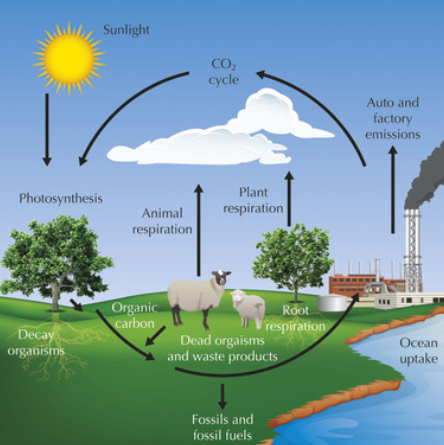
Biogeochemical cycle of which element has atmospheric phase?
AnswerThe carbon cycle involves the exchange of carbon among the biosphere, pedosphere, geosphere, hydrosphere and atmosphere of the Earth.
View full question & answer→MCQ 661 Mark
The flow of materials from non living components to living components and back to the non living components in a more or less cyclic manner is called:
AnswerA biogeochemical cycle or inorganic$-$organic cycle is a circulating or repeatable pathway by which either a chemical element or a molecule moves through both biotic $($bio$-)$ and abiotic $($geo$-)$ compartments of an ecosystem.
View full question & answer→MCQ 671 Mark
Phosphorus cycles in the form of $........?$
AnswerCorrect option: C. $ \mathrm{PO}_4^{3-} $
Phosphorus is obtained from soil as orthophosphate $( \mathrm{PO}_4^{3-} ).$ Organic phosphorus circulates in nature from plants to animals. Phosphate is released by decomposers $($Phosphatising bacteria$)$ back to soil.
View full question & answer→MCQ 681 Mark
Study of inter$-$relationships between living organisms and their environment is:
View full question & answer→MCQ 691 Mark
Plants such as Prosop is, Acaciaand Capparis represent examples of tropical.
MCQ 701 Mark
The sum total of the population of the same kind of organisms constitute:
MCQ 711 Mark
Inverted pyramid is found in:
- ✓
Biomass pyramid of aquatic system
- B
Energy pyramid of grassland
- C
Biomass pyramid of grassland
- D
Pyramid of number of aquatic system
AnswerCorrect option: A. Biomass pyramid of aquatic system
Pyramid of biomass represents the amount of biomass at the various trophic levels. Pyramid of biomass is upright, except in aquatic food chain involving short$-$lived planktons when biomass at any given one time will be less than consumers at the higher level.
View full question & answer→MCQ 721 Mark
In grass$-$deer$-$tiger food chain, grass biom$-$ ass is one tonne. The tiger biomass shall be:
- A
$100\ kg.$
- ✓
$10\ kg.$
- C
$200\ kg.$
- D
$1\ kg.$
AnswerCorrect option: B. $10\ kg.$
View full question & answer→MCQ 731 Mark
The final stable community in ecological succession is termed as:
AnswerThis final, stable community is called as climax community because, unlike communities earlier on in the successional process, it doesn’t change much in composition from year to year succession has reached its climax.
View full question & answer→MCQ 741 Mark
Which of the following ecosystem has the highest gross primary productivity?
MCQ 751 Mark
Living organisms require $.............$ to produce proteins and nucleic acids in their body.
View full question & answer→MCQ 761 Mark
Two different species cannot live for long duration in the same niche or habitat. This law is:
- A
- B
- ✓
Gause’s competitive exclusion principal.
- D
AnswerCorrect option: C. Gause’s competitive exclusion principal.
View full question & answer→MCQ 771 Mark
The relation between algae and fungi in a lichen is:
MCQ 781 Mark
When the number of organisms at successive levels are plotted, then this pyramid is called the pyramid of $..........?$
AnswerA pyramid of numbers is a graphical representation of the number of organisms per unit area at each trophic level.
It is generally upright as the maximum number of individuals occur at the producer level.
View full question & answer→MCQ 791 Mark
The efficiency of any ecosystem is best depicted by pyramid of:
MCQ 801 Mark
Reason of fast speciation in present day crop plants is.
MCQ 811 Mark
In a biotic community, the primary consum$-$ers are:
View full question & answer→MCQ 821 Mark
In the phosphorus cycle, phosphate becomes available by weathering of rocks first to:
MCQ 831 Mark
The following represents the different trophic levels of a food chain. Which one has the highest level of $\text{DDT}$ deposition in its body?
View full question & answer→MCQ 841 Mark
Which of the following cycle would be affected if decomposers of an ecosystem vanish $..........?$
AnswerRecycling of material is carried out by decomposers. If decomposers of an ecosystem vanish recycling of materials is stopped, thereby affecting the movement materials between the biotic and the abiotic systems that forms the biogeochemical cycle.
View full question & answer→MCQ 851 Mark
Pyramid of energy in a pond ecosystem is always:
MCQ 861 Mark
Food chain in which micro$-$organisms break$-$ down the food formed by primary producers are:
View full question & answer→MCQ 871 Mark
Which of the following is the major source of phosphorus?
MCQ 881 Mark
View full question & answer→MCQ 891 Mark
The second trophic level in a lake is$-$
AnswerZooplankton are primary consumers in aquatic food chains that feed upon phytoplankton.
Therefore, they are present at the second trophic level in a lake.
View full question & answer→MCQ 901 Mark
Pyramid of energy in a river ecosystem is:
AnswerPyramid of energy is ecological pyramid that gives graphic representation of amount of energy trapped by different trophic levels per unit area. It is always upright because during transfer of energy from one trophic level to the next a lot of wastage occurs in feeding, digestion, assimilation and respiration $i.e.$ metabolism at each trophic level. Hence, organisms of each trophic level have more energy than each succeeding trophic level and less energy than organisms at previous trophic level.
View full question & answer→MCQ 911 Mark
Volcano eruption disturbs:
MCQ 921 Mark
The storage of energy at consumer level is known as:
MCQ 931 Mark
There exists a close association between the alga and the fungus within a lichen. The fun$-$gus.
- ✓
Provides protection, anchorage and absorption for the alga.
- B
Provides food for the alga.
- C
Fixes the atmospheric nitrogen for the alga.
- D
Release oxygen for the alga.
AnswerCorrect option: A. Provides protection, anchorage and absorption for the alga.
View full question & answer→MCQ 941 Mark
Pyramid of number deals with number of:
AnswerCorrect option: C. Individuals in a trophic level.
View full question & answer→MCQ 951 Mark
Secondary productivity is:
- A
Conversion of physical energy into chemical energy at producer level
- B
Conversion of physical energy into chemical energy at consumer level
- ✓
The rate of energy storage at consumer level
- D
The decomposition of organic matter by decomposers
AnswerCorrect option: C. The rate of energy storage at consumer level
View full question & answer→MCQ 961 Mark
In a food chain, the largest population is that of:
MCQ 971 Mark
The sequence of communities of primary succession in water is:
- A
Phytoplankton, sedges, free$-$floating hydrophytes, rooted hydrophytes, grasses and trees.
- B
Phytoplankton, free$-$floating hydrophytes, rooted hydrophytes, sedges, grasses and trees.
- C
Free$-$floating hydrophytes, sedges, phytoplankton, rooted hydrophytes, grasses and trees.
- ✓
Phytoplankton, rooted submerged hydrophytes, floating hydrophytes, reed swamp, sedges, meadow and trees.
AnswerCorrect option: D. Phytoplankton, rooted submerged hydrophytes, floating hydrophytes, reed swamp, sedges, meadow and trees.
View full question & answer→MCQ 981 Mark
Which of the following ecosystems is most productive in terms of net primary production?
MCQ 991 Mark
Two main structural features of an ecosystem are.
- ✓
Species composition and stratification.
- B
Species composition and productivity.
- C
Productivity and energy flow.
- D
Nutrient cycling and stratification.
AnswerCorrect option: A. Species composition and stratification.
View full question & answer→MCQ 1001 Mark
Which of the following ecosystem has the highest gross primary productivity?
MCQ 1011 Mark
If all decomposers are removed from an ecosystem, what will happen?
- A
- B
Energy cycle will be inverted
- ✓
Balance of biogeochemical cycle will be disturbed
- D
AnswerCorrect option: C. Balance of biogeochemical cycle will be disturbed
View full question & answer→MCQ 1021 Mark
Bell$-$shaped polygonal pyramid indicates:
- A
High percentage of young individuals
- ✓
Moderate percentage of young individuals
- C
Low percentage of young individuals
- D
Low percentage of old individuals
AnswerCorrect option: B. Moderate percentage of young individuals
View full question & answer→MCQ 1031 Mark
Which one of the following is not an ecological pyramid?
- A
- ✓
Pyramid of standing crop aing crop.
- C
- D
AnswerCorrect option: B. Pyramid of standing crop aing crop.
View full question & answer→MCQ 1041 Mark
The transfer of energy from one trophic level to another is governed by the $2^{nd}$ law of ther$-$modynamics. The average efficiency of energy transfer from herbivores to carnivores is:
- A
$5\%.$
- ✓
$10\%.$
- C
$25\%.$
- D
$50\%.$
AnswerCorrect option: B. $10\%.$
View full question & answer→MCQ 1051 Mark
Which of the following type of ecosystem is expected in an area where evaporation exceeds precipitation, and mean annual rainfall is below $100\ mm:$
View full question & answer→MCQ 1061 Mark
Pick up the correct food chain:
- A
Grass $\rightarrow$ Chaemeleon $\rightarrow$ Insect $\rightarrow$ Bird.
- B
Grass $\rightarrow$ Fox $\rightarrow$ Rabbit $\rightarrow$ Bird.
- ✓
Phytoplankton $\rightarrow$ Zooplankton $\rightarrow$ Fish.
- D
Fallen leaves $\rightarrow$ Bacteria $\rightarrow$ Insect larvae.
AnswerCorrect option: C. Phytoplankton $\rightarrow$ Zooplankton $\rightarrow$ Fish.
View full question & answer→MCQ 1071 Mark
How much portion of the photosynthetically active radiation $\text{(PAR)}$ is captured by the plants?
- A
$5 – 10\%.$
- B
$7 – 10\%.$
- C
$8 – 10\%.$
- ✓
$2 – 10\%.$
AnswerCorrect option: D. $2 – 10\%.$
View full question & answer→MCQ 1081 Mark
Pyramid of numbers in a grassland$/$ true eco$-$ system is:
- A
- ✓
- C
Both $(a)$ and $(b).$
- D
Spindle$-$shaped.
View full question & answer→MCQ 1091 Mark
All the interacting organisms in an area together with the $........$ constituents of the environment form an $..........?$
- ✓
- B
- C
Non$-$living, atmosphere
- D
Non$-$living, earth
View full question & answer→MCQ 1101 Mark
The average trophic efficiency of transfer of energy from one trophic level to the. higher trophic level is called:
- A
- B
Assimilation. Efficiency.
- ✓
Linderman's trophic efficiency rule.
- D
AnswerCorrect option: C. Linderman's trophic efficiency rule.
View full question & answer→MCQ 1111 Mark
The term ecosystem was coined by:
- ✓
$A.G.$ Tansley.
- B
$E.P.$ Odum.
- C
$E.$ Haeckel.
- D
$E.$ Haeckel.
AnswerCorrect option: A. $A.G.$ Tansley.
View full question & answer→MCQ 1121 Mark
During the process of ecological succession the changes that take place in communities are:
- ✓
- B
- C
- D
Not influenced by the physical environment.
View full question & answer→MCQ 1131 Mark
The phosphorus cycle differs from those of carbon and nitrogen as well as those of sulphur, oxygen and hydrogen in that it lacks:
AnswerPhosphorus cycle differs from the other cycles that it locks the gaseous phase. Although small amount of phosphoric acid $\left(\mathrm{H}_3 \mathrm{PO}_4\right)$ may make their way into the atmosphere contributing in some cases $-$ to acid rain. It is the slowest cycle amongst the all cycles.
View full question & answer→MCQ 1141 Mark
Energy storage at consumer level is called as:
- A
Gross primary productivity
- ✓
- C
- D
AnswerPrimary productivity is the amount of energy or biomass accumulation in green plants per unit area per unit time. It depends upon the availability of solar radiations, optimum temperature, soil moisture and biogenetic nutrients.
Gross primary productivity is the total organic matter synthesized by the producers in the process of photosynthesis.
Net primary productivity is the total organic matter stored by producers per unit area per unit time.
Secondary productivity is synthesis of organic matter by consumers per unit area per unit time.
View full question & answer→MCQ 1151 Mark
Which of the following represents the sedimentary type of nutrient cycle?
MCQ 1161 Mark
Which of the following is not true for a spe$-$cies?
- A
Members of a species can interbreed.
- B
Variations occur among members of a species.
- C
Each species is reproductively isolated from every other species.
- ✓
Gene flow does not occur between the populations of a species.
AnswerCorrect option: D. Gene flow does not occur between the populations of a species.
View full question & answer→MCQ 1171 Mark
Species are considered as.
- A
Artificial concept of human mind which cannot be defined in absolute terms.
- B
Real units of classification devised by taxonomists.
- ✓
Real basic units of classification.
- D
The lowest units of classification.
AnswerCorrect option: C. Real basic units of classification.
View full question & answer→MCQ 1181 Mark
Oxygen forms about $.........$ of the air in the atmosphere.
- ✓
$20\%$
- B
$30\%$
- C
$40\%$
- D
$45\%$
AnswerCorrect option: A. $20\%$
View full question & answer→MCQ 1191 Mark
If we completely remove the decomposers, from an ecosystem, its functioning will be adversely affected, because:
- A
Energy flow will be blocked.
- B
Herbivores will not receive solar energy.
- ✓
Mineral movement will be blocked.
- D
Rate of decomposition will be very high.
AnswerCorrect option: C. Mineral movement will be blocked.
View full question & answer→MCQ 1201 Mark
Gross primary productivity is the rate of production of $..........$ during photosynthesis.
AnswerThe rate of production of total organic matter during photosynthesis is called the gross primary productivity. It is also equal to the amount of carbon fixed during photosynthesis by all producers in that particular ecosystem.
View full question & answer→MCQ 1211 Mark
Ecological factors, which prevent a species from producing at its maximum rate are termed as:
MCQ 1221 Mark
Biogeochemical cycles are of $..........?$
AnswerThe biogeochemical cycles are classified into $2$ types namely gaseous cycles like Nitrogen, Carbon dioxide and sedimentary cycles like Phosphorus and Sulphur.
View full question & answer→MCQ 1231 Mark
Which of the following can fix atmospheric nitrogen?
MCQ 1241 Mark
In a food chain, the total amount of living material is depicted by ?
AnswerThe pyramid of biomass is an ecological pyramid, which represents the biomass at various trophic levels.
It represents the living material produced at each level from the food obtained from the previous level.
It is upright except for the aquatic food chain, which involves planktons.
View full question & answer→MCQ 1251 Mark
In succession, complexities in structure are:
- A
- ✓
- C
Not increasing but decreasing
- D
View full question & answer→MCQ 1261 Mark
Which of the following is$/$ are example$(s)$ of man$-$made ecosystem?
- A
- B
- C
- ✓
Both $(b)$ and $(c).$
AnswerCorrect option: D. Both $(b)$ and $(c).$
View full question & answer→MCQ 1271 Mark
The possible beneficial affect of grazing animals is the:
- A
- B
- C
- ✓
Addition of their excrete to the soil
AnswerCorrect option: D. Addition of their excrete to the soil
Although grazing is harmful for plants but grazing may beneficial by adding their excretion into soil, which provides essential mineral nutrition to plants.
View full question & answer→MCQ 1281 Mark
What is represented by the following sequence? Cyanobacteria, Crustose lichens, Foliose lichens, Mosses, Shrub, Dicotyledenous plants.
- A
- B
- ✓
- D
Phylogenetic relationship
View full question & answer→MCQ 1291 Mark
Biogeochemical cycling means cycling of:
- A
- B
Gases between plants and the atmosphere
- ✓
Nutrients in an ecosystem
- D
AnswerCorrect option: C. Nutrients in an ecosystem
View full question & answer→MCQ 1301 Mark
The primary succession refers to the devel$-$opment of communities on a.
AnswerCorrect option: D. Newly$-$exposed habitat with no record of earlier vegetation.
View full question & answer→MCQ 1311 Mark
Productivity is the rate of production of biomass expressed in terms of:
- $ \left(\text { Kcal m}^{-3}\right) \mathrm{yr}^{-1} $
- $ \mathrm{G}^{-2} \mathrm{yr}^{-1} $
- $\mathrm{G}^{-1} \mathrm{yr}^{-1} $
- $ \left(\mathrm{Kcal} \ \mathrm{m}^{-2}\right) \mathrm{yr}^{-1} $
- A
$i$ and $iii.$
- B
$iii.$
- ✓
$ii$ and $iv.$
- D
$ii.$
AnswerCorrect option: C. $ii$ and $iv.$
View full question & answer→MCQ 1321 Mark
Cycling of elements in an ecosystem is called:
MCQ 1331 Mark
Escherichia coli is used as an indicator or$-$ganism to determine pollution of water with:
- A
- B
Pollen of aquatic plants.
- C
- ✓
View full question & answer→MCQ 1341 Mark
In primary succession on rocks, the pioneer species are usually:
AnswerLichens are considered as pioneer species in primary succession on rocks because they can easily grow on rocks where other plants cannot grow. They produce oxalic acid which induced the weathering of rocks and thus soil is formed. When these lichens die they increase the soil fertility so other plants can grow and start the chain reaction.
View full question & answer→MCQ 1351 Mark
Which of the following pair is a sedimen$-$tary type of biogeochemical cycle?
- A
- ✓
- C
- D
Phosphorus and carbon dioxide.
View full question & answer→MCQ 1361 Mark
In which layer of atmosphere ozone is maximum concentrated?
AnswerOzone layer is a region of concentration of ozone molecule. $O_3 (O_2 + O)$ in the earth's atmosphere. The layer lies in the stratosphere at an altitude of $18-50 \ km.$ The ozone layer naturally shields earth's life from the harmful effect of the Sun's ultraviolet radiations.
View full question & answer→MCQ 1371 Mark
What is true for individuals of same species?
- A
- B
- ✓
- D
Live in different habitats.
View full question & answer→MCQ 1381 Mark
Gross primary productivity is:
- ✓
Rate at which organic molecules are formed in an autotroph
- B
Rate at which organic molecules are used up by an autotroph
- C
Storage of organic molecules in the body of an autotroph
- D
Rate at which organic molecules are transferred to next higher trophic level
AnswerCorrect option: A. Rate at which organic molecules are formed in an autotroph
View full question & answer→MCQ 1391 Mark
the rate at which light energy is converted into chemical energy of organic molecules is the ecosystem’s.
- A
Net primary productivity.
- B
Gross secondary productivity.
- C
Net secondary productivity.
- ✓
Gross primary productivity.
AnswerCorrect option: D. Gross primary productivity.
View full question & answer→MCQ 1401 Mark
Earliest settlers on barren lands or the 'farmers of nature' are:
AnswerLichens are pioneer in succession in a new terrain and colonise bare rocks. They are the pioneers of plant kingdom. Since they are able to establish themselves on bare rocks and initiate formation of soil, they are called "farmers of nature".
View full question & answer→MCQ 1411 Mark
Which of these statements is correct?
MCQ 1421 Mark
Which one of the following is not a major component of the ecosystem?
MCQ 1431 Mark
Secondary Succession takes place on$/$ in:
View full question & answer→MCQ 1441 Mark
Which of the following is an example of secondary succession?
- A
Vegetation developing on a bare rock
- ✓
Vegetation developing following forest fire
- C
Fungus growing on a banana peel
- D
Conversion of pond into a crop field by humans
AnswerCorrect option: B. Vegetation developing following forest fire
Secondary succession is the sequence of changes that happens on a previously colonized but damaged habitat. The forests fires have resulted in the destruction of the habitat which was present at a time. The development of new vegetation after forest fire is an example of secondary succession.
View full question & answer→MCQ 1451 Mark
The maximum biomagnification would be in which of the following in case of aquatic ecosystem?
MCQ 1461 Mark
In plant succession, last community is called as:
AnswerEcological succession is the process of change in the species structure of an ecological community over time. The community begins with relatively few pioneer plants and animals and gradually develops stable or self$-$perpetuating species as a climax community.
View full question & answer→MCQ 1471 Mark
The utilization of elements and compounds in nature and their subsequent return to the environment is called:
MCQ 1481 Mark
Identification and enumeration of plant and animal species of an ecosystem gives its:
MCQ 1491 Mark
The primary difference between sedimentary and atmospheric cycles is that in $..........$ cycles the nutrient does not $..........$
- A
Sedimentary; leave the terrestrial environment.
- B
Sedimentary; leave the aquatic environment.
- C
Atmospheric; leave the aquatic environment.
- ✓
Sedimentary; enter the atmosphere.
AnswerCorrect option: D. Sedimentary; enter the atmosphere.
View full question & answer→MCQ 1501 Mark
The pyramid of numbers in grassland ecosystem will be ?
MCQ 1511 Mark
Ecosystems are $.........$ because resources $.........$ move from one ecosystem to another.
- ✓
- B
- C
One$-$way; can.
- D
One$-$way; cannot.
View full question & answer→MCQ 1521 Mark
Out of the following options which most often limits the primary productivity of the ecosystem?
- ✓
Solar radiation$/$ light
- B
- C
- D
AnswerCorrect option: A. Solar radiation$/$ light
View full question & answer→MCQ 1531 Mark
The rate of formation of new organic matter by rabbit in a grassland, is called as:
- A
- ✓
- C
- D
Gross primary productivity
View full question & answer→MCQ 1541 Mark
In an ecosystem abiotic components includes which of the following?
- A
- B
- C
- ✓
Flow of energy and cycling of materials.
AnswerCorrect option: D. Flow of energy and cycling of materials.
View full question & answer→MCQ 1551 Mark
- A
- B
- ✓
Ether upright or inverted.
- D
Neither upright nor inverted.
AnswerCorrect option: C. Ether upright or inverted.
View full question & answer→MCQ 1561 Mark
The reservoir for the gaseous type of bio$-$geo chemical cycle exists in:
View full question & answer→MCQ 1571 Mark
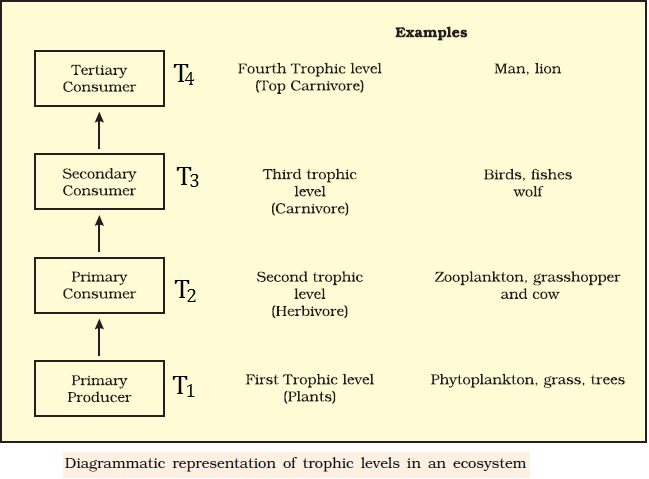
If the carbon atoms fixed by producers already have passed through three species, the trophic level of the last species would be:
AnswerIf the carbon atoms fixed by producers already have passed through three species, the trophic level of the last species would be tertiary consumer.
View full question & answer→MCQ 1581 Mark
$...........$ are the cyclic pathways through which chemical elements move from environment to organism and back to the environment.
- ✓
- B
Geo$-$chemical cycles
- C
Physio$-$chemical cycles
- D
View full question & answer→MCQ 1591 Mark
An inverted pyramid of biomass can be found in which ecosystem?
MCQ 1601 Mark
A long term global cycle which is linked by water and in which sea floor rising play an important role is:
- A
- B
- ✓
- D
Carbon and nitrogen cycle
View full question & answer→MCQ 1611 Mark
Which of the following is an ecosystem service provided by a natural ecosystem?
- A
- B
Prevention of soil erosion.
- C
Pollutant absorption and reduction of the threat of global warming.
- ✓
AnswerCycling of nutrients, prevention of soil erosion and pollutant absorption and reduction of the threat of global warming is an ecosystem service provided by a natural ecosystem.
View full question & answer→MCQ 1621 Mark
In a terrestrial ecosystem such as forest, maxi$-$mum energy is in which trophic level?
View full question & answer→MCQ 1631 Mark
Choose the correct statement about ecological succession.
- A
It is a natural progression of plant types that cannot be reversed.
- B
It always occurs over a short period of time.
- ✓
The rate can be changed by factors such as fire, clear cutting, and lava flows.
- D
The rate is very slow and constant.
AnswerCorrect option: C. The rate can be changed by factors such as fire, clear cutting, and lava flows.
View full question & answer→MCQ 1641 Mark
Which one of the following is not a gaseous biogeochemical cycle in ecosystem:
MCQ 1651 Mark
Edaphic factor refers to:
MCQ 1661 Mark
Climax vegetation of a region generally:
MCQ 1671 Mark
The community which starts succession at a place is termed as:
MCQ 1681 Mark
The reservoir for the gaseous type of bio$-$geo chemical cycle exists in:
AnswerThe reservoir for the gaseous$-$type of bio$-$geo$-$chemical cycle exists in atmosphere.
View full question & answer→MCQ 1691 Mark
An ecosystem resists change because it is in a state of:
MCQ 1701 Mark
The total solar energy converted to biomass on earth amounts to:
- ✓
$2 \%$
- B
$0.2 \%$
- C
$0.02 \%$
- D
$20 \%$
AnswerCorrect option: A. $2 \%$
View full question & answer→MCQ 1711 Mark
Which one of the following is not an abiotic component?
MCQ 1721 Mark
The sequence of communities of primary succession in water is:
- ✓
Free$-$floating hydrophytes, sedges, phytoplankton, rooted hydrophytes, grasses and trees
- B
Phytoplankton, free$-$floating hydrophytes, rooted hydrophytes, sedges, grasses and trees.
- C
Phytoplankton, sedges, free$-$floating hydrophytes, rooted hydrophytes, grasses and trees.
- D
Phytoplankton, rooted submerged hydrophytes, floating hydrophytes, reed swamp, sedges, meadow and trees.
AnswerCorrect option: A. Free$-$floating hydrophytes, sedges, phytoplankton, rooted hydrophytes, grasses and trees
View full question & answer→MCQ 1731 Mark
The process of mineralisation by micro organisms helps in the release of:
- ✓
Inorganic nutrients from humus.
- B
Both organic and inorganic nutrients from detritus.
- C
Organic nutrients from humus.
- D
Inorganic nutrients from detritus and formation of humus.
AnswerCorrect option: A. Inorganic nutrients from humus.
View full question & answer→MCQ 1741 Mark
- A
- B
- ✓
Ether upright or inverted.
- D
Neither upright nor inverted.
AnswerCorrect option: C. Ether upright or inverted.
View full question & answer→MCQ 1751 Mark
The productivity of all the autotrophs including green plants, protists and bacteria is called as:
- A
- ✓
- C
$\text{NPP}$
- D
$\text{GPP}$
View full question & answer→MCQ 1761 Mark
Consider the following statements.
- An ecosystem is a functional unit of nature and comprises abiotic and biotic components.
- Abiotic components are organic materials.
- Biotic components are producers, consumers and decomposers.
- Energy flow is bidirectional.
Which two statements are correct?
- A
$(i)$ and $(ii).$
- B
$(ii)$ and $(iv).$
- C
$(iii)$ and $(iv).$
- ✓
$(i)$ and $(iii).$
AnswerCorrect option: D. $(i)$ and $(iii).$
View full question & answer→MCQ 1771 Mark
Energy pyramids are used to represent energy transfer in an ecosystem because energy is $........$ between each trophic level.
- A
- ✓
- C
- D
Either conserved or gained.
View full question & answer→MCQ 1781 Mark
The pyramid which cannot be inverted in a stable ecosystem is that of:
MCQ 1791 Mark
In a tree ecosystem, the pyramid of number is:
MCQ 1801 Mark
The nature of climax community ultimately depends on:
- ✓
- B
- C
- D
Pool of available nutrients.
View full question & answer→MCQ 1811 Mark
As energy is passed from one trophic level to another, the amount of usable energy?
- A
- ✓
- C
- D
Energy is not passed from one tropical level to another
AnswerThe transfer of energy from one trophic level to next trophic level follows $10$ percent law known as Lindeman's law of trophic efficiency which states that the efficiency of energy transferred from one trophic level to the next higher trophic level is about $10\%.$ Rest of the energy is lost in respiration. So the energy decreases as it is transferred to subsequent trophic levels.
View full question & answer→MCQ 1821 Mark
Keystone species in an ecosystem are those which.
- A
Are present in maximum number.
- ✓
- C
- D
Contribute to ecosystem properties.
View full question & answer→MCQ 1831 Mark
The pyramid that cannot be inverted in a stable ecosystem, is pyramid of:
AnswerPyramid of energy is ecological pyramid, that represents the flow of energy from one trophic level to the next a lot of wastage occurs in metabolism and energy transfer. Maximum energy content is present in producers and least at top carnivore levels.
View full question & answer→MCQ 1841 Mark
Which of the following is most important for speciation?
MCQ 1851 Mark
An ecosystem which can be easily damaged but can recover after some time if damaging effect stops, will be having.
- ✓
Low stability and high resilience.
- B
High stability and low resilience.
- C
Low stability and low resilience.
- D
High stability and high resilience.
AnswerCorrect option: A. Low stability and high resilience.
View full question & answer→MCQ 1861 Mark
Which of the following is a correct pair?
AnswerCorrect option: A. Cuscuta $-$ Parasite.
View full question & answer→MCQ 1871 Mark
Which of the following is not a producer?
MCQ 1881 Mark
Which of the following is a pioneer species in xerarch succession?
MCQ 1891 Mark
Biotic component of biosphere is not constituted of:
MCQ 1901 Mark
In order to maintain proper ecological balance.
- A
The existing forests would be cleared and new ones should be planted.
- B
Some quick growing annuals should be planted if a tree must be cut for other uses.
- C
Tree must be cut whenever necessary because the underground part performs the useful purpose.
- ✓
A tree should be planted in place of one to be cut.
AnswerCorrect option: D. A tree should be planted in place of one to be cut.
View full question & answer→MCQ 1911 Mark
Which of the following type of ecosystem is expected in an area where evaporation exceeds precipitation, and mean annual rainfall is below $100\ mm:$
AnswerDesert ecosystem is expected in an area where evaporation exceeds precipitation, and means annual rainfall is below $100\ mm.$
View full question & answer→MCQ 1921 Mark
Animals have the innate ability to escape from predation. Examples for the same are given below. Select the incorrect example.
- A
Enlargement of body size by swallowing air in puffer fish.
- B
- ✓
- D
Colour change in Chamaeleon.
View full question & answer→MCQ 1931 Mark
Edaphic factor refers to:
MCQ 1941 Mark
Which one of the following is sedimentary cycle?
MCQ 1951 Mark
Major autotrophic biomass in oceans is contributed by:
MCQ 1961 Mark
Pyramid of number in a pond ecosystem is:
MCQ 1971 Mark
Vertical distribution of different species occupying different levels is called:
MCQ 1981 Mark
How much of the net primary productivity of a terrestrial ecosystem is eaten and digested by herbivores?
- A
$1\%.$
- ✓
$10\%.$
- C
$40\%.$
- D
$90\%.$
AnswerCorrect option: B. $10\%.$
View full question & answer→MCQ 1991 Mark
Lichen is the pioneer vegetation on which succession:
MCQ 2001 Mark
Primary succession is development of communities on ?
- ✓
- B
- C
Freshly harvested crop field.
- D
Pond filled after a dry season.
View full question & answer→MCQ 2011 Mark
Stable plant community formed during succession is called as:
AnswerEcological succession is the process of change in the species structure of an ecological community over time. The community begins with relatively few pioneer plants and animals and gradually develops stable or self$-$perpetuating species as a climax community.
View full question & answer→MCQ 2021 Mark
In a food chain, the largest population is that of:
MCQ 2031 Mark
Niche of a species in an ecosystem refers to its:
- ✓
Function at its place of occurrence.
- B
- C
- D
AnswerCorrect option: A. Function at its place of occurrence.
View full question & answer→MCQ 2041 Mark
The final stage seen in an ecosystem succession is:
MCQ 2051 Mark
Mycorrhiza is an example of.
MCQ 2061 Mark
What is the percentage of photosynthetically active radiation $\text{(PAR)},$ in the incident solar radiation.
- A
$100\%$
- ✓
$50\%$
- C
$1-5\%$
- D
$2-10\%$
AnswerCorrect option: B. $50\%$
Out of total incident solar radiation, about fifty percent of it forms photosynthetically active radiation $\text{(PAR)}.$
View full question & answer→MCQ 2071 Mark
AnswerCorrect option: A. Pattern of vegetation change in which a small number of species tend to replace each other over time in the absence of large$-$scale disturbance
View full question & answer→MCQ 2081 Mark
An ecosystem which can be easily ruined$/$ damaged but can recover after some time if damaging effect stops. The ecosystem is characterised by having ?
- A
Low and poor stability with low resilience
- B
High stability and low resilience
- ✓
Low stability and high resilience
- D
High stability and high resilience
AnswerCorrect option: C. Low stability and high resilience
View full question & answer→MCQ 2091 Mark
If carbon dioxide is withdrawn from the biosphere, which organism would first experience negative effects:
AnswerBecause primary producer first requires $CO_2$, for the process of photosynthesis by which they make their food.
View full question & answer→MCQ 2101 Mark
Which one of the following is not used for construction of ecological pyramids?
MCQ 2111 Mark
Which of the following is not a producer?
AnswerAgaricus belongs to fungi and hence are saprotrophs, while others belong to algae which are autotrophs.
View full question & answer→MCQ 2121 Mark
Mycorrhiza is a symbiotic relationship be$-$tween roots of higher plants and:
View full question & answer→MCQ 2131 Mark
Natural reservoir of phosphorus is:
AnswerThe natural reservoir of phosphate is the rock which contains phosphorus in the form of phosphates when rocks are weathered, minute amounts of these phosphate dissolve in soil solution and are absorbed by the roots of the plants. Herbivores and other animals obtain this element from plants.
View full question & answer→MCQ 2141 Mark
Approximately how much of the solar energy that falls on the leaves of a plant is converted to chemical energy by photosynthesis?
- A
$30\%.$
- B
$50\%.$
- C
Less than $1\%.$
- ✓
$2-10\%.$
AnswerCorrect option: D. $2-10\%.$
View full question & answer→MCQ 2151 Mark
Decomposers like fungi and bacteria are:
- Autotrophs.
- Heterotrophs.
- Saprotrophs.
- Chemo$-$autotrophs.
Choose the correct answer:
- A
$i$ and $iii.$
- B
$i$ and $iv.$
- ✓
$ii$ and $iii.$
- D
$i$ and $ii.$
AnswerCorrect option: C. $ii$ and $iii.$
Decomposers depend on other organisms for food, hence they are heterotrophs. They obtain nutrients by decomposing the detritus and hence are called saprotrophs.
View full question & answer→MCQ 2161 Mark
Ecological succession on sand is:
AnswerPrimary succession can happen when bare sand is colonised by plants. Over time, the sand builds up into sand dunes, raising the ground above the height of sea level. Succession in sand dunes is sometimes called a psammosere.
View full question & answer→MCQ 2171 Mark
Which of the following is an example of man$-$made ecosystem?
View full question & answer→MCQ 2181 Mark
Approximately how much of the solar energy that falls on the leaves of a plant is converted to chemical energy by photosynthesis?
- A
Less than $1\%.$
- ✓
$2-10\%.$
- C
$30\%.$
- D
$50\%.$
AnswerCorrect option: B. $2-10\%.$
View full question & answer→MCQ 2191 Mark
Which one of the following element is the critical limiting factor in the function of ecosphere because of its irretrievable loss into the ocean $...........?$
AnswerA large amount of phosphate is lost in the sea by sedimentation. This is irretrievable loss.
View full question & answer→MCQ 2201 Mark
In ecotone which species become abundant?
MCQ 2211 Mark
Which part of the world has high density of organisms?
MCQ 2221 Mark
Among the following, where do you think the process of decomposition would be the fastest?
MCQ 2231 Mark
Inverted pyramid of biomass can be traced in which one of the following ecosystem?
AnswerThe pyramid of biomass is more fundamental, they represent the quantitative relationships of the standing crops. In this pyramid, there is a gradual decrease in the biomass from the producers to the higher trophic levels.
In an ocean, as the producers are small organisms, their biomass is the least, and this value gradually shows an increase towards the apex of the pyramid, thus making the pyramid inverted in shape.
View full question & answer→MCQ 2241 Mark
Which one of the following pairs is a sedimentary type of biogeochemical cycle?
- A
Phosphorus and carbon monoxide.
- B
- C
- ✓
View full question & answer→MCQ 2251 Mark
An inverted pyramid of biomass can be found in which ecosystem?
AnswerIn terrestrial ecosystem pyramid of biomass is generally upright. The pyramid of biomass in sea or lake is generally inverted because the biomass of fishes for exceeds that of phytoplankton.
View full question & answer→MCQ 2261 Mark
As energy is passed from one trophic level to another, the amount of usable energy:
- A
- ✓
- C
- D
Energy is not passed from one trophic level to another
View full question & answer→MCQ 2271 Mark
The pyramid of number in tree ecosystem:
MCQ 2281 Mark
In which of the following cycles, does the reservoir of the nutrient exist in material from?
MCQ 2291 Mark
The graphic representation of trophic level is represented by a pyramid. Which of the following pyramid is always a true pyramid unlike the others?
AnswerPyramid of energy is always upright which makes it true pyramid because when energy flows from a particular trophic level to the next trophic level is always lost at each step by the metabolic activity and only $10\%$ energy transfers from one to next trophic level.
View full question & answer→MCQ 2301 Mark
In forest ecosystem, the pyramid of energy is:
- A
- ✓
- C
First upright then inverted
- D
View full question & answer→MCQ 2311 Mark
Which of the following ecosystems is most productive in terms of net primary production?
AnswerTropical rain forests have high population density of green plants. Hence, net primary productions are maximum in such conditions.
View full question & answer→MCQ 2321 Mark
The reservoir for the gaseous type of biogeochemical cycle exists in:
MCQ 2331 Mark
Maximum biomass and variable organisms are found in:
AnswerPonds are generally shallower with depth less than $2$ meters. Hence, the pond has good light penetration, which in turn leads to more photosynthesis and increased biomass and consequently rich diversity of organisms.
View full question & answer→MCQ 2341 Mark
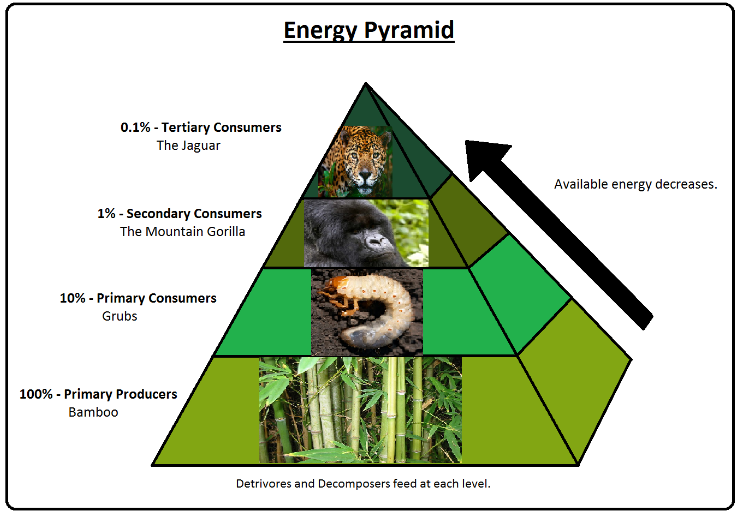
One of Eltonian pyramids have to be upright always. That is, pyramid of:
AnswerPyramid of energy is always upright, and can never be inverted, because when energy flows from a particular trophic level to the next, some energy is always lost as heat at each step. The base of the pyramid is broad and it narrows down at the apex.
View full question & answer→MCQ 2351 Mark
AnswerAn ecosystem is an open system because an open system is a system in which energy and nutrients are exchanged between the physical environment and living organisms.
All the ecosystems on Earth are called open systems.
View full question & answer→MCQ 2361 Mark
Pyramid of biomass for forest is:
AnswerProducers are more in number $($forest$)$ than the primary consumers. Primary consumers are more in number than secondary consumers. That is why the pyramid of biomass is upright for forests.
View full question & answer→MCQ 2371 Mark
On the global basis, the maximum productivity is shown by:
MCQ 2381 Mark
Maximum photosynthesis takes place by:
MCQ 2391 Mark
Which of the following most often limits the primary productivity of the ecosystem?
AnswerCorrect option: A. Solar radiation$/$ light.
View full question & answer→MCQ 2401 Mark
The pioneer species in Xerarch and Hydrarch succession are respectively:
- A
- B
Lichens and rooted hydrophytes
- ✓
Lichens and phytoplanktons
- D
Phytoplanktons and lichens
AnswerCorrect option: C. Lichens and phytoplanktons
View full question & answer→MCQ 2411 Mark
Which type of pyramid of energy is inverted?
MCQ 2421 Mark
Which one of the following regarding ecological pyramid is not correct?
AnswerCorrect option: C. In deep water ecosystems, the pyramid of biomass is upright.
View full question & answer→MCQ 2431 Mark
Biotic resources are $..........?$
AnswerCorrect option: A. Derived from living things
Abiotic resources are non$-$living while biotic resources are living. Soils, rocks, and minerals are abiotic but plants and animals are biotic resources.
View full question & answer→MCQ 2441 Mark
Lichens are well known combination of an alga and a fungus where fungus has.
- A
A saprophytic relationship with the alga.
- B
An epiphytic relationship with the alga.
- C
A parasitic relationship with the alga.
- ✓
A symbiotic relationship with the alga.
AnswerCorrect option: D. A symbiotic relationship with the alga.
View full question & answer→MCQ 2451 Mark
Which of the following is expected to have the highest value $(gm/ m^2/ yr)$ in a grass$-$ land ecosystem?
AnswerCorrect option: C. Gross Production $(GP).$
View full question & answer→MCQ 2461 Mark
Praying mantis is a good example of.
MCQ 2471 Mark
The zone at the edge of a lake or ocean which is alternatively exposed to air and immersed in water is called:
AnswerThe zone at the edge of a lake or ocean which is alternatively exposed to air and immersed in water is called littoral zone.
View full question & answer→MCQ 2481 Mark
Energy flow in an ecosystem is:
MCQ 2491 Mark
Species restricted to a given area are called:
MCQ 2501 Mark
Productivity is the rate of production of biomass expressed in terms of:
- $ \left(\mathrm{kcal} \ \mathrm{m}^{-3}\right) \mathrm{yr}^{-1} $
- $ \mathrm{~g}^{-2} \mathrm{yr}^{-1} $
- $ \mathrm{~g}^{-1} \mathrm{yr}^{-1}$
- $\left(\mathrm{kcal} \ \mathrm{m}^{-2}\right) \mathrm{yr}^{-1}$
- A
$ii.$
- B
$iii.$
- ✓
$ii$ and $iv.$
- D
$i$ and $iii.$
AnswerCorrect option: C. $ii$ and $iv.$
View full question & answer→MCQ 2511 Mark
Which one of the following process help the watersoluble inorganic nutrients go down into the soil horizon and get precipitated as unavailable salts?
MCQ 2521 Mark
Study of biogeochemical cycles is called biogeochemistry, it involves:
AnswerThe term biogeochemical cycle is used for exchange or circulation of biogenetic nutrients between living and nonliving components of biosphere. Cycling of biogenetic nutrients is an important characteristic of an ecosystem.
View full question & answer→MCQ 2531 Mark
Which one of the following statement for pyramid of energy is incorrect, whereas the remaining three are correct?
- A
- B
- C
It shows energy content of different trophic level.
- ✓
AnswerPyramid of energy is an ecological pyramid, that gives a graphic representation of the flow of energy in an ecosystem.
It is always upright because during transfer of energy from one trophic level to the next$, 90\%$ of energy is lost in feeding, digestion, assimilation, respiration and other metabolic reactions.
View full question & answer→MCQ 2541 Mark
The pyramid of number in grassland ecosystem is:
MCQ 2551 Mark
The last stable community in succession that is in equilibrium with the environment, is called:
MCQ 2561 Mark
The pyramid of number is based on:
- ✓
- B
- C
Individuals in trophic level
- D
AnswerPyramid of number is an ecological$/$ Eltonian pyramid.
It is a graphical representation of a number of individuals at each trophic levels.
It puts organisms sequence$-$wise, with producers at the base and various consumers at successively higher levels.
View full question & answer→MCQ 2571 Mark
AnswerCorrect option: C. Both $(a)$ and $(b).$
View full question & answer→MCQ 2581 Mark
AnswerPyramid of energy is always upright, can never be inverted, because the energy always flows from a particular trophic level to the next trophic level. The amount of available energy decreases during transfer from one trophic level to another. So, as we go from the first trophic level to the top trophic level, the amount of available energy becomes less and less.
View full question & answer→MCQ 2591 Mark
Which of the following is the most stable eco$-$system?
View full question & answer→MCQ 2601 Mark
Which is the reason for highest biomass in aquatic ecosystem?
- ✓
Benthonic and brown algae.
- B
Sea grass, and slime molds.
- C
Nanoplankton, blue green algae, green algae.
- D
AnswerCorrect option: A. Benthonic and brown algae.
View full question & answer→MCQ 2611 Mark
Concept of ecological pyramid is given by:
AnswerAn ecological pyramid is a graphical representation to describe the number of organisms, energy relationships, and biomass of an ecosystem. They are also called as Eltonian pyramids after Charles Elton, who developed the concept of ecological pyramids.
View full question & answer→