Questions

2 Marks Questions

Take a timed test

9 questions · self-marked practice — reveal the answer and mark yourself.

Question 12 Marks
What is genetic equilibrium? Write any four factors affecting Hardy-Weinberg equilibrium law.
Answer
Hardy Weinberg equilibrium principle states that allele frequencies in a population are stable and is constant from generation to generation. The gene pool i.e. total genes and their alleles in a population remains constant. This is called genetic equilibrium. The factors influencing the genetic equilibrium are follows : 1. Gene flow 2. Genetic drift 3. Mutation 4. Selection pressure.
View full question & answer
Question 22 Marks
The process of evolution of different species starts from one point in a geographical area and spreads to other geographical areas. Explain with examples.
Answer
When Darwin visited galapagos islands during his voyage through beagle Ship, he observed this phenomenon in animals. Darwin was surprised by a small black bird (Darwin's Finch). He realized that various types of finches were also found on this island. All the varieties that he had envisioned were developed in this island. This bird originally adapted seed-eating characteristics as well as other morphological changes, such as the elevation of the beak, which made it an insectivorous and herbivorous finches. The process of evolution of different species in a particular geo-geographical region started from a point. This spread to other geographical areas is called adaptive radiation. Darwin's finches provide the best example of this type of phenomenon.
View full question & answer
Question 42 Marks
Write briefly Hardy weinberg Law.
Answer
Hardy Weinberg Equilibrium Law : The relative frequency of alleles in the population remains constant from generation to generation in a population of sexually reproducing organism when :
1. Mating takes place at random.
2. The population is large so that accident of Sampling may be ignored.
3. In the absence of mutation, gene flow, genetic drift, genetic recombination and natural selection
View full question & answer
Question 52 Marks
Image
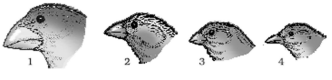
(i) Write what differences you see in the Darwin’s finches shown above.
(ii) How did Darwin explain the existence of different types of finches on galapagos?
Answer
(i) The Darwin finches shown above are showing the differences in beaks.
(ii) Darwin explain the existence of different type of finches on Galapagos on the basis of adaptive radiation. 
View full question & answer
Question 62 Marks
How does animal classification prove biological evolution?
Answer
Animals of various species found in nature have been classified into small or large groups on the basis of similarities and differences. This is an important evidence of biological evolution. All the animals were first divided by Linnaeus into different groups on the basis of binomial system. The vertebrate subfamily was divided into several classes, which according to evolution were categorized into cyclostomes, fishes, amphibians, reptiles, birds and mammals. From this sequence, it is clear that in the ancient times some vertebrates evolved from fish-like vertebrate to fishes, from fishes to amphibians, from amphibians to reptiles, from reptiles to birds and later on to mammals. Evidence of gradual evolution in all these classes can be traced by similarities found in them. By this method of classification, a family tree of all animals and plants can be prepared, which provides evidence of gradual evolution in animals of different groups, from protozoa to vertebrates.
View full question & answer
Question 72 Marks
Write a short note on the origin of life from space.
Answer
According to this theory :
Life first arrived on the earth along with cosmic dust in the form of protoplasm spores or other particles from another planet or constellations which gave rise to various forms of life. Some astronomers still recognize panspermia.
View full question & answer
Question 82 Marks
What do you understand by spontaneous generation?
Answer
Spontaneous Creation : According to this, life originated spontaneously from inanimate matter. This theory was propounded by Van Helmont. He said that by keeping sweat-soaked clothes and wheat straw together, rats are born in 21 days on the Nile River. When the sun's rays fall, life is created; frogs are formed in the soil; even today many people in India believe that scorpions are born from donkey urine and cow dung. This idea has been rejected by scientists now-a-days.
View full question & answer
Question 92 Marks
What is called Atavism or reversion? Give any two examples of this.
Answer
Atavism or reversion is the sudden reappearance of some ancestral features which was either vestigial or altogether absent in parents. These structures prove that those who possess these structures have evolved from ancestors in whom these structures would have been fully developed.
Example : (i) presence of thick body hairs, (ii) short temporary tail, (iii) ability to move Pinniae etc.
View full question & answer