Questions · Page 3 of 3

2 Marks Questions

Question 1012 Marks
Put these statements in the proper order, by rearranging the letters, to describe Darwin's theory of natural selection-
  1. The end result of organic evolution is many different species, each adapted to specific environments.
  2. Many more individuals are produced each generation that can survive and reproduce.
  3. Gradually, over long periods of time, a population can become well adapted to a particular environment.
  4. There are inheritable variation among the members of a population.
  5. Individuals with adaptive characteristics are more likely to be selected to reproduce by the environment.
Answer
  1. There are inheritable variation among the members of a population.
  2. Many more individuals are produced each generation that can survive and reproduce.
  3. Individuals with adaptive characteristics are more likely to be selected to reproduce by the environment.
  4. Gradually, over long periods of time, a population can become well adapted to a particular environment.
  5. The end result of organic evolution is many different species, each adapted to specific environments.
View full question & answer
Question 1022 Marks
Name the ancestors of man based on the features given below:
  1. Human-like meat eater with 900cc brain, lived in Java.
  2. More human with brain size 1400cc, lived in Central Asia, used hides and buried their dead.
  3. Human-like, vegetarian, with brain capacity between 650cc and 800cc.
  4. Man-like primate, that existed about 15 mya. Fossils found in Tanzania.
Answer
  1. Homo erectus.
  2. Neanderthal man.
  3. Homo habilis.
  4. Dryopithecus and Ramapithecus.
View full question & answer
Question 1032 Marks
Discovery of lobefins is considered very significant by evolutionary biologists. Explain.
Answer
  1. Lobefins are the fish with stout and strong fins, that could move on land and go back to water, they must have lived about 350 mya and were thought to be extinct.
  2. In 1938, a Coelacanth (lobefin) was caught in South Africa.
  3. Though no specimens of these are left with us, they evolved into the first amphibians.
  4. These were the ancestors of modern day frogs and salamanders.
View full question & answer
Question 1042 Marks
All vertebrate embryos show some similarities at an early stage. Mention two such similarities. What do they indicate? Explain.
Answer
  1. All vertebrate embryos develop a row of gill slits, which are functional only in fish and tadpole larva and not in other vertebrates.
  2. Notochord is present in all vertebrate embryos.

Such similarities indicate that they have descended/ evolved from a common ancestor.

View full question & answer
Question 1052 Marks
The scientists believe that evolution is gradual. But extinction, part of evolutionary story, are 'sudden' and 'abrupt' and also group-specific. Comment whether a natural disaster can be the cause for extinction of species.
Answer
Natural disaster like earth quake can be the cause for extinction of species. During the long period since the origin and diversification of life on earth there were five episodes of mass extinction of species.
View full question & answer
Question 1062 Marks
Life originated from the earth's inorganic atmosphere in the past, but this no longer happens today. Give two reasons.
Answer
  1. Presence of free oxygen in present day atmosphere.
  2. Existence of living organisms.
View full question & answer
Question 1072 Marks
Mention any three evolutionary features of mammals.
Answer
Three evolutionary features of mammals:
  • Mammals are endothermic vertebrates.
  • Have hair and fur on the body.
  • Have mammary glands.
View full question & answer
Question 1082 Marks
Give two examples of biogeographical evidence in favour of evolution.
Answer
  1. Darwin’s finches.
  2. Australian marsupials.
View full question & answer
Question 1092 Marks
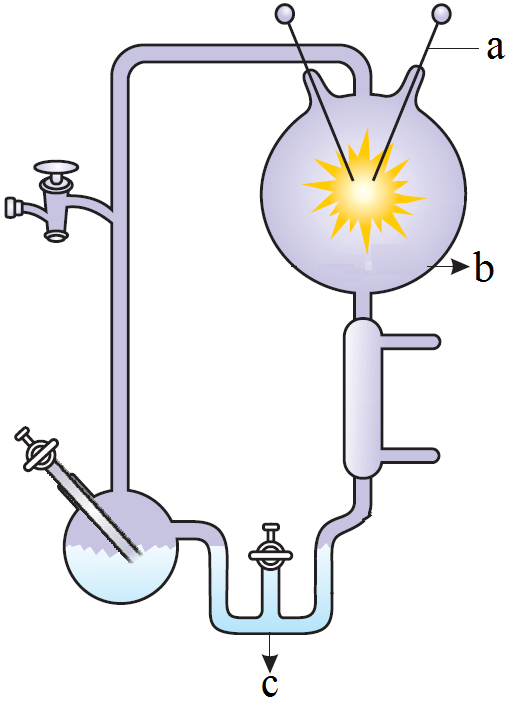
The figure given below represents Miller's apparatus used for his experiment.

Name the chemicals found in the sample drawn from 'e'. How did this experiment support evolution?
Answer
  • Amino acids were found.
  • Miller created in a laboratory scale, the conditions similar to the primitive earth.
  • Electric discharge using electrodes was created in a closed flask containing CH4, NH3, H2, and water vapour at 800°C.
  • The production of organic compounds supported the chemical evolution that preceded the formation of life on earth.
View full question & answer
Question 1102 Marks
When we say 'survival of the fittest', does it mean that:
  1. Those which are fit only survive.
  2. Those that survive are called fit? Comment.
Answer
  1. The characteristics which enable some population or individuals to survive better in natural conditions (foods, climate, physical factors) would outbreed others (survival of the finest).
  2. Thus, those organisms, which are better fit or adapt well will survive and get selected by nature, which furthers their evolution. This is called natural selection.
View full question & answer
Question 1112 Marks
What do you understand by differential reproduction and reproductive isolation? In what context are these term used?
Answer
  • Differential reproduction: The phenomenon in which all organisms who reach reproductive stage reproduce with varying degree of success, some reproduce more offsprings and some reproduce only few and other reproduce none depending upon their degree of fitness.

  • Reproductive isolation: The biological phenomenon in which the individual belonging to same species reproduce among themselves, to maintain the species integrity. Both these terms are used in reference to natural selection.

View full question & answer
2 Marks Questions - Page 3 - BIOLOGY STD 12 Science Questions - Vidyadip