Questions

2 Marks Questions

🎯

Test yourself on this topic

12 questions · timed · auto-graded

Question 12 Marks
When is medical termination of pregnancy is needed?
Answer
→ Intentional or voluntary termination of pregnancy before full term is called medical termination of pregnancy (MTP) or induced abortion.
→ Nearly 45 to 50 million MTPs are performed in a year all over the world which accounts to 1/5th of the total number of conceived pregnancies in a year.
→ MTP has a significant role in decreasing the population though it is not meant for that purpose.
→ Whether to accept/legalise MTP or not is being debated upon in many countries due to emotional, ethical, religious and social issues involved in it.
→ Government of India legalised MTP in 1971 with some strict conditions to avoid its misuse.
→ Such restrictions are all the more important to check indiscriminate and illegal female foeticides which are reported to be high in India.
→ Why MTP?
→ Obviously the answer is-to get rid of unwanted pregnancies either due to casual unprotected intercourse or failure of the contraceptive used during coitus or rapes.
→ MTPs are also essential in certain cases where continuation of the pregnancy could be harmful or even fatal either to the mother or to the foetus or both.
→ MTPs are considered relatively safe during the first trimester, i.e. upto 12 weeks of pregnancy.
→ Second trimester abortions are much more riskier.
→ One disturbing trend observed is that a majority of the MTPs are performed illegally by unqualified quacks which are not only unsafe but could be fatal too.
→ Another dangerous trend is the misuse of amniocentesis to determine the sex of the unborn child.
→ Frequently, if the foetus is found to be female, it is followed by MTP - this is totally against what is legal.
→ Such practices should be avoided because these are dangerous both for the young mother and the foetus.
→ Effective counselling on the need to avoid unprotected coitus and the risk factors involved in illegal abortions as well as providing more health care facilities could reverse the mentioned unhealthy trend.
View full question & answer
Question 22 Marks
Explain - Geitonogamy and Xenogamy.
Answer
Geitonogamy
→ It is the Transfer of pollen grains from the anther to the stigma of another flower of the same plant.
→ Although geitonogamy is functionally cross-pollination involving a pollinating agent, genetically it is similar to autogamy since the pollen grains come from the same plant. Monoceious plant like maize show geitonogamy but not autogamy.
Xenogamy
→ It is the transfer of pollen grains from anther to the stigma of a different plant.
→ This is the only type of pollination which during pollination brings genetically different types of pollen. grains to the stigma.
View full question & answer
Question 32 Marks
Explain Brood parasitism in birds.
Answer
→ Brood parasitism in birds is a fascinating example of parasitism in which the parasitic bird lays its eggs in the nest of its host and let the host incubate them.
→ During the course of evolution, the eggs of the parasitic bird have evolved to resemble the host's egg in size and colour to reduce the chances of the host bird detecting the foreign eggs and ejecting them from the nest.
View full question & answer
Question 42 Marks
Define Gross primary productivity and Net primary productivity.
Answer
→ A constant input of solar energy is the basic requirement for any ecosystem to function and sustain.
Primary production is defined as the amount of biomass or organic matter produced per unit area over a time period by plants during photosynthesis. It is expressed in terms of weight (gm) or energy (kcal m) The rate of biomass production is called productivity.
→ It is expressed in terms of gm-2 yr-1 or (kcal m-2) yr-1 to compare the productivity of different ecosystems It can be divided into gross primary productivity (GPP) and net primary productivity (NPP).
Gross primary productivity of an ecosystem is the rate of production of organic matter during photosynthesis. A considerable amount of GPP is utilised by plants in respiration. Gross primary productivity minus respiration losses (R). is the net primary productivity (NPP).
GPP - R = NPP 
→ Net primary productivity is the available biomass for the consumption to heterotrophs (herbivores and decomposers).
View full question & answer
Question 52 Marks
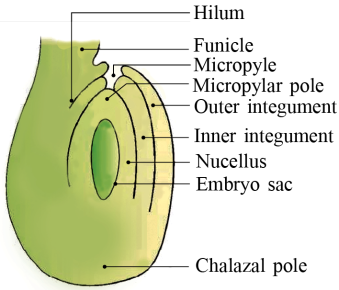
Draw the labeled diagram of typical anatropus ovule.
Answer

Image
→ An ovule is a female megasporangium where the formation of megaspores takes place.
→ The various parts of an ovule are -
→ Funicle - It is a stalk-like structure which represents the point of attachment of the ovule to the placenta of the ovary.
→ Hilum - It is the point where the body of the ovule is attached to the funiculus.
→ Integuments - They are the outer layers surrounding the ovule that provide protection to the developing embryo.
→ Micropyle - It is a narrow pore formed by the projection of integuments. It marks the point where the pollen tube enters the ovule at the time of fertilization.
→ Nucellus - It is a mass of the parenchymatous tissue surrounded by the integuments from the outside. The nucellus provides nutrition to the developing embryo. The embryo sac is located inside the nucellus.
→ Chalazal - It is the basal part of the ovule in plants, where nucellus and integuments join.
View full question & answer
Question 62 Marks
Explain four basic processes for population density. (Figure is not required)
Answer
→ The population size is measured by its density.
→ At given time, the organisms in the population is counted per given unit area.
→ For this the unit of measurement is decided such as unit per acre or unit per hectares. For small organisms, small units are considered.
→ In our country, every 10 years population is measured.
→ In a specific habitat, the population density is fluctuating. For instance in rainy season density is high whereas in dry season it is less.
→ The population density depends on the necessity of an organism.
View full question & answer
Question 72 Marks
How was the first antibiotic discovered? Explain it
Answer
→ Antibiotics are chemical substances which is produced by microbes. It kills pathogenic microbes or slow down their growth.
→ This chemicals are called antibiotics.
(anti=opposite, bio=life)
e.g. Penicillin is the first discovered antibiotic.
→ Discovery :
→ Alexander Fleming while working on staphylococci bacteria, once observed a mould growing in one of his unwashed culture plated around which staphylococci could not grow.
→ He found out that it was due to a chemical produced by the mould and he named it penicillin after the mould penicillium notatum.
→ This antibiotic was extensively used to treat American soldiers wounded in world war II
→ Fleming, chain and flory were awarded the Nobel prize in 1945, for this discovery.
View full question & answer
Question 82 Marks
What is withdrawal syndrome? Give its symptoms.
Answer
It is the tendency of the body to manifest a characteristic and unpleasant withdrawal syndrome if regular dose of drugs / alcohol is abruptly discontinued. This results in anxiety, shakiness, nausea and sweating. Dependence leads to social adjustment problems.
View full question & answer
Question 92 Marks
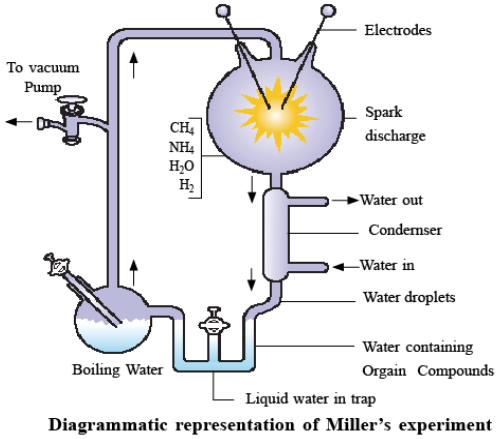
Draw a neat and labeled diagram of S.L. Miller's experiment.
Answer

Image
→ In 1953, S. L. Miller, an american scientist created similar conditions in a laboratory scale (Figure).
→ He created electric discharge in a closed flask containing CH4, H2, NH3, and water vapour at $800^{\circ} $C.
→ He observed formation of amino acids. In similar experiments others observed, formation of sugars, nitrogen bases, pigment and fats.
→ Analysis of meteorite content also revealed similar compounds indicating that similar processes are occurring elsewhere in space. With this limited evidence, the first part of the conjectured story, i.e., chemical evolution was more or less accepted.
→ We have no idea about how the first self replicating metabolic capsule of life arose. The first non-cellular forms of life could have originated 3 billion years back.
View full question & answer
Question 102 Marks
Give the successive steps for the DNA finger- printing technique.
Answer
→ The technique which is used to identify and analyse the variation in DNA in every individual is known as DNA fingerprinting.
→ The various applications of DNA fingerprinting are as follow :
(1) In forensic science, it is used for identifying potential crime suspects.
(2) It is used for finding out paternity and family relationships.
(3) It is used for the identification and protection of commercial crop varieties and livestock.
(4) It is used to find out the evolutionary relationship and linkage between the various organisms.
View full question & answer
Question 112 Marks
Write a short note on - Phenylketonuria
Answer
→ It is an inborn error of metabolism.
→ It is an autosomal recessive disease.
→ It is due to mutation of a gene that codes for the enzyme phenyl alanine hydroxylase. This enzyme converts an amino acid phenylalanine into tyrosine.
→ The affected individual lacks this enzyme. As a result, phenylalanine accumulates and converts into phenyl pyruvic acid and other derivatives.
→ They accumulate in brain resulting in mental retardation. These are also excreted through urine because of poor absorption by kidney.
View full question & answer
Question 122 Marks
What is sexually transmitted infection? Give simple principles to control it.
Answer
In early age marriage, children do not have proper knowledge, reproductive health and organs. Sexually transmitted infections are common in these age group.
View full question & answer
2 Marks Questions - BIOLOGY STD 12 Science Questions - Vidyadip