Questions

3 Marks Question

🎯

Test yourself on this topic

7 questions · timed · auto-graded

Question 13 Marks
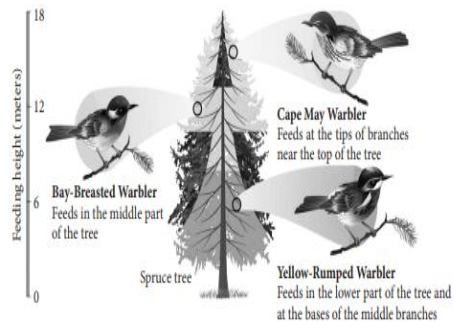
A. Diagram given below depicts different species of Warbler birds feeding on different regions on a Spruce tree. Explain the mechanism which helps them to co-exist.
Image
B. What does Gause's exclusion principle state? Does it apply in the case shown above? Explain.
Answer
A.
→They are able to co-exist by mechanism of 'resource partitioning'.
→ If two species compete for the same resource, they could avoid competition by choosing different foraging patterns.
→ MacArthur showed that five closely related species of warblers living on the same tree were able to avoid competition and co-exist due to behavioural differences in their foraging activities.
B.
→ Gause's 'Competitive Exclusion Principle' states that two closely related
species competing for the same resources cannot co-exist indefinitely
→ and the competitively inferior one will be eliminated eventually.
→ No
View full question & answer
Question 23 Marks
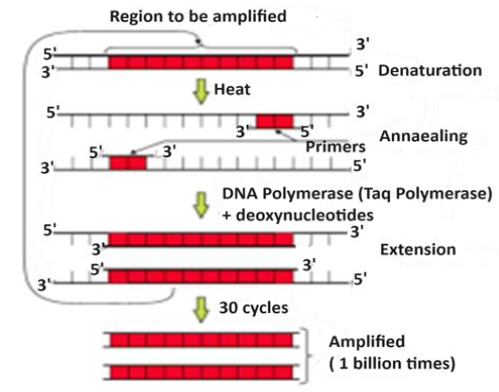
Explain how PCR technique can be used for amplification of a small amount of DNA template.
Answer
PCR stands for Polymerase Chain Reaction. In this reaction, multiple copies of the gene (or DNA) of interest are synthesised in vitro using two sets of primers (small chemically synthesised oligonucleotides that are complementary to the regions of DNA) and the enzyme DNA polymerase. The enzyme extends the primers using the nucleotides provided in the reaction and the genomic DNA as template.
If the process of replication of DNA is repeated many times, the segment of DNA can be amplified to approximately billion times, i.e., 1 billion copies are made. Such repeated amplification is achieved by the use of a thermostable DNA polymerase (isolated from a bacterium, Thermus aquaticus), which remains active during the high temperature induced denaturation of double stranded DNA. The amplified fragment if desired can now be used to ligate with a vector for further cloning.
Each cycle has three steps: (i) Denaturation, (ii) Annealing and (iii) Extensions.
Image
View full question & answer
Question 33 Marks
Bio-fertilisers are organisms that enrich the nutrient quality in the soil. Explain the role of three main sources of bio-fertilisers.
Answer
The main sources of biofertilizers are bacteria, fungi and cyanobacteria.
→ The nodules on the roots of leguminous plants are formed by the symbiotic association of Rhizobium. These bacteria fix atmospheric nitrogen into organic forms, which is used by the plant as a nutrient. Other bacteria can fix atmospheric nitrogen while free-living in the soil (examples Azospirillum and Azotobacter), thus enriching the nitrogen content of the soil.
→ Fungi are also known to form symbiotic associations with plants (mycorrhiza). Many members of the genus Glomus form mycorrhiza. The fungal symbiont in these associations absorbs phosphorus from soil and passes it to the plant. Plants having such associations show other benefits also, such as resistance to root-borne pathogens, tolerance to salinity and drought, and an overall increase in plant growth and development.
→ Cyanobacteria are autotrophic microbes widely distributed in aquatic and terrestrial environments many of which can fix atmospheric nitrogen, e.g. Anabaena, Nostoc, Oscillatoria, etc. In paddy fields, cyanobacteria serve as an important biofertiliser. Blue green algae also add organic matter to the soil and increase its fertility.
View full question & answer
Question 43 Marks
Describe the steps involved in Southern blot hybridization using radiolabeled VNTR as a probe.
Answer
→ isolation of DNA,
→ digestion of DNA by restriction endonucleases,
→ separation of DNA fragments by electrophoresis,
→ transferring (blotting) of separated DNA fragments to synthetic membranes, such as nitrocellulose or nylon,
→ hybridisation using labelled VNTR probe, and
→ detection of hybridised DNA fragments by autoradiography.
View full question & answer
Question 53 Marks
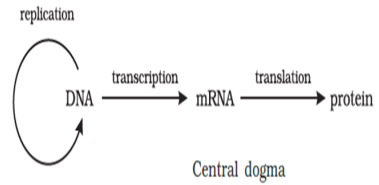
The schematic representation given below shows the concept of Central Dogma.
Image
A. During the process of replication and transcription the pairing of
nitrogenous bases is not similar. Explain.
B. How is the above process modified in a retrovirus? Name the process.
C. Justify why during the process of transcription only a segment of DNA is copied into RNA.
Answer
A. During replication, Adenine pairs with thymine in DNA; during transcription, adenine pairs with uracil in RNA.
B. In retrovirus the nucleic acid is RNA and it is used to synthesize DNA; the process is called reverse transcription.
C. It is a highly energy-rich process/ or as per the need only the gene coding for a specific protein is transcribed.

View full question & answer
Question 63 Marks
Name the place in human ovary where the first meiotic division is completed during oogenesis. What are the products of this division? Give the chromosome number of each type of cells involved in the process.
Answer
→ The first meiotic division is completed in the primary oocyte during oogenesis.
→ Then primary oocyte undergoes first meiotic division to form a large haploid secondary oocyte and a tiny first polar body.
→ The primary oocyte comprises of 46 chromosomes, whereas secondary oocyte and first polar body have 23 chromosomes each.
View full question & answer
Question 73 Marks
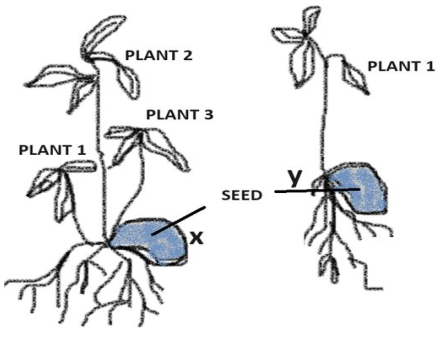
The image below shows two germinated seeds X and Y which belong to the same species. Seed X is produced by apomixis whereas seed Y is a product of sexual reproduction.
Image
A. Write the number of embryo(s), embryo sac(s) and ovules in the ovary of seed X.
B. How multiples embryos are formed in citrus fruits?
C. What advantage will plants developed from seed Y have over seed X?
Answer
A. Seed X-3 embryos; 1embryo sac; 1ovule;
B. The nucellar cells grow mitotically and develop into the embryos by asexual reproduction.
C. The plants growing from seed X will have to share the resources/endosperm so there is a possibility of some plant being undernourished/; only one plant in seed Y will use the entire endosperm for its growth or as the plants of seed X are clones they will not show variation and may succumb to environmental stress;/ plants from seed Y will have genetic variation and so can show greater adaptability.
View full question & answer