Questions

2 Marks Questions

🎯

Test yourself on this topic

6 questions · timed · auto-graded

Question 12 Marks
Name the effective biocontrol agents of several plant pathogens belonging to group of viruses. Also write about the ways they support the environment.
Answer
i. Baculoviruses / Nucleopolyhedrovirus
ii. Species specific, narrow spectrum insecticidal application, no negative impact on plants/ vertebrates/non-target insects, help to conserve beneficial insects, useful in IPM, useful in ecologically sensitive area
View full question & answer
Question 22 Marks
State the most important contribution of the following microbes for human welfare:
a. monascus purpureus
b. Trichoderma Polysporum
Answer
a. Monascus Purpureus: Statins produced by the yeast Monascus purpureus have been commercialised as blood-cholesterol- lowering agents. It acts by competitively inhibiting the enzyme responsible for synthesis of cholesterol.
b. Trichoderma Polysporum: Cyclosporin A, that is used as an immunosuppressive agent in organ-transplant patients, is produced by the fungus Trichoderma polysporum.
View full question & answer
Question 32 Marks
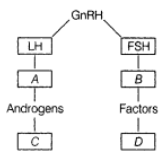
Identify A, B, C and D with reference to gametogenesis in humans, in the flow chart given below.
Image
Answer
A- Leydig's cell
B- Sertoli cell
C- Spermatogenesis (Formation of sperms)
D- Spermiogenesis (Transformation of spermatid into sperm)
View full question & answer
Question 42 Marks
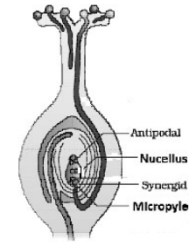
a. Draw an L.S. of pistil showing pollen tube entering into the embryo sac. Label the following:
i. Nucellus
ii. Antipodals
iii. Synergids
iv. Micropyle
b. Write the functions of the following:
i. Synergids
ii. Micropyle
Answer
a.
Image

b. i. Function - Synergids have Filiform apparatus which guides the entry of pollen tube to the embryo sac.
ii. Function - Micropyle allows the entry of pollen tube to embryo sacs.
View full question & answer
Question 52 Marks
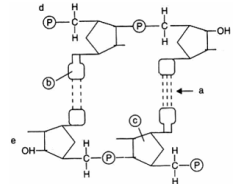
Study the given portion of double-stranded polynucleotide chain carefully. Identify a, b, c and the 5' end of the chain.
Image
Answer
a. Hydrogen bonds
b. Purine base
c. Pentose sugar (Deoxyribose)
d. 5' end of the chain - d
View full question & answer
Question 62 Marks
Name the group of bacteria involved in setting milk into curd. Explain the process they carry in doing so. Write another beneficial role of such bacteria.
Answer
Microorganisms such as Lactobacillus and others commonly called lactic acid bacteria $ \text{(LAB)}$ grow in milk and convert into curd.
$ \text{LAB}$ produce acid that coagulate and partially digest the milk proteins.
Beneficial role $-$ Increases Vitamin $B_{12} $ Checks disease causing microbes in the stomach.
View full question & answer
2 Marks Questions - BIOLOGY STD 12 Science Questions - Vidyadip