Questions

3 Marks Question

Take a timed test

8 questions · self-marked practice — reveal the answer and mark yourself.

Question 13 Marks
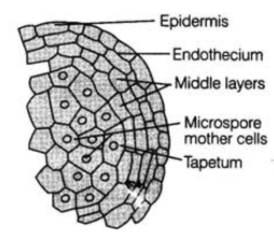
Draw the diagram of a microsporangium and label its wall layers. Write briefly on the role of the endothecium.
Answer
Image
Role of Endothecium: Endothecium; along with the epidermis and the middle layer; provides protection to the pollens during development. Once pollen grains are mature, the three layers (including endothecium) rupture and thus facilitate the dehiscence of pollens.
View full question & answer
Question 23 Marks
Why is Saheli considered an effective contraceptive for women to space children?
Answer
Oral pills/Injections/Implants: Hormonal preparations (Progestogens or progestogens and estrogen) inhibit ovulation and implantation. "Saheli", a new oral pill is used once-a-week". It's a steroid preparation with very fewer side effects and high contraceptive value developed by CDRI in Lucknow, India.
View full question & answer
Question 33 Marks
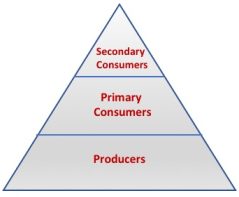
i. Name an ideal pyramid existing in an ecosystem. Construct it up to its three trophic levels along with their
names.
ii. The sun provides 1,000,000 J of sunlight (solar energy) to an ecosystem. Write the amount of energy that is available to the first and third trophic levels, respectively.
View full question & answer
Question 43 Marks
i. Why is tender coconut considered as a healthy source of nutrition?
ii. How are pea seeds different from castor seeds with respect to endosperm?
Answer
i. The tender coconut is immature with soft and gentle solid white kernel (it is Primary Endosperm Cell) also called coconut 'meat' and the central watery fluid, free nuclear endosperm, called coconut milk( it is Primary Endosperm Nucleus) or water is highly nutritious as it contains a large number of nucleus having high amount of proteins, oils, vitamins and minerals.
ii. The seeds of pea are dicot, non-endospermic/ex-albuminous because the whole of endosperm is consumed during embryogenesis. The food is stored in massive cotyledons and there are no remnants of endosperm in the mature pea, seeds. However, in castor seeds, the whole of endosperm is not consumed completely during embryogenesis. The cotyledons are papery and the fleshy massive endosperm is present in the mature castor seeds. Seeds are known as an endospermic seed or albuminous seeds.
View full question & answer
Question 53 Marks
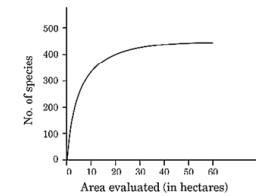
The graph given below shows species-area relationship of a certain region.
Image
a. Study the graph and explain what it represents.
b. After a while, a small area was taken for constructing a road which divided the region into two. Write the impact this construction would have on species richness of the region.
Answer
i. "Within a region species richness increased with increasing explored area, but only up to a limit."
ii. Very gradually impact on species diversity will be visible/species diversity will be gradually reduced/negative impact on species diversity.
View full question & answer
Question 63 Marks
Anita was happy when she gave birth to her first child. Her in-laws were dissatisfied at her not giving birth to a male child and blamed Anita. Anita tried to convince her in-laws that she had no role in the child's gender. They understood the biological reason but were yet to be satisfied. Anita's husband took up the matter and convinced the parents.
i. What values did Anita's husband show in the above situation?
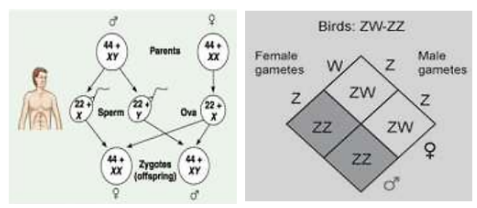
ii. What governs sex determination in humans? How is it different from birds?
iii. Why can't Anita be blamed for not giving birth to a male child?
Answer
i. Strong and determined personality with responsibility towards the family and respect for elders.
ii. Sex chromosomes. In human males it is XY and in the female it is XX. In birds, the male is ZZ while the female is ZW.
iii. Human females are homogametic i.e. produces only one type of gametes containing 22+X chromosomes only. Males are heterogametic and produce two types of gametes 22+X and 22+Y. It is the type of male gamete which determines the sex of the foetus. If X chromosome containing sperm fuses with the egg, it produces a female child whereas if Y chromosome containing sperm fuses with the egg, it produces a male child.

Image
View full question & answer
Question 73 Marks
Answer
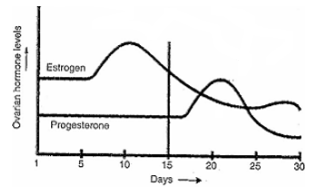
i. a. It is the follicular phase, when the endometrium regenerates through proliferation.
b. Progesterone increases (luteal phase) and maintains the endometrium essential for the implantation of the embryo.
c. If the ovum is not fertilized, the endometrium disintegrates, leading to menstruation.
ii. Estrogen is secreted by the follicle cells.
Progesterone is secreted by the corpus luteum of the ovary.
View full question & answer
Question 83 Marks
Three water samples namely river water, untreated sewage water and secondary effluent discharged from a sewage treatment plant were subjected to BOD test. The samples were labelled A, B and C but the laboratory attendant did not note which was which. The BOD values of the three samples A, B and C were recorded as 20 mg/L, 8 mg/L and 400 mg/L respectively. Which sample of the water is most polluted? Can you assign the correct label to each assuming the river water is relatively clean?
Answer
Biological oxygen demand (BOD) is the method of determining the amount of oxygen required by micro-organisms to decompose the waste present in the water supply. If the quantity of organic wastes in the water supply is high, then the number of decomposing bacteria present in the water will also be high. As a result, the BOD value will increase. Therefore, it can be concluded that if the water supply is more polluted, then it will have a higher BOD value. Out of the above three samples, sample C is the most polluted since it has the maximum BOD value of 400 mg/L. After untreated sewage water, secondary effluent discharge from a sewage treatment plant is most polluted.
Thus, sample A is secondary effluent discharge from a sewage treatment plant and has the BOD value of 20 mg/L, while sample B is river water and has the BOD value of 8 mg/L.
Hence, the correct label for each sample is:
Label BOD value Sample
A. 20 mg/L Secondary effluent discharge from a sewage treatment plant
B. 8 mg/L River water
C. 400 mg/L Untreated sewage water
View full question & answer