Questions

M.C.Q (1 Marks)

Take a timed test

12 questions · 2 auto-graded MCQ + 10 self-marked written.

MCQ 11 Mark
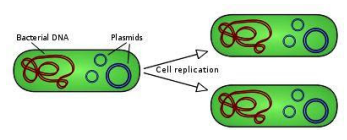
Which of the following is true for a Plasmid -
Image
  • A
    It can be replicate independently
  • B
    It cannot replicate
  • C
    It lies together with chromosomes
  • D
    It shows independent assortment
Answer
(d) : It shows independent assortment
Explanation: It shows independent assortment
View full question & answer
MCQ 21 Mark
$ \text{DNA} $ replication takes place during:
  • $S-$phase
  • B
    $G_1$ phase
  • C
    $G_2$ phase
  • D
    Prophase
Answer
Correct option: A.
$S-$phase
 $S-$phase
View full question & answer
MCQ 31 Mark
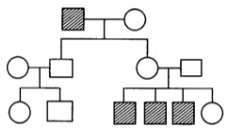
Inthe given pedigree the shaded figures denote individuals expressing a specific trait:

Image
Which of the following is the most probable mode of inheritance of this trait?
  • A
    X-linked recessive transmission
  • B
    Simple Mendelian Recessive
  • C
    Codominant relationship of a single pair of alleles
  • D
    X-linked dominant transmission
Answer
(a) : X-linked recessive transmission
Explanation: X-linked recessive transmission
View full question & answer
MCQ 41 Mark
Tapetum in pollen grains help in:
  • A
    Provide nourishment to the young microspore mother cell
  • B
    Help in pollen grain germination
  • C
    Provide protection to the microspore mother cell
  • D
    Help in the dispersal of pollen grain
Answer
(a) : Provide nourishment to the young microspore mother cell
Explanation: Tapetum is the cells surrounding the microspore mother cells. These cells provide nourishment to the young microspore mother cells.
View full question & answer
MCQ 51 Mark
The diagram shows an important concept in the genetic implication of DNA. Fill in the blanks A to C.
Image
  • A
    A - translation B - transcription C - Erevin Chargaff
  • B
    A-translation B - extension C - Rosalind Franklin
  • C
    A - transcription B - translation C - Francis Crick
  • D
    A - transcription B - replication C - James Watson
Answer
(c) : A - transcription B - translation C - Francis Crick
Explanation: A transcription B-translation C - Francis Crick
View full question & answer
MCQ 61 Mark
Rosie's milk is enriched nutritionally as it has:
  • A
    Beta lactalbumin
  • B
    Human gene alpha lactalbumin
  • C
    lactose
  • D
    Vitamin A
Answer
(b) : Human gene alpha lactalbumin
Explanation: The first transgenic cow Rosie produced human protein-enriched milk. The milk contained Alpha-lactalbumin which was nutritionally more balanced than normal cow milk for babies.
View full question & answer
MCQ 71 Mark
The natural parthenogenesis is found in:
  • A
    Drosophila
  • B
    Sharks
  • C
    Honey bee
  • D
    Housefly
Answer
(c) : Honey bee
Explanation: Honey bee
View full question & answer
MCQ 81 Mark
Among the ecosystem mentioned below, where can one find maximum biodiversity?
  • A
    Desert
  • B
    Coral reefs
  • C
    Alpine meadows
  • D
    Mangroves
Answer
(b) : Coral reefs
Explanation: Coral reefs are believed by many to have the highest biodiversity of any ecosystem on the planet even more than a tropical rainforest. Occupying less than one percent of the ocean floor, coral reefs are home to more than twenty-five percent of marine life.
View full question & answer
MCQ 91 Mark
Which of the following restriction enzymes produces blunt ends?
  • A
    Eco RV
  • B
    Hind III
  • C
    Xho1
  • D
    Sal I
Answer
(a) : Eco RV
Explanation: Eco RV
View full question & answer
MCQ 101 Mark
Which one of the following plants shows very close relationships with a species of moth, where none of the two can complete its life cycle without the other?
  • A
    Viola
  • B
    Yucca
  • C
    Hydrilla
  • D
    Banana
Answer
(b) : Yucca
Explanation: Yucca
View full question & answer
MCQ 111 Mark
$N_2-$fixing bacteria in non$-$legume plants are:
  • Frankia
  • B
    Aspergillus
  • C
    Rhizobia
  • D
    Plasmodium
Answer
Correct option: A.
Frankia
 Frankia
View full question & answer
MCQ 121 Mark
The phenomenon involved in the formation of female gametophyte is known as:
  • A
    Hydrolysis
  • B
    Megasporogenesis
  • C
    Multisporogenesis
  • D
    Microsporogenesis
Answer
(b) : Megasporogenesis
Explanation:  The process of formation of female gametophyte inside the ovary by meiotic and mitotic division is called megasporogenesis.
View full question & answer
