Questions

5 Marks Questions

🎯

Test yourself on this topic

6 questions · timed · auto-graded

Question 15 Marks
Recombinant DNA vectors are typically attenuated viruses or bacteria that are unrelated to the pathogen of interest.
These vectors can penetrate human cells and often replicate within them, but do not cause disease in the host.
Image
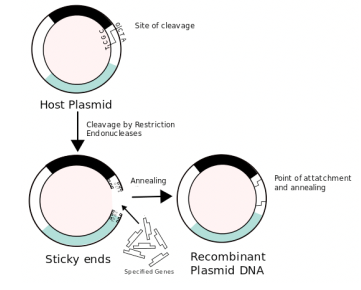
i. A recombinant vector with a gene of interest inserted within the gene of a-galactosidase enzyme, is introduced into a bacterium. Explain the method that would help in selection of recombinant colonies from non-recombinant ones.
ii. Why is this method of selection referred to as insertional inactivation?
Answer
i. The insertion of recombinant DNA within the coding sequence of enzyme a-galactosidase results in the inactivation of the
enzyme called insertional inactivation. The colonies do not produce a blue colour in the presence of chromogenic substrate
and are identified as recombinant colonies whereas non-recombinant colonies produce blue colour from the chromogenic
substrate, due to the presence of the activated enzyme.
ii. The method is referred as "insertional inactivation" because the enzyme a-galactosidase produced is inactivated due to insertion of alien DNA within the coding sequence of the enzyme, which acts as a selectable marker to differentiate recombinant colonies from non-recombinant one.
View full question & answer
Question 25 Marks
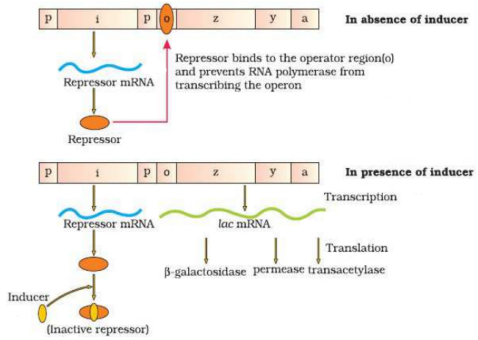
Explain how does lac operon in E. coli operate
a. in the absence of an inducer.
b. in the presence of an inducer.
Answer
a. In the absence of an inducer - The repressor of the Lac-operon is synthesised from the i gene, The repressor protein binds to the operator region of the operon in absence of the inducer, and prevents RNA polymerase from transcribing the operon.
b. In the presence of an inducer, (lactose) the repressor is inactivated by interaction with the inducer, This allows RNA polymerase access to the promoter and transcription proceeds.
Image
View full question & answer
Question 35 Marks
a. Where is microsporangium located in an angiosperm? State the functions of tapetum and the other three layers of microsporangium.
b. Describe the structure of the male gametophyte produced as a result of microsporogenesis.
c. State the functions of each part of the male gametophyte.
Answer
a. Microsporangium located in the anther lobe in an angiosperm.
Tapetum- nourishes the developing pollen grain
Epidermis, Endothecium, middle layers- protection and dehiscence (of microsporangium)
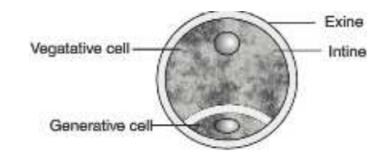
b. Structure of Pollen grain / male gemetophyte
i. Outer wall layer - Exine
ii. Inner wall layer - Intine
iii. Vegetative cell
iv. Generative cell
Image
c. Function of each part of male gametophyte are
i. Exine and Intine Protection
ii. Vegetative cell reserve food material / formation of pollen tube
iii. Generative cell formation of two male gametes
View full question & answer
Question 45 Marks
Suggest and describe a technique to obtain multiple copies of a gene of interest in vitro.
Answer
Polymerase Chain Reaction (PCR) is a technique to obtaining multiple copies of a gene of interest in vitro. This technique amplifies DNA through a simple enzymatic reaction. This technique was developed by Kary Mullis in 1965. The basic requirements of a PCR are the following:
i. DNA template
ii. Primers
iii. Enzyme-Taq polymerase
Amplification of recombinant DNA gene is done using Polymerase Chain Reaction (PCR). It is carried out in the following steps:
i. Denaturation - The double-stranded DNA is denatured by applying high temperature of 95°C for 15 seconds. Each separated strand acts as a template.
ii. Annealing -Two sets of primers are added, which anneal to the 3'end of each separated strand.
iii. Extension - DNA polymerase extends the primers by adding nucleotides complementary to the template provided in the reaction. Taq polymerase is used in the reaction, which can tolerate heat. All these steps are repeated many times to get several copies of the desired DNA.
View full question & answer
Question 55 Marks
Name and describe the steps involved in the technique widely used in forensics that serves as the basis of paternity testing in case of disputes.
Answer
DNA fingerprinting is used in forensic.
Steps which are involved in DNA fingerprinting are as follows:
i. Isolation of DNA
ii. Digestion of DNA by restriction endonuclease enzyme
iii. Separation of DNA fragments, by electrophoresis
iv. Transferring of separated DNA fragments to synthetic membrane such as nitrocellulose or nylon.
v. Hybridization, using labelled VNTR probe.
vi. Detection of hybridized DNA fragments by autoradiography
View full question & answer
Question 65 Marks
State the similarity and differences between geitonogamy and xenogamy. Why do cleistogamous flowers assure seed sets?
Answer
The similarity between geitonogamy and xenogamy is that both pollinations take place by pollinating agencies, pollinating agencies transfer the pollen from anther of one flower to the receptive stigma of another plant in case of xenogamy and another flower of the same plant in geitonogamy.

The difference between the two is that in geitonogamy the pollen and stigma are genetically similar because they both belong to the same plant but in xenogamy, they are genetically different as they belong to different plants of same species. Geitonogamy is functionally cross-pollination but genetically self-pollination.

As cleistogamous flowers are the flowers which remain closed and never open, so in these flowers anther and stigma are in close association. So these flowers do not require pollinating agencies for pollination and thus produce assured seed set even in absence of pollinating agencies.
View full question & answer
5 Marks Questions - BIOLOGY STD 12 Science Questions - Vidyadip