Questions

M.C.Q (1 Marks)

Take a timed test

12 questions · self-marked practice — reveal the answer and mark yourself.

MCQ 11 Mark
Thermostable DNA polymerase is isolated from bacterium:
  • A
    Rhizobium
  • B
    Salmonella typhii
  • C
    Escherichia coli
  • D
    Thermus aquaticus
Answer
Thermus aquaticus
Explanation: Taq polymerase is a thermostable DNA polymerase named after the thermophilic bacterium Thermus aquaticus from which it was originally isolated by Chien et al. in 1976. Its name is often abbreviated to Taq Pol or simply Taq. It is frequently used in the polymerase chain reaction (PCR), a method for greatly amplifying the quantity of short segments of DNA. It remains active during high temperature-induced denaturation of double-stranded DNA.

View full question & answer
MCQ 21 Mark
Large-holes in Swiss-Cheese are due to
  • A
    Acetobacter aceti
  • B
    Propionibacterium sharmanii
  • C
    Penicillium chrysogenum
  • D
    Saccharomyces cerevisiae
Answer
Propionibacterium sharmanii
Explanation: Propionibacterium sharmanii
View full question & answer
MCQ 31 Mark
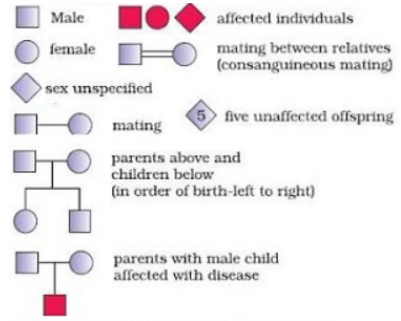
Which one of the following symbols and its representation used in the human pedigree analysis is correct?
Image
  • A
    unaffected female
  • B
    unaffected male
  • C
    affected male
  • D
    Mating between relatives
Answer
Mating between relatives
Explanation: The symbols and its representation used in the human pedigree analysis is mating between relatives is correct.
Image

View full question & answer
MCQ 51 Mark
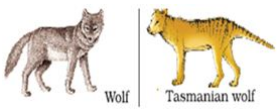
Picture shown below is an example of:-
Image
  • A
    Convergent evolution of Australian marsupials and placental mammal
  • B
    Divergent evolution of Australian marsupials and placental mammals
  • C
    Homologous organs of both animals
  • D
    Analogous organs of both animals
Answer
Convergent evolution of Australian marsupials and placental mammals
Explanation: Wolf and Tasmania Wolf are examples of convergent evolution of placental mammals and Australian marsupials. They are evolved differently due to different in climatic and geographic regions.
View full question & answer
MCQ 61 Mark
In the pedigree analysis, the symbol shown below represent
Image
  • A
    Sex unspecified
  • B
    Affected individuals
  • C
    Normal individuals
  • D
    Matting between relatives
Answer
Affected individuals
Explanation: In pedigree analysis, the symbol shown above represents affected individuals.
Image

View full question & answer
MCQ 71 Mark
Which one among the following biofertilizers does not fix atmospheric nitrogen?
  • A
    Rhizobium
  • B
    Oscillatoria
  • C
    Azospirillum
  • D
    Glomus
Answer
Glomus
Explanation: The genus Glomus exhibits symbiotic association with higher plants.
View full question & answer
MCQ 81 Mark
The organism used in construction of the first artificial recombinant DNA by Cohen and Boyer in 1972 was:
  • A
    Bacillus thuringiensis
  • B
    E. coli
  • C
    Agrobacterium tumefaciens
  • D
    Salmonella typhimurium
Answer
Salmonella typhimurium
Explanation: Salmonella typhimurium
View full question & answer
MCQ 91 Mark
Which of the following is a STD?
  • A
    Pneumonia
  • B
    Malaria
  • C
    Cancer
  • D
    Trichomoniasis
Answer
Trichomoniasis
Explanation: Trichomoniasis
View full question & answer
MCQ 111 Mark
Female hired to develop the in-vitro fertilized egg of another female to maturity is called:
  • A
    Step-mother
  • B
    Biological mother
  • C
    Feeding mother
  • D
    Surrogate mother
Answer
Surrogate mother
Explanation: Sometimes eggs of females and sperm of males are able to produce but a fallopian tube is either blocked or uterus is not capable of implantation. In this case, ovum collected from females and sperm collected from males is fertilized and transferred to another female called surrogate mother for further development.
View full question & answer
MCQ 121 Mark
The rate of storage of organic matter in producers in excess of their metabolic consumption is:
  • A
    Community productivity
  • B
    Biomass
  • C
    Gross primary productivity
  • D
    net primary productivity
Answer
net primary productivity
Explanation: Net Primary Productivity (NPP) is the amount of carbon uptake after subtracting Plant Respiration (RES) from Gross Primary Productivity (GPP). GPP is the total rate at which the ecosystem capture and store carbon as plant biomass, for a given length of time. NPP GPP - RES.
View full question & answer