Questions

2 Marks Questions

🎯

Test yourself on this topic

6 questions · timed · auto-graded

Question 12 Marks
Mention the common bacterium found in the anaerobic sludge during sewage treatment and also in the rumen of cattle. How is this bacterium commercially useful?
Answer
The group of bacteria found in both the rumen of cattle and sludge of sewage treatment is Methanogen bacteria. Biological methanation occurs naturally in swamps, digestive systems of animals, oil fields and other environments and is already commonly used in sewage water plants and biogas plants.
View full question & answer
Question 22 Marks
a. Give an example of viral biocontrol agent.
b. Why are they considered to be desirable when an ecologically sensitive area is being treated?
Answer
a. Baculoviruses / Nucleopolyhedrovirus
b. They are considered to be good bio-control agents because these viruses are excellent candidates for species-specific, narrow- spectrum insecticidal applications and show no negative impacts on plants, mammals, birds or even non-target insects and are desirable for integrated pest management.
View full question & answer
Question 32 Marks
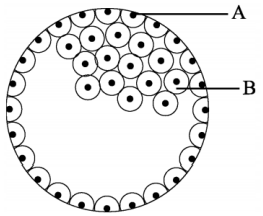
In the given figure, give the name and functions of parts labelled A and B.
Image
Answer
A. Trophoblast - Gets attached to the endometrium and draws nutritive material secreted by uterine endometrium gland.
B. Inner cell mass - Differentiates as Embryo.
View full question & answer
Question 42 Marks
Differentiate between perisperm and endosperm giving one example of each.
Answer
Perisperm is the remnant of nucellus persistent in the mature seeds of some plants e.g., black pepper, beet etc. The endosperm is a nutritive tissue (triploid) present in the albuminous seeds e.g., coconut, cereals, castor etc.
View full question & answer
Question 52 Marks
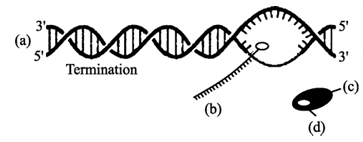
The process of termination during transcription in a prokaryotic cell is being represented here. Name the label a, b, c and d.
Image
Answer
a. DNA molecule
b. mRNA transcript
c. RNA polymers
d. Rho factor
View full question & answer
Question 62 Marks
What are flocs? State their role in biological treatment of sewage.
Answer
Flocs are masses of bacteria held together by slime and fungal filaments to form mesh like structures. They are formed during the secondary treatment of sewage.
Consume major part of organic matter in the effluent/lower BOD significantly/reduces polluting potential.
View full question & answer
2 Marks Questions - BIOLOGY STD 12 Science Questions - Vidyadip