Questions

3 Marks Question

🎯

Test yourself on this topic

8 questions · timed · auto-graded

Question 13 Marks
Give three hypothesis for explaining why tropics show greatest levels of species richness.
Answer
Biodiversity is not uniformly distributed throughout the world. Polar regions have very little biodiversity whereas South America has the greatest biodiversity on the earth. There are many hypothesis for higher biodiversity in tropics:
1. There are no unfavourable seasons or harsh climatic conditions in tropics. Continued favourable environmental condition has helped tropical organisms to flourish more.
2. There is more solar energy available in the tropics due to which productivity is higher and this contribute to greater diversity in both plants and animal species.
3. The tropical environment is older than other types of habitats. This has provided more time for the evolution of greater number of plants and animals.

View full question & answer
Question 23 Marks
Differentiate between vaccination and immunization. Describe the two types of vaccines with suitable examples?
Answer
Vaccination is the phenomenon of injection of killed or inactivated microbe to trigger the immune system to produce antibodies against a particular disease. Vaccination is the process of administering vaccines. Diseases can be prevented by vaccination. During vaccination inactivated or weakened microbes called as vaccines are introduced into the body. They trigger the production of antibodies. When disease-carrying microbes enter our body, self-protecting proteins called antibodies fight against the invader.
Immunisation is the protection of individuals from communicable diseases by administration of a suspension of dead micro- organisms. This is the stimulation of immune system in the body to produce memory cells which further can detect disease causing pathogens and immediately eliminate them before causing the disease.
Generally vaccines are of two types:
(a) Attenuated Vaccines: They are prepared from live organisms (generally pathogen is made weak to make it non virulent).
Examples: BCG and influenza vaccine.
(b) Killed Vaccines: They are prepared by killing the pathogenic organisms by heat or UV rays.
Examples: Polio and Rabies vaccines.
View full question & answer
Question 33 Marks
What data support that the evolutionary history of man is like that of any other organism?
Answer
It is a true and confirmed fact that the evolutionary history of man is similar to that of any other organism. Following are some of the points which support this theory.
i. Evolution continues from a simple form to complex form and this is true for human evolution as well as other organisms' evolution.
ii. Evidence from fossils and embryological studies suggest the similarity in the development of different species including humans.
iii. Evidence from molecular studies shows similarities in the sequence of blood proteins and nucleic acids indicate a relationship with apes.
iv. Evidence from the banding pattern in a chromosomal study of man and apes confirm the ancestral relationship between the two.
v. Evidence from structural comparisons of haemoglobin from different species supports the evolution in humans being similar to other species.
View full question & answer
Question 43 Marks
Briefly classify the extinction processes.
Answer
Extinction of species: The extinction of species is a natural process. Many species have disappeared and new ones have evolved to take over their place. There are three types of extinction processes:
i. Natural extinction: When there is a change in environmental conditions, certain species disappear and others, (which are more adapted to changed conditions) take their place. This loss of species that occurred in the geological past at a very slow rate is known as natural (background extinction).
ii. Mass extinction: There have been several periods in the earth's geological history when a large number of species became extinct due to catastrophes.
iii. Anthropogenic extinction: Recently more number of species is disappearing from the face of the earth due to human activities. Man-made mass extinction represents a very severe depletion of biodiversity.
View full question & answer
Question 53 Marks
The below image shows is the headquarter of Eli Lilly company. Eli lily is one of the first pharmaceutical companies to produce human insulin using RDT technology by cell-based fermentation method.
Image
i. How did Eli Lilly synthesize human insulin?
ii. Mention one difference between this insulin and the one produce by the human pancreas.
Answer
Eli Lilly company prepares proinsulin chain A and B using separate DNA sequences corresponding to A and B, chains of human insulin and introduced them in the plasmid of E. coli to prepare insulin chains, chains A and B produced separately, extracted and combined by disulphide bond produces mature insulin.
The one important difference between the insulin produced by human pancreas and the one produced by Eli Lilly is that human insulin has an additional C peptide.
View full question & answer
Question 63 Marks
Egrets are often seen along with grazing cattle. How do you refer to this interaction? Give reason.
Answer
(- Commensalism)
- As egrets move, the cattle stir up and flush out from the vegetation the insects which otherwise might be difficult for the egrets to find and catch. Thus, the egrets are benefited while the cattle are neither benefited nor harmed.
View full question & answer
Question 73 Marks
$F_1$ progeny of pea plant bearing violet flowers and snapdragon plant bearing red flowers were selfed to produce their respective $F_2$ progeny. Compare the phenotypes, the genotypes and the pattern of inheritance of their respective $F_2$ progeny.
Answer
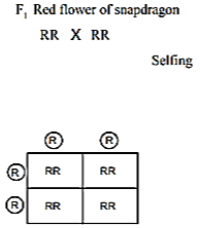
The snapdragon flower shows dominance. If a plant with red coloured flowers $(RR)$ is crossed with a plant with white coloured flower $(rr),$ the $F_1$ progeny shows $(Rr)$ the plant with pink coloured flowers.
Hence, in the condition in which the selfing of the plant bearing red flower, they have $RR$ genotype.
Image
Phenotype: All plants are bearing red coloured flowers.
Phenotypic ratio: $100\%$
Genotype: $RR$
Genotypic ratio: $RR \ (100\%).$
View full question & answer
Question 83 Marks
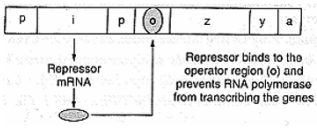
Look at the figure below depicting lac operon of E.coli.
Image
i. What could be the series of events when an inducer is present in the medium in which E.coli is growing?
ii. Name the inducer.
Answer
i. When the inducer is present, it combines with the repressor, coded by i gene.
  • After reacting with repressor it inactivates the repressor.
  • The repressor now cannot bind to the operator, hence the pathway for RA polymerase is open.
    The structural genes (z, y, a) are transcribed and the metabolism continues.
ii. Lactose is inducer.
View full question & answer
3 Marks Question - BIOLOGY STD 12 Science Questions - Vidyadip