Questions · Page 1 of 4

1 Marks Question

🎯

Test yourself on this topic

50 questions · timed · auto-graded

Question 11 Mark
Select the statement which explains best parasitism.
  1. One organism is benefited.
  2. Both the organisms are benefited.
  3. One organism is benefited, other is not affected.
  4. One organism is benefited, other is affected.
Answer
  1.  One organism is benefited, other is affected.

Parasitism is an interaction between two species in which one species (parasite) derives benefit while the other species (host) is harmed. For example, ticks and lice (parasites) present on the human body represent this interaction where in the parasites receive benefit (as they derive nourishment by feeding on the blood of humans). On the other hand, these parasites reduce host fitness and cause harm to the human body.
View full question & answer
Question 21 Mark
Define the following terms and give one example for each:
Commensalism
Answer
Commensalism: Commensalism is an interaction between two species in which one species gets benefited while the other remains unaffected. An orchid growing on the branches of a mango tree and barnacles attached to the body of whales are examples of commensalisms.
View full question & answer
Question 31 Mark
Define the following terms and give one example for each:
Camouflage
Answer
Camouflage: It is a strategy adapted by prey species to escape their predators. Organisms are cryptically coloured so that they can easily mingle in their surroundings and escape their predators. Many species of frogs and insects camouflage in their surroundings and escape their predators.
View full question & answer
Question 41 Mark
Define the following terms and give one example for each:
Mutualism
Answer
Mutualism: It is an interaction between two species in which both species involved are benefited. For example, lichens show a mutual symbiotic relationship between fungi and blue green algae, where both are equally benefited from each other.
View full question & answer
Question 51 Mark
Define the following terms and give one example for each:
Interspecific competition
Answer
Interspecific competition: It is an interaction between individuals of different species where both species get negatively affected. For example, the competition between flamingos and resident fishes in South American lakes for common food resources i.e., zooplankton.
View full question & answer
Question 61 Mark
Define the following terms and give one example for each:
Parasitism
Answer
Parasitism: It is an interaction between two species in which one species (usually smaller) gets positively affected, while the other species (usually larger) is negatively affected. An example of this is liver fluke. Liver fluke is a parasite that lives inside the liver of the host body and derives nutrition from it. Hence, the parasite is benefited as it derives nutrition from the host, while the host is negatively affected as the parasite reduces the host fitness, making its body weak.
View full question & answer
Question 101 Mark
Name the type of association that the genus Glomus exhibits with higher plants.
Answer
Symbiosis/Mycorrhizae/Mutualism.
View full question & answer
Question 111 Mark
Mention any two significant roles prediction plays in nature.
Answer
Conduits of energy transfer to the next trophic level/prey population is kept under control/helps in biological control/maintains species diversity.
View full question & answer
Question 121 Mark
Why is the polar region not suitable habitat for tiny hummingbirds?
Answer
When volume is considered surface area is large, loss of heat is more in cooler regions/difficult to generate more heat.
View full question & answer
Question 131 Mark
Very small animals are rarely found in polar regions. Give two reasons.
Answer
Small animals have larger surface area relative to their volume loose heat very fast, due to small size, expend much energy to generate body heat through metabolism.
View full question & answer
Question 141 Mark
What does nature’s carrying capacity for a species indicate?
Answer
(In nature) a given habitat has enough (limited) resources to support a maximum possible number, no further growth in population is possible
View full question & answer
Question 151 Mark
How do mycorrhizae help the plants to grow better?
Answer
Absorbs phosphorus, provide resistance to root borne pathogens, enhanced to tolerate salinity/drought.
View full question & answer
Question 161 Mark
Name the two intermediate hosts which the human liver fluke depends on to complete its life cycle so as to facilitate parasitization of its primary host.
Answer
Snail and Fish.
View full question & answer
Question 171 Mark
Give an example of an organism that enters ‘diapause’ and why.
Answer
(Many species of) Zooplankton, unfavourable condition.
View full question & answer
Question 191 Mark
If 8 individuals in a laboratory population of 80 fruit flies died in a week, then what would be the death rate for population for the said period?
Answer
0.1, individuals per fruitfly per week.
View full question & answer
Question 201 Mark
Name the world’s most problematic aquatic weed. What is the nature of the water body in which the weeds grow abundantly?
Answer
 Eicchornia crassipes/water hyacinth.

Stagnant water/Eutrophic/nutrient enriched water bodies/polluted with nutrients. 

View full question & answer
Question 211 Mark
What advantage does the sea anemone get in the sea anemone hermit crab facultative mutualism? Give an alternative term for this kind of mutualism.
Answer
Transport/ to reach new food sources, protocooperation.
View full question & answer
Question 221 Mark
Mention any two significant roles predation plays in nature.
Answer
  1. Predation helps to check the ecological balance in nature.
  2. Predation helps in maintaining species diversity as in abs.ce of predator there will be more interspecific competition.
View full question & answer
Question 231 Mark
What causes the annual variations in the distinct seasons?
Answer
Cause of annual variations in the distinct seasons:
  1. Tilt of the earth on its axis.
  2. Rotation of earth around the sun.
View full question & answer
Question 241 Mark
Name the two factors that cause the formation of major biomes.
Answer
  1. Variation in the intensity and duration of temperature.
  2. Variation in precipitation.
View full question & answer
Question 251 Mark
Give two examples of mutualism in living organisms.
Answer
  1. Lichens formed jointly by an alga and fungus.
  2. Termites harbouring cellulose digesting protozoans.
View full question & answer
Question 261 Mark
Name the two intermediate hosts on which human liver fluke depend to complete its life cycle.
Answer
Snail and fish.
View full question & answer
Question 271 Mark
Give an example where animal-plant interaction involves co-evolution.
Answer
  1. The mediterranean orchid, Ophrys and its pollinators (bumble bees and bees).
  2. The fig species and its pollinator wasp.
View full question & answer
Question 281 Mark
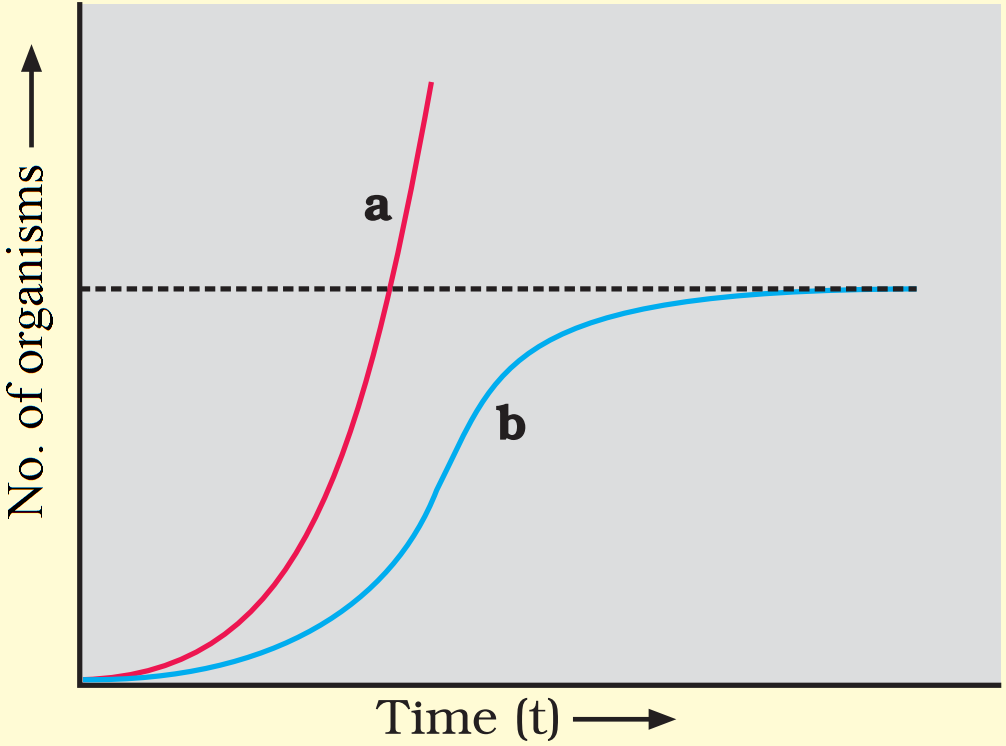
In the given population growth curve.

  1. What is the status of food and space in the curves (a) and (b)?
  2. In the absence of the predators, which curve (a) or (b) would appropriately depict the prey population?
Answer
  1. In the curve (a) there is unlimited supply while (b) there are limited sources.
  2. Curve (a).
View full question & answer
Question 291 Mark
When and why do some animals like snails go into aestivation?
Answer
  1. Summer.
  2. To survive from heat/ to escape from desiccation.
View full question & answer
Question 301 Mark
Define the following terms:
  1. Biotic community.
  2. Biome.
Answer
  1. Biotic community is defined as a group of different populations living at one place and interacting with one another in several ways.
  2. Biome is a major terrestrial biotic community characterised by distinctive live form, e.g., temperate deciduous forest, grassland etc.
View full question & answer
Question 311 Mark
Mention any two activities of animals which get cues from diurnal and seasonal variations in light intensity.
Answer
  1. Timing their foraging.
  2. Migratory activities.
  3. Reproduction.
View full question & answer
Question 321 Mark
Name the interactions in each of the following?
  1. Cuscuta growing on a shoe flower plant.
  2. Mycorrhizae living on the roots of higher plants.
  3. Clown fish living among the tentacles of sea anemone.
  4. Koyel laying her eggs in crow's nest.
Answer
  1. Parasitism.
  2. Mutualism.
  3. Commensalism.
  4. Brood parasitism.
View full question & answer
Question 331 Mark
Name the interaction in each of the following:
  1. Cuckoo lays her eggs in the crow's nest.
  2. Orchid grows on a mango tree.
  3. Ticks live on the skin of dogs.
  4. Sea anemone is often found on the shell of hermit crab.
Answer
  1. Brood parasitism.
  2. Commensalism.
  3. Ectoparasitism.
  4. Commensalism.
View full question & answer
Question 341 Mark
Define the following terms:
  1. Leaching.
  2. Photoperiodism.
Answer
  1. The removal or downward movement of soluble chemicals from soil by water is called leaching.
  2. The response of organism to number and duration of day lengths is called as photoperiodism.
View full question & answer
Question 351 Mark
Write four levels of biological organization which are basically concerned with ecology.
Answer
  1. Organisms.
  2. Populations.
  3. Communities.
  4. Biomes.
View full question & answer
Question 371 Mark
What does sigmoid growth curve of a population indicate?
Answer
Sigmoid growth curve of a population indicates following characteristics:
  1. Initially the growth is slow.
  2. The growth becomes rapid and the curve becomes steady due to environmental resistance.
View full question & answer
Question 381 Mark
What is meant by carrying capacity of the environment?
Answer
Carrying capacity is defined as the maximum number of individuals of a population that can be sustained by a given habitat or ecosystem.
View full question & answer
Question 391 Mark
Name the interaction that exists between sucker fish and shark.
Answer
Sucker fish and shark is commensalism.
View full question & answer
Question 411 Mark
  1. What is 'r' in the population equation given as: dN/ dt = rN
  2. How does the increase and the decrease in the value of r affect the population size?
Answer
  1. 'r' is the intrinsic rate of natural increase
  2. Increase in 'r' increases the population size while decrease in 'r' decreases the population size.
View full question & answer
Question 421 Mark
What is meant by ‘competitive release’?
Answer
Competitive release is a phenomenon in which a species whose distribution is restricted to a small geographical area because of the presence of a competitively superior species, is found to expand drastically when the competing species is removed.
View full question & answer
Question 431 Mark
Name two organisms (one plant and one animal) which breed only once in their lifetime.
Answer
Bamboo; Pacific Salmon Fish.
View full question & answer
Question 441 Mark
Define migration. Mention the types of migration.
Answer
Migration is a two-way movement of an animal group to other places for food, appropriate climate and other reasons. Migration is of three types:
  1. Daily.
  2. Seasonal.
  3. Periodic.
View full question & answer
Question 461 Mark
What do you understand by age-pyramid? Give the integral form of equation of exponential growth of a population.
Answer
Graphic representation of different age groups found in a population with pre reproductive groups at the base, reproductive groups in the middle and postreproductive groups at the top is called age-pyramid.
$-\text{N}_\text{t}=\text{N}_0\text{e}^{\text{rt}}$
View full question & answer
Question 471 Mark
Define Allen's rule.
Answer
Mammals from colder climates generally have shorter ears and limbs to minimize heat loss. This is called Allen's rule.
View full question & answer
Question 481 Mark
Name the two intermediate hosts on which the human liver fluke depends to complete its life cycle so as to facilitate parasitisation of its primary host.
Answer
The human liver fluke requires two intermediate hosts, i.e. freshwater snail and fish to complete its life cycle and facilitates parasitisation of its primary host.
View full question & answer
Question 491 Mark
Write one common feature among predation, parasitism and commensalism.
Answer
In all these, the interacting species live closely together and one of the species is benefitted.
View full question & answer
Question 501 Mark
What is meant by 'competitive release'?
Answer
Competitive release is a phenomenon in which a species whose distribution is restricted to a small geographical area because of the presence of a competitively superior species, is found to expand drastically when the competing species is removed.
View full question & answer
1 Marks Question - BIOLOGY STD 12 Science Questions - Vidyadip