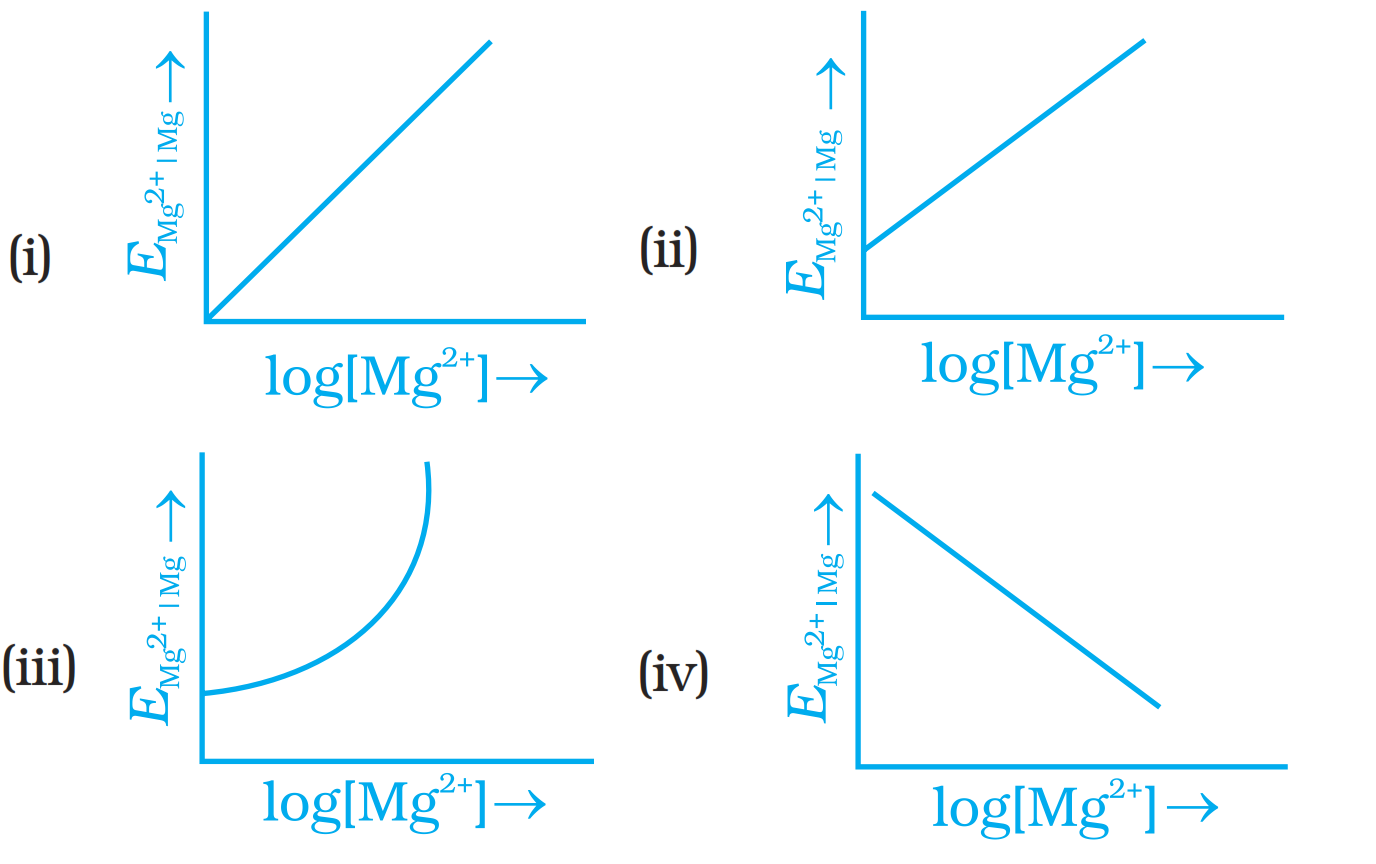
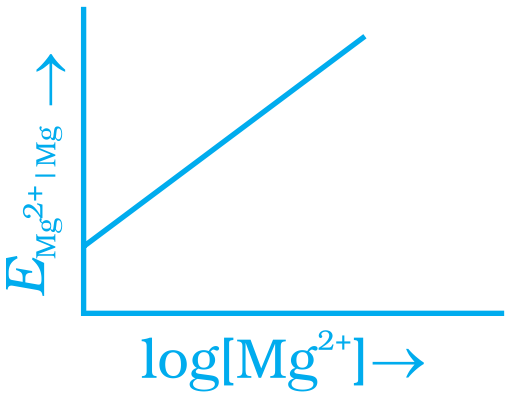
Why does the conductivity of a solution decrease with dilution?
Answer
The conductivity of a solution is the conductance of ions present in a unit volume of the solution. The number of ions (responsible for carrying current) decreases when the solution is diluted. As a result, the conductivity of a solution decreases with dilution.
How much electricity is required in coulomb for the oxidation of 1 mol of H2O to O2.
Answer
According to the question, $\text{H}_2\text{O}\ \rightarrow\ \text{H}_2\ +\ \frac{1}{2}\text{O}_2$ Now, we can write: $\text{O}_2\rightarrow\frac{1}{2}\text{O}_2+2\text{e}^-$ Electricity required for the oxidation of 1 mol of H2O to O2 = 2 F = 2 × 96487 C = 192974 C
Given the standard electrode potentials, K+/K = –2.93V, Ag+/Ag = 0.80V, Hg2+/Hg = 0.79V Mg2+/Mg = –2.37 V, Cr3+/Cr = –0.74V Arrange these metals in their increasing order of reducing power.
How much electricity in terms of Faraday is required to produce, 40.0g of Al from molten Al2O3.
Answer
According to the question, $\text{Al}^{3+}+3\text{e}^{-1}\ \rightarrow\ \text{Al}\\ \ \ \ \ \ \ \ \ \ \ \ \ \ \ \ \ \ \ \ \ \ \ \ \ \ \ \ \ \ 27\text{g}$ Electricity required to produce 27g of Al = 3 F Therefore, electricity required to produce 40 g of Al $=\frac{3\times40}{27}\text{F}=4.44\ \text{F}$
Can you store copper sulphate solutions in a zinc pot?
Answer
Zn being more reactive than Cu, displaces Cu from CuSO4 solution as follows: Zn (s) + CuSO4 (aq) → ZnSO4(ag) + Cu (s) In terms of EMF, we have Zn|Zn2+||Cu2+|Cu $\text{E}^\circ_\text{cell}=\text{E}^\circ_{\text{Cu}^{2+}\text{Cu}}-\text{E}^\circ_{\text{Zn}^{2+}/\text{Zn}}$ = 0.34 V - (-0.76 V) = 1.10 V As $\text{E}^\circ_\text{cell}$ is positive, reaction takes place, i.e., Zn reacts with copper and hence, we cannot store CuSo4 solution in zinc pot.
Consider the reaction: Cr2O72– + 14H+ + 6e– → 2Cr3+ + 8H2O What is the quantity of electricity in coulombs needed to reduce 1 mol of Cr2O72–?
Answer
Cr2O72– → 2Cr3+ 2Cr6+ + 6e– → 2Cr3+ In given equation there are 6 electrons are required so that n = 6 Use the formula Required charge = nF Plug the values in this formula we get Required charge = 6 × 96487 Coulombs = 578922 Coulombs = 5.79 × 10⁵ Coulombs
How much electricity in terms of Faraday is required to produce, 20.0 g of Ca from molten CaCl2.
Answer
According to the question, $\text{Ca}^{2+}+2\text{e}^{-1}\ \rightarrow\ \text{Ca}\\ \ \ \ \ \ \ \ \ \ \ \ \ \ \ \ \ \ \ \ \ \ \ \ \ \ \ \ \ \ 40\text{g}$ Electricity required to produce 40 g of calcium = 2 F Therefore, electricity required to produce 20 g of calcium $\frac{2\times20}{40}\text{F}=1\text{F}$
Out of zinc and tin, whose coating is better to protect iron objects?
Answer
Zink is better than tin in protecting iron from corrosion because zink has more affinity to oxygen than tin. When is coated on iron layer then it reacts with oxygen if air to form a protective layer of zink oxide on iron which prevent the further reaction of iron with oxygen, and thus preventing the process of rusting. But in the case of tin, it(tin) does not react with oxygen thus it is less effective in preventing rusting.
ZnCl2 combines with the NH3 produced to form the complex salt [Zn(NH3)2Cl2] otherwise the pressure developed due to NH3 would crack the seal of the cell.
Cell constant is the ratio of distance (l) between electrodes and area of cross-section (A). It is denoted by $\frac{\text{l}}{\text{A}}.$ Its unit is cm-1.
Value of standard electrode potential for the oxidation of Cl- ions is more positive than that of water, even then in the electrolysis of aqueous sodium chloride, why is Cl- oxidised at anode instead of water?
Answer
Under the conditions of electrolysis of aqueous sodium chloride, oxidation of water at anode requires overpotential hence Cl- is oxidised instead of water.
Why does a galvanic cell become dead after some time?
Answer
As the reaction proceeds, concentration of ions in anodic half keeps on increasing while in the cathodic half it keeps on decreasing. Hence, their electrode potentials also keep on changing till ultimately they become equal and then e.m.f. of the cell becomes zero.
Using the E° values of A and B, predict which is better for coating the surface of iron $\Big[\text{E}^{\circ}_{\text{Fe}^{2+}/\text{Fe}}=-0.44\text{V}\Big]$ to prevent corrosion and why? Given: $\Big[\text{E}^{\circ}_{\text{A}^{2+}/\text{A}}=-2.37\text{V, E}^{\circ}_{\text{B}^{2+}/\text{B}}=-0.14\text{V}\Big]$
Answer
A, as its standard reduction potential is less than B, therefore, it will undergo oxidation more easily than B.
Why electrolysis of NaBr and NaI gives Br2 and I2 respectively while that of NaF gives O2 instead of F2?
Answer
Br- and I- ions have higher oxidation potentials than water. Hence, they are more easily oxidised. But F- ions have lower oxidation potential than H2O. So, H2O is easily oxidised to give O2 gas.
Why is it not possible to measure the single electrode potential?
Answer
Oxidation or reduction cannot take place alone. Moreover, electrode potential is a relative tendency and can be measured with respect to a reference electrode only.
Write Nernst equation for the general cell reaction, $\text{aA}+\text{bB}\xrightarrow{ \ \ \ \ \ \ }\text{xX + yY}.$
Answer
If n moles of electrons are transferred, Nernst equation is: $\text{E}_{\text{cell}}=\text{E}^{\circ}_{\text{cell}}-\frac{\text{RT}}{\text{nF}}\text{In}\frac{[\text{X}]^{\text{z}}[\text{Y}]^{\text{y}}}{[\text{A}]^{\text{a}}[\text{B}]^{\text{b}}}$
How can the reduction potential of an electrode be increased?
Answer
$\text{M}^{\text{n}+}+\text{ne}^-\xrightarrow{ \ \ \ \ \ \ \ }\text{M},$ $\frac{\text{E}_{\text{M}^{\text{n}+}}}{\text{M}}=\frac{\text{E}^{\circ}_{\text{M}^{\text{n}+}}}{\text{M}}-\frac{\text{RT}}{\text{nF}}\text{In}\frac{1}{[\text{M}^{\text{n}+}]}$ $=\frac{\text{E}^{\circ}_{\text{M}^{\text{n}+}}}{\text{M}}+\frac{\text{RT}}{\text{nF}}\text{In}[\text{M}^{\text{n}+}]$ Thus, electrode potential can be increased by increasing the metal ion concentration.
What is the necessity to use a salt bridge in a Galvanic cell?
Answer
To complete the inner circuit and to maintain the electrical neutrality of the electrolytic solutions of the half-cells we use a salt bridge in a Galvanic cell.