Questions

Case study (4 Marks)

🎯

Test yourself on this topic

4 questions · timed · auto-graded

Question 14 Marks
What is the most suitable pKa value of the substituted propylamine formed with substituent "X" with electronegativity 3.0
(i)10.67 (ii)10.08 (iii) 10.15 (iv)11.10
Answer
(iii) 10.15
View full question & answer
Question 24 Marks
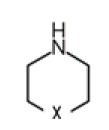
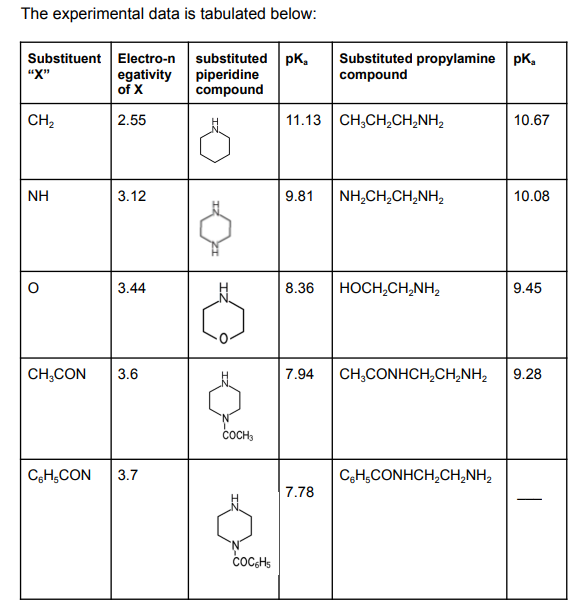
Amines are basic in nature. The $pK_b$ value is a measure of the basic strength of an amine. Lower the value of $pK_b$ more basic is the amine. The effect of substituent on the basic strength of amines in aqueous solution was determined using titrations. The substituent $"X"$ replaced $"-CH_2"$ group in piperidine $($ compound $1)$ and propylamine $CH_3CH_2CH_2NH_2, ($compound $2).$
Compound $1:$
Image
Compound $2: HXCH_2CH_2NH_2$
Image
(source: Hall Jr, $H. K. (1956).$ Field and inductive effects on the base strengths of amines. Journal of the American Chemical Society, $78(11), 2570-2572.) $
Study the above data and answer the following questions:
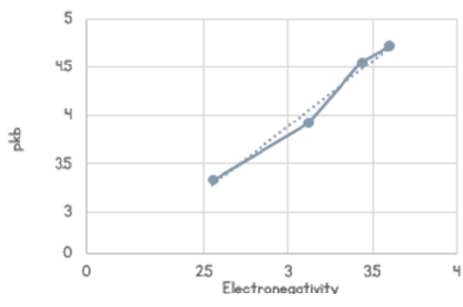
$a.$ Plot a graph between the electronegativity of the substituent vs $pK_b$ value of the corresponding substituted propyl amine $($ given that $pK_a + pK_b =14).$ Is there any relation between the electronegativity of the substituent and its basic strength?
$b.$ The electronegativity of the substituent $"C6H5CON\ "$ is $3.7,$ what is the expected pKa value of compound $C_6H_5CONHCH_2CH_2NH_2?$
$(i) \ 9.9 \ (ii) \ 9.5 \ (iii) \ 9.3 \ (iv) \ 9.1$
$c.$ The pKa value of the substituted piperidine formed with substituent $"X\ "$ is found to be $8.28.$ What is the expected electronegativity of $"X\ "$
$(i)\ 3.5 \ (ii)\ 3.4 \ (iii)\ 3.8\ (iv) \ 3.1$
Answer
Image
.......... Is the line of best fit The pKb increases with an increase in the electronegativity of the substituent, therefore the basic strength decreases with an increase in the electronegativity of the substituent
$b. (iv) \ 9.1$
$c. (i) \ 3.5$
View full question & answer
Question 34 Marks
What change in the concentration of H₂ will triple the rate of reaction?
(c). Suppose a reaction between A and B, was experimentally found to be first order with respect to both A and B. So the rate equation is:
Rate = k[A][B]
Which of these two mechanisms is consistent with this experimental finding? Why?
Mechanism 1
A → C + D (slow)
B+C → E (fast)
Mechanism 2
A+B →C + D (slow)
C → E (fast)
Answer
$\begin{aligned} & \text { Rate }=\mathrm{k}\left[\mathrm{H}_2\right]\left[\mathrm{Br}_2\right]^{1 / 2} \text { If conc of } \mathrm{Br}_2 \text { is tripled } \\ & \text { Rate' }=3 \mathrm{Rate}=\mathrm{k}\left[\mathrm{xH}_2\right]\left[\mathrm{Br}_2\right]^{1 / 2} \\ & 3 \text { Rate }=\mathrm{k}\left[\mathrm{xH}_2\right]\left[\mathrm{Br}_2\right]^{1 / 2} \\ & \mathrm{x}=3 \text {, the concentration of } \mathrm{H}_2 \text { is tripled }\end{aligned}$
c. The slowest step is the rate-determining step. From mechanism 2, Rate = k [A] [B] while from mechanism 1 Rate = k [A] Therefore mechanism 2, is consistent with the experimental finding
View full question & answer
Question 44 Marks
Dependence of the rate of reaction on the concentration of reactants, temperature, and other factors is the most general method for weeding out unsuitable reaction mechanisms. The term mechanism means all the individual collisional or elementary processes involving molecules $($atoms, radicals, and ions included$)$ that take place simultaneously or consecutively to produce the observed overall reaction. For example, when hydrogen gas reacts with bromine, the rate of the reaction was found to be proportional to the concentration of $H_2$ and to the square root of the concentration of $Br_2.$ Furthermore, the rate was inhibited by increasing the concentration of $HBr$ as the reaction proceeded. These observations are not consistent with a mechanism involving bimolecular collisions of a single molecule of each kind. The currently accepted mechanism is considerably more complicated, involving the dissociation of bromine molecules into atoms followed by reactions between atoms and molecules: It is clear from this example that the mechanism cannot be predicted from the overall stoichiometry. $($source: Moore, $J. W.,$ Pearson, $R. G. (1981).$ Kinetics and mechanism. John Wiley Sons.$)$
$(a).$ Predict the expression for the rate of reaction and order for the following:
$H_2 + Br_2 \rightarrow 2 HBr$
What are the units of rate constant for the above reaction?
$(b).$ How will the rate of reaction be affected if the concentration of $Br_2$ is tripled?
Answer
$ \text { a. Rate }=\mathrm{k}\left[\mathrm{H}_2\right]\left[\mathrm{Br}_2\right]^{1 / 2}$
$ \text { order }=3 / 2$
$ \text { units of } \mathrm{k}=\frac{\mathrm{molL}^{-1}}{\mathrm{~mol}^{3 / 2} \mathrm{~s}^{-1} \mathrm{~L}^{-3 / 2}}=\mathrm{mol}^{-1 / 2} \mathrm{~L}^{1 / 2} \mathrm{~s}^{-1}$
$ \text { b. Rate }=\mathrm{k}\left[\mathrm{H}_2\right]\left[\mathrm{Br}_2\right]^{1 / 2} \text { If conc of } \mathrm{Br}_2 \text { is tripled }$
$ \text { Rate' }=\mathrm{k}\left[\mathrm{H}_2\right]\left[3 \mathrm{Br}_2\right]^{1 / 2}$
$ \text { Rate }=\sqrt{3} \mathrm{k}\left[\mathrm{H}_2\right]\left[\mathrm{Br}_2\right]^{1 / 2}$
$ \text { Rate' }=\sqrt{3 } \text { Rate }$
View full question & answer
Case study (4 Marks) - Chemistry STD 12 Science Questions - Vidyadip