MCQ 11 Mark
The displacement of a particle in time $ t$ is given by $s = 2{t^2} - 3t + 1$. The acceleration is
Answerc
(c) $s = 2{t^2} - 3t + 1;\,\,\,\therefore \frac{{ds}}{{dt}} = v = 4t - 3$
At $t = 0{\left( {\frac{{ds}}{{dt}}} \right)_{t.0}} = - 3 = {v_1}$
Now, at $t = 1$, we get ${\left( {\frac{{ds}}{{dt}}} \right)_{t = 1}} = 4 - 3 = 1 = {v_2}$
Hence rate of velocity $ = {v_2} - {v_1} = 1 - ( - 3) = 4$
Aliter : Given that $s = 2{t^2} - 3t + 1$
$\frac{{ds}}{{dt}} = 4t - 3 $ ( velocity), Again $\frac{{{d^2}s}}{{d{t^2}}} = 4$ (acceleration).
View full question & answer→MCQ 21 Mark
The equation of motion of a car is $s = {t^2} - 2t$, where $t$ is measured in hours and $s$ in kilometers. When the distance travelled by the car is $15\,km$, the velocity of the car is ......... $km/h$.
Answerd
(d) Given equation $s = {t^2} - 2t$ .....$(i)$
and $\frac{{ds}}{{dt}} = $ velocity $2t - 2 $ .....$(ii)$
Put $s = 15$ in $(i),$ we get ${t^2} - 2t - 15 = 0$
or $(t - 5)(t + 3) = 0$
$\therefore t = 5$
Hence velocity of car $ = v = 2(5) - 2 = 8\,\,km/h$.
View full question & answer→MCQ 31 Mark
A stone moving vertically upwards has its equation of motion $s = 490t - 4.9{t^2}$. The maximum height reached by the stone is
AnswerCorrect option: A. $12250$
a
(a) Here $u = 490,\,\;\;g = 9.8$ (downward)
Therefore, $S = \frac{{{u^2}}}{{2g}} = 12250.$
View full question & answer→MCQ 41 Mark
The edge of a cube is increasing at the rate of $5 \, cm/\sec .$ How fast is the volume of the cube increasing when the edge is $12\,cm$ long ......... $c{m^3}/\sec $.
AnswerCorrect option: B. $2160$
b
(b) Let velocity $v = 5\,cm/\sec $
(Increasing the rate/sec is called the velocity)
$\frac{{da}}{{dt}} = 5$ .....$(i)$
Where $ a$ is distance and $t$ is time.
But if $a$ is edge of a cube, then $V = {a^3}$
Differentiating w.r.t. time $t,$ so
$\frac{{dV}}{{dt}} = 3{a^2}\frac{{da}}{{dt}} = 3{a^2}.5\, = \,15{a^2} = 15 \times {(12)^2}$
$ = 2160\,\,c{m^3}/\sec $ ( $\because$ edge $a = 12\,cm)$.
View full question & answer→MCQ 51 Mark
If the law of motion in a straight line is $s = {1 \over 2}v\,t,$ then acceleration is
- ✓
- B
Proportional to $ t$
- C
Proportional to $v$
- D
Proportional to $ s$
Answera
(a) $s = \frac{1}{2}vt$ ==> $2s = vt$==> $2\frac{{ds}}{{dt}} = v + t.\frac{{dv}}{{dt}}$
==> $2\frac{{{d^2}s}}{{d{t^2}}} = \frac{{dv}}{{dt}} + t.\frac{{{d^2}v}}{{d{t^2}}} + \frac{{dv}}{{dt}}$
But $\frac{{dv}}{{dt}} =$ acceleration $(a)$
==> $2a = a + t.\frac{{da}}{{dt}} + a$ ==> $\frac{{da}}{{dt}} = 0$ or $xy = 4 \times 4 = 16$
But for whole notation $t = 0$ is impossible so that $\frac{{da}}{{dt}} = 0$ $i.e.,$ $a$ is constant.
View full question & answer→MCQ 61 Mark
A point moves in a straight line during the time $t = 0$ to $t = 3$ according to the law $s = 15t - 2{t^2}$. The average velocity is
Answerb
(b) Motion of a particle $s = 15t - 2{t^2}$
Therefore, velocity $\frac{{ds}}{{dt}} = 15 - 4t$
==> ${\left( {\frac{{ds}}{{dt}}} \right)_{t = 0}} = 15$ and ${\left( {\frac{{ds}}{{dt}}} \right)_{t = 3}} = 3$
Therefore, average $ = \frac{{15 + 3}}{2} = 9$.
View full question & answer→MCQ 71 Mark
The equation of motion of a stone thrown vertically upward from the surface of a planet is given by $s = 10\,\,t - 3{t^2}$, and the units of $s$ and $t$ are $cm$ and $sec$ respectively. The stone will return to the surface of the planet after
- ✓
${{10} \over 3}\sec $
- B
${5 \over 3}\sec $
- C
${{20} \over 3}\sec $
- D
${5 \over 6}\sec $
AnswerCorrect option: A. ${{10} \over 3}\sec $
a
(a) $\frac{{ds}}{{dt}} = 10 - 6t = v$
But $v = 0$ (at maximum height), $\therefore t = \frac{{10}}{6}$
Therefore, the stone will return in $2 \times \frac{{10}}{6} = \frac{{10}}{3}\sec .$
View full question & answer→MCQ 81 Mark
The equations of motion of two stones thrown vertically upwards simultaneously are $s = 19.6\,t - 4.9\,{t^2}$ and $s = 9.8\,t - 4.9\,{t^2}$ respectively and the maximum height attained by the first one is $h.$ When the height of the first stone is maximum, the height of the second stone will be
Answerd
(d) The time taken by first stone to secure maximum height =$t = \frac{u}{g} = \frac{{19.6}}{{9.8}} = 2sec$.
The time taken by second stone to secure maximum height is, $t = \frac{{9.8}}{{9.8}} = 1\,\,sec. $
Therefore, in $2\, sec$, second stone will come back to the ground. Hence height $s = a{t^2} + bt + 6$.
View full question & answer→MCQ 91 Mark
The maximum height is reached in $5$ seconds by a stone thrown vertically upwards and moving under the equation $10s = 10ut -49{t^2}$, where $ s$ is in metre and $t$ is in second. The value of $u$ is ........ $m/\sec $
Answerb
(b) Given equation is $\frac{{dy}}{{dt}} = - \frac{{16}}{6} = - \frac{8}{3}cm/\sec .$ or $s = ut - 4.9{t^2}$
==> $\frac{{ds}}{{dt}} = u - 9.8t = v$
When stone reached the maximum height, then $v = 0$
==> $u - 9.8t = 0 \Rightarrow u = 9.8\,t$
But time $t = 5\,sec$
So the value of $u = 9.8 \times 5 = 49.0\,m/sec$
Hence initial velocity $ = 49\,m/sec.$
View full question & answer→MCQ 101 Mark
The equation of motion of a particle moving along a straight line is $s = 2$${t^3} - 9{t^2} + 12t$, where the units of $s $ and $ t$ are $cm$ and $sec$. The acceleration of the particle will be zero after
- ✓
${3 \over 2}\,sec$
- B
${2 \over 3}sec$
- C
${1 \over 2}sec$
- D
AnswerCorrect option: A. ${3 \over 2}\,sec$
a
(a) $\frac{{ds}}{{dt}} = 6{t^2} - 18t + 12$
Again $\frac{{{d^2}s}}{{d{t^2}}} = 12t - 18 =$ acceleration
If acceleration becomes zero, then $0 = 12t - 18$ ==> $t = \frac{3}{2}\sec .$
Hence acceleration will be zero after $\frac{3}{2}\,sec.$
View full question & answer→MCQ 111 Mark
A particle is moving in a straight line according to the formula $s = {t^2} + 8t + 12.$ If $s$ be measured in metre and $ t $ be measured in second, then the average velocity of the particle in third second is .......... $m/\sec $.
Answerb
(b) Average velocity in third second $=$ Distance travelled in third second.
$=$ Distance travelled in $3\, sec -$ Distance travelled in $2\, sec.$
$ = (9 + 24 + 12) - (4 + 16 + 12) = 45 - 32 = 13$.
View full question & answer→MCQ 121 Mark
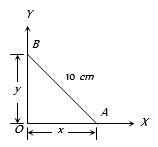
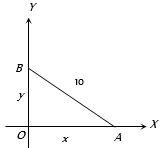
$A $ $10\,cm$ long rod $ AB$ moves with its ends on two mutually perpendicular straight lines $OX$ and $OY$ . If the end $ A$ be moving at the rate of $2\,cm/\sec $, then when the distance of $A$ from $ O $ is $8\,cm$, the rate at which the end $B$ is moving, is
- ✓
${8 \over 3} \,cm/\sec $
- B
${4 \over 3} \,cm/\sec $
- C
${2 \over 9} \,cm/\sec $
- D
AnswerCorrect option: A. ${8 \over 3} \,cm/\sec $
a
(a) By figure, ${x^2} + {y^2} = 100$ .....$(i)$
$ \Rightarrow 2x\frac{{dx}}{{dt}} + 2y\frac{{dy}}{{dt}} = 0$ .....$(ii)$
$x = 8$
Therefore by $(i)$ and $(ii),$
$\frac{{dy}}{{dt}} = - \frac{{16}}{6} = - \frac{8}{3}cm/\sec .$
$ = \frac{8}{3}cm/\sec $.
View full question & answer→MCQ 131 Mark
If the radius of a circle increases from $3 \,\, cm$ to $3.2 \,\, cm,$ then the increase in the area of the circle is
- ✓
$1.2\pi \,\,c{m^2}$
- B
$12\pi \,\,c{m^2}$
- C
$6\pi \,\,c{m^2}$
- D
AnswerCorrect option: A. $1.2\pi \,\,c{m^2}$
a
(a) We know that area of a circle is $A = \pi {R^2}$
$\therefore \frac{{dA}}{{dt}} = 2\pi R\frac{{dR}}{{dt}} = 1.2\pi \,c{m^2}$.
View full question & answer→MCQ 141 Mark
A particle is moving on a straight line, where its position $s$ (in metre) is a function of time $ t$ (in seconds) given by $s = a{t^2} + bt + 6,t \ge 0$. If it is known that the particle comes to rest after $4$ seconds at a distance of $16$ metre from the starting position $(t = 0)$, then the retardation in its motion is
AnswerCorrect option: B. ${5 \over 4}m/{\sec ^2}$
b
(b) Given equation $s = a{t^2} + bt + 6$ ……$(i)$
Differentiating w.r.t. time, we get
Velocity $(v)= 2at + b$ ……$(ii)$
After $4\,sec,$ $v = 0$ and distance $s = 16\,metres$
$\therefore 0 = 2a \times 4 + b \Rightarrow 8a + b = 0$ …..$(iii)$
and $16 = 16a + 4b + 6$==> $16 = 16a + 4( - 8a) + 6$
$\therefore $ $a = - \frac{5}{8}$
But retardation in its motion is, $2a = \frac{{ - 5}}{4}m/{\sec ^2}$
$\therefore $ Retardation $ = \frac{5}{4}m/{s^2}$ (Retardation itself means $-ve$).
View full question & answer→MCQ 151 Mark
A particle is moving in a straight line according as $s = 45\,t + 11{t^2} - {t^3}$ then the time when it will come to rest, is ......... $\sec$.
- A
$-9 $
- B
${5 \over 3}$
- ✓
$9$
- D
$ - {5 \over 3}$
Answerc
(c) $\frac{{ds}}{{dt}} = $velocity $ = 45 + 22t - 3{t^2}$
When particle will come to rest, then $v = 0$
==> $3{t^2} - 22t - 45 = 0 \Rightarrow t = 9,\,\,\left( {{\rm{since}}\,\,{\rm{t}} \ne - \frac{5}{3}} \right)$.
View full question & answer→MCQ 161 Mark
A ball thrown vertically upwards falls back on the ground after $6$ second. Assuming that the equation of motion is of the form $s = ut - 4.9{t^2}$, where s is in metre and $t$ is in second, find the velocity at $t = 0$ .......... $m/s$.
AnswerCorrect option: C. $29.4$
c
(c) Velocity of ball $(v) =\frac{{ds}}{{dt}} = $$u - 9.8\,t$
Here terminal velocity $v = 0$ and $t = 3\,sec$
$u = 9.8(3) = 29.4 \,m/sec$.
View full question & answer→MCQ 171 Mark
Radius of a circle is increasing uniformly at the rate of $3\,cm/\sec .$ The rate of increasing of area when radius is $10\,cm$, will be
- A
$\pi \,c{m^2}/s$
- B
$2\pi \,c{m^2}/s$
- C
$10\pi \,c{m^2}/s$
- ✓
Answerd
(d) $\frac{{dr}}{{dt}} = 3$, we have $S = \pi {r^2} \Rightarrow \frac{{dS}}{{dt}} = 2\pi r\frac{{dr}}{{dt}}$
==> ${\left( {\frac{{dS}}{{dt}}} \right)_{r = 10}} = 2.\pi \times 10 \times 3 = 60\,\pi \,c{m^2}/sec.$
View full question & answer→MCQ 181 Mark
The motion of stone thrown up vertically is given by $s = 13.8t - 4.9{t^2}$, where $s$ is in metre and $t $ is in seconds. Then its velocity at $t = 1$ second is ........ $m/s$
Answerc
(c) $s = 13.8t - 4.9{t^2}$
Its velocity $v = \frac{{ds}}{{dt}} = 13.8 - 9.8\,t$
Hence ${\left( {\frac{{ds}}{{dt}}} \right)_{t = 1}} = 13.8 - 9.8 \times 1 = 4.0 = 4\,m/\sec .$
View full question & answer→MCQ 191 Mark
A particle is moving in a straight line. Its displacement at time $t$ is given by $s = - 4{t^2} + 2t$, then its velocity and acceleration at time $t = {1 \over 2}$ second are
- ✓
$-2, -8$
- B
$2, 6$
- C
$-2, 8$
- D
$2, 8$
AnswerCorrect option: A. $-2, -8$
a
(a) Displacements $s = - 4{t^2} + 2t$
Now velocity $v = - 8t + 2$ and its acceleration $a = - 8$
So ${\left( {\frac{{ds}}{{dt}}} \right)_{t = 1/2}} = - 8 \times \frac{1}{2} + 2 = - 2$ and
${\left( {\frac{{{d^2}s}}{{d{t^2}}}} \right)_{t = 1/2}} = - 8$.
View full question & answer→MCQ 201 Mark
If the distance travelled by a point in time $ t $ is $s = 180t - 16{t^2}$, then the rate of change in velocity is ......... $unit$
Answerc
(c) $\frac{{{d^2}s}}{{d{t^2}}} = - 32\,unit.$
View full question & answer→MCQ 211 Mark
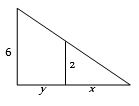
A man $ 2 $ metre high walks at a uniform speed $5$ metre/hour away from a lamp post $ 6$ metre high. The rate at which the length of his shadow increases is
- A
$5 \,m/h$
- ✓
${5 \over 2}$ $m/h$
- C
${5 \over 3}$ $m/h$
- D
${5 \over 4}$ $m/h$
AnswerCorrect option: B. ${5 \over 2}$ $m/h$
b
(b) $\frac{{dy}}{{dt}} = 5,\;\;\;\frac{{dx}}{{dt}} = $
From figure, $\frac{x}{2} = \frac{{x + y}}{6} \Rightarrow 4x = 2y \Rightarrow x = \frac{1}{2}y$
Hence $\frac{{dx}}{{dt}} = \frac{1}{2}\frac{{dy}}{{dt}} = \frac{5}{2}metre/hour$.
View full question & answer→MCQ 221 Mark
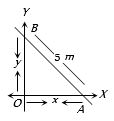
A ladder $5\ m$ in length is resting against vertical wall. The bottom of the ladder is pulled along the ground away from the wall at the rate of $1.5\,m/\sec $. The length of the highest point of the ladder when the foot of the ladder $4.0\,m$ away from the wall decreases at the rate of .......... $m/sec$
Answera
(a) According to fig. ${x^2} + {y^2} = 25$ .....$(i)$
Differentiate $(i)$ $w.r.t.$ $t,$ we get
$2x\frac{{dx}}{{dt}} + 2y\frac{{dy}}{{dt}} = 0$ …..$(ii)$
Here $x = 4$ and $\frac{{dx}}{{dt}} = 1.5$
From $(i),$ ${4^2} + {y^2} = 25 \Rightarrow y = 3$
$\therefore $ From $(ii),$ $2(4)(1.5) + 2(3)\frac{{dy}}{{dt}} = 0$
So, $\frac{{dy}}{{dt}} = - 2\,m/\sec $
Hence, length of the highest point decreases at the rate of $2 \,m/sec.$
View full question & answer→MCQ 231 Mark
If by dropping a stone in a quiet lake a wave moves in circle at a speed of $3.5 \,cm/sec,$ then the rate of increase of the enclosed circular region when the radius of the circular wave is $10$ $cm,$ is ......... $c{m^2}/sec$. $\left( {\pi = {{22} \over 7}} \right)$
Answera
(a) Given the rate of increasing the radius $ = \frac{{dr}}{{dt}} = 3.5\,cm/sec$ and$r = 10\,cm$
Area of circle $ = \pi {r^2}$, $A = \pi {r^2}$
==> $\frac{{dA}}{{dt}} = 2\pi r.\frac{{dr}}{{dt}}$==> $\frac{{dA}}{{dt}} = 2\pi \times 10 \times 3.5$
==> $\frac{{dA}}{{dt}} = 220c{m^2}/sec$.
View full question & answer→MCQ 241 Mark
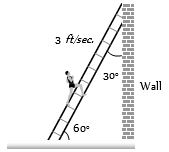
A ladder is resting with the wall at an angle of ${30^o}$. A man is ascending the ladder at the rate of $ 3 \,ft/sec$. His rate of approaching the wall is
AnswerCorrect option: B. ${3 \over 2}\,ft/sec$
b
(b) His rate of approaching the wall $ = 3 \times \cos 60^\circ = \frac{3}{2} \, ft/sec$.
View full question & answer→MCQ 251 Mark
If the edge of a cube increases at the rate of $60\, cm$ per second, at what rate the volume is increasing when the edge is $ 90\, cm$ .......... $cu\, cm \,per\, sec$
- A
$486000$
- ✓
$1458000 $
- C
$43740000$
- D
AnswerCorrect option: B. $1458000 $
b
(b) $\frac{{da}}{{dt}} = 60\,cm/sec,$ where $a $ is edge and $ t$ is time.
$V = {a^3}$.
$\therefore \frac{{dV}}{{dt}} = 3{a^2}\frac{{da}}{{dt}} = 3{a^2} \times 60 = 180{a^2} = 180 \times {(90)^2}$
$ = 1458000 \, c{m^3}/sec$.
View full question & answer→MCQ 261 Mark
If the distance $‘s’$ traveled by a particle in time $ t$ is $s = a\sin t + b\cos 2t$, then the acceleration at $ t = 0$ is
Answerd
(d) Given $s = a\sin t + b\cos 2t$
$\therefore $ $\frac{{ds}}{{dt}} = a\cos t - 2b\sin 2t$
$\frac{{{d^2}s}}{{d{t^2}}} = - a\sin t - 4b\cos 2t$
At $t = 0$, $\frac{{{d^2}s}}{{d{t^2}}} = - a\sin 0^\circ - 4b\cos 0^\circ = - 4b$.
View full question & answer→MCQ 271 Mark
A particle moves so that $S = 6 + 48t - {t^3}$. The direction of motion reverses after moving a distance of
Answerc
(c) $S = 6 + 48t - {t^3}$
$v = \frac{{dS}}{{dt}} = 0 + 48 - 3{t^2}$
when direction of motion reverses, $v = 0$
$48 - 3{t^2} = 0$ $ \Rightarrow $ $t = - 4,\;4$;
${(S)_4} = 6 + 192 - 64$ $i.e.,$ $S = 134$.
View full question & answer→MCQ 281 Mark
If the volume of a spherical balloon is increasing at the rate of $ 900$ $cm^3$ $per\, sec$ , then the rate of change of radius of balloon at instant when radius is $ 15\,cm$ [ in $cm/sec$ ]
- A
${{22} \over 7}$
- B
$22$
- ✓
${7 \over {22}}$
- D
AnswerCorrect option: C. ${7 \over {22}}$
c
(c) $V = \frac{4}{3}\pi {r^3}$
Differentiate with respect to $t,$
$\frac{{dV}}{{dt}} = \frac{4}{3}\pi 3{r^2}.\frac{{dr}}{{dt}}$ ==> $\frac{{dr}}{{dt}} = \frac{1}{{4\pi {r^2}}}.\frac{{dV}}{{dt}}$
$\frac{{dr}}{{dt}} = \frac{1}{{4 \times \pi \times 15 \times 15}} \times 900$
$ \Rightarrow $ $\frac{{dr}}{{dt}} = \frac{1}{\pi } = \frac{7}{{22}}$.
View full question & answer→MCQ 291 Mark
If the path of a moving point is the curve $x = at$, $y = b\sin at$, then its acceleration at any instant
AnswerCorrect option: C. Varies as the distance from the axis of $y$
c
(c) $\frac{{dx}}{{dt}} = {v_x} = a \Rightarrow \frac{{{d^2}x}}{{d{t^2}}} = 0 = {a_x}$
${a_x}$ is acceleration in $x-$ axis
$\frac{{{d^2}y}}{{d{t^2}}} = - b{a^2}\sin at \Rightarrow {a_y} = - {a^2}y$
Hence, ${a_y}$ changes as $ y $ changes.
View full question & answer→MCQ 301 Mark
If the rate of increase of area of a circle is not constant but the rate of increase of $(perimeter)$ is constant, then the rate of increase of area varies
- A
As the square of the perimeter
- B
Inversely as the perimeter
- ✓
- D
Answerc
(c) Perimeter $P = 2\pi r$
$\frac{{dP}}{{dt}} = 2\pi .\,\frac{{dr}}{{dt}}$ and $A = \pi {r^2}$
$\frac{{dA}}{{dt}} = 2\pi r.\,\,\frac{{dr}}{{dt}}$
==> $\frac{{dA}}{{dt}} = \frac{{dP}}{{dt}} \times r$==> $\frac{{dA}}{{dt}} \propto r$.
View full question & answer→MCQ 311 Mark
A stone thrown vertically upwards rises $ ‘s’$ metre in $t $ seconds, where $s = 80t - 16{t^2}$, then the velocity after $2 $ seconds is .......... $m\, per\, sec$
Answerb
(b) $s = 80 - 16{t^2}$, $\frac{{ds}}{{dt}} = v = 80 - 32t$
${(v)_{t = 2}} = 80 - 64 = 16\,m/sec$.
View full question & answer→MCQ 321 Mark
A particle moves along a straight line so that its distance $ s $ in time $ t$ sec is $s = t + 6{t^2} - {t^3}$. After what time is the acceleration zero .......... $\sec$.
Answera
(a) $s = t + 6{t^2} - {t^3}$
==> $\frac{{ds}}{{dt}} = 1 + 12t - 3{t^2}$ ==> $v = 5\,cm/\sec $
==> $\frac{{{d^2}s}}{{d{t^2}}} = 0$ ==> $12 - 6t = 0 \Rightarrow t = 2$.
View full question & answer→MCQ 331 Mark
The distance s metre covered by a body in $t$ seconds is given by $s = 3{t^2} - 8t + 5,$ the body will stop after
- A
$1 \, sec$
- B
$3/4\,sec$
- ✓
$4/3 \, sec$
- D
$4 \,sec$
AnswerCorrect option: C. $4/3 \, sec$
c
(c) The distance $s = 3{t^2} - 8t + 5$ and velocity $v = \frac{{ds}}{{dt}} = 6t - 8$
The body will be stopped when $v = 0$
==> $6t - 8 = 0$ ==> $t = 4/3$.
View full question & answer→MCQ 341 Mark
The rate of change of $\sqrt {({x^2} + 16)} $ with respect to ${x \over {x - 1}}$ at $x = 3$ is
- A
$2$
- B
${{11} \over 5}$
- ✓
$ - {{12} \over 5}$
- D
$ - 3$
AnswerCorrect option: C. $ - {{12} \over 5}$
c
(c) Let $y = \sqrt {{x^2} + 16} $ and $z = \frac{x}{{x - 1}}$
==> $\frac{{dy}}{{dx}} = \frac{1}{2}{({x^2} + 16)^{ - 1/2}}(2x)$ and
$\frac{{dz}}{{dx}} = \frac{{x - 1 - x}}{{{{(x - 1)}^2}}} = \frac{{ - 1}}{{{{(x - 1)}^2}}}$
$\therefore$ $\frac{{dy}}{{dz}} = \frac{{ - x}}{{\sqrt {{x^2} + 16} }}\,\frac{1}{{1/{{(x - 1)}^2}}}$
${\left( {\frac{{dy}}{{dz}}} \right)_{x = 3}} = \frac{{ - 3{{(2)}^2}}}{5} = \frac{{ - 12}}{5}$.
View full question & answer→MCQ 351 Mark
The speed $v$ of a particle moving along a straight line is given by $a + b{v^2} = {x^2}$ (where $x$ is its distance from the origin). The acceleration of the particle is
Answerc
(c) $a + b{v^2} = {x^2}$
==> $0 + b\left( {2v.\,\frac{{dv}}{{dt}}} \right) = 2x\,.\,\frac{{dx}}{{dt}}$
==> $v.b\frac{{dv}}{{dt}} = x\,.\,\frac{{dx}}{{dt}}$
==> $\frac{{dv}}{{dt}} = \frac{x}{b}$ , $\left(\because {\frac{{dx}}{{dt}} = v} \right)$
View full question & answer→MCQ 361 Mark
A particle is moving along the curve $x = a{t^2} + bt + c.$ If $ac = {b^2},$ then the particle would be moving with uniform
Answerc
(c) $\frac{{dx}}{{dt}} = 2at + b$==> $\frac{{{d^2}x}}{{d{t^2}}} = 2a$.
View full question & answer→MCQ 371 Mark
The sides of an equilateral triangle are increasing at the rate of $2 \,cm/sec$ . The rate at which the area increases, when the side is $ 10 \,cm$ is
- A
$\sqrt 3 \,\,sq.\, unit/sec$
- B
$10 \,\,sq.\, unit/sec$
- ✓
$10\sqrt 3 \,\,sq.\, unit/sec$
- D
${{10} \over {\sqrt 3 }} \,\,sq.\, unit/sec$
AnswerCorrect option: C. $10\sqrt 3 \,\,sq.\, unit/sec$
c
(c) If $ x$ is the length of each side of an equilateral triangle and $ A $ is its area, then
$A = \frac{{\sqrt 3 }}{4}{x^2} \Rightarrow \frac{{dA}}{{dt}} = \frac{{\sqrt 3 }}{4}2x\frac{{dx}}{{dt}}$
Here, $x = 10\,\,cm$ and $\frac{{dx}}{{dt}} = 2\,\,cm/sec$
==> $A = 10\sqrt 3 \,\,sq.\, unit/sec$
View full question & answer→MCQ 381 Mark
The rate of change of the surface area of a sphere of radius $ r $ when the radius is increasing at the rate of $ 2\, cm/sec$ is proportional to
- A
${1 \over r}$
- B
${1 \over {{r^2}}}$
- ✓
$r$
- D
${r^2}$
Answerc
(c) Surface area $s = 4\pi {r^2}$ and $\frac{{dr}}{{dt}} = 2$
$\therefore$ $\frac{{ds}}{{dt}} = 4\pi \times 2r\frac{{dr}}{{dt}} = 8\pi r \times 2 = 16\pi r$
==> $\frac{{ds}}{{dt}} \propto r$.
View full question & answer→MCQ 391 Mark
Moving along the $ x-$ axis are two points with $x = 10 + 6t; \, x = 3 + {t^2}.$ The speed with which they are reaching from each other at the time of encounter is ........... $cm/sec$. ( $x$ is in $cm$ and $t$ is in seconds)
Answerc
(c) Time of encounter $10 + 6t = 3 + {t^2}$
==> ${t^2} - 6t - 7 = 0$, $t = 7\,sec.$
At $t = 7\sec $., ${v_1} = \frac{d}{{dt}}(10 + 6t) = 6\,cm/sec$
At $t = 7\sec .$ ${v_2} = \frac{d}{{dt}}(3 + {t^2}) = 2t = 2 \times 7 = 14\,cm/sec$
$\therefore$ Resultant velocity $= {v_2} - {v_1} = 14 - 6 = 8\,cm/sec$
View full question & answer→MCQ 401 Mark
The position of a point in time $ ‘ t’ $ is given by $x = a + bt - c{t^2}$, $y = at + b{t^2}$. Its acceleration at time $ ‘t’$ is
AnswerCorrect option: D. $2\sqrt {{b^2} + {c^2}} $
d
(d) Acceleration in direction of $x-axis $$ = \frac{{{d^2}x}}{{d{t^2}}} = - 2c$ and
acceleration in direction of $ y-axis $$ = \frac{{{d^2}y}}{{d{t^2}}} = 2b$
$\therefore$ Resultant acceleration is $=\sqrt {{{( - 2c)}^2} + {{(2b)}^2}} = 2\sqrt {{b^2} + {c^2}} $
View full question & answer→MCQ 411 Mark
Gas is being pumped into a spherical balloon at the rate of $ 30$ $ft^3/min$. Then the rate at which the radius increases when it reaches the value $15 \,ft $ is
- ✓
${1 \over {30\pi }}ft/\min {\rm{.}}$
- B
${1 \over {15\pi }}ft/\min {\rm{.}}$
- C
${1 \over {20}}ft/\min {\rm{.}}$
- D
${1 \over {25}}ft/\min {\rm{.}}$
AnswerCorrect option: A. ${1 \over {30\pi }}ft/\min {\rm{.}}$
a
(a) Given that $dV/dt = 30f{t^3}/min$ and $r = 15ft$
$V = \frac{4}{3}\pi {r^3};$$\frac{{dV}}{{dt}} = 4\pi {r^2}\frac{{dr}}{{dt}}$
$\frac{{dr}}{{dt}} = \frac{{dV/dt}}{{4\pi {r^2}}} = \frac{{30}}{{4 \times \pi \times 15 \times 15}} = \frac{1}{{30\pi }}$ft/min
View full question & answer→MCQ 421 Mark
If the distance $‘s’ $ metre traversed by a particle in $ t$ seconds is given by $s = {t^3} - 3{t^2}$, then the velocity of the particle when the acceleration is zero, in $metre/sec$ is
Answerc
(c) Given $s = {t^3} - 3{t^2}$
$\therefore$ $v = \frac{{ds}}{{dt}} = 3{t^2} - 6t$, $a = \frac{{{d^2}s}}{{d{t^2}}} = 6t - 6$
Acceleration is zero, if $6t - 6 = 0$==> $t = 1$
$\therefore$ Required velocity of particle at $t = 1$ is $v = 3{(1)^2} - 6(1)$
$ \Rightarrow \,v = - 3$.
View full question & answer→MCQ 431 Mark
A particle moves in a straight line so that $s = \sqrt t $, then its acceleration is proportional to
- ✓
$(Velocity)$ $^ 3$
- B
$(Velocity)$ $^{3/2}$
- C
$Velocity$
- D
$(Velocity)$ $^2$
AnswerCorrect option: A. $(Velocity)$ $^ 3$
a
(a) Given $s = \sqrt t $. Now $v = \frac{{ds}}{{dt}} = \frac{1}{{2\sqrt t }}$
Also $a = \frac{{dv}}{{dt}} = \frac{{ - 1}}{{2 \times 2{{(t)}^{3/2}}}}$
==> $a \propto \frac{1}{{t\sqrt t }}$ or $a \propto {v^3}$.
View full question & answer→MCQ 441 Mark
A spherical balloon is being inflated at the rate of $35 \,cc/min.$ The rate of increase of the surface area of the balloon when its diameter is $14\, cm $ is ....... $sq\,. cm/min$.
Answerb
(b) Volume $=V = \frac{4}{3}\pi {r^3}$==> $\frac{{dV}}{{dt}} = 4\pi {r^2}.\frac{{dr}}{{dt}}$, at $r = 7\, cm $
$35\, cc/ min$ $= 4\pi {(7)^2}\frac{{dr}}{{dt}} \Rightarrow \frac{{dr}}{{dt}} = \frac{5}{{28\pi }}$
Surface area, $S = 4\pi {r^2}$
$\frac{{dS}}{{dt}} = 8\pi r\frac{{dr}}{{dt}} = \frac{{8\pi .7.5}}{{28\pi }} = 10\,$ $cm^2/min$.
View full question & answer→MCQ 451 Mark
If a particle moves such that the displacement is proportional to the square of the velocity acquired, then its acceleration is
Answerd
(d) If displacement $ \propto $ (velocity)$^2$ $ \Rightarrow \, s \propto {v^2}$ $ \Rightarrow \,\,{v^2} = 2\,as$.
Hence $ a $ is constant.
View full question & answer→MCQ 461 Mark
The radius of a cylinder is increasing at the rate of $3\,\,m/sec$ and its altitude is decreasing at the rate of $4 \,m/sec$. The rate of change of volume when radius is $ 4 $ metres and altitude is $6 $ metres is
AnswerCorrect option: A. $80\pi \, cu. \,m/sec$
a
(a) $V = \pi {r^2}h$; $\frac{{\partial V}}{{\partial t}} = \pi \left[ {2r\frac{{\partial r}}{{\partial t}}h + {r^2}\frac{{\partial h}}{{\partial t}}} \right]$
$\frac{{\partial V}}{{\partial t}} = \pi \,[2(4)\,(3)\,(6)\, + \,{(4)^2}( - 4)] $
$= \pi \,[144 - 64] = 80\,\pi {\rm{ }}cu\,m/sec$.
View full question & answer→MCQ 471 Mark
A ladder $10 \,m $ long rests against a vertical wall with the lower end on the horizontal ground. The lower end of the ladder is pulled along the ground away from the wall at the rate of $3\,\,cm/sec$. The height of the upper end while it is descending at the rate of $4 \,\, cm/sec$ is
- A
$4 \, m$
- ✓
$6 \, m$
- C
$7 \, m$
- D
$8 \, m$
AnswerCorrect option: B. $6 \, m$
b
(b) We have ${x^2} + {y^2} = {10^2}$
==> $2x\frac{{dx}}{{dt}} + 2y\frac{{dy}}{{dt}} = 0$ ==> $x.3 + y.( - 4) = 0$
==> $x = \frac{4}{3}y$.
Thus, ${\left( {\frac{4}{3}y} \right)^2} + {y^2} = {10^2} \Rightarrow y = 6\,m.$
View full question & answer→MCQ 481 Mark
The volume of a spherical balloon is increasing at the rate of $40$ cubic centrimetre per minute. The rate of change of the surface of the balloon at the instant when its radius is $8$ centimetre, is ........ $sq \,cm/\min$.
- A
${5 \over 2}$
- B
$5$
- ✓
$10$
- D
$20$
Answerc
(c) Here $f'(x) = 2x\log x + x$ and $S = 4\pi {r^2}$
==> $\frac{{dV}}{{dt}} = 4\pi {r^2}\frac{{dr}}{{dt}}$
==> $f''(1) = 3 + 2{\log _e}1$
$\therefore \frac{{dS}}{{dt}} = 8\pi r\frac{{dr}}{{dt}} = 8\pi \times 8 \times \frac{5}{{32\pi }} = 10$.
View full question & answer→MCQ 491 Mark
A stone, thrown vertically upward from the surface of the moon at a velocity of $24\,m/sec$ reaches a height of $s = 24$ $t - 0.8{t^2}$ metre after $t$ second. The acceleration due to gravity in $m/{\sec ^2}$ at the surface of the moon is
Answerb
(b) $\frac{{ds}}{{dt}} = $ velocity $ = 24 = 24 - 1.6t$
So acceleration at $t$ is $\left[ {\frac{{{d^2}s}}{{d{t^2}}}} \right] = - 1.6$
As stone is thrown upwards, so acceleration $ = 1.6$.
View full question & answer→MCQ 501 Mark
The distance travelled by a particle moving in a striaght line in time $t$ is $s = \sqrt {a{t^2} + bt + c} $. Acceleration of the particle is
AnswerCorrect option: C. Proportional to ${s^{ - 3}}$
c
(c) Distance ${s^2} = a{t^2} + bt + c$
Differentiating $w.r.t$. time $t$ of distance $s$, we get
$2s\frac{{ds}}{{dt}} = 2at + b$…..(i)
$\therefore $ Velocity $ = \frac{{ds}}{{dt}} = \frac{1}{2}{(a{t^2} + bt + c)^{ - 1/2}}(2at + b)$
Again differentiating $(i)$, we have $2{\rm{ }}{\left( {\frac{{ds}}{{dt}}} \right)^2} + 2s\frac{{{d^2}s}}{{d{t^2}}} = 2a$
or $s\frac{{{d^2}s}}{{d{t^2}}} = a - {\left( {\frac{{ds}}{{dt}}} \right)^2} = a - \frac{1}{4}\frac{{{{(2at + b)}^2}}}{{(a{t^2} + bt + c)}}$
or $\frac{{{d^2}s}}{{d{t^2}}} = $ acceleration
$ = \frac{a}{{{{(a{t^2} + bt + c)}^{1/2}}}} - \frac{1}{4}\frac{{{{(2at + b)}^2}}}{{{{(a{t^2} + bt + c)}^{3/2}}}}$
$ = \frac{1}{{4{{(a{t^2} + bt + c)}^{3/2}}}}[4a(a{t^2} + bt + c) - {(2at + b)^2}]$
$ = \frac{1}{{4{{(a{t^2} + bt + c)}^{3/2}}}}$
$[4{a^2}{t^2} + 4abt + 4ac - 4{a^2}{t^2} - {b^2} - 4abt]$
= $\left( {\frac{{4ac - {b^2}}}{4}} \right)\frac{1}{{{s^3}}}$.
Thus acceleration $f \propto {s^{ - 3}},$ where $\frac{{4ac - {b^2}}}{4}$ is constant.
View full question & answer→