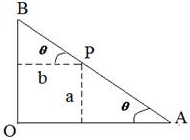
$AP = a\cos ec\theta $
$BP = b\sec \theta $
$l = AP + BP$
$l = a\cos ec\theta + b\sec \theta $
$\frac{{dl}}{{d\theta }} = -a\cos ec\theta \cot \theta + b\sec \theta .\tan \theta $
$\frac{{{d^2}l}}{{d{\theta ^2}}} = a\cos e{c^2}\theta + a\cos ec\theta {\cot ^2}\theta + {b^2} - {\sec ^3}\theta + b\sec \theta .{\tan ^2}\theta $
For maximum/minimum
$\frac{{dl}}{{d\theta }} = 0$
$\frac{{dl}}{{d\theta }} = -a\cos ec\theta \cot \theta + b\sec \theta .\tan \theta $
$\frac{acos\theta}{sin^2\theta}=\frac{bsin\theta}{cos^2\theta}$
${\tan ^3}\theta = \frac{a}{b}$
$\tan \theta = {\left( {\frac{a}{b}} \right)^{1/3}}$
$\sin \theta = \frac{{{a^{1/3}}}}{{\sqrt {{a^{2/3}} + {b^{2/3}}} }},\cos \theta = \frac{{{b^{1/3}}}}{{\sqrt {{a^{2/3}} + {b^{2/3}}} }}$
$\frac{{{d^2}l}}{{d{\theta ^2}}} < 0$ for $\tan \theta = {\left( {\frac{a}{b}} \right)^{1/3}}$
l is minimum and minimum value of l is given by,
$l = a\cos ec\theta + b\sec \theta $
$=a\sqrt{1+cot^2\theta}+b\sqrt{1+tan^2\theta}$
$=a\sqrt{1+(\frac{b}{a})^{2/3}}+b\sqrt{1+(\frac{a}{b})^{2/3}}$
$=a^{2/3}\sqrt{a^{2/3}+b^{2/3}}+b^{2/3}\sqrt{b^{2/3}+a^{2/3}}$
$l = {\left( {{a^{2/3}} + {b^{2/3}}} \right)^{3/2}}$
Questions
4 Marks
🎯
Test yourself on this topic
23 questions · timed · auto-graded
Question 14 Marks
A point on the hypotenuse of a triangle is at distance a and b from the sides of the triangle. Show that the minimum length of the hypotenuse is$(a^{\frac{2}{3}} + b^{\frac{2}{3}})^{\frac{3}{2}}$
Answer
View full question & answer→Question 24 Marks
A window is in the form of a rectangle surmounted by a semicircular opening. The total perimeter of the window is 10 m. Find the dimensions of the window to admit maximum light through the whole opening.
Answer
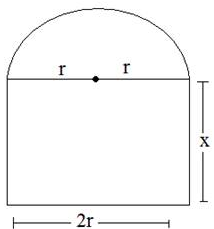
Let P be the perimeter of window
$P = 2x + 2r + \frac{1}{2} \times 2\pi r$
$10 =2x + 2r + \pi r$ [P = 10]
$x = \frac{{10 - 2r - \pi r}}{2}$
Let A be area of window
$A = 2rx + \frac{1}{2}\pi {r^2}$
$ = 2r\left[ {\frac{{10 - 2r - \pi r}}{2}} \right] + \frac{1}{2}\pi {r^2}$
$ = 10r - 2{r^2} - \pi {r^2} + \frac{1}{2}\pi {r^2}$
$ = 10r - 2{r^2} - \frac{{\pi {r^2}}}{2}$
$\frac{{dA}}{{dr}} = 10 - 4r - \pi r$
$\frac{{{d^2}A}}{{d{r^2}}} = - \left( {\pi + 4} \right)$
$\frac{{dA}}{{dr}} = 0$
$r = \frac{{10}}{{\pi + 4}}$
$\frac{{{d^2}A}}{{d{r^2}}} < 0$ maximum
$x = \frac{{10 - 2r - \pi r}}{2}$
$x = \frac{{10}}{{\pi + 4}}$
Length of rectangle = 2r $ = \frac{{20}}{{\pi + 4}}$
width $ = \frac{{10}}{{\pi + 4}}$
View full question & answer→Let P be the perimeter of window
$P = 2x + 2r + \frac{1}{2} \times 2\pi r$
$10 =2x + 2r + \pi r$ [P = 10]
$x = \frac{{10 - 2r - \pi r}}{2}$
Let A be area of window
$A = 2rx + \frac{1}{2}\pi {r^2}$
$ = 2r\left[ {\frac{{10 - 2r - \pi r}}{2}} \right] + \frac{1}{2}\pi {r^2}$
$ = 10r - 2{r^2} - \pi {r^2} + \frac{1}{2}\pi {r^2}$
$ = 10r - 2{r^2} - \frac{{\pi {r^2}}}{2}$
$\frac{{dA}}{{dr}} = 10 - 4r - \pi r$
$\frac{{{d^2}A}}{{d{r^2}}} = - \left( {\pi + 4} \right)$
$\frac{{dA}}{{dr}} = 0$
$r = \frac{{10}}{{\pi + 4}}$
$\frac{{{d^2}A}}{{d{r^2}}} < 0$ maximum
$x = \frac{{10 - 2r - \pi r}}{2}$
$x = \frac{{10}}{{\pi + 4}}$
Length of rectangle = 2r $ = \frac{{20}}{{\pi + 4}}$
width $ = \frac{{10}}{{\pi + 4}}$
Question 34 Marks
The sum of the perimeter of a circle and square is k, where k is some constant. Prove that the sum of their area is least when the side of square is double the radius of the circle.
Answer
View full question & answer→r is the radius of circle and x be side of sq.
$2\pi r + 4x = K$
$s = \pi {r^2} + {x^2}$
$s = \pi {r^2} + {\left( {\frac{{K - 2\pi r}}{4}} \right)^2}$
$\frac{{ds}}{{dr}} = 2\pi r + 2\left( {\frac{{K - 2\pi r}}{4}} \right).\left( {0 - \frac{{2\pi }}{4}} \right)$
$\frac{{ds}}{{dr}} = 2\pi r - \frac{\pi }{4}\left( {K - 2\pi r} \right)$
$\frac{{{d^2}s}}{{d{r^2}}} = 2\pi - \frac{\pi }{4}\left( {0 - 2\pi } \right)$
$ = 2\pi + \frac{{2{\pi ^2}}}{4}$
For maximum/minimum
$\frac{{ds}}{{dr}} = 0$
$\frac{\pi }{4}\left( {k - 2\pi r} \right) = 2\pi r$
$k - 2\pi r = 8r$
$k = 8r + 2\pi r$
$\frac{K}{{2(4 + \pi )}} = r$
Now $\frac{{{d^2}s}}{{d{r^2}}} > 0$
Area is minimum at $r = \frac{k}{{2(4 + \pi )}}$
$2\pi r + 4x = k$
$x = \frac{{k - 2\pi r}}{4}$
$x = \frac{{k - 2\pi \frac{k}{{2(4 + \pi )}}}}{4}$
$ = \frac{{4k + k\pi - k\pi }}{{4(4 + \pi )}} = \frac{{4k}}{{4(4 + \pi )}}$
x = 2r
Question 44 Marks
A tank with rectangular base and rectangular sides, open at the top is to be constructed so that its depth is 2 m and volume is 8 m3. If building of tank costs Rs 70 per sq.metres for the base and Rs 45 per sq. metre for sides. What is the cost of least expensive tank ?
Answer
View full question & answer→Let x and y be the length and width of rectangular base, v be the volume.
v = 8 (Given)
v = 2xy
8 = 2xy
$y = \frac{4}{x}$
$s = (xy) \times 70 + 2(x + y) \times 45$
$ = x \times \frac{4}{x} \times 70 + 90\left( {x + \frac{4}{x}} \right)$
$ = 280 + 90\left( {x + \frac{4}{x}} \right)$
$\frac{{ds}}{{dx}} = 0 + 90\left( {1 - \frac{4}{{{x^2}}}} \right)$
=$\frac{{{d^2}s}}{{d{x^2}}} = 90\left( {0 + \frac{8}{{{x^3}}}} \right)$
For maximum/minimum
$\frac{{ds}}{{dx}} = 0$
x = 2
${\left( {\frac{{{d^2}s}}{{d{x^2}}}} \right)_{x = 2}}=\frac{{720}}{{{2^3}}} > 0$
s is Minimum at x=2
Minimum cost is given by
$s = 280 + 90\left( {2 + \frac{4}{2}} \right)$
= 280+ 90 (4)
= 280+360
= 640
Question 54 Marks
Find the maximum area of an isosceles $\triangle $ inscribed in the ellipse $\frac{{{x^2}}}{{{a^2}}} + \frac{{{y^2}}}{{{b^2}}} = 1$ with its vertex at one end of the major axis
Answer
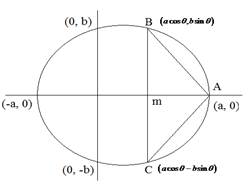
Let A be the area of $\triangle$ABC
$A = \frac{1}{2}(2b\sin \theta ) \times (a - a\cos \theta )$
$A = ab(\sin \theta - \sin \theta .\cos \theta )$
$\frac{{dA}}{{d\theta }}$ = ab[cos $\theta$ the perimter(b) the area of the rectangle. cos2$\theta$ + sin2$\theta$]
$ = ab\left[ {\cos \theta - \cos 2\theta } \right]$
For maximum / minimum
$\frac{{dA}}{{d\theta }} = 0$
$ab(\cos \theta - \cos 2\theta ) = 0$
$\cos \theta = \cos 2\theta $
$\cos \theta = \cos (2\pi - 2\theta )$
$\theta = 2\pi - 2\theta $
$3\theta = 2\pi $
$\theta = \frac{{2\pi }}{3}$
$\frac{{{d^2}A}}{{d{\theta ^2}}} = ab\left( { - \sin \theta + 2\sin 2\theta } \right)$
${\left. {\frac{{{d^2}A}}{{d{\theta ^2}}}} \right]_{\theta = \frac{{2\pi }}{3}}} = ab\left[ { - \sin \frac{{2\pi }}{3} + 2\sin 2.\frac{{2\pi }}{3}} \right]$
$ = ab\left[ { - \frac{{\sqrt 3 }}{2} - 2 \times \frac{{\sqrt 3 }}{2}} \right] < 0$
So,area is maximum
$A = ab\left[ {\sin \frac{{2\pi }}{3} - \sin \frac{{2\pi }}{3}\cos \frac{{2\pi }}{3}} \right]$
$ = ab\left[ {\frac{{\sqrt 3 }}{2} + \frac{{\sqrt 3 }}{2} \times \frac{1}{2}} \right]$
$ = \frac{{3\sqrt 3 }}{4}ab.$
View full question & answer→Let A be the area of $\triangle$ABC
$A = \frac{1}{2}(2b\sin \theta ) \times (a - a\cos \theta )$
$A = ab(\sin \theta - \sin \theta .\cos \theta )$
$\frac{{dA}}{{d\theta }}$ = ab[cos $\theta$ the perimter(b) the area of the rectangle. cos2$\theta$ + sin2$\theta$]
$ = ab\left[ {\cos \theta - \cos 2\theta } \right]$
For maximum / minimum
$\frac{{dA}}{{d\theta }} = 0$
$ab(\cos \theta - \cos 2\theta ) = 0$
$\cos \theta = \cos 2\theta $
$\cos \theta = \cos (2\pi - 2\theta )$
$\theta = 2\pi - 2\theta $
$3\theta = 2\pi $
$\theta = \frac{{2\pi }}{3}$
$\frac{{{d^2}A}}{{d{\theta ^2}}} = ab\left( { - \sin \theta + 2\sin 2\theta } \right)$
${\left. {\frac{{{d^2}A}}{{d{\theta ^2}}}} \right]_{\theta = \frac{{2\pi }}{3}}} = ab\left[ { - \sin \frac{{2\pi }}{3} + 2\sin 2.\frac{{2\pi }}{3}} \right]$
$ = ab\left[ { - \frac{{\sqrt 3 }}{2} - 2 \times \frac{{\sqrt 3 }}{2}} \right] < 0$
So,area is maximum
$A = ab\left[ {\sin \frac{{2\pi }}{3} - \sin \frac{{2\pi }}{3}\cos \frac{{2\pi }}{3}} \right]$
$ = ab\left[ {\frac{{\sqrt 3 }}{2} + \frac{{\sqrt 3 }}{2} \times \frac{1}{2}} \right]$
$ = \frac{{3\sqrt 3 }}{4}ab.$
Question 64 Marks
The two equal sides of an isosceles $\triangle$ with fixed base b are decreasing at the rate of 3 cm/s. How fast is the area decreasing when the two equal sides are equal to the base?
Answer
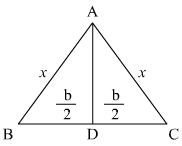
Let at any time t, the length of each equal side be x cm and area of triangle be A.Then.
$A = \frac{1}{2}BC \times AD = \frac{1}{2}b\sqrt {{x^2} - \frac{{{b^2}}}{4}}$ $ = \frac{b}{4}\sqrt {4{x^2} - {b^2}}$
$\Rightarrow \frac{{dA}}{{dt}} = \frac{b}{4} \times \frac{1}{{2\sqrt {4{x^2} - {b^2}} }} \times 8x\frac{{dx}}{{dt}}$
$ = \frac{{bx}}{{\sqrt {4{x^2} - {b^2}} }}\frac{{dx}}{{dt}}$
$\Rightarrow \frac{{dA}}{{dt}} = \frac{{3bx}}{{\sqrt {4{x^2} - {b^2}} }}\left( {\because \frac{{dx}}{{dt}} = 3cm/\sec } \right)$
$\Rightarrow {\left( {\frac{{dA}}{{dt}}} \right)_{x = b}} = \frac{{3{b^2}}}{{\sqrt {4{b^2} - {b^2}} }} = \sqrt 3 b$ cm2/sec
View full question & answer→Let at any time t, the length of each equal side be x cm and area of triangle be A.Then.
$A = \frac{1}{2}BC \times AD = \frac{1}{2}b\sqrt {{x^2} - \frac{{{b^2}}}{4}}$ $ = \frac{b}{4}\sqrt {4{x^2} - {b^2}}$
$\Rightarrow \frac{{dA}}{{dt}} = \frac{b}{4} \times \frac{1}{{2\sqrt {4{x^2} - {b^2}} }} \times 8x\frac{{dx}}{{dt}}$
$ = \frac{{bx}}{{\sqrt {4{x^2} - {b^2}} }}\frac{{dx}}{{dt}}$
$\Rightarrow \frac{{dA}}{{dt}} = \frac{{3bx}}{{\sqrt {4{x^2} - {b^2}} }}\left( {\because \frac{{dx}}{{dt}} = 3cm/\sec } \right)$
$\Rightarrow {\left( {\frac{{dA}}{{dt}}} \right)_{x = b}} = \frac{{3{b^2}}}{{\sqrt {4{b^2} - {b^2}} }} = \sqrt 3 b$ cm2/sec
Question 74 Marks
A cylindrical tank of radius 10 m is being filled with wheat at the rate of 314 cubic metre per hour. Then the depth of the wheat is increasing at the rate of:
Answer
View full question & answer→Let V be the volume of the cylinder
Then, ${V}=\pi \mathrm{r}^{2} \mathrm{h}$
= $\pi(10)^{2} h$
$\Rightarrow$ V = 100$\pi$h
Differentiating w.r.t. t we get,
$\frac{\mathrm{d} \mathrm{V}}{\mathrm{dt}}=100 \pi \frac{\mathrm{dh}}{\mathrm{dt}}$
The tank is being filled with wheat at the rate of 314 cubic meters per hour.
i.e, $\frac{\mathrm{d} \mathrm{V}}{\mathrm{dt}}=314 ~~\mathrm{m}^{3} / \mathrm{h}$
Then, we have
$314=100 \pi \frac{d h}{d t}$
$\Rightarrow \frac{\mathrm{dh}}{\mathrm{dt}}=\frac{314}{100 \times 3.14}=1$
Therefore, the depth of wheat is increasing at the rate of 1 m/h.
Then, ${V}=\pi \mathrm{r}^{2} \mathrm{h}$
= $\pi(10)^{2} h$
$\Rightarrow$ V = 100$\pi$h
Differentiating w.r.t. t we get,
$\frac{\mathrm{d} \mathrm{V}}{\mathrm{dt}}=100 \pi \frac{\mathrm{dh}}{\mathrm{dt}}$
The tank is being filled with wheat at the rate of 314 cubic meters per hour.
i.e, $\frac{\mathrm{d} \mathrm{V}}{\mathrm{dt}}=314 ~~\mathrm{m}^{3} / \mathrm{h}$
Then, we have
$314=100 \pi \frac{d h}{d t}$
$\Rightarrow \frac{\mathrm{dh}}{\mathrm{dt}}=\frac{314}{100 \times 3.14}=1$
Therefore, the depth of wheat is increasing at the rate of 1 m/h.
Question 84 Marks
Show that height of the cylinder of greatest volume which can be inscribed in a right circular cone of height h and semi vertical angle α is one-third that of the cone and the greatest volume of cylinder is $\frac{4}{{27}}{\pi}h^3\tan^2 \alpha .$
Answer
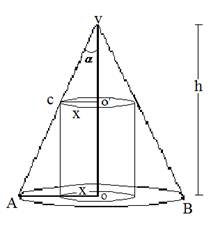
$\frac{{vo'}}{x} = \cot \alpha $
$vo' = x\cot \alpha $
$oo' = h - x\cot \alpha $
$V = \pi {x^2}.(h - x\cot \alpha )$
$V = \pi {x^2}h - \pi {x^3}\cot \alpha $
$\frac{{dv}}{{dx}} = 2\pi xh - 3\pi {x^2}\cot \alpha $
For maximum/minimum
$\frac{{dv}}{{dx}} = 0$
$2\pi xh - 3\pi {x^2}\cot \alpha = 0$
$x = \frac{{2h}}{3}\tan \alpha $
$\frac{{{d^2}v}}{{d{x^2}}} = 2\pi h - 6\pi x\cot \alpha $
${\left. {\frac{{{d^2}v}}{{d{x^2}}}} \right]_{x = \frac{{2h}}{3}\tan \alpha }} = \pi (2h - 4h)$
Volume is maximum at $x = \frac{{2h}}{3}\tan \alpha $
Maximum volume is
$V = \pi .{x^2}(h - x\cot \alpha )$
$ = \pi {\left( {\frac{{2h}}{3}\tan \alpha } \right)^2}\left[ {h - \frac{{2h}}{3}\tan \alpha \cot \alpha } \right]$
$ = \pi .\frac{{4{h^2}}}{9}{\tan ^2}\alpha .\frac{h}{3}$
$V = \frac{9}{{27}}\pi {h^3}{\tan ^2}\alpha $
View full question & answer→$\frac{{vo'}}{x} = \cot \alpha $
$vo' = x\cot \alpha $
$oo' = h - x\cot \alpha $
$V = \pi {x^2}.(h - x\cot \alpha )$
$V = \pi {x^2}h - \pi {x^3}\cot \alpha $
$\frac{{dv}}{{dx}} = 2\pi xh - 3\pi {x^2}\cot \alpha $
For maximum/minimum
$\frac{{dv}}{{dx}} = 0$
$2\pi xh - 3\pi {x^2}\cot \alpha = 0$
$x = \frac{{2h}}{3}\tan \alpha $
$\frac{{{d^2}v}}{{d{x^2}}} = 2\pi h - 6\pi x\cot \alpha $
${\left. {\frac{{{d^2}v}}{{d{x^2}}}} \right]_{x = \frac{{2h}}{3}\tan \alpha }} = \pi (2h - 4h)$
Volume is maximum at $x = \frac{{2h}}{3}\tan \alpha $
Maximum volume is
$V = \pi .{x^2}(h - x\cot \alpha )$
$ = \pi {\left( {\frac{{2h}}{3}\tan \alpha } \right)^2}\left[ {h - \frac{{2h}}{3}\tan \alpha \cot \alpha } \right]$
$ = \pi .\frac{{4{h^2}}}{9}{\tan ^2}\alpha .\frac{h}{3}$
$V = \frac{9}{{27}}\pi {h^3}{\tan ^2}\alpha $
Question 94 Marks
Show that the height of the cylinder of maximum volume that can be inscribed in a sphere of radius R is $\frac{{2R}}{{\sqrt 3 }}$ Also find the maximum volume.
Answer
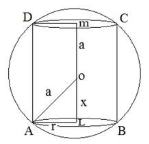
$V = \pi {r^2}.2x$ $ [\because OL = x , LM = 2x ]$
$ = \pi .({a^2} - {x^2}).2x$
$V = 2\pi ({a^2}x - {x^3})$
$\frac{{dv}}{{dx}} = 2\pi ({a^2} - 3{x^2})$
$\frac{{{d^2}v}}{{d{x^2}}} = 2\pi \left[ {0 - 6x} \right]$
$ = - 12\pi x$
For maximum/minimum
$\frac{{dv}}{{dx}} = 0$
$2\pi [{a^2} - 3{x^2}] = 0$
${a^2} = 3{x^2} \Rightarrow \sqrt {\frac{{{a^2}}}{3}} = x$
$ \Rightarrow x = \frac{a}{{\sqrt 3 }}$
${\left. {\frac{{{d^2}v}}{{d{x^2}}}} \right]_{x = \frac{a}{{\sqrt 3 }}}} = - 12\pi .\frac{a}{{\sqrt 3 }}$
= negative maximum
Volume is maximum at $x = \frac{a}{{\sqrt 3 }}$
Height of cylinder of maximum volume is
= 2x
$ = 2 \times \frac{a}{{\sqrt 3 }}$
$ = \frac{{2a}}{{\sqrt 3 }}$
View full question & answer→$V = \pi {r^2}.2x$ $ [\because OL = x , LM = 2x ]$
$ = \pi .({a^2} - {x^2}).2x$
$V = 2\pi ({a^2}x - {x^3})$
$\frac{{dv}}{{dx}} = 2\pi ({a^2} - 3{x^2})$
$\frac{{{d^2}v}}{{d{x^2}}} = 2\pi \left[ {0 - 6x} \right]$
$ = - 12\pi x$
For maximum/minimum
$\frac{{dv}}{{dx}} = 0$
$2\pi [{a^2} - 3{x^2}] = 0$
${a^2} = 3{x^2} \Rightarrow \sqrt {\frac{{{a^2}}}{3}} = x$
$ \Rightarrow x = \frac{a}{{\sqrt 3 }}$
${\left. {\frac{{{d^2}v}}{{d{x^2}}}} \right]_{x = \frac{a}{{\sqrt 3 }}}} = - 12\pi .\frac{a}{{\sqrt 3 }}$
= negative maximum
Volume is maximum at $x = \frac{a}{{\sqrt 3 }}$
Height of cylinder of maximum volume is
= 2x
$ = 2 \times \frac{a}{{\sqrt 3 }}$
$ = \frac{{2a}}{{\sqrt 3 }}$
Question 104 Marks
Let f be a function defined on [a, b] such that f ′(x) > 0, for all x $\in$ (a, b). Then prove that f is an increasing function on (a, b).
Answer
View full question & answer→Since, f'(x) > 0 on (a, b)
Then, f is a differentiable function on (a, b)
Also, every differentiable function is continuous,
Therefore, f is continuous on [a, b]
Let x1, x2 $\in$ (a, b) such that, x2 > x1 then by LMV theorem, there exists c $\in$ (a, b) s.t.
$f^{\prime}(c)=\frac{f(x_{2})-f(x_{1})}{x_{2}-x_{1}}$
$\Rightarrow$ f(x2) - f(x1) = (x2 - x1)$f^\prime$(c)
$\Rightarrow$ f(x2) - f(x1) > 0 as x2 > x1 and $f^\prime$(x) > 0
$\Rightarrow$ f(x2) > f(x1)
$\therefore$ for x1 < x2 $\Rightarrow$ f(x1) < f(x2)
Therefore, f is an increasing function.
Then, f is a differentiable function on (a, b)
Also, every differentiable function is continuous,
Therefore, f is continuous on [a, b]
Let x1, x2 $\in$ (a, b) such that, x2 > x1 then by LMV theorem, there exists c $\in$ (a, b) s.t.
$f^{\prime}(c)=\frac{f(x_{2})-f(x_{1})}{x_{2}-x_{1}}$
$\Rightarrow$ f(x2) - f(x1) = (x2 - x1)$f^\prime$(c)
$\Rightarrow$ f(x2) - f(x1) > 0 as x2 > x1 and $f^\prime$(x) > 0
$\Rightarrow$ f(x2) > f(x1)
$\therefore$ for x1 < x2 $\Rightarrow$ f(x1) < f(x2)
Therefore, f is an increasing function.
Question 114 Marks
Show that the altitude of the right circular cone of maximum volume that can be inscribed in a sphere of radius r is $\frac{4r}{3}$.
Answer
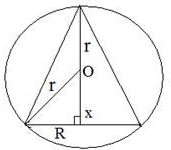
Let R and h be the radius and height of the cone.
r be the radius of sphere.
$V = \frac{1}{3}\pi {R^2}H$
$= \frac{1}{3}\pi {R^2}.\left( {r + x} \right)$
$= \frac{1}{3}\pi .\left( {{r^2} - {x^2}} \right)\left( {r + x} \right)\,\,\left[ {\because {R^2} = {r^2} - {x^2}} \right]$
$\frac{{dv}}{{dx}} = \frac{1}{3}\pi \left[ {\left( {{r^2} - {x^2}} \right)\left( 1 \right) + \left( {r + x} \right)\left( {0 - 2x} \right)} \right]$
$\frac{{dv}}{{dx}} = \frac{1}{3}\pi \left[ {{r^2} - {x^2} - 2rx - 2{x^2}} \right]$
$= \frac{1}{3}\pi \left[ {{r^2} - 2rx - 3{x^2}} \right]$
$ = \frac{1}{3}\pi \left[ {{r^2} - 3rx + rx - 3{x^2}} \right]$
$= \frac{1}{3}\pi \left[ {r\left( {r - 3x} \right) + x\left( {r - 3x} \right)} \right]$
$= \frac{1}{3}\pi \left[ {\left( {r - 3x} \right)\left( {r + x} \right)} \right]$
For critical points$\frac{{dv}}{{dx}} = 0$
$r -3x=0 \implies r=3x$
$\Rightarrow\frac{r}{3} = x$
$\frac{{{d^2}v}}{{d{x^2}}} = \frac{1}{3}\pi \left[ {0 - 2r - 6x} \right]$
${\left. {\frac{{{d^2}v}}{{d{x^2}}}} \right]_{x = \frac{r}{3}}} = \frac{1}{3}\pi \left[ { - 2r - 6 \times \frac{r}{3}} \right]$
$= \frac{1}{3}\pi \left[ { - 4r} \right]$
= - ve
therefore, maximum
Altitude = r + x
$= \frac{r}{3} + r$
$ = \frac{{4r}}{3}$
View full question & answer→Let R and h be the radius and height of the cone.
r be the radius of sphere.
$V = \frac{1}{3}\pi {R^2}H$
$= \frac{1}{3}\pi {R^2}.\left( {r + x} \right)$
$= \frac{1}{3}\pi .\left( {{r^2} - {x^2}} \right)\left( {r + x} \right)\,\,\left[ {\because {R^2} = {r^2} - {x^2}} \right]$
$\frac{{dv}}{{dx}} = \frac{1}{3}\pi \left[ {\left( {{r^2} - {x^2}} \right)\left( 1 \right) + \left( {r + x} \right)\left( {0 - 2x} \right)} \right]$
$\frac{{dv}}{{dx}} = \frac{1}{3}\pi \left[ {{r^2} - {x^2} - 2rx - 2{x^2}} \right]$
$= \frac{1}{3}\pi \left[ {{r^2} - 2rx - 3{x^2}} \right]$
$ = \frac{1}{3}\pi \left[ {{r^2} - 3rx + rx - 3{x^2}} \right]$
$= \frac{1}{3}\pi \left[ {r\left( {r - 3x} \right) + x\left( {r - 3x} \right)} \right]$
$= \frac{1}{3}\pi \left[ {\left( {r - 3x} \right)\left( {r + x} \right)} \right]$
For critical points$\frac{{dv}}{{dx}} = 0$
$r -3x=0 \implies r=3x$
$\Rightarrow\frac{r}{3} = x$
$\frac{{{d^2}v}}{{d{x^2}}} = \frac{1}{3}\pi \left[ {0 - 2r - 6x} \right]$
${\left. {\frac{{{d^2}v}}{{d{x^2}}}} \right]_{x = \frac{r}{3}}} = \frac{1}{3}\pi \left[ { - 2r - 6 \times \frac{r}{3}} \right]$
$= \frac{1}{3}\pi \left[ { - 4r} \right]$
= - ve
therefore, maximum
Altitude = r + x
$= \frac{r}{3} + r$
$ = \frac{{4r}}{3}$
Question 124 Marks
Find the absolute maximum and minimum values of the function f given by f(x) = cos2 x + sin x, x $\in$ [0, $\pi$]
Answer
View full question & answer→It is given that f(x) = cos2 x + sin x, $x \in[0, \pi]$
$f^\prime$(x) = 2 cos x (-sin x) + cos x
= -2 sin x cos x + cos x
Now, if $f^\prime$(x) = 0
$\Rightarrow$ 2 sin x cos x = cos x
$\Rightarrow$ cos x (2 sin x - 1) = 0
$\Rightarrow$ sin x = $\frac{1}{2}$ or cos x = 0
$\Rightarrow$ $x=\frac{\pi}{6},\frac{5\pi}{6}$ or $\frac{\pi}{2}$ as $\mathrm{x} \in[0, \pi]$
Next, evaluating the value of f at critical points $x=\frac{\pi}{2}$ and $x=\frac{\pi}{6}$ and at the end points of the interval $[0, \pi]$, (i.e. at x = 0 and $x=\pi$ ), we get,
$f\left(\frac{\pi}{6}\right)=\cos ^{2} \frac{\pi}{6}+\sin \frac{\pi}{6}=\left(\frac{\sqrt{3}}{2}\right)^{2}+\frac{1}{2}=\frac{5}{4}$
$f(\frac{5\pi}{6}) = cos^2(\frac{5\pi}{6})+ sin(\frac{5\pi}{6}) = cos^2(\pi-\frac\pi6)+sin(\pi-\frac\pi6)=cos^2\frac\pi6-sin\frac\pi6=\frac54$
f(0) = cos2 0 + sin 0 = 1 + 0 = 1
$f(\pi)=\cos ^{2} \pi+\sin \pi$ = (-1)2 + 0 = 1
$f\left(\frac{\pi}{2}\right)=\cos ^{2} \frac{\pi}{2}+\sin \frac{\pi}{2}=0+1=1$
Therefore, the absolute maximum value of f is $\frac{5}{4}$ occurring at x = $\frac{\pi}{6}$ and the absolute minimum value of f is 1 occurring at x = 1, $\frac{\pi}{2}$ and $\pi$.
$f^\prime$(x) = 2 cos x (-sin x) + cos x
= -2 sin x cos x + cos x
Now, if $f^\prime$(x) = 0
$\Rightarrow$ 2 sin x cos x = cos x
$\Rightarrow$ cos x (2 sin x - 1) = 0
$\Rightarrow$ sin x = $\frac{1}{2}$ or cos x = 0
$\Rightarrow$ $x=\frac{\pi}{6},\frac{5\pi}{6}$ or $\frac{\pi}{2}$ as $\mathrm{x} \in[0, \pi]$
Next, evaluating the value of f at critical points $x=\frac{\pi}{2}$ and $x=\frac{\pi}{6}$ and at the end points of the interval $[0, \pi]$, (i.e. at x = 0 and $x=\pi$ ), we get,
$f\left(\frac{\pi}{6}\right)=\cos ^{2} \frac{\pi}{6}+\sin \frac{\pi}{6}=\left(\frac{\sqrt{3}}{2}\right)^{2}+\frac{1}{2}=\frac{5}{4}$
$f(\frac{5\pi}{6}) = cos^2(\frac{5\pi}{6})+ sin(\frac{5\pi}{6}) = cos^2(\pi-\frac\pi6)+sin(\pi-\frac\pi6)=cos^2\frac\pi6-sin\frac\pi6=\frac54$
f(0) = cos2 0 + sin 0 = 1 + 0 = 1
$f(\pi)=\cos ^{2} \pi+\sin \pi$ = (-1)2 + 0 = 1
$f\left(\frac{\pi}{2}\right)=\cos ^{2} \frac{\pi}{2}+\sin \frac{\pi}{2}=0+1=1$
Therefore, the absolute maximum value of f is $\frac{5}{4}$ occurring at x = $\frac{\pi}{6}$ and the absolute minimum value of f is 1 occurring at x = 1, $\frac{\pi}{2}$ and $\pi$.
Question 134 Marks
Find the points at which the function f given by f(x) = (x - 2)4 (x + 1)3 has
- local maxima
- local minima
- point of inflexion
Answer
View full question & answer→It is given that function is f(x) = (x - 2)4 (x + 1)3
$\Rightarrow$ f'(x) = 4(x - 2)3 (x + 1)3 + 3(x + 1)2 (x - 2)4
= (x - 2)3(x + 1)2 [4(x + 1) + 3(x - 2)]
= (x - 2)3(x + 1)2 (7x - 2)
Now, f'(x) = 0
$\Rightarrow$ x = -1 and x = $\frac{2}{7}$ or x = 2
Now, for values of x close to $\frac{2}{7}$ and to the left of $\frac{2}{7}$
f'(x) > 0
Also, for values of x close to $\frac{2}{7}$ and to the right of $\frac{2}{7}$, f'(x) < 0.
Then, x = $\frac{2}{7}$ is the point of local maxima.
Now, for values of x close to 2 and to the left of 2, f'(x) < 0.
Also, for values of x close to 2 and to the right of 2, f'(x) > 0.
Then, x = 2 is the point of local minima.
Now, as the value of x varies through -1, f'(x) does not changes its sign.
Then, x = -1 is the point of inflexion.
$\Rightarrow$ f'(x) = 4(x - 2)3 (x + 1)3 + 3(x + 1)2 (x - 2)4
= (x - 2)3(x + 1)2 [4(x + 1) + 3(x - 2)]
= (x - 2)3(x + 1)2 (7x - 2)
Now, f'(x) = 0
$\Rightarrow$ x = -1 and x = $\frac{2}{7}$ or x = 2
Now, for values of x close to $\frac{2}{7}$ and to the left of $\frac{2}{7}$
f'(x) > 0
Also, for values of x close to $\frac{2}{7}$ and to the right of $\frac{2}{7}$, f'(x) < 0.
Then, x = $\frac{2}{7}$ is the point of local maxima.
Now, for values of x close to 2 and to the left of 2, f'(x) < 0.
Also, for values of x close to 2 and to the right of 2, f'(x) > 0.
Then, x = 2 is the point of local minima.
Now, as the value of x varies through -1, f'(x) does not changes its sign.
Then, x = -1 is the point of inflexion.
Question 144 Marks
Show that semi – vertical angle of right circular cone of given surface area and maximum volume is ${\sin ^{ - 1}}\left( {\frac{1}{3}} \right)$
Answer
View full question & answer→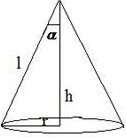
$s = \pi {r^2} + \pi rl$ (given)
$\Rightarrow$$l = \frac{{s - \pi {r^2}}}{{\pi r}}$
Let v be the volume
$v = \frac{1}{3}\pi {r^2}h$
$\Rightarrow$${v^2} = \frac{1}{9}{\pi ^2}{r^4}{h^2}\,\,\left[ {{h^2} = {l^2} - {r^2}} \right]$
$\Rightarrow$${v^2} = \frac{1}{9}{\pi ^2}{r^4}\,\left( {{l^2} - {r^2}} \right)$
$\Rightarrow$${v^2} = \frac{1}{9}{\pi ^2}{r^4}\left[ {\,{{\left( {\frac{{s - \pi {r^2}}}{{\pi r}}} \right)}^2} - {r^2}} \right]$
$= \frac{1}{9}{\pi ^2}{r^4}\left[ {\frac{{\left( {s - \pi {r^2}} \right)}^2}{{{\pi ^2}{r^2}}} - \frac{{{r^2}}}{1}} \right]$
$= \frac{1}{9}{r^2}\left[ {{{\left( {s - \pi {r^2}} \right)}^2} - {\pi ^2}{r^4}} \right]$
$= \frac{1}{9}{r^2}\left[ {{s^2} + {\pi ^2}{r^4} - 2s\pi {r^2} - {\pi ^2}{r^4}} \right]$
$= \frac{1}{9}{r^2}\left[ {{s^2} - 2s\pi {r^2}} \right]$
$z = \frac{1}{9}\left[ {{s^2}{r^2} - 2s\pi {r^4}} \right]$
$\left[ {\because {v^2} = z} \right]$
Now $\frac{{dz}}{{dr}} = \frac{1}{9}\,\left[ {2r{s^2} - 8s\pi {r^3}} \right]$
$0 = \frac{1}{9}\,\left[ {2r{s^2} - 8s\pi {r^3}} \right]$
$8s\pi {r^2} = 2r{s^2}$
$\implies$ $4\pi {r^2} = s$
Now $\frac{{{d^2}z}}{{d{x^2}}} = \frac{1}{9}\,\left[ {2{s^2} - 24s\pi {r^2}} \right]$
${\left. {\frac{{{d^2}z}}{{d{x^2}}}} \right]_{{r^2} = \frac{s}{{4\pi }}}} = \frac{1}{9}\,\left[ {{{25}^2} - 24\pi .\frac{5}{{4\pi }}} \right]$
= + ve
Hence minimum
Now $s = 4\pi {r^2}$
We have $s = \pi rl + \pi {r^2}$
$4\pi {r^2} = \pi rl + \pi {r^2}$
$\Rightarrow$ $3\pi {r^2} = \pi rl$
$\Rightarrow$3 r = l
$\Rightarrow$$\frac{r}{l} = \frac{1}{3}$
$\Rightarrow$$\sin \alpha = \frac{1}{3}$
$\therefore$$\alpha = {\sin ^{ - 1}}\left( {\frac{1}{3}} \right)$
Question 154 Marks
Show that the semi-vertical angle of the cone of the maximum value and of given slant height is ${\tan ^{ - 1}}\sqrt 2$
Answer
View full question & answer→Let x be the radius, y be the height, l be the slant height of given cone and $\theta $ be the semi-vertical angle of cone.
$\therefore {l^2} = {x^2} + {y^2}$
$ \Rightarrow {x^2} = {l^2} - {y^2}$ …(i)
$\therefore$ Volume of the cone $\left( V \right) = \frac{1}{3}\pi {x^2}y$ …(ii)
$ \Rightarrow V = \frac{1}{3}\pi \left( {{l^2} - {y^2}} \right)y$
$= \frac{\pi }{3}\left( {{l^2}y - {y^3}} \right)$
$\Rightarrow \frac{{dV}}{{dy}} = \frac{\pi }{3}\left( {{l^2} - 3{y^2}} \right)$ and $\frac{{{d^2}V}}{{d{y^2}}} = \frac{\pi }{3}\left( { - 6y} \right) = - 2\pi y$
Now $\frac{{dV}}{{dy}} = 0$
$\Rightarrow \frac{\pi }{3}\left( {{l^2} - 3{y^2}} \right) = 0$
$ \Rightarrow {l^2} - 3{y^2} = 0$
$\Rightarrow 3{y^2} = {l^2}$
$\Rightarrow y = \frac{l}{{\sqrt 3 }}$
At $y = \frac{1}{{\sqrt 3 }}\frac{{{d^2}V}}{{d{x^2}}} = - 2\pi \left( {\frac{l}{{\sqrt 3 }}} \right)$
$= \frac{{ - 2\pi l}}{{\sqrt 3 }}$ [Negative]
$\therefore $ V is maximum at $y = \frac{1}{{\sqrt 3 }}$
$\therefore$ From eq. (i), ${x^2} = {l^2} - \frac{{{l^2}}}{3} = \frac{{2{l^2}}}{3}$
$\Rightarrow x = \sqrt 2 \frac{1}{{\sqrt 3 }}$
$\therefore$ Semi-vertical angle, $\tan \theta = \frac{x}{y}$
$= \frac{{\sqrt 2 \frac{1}{{\sqrt 3 }}}}{{\frac{1}{{\sqrt 3 }}}} = \sqrt 2 $
$ \Rightarrow \theta = {\tan ^{ - 1}}\sqrt 2 $
Question 164 Marks
Show that the right circular cone of least curved surface and given volume has an altitude equal to $\sqrt 2 $ times the radius of the base.
Answer
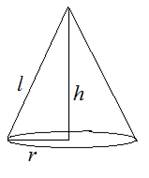
Volume of the cone is: $v = \frac{1}{3}.\pi {r^2}h$
Let ${r^2}h = k$
Where k is constant
${r^2}h = k$
$h = \frac{k}{{{r^2}}}$
$s = \pi rl$
${s^2} = {\pi ^2}{r^2}{l^2}$
$ = {\pi ^2}.{r^2}({r^2} + {h^2})$
$ = {\pi ^2}.{r^2}\left[ {{r^2} + \frac{{{k^2}}}{{{r^4}}}} \right]\left[ {\because h = \frac{k}{{{r^2}}}} \right]$
$z = {\pi ^2}{r^4} + {\pi ^2}{k^2}{r^{ - 2}}$
$\frac{{dz}}{{dr}} = 4{\pi ^2}{r^3} - 2{\pi ^2}{k^2}{r^{ - 3}}$
$\frac{{{d^2}z}}{{d{r^2}}} = 12{\pi ^2}{r^2} + 6{\pi ^2}{k^2}{r^{ - 4}}$
$\frac{{dz}}{{dr}} = 0$
$4{\pi ^2}{r^3} - \frac{{2{\pi ^2}{k^2}}}{{{r^3}}} = 0$
$4{\pi ^2}{r^6} - 2{\pi ^2}{k^2} = 0$
$2{\pi ^2}{k^2} = 4{\pi ^2}{r^6}$
${k^2} = 2{r^6}$
Put $k = {r^2}h$ we get
${r^4}{h^2} = 2{r^6}$
${h^2} = 2{r^2}$
$h = \sqrt 2 r$
${\left( {\frac{{{d^2}z}}{{d{r^2}}}} \right)_{h = \sqrt 2 r}}$ is negative
z is maximum at $h = \sqrt 2 r$
View full question & answer→Volume of the cone is: $v = \frac{1}{3}.\pi {r^2}h$
Let ${r^2}h = k$
Where k is constant
${r^2}h = k$
$h = \frac{k}{{{r^2}}}$
$s = \pi rl$
${s^2} = {\pi ^2}{r^2}{l^2}$
$ = {\pi ^2}.{r^2}({r^2} + {h^2})$
$ = {\pi ^2}.{r^2}\left[ {{r^2} + \frac{{{k^2}}}{{{r^4}}}} \right]\left[ {\because h = \frac{k}{{{r^2}}}} \right]$
$z = {\pi ^2}{r^4} + {\pi ^2}{k^2}{r^{ - 2}}$
$\frac{{dz}}{{dr}} = 4{\pi ^2}{r^3} - 2{\pi ^2}{k^2}{r^{ - 3}}$
$\frac{{{d^2}z}}{{d{r^2}}} = 12{\pi ^2}{r^2} + 6{\pi ^2}{k^2}{r^{ - 4}}$
$\frac{{dz}}{{dr}} = 0$
$4{\pi ^2}{r^3} - \frac{{2{\pi ^2}{k^2}}}{{{r^3}}} = 0$
$4{\pi ^2}{r^6} - 2{\pi ^2}{k^2} = 0$
$2{\pi ^2}{k^2} = 4{\pi ^2}{r^6}$
${k^2} = 2{r^6}$
Put $k = {r^2}h$ we get
${r^4}{h^2} = 2{r^6}$
${h^2} = 2{r^2}$
$h = \sqrt 2 r$
${\left( {\frac{{{d^2}z}}{{d{r^2}}}} \right)_{h = \sqrt 2 r}}$ is negative
z is maximum at $h = \sqrt 2 r$
Question 174 Marks
Prove that the volume of the largest cone that can be inscribed in a sphere of radius R is $\frac{8}{{27}}$ of the volume of the sphere.
Answer
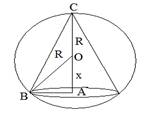
$v = \frac{1}{3}\pi {r^2}h$ $\left[ {{r^2} = \sqrt {{R^2} - {x^2}} } \right]$
$V = \frac{1}{2}\pi .\left( {{R^2} - {x^2}} \right).\left( {R + x} \right)$
$\frac{{dy}}{{dx}} = \frac{1}{3}\pi \left[ {\left( {{R^2} - {x^2}} \right)\left( 1 \right) + \left( {R + x} \right)( - 2x)} \right]$
$ = \frac{1}{3}\pi \left[ {\left( {R + x} \right)\left( {R - x} \right) - 2x\left( {R + x} \right)} \right]$
$ = \frac{1}{3}\pi \left( {R + x} \right)\left[ {R - x - 2x} \right]$
$ = \frac{1}{3}\pi \left( {R + x} \right)(R - 3x)$....(1)
Put $\frac{{dv}}{{dr}} = 0$
R = - x (neglecting)
R = 3x
$\frac{R}{3} = x$
On again differentiating equation (1)
$\frac{{{d^2}v}}{{d{x^2}}} = \frac{1}{3}\pi \left[ {(R + x)( - 3) + (R - 3x)(1)} \right]$
=${\left. {\frac{{{d^2}v}}{{d{x^2}}}} \right]_{x = \frac{R}{3}}} = \frac{1}{3}\pi \left[ {\left( {R + \frac{R}{3}} \right)( - 3) + \left( {R - 3.\frac{R}{3}} \right)} \right]$
$\frac{1}{3}\pi \left[ {\frac{{4R}}{3} \times - 3 + 0} \right]$
$ = \frac{{ - 1}}{3}\pi 4R$
$\frac{{{d^2}v}}{{d{x^2}}} < 0$ Hence maximum
Now $v = \frac{1}{3}\pi \left[ {\left( {{R^2} - {x^2}} \right)\left( {R + x} \right)} \right]$$\left[ {x = \frac{R}{3}} \right]$
$v = \frac{1}{3}\pi \left[ {\left( {{R^2} - {{\left( {\frac{R}{3}} \right)}^2}} \right)\left( {R + \left( {\frac{R}{3}} \right)} \right)} \right]$
$ = \frac{1}{3}\pi \left[ {\frac{{8{R^2}}}{9} \times \frac{{4R}}{3}} \right]$
$v = \frac{8}{{27}}\left( {\frac{4}{3}} \right)\pi {R^3}$
$v = \frac{8}{{27}}$ Volume of sphere
Volume of cone $ = \frac{8}{{27}}$ of volume of sphere.
View full question & answer→$v = \frac{1}{3}\pi {r^2}h$ $\left[ {{r^2} = \sqrt {{R^2} - {x^2}} } \right]$
$V = \frac{1}{2}\pi .\left( {{R^2} - {x^2}} \right).\left( {R + x} \right)$
$\frac{{dy}}{{dx}} = \frac{1}{3}\pi \left[ {\left( {{R^2} - {x^2}} \right)\left( 1 \right) + \left( {R + x} \right)( - 2x)} \right]$
$ = \frac{1}{3}\pi \left[ {\left( {R + x} \right)\left( {R - x} \right) - 2x\left( {R + x} \right)} \right]$
$ = \frac{1}{3}\pi \left( {R + x} \right)\left[ {R - x - 2x} \right]$
$ = \frac{1}{3}\pi \left( {R + x} \right)(R - 3x)$....(1)
Put $\frac{{dv}}{{dr}} = 0$
R = - x (neglecting)
R = 3x
$\frac{R}{3} = x$
On again differentiating equation (1)
$\frac{{{d^2}v}}{{d{x^2}}} = \frac{1}{3}\pi \left[ {(R + x)( - 3) + (R - 3x)(1)} \right]$
=${\left. {\frac{{{d^2}v}}{{d{x^2}}}} \right]_{x = \frac{R}{3}}} = \frac{1}{3}\pi \left[ {\left( {R + \frac{R}{3}} \right)( - 3) + \left( {R - 3.\frac{R}{3}} \right)} \right]$
$\frac{1}{3}\pi \left[ {\frac{{4R}}{3} \times - 3 + 0} \right]$
$ = \frac{{ - 1}}{3}\pi 4R$
$\frac{{{d^2}v}}{{d{x^2}}} < 0$ Hence maximum
Now $v = \frac{1}{3}\pi \left[ {\left( {{R^2} - {x^2}} \right)\left( {R + x} \right)} \right]$$\left[ {x = \frac{R}{3}} \right]$
$v = \frac{1}{3}\pi \left[ {\left( {{R^2} - {{\left( {\frac{R}{3}} \right)}^2}} \right)\left( {R + \left( {\frac{R}{3}} \right)} \right)} \right]$
$ = \frac{1}{3}\pi \left[ {\frac{{8{R^2}}}{9} \times \frac{{4R}}{3}} \right]$
$v = \frac{8}{{27}}\left( {\frac{4}{3}} \right)\pi {R^3}$
$v = \frac{8}{{27}}$ Volume of sphere
Volume of cone $ = \frac{8}{{27}}$ of volume of sphere.
Question 184 Marks
A wire of length 28m is to be cut into two pieces. One of the pieces is to be made into a square and the other into a circle. What should be the length of the two pieces so that the combined areas of the square and the circle is minimum?
Answer
View full question & answer→Let 1st length = x
2nd length = 28 - x
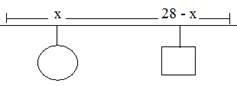
Now circumference of circle is 2$\pi$r
$\therefore$ $2\pi r = x$
$\Rightarrow$$r = \frac{x}{{2\pi }}$
Now perimeter of rectangle = 4a
$\therefore$$4a = 28 - x$
$\Rightarrow a = 7 - \frac{x}{4}$
ATQ
A = area of circle + area of square
$\pi {\left( {\frac{x}{{2\pi }}} \right)^2} + {\left( {7 - \frac{x}{4}} \right)^2}$
Now, $A = \pi .\frac{{{x^2}}}{{4{\pi ^2}}} + {\left( {7 - \frac{x}{4}} \right)^2}$
So,$\frac{{dA}}{{dx}} = \frac{{2x}}{{4\pi }} + 2\left( {7 - \frac{x}{4}} \right)\left( { - \frac{1}{4}} \right)$
$\frac{{dA}}{{dx}} = 0$
$\Rightarrow$ $\frac{{2x}}{{4\pi }} + 2\left( {7 - \frac{x}{4}} \right)\left( { - \frac{1}{4}} \right) = 0$
$\Rightarrow \frac{1}{2}\left( {7 - \frac{x}{4}} \right) = \frac{x}{{2\pi }}$
$\Rightarrow$ $7 - \frac{x}{4} = \frac{x}{\pi }$
$\Rightarrow$$7 = \frac{x}{\pi } + \frac{x}{4}$
$\Rightarrow$$7 = x\left( {\frac{{4 + \pi }}{{4\pi }}} \right)$
$\Rightarrow$$\frac{{28\pi }}{{4 + \pi }} = x$
Now, $\frac{{{d^2}y}}{{d{x^2}}} = \frac{1}{{2\pi }} - \frac{1}{2}\left( {\frac{{ - 1}}{4}} \right)$
$= \frac{1}{{2\pi }} + \frac{1}{8}$
positive, hence minimum
Therefore, 1st length $= \frac{{28\pi }}{{4 + \pi }}$
2nd length $= \frac{{28}}{1} - \frac{{28\pi }}{{4 + \pi }}$
$= 28\left[ {\frac{{4 + \pi - \pi }}{{4 + \pi }}} \right]$
$= \frac{{112}}{{4 + \pi }}$
2nd length = 28 - x
Now circumference of circle is 2$\pi$r
$\therefore$ $2\pi r = x$
$\Rightarrow$$r = \frac{x}{{2\pi }}$
Now perimeter of rectangle = 4a
$\therefore$$4a = 28 - x$
$\Rightarrow a = 7 - \frac{x}{4}$
ATQ
A = area of circle + area of square
$\pi {\left( {\frac{x}{{2\pi }}} \right)^2} + {\left( {7 - \frac{x}{4}} \right)^2}$
Now, $A = \pi .\frac{{{x^2}}}{{4{\pi ^2}}} + {\left( {7 - \frac{x}{4}} \right)^2}$
So,$\frac{{dA}}{{dx}} = \frac{{2x}}{{4\pi }} + 2\left( {7 - \frac{x}{4}} \right)\left( { - \frac{1}{4}} \right)$
$\frac{{dA}}{{dx}} = 0$
$\Rightarrow$ $\frac{{2x}}{{4\pi }} + 2\left( {7 - \frac{x}{4}} \right)\left( { - \frac{1}{4}} \right) = 0$
$\Rightarrow \frac{1}{2}\left( {7 - \frac{x}{4}} \right) = \frac{x}{{2\pi }}$
$\Rightarrow$ $7 - \frac{x}{4} = \frac{x}{\pi }$
$\Rightarrow$$7 = \frac{x}{\pi } + \frac{x}{4}$
$\Rightarrow$$7 = x\left( {\frac{{4 + \pi }}{{4\pi }}} \right)$
$\Rightarrow$$\frac{{28\pi }}{{4 + \pi }} = x$
Now, $\frac{{{d^2}y}}{{d{x^2}}} = \frac{1}{{2\pi }} - \frac{1}{2}\left( {\frac{{ - 1}}{4}} \right)$
$= \frac{1}{{2\pi }} + \frac{1}{8}$
positive, hence minimum
Therefore, 1st length $= \frac{{28\pi }}{{4 + \pi }}$
2nd length $= \frac{{28}}{1} - \frac{{28\pi }}{{4 + \pi }}$
$= 28\left[ {\frac{{4 + \pi - \pi }}{{4 + \pi }}} \right]$
$= \frac{{112}}{{4 + \pi }}$
Question 194 Marks
Of all the closed cylindrical cans (right circular) of a given volume of 100 cubic centimetres, find the dimensions of the can which has the minimum surface area.
Answer
View full question & answer→Let r be the radius and h be the height of the required cylinder.
Let V be the volume of the cylinder. Then
V = $\pi r^{2} h$ = 100(given)
$\Rightarrow \mathrm{h}=\frac{100}{\pi \mathrm{r}^{2}}$ .......(i)
Hence, the surface area S (say) of the cylinder is given by:
$S=2 \pi r^{2}+2 \pi r h$
= $2 \pi r^{2}+\frac{200}{r}$ , .....(using (i)
Now, $\frac{\mathrm{d} \mathrm{S}}{\mathrm{dr}}=4 \pi \mathrm{r}-\frac{200}{\mathrm{r}^{2}}, and \frac{\mathrm{d}^{2} \mathrm{S}}{\mathrm{dr}^{2}}=4 \pi+\frac{400}{\mathrm{r}^{3}}$
If $\frac{d S}{d r}=0 \Rightarrow 4 \pi r=\frac{200}{r^{2}} \Rightarrow r^{3}=\frac{200}{4 \pi}=\frac{50}{\pi} \Rightarrow r=\left(\frac{50}{\pi}\right)^{\frac{1}{3}}$
Further, at, $r=\left(\frac{50}{\pi}\right)^{\frac{1}{3}} $ we have, $\frac{\mathrm{d}^{2} \mathrm{S}}{\mathrm{dr}^{2}}>0$
Then, by second derivative test, the surface area is the minimum when $r=\left(\frac{50}{\pi}\right)^{\frac{1}{3}}$
Now, when $r=\left(\frac{50}{\pi}\right)^{\frac{1}{3}}$ then $h=\frac{100}{\pi\left(\frac{50}{\pi}\right)^{\frac{2}{3}}}=2\left(\frac{50}{\pi}\right)^{\frac{1}{3}} \mathrm{cm}$
Therefore, the dimensions of the can which has the minimum surface area are $r=\left(\frac{50}{\pi}\right)^{\frac{1}{3}}$ and $h=2\left(\frac{50}{\pi}\right)^{\frac{1}{3}}$ cm.
Let V be the volume of the cylinder. Then
V = $\pi r^{2} h$ = 100(given)
$\Rightarrow \mathrm{h}=\frac{100}{\pi \mathrm{r}^{2}}$ .......(i)
Hence, the surface area S (say) of the cylinder is given by:
$S=2 \pi r^{2}+2 \pi r h$
= $2 \pi r^{2}+\frac{200}{r}$ , .....(using (i)
Now, $\frac{\mathrm{d} \mathrm{S}}{\mathrm{dr}}=4 \pi \mathrm{r}-\frac{200}{\mathrm{r}^{2}}, and \frac{\mathrm{d}^{2} \mathrm{S}}{\mathrm{dr}^{2}}=4 \pi+\frac{400}{\mathrm{r}^{3}}$
If $\frac{d S}{d r}=0 \Rightarrow 4 \pi r=\frac{200}{r^{2}} \Rightarrow r^{3}=\frac{200}{4 \pi}=\frac{50}{\pi} \Rightarrow r=\left(\frac{50}{\pi}\right)^{\frac{1}{3}}$
Further, at, $r=\left(\frac{50}{\pi}\right)^{\frac{1}{3}} $ we have, $\frac{\mathrm{d}^{2} \mathrm{S}}{\mathrm{dr}^{2}}>0$
Then, by second derivative test, the surface area is the minimum when $r=\left(\frac{50}{\pi}\right)^{\frac{1}{3}}$
Now, when $r=\left(\frac{50}{\pi}\right)^{\frac{1}{3}}$ then $h=\frac{100}{\pi\left(\frac{50}{\pi}\right)^{\frac{2}{3}}}=2\left(\frac{50}{\pi}\right)^{\frac{1}{3}} \mathrm{cm}$
Therefore, the dimensions of the can which has the minimum surface area are $r=\left(\frac{50}{\pi}\right)^{\frac{1}{3}}$ and $h=2\left(\frac{50}{\pi}\right)^{\frac{1}{3}}$ cm.
Question 204 Marks
Show that the right circular cylinder of given surface and maximum volume is such that its height is equal to the diameter of the base.
Answer
View full question & answer→Let radius of the cylinder = r
Height of the cylinder = h|
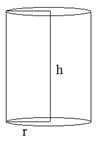
$s = 2\pi rh + 2\pi {r^2}$ (1)
$\Rightarrow\frac{{s-2\pi {r^2}}}{{2\pi r}} = h$
Now volume of cylinder is, $v = \pi {r^2}h$
$\Rightarrow$ $v = \pi .{r^2}\left( {\frac{{s - 2\pi {r^2}}}{{2\pi r}}} \right)$
$\Rightarrow v = \frac{1}{2}\left[ {sr - 2\pi {r^3}} \right]$
Now, $\frac{{dv}}{{dr}} = \frac{1}{2}\left[ {s - 6\pi {r^2}} \right]$
$\Rightarrow\frac{{{d^2}v}}{{d{r^2}}} = \frac{1}{2}\left[ {0 - 12\pi r} \right]$
For maximum/minimum
$\frac{{dv}}{{dr}} = 0$
$ \Rightarrow s = 6\pi {r^2}$
From equ (1)
$\Rightarrow 2\pi rh + \ 2π {r^2} = 6\pi {r^2}$
$\Rightarrow r = \frac{h}{2}$
${\left[ {\frac{{{d^2}v}}{{d{r^2}}}} \right]_{r = \frac{h}{2}}} = \frac{1}{2}\left[ {0 - 12\pi \times \frac{h}{2}} \right]$
$ = - 3\pi h < 0$
$\Rightarrow$ s is maximum at $r = \frac{h}{2}$
Hence h = 2r
Height of the cylinder = h|
$s = 2\pi rh + 2\pi {r^2}$ (1)
$\Rightarrow\frac{{s-2\pi {r^2}}}{{2\pi r}} = h$
Now volume of cylinder is, $v = \pi {r^2}h$
$\Rightarrow$ $v = \pi .{r^2}\left( {\frac{{s - 2\pi {r^2}}}{{2\pi r}}} \right)$
$\Rightarrow v = \frac{1}{2}\left[ {sr - 2\pi {r^3}} \right]$
Now, $\frac{{dv}}{{dr}} = \frac{1}{2}\left[ {s - 6\pi {r^2}} \right]$
$\Rightarrow\frac{{{d^2}v}}{{d{r^2}}} = \frac{1}{2}\left[ {0 - 12\pi r} \right]$
For maximum/minimum
$\frac{{dv}}{{dr}} = 0$
$ \Rightarrow s = 6\pi {r^2}$
From equ (1)
$\Rightarrow 2\pi rh + \ 2π {r^2} = 6\pi {r^2}$
$\Rightarrow r = \frac{h}{2}$
${\left[ {\frac{{{d^2}v}}{{d{r^2}}}} \right]_{r = \frac{h}{2}}} = \frac{1}{2}\left[ {0 - 12\pi \times \frac{h}{2}} \right]$
$ = - 3\pi h < 0$
$\Rightarrow$ s is maximum at $r = \frac{h}{2}$
Hence h = 2r
Question 214 Marks
Show that of all the rectangles inscribed in a given fixed circle, the square has the maximum area.
Answer
View full question & answer→Let ABCD be the rectangle which is inscribed in a fixed circle whose centre is O and radius b. Let AB = 2x and BC = 2y.
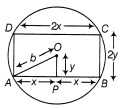
In right-angled $\Delta$OPA by Pythagoras theorem,
we have
AP2 + OP2 = OA2
$\Rightarrow \quad x ^ { 2 } + y ^ { 2 } = b ^ { 2 }$
$\Rightarrow \quad y ^ { 2 } = b ^ { 2 } - x ^ { 2 }$
$\Rightarrow \quad y = \sqrt { b ^ { 2 } - x ^ { 2 } }$ ...(i)
Let A be the area of the rectangle.
$\therefore$ A = (2x) (2y) [$\because$ area of rectangle = length $\times$ breadth]
$\Rightarrow \quad A = 4 x y$
$\Rightarrow \quad A = 4 x \sqrt { b ^ { 2 } - x ^ { 2 } } \quad \left[ \because \quad y = \sqrt { b ^ { 2 } - x ^ { 2 } } \right]$
Therefore, on differentiating both sides w.r.t. x, we get,
$\frac { d A } { d x } = 4 x \cdot \frac { d } { d x } \sqrt { b ^ { 2 } - x ^ { 2 } } + \sqrt { b ^ { 2 } - x ^ { 2 } } \cdot \frac { d } { d x } ( 4 x )$ [by using product rule of derivative]
$\Rightarrow \frac { d A } { d x } = 4 x \cdot \frac { - 2 x } { 2 \sqrt { b ^ { 2 } - x ^ { 2 } } } + \sqrt { b ^ { 2 } - x ^ { 2 } } \cdot 4$
$= 4 \left[ \frac { b ^ { 2 } - x ^ { 2 } - x ^ { 2 } } { \sqrt { b ^ { 2 } - x ^ { 2 } } } \right]$
$\Rightarrow \frac { d A } { d x } = 4 \left( \frac { b ^ { 2 } - 2 x ^ { 2 } } { \sqrt { b ^ { 2 } - x ^ { 2 } } } \right)$
For maxima or minima, put $\frac { d A } { d x } = 0$
$\therefore \quad 4 \left( \frac { b ^ { 2 } - 2 x ^ { 2 } } { \sqrt { b ^ { 2 } - x ^ { 2 } } } \right) = 0$
$\Rightarrow \quad b ^ { 2 } - 2 x ^ { 2 } = 0$
$\Rightarrow \quad 2 x ^ { 2 } = b ^ { 2 }$
$\Rightarrow \quad x = \frac { b } { \sqrt { 2 } }$ [$\because$ x cannot be negative]
Also, $\frac { d ^ { 2 } A } { d x ^ { 2 } } = \frac { d } { d x } \left( \frac { d A } { d x } \right) = \frac { d } { d x } \left[ \frac { 4 \left( b ^ { 2 } - 2 x ^ { 2 } \right) } { \sqrt { b ^ { 2 } - x ^ { 2 } } } \right]$
$\Rightarrow \quad \frac { d ^ { 2 } A } { d x ^ { 2 } } = \frac { d } { d x } \left[ 4 \left( b ^ { 2 } - 2 x ^ { 2 } \right) \left( b ^ { 2 } - x ^ { 2 } \right) ^ { - 1 / 2 } \right]$
$ \Rightarrow \quad \frac{{{d^2}A}}{{d{x^2}}}$ $ = 4\left[ { - 4x{{\left( {{b^2} - {x^2}} \right)}^{ - 1/2}} + \left( {{b^2} - 2{x^2}} \right)\left( { - \frac{1}{2}} \right){{\left( {{b^2} - {x^2}} \right)}^{ - 3/2}}( - 2x)} \right]$ [by using product rule of derivative]
$\Rightarrow \quad \frac { d ^ { 2 } A } { d x ^ { 2 } } = 4 \left[ \frac { - 4 x } { \sqrt { b ^ { 2 } - x ^ { 2 } } } + \frac { x \left( b ^ { 2 } - 2 x ^ { 2 } \right) } { \left( b ^ { 2 } - x ^ { 2 } \right) ^ { 3 / 2 } } \right]$
On putting $x = \frac { b } { \sqrt { 2 } }$, we get
$\frac { d ^ { 2 } A } { d x ^ { 2 } } = 4 \left[ \frac { \frac { - 4 b } { \sqrt { 2 } } } { \sqrt { b ^ { 2 } - \frac { b ^ { 2 } } { 2 } } } + \frac { \frac { b } { \sqrt { 2 } } \left( b ^ { 2 } - 2 \frac { b ^ { 2 } } { 2 } \right) } { \left( b ^ { 2 } - \frac { b ^ { 2 } } { 2 } \right) ^ { 3 / 2 } } \right]$
$= 4 \left[ \frac { \frac { - 4 b } { \sqrt { 2 } } } { \sqrt { \frac { b ^ { 2 } } { 2 } } } +0\right]$
$\Rightarrow \quad \frac { d ^ { 2 } A } { d x ^ { 2 } } = - 16 < 0$
$\therefore \frac { d ^ { 2 } A } { d x ^ { 2 } } < 0$. Therefore, A is maximum at $x = \frac { b } { \sqrt { 2 } }$
Now, on putting $x = \frac { b } { \sqrt { 2 } }$ in Eq. (i), we get
$y = \sqrt { b ^ { 2 } - \frac { b ^ { 2 } } { 2 } } = \sqrt { \frac { b ^ { 2 } } { 2 } } = \frac { b } { \sqrt { 2 } }$
$\therefore \quad x = y = \frac { b } { \sqrt { 2 } } \Rightarrow 2 x = 2 y = \sqrt { 2 } b$
Thus, area of rectangle is maximum, when 2x = 2y, i.e. when rectangle is a square
In right-angled $\Delta$OPA by Pythagoras theorem,
we have
AP2 + OP2 = OA2
$\Rightarrow \quad x ^ { 2 } + y ^ { 2 } = b ^ { 2 }$
$\Rightarrow \quad y ^ { 2 } = b ^ { 2 } - x ^ { 2 }$
$\Rightarrow \quad y = \sqrt { b ^ { 2 } - x ^ { 2 } }$ ...(i)
Let A be the area of the rectangle.
$\therefore$ A = (2x) (2y) [$\because$ area of rectangle = length $\times$ breadth]
$\Rightarrow \quad A = 4 x y$
$\Rightarrow \quad A = 4 x \sqrt { b ^ { 2 } - x ^ { 2 } } \quad \left[ \because \quad y = \sqrt { b ^ { 2 } - x ^ { 2 } } \right]$
Therefore, on differentiating both sides w.r.t. x, we get,
$\frac { d A } { d x } = 4 x \cdot \frac { d } { d x } \sqrt { b ^ { 2 } - x ^ { 2 } } + \sqrt { b ^ { 2 } - x ^ { 2 } } \cdot \frac { d } { d x } ( 4 x )$ [by using product rule of derivative]
$\Rightarrow \frac { d A } { d x } = 4 x \cdot \frac { - 2 x } { 2 \sqrt { b ^ { 2 } - x ^ { 2 } } } + \sqrt { b ^ { 2 } - x ^ { 2 } } \cdot 4$
$= 4 \left[ \frac { b ^ { 2 } - x ^ { 2 } - x ^ { 2 } } { \sqrt { b ^ { 2 } - x ^ { 2 } } } \right]$
$\Rightarrow \frac { d A } { d x } = 4 \left( \frac { b ^ { 2 } - 2 x ^ { 2 } } { \sqrt { b ^ { 2 } - x ^ { 2 } } } \right)$
For maxima or minima, put $\frac { d A } { d x } = 0$
$\therefore \quad 4 \left( \frac { b ^ { 2 } - 2 x ^ { 2 } } { \sqrt { b ^ { 2 } - x ^ { 2 } } } \right) = 0$
$\Rightarrow \quad b ^ { 2 } - 2 x ^ { 2 } = 0$
$\Rightarrow \quad 2 x ^ { 2 } = b ^ { 2 }$
$\Rightarrow \quad x = \frac { b } { \sqrt { 2 } }$ [$\because$ x cannot be negative]
Also, $\frac { d ^ { 2 } A } { d x ^ { 2 } } = \frac { d } { d x } \left( \frac { d A } { d x } \right) = \frac { d } { d x } \left[ \frac { 4 \left( b ^ { 2 } - 2 x ^ { 2 } \right) } { \sqrt { b ^ { 2 } - x ^ { 2 } } } \right]$
$\Rightarrow \quad \frac { d ^ { 2 } A } { d x ^ { 2 } } = \frac { d } { d x } \left[ 4 \left( b ^ { 2 } - 2 x ^ { 2 } \right) \left( b ^ { 2 } - x ^ { 2 } \right) ^ { - 1 / 2 } \right]$
$ \Rightarrow \quad \frac{{{d^2}A}}{{d{x^2}}}$ $ = 4\left[ { - 4x{{\left( {{b^2} - {x^2}} \right)}^{ - 1/2}} + \left( {{b^2} - 2{x^2}} \right)\left( { - \frac{1}{2}} \right){{\left( {{b^2} - {x^2}} \right)}^{ - 3/2}}( - 2x)} \right]$ [by using product rule of derivative]
$\Rightarrow \quad \frac { d ^ { 2 } A } { d x ^ { 2 } } = 4 \left[ \frac { - 4 x } { \sqrt { b ^ { 2 } - x ^ { 2 } } } + \frac { x \left( b ^ { 2 } - 2 x ^ { 2 } \right) } { \left( b ^ { 2 } - x ^ { 2 } \right) ^ { 3 / 2 } } \right]$
On putting $x = \frac { b } { \sqrt { 2 } }$, we get
$\frac { d ^ { 2 } A } { d x ^ { 2 } } = 4 \left[ \frac { \frac { - 4 b } { \sqrt { 2 } } } { \sqrt { b ^ { 2 } - \frac { b ^ { 2 } } { 2 } } } + \frac { \frac { b } { \sqrt { 2 } } \left( b ^ { 2 } - 2 \frac { b ^ { 2 } } { 2 } \right) } { \left( b ^ { 2 } - \frac { b ^ { 2 } } { 2 } \right) ^ { 3 / 2 } } \right]$
$= 4 \left[ \frac { \frac { - 4 b } { \sqrt { 2 } } } { \sqrt { \frac { b ^ { 2 } } { 2 } } } +0\right]$
$\Rightarrow \quad \frac { d ^ { 2 } A } { d x ^ { 2 } } = - 16 < 0$
$\therefore \frac { d ^ { 2 } A } { d x ^ { 2 } } < 0$. Therefore, A is maximum at $x = \frac { b } { \sqrt { 2 } }$
Now, on putting $x = \frac { b } { \sqrt { 2 } }$ in Eq. (i), we get
$y = \sqrt { b ^ { 2 } - \frac { b ^ { 2 } } { 2 } } = \sqrt { \frac { b ^ { 2 } } { 2 } } = \frac { b } { \sqrt { 2 } }$
$\therefore \quad x = y = \frac { b } { \sqrt { 2 } } \Rightarrow 2 x = 2 y = \sqrt { 2 } b$
Thus, area of rectangle is maximum, when 2x = 2y, i.e. when rectangle is a square
Question 224 Marks
A rectangular sheet of tin 45 cm by 24 cm is to be made into a box without top, by cutting off square from each corner and folding up the flaps. What should be the side of the square to be cut off so that the volume of the box is maximum?
Answer
View full question & answer→Let the side of the square to be cut off be x, then, the height of the box is x and the length is 45 - 2x and the breadth is 24 - 2x.
Then, the volume V(x) of the box is given by:
V(x) = x(45 - 2x)(24 - x)
= x(1080 - 90x - 48x + 4x2)
= 4x3 - 138x2 + 1080x
$\therefore$ $V^\prime$(x) = 12x2 - 276x + 1080
= 12(x2 - 23x + 90)
= 12(x - 18)(x - 5)
And, $V^\prime{^\prime}$(x) = 24x - 276 = 12(2x - 23)
Now, $V^\prime$(x) = 0
$\Rightarrow$ x = 18 or 5
It is not possible to cut off a square of side 18 cm from each corner of the rectangular sheet. So, x cannot be equal to 18.
Therefore, x = 5
$V^\prime{^\prime}$(5) = 12(10 - 23) = -156 < 0
Then, by second derivative test, x = 5 is the point of maxima of V.
Therefore, the side of the square to be cut off to make the volume of the box maximum is 5 cm.
Then, the volume V(x) of the box is given by:
V(x) = x(45 - 2x)(24 - x)
= x(1080 - 90x - 48x + 4x2)
= 4x3 - 138x2 + 1080x
$\therefore$ $V^\prime$(x) = 12x2 - 276x + 1080
= 12(x2 - 23x + 90)
= 12(x - 18)(x - 5)
And, $V^\prime{^\prime}$(x) = 24x - 276 = 12(2x - 23)
Now, $V^\prime$(x) = 0
$\Rightarrow$ x = 18 or 5
It is not possible to cut off a square of side 18 cm from each corner of the rectangular sheet. So, x cannot be equal to 18.
Therefore, x = 5
$V^\prime{^\prime}$(5) = 12(10 - 23) = -156 < 0
Then, by second derivative test, x = 5 is the point of maxima of V.
Therefore, the side of the square to be cut off to make the volume of the box maximum is 5 cm.
Question 234 Marks
A square piece of tin of side 18cm is to be made into a box without top, by cutting a square from each corner and folding up the flaps to form the box. What should be the side of the square to be cut off so that the volume of the box is the maximum possible.
Answer
View full question & answer→Let side of square piece cut from the corner is = x
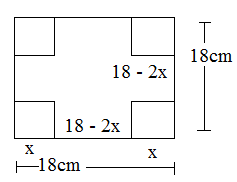
l = (18 - 2x)cm
b = (18 - 2x)cm
h = x cm
$v = l \times b \times h$
$v = \left( {18 - 2x} \right) \times \left( {18 - 2x} \right) \times x$
$v = {\left( {18 - 2x} \right)^2} \times x$
$\frac{{dv}}{{dx}} = {\left( {18 - 2x} \right)^2}.\left( 1 \right) + \left( x \right).2\left( {18 - 2x} \right)\left( { - 2} \right)$
$\frac{{dv}}{{dx}} = \left( {18 - 2x} \right)\left[ {\left( {18 - 2x} \right) - 4x} \right]$
For maximum/minimum
$0 = \left( {18 - 2x} \right)\left( {18 - 6x} \right)$
Now 18 - 2x = 0
$\Rightarrow$x = 9 (neglect)
Now 18 - 6x =0
$\Rightarrow$ x = 3
$\frac{{{d^2}y}}{{d{x^2}}} = \left( {18 - 2x} \right)(-6) + \left( {18 - 6x} \right)\left( { - 2} \right)$
${\left. {\frac{{{d^2}y}}{{d{x^2}}}} \right]_{x = 3}} = 12 \times( -6)$
= - 72<0 , Hence maximum
$l = 18 - 2 \times 3 = 12cm$
b = 12 cm
h = 3 cm
Side of square piece cut at the corner is 3cm so that the volume of the box become maximum
l = (18 - 2x)cm
b = (18 - 2x)cm
h = x cm
$v = l \times b \times h$
$v = \left( {18 - 2x} \right) \times \left( {18 - 2x} \right) \times x$
$v = {\left( {18 - 2x} \right)^2} \times x$
$\frac{{dv}}{{dx}} = {\left( {18 - 2x} \right)^2}.\left( 1 \right) + \left( x \right).2\left( {18 - 2x} \right)\left( { - 2} \right)$
$\frac{{dv}}{{dx}} = \left( {18 - 2x} \right)\left[ {\left( {18 - 2x} \right) - 4x} \right]$
For maximum/minimum
$0 = \left( {18 - 2x} \right)\left( {18 - 6x} \right)$
Now 18 - 2x = 0
$\Rightarrow$x = 9 (neglect)
Now 18 - 6x =0
$\Rightarrow$ x = 3
$\frac{{{d^2}y}}{{d{x^2}}} = \left( {18 - 2x} \right)(-6) + \left( {18 - 6x} \right)\left( { - 2} \right)$
${\left. {\frac{{{d^2}y}}{{d{x^2}}}} \right]_{x = 3}} = 12 \times( -6)$
= - 72<0 , Hence maximum
$l = 18 - 2 \times 3 = 12cm$
b = 12 cm
h = 3 cm
Side of square piece cut at the corner is 3cm so that the volume of the box become maximum