Questions

4 Marks

🎯

Test yourself on this topic

20 questions · timed · auto-graded

Question 14 Marks
An open box with square base is to be made of a given quantity of card board of area c2. Show that the maximum volume of the box is $\frac{\text{c}^2}{6\sqrt{3}}$ cubic units.
Answer
Suppose, the side of the square base of open box be x units and its height be y units.
Thus, the area of the metal used = x2 + 4xy
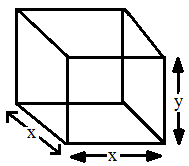
Now, $\text{x}^2+4\text{xy}=\text{c}^2$
$\Rightarrow\ \text{y}=\frac{\text{c}^2-\text{x}^2}{4\text{x}}$
The volume of the box (V) is given by V = x2y
Substituting $\text{y}=\frac{\text{c}^2-\text{x}^2}{4\text{x}}$ in V = x2, we get
$\text{V}=\text{x}^2\cdot\Big(\frac{\text{c}^2-\text{x}^2}{4\text{x}}\Big)$
$\Rightarrow\ \text{V}=\frac{1}{4}\text{x}(\text{c}^2-\text{x}^2)$
$\Rightarrow\ \text{V}=\frac{1}{4}(\text{c}^2-\text{x}-\text{x}^3)$
$\Rightarrow\ \frac{\text{dV}}{\text{dx}}=\frac{1}{4}(\text{c}^2-3\text{x}^2)$
Find the critical points by equating $\frac{\text{dV}}{\text{dx}}$ to zero.
$\therefore\ \text{c}^2-3\text{x}^2=0$
$\Rightarrow\ \text{x}^2=\frac{\text{c}^2}{3}$
$\Rightarrow\ \text{x}=\frac{\text{c}}{\sqrt{3}}$ [Neglecting negative value of x as side can’t be negative]
Consider, $\frac{\text{dV}}{\text{dx}}=\frac{1}{4}(\text{c}^2-3\text{x}^2)$
$\Rightarrow\ \frac{\text{d}^2\text{V}}{\text{dx}^2}=\frac{1}{4}(-6\text{x})=\frac{-3}{2}\text{x}$
$\Rightarrow\Big(\frac{\text{dv}^2}{\text{dx}^2}\Big)_{\text{x}=\frac{\text{C}}{\sqrt{3}}}=-\frac{3}{2}\Big(\frac{\text{G}}{\sqrt{3}}\Big)<0$
Thus, the volume (V) is maximum at $\text{x}=\frac{\text{c}}{\sqrt{3}}$
$\therefore$ Maximum volume of the box, $(\text{V})_{\text{x}=\frac{\text{c}}{\sqrt{3}}}=\frac{1}{4}\Big(\text{c}^2\cdot\frac{\text{c}}{\sqrt{3}}-\frac{\text{c}^3}{3\sqrt{3}}\Big)$
$=\frac{1}{4}\cdot\frac{(3\text{c}^3-\text{c}^3)}{3\sqrt{3}}=\frac{1}{4}\cdot\frac{2\text{c}^3}{3\sqrt{3}}$
$=\frac{\text{c}^2}{6\sqrt{3}}\text{ cu units}$ 
View full question & answer
Question 24 Marks
Find the points of local maxima, local minima and the points of inflection of the function f(x) = x5 - 5x4 + 5x3 - 1. Also find the corresponding local maximum and local minimum values.
Answer
Given that, f(x) = x5 - 5x4 + 5x3 -1
On differentiating w.r.t. x, we get
f'(x) = 5x4 - 20x3 + 15x2
For maxima or minima f'(x) = 0
⇒ 5x4 - 20x3 + 15x2 = 0
⇒ 5x2(x2 - 4x + 3) = 0
⇒ 5x2(x2 - 3x - x + 3) = 0
⇒ 5x2[x(x - 3) -1(x - 3)] = 0
⇒ 5x2[(x - 1)(x - 3)] = 0
$\therefore$ x = 0, 1, 3
Sing scheme for $\frac{\text{dy}}{\text{dx}}=5\text{x}^2(\text{x}-1)(\text{x}-3)$
So, y has maximum value at x = 1 and minimum value at x = 3.
At x = 0, y has neither maximum nor minimum value, so x = 0 is the point of inflection
Maximum value of y = 1 - 5 + 5 - 1 = 0 (at x = 1)
and Minimum value of y = 35 -5(3)4 + 5(3)3 -1 = 243 - 405 + 135 - 1 = -28 (at x = 3)
View full question & answer
Question 34 Marks
AB is a diameter of a circle and C is any point on the circle. Show that the area of $\triangle\text{ABC}$ is maximum, when it is isosceles.
Answer
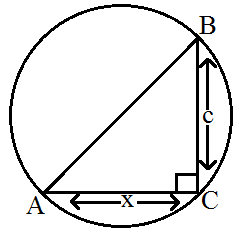
We have, AB = 2r

And $\angle\text{ACB}=90^\circ$ [Since, angle in the semi-circle is always 90°]
Let AC = x and BC = y
$(2\text{r})^2 = \text{x}^2 + \text{y}^2$
$\Rightarrow\ \text{y}^2 = 4\text{r}^2 - \text{x}^2$
$\Rightarrow\ \text{y}=\sqrt{4\text{r}^2-\text{x}^2}\ \ \dots(\text{i})$
Now, area of $\triangle\text{ABC, A}=\frac{1}{2}\times\text{x}\times\text{y}$
$=\frac{1}{2}\times\text{x}\times(4\text{r}^2-\text{x}^2)^{\frac{1}{2}}$[using Eq. (i)]
 Now, differentiating both sides w.r.t. x, we get
$\frac{\text{dA}}{\text{dx}}=\frac{1}{2}\Big[\text{x}\cdot\frac{1}{2}(4\text{r}^2-\text{x}^2)^{\frac{-1}{2}}\cdot(0-2\text{x})+(4\text{r}^2-\text{x}^2)^{\frac{-1}{2}}\cdot1\Big]$
$=\frac{1}2{}\Big[\frac{-2\text{x}^2}{2\sqrt{4\text{r}^2-\text{x}^2}}+(4\text{r}^2-\text{x}^2)^{\frac{1}{2}}\Big]$
$=\frac{1}{2}\Big[\frac{-\text{x}^2}{\sqrt{4\text{r}^2-\text{x}^2}}+\sqrt{4\text{r}^2-\text{x}^2}\Big]$
$=\frac{1}{2}\Big[\frac{-\text{x}^2+4\text{r}^2-\text{x}^2}{\sqrt{4\text{r}^2-\text{x}^2}}\Big]$ $=\frac{1}{2}\Big[\frac{-2\text{x}^2+4\text{r}^2}{\sqrt{4\text{r}^2-\text{x}^2}}\Big]$
$\frac{\text{dA}}{\text{dx}}=\Big[\frac{(-\text{x}^2+2\text{r}^2)}{\sqrt{4\text{r}^2-\text{x}^2}}\Big]$
Now, $\frac{\text{dA}}{\text{dx}}=0$
$-\text{x}^2+2\text{r}^2=0$
$\text{r}^2=\frac{1}{2}\text{x}^2$
$\text{r}=\frac{1}{\sqrt{2}}\text{x}^2$
$\text{x}=\text{r}\sqrt{2}$
Again, differentiating both sides w.r.t. x, we get
$\frac{\text{d}^2\text{A}}{\text{dx}^2}=\frac{\sqrt{4\text{r}^2-\text{x}^2}\cdot(2\text{x})+(2\text{r}^2-\text{x}^2)\cdot\frac{1}{2}(4\text{r}^2-\text{x}^2)^{\frac{-1}{2}}(-2\text{x})}{\big(\sqrt{4\text{r}^2-\text{x}^2}\big)^2}$
$=\frac{-2\text{x}\Big[\sqrt{4\text{r}^2-\text{x}^2}+(2\text{r}^2-\text{x}^2)\cdot\frac{1}{2\sqrt{4\text{r}^2-\text{x}^2}}\Big]}{\big(\sqrt{4\text{r}^2-\text{x}^2}\big)^2}$
$=\frac{-4\text{x}\cdot\big(\sqrt{4\text{r}^2-\text{x}^2}\big)^2+(2\text{r}^2-\text{x}^2)(-2\text{x})}{2\cdot(4\text{r}^2-\text{x}^2)^{\frac{3}{2}}}$
$=\frac{-4\text{x}(4\text{r}^2-\text{x}^2)^2+(2\text{r}^2-\text{x}^2)\cdot(-2\text{x})}{2\cdot(4\text{r}^2-\text{x}^2)^{\frac{3}{2}}}$
$=\frac{-16\text{xr}^2+4\text{x}^3+(2\text{r}^2-\text{x}^2)(-2\text{x})}{2\cdot(4\text{r}^2-\text{x}^2)^{\frac{3}{2}}}$
$\Big(\frac{\text{d}^2\text{A}}{\text{dx}^2}\Big)_{\text{x}=\text{r}\sqrt{2}}=\frac{-16\cdot\text{r}\sqrt{2}\cdot\text{r}^2+4\cdot\big(\text{r}\sqrt{2}\big)^3+\Big[2\text{r}^2-\big(\text{r}\sqrt{2}\big)^2\Big]\cdot\big(-2\cdot\text{r}\sqrt{2}\big)}{2\cdot(4\text{r}^2-2\text{r}^2)^{\frac{3}{2}}}$ $\big[\because\ \text{x}=\text{r}\sqrt{2}\big]$
$=\frac{-16\sqrt{2}\cdot\text{r}^3+8\sqrt{2}\text{r}^3}{2(2\text{r}^2)^{\frac{3}{2}}}=\frac{8\sqrt{2}\text{r}^2[\text{r}-2\text{r}]}{4\text{r}^3}$
$=\frac{-8\sqrt{2}\text{r}^3}{4\text{r}^3}=-2\sqrt{2}<0$
For $\text{x}=\text{r}\sqrt{2},$ the area of triangle is maximum.
For $\text{x}=\text{r}\sqrt{2},$ $\text{y}=\sqrt{4\text{r}^2\big(\text{r}\sqrt{2}\big)^2}=\sqrt{2\text{r}^2}=\text{r}\sqrt{2}$
Since, $\text{x}=\text{r}\sqrt{2}=\text{y}$
Hence, the triangle is isosceles.
View full question & answer
Question 44 Marks
A man, 2m tall, walks at the rate of $1\frac{2}{3}\text{m/s}$ towards a street light which is $5\frac{1}{3}\text{m}$ above the ground. At what rate is the tip of his shadow moving? at what rate is the length of the shadow changing when he is $3\frac{1}{3}\text{m}$ from the base of the light?
Answer
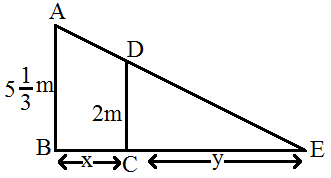
Let AB be the street light post and CD be the height of man i.e., CD = 2m.

Let BC = x m, CE = y m and $\frac{\text{dx}}{\text{dt}}=\frac{-5}{3}\text{m/s}$
From $\triangle\text{ABE}$ and $\triangle\text{DCE},$ we see that
$\triangle\text{ABE}\sim\triangle\text{DCE}$ [by AAA similarity]
$\therefore\ \frac{\text{AB}}{\text{DC}}=\frac{\text{BE}}{\text{CE}}$ $\Rightarrow\ \frac{\frac{16}{3}}{2}=\frac{\text{x}+\text{y}}{\text{y}}$
$\Rightarrow\ \frac{16}{6}=\frac{\text{x}+\text{y}}{\text{y}}$
$\Rightarrow\ 16\text{y}=6\text{x}+6\text{y}\Rightarrow10\text{y}=6\text{x}$
$\Rightarrow\ \text{y}=\frac{3}{5}\text{x}$
On differentiating both sides w.r.t. t, we get
$\frac{\text{dy}}{\text{dt}}=\frac{3}{5}\cdot\frac{\text{dx}}{\text{dt}}=\frac{3}{5}\cdot\Big(-1\frac{2}{3}\Big)$ [Since, the man is moving toward the light post]
$=\frac{3}{5}\cdot\Big(\frac{-5}{3}\Big)=-1\text{m/s}$
Let the distance of the tip of shadow at any instant from the foot of street light is z
$\Rightarrow\ \text{z}=\text{x}+\text{y}$
Now, differentiating both sides w.r.t. t, we get
$\frac{\text{dz}}{\text{dt}}=\frac{\text{dx}}{\text{dt}}+\frac{\text{dy}}{\text{dt}}=-\Big(\frac{5}{3}+1\Big)$
$=-\frac{8}{3}=-\Big(-2\frac{2}{3}\Big)\text{m/s}$
Hence, the tip of shadow is moving at the rate of $2\frac{2}{3}\text{m/s}$ towards the light source and length of the shadow is decreasing at the rate of 1m/ s.
View full question & answer
Question 54 Marks
If the sum of the lengths of the hypotenuse and a side of a right angled triangle is given, show that the area of the triangle is maximum when the angle between them is $\frac{\pi}{3}.$
Answer

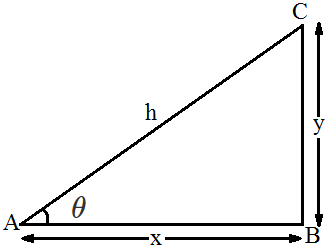
Let ABC be a triangle with AC = h, AB = x and BC = y
Let h + x = k ...(1)
Also, $\angle\text{CAB}=\theta$
$\Rightarrow\ \cos\theta=\frac{\text{x}}{\text{h}}$
$\Rightarrow\ \text{x}=\text{h}\cos\theta$
Substituting $\text{x}=\text{h}\cos\theta$ in $\text{h}+\text{x}=\text{k},$ we get
$\text{h}+\text{h}\cos\theta=\text{k}$ [using (1)]
$\Rightarrow\ \text{h}=\frac{\text{k}}{(1+\cos\theta)}\ \ \dots(2)$
Now, area of $\triangle\text{ABC}=\frac{1}{2}(\text{AB}\cdot\text{BC})$
$\text{A}=\frac{1}{2}\cdot\text{x}\cdot\text{y}$
$=\frac{1}{2}\text{h}\cos\theta\cdot\text{h}\sin\theta$ $\Big[\because\ \text{x}=\text{h}\cos\theta\text{ and }\sin\theta=\frac{\text{y}}{\text{h}}\Big]$
$=\frac{1}{2}\text{h}^2\sin\theta\cos\theta$
$=\frac{2\text{h}^2}{4}\sin\theta\cdot\cos\theta$
$\therefore\ \text{A}=\frac{1}{4}\text{h}^2\sin2\theta\ \ \dots(3)$
Substituting $\text{h}=\frac{\text{k}}{1+\cos\theta}$ in $\text{A}=\frac{1}{4}\text{h}^2\sin2\theta,$ we get
$\text{A}=\frac{1}{4}\Big(\frac{\text{k}}{1+\cos\theta}\Big)^2\cdot\sin2\theta$
$\Rightarrow\ \text{A}=\frac{\text{k}^2}{4}\cdot\frac{\sin2\theta}{(1+\cos\theta)^2}\ \ \dots(4)$
$\Rightarrow\ \frac{\text{dA}}{\text{d}\theta}=\frac{\text{k}^2}{4}\bigg[\frac{(1+\cos\theta)^2\cdot\cos2\theta\cdot2-\sin2\theta\cdot2(1+\cos\theta)\cdot(0-\sin\theta)}{(1+\cos\theta)^4}\bigg]$
$\frac{\text{k}^2}{4}\Bigg\{\frac{2(1+\cos\theta)\big[(1+\cos\theta)\cdot\cos2\theta+\sin2\theta(\sin\theta)\big]}{(1+\cos\theta)^4}\Bigg\}$
$\frac{\text{k}^2}{4}\cdot\frac{2}{(1+\cos\theta)^3}\big[(1+\cos\theta)\cdot\cos2\theta+2\sin^2\theta\cdot\cos\theta\big]$
$=\frac{\text{k}^2}{2(1+\cos\theta)^3}\big[(1+\cos\theta)(1-2\sin^2\theta)+2\sin^2\theta\cdot\cos\theta\big]$
$=\frac{\text{k}^2}{2(1+\cos\theta)^3}\big[1+\cos\theta-2\sin^2\theta -2\sin^2\theta\cdot\cos\theta+2\sin^1\theta\cdot\cos\theta\big]$
$=\frac{\text{k}^2}{2(1+\cos\theta)^3}\big[(1+\cos\theta)-2\sin^2\theta\big]$
$ =\frac{\text{k}^2}{2(1+\cos\theta)^3}\big[1+\cos\theta-2+2\cos^2\theta\big]$
$=\frac{\text{k}^2}{2(1+\cos\theta)^3}(2\cos^2\theta+\cos\theta-1)\ \ \dots(5)$
For $\frac{\text{dA}}{\text{d}\theta}=0,$
$=\frac{\text{k}^2}{2(1+\cos\theta)^3}(2\cos^2\theta+\cos\theta-1)=0$
$\Rightarrow\ 2\cos^2\theta+\cos\theta-1=0$
$\Rightarrow\ 2\cos^2\theta+2\cos\theta-\cos\theta-1=0$
$\Rightarrow\ 2\cos^2\theta(\cos\theta+1)-1(\cos\theta+1)=0$
$\Rightarrow\ (2\cos\theta-1)(\cos\theta+1)=0$
$\Rightarrow\ \cos\theta=\frac{1}{2}\text{ or }\cos\theta=-1$
$\Rightarrow\ \theta=\frac{\pi}{3}$
$\theta=2\text{n}\pi\pm\pi$
Again, differentiating w.r.t $\theta$ in Eq. (v), we get
$\frac{\text{d}}{\text{d}\theta}\Big(\frac{\text{dA}}{\text{d}\theta}\Big)=\frac{\text{d}}{\text{d}\theta}\bigg[\frac{\text{k}^2}{2(1+\cos\theta)^3}(2\cos^2\theta+\cos\theta-1)\bigg]$
$\frac{\text{d}^2\text{A}}{\text{d}\theta^2}=\frac{\text{d}}{\text{d}\theta}\bigg[\frac{\text{k}^2(2\cos\theta-1)(1+\cos\theta)}{2(1+\cos\theta)^3}\bigg]=\frac{\text{d}}{\text{d}\theta}\bigg[\frac{\text{k}^2}{2}.\frac{(2\cos\theta-1)}{(1+\cos\theta)^2}\bigg]$
$=\frac{\text{k}^2}{2}\bigg[\frac{(1+\cos\theta)^2\cdot(-2\sin\theta)-2(1+\cos\theta)\cdot(-\sin\theta)(2\cos\theta-1)}{(1+\cos\theta)^4}\bigg]$
$=\frac{\text{k}^2}{2}\bigg[\frac{(1+\cos\theta)\cdot[1+\cos\theta](-2\sin\theta)+(2\sin\theta)(2\cos\theta-1)}{(1+\cos\theta)^4}\bigg]$
$=\frac{\text{k}^2}{2}\bigg[\frac{-2\sin\theta-2\sin\theta\cdot\cos\theta+4\sin\theta\cdot\cos\theta-2\sin\theta}{(1+\cos\theta)^3}\bigg]$
$=\frac{\text{k}^2}{2}\bigg[\frac{-4\sin\theta-\sin2\theta+2\sin2\theta}{(1+\cos\theta)^3}\bigg]=\frac{\text{k}^2}{2}\bigg[\frac{\sin2\theta-4\sin\theta}{(1+\cos\theta)^3}\bigg]$
$\bigg(\frac{\text{d}^2\text{A}}{\text{d}\theta^2}\bigg)_{\text{at}\theta=\frac{\pi}{3}}=\frac{\text{k}^2}{2}\Bigg[\frac{\sin\frac{2\pi}{3}-4\sin\frac{\pi}{3}}{\Big(1+\cos\theta\frac{\pi}{3}\Big)^3}\Bigg]=\frac{\text{k}^2}{2}\Bigg[\frac{\frac{\sqrt{3}}{2}-4\frac{\sqrt{3}}{2}}{\Big({1+\frac{1}{2}\Big)^3}}\Bigg]$
$=\frac{\text{k}^2}{2}\bigg[\frac{-3\sqrt{3}.8}{2.27}\bigg]=-\text{k}^2\Big(\frac{2\sqrt{3}}{9}\Big)<0$
Hence, area of the right angled triangle is maximum, when the angle between them is $\frac{\pi}{3}.$
View full question & answer
Question 64 Marks
Prove that the curves xy = 4 and x2 + y2 = 8 touch each other.
Answer
Given equation of curves are
xy = 4 ...(i)
and x2 + y2 = 8 ...(ii)
Let's first find the point of intersection of curves
From equation (i), $\text{y}=\frac{4}{\text{x}}$
Putting this is equation (ii), we get
$\text{x}^2+\frac{16}{\text{x}^2}=8$
$\Rightarrow\ \text{x}^4-8\text{x}^2+16=0$
$\Rightarrow\ (\text{x}^2-4)^2=0$
$\Rightarrow\ \text{x}^2=4$
$\Rightarrow\ \text{x}=\pm2$
$\Rightarrow\ \text{y}=\pm2$ (using (i))
$\therefore$ Points of intersection are (2, 2) and (-2, -2)
For curve (i), $\text{y}+\text{x}\Big(\frac{\text{dy}}{\text{dx}}\Big)_1=0$
$\Rightarrow\ \Big(\frac{\text{dy}}{\text{dx}}\Big)_1=-\frac{\text{y}}{\text{x}}$
At point (2, 2) and (-2, -2), $\Big(\frac{\text{dy}}{\text{dx}}\Big)_1=-1$
For curve (ii), $2\text{x}+2\text{y}\Big(\frac{\text{dy}}{\text{dx}}\Big)_2=0$
$\Rightarrow\ \Big(\frac{\text{dy}}{\text{dx}}\Big)_1=-\frac{\text{x}}{\text{y}}$
At point (2, 2) and (-2, -2), $\Big(\frac{\text{dy}}{\text{dx}}\Big)_2=-1$
Thus two curves touch each other at their points of intersection.
View full question & answer
Question 74 Marks
At what points on the curve x2 + y2 - 2x - 4y + 1 = 0, the tangents are parallel to the y-axis?
Answer
Given, equation of curve which is
x2 + y2 - 2x - 4y + 1 = 0 ...(i)
$\Rightarrow\ 2\text{x}+2\text{y}\frac{\text{dy}}{\text{dx}}-2-4\frac{\text{dy}}{\text{dx}}=0$
$\Rightarrow\ \frac{\text{dy}}{\text{dx}}(2\text{y}-4)=2-2\text{x}$
$\Rightarrow\ \frac{\text{dy}}{\text{dx}}=\frac{2(1-\text{x})}{2(\text{y}-2)}$
Since, the tangents are parallel to the Y-axis i.e., $\tan\theta=\tan90^\circ=\frac{\text{dy}}{\text{dx}}.$
$\frac{1-\text{x}}{\text{y}-2}=\frac{1}{0}$
$\Rightarrow\ \text{y}-2=0$
$\Rightarrow\ \text{y}=2$
For y = 2 from Eq. (i), we get
$\text{x}^2+2^2-2\text{x}-4\times2+1=0$
$\Rightarrow\ \text{x}^2-2\text{x}-3=0$
$\Rightarrow\ \text{x}^2-3\text{x}+\text{x}-3=0$
$\Rightarrow\ \text{x}(\text{x}-3)+1(\text{x}-3)=0$
$\Rightarrow\ (\text{x}+1)(\text{x}-3)=0$
$\therefore\ \text{x}=-1,\text{ x}=3$
So, the required points are (-1, 2) and (3, 2).
View full question & answer
Question 84 Marks
Find the condition that the curves 2x = y2 and 2xy = k intersect orthogonally.
Answer
We have, 2xy = k
$\Rightarrow\ \text{y}=\frac{\text{k}}{2\text{x}}$
Substituting $\text{y}=\frac{\text{k}}{2\text{x}}$ in 2x = y2, we get
$2\text{x}=\Big(\frac{\text{k}}{2\text{x}}\Big)^2$
$\Rightarrow\ 8\text{x}^3=\text{k}^2$
$\Rightarrow\ \text{x}^3=\frac{1}{8}\text{k}^2$
$\Rightarrow\ \text{x}=\frac{1}{2}\text{k}^{\frac{2}{3}}$
Substituting $\text{x}=\frac{1}{2}\text{k}^{\frac{2}{3}}$ in $\text{y}=\frac{\text{k}}{2\text{x}},$ we get
$\text{y}=\frac{\text{k}}{2\text{k}}=\frac{\text{k}}{2\cdot\frac{1}{2}\text{k}^{\frac{2}{3}}}=\text{k}^{\frac{1}{3}}$
Thus, the point of intersection of two curves which is $\Big(\frac{1}{2}\text{k}^{\frac{2}{3}},\text{k}^{\frac{1}{3}}\Big)$
Consider, 2x = y2 and 2xy = k
$\Rightarrow\ 2=2\text{y}\frac{\text{dy}}{\text{dx}}$ and $2\Big[\text{x}\cdot\frac{\text{dy}}{\text{dx}}+\text{y}\cdot1\Big]=0$
$\Rightarrow\ \frac{\text{dy}}{\text{dx}}=\frac{1}{\text{y}}$ and $\Big(\frac{\text{dy}}{\text{dx}}\Big)=-\frac{\text{y}}{\text{x}}$
$\Rightarrow\ \Big(\frac{\text{dy}}{\text{dx}}\Big)_{\Big(\frac{1}{2}\text{k}^\frac{2}{3},\text{k}^\frac{1}{3}\Big)}=\frac{1}{\text{k}^{\frac{1}{3}}}$ [say m1] and $\Big(\frac{\text{dy}}{\text{dx}}\Big)_{\Big(\frac{1}{2}\text{k}^\frac{2}{3},\text{k}^\frac{1}{3}\Big)}=\frac{-\text{k}^{\frac{1}{3}}}{\frac{1}{2}\text{k}^{\frac{2}{3}}}=-2\text{k}^{\frac{-1}{3}}$ [say m2]
Since, the curves intersect orthogonally.
$\therefore\ \text{m}_1\cdot\text{m}_2=-1$
$\Rightarrow\ \frac{1}{\text{k}^{\frac{1}{3}}}\cdot\Big(-2\text{k}^{\frac{-1}{3}}\Big)=-1$
$\Rightarrow-2\text{k}^{\frac{-2}{3}=-1}$
$\Rightarrow\ \frac{2}{\text{k}^{\frac{2}{3}}}=1$
$\Rightarrow\ \text{k}^{\frac{2}{3}}=2$
$\therefore\ \text{k}^2=8$
which is the required condition.
View full question & answer
Question 94 Marks
Two men A and B start with velocities v at the same time from the junction of two roads inclined at 45° to each other. If they travel by different roads, find the rate at which they are being seperated.
Answer
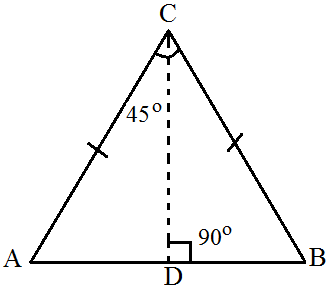
Let two men start from the point C with velocity v each at the same time.
Also, $\angle\text{BCA}=45^\circ$
Since, A and B are moving with same velocity v, so they will cover same distance in same time.
Therefore, $\triangle\text{ABC}$ ABC is an isosceles triangle with AC = BC.
Now, draw $\text{CD}\bot\text{AB}$
Let at any instant t, the distance between them is AB

Let $\text{AC}=\text{BC}=\text{x}$ and $\text{AB}=\text{y}$
In $\triangle\text{ACD}$ and $\triangle\text{DCB},$
$\angle\text{CAD}=\angle\text{CBD}$ $[\because\text{AC}=\text{BC}]$
$\angle\text{CDA}=\angle\text{CDB}=90^\circ$
$\therefore\ \angle\text{ACD}=\angle\text{DCB}$
or $\angle\text{ACD}=\frac{1}{2}\times\angle\text{ACB}$
$\Rightarrow\ \angle\text{ACD}=\frac{1}{2}\times45^\circ$
$\Rightarrow\ \angle\text{ACD}=\frac{\pi}{8}$
$\therefore\ \sin\frac{\pi}{8}=\frac{\text{AD}}{\text{AC}}$
$\Rightarrow\ \sin\frac{\pi}{8}=\frac{\frac{\text{y}}{2}}{\text{x}}$ $\big[\because\text{AD}=\frac{\text{y}}{2}\big]$
$\Rightarrow\ \frac{\text{y}}{2}=\text{x}\sin\frac{\pi}{8}$
$\Rightarrow\ \text{y}=2\text{x}\sin\frac{\pi}{8}$
Now, differentiating both sides w.r.t. t, we get
$\frac{\text{dy}}{\text{dt}}=2.\sin\frac{\pi}{8}\cdot\frac{\text{dx}}{\text{dt}}$
$=2.\sin\frac{\pi}{8}.\text{v}$ $\Big[\because\text{v}=\frac{\text{dx}}{\text{dt}}\Big]$
$=2\text{v}.\frac{\sqrt{2-\sqrt{2}}}{2}$ $\Bigg[\because\ \sin\frac{\pi}{8}=\frac{\sqrt{2-\sqrt{2}}}{2}\Bigg]$
$=\sqrt{2-\sqrt{2}}\text{ v unit/s}$
which is the rate at which A and B are being separated.
View full question & answer
Question 104 Marks
Find the angle of intersection of the curves y = 4 - x2 and y = x2.
Answer
We have, y = 4 - x2 ...(i)
and y = x2 ...(ii)
Solving these equations, we get
$\text{x}^2=4-\text{x}^2$
$\Rightarrow\ \text{x}^2=2$
$\Rightarrow\ \text{x}=\pm\sqrt{2}$
$\therefore\ \text{y}=\text{x}^2=2$
So, the points of intersection are $\big(\sqrt{2},2\big)$ and $\big(-\sqrt{2},2\big).$
Now,
For first curve, $\text{m}_1=\Big(\frac{\text{dy}}{\text{dx}}\Big)_1=-2\text{x}$
For first curve, $\text{m}_2=\Big(\frac{\text{dy}}{\text{dx}}\Big)_2=2\text{x}$
At ponit $\big(\sqrt{2},2\big),\text{m}_1=-2\sqrt{2}$ and $\text{m}_2=2\sqrt{2}$
If angle between curves is $'\theta',$ then
$\therefore\ \tan\theta=\Big|\frac{\text{m}_1-\text{m}_2}{1+\text{m}_1\text{m}_2}\Big|=\Big|\frac{-2\sqrt{2}-2\sqrt{2}}{1-2\sqrt{2}\cdot2\sqrt{2}}\Big|=\Big|\frac{-4\sqrt{2}}{-7}\Big|$
$\therefore\ \theta=\tan^{-1}\frac{4\sqrt{2}}{7}$
For point $\big(-\sqrt{2},2\big),\text{m}_1=2\sqrt{2}$ and $\text{m}_2=-2\sqrt{2}$
$\therefore$ For this point also $\theta=\tan^{-1}\frac{4\sqrt{2}}7{}$
View full question & answer
Question 114 Marks
The volume of a cube increases at a constant rate. Prove that the increase in its surface area varies inversely as the length of the side.
Answer
Let the side of a cube be x unit.
$\therefore$ Volume of cube (V) = x3
$\Rightarrow\ \frac{\text{dV}}{\text{dt}}=3\text{x}^2\frac{\text{dx}}{\text{dt}}$
$\Rightarrow\ \text{k}=3\text{x}^2\frac{\text{dx}}{\text{dt}}$ (Since, the volume is increasing at constant rate)
$\Rightarrow\ \frac{\text{dx}}{\text{dt}}=\frac{\text{k}}{3\text{x}^2}$
Now, surface area of cube, S = 6x2
$\Rightarrow\ \frac{\text{dS}}{\text{dt}}=12\text{x}\cdot\frac{\text{dx}}{\text{dy}}$
$\Rightarrow\ \frac{\text{dS}}{\text{dt}}12\text{x}\cdot\frac{\text{k}}{3\text{x}^2}$ $\Big[\because\ \frac{\text{dx}}{\text{dt}}=\frac{\text{k}}{3\text{x}^2}\Big]$
$\Rightarrow\ \frac{\text{dS}}{\text{dt}}=\frac{12\text{k}}{3\text{x}}=4\Big(\frac{\text{k}}{\text{x}}\Big)$
$\Rightarrow\ \frac{\text{dS}}{\text{dt}}\propto\frac{1}{\text{x}}$
Thus, the surface area of the cube varies inversely as the length of the side.
View full question & answer
Question 124 Marks
If the sum of the surface areas of cube and a sphere is constant, what is the ratio of an edge of the cube to the diameter of the sphere, when the sum of their volumes is minimum?
Answer
Let length of one edge of cube be x units and radius of sphere be r units.
Now Surface area of cube $ = 6\text{x}^2$
And surface area of sphere $=4\pi\text{r}^2$
According to the question
$6\text{x}^2+4\pi\text{r}^2=\text{k},$ where k is constant
$\Rightarrow\ \text{x}=\Big[\frac{\text{k}-4\pi\text{r}^2}{6}\Big]^{\frac{1}{2}}$
Now, volume of cube $ =\text{x}^3$
and volume of sphere $=\frac{4}{3}\pi\text{r}^3$
The sum of volume of the cube and volume of the sphere is
$\text{S}=\text{x}^3+\frac{4}{3}\pi\text{r}^3$
$=\Big[\frac{\text{k}-4\pi\text{r}^2}{6}\Big]^{\frac{3}{2}}+\frac{4}{3}\pi\text{r}^3$
$\Rightarrow\ \frac{\text{dS}}{\text{dr}}=-2\pi\text{r}\Big[\frac{\text{k}-4\pi\text{r}^2}{6}\Big]^{\frac{1}{2}}+4\pi\text{r}^2\ \ \dots(\text{ii})$
$=-2\pi\text{r}\bigg[\Big\{\frac{\text{k}-4\pi\text{r}^2}{6}\Big\}^{\frac{1}{2}}-2\text{r}\bigg]$
Now, $\frac{\text{dS}}{\text{dr}}=0$
$\Rightarrow\ 2\text{r}=\Big(\frac{\text{k}-4\pi\text{r}^2}{6}\Big)^{\frac{1}{2}}\ (\text{as r}\neq0)$
$\Rightarrow\ 4\text{r}^2=\frac{\text{k}-4\pi\text{r}^2}{6}$
$\Rightarrow\ 24\text{r}^2=\text{k}-4\pi\text{r}^2$
$\Rightarrow\ \text{r}^2[24+4\pi]=\text{k}$
$\Rightarrow\ \text{r}=\sqrt{\frac{\text{k}}{24+4\pi}}=\frac{1}{2}\sqrt{\frac{\text{k}}{6+\pi}}$
Clearly, this is point of minima
For $\text{r}=\frac{1}{2}\sqrt{\frac{\text{k}}{6+\pi}},\text{x}=\Bigg[\frac{\text{k}-4\pi\cdot\frac{1}{4}\cdot\frac{\text{k}}{(6+\pi)}}{6}\Bigg]^{\frac{1}{2}}$
$=\bigg[\frac{(6+\pi)\text{k}-\pi\text{k}}{6(6+\pi)}\bigg]^{\frac{1}{2}}=\Big[\frac{\text{k}}{6+\pi}\Big]^{\frac{1}{2}}=2\text{r}$
Thus, the sum of their volume is minimum when x = 2r.
Hence, the ratio of an edge of cube to the diameter of the sphere is 1 : 1.
View full question & answer
Question 134 Marks
A kite is moving horizontally at a height of 151.5 meters. If the speed of kite is 10m/ s, how fast is the string being let out; when the kite is 250m away from the boy who is flying the kite? The height of boy is 1.5m.
Answer
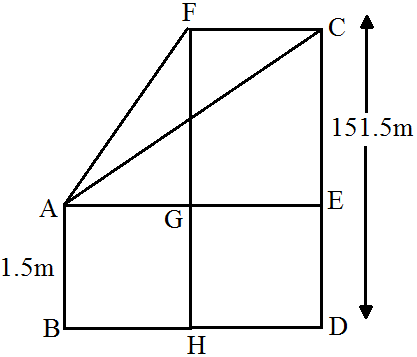
Consider the figure,

We have, height (h) = 151.5m, speed of kite (v) = 10m/ s
Let CD be the height of kite and AB be the height of boy.
Let DB = x m = EA and AC = 250m
$\therefore\ \frac{\text{dx}}{\text{dt}}=10\text{m/s}$
From the figure, we have
EC = 151.5 - 1.5 = 150m and AE = x
Also, AC = 250m
In right angled $\triangle\text{CEA},$
AE2 + EC2 = AC2
⇒ x2 + (150)2 = y2
⇒ x2 + (150)2 = (250)2
⇒ x2 = (250)2 - (150)2
⇒ x2 = (250 + 150)(250 - 150)
⇒ x2 = 400 × 100
$\therefore$ x = 20 × 10 = 200
Consider, x2 + (150)2 = y2
$\Rightarrow\ 2\text{x}\cdot\frac{\text{dx}}{\text{dt}}+0=2\text{y}\frac{\text{dy}}{\text{dt}}$
$\Rightarrow\ 2\text{y}\frac{\text{dy}}{\text{dt}}=2\text{x}\frac{\text{dx}}{\text{dt}}$
$\Rightarrow\ \frac{\text{dy}}{\text{dt}}=\frac{\text{x}}{\text{y}}\cdot\frac{\text{dx}}{\text{dt}}$
$=\frac{200}{250}\cdot10=8\text{m/s}$ $\Big[\because\ \frac{\text{dx}}{\text{dt}}=10\text{m/s}\Big]$
So, the required rate at which the string is being let out is 8m/ s.
View full question & answer
Question 144 Marks
Find the co-ordinates of the point on the curve $\sqrt{\text{x}}+\sqrt{\text{y}}=4$ at which tangent is equally inclined to the axes.
Answer
We have, $\sqrt{\text{x}}+\sqrt{\text{y}}=4\ \ \dots(\text{i})$
$\Rightarrow\ \text{x}^{\frac{1}{2}}+\text{y}^{\frac{1}{2}}=4$
Difference,
$\frac{1}{2}\frac{1}{\text{x}{\frac{1}{2}}}+\frac{1}{2}\cdot\frac{1}{\text{y}{\frac{1}{2}}}=0$
$\frac{1}{2}\text{x}^{\frac{-1}{2}}+\frac{1}{2}\text{y}^{\frac{-1}{2}}\frac{\text{dy}}{\text{dx}}=0$
$\frac{1}{2}\text{y}^{\frac{-1}{2}}\frac{\text{dy}}{\text{dx}}=\frac{-1}{2}\text{x}^{\frac{-1}{2}}$
$$$\text{y}^{\frac{-1}{2}}\frac{\text{dy}}{\text{dx}}=2\times\frac{-1}{2}\text{x}^{\frac{-1}{2}}$
$\frac{\text{dy}}{\text{dx}}=-\frac{\text{x}^{\frac{-1}{2}}}{\text{y}^{\frac{-1}{2}}}$
$\frac{\text{dy}}{\text{dx}}=-\frac{\frac{1}{\text{x}^{\frac{1}{2}}}}{\frac{1}{\text{y}^{\frac{1}{2}}}}$
$\frac{\text{dy}}{\text{dx}}=-\frac{\text{y}^{\frac{1}{2}}}{\text{x}\frac{1}{2}}$
$\frac{\text{dy}}{\text{dx}}=-\sqrt{\frac{\text{y}}{\text{x}}}$
Since, tangent is equally inclined to the axes.
$\therefore\ \frac{\text{dy}}{\text{dx}}=\pm1$
$\Rightarrow-\sqrt{\frac{\text{y}}{\text{x}}}=\pm1$
$\Rightarrow\ \frac{\text{y}}{\text{x}}=1\Rightarrow\text{y}=\text{x}$
From Eq. (i), $\sqrt{\text{y}}+\sqrt{\text{y}}+=4$
$\Rightarrow\ 2\sqrt{\text{y}}=4$
$\Rightarrow4\text{y}=16$
$\therefore$ y = 4 and x = 4
when y = 4 and x = 4
So, the required coordinates are (4, 4).
View full question & answer
Question 154 Marks
If the straight line $\text{x}\cos\alpha+\text{y}\sin\alpha=\text{p}$ touches the curve $\frac{\text{x}^2}{\text{a}^2}+\frac{\text{y}^2}{\text{b}^2}=1,$ then prove that $\text{a}^2\cos^2\alpha+\text{b}^2\sin^2\alpha=\text{p}^2.$
Answer
We know that, if a line y = mx + c touches the ellipse $\frac{\text{x}^2}{\text{a}^2}+\frac{\text{y}^2}{\text{b}^2}=1,$ then
The required condition is c2 = a2 m2 + b2
Here, given equation of the line is,
$\text{x}\cos\alpha+\text{y}\sin\alpha=\text{p}$
$\Rightarrow\ \text{y}=\frac{\text{p}-\text{x}\cos\alpha}{\sin\alpha}$
$=-\text{x}\cot\alpha+\frac{\text{p}}{\sin\alpha}$
$\Rightarrow\text{c}=\frac{\text{p}}{\sin\alpha}$
And $\text{m}=\cot\alpha$
$\therefore\Big(\frac{\text{P}}{\sin\alpha}\Big)^{2}=\text{a}^2(-\cot\alpha)^2+\text{b}^2$
$\Rightarrow\frac{\text{p}}{\sin^2\alpha}=\text{a}^2\frac{\cot^2\alpha}{\sin^2\alpha}+\text{b}$
$\Rightarrow\text{p}^2=\text{a}^2\cos^2\alpha+\text{b}^2\sin^2\alpha$
Hence proved.
View full question & answer
Question 164 Marks
Find the equation of the normal lines to the curve 3x2 - y2 = 8 which are parallel to the line x + 3y = 4.
Answer
We have, 3x2 - y2 = 8 ...(1)
$\Rightarrow\ 6\text{x}-2\text{y}\frac{\text{dy}}{\text{dx}}=0$
$\Rightarrow\ \frac{\text{dy}}{\text{dx}}=\frac{6\text{x}}{2\text{y}}$
$\Rightarrow\ \frac{\text{dy}}{\text{dx}}=\frac{3\text{x}}{\text{y}}=\text{m}_1$ (say)
And slope of normal $(\text{m}_2)=\frac{-1}{\text{m}_1}=\frac{-\text{y}}{3\text{x}}\ \ \dots(2)$
Consider, $\text{x}+3\text{y}=4$
$\Rightarrow\ \text{y}=\frac{4-\text{x}}{3}=\frac{-\text{x}}{3}+\frac{4}{3}$
$\therefore$ Slope of the line $(\text{m}_3)=\frac{-1}{3}$
Since, slope of normal to the curve should be equal to the slope of line x + 3y = 4, which is parallel to curve.
$\therefore\ \text{m}_2=\text{m}_3$
$\Rightarrow\ \frac{-\text{y}}{3\text{x}}=-\frac{1}{3}$
$\Rightarrow-3\text{y}=-3\text{x}$
$\Rightarrow\ \text{y}=\text{x}\ \ \dots(3)$
Substituting y = x in (1), we get
$3\text{x}^2-\text{x}^2=8$
$\Rightarrow\ \text{x}^2=4$
$\Rightarrow\ \text{x}=\pm2$
Substituting $\text{x}=\pm2$ in (3), we get
$\text{y}=\pm2$
Thus, the points at which normal to the curve is parallel to the line x + 3y = 4 are (2, 2) and (-2, -2).
Now, the equations of normal are given by
$\text{y}-2=\text{m}_2(\text{x}-2)$ and $\text{y}+2=\text{m}_2(\text{x}+2)$
$\Rightarrow\ \text{y}-2=\frac{-1}{3}(\text{x}-2)$ and $\text{y}+2=\frac{-1}{3}(\text{x}+2)$
$\Rightarrow\ 3\text{y}-6=-\text{x}+2$ and $3\text{y}+6=-\text{x}-2$
$\Rightarrow\ 3\text{y}+\text{x}=+8$ and $3\text{y}+\text{x}=-8$
So, the required equations are $3\text{y}+\text{x}=\pm8$
View full question & answer
Question 174 Marks
Prove that the curves y2 = 4x and x2 + y2 - 6x + 1 = 0 touch each other at the point (1, 2).
Answer
We have, y2 = 4x and x2 + y2 - 6x + 1 = 0
Since, both the curves touch each other at (1, 2) i.e., curves are passing through (1, 2).
$\therefore\ 2\text{y}\cdot\frac{\text{dy}}{\text{dx}}=4$
and $2\text{x}+2\text{y}\frac{\text{dy}}{\text{dx}}=6$
$\Rightarrow\ \frac{\text{dy}}{\text{dx}}=\frac{4}{2\text{y}}$
and $\frac{\text{dy}}{\text{dx}}=\frac{6-2\text{x}}{2\text{y}}$
$\Rightarrow\ \Big(\frac{\text{dy}}{\text{dx}}\Big)_{(1,2)}=\frac{4}{4}=1$
and $\Big(\frac{\text{dy}}{\text{dx}}\Big)_{(1,2)}=\frac{6-2\cdot1}{2\cdot2}=\frac{4}{4}=1$
$\Rightarrow\ \text{m}_1=1$ and $\text{m}_2=1$
Thus, we see that slope of both the curves are equal to each other i.e., m1 = m2 = 1 at the point (1, 2).
Hence, both the curves touch each other.
View full question & answer
Question 184 Marks
Show that the line $\frac{\text{x}}{\text{a}}+\frac{\text{y}}{\text{b}}=1,$ touches the curve $\text{y}=\text{b}\cdot\text{e}^{\frac{-\text{x}}{\text{a}}}$ a e at the point where the curve intersects the axis of y.
Answer
Given equation of the curve, $\text{y}=\text{b}\cdot\text{e}^{\frac{-\text{x}}{\text{a}}}\ \ \dots(\text{i})$
It meets y-axis,
$\therefore\ \text{y}=\text{b e}^0=\text{b}$
$\therefore$ point where it meets y-axis is (0, b)
Differentiating (i), w.r.t. x, we get
$\frac{\text{dy}}{\text{dx}}=-\frac{\text{b}}{\text{a}}\text{e}^{\frac{-\text{x}}{\text{a}}}$
$\therefore\ \Big(\frac{\text{dy}}{\text{dx}}\Big)_{(0,\text{ b})}=-\frac{\text{b}}{\text{a}}\text{e}^{-0}=-\frac{\text{b}}{\text{a}}$
$\therefore$ Equation of tangent at point (0, b) is
$\text{y}-\text{b}=-\frac{\text{b}}{\text{a}}(\text{x}-0)$
$\therefore\ \text{ay}-\text{ab}=-\text{bx}$
or $\frac{\text{x}}{\text{a}}+\frac{\text{y}}{\text{b}}=1$
Hence, the line touches the curve at the point, where the curve intersects the axis of Y.
View full question & answer
Question 194 Marks
A swimming pool is to be drained for cleaning. If L represents the number of litres of water in the pool t seconds after the pool has been plugged off to drain and L = 200(10 - t)2. How fast is the water running out at the end of 5 seconds? What is the average rate at which the water flows out during the first 5 seconds?
Answer
Let L represents the number of litres of water in the pool t seconds after the pool been plugged off to drain, then
$\text{L} = 200(10 - \text{t})^2$
$\therefore$ Rate at which the water is running out $=-\frac{\text{dL}}{\text{dt}}$
$=\frac{\text{dL}}{\text{dt}}=-200.2(10-\text{t}).(-1)$
$=400(10-\text{t})$
Rate at which the water is running out at the end of 5s
$=400(10-5)$
$=2000\text{L/s}$ Final rate
Since, initial rate $=-\Big(\frac{\text{dL}}{\text{dt}}\Big)_{\text{t}-0}=4000\text{L/s}$
$\therefore$ Aver agerate during 5s $=\frac{\text{Initial rate}+\text{Final rate}}{2}$
$=\frac{4000+2000}{2}$
$=3000\text{L/s}$
View full question & answer
Question 204 Marks
Find the dimensions of the rectangle of perimeter 36cm which will sweep out a volume as large as possible, when revolved about one of its sides. Also find the maximum volume.
Answer
Let breadth and length of the rectangle be x and y, respectively.

It is given that the perimeter of the rectangle = 36cm
⇒ 2x + 2y = 36
⇒ x + y = 18
⇒ y = 18 - x
Let the rectangle is being revolved about its length y.
Then, volume of resultant cylinder,
$\text{B}=\pi\text{x}^2\text{y}$
$\Rightarrow\ \text{V}=\pi\text{x}^2(18-\text{x})=\pi(18\text{x}^2-\text{x}^3)$
$\Rightarrow\ \frac{\text{dV}}{\text{dx}}=\pi(36\text{x}-3\text{x}^2)$
$\frac{\text{dv}}{\text{dx}}=0$
$\Rightarrow\ 36\text{x}=3\text{x}^2$
$\Rightarrow\ \text{x}=12\ (\text{ax x}\neq0)$
Also $\frac{\text{d}^2\text{V}}{\text{dx}^2}=\pi(36-6\text{x})$
$\Rightarrow\ \Big(\frac{\text{d}^2\text{V}}{\text{dx}^2}\Big)_{\text{x}=12}=\pi(36-72)=-36\pi<0$
$\therefore$ For x = 12, volume of the resultant cylinder is the maximum.
$\therefore$ y = 18 - 12 = 6
So, the dimensions of rectangle are 12cm and 6cm, respectively.
$\therefore$ Maximum volume of resultant cylinder,
$\text{V}=\pi\big[18\cdot(12)^2-(12)^3\big]$
$=\pi12^2(18-12)$
$=864\pi\text{cm}^3$
View full question & answer
4 Marks - Maths STD 12 Science Questions - Vidyadip