Questions

Assertion (A) & Reason (B) MCQ

Take a timed test

6 questions · auto-graded multiple-choice test.

MCQ 11 Mark
Directions: In these questions, a statement of Assertion is followed by a statement of Reason is given. Choose the correct answer out of the following choices:
Assertion: The area of the smaller region bounded by the ellipse $\frac{\text{x}^2}{9}+\frac{\text{y}^2}{4}=1$ the line $\frac{\text{x}}{3}+\frac{\text{y}}{2}=1$ is $\frac{3}{2}(\pi-2)\text{ sq.units}$
Reason: Formula to calculate the area of the smaller region bounded by the ellipse $\frac{\text{x}^2}{\text{a}^2}+\frac{\text{y}^2}{\text{b}^2}=1$ and the line $\frac{\text{x}}{\text{a}}+\frac{\text{y}}{\text{b}}=1$ is $\frac{\text{ab}}{4}(\pi-2) \text{ sq.units}$
  • Assertion and Reason both are correct statements and Reason is the correct explanation of Assertion.
  • B
    Assertion and Reason both are correct statements but Reason is not the correct explanation of Assertion.
  • C
    Assertion is correct statement but Reason is wrong statement.
  • D
    Assertion is wrong statement but Reason is correct statement.
Answer
Correct option: A.
Assertion and Reason both are correct statements and Reason is the correct explanation of Assertion.
Clearly, reason is correct statement. Now, we have, equation of ellipse
$\frac{\text{x}^2}{9}+\frac{\text{y}^2}{4}=1$ the line $\frac{\text{x}}{3}+\frac{\text{y}}{2}=1$
$\therefore$ Here, $\text{a}=3, \text{ b}=3$
$\therefore$ Required area $=\frac{\text{ab}}{4}(\pi-2)$
$=\frac{3\times2}{4}(\pi-2)$
$=\frac{3}{2}(\pi-2)\text{ sq.units}$
View full question & answer
MCQ 21 Mark
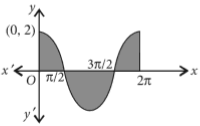
Assertion $(A) :$ The area bounded by the curve $y=2 \cos x$ and the $x$-axis from $x=0$ to $x=2 \pi$ is $8$ sq. units.
Reason $(R) :$ Maximum value of the curve $y=2 \cos x$ is $2 .$
  • A
    Both $(A)$ and $(R)$ are true and $(R)$ is the correct explanation of $(A).$
  • Both $(A)$ and $(R)$ are true but $(R)$ is not the correct explanation of $(A).$
  • C
    $(A)$ is true but $(R)$ is false.
  • D
    $(A)$ is false but $(R)$ is true.
Answer
Correct option: B.
Both $(A)$ and $(R)$ are true but $(R)$ is not the correct explanation of $(A).$
We have, $y=2 \cos x$
Let us draw the graph of $2 \cos x$ between $0$ to $2 \pi$.
Image
$\therefore$ Required area
$=\int_0^{\pi / 2} 2 \cos x d x+\left|\int_{\pi / 2}^{3 \pi / 2} 2 \cos x d x\right|+\int_{3 \pi / 2}^{2 \pi} 2 \cos x d x$
$=2[\sin x]_0^{\pi / 2}+\left|[2 \sin x]_{\pi / 2}^{3 \pi / 2}\right|+[2 \sin x]_{3 \pi / 2}^{2 \pi}$
$=2\left[\sin \frac{\pi}{2}-0\right]+\left|2\left[\sin \frac{3 \pi}{2}-\sin \frac{\pi}{2}\right]\right|+2\left[\sin 2 \pi-\sin \frac{3 \pi}{2}\right]$
$=2+2 \times 2+2$
$=2+4+2$
$=8 \text { sq. units }$
View full question & answer
MCQ 31 Mark
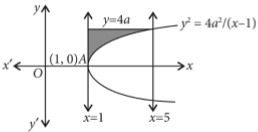
Assertion $(A)$ : The area bounded by the curves $y^2=4 a^2(x-1)$ and lines $x=1$ and $y=4 a$ is $\frac{8 a}{3}$ sq. units.
Reason $(R)$ : The area enclosed between the parabola $y^2=49 x$ and its latus rectum $\frac{8 a^2}{3}$ sq. units.
  • A
    Both $(A)$ and $(R)$ are true and $(R)$ is the correct explanation of $(A)$.
  • Both $(A)$ and $(R)$ are true but $(R)$ is not the correct explanation of $(A).$
  • C
    $(A)$ is true but $(R)$ is false.
  • D
    $(A)$ is false but $(R)$ is true.
Answer
Correct option: B.
Both $(A)$ and $(R)$ are true but $(R)$ is not the correct explanation of $(A).$
On solving $y^2=4 a^2(x-1)$ and $y=4 a$, we get $x=5$
Image
$\therefore \text { Required area }=\int_1^5(4 a-2 a \sqrt{x-1}) d x$
$=\left[4 a x-2 a \cdot \frac{(x-1)^{3 / 2}}{3 / 2}\right]_1^5$
$=\frac{16 a}{3} \text { sq. units }$ Clearly, reason is true.
View full question & answer
MCQ 41 Mark
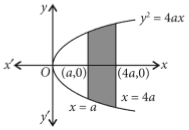
Assertion (A): The area bounded by the parabola $y^2=4 a x$ and the line $x=a$ and $x=4 a$ is $\frac{56 a^2}{3}$ sq. units.
Reason (R) : The area bounded by the parabola $y^2=49 x$ and $y=m x$ is $8 a^2 / 3 m^3$ sq. units.
  • A
    Both (A) and (R) are true and (R) is the correct explanation of (A).
  • B
    Both (A) and (R) are true but (R) is not the correct explanation of (A).
  • (A) is true but (R) is false.
  • D
    (A) is false but (R) is true.
Answer
Correct option: C.
(A) is true but (R) is false.
(c) :
Image
Required area $=2 \int_a^{4 a} \sqrt{4 a x} d x=4 \sqrt{a}\left[\frac{x^{3 / 2}}{3 / 2}\right]_a^{4 a}$
$=\frac{8}{3} \sqrt{a}\left(8 a^{3 / 2}-a^{3 / 2}\right)=\frac{56 a^2}{3}$ sq. units
Clearly, reason is true.
View full question & answer
MCQ 51 Mark
Assertion (A) : The area of the smaller region bounded by the ellipse $\frac{x^2}{9}+\frac{y^2}{4}=1$ and the line $\frac{x}{3}+\frac{y}{2}=1$ is $\frac{3}{2}(\pi-2)$ sq. units.
Reason (R) : Formula to calculate the area of the smaller region bounded by the ellipse $\frac{x^2}{a^2}+\frac{y^2}{b^2}=1$ and the line $\frac{x}{a}+\frac{y}{b}=1$ is $\frac{a b}{4}(\pi-2)$ sq. units.
  • Both (A) and (R) are true and (R) is the correct explanation of (A).
  • B
    Both (A) and (R) are true but (R) is not the correct explanation of (A).
  • C
    (A) is true but (R) is false.
  • D
    (A) is false but (R) is true.
Answer
Correct option: A.
Both (A) and (R) are true and (R) is the correct explanation of (A).
(a): Clearly, reason is true.
We have, equation of ellipse $\frac{x^2}{9}+\frac{y^2}{4}=1$ and line $\frac{x}{3}+\frac{y}{2}=1$
$\therefore \quad$ Here, $a=3, b=2$
$\therefore \quad$ Required area $=\frac{a b}{4}(\pi-2)$
$=\frac{3 \times 2}{4}(\pi-2)$ sq. units $=\frac{3}{2}(\pi-2)$ sq. units
View full question & answer
MCQ 61 Mark
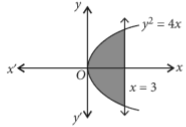
Assertion $(A) :$ The area of the region bounded by the curve $y^2=4 x$ and the line $x=3$ is $8 \sqrt{3}$ sq. units.
Reason $(R):$ The area is symmetric about $x$ and $y$ axes.
  • A
    Both $(A)$ and $(R)$ are true and $(R)$ is the correct explanation of $(A).$
  • B
    Both $(A)$ and $(R)$ are true but $(R)$ is not the correct explanation of $(A).$
  • $(A)$ is true but $(R)$ is false.
  • D
    $(A)$ is false but $(R)$ is true.
Answer
Correct option: C.
$(A)$ is true but $(R)$ is false.
We have, $y^2=4 x$ and $x=3$.
Image
$\therefore$ Required area
$=2 \int_0^3|y| d x$
$=2 \int_0^3 2 \sqrt{x} d x$
$=4\left[\frac{x^{3 / 2}}{3 / 2}\right]_0^3$
$=\frac{8}{3}(3 \sqrt{3})=8 \sqrt{3} \text { sq. units }$
$\therefore$ Assertion is true.
Clearly, reason is false.
View full question & answer