MCQ 11 Mark
He area of the region bounded by the parabola $y = x^2$ and $y = |x|$ is:
- A
$3$
- B
$\frac{1}{2}$
- ✓
$\frac{1}{3}$
- D
$2$
AnswerCorrect option: C. $\frac{1}{3}$
View full question & answer→MCQ 21 Mark
The area of the region bounded by the curve $x = y^2 - 2$ and $x = y$ is:
- A
$\frac { 9 }{ 4 }$
- B
$9$
- ✓
$\frac { 9 }{ 2 }$
- D
$\frac { 9 }{ 7 }$
AnswerCorrect option: C. $\frac { 9 }{ 2 }$
View full question & answer→MCQ 31 Mark
The area of the ellipse $\frac{\text{x}2}{9}+\frac{\text{y}^2}{4}=1$ in first quadrant is $6\pi\ \text{sq. units}.$The ellipse is rotated about its centre in anti$-$clockwise direction till its major axis coincides with $y-$axis. Now the area of the ellipse in first Quadrant is $\pi\ \text{sq. units}.$
View full question & answer→MCQ 41 Mark
Area bounded by the lines $y = |x| - 2$ and $y = 1 - |x - 1|$ is equal to:
- ✓
$4 \ sq.$ units
- B
$6 \ sq.$ units
- C
$2 \ sq.$ units
- D
$8 \ sq.$ units
AnswerCorrect option: A. $4 \ sq.$ units
View full question & answer→MCQ 51 Mark
Area of the region bounded by $y = |x – 1|$ and $y = 1$ is:
- A
$2\text{ sq.}\text{ units}$
- ✓
$1\text{ sq.}\text{ units}$
- C
$\frac{1}{2}\text{ sq.}\text{ units}$
- D
AnswerCorrect option: B. $1\text{ sq.}\text{ units}$
View full question & answer→MCQ 61 Mark
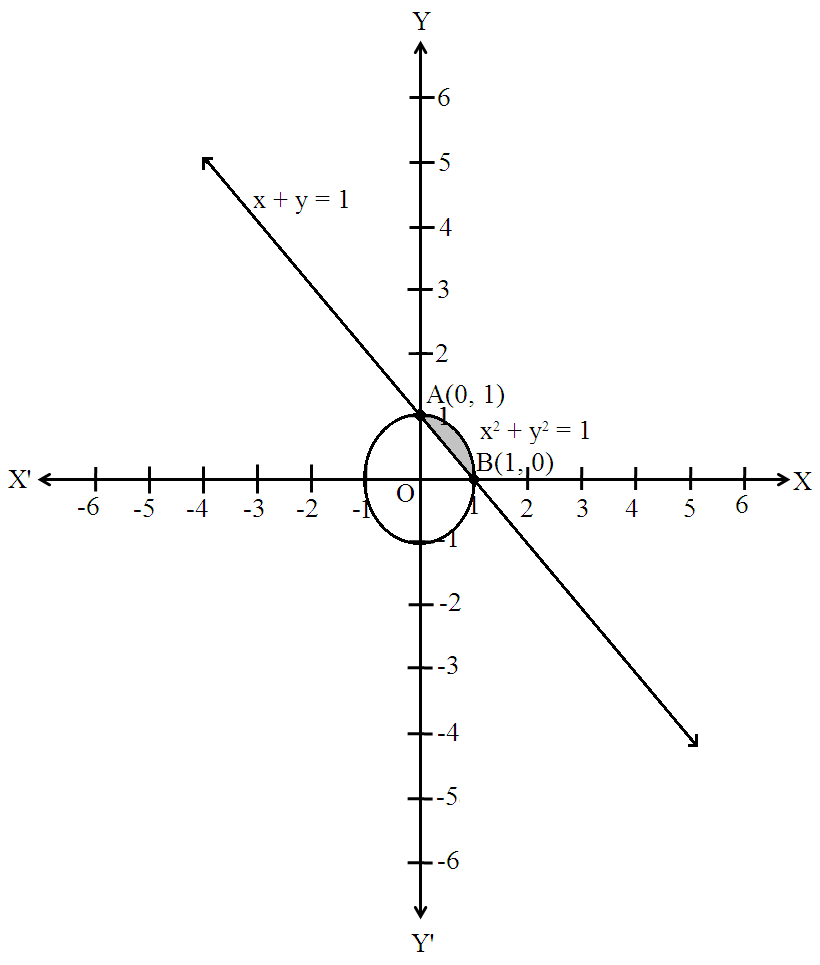
The area of the region $\{(\text{x},\text{y}):\text{x}^2+\text{y}^2\leq1\leq\text{x}+\text{y}\}$ is:
AnswerCorrect option: C. $\frac{\pi}{2}-\frac{1}{2}$
None of the given option is correct.
To find the points of intersection of the line
and the circle substitute $y = 1 - x$ in $x^2 + y^2 = 1$,
we get $A(0, 1)$ and $B(1, 0).$
Therefore, the required area of the shaded region,
$\text{A} = \int\limits^1_0(\text{y}_1-\text{y}_2)\text{dx}$ $\big($Where, $\text{y}_1=\sqrt{1-\text{x}^2}$ and $\text{y}_2=1-\text{x}\big)$
$= \int\limits^1_0\Big[\big(\sqrt{1-\text{x}^{2}}\big)-(1-\text{x})\Big]\text{dx}$
$=\int\limits^1_0\Big(\sqrt{1-\text{x}^2}-1+\text{x}\Big)\text{dx}$
$=\Big[\frac{\text{x}}{2}\sqrt{1-\text{x}^2}+\frac{1}{2}\sin^{-1}(\text{x})-\text{x}+\frac{\text{x}^2}{2}\Big]^1_0$
$=\bigg[\frac{1}{2}\sqrt{1-1^2}+\frac{1}{2}\sin^{-1}(1)-(1)+\frac{(1)^2}{2}\bigg]\\-\bigg[\frac{(0)}{2}\sqrt{1-(0)^2}+\frac{1}{2}\sin^{-1}(0)-(0)+\frac{(0)^2}{2}\bigg]$
$=\Big(\frac{\pi}{4}-\frac{1}{2}\Big)$ square units View full question & answer→MCQ 71 Mark
Choose the correct answer : Smaller area enclosed by the circle $x^2 + y^2 = 4$ and the line $x + y = 2$ is:
AnswerStep $I$. Equation of circle is $x^2 + y^2 = 2^2 ...(i)$
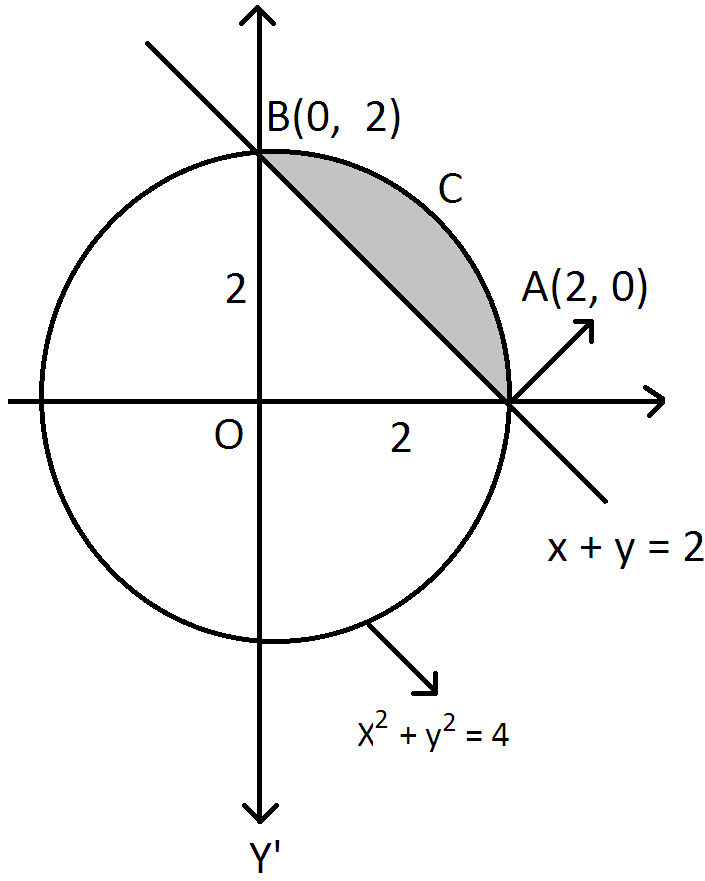
$\Rightarrow\text{y}=\sqrt{2^2-\text{x}^2}\dots(\text{ii})$ Also, equation of the line is $x + y = 2 ...(iii)$ Table of values
Therefore graph of equation $(iii)$ is the straight line joining the points $(0, 2)$ and $(2, 0)$.
Step $II$. From the graph of circle $(i)$ and straight line $(iii),$ it is clear that points of intersections of circle $(i)$ and straight line $(iii)$ are $A(2, 0)$ and $B(0, 2).$
Step $III$. Area $\text{OACB},$ bounded by circle $(i)$ and coordinate axes in first quadrant
$=\Bigg|\int\limits^2_0\text{y dx}\Bigg|=\Bigg|\int\limits^2_0\sqrt{2^2-\text{x}^2}\text{ dx}\Bigg|$
$=\Big(\frac{\text{x}}{2}\sqrt{2^2-\text{x}^2}+\frac{2^2}{2}\sin^{-1}\frac{\text{x}}{2}\Big)^2_0$
$=\Big(\frac22\sqrt{4-4}+2\sin^{-1}1\Big)-\Big(0+2\sin^{-1}0\Big)$
$=0+2\Big(\frac{\pi}{2}\Big)-2(0)=\pi\text{ sq. units}\dots(\text{iv})$
Step $IV$. Area of triangle $\text{OAB},$ bounded by straight line $(iii)$ and coordinate axes
$=\Bigg|\int\limits^2_0\text{y dx}\Bigg|=\Bigg|\int\limits^2_0(2-\text{x})\text{ dx}\Bigg|$
$=\Big(2\text{x}-\frac{\text{x}^2}{2}\Big)^2_0$
$=(4-2)-(0-0)=2\text{ sq. units}\dots(\text{v})$
Step $V$. Required shaded area $=$ Area $\text{OACB}$ given by $(iv) -$ Area of triangle $\text{OAB}$ by $(v)$
$=(\pi-2)\text{ sq. units}$
Therefore, option $(B)$ is correct. View full question & answer→MCQ 81 Mark
The area of the region bounded by the curve $\text{y}=\sqrt{16-\text{x}^2}$ and $x-$axis is:
- ✓
$8\pi\text{ sq.}\text{units}$
- B
$20\pi\text{ sq.}\text{units}$
- C
$16\pi\text{ sq.}\text{units}$
- D
$256\pi\text{ sq.}\text{units}$
AnswerCorrect option: A. $8\pi\text{ sq.}\text{units}$
View full question & answer→MCQ 91 Mark
The area of the triangle formed by the tangent and normal at the point $(1,\sqrt{3})$ on the circle $x^2 + y^2 = 4$ and the $x-$ axis is:
- A
$3\text{ sq.}\text{ units}$
- ✓
$2\sqrt{3}\text{ sq.}\text{ units}$
- C
$3\sqrt{2}\text{ sq.}\text{ units}$
- D
$4\text{ sq.}\text{ units}$
AnswerCorrect option: B. $2\sqrt{3}\text{ sq.}\text{ units}$
$2\sqrt{3}\text{ sq.}\text{ units}$
View full question & answer→MCQ 101 Mark
The area bounded by the curve $2x^2 + y^2 = 2$ is :
- A
$\pi\text{ sq}.\text{units}$
- ✓
$\sqrt{2}\pi\text{ sq}.\text{units}$
- C
$\frac{\pi}{2}\text{sq}.\text{units}$
- D
$2\pi\text{ sq}.\text{units}$
AnswerCorrect option: B. $\sqrt{2}\pi\text{ sq}.\text{units}$
$\sqrt{2}\pi\text{ sq}.\text{units}$
View full question & answer→MCQ 111 Mark
If $\text{y}=2\sin\text{x}+\sin2\text{x}$ for $0≤\text{x}≤2\pi,$ then the area enclosed by the curve and $x-$axis is:
AnswerCorrect option: C. $\text{12 sq. units}$
View full question & answer→MCQ 121 Mark
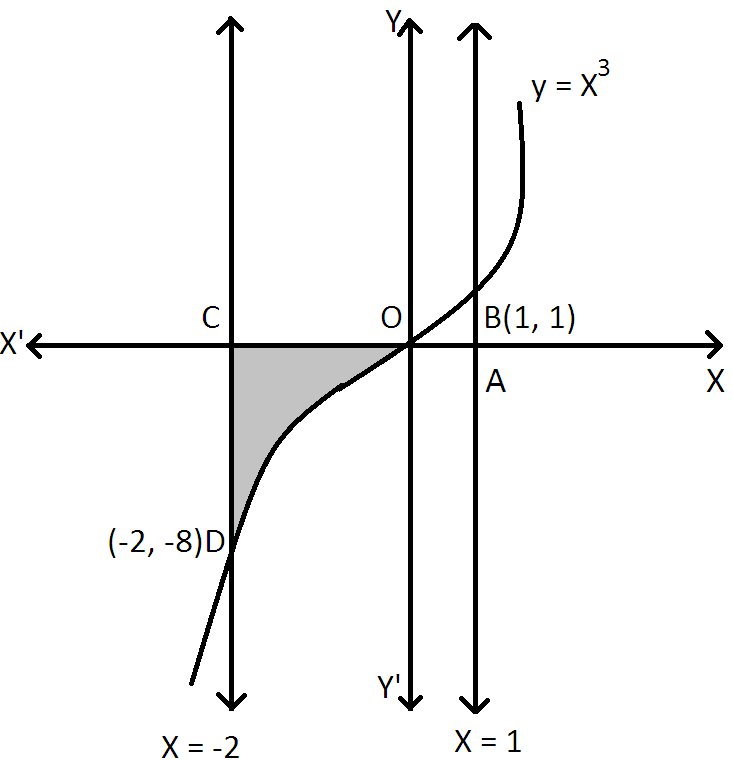
Choose the correct answer in the following. Area bounded by the curve $y = x^3,$ the $x-$ axis and the ordinates $x = –2$ and $x = 1$ is :
- A
$-9$
- ✓
$-\frac{15}{4}$
- C
$\frac{15}{4}$
- D
$\frac{17}{4}.$
AnswerCorrect option: B. $-\frac{15}{4}$
$\text{Required area}=\int\limits^1_{-2}\text{y dx}$
$=\int\limits^1_{-2}\text{x}^3\text{dx}$
$=\Big[\frac{\text{x}^4}{4}\Big]^1_{-2}$
$=\Big[\frac14-\frac{(-2)^4}{4}\Big]$
$=\Big(\frac14-4\Big)=-\frac{15}{4}\text{ units}$
Thus, the correct answer is $B.$ View full question & answer→MCQ 131 Mark
The area bounded by the line $y = 2x - 2, y = -x$ and $x-$axis is given by:
- A
$\frac{9}{2}\text{sq}.\text{units}$
- B
$\frac{43}{6}\text{sq}.\text{units}$
- C
$\frac{35}{6}\text{ sq}.\text{units}$
- ✓
View full question & answer→MCQ 141 Mark
The area bounded by the curve $\text{y}=\log_{\text{e}}\text{x}$ and x-axis and the straight line x = e is:
AnswerCorrect option: B. $1\text{ sq. units}$
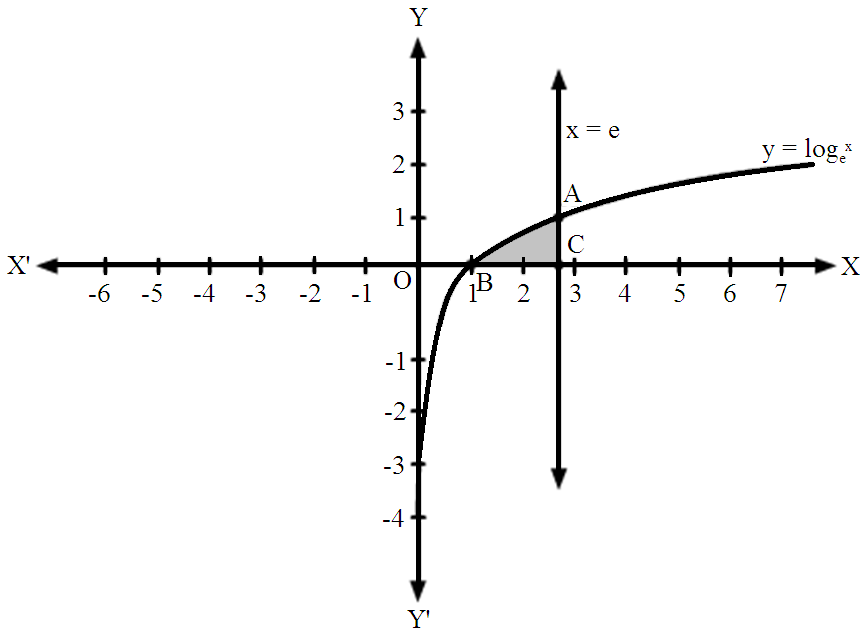
The point of intersection of the curve and the straight line is A(e, 1). Therefore, the area of the required region ABC,
$\text{A} = \int\limits^1_0(\text{x}_1-\text{x}_2)\text{dy}$ $(\text{where}, \text{x}_1 = \text{e}\text { and }\text{x}_2 = \text{e}_{\text{y}})$
$= \int\limits^1_0(\text{e}-\text{e}^{\text{y}})\text{dy}$
$=\big [\text{ey}-\text{e}^{\text{y}}\big]^1_0$
$=\big\{\text{e}(1)-\text{e}^{(1)}\big\} -\big \{\text{e}(0)-\text{e}^{(0)}\big\}$
$= \text{e}-\text{e}+1$
$= 1 \text{ square unit}$ View full question & answer→MCQ 151 Mark
Area bounded by the curve $\text{y}=\cos\text{x}$ between $\text{x}=0$ and $\text{x}=3\frac{\pi}{2}$ is:
- A
$1 \ sq.$ unit
- B
$2 \ sq.$ units
- ✓
$3 \ sq.$ units
- D
$4 \ sq.$ units
AnswerCorrect option: C. $3 \ sq.$ units
View full question & answer→MCQ 161 Mark
The area included between the parabolas $y^2 = 4x$ and $x^2 = 4y$ is:
- A
$\frac{8}{3}\text{sq}\text{ unit}$
- B
$8\text{sq}\text{ unit}$
- ✓
$\frac{16}{3}\text{sq}\text{ unit}$
- D
$12\text{sq}\text{ unit}$
AnswerCorrect option: C. $\frac{16}{3}\text{sq}\text{ unit}$
We know that, the area of region bounded by the parabolas $y^2 = 4ax$ and $= 4by$ is
$=\frac{16}{3}\text{ab}\text{ sq.}\text{ unit.}$
Therefore, $y^2 = 4ax$ and $x^2 = 4y$ is
$=\frac{16}{3}\text{ sq.}\text{ unit.}$
$(\because\text{a}=1,\text{b}=1)$
View full question & answer→MCQ 171 Mark
The area of the region bounded by the ellipse $\frac{\text{x}^2}{25}+\frac{\text{y}^2}{16}=1$ is:
- ✓
$20\pi\text{ sq}.\text{units}$
- B
$20^2\pi\text{ sq}.\text{units}$
- C
$16^2\pi\text{ sq}.\text{units}$
- D
$25\pi\text{ sq}.\text{units}$
AnswerCorrect option: A. $20\pi\text{ sq}.\text{units}$
View full question & answer→MCQ 181 Mark
Area bounded by the curve $y = x^3,$ the $x-$ axis and the ordinates $x = -2$ and $x = 1$ is:
- A
$-9$
- B
$\frac{-15}{4}$
- C
$\frac{15}{4}$
- ✓
$\frac{17}{4}$
AnswerCorrect option: D. $\frac{17}{4}$
$x = -2$ and $x = 1$ intersect the curve $y = x^3$ at $A(-2, -8)$ and $B(1, 1)$ respectively
If $P(x, y_1)$ lies on $OA\ \ O(x, y_2)$ lies on curve $OB$
Then, $y_1 > 0 $
$\Rightarrow |y_1| = y_1$
$\ \ y_2 < 0 $
$\Rightarrow |y_2| = -y_2$
Area of curve bound by the two lines $=$ shaded are $\text{(OADO)}\ +$ shaded area $\text{(OCBO)}$
$= \int\limits^0_{-2}|\text{y}_2|\text{dx}+\int\limits^1_0|\text{y}_1|\text{dx}$
$= \int\limits^0_{-2}-\text{y}_2\text{dx}+\int\limits^1_0\text{y}_1\text{dx}$
$=\int\limits^0_{-2}-(\text{x}^3)\text{dx}+\int\limits^1_0\text{x}^3\text{dx}$
$= \Big[-\frac{\text{x}^4}{4}\Big]^0_{-2}+\Big[\frac{\text{x}^4}{4}\Big]^1_0$
$= 0-\Big(-\frac{16}{4}\Big)+\Big(\frac{1}{4}-0\Big)$
$= 4+\frac{1}{4}$
$=\frac{17}{4}\text{ sq. units}$
View full question & answer→MCQ 191 Mark
Find the area of the region bounded by the curves $y = x^3,$ the line $x = 2, x = 5$ and the $x -$ axis?
- A
$173.50$
- B
$230.25$
- C
$175.35$
- ✓
$152.25$
AnswerCorrect option: D. $152.25$
$\int\limits\text{x}^\text{n}\text{dx}=\frac{\text{x}^\text{n-1}}{\text{n+1}}+\text{c}$
Here, we have to find the area of the region bounded by the curves $y = x^3$, the line $x = 2, x = 5$ and the $x -$ axis
So, the area enclosed by the given curves is given by $\int\limits^3_2\text{x}^3\text{dx}$
As we know that, $\int\limits\text{x}^\text{n}\text{dx}=\frac{\text{x}^\text{n}}{\text{n+1}}+\text{c}$
$\Rightarrow\int\limits^5_2\text{x}^3\text{dx}=\Big[\frac{\text{x}^4}{4}\Big]^5_4$
$\Rightarrow\int\limits^5_2\text{x}^3\text{dx}=\frac{1}{4}(625-16)$
$=152.25$
View full question & answer→MCQ 201 Mark
Area bounded by parabola $y^2 = x$ and straight line $2y = x$ is:
AnswerPoint of intersection is obtained by solving the equation of parabola $y^2 = x$ and equation of line $2y = x,$ we have
$y^2 = x$ and $2y = x$
$\Rightarrow y^2 = 2y$
$\Rightarrow y^2 - 2y = 0$
$\Rightarrow y = 0$ or $y = 2$
$\Rightarrow x = 0$ or $x = 4$
Thus $O(0, 0)$ and $A(4, 2)$ are the points of intersection of the curve and straight line. Area bound by then
$\text{A}=\int\limits_0^4(\text{y}_1-\text{y}_2)\text{ dx}$
$\Big[\text{Where, y}_1 =\sqrt{\text{x}}\text{ and y}_2=\frac{\text{x}}{2}\Big]$
$=\int\limits_0^4\Big(\sqrt{\text{x}}-\frac{\text{x}}{2}\Big)\text{dx}$
$=\Bigg[\frac{\text{x}^\frac{3}{2}}{\frac{3}{2}}-\frac{1}{2}\times\frac{\text{x}^2}{2}\Bigg]_0^4$
$=\Big[\frac{2}{3}\text{x}^\frac{3}{2}-\frac{\text{x}^2}{4}\Big]_0^4$
$=\frac{2}{3}4^\frac{3}{2}-\frac{1}{4}\times4^2-0$
$=\frac{2}{3}\times2^3-\frac{16}{4}$
$=\frac{16}{3}-4$
$=\frac{16-12}{3}$
$=\frac{4}{3}\text{ Sq units}$
View full question & answer→MCQ 211 Mark
The area bounded by the curve $y^2= 8x$ and $x^2 = 8y$ is:
- ✓
$\frac{16}{3}\text{ sq. units}$
- B
$\frac{3}{16}\text{ sq. units}$
- C
$\frac{14}{3}\text{ sq. units}$
- D
$\frac{3}{14}\text{ sq. units}$
AnswerCorrect option: A. $\frac{16}{3}\text{ sq. units}$
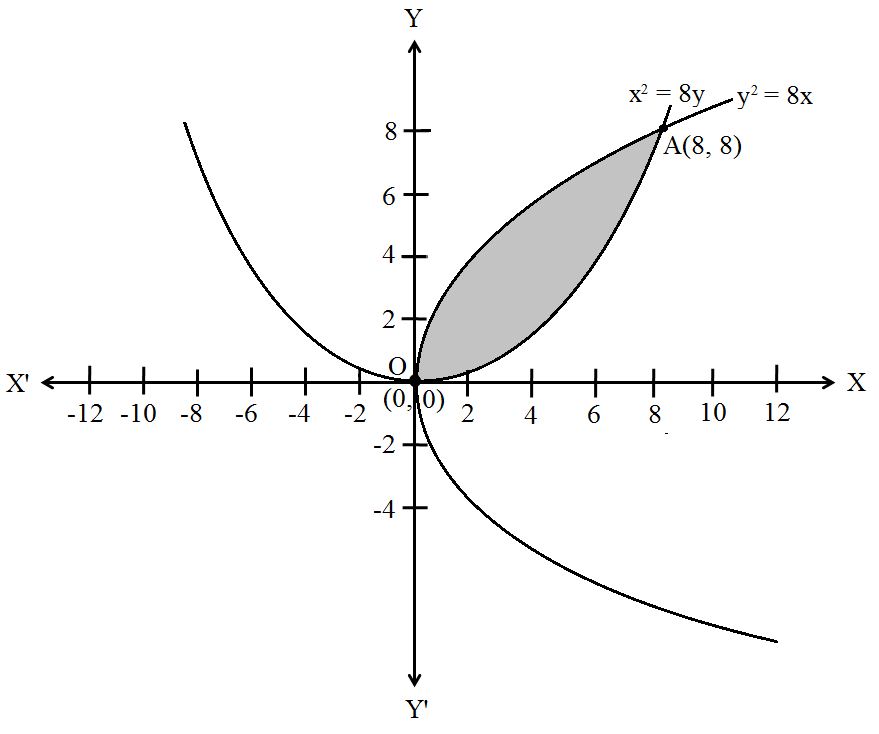
Point of intersection of both the parabolas $y^2 = 8x$ and $x^2 = 8y$ is obtaining by solving the two equations,
$\text{y}^{2} = \text{8x}$ and $\text{x}^{2} = \text{8y}$
$\therefore \frac{\text{y}^{4}}{64} - \text{8y} = 0$
$\Rightarrow \text{y}(\text{y}^{3} - 8^{3}) - 0$
$\Rightarrow \text{y} = 0$ or $\text{y} = 8$
$\Rightarrow \text{x} = 0$ or $\text{x} = 8$
$\therefore O(0, 0)$ and $A(8, 8)$ are the points of intersection.
Area of the shaded region $= \int\limits^{8}_{0} |\text{y}_{2} - \text{y}_{1}| \text{dx}$
$=\int\limits^{8}_{0} (\text{y}_{2} - \text{y}_{1}) \text{dx}$
$=\int\limits^{8}_{0} \big(\sqrt{8\text{x}} - \frac{\text{x}^{2}}{8}\big) \text{dx}$
$= \bigg[\frac{\sqrt{8}}{\frac{3}{2}} \text{x}^{\frac{3}{2}} - \frac{1}{8} \times \frac{\text{x}^{2}}{3}\bigg]^{8}_{0}$
$ = \frac{2}{3} \times \sqrt{8} \times 8^{\frac{3}{2}} - \frac{1}{8} \times \frac{8^{3}}{3} - 0$
$= \frac{2}{3} \times \sqrt{8} \times 8 \sqrt{8} - \frac{8^{2}}{3}$
$= \frac{2}{3} \times 8^{2} - \frac{8^{2}}{3}$
$=\frac{8^{2}}{3} (2 - 1)$
$=\frac{64}{3} \text{sq units}$ View full question & answer→MCQ 221 Mark
The area bounded by the parabola $y^2 = 4ax$ and $x^2 = 4ay$ is:
- A
$\frac{8\text{a}^3}{3}$
- ✓
$\frac{16\text{a}^2}{3}$
- C
$\frac{32\text{a}^2}{3}$
- D
$\frac{64\text{a}^2}{3}$
AnswerCorrect option: B. $\frac{16\text{a}^2}{3}$
To find the point of intersection of the parabola substitute $\text{y} = \frac{\text{x}^{2}}{4\text{a}}$ in $y^2= 4ax$
We get,
$\frac{\text{x}^4}{16\text{a}^{2}}=4\text{ax}$
$\Rightarrow x^4 - 64a^3 x = 0$
$\Rightarrow x(x^3- 64a^3) = 0$
$\Rightarrow x = 0$ or $x = 4a$
$\Rightarrow y = 0$ or $y = 4a$
Therefore, the required area $\text{ABCD},$
$\text{A} =\int\limits^\text{4a}_0(\text{y}_1-\text{y}_2)\text{dx}\Big($Where$, \text{ y}_1 = 2\sqrt{\text{ax}}$ and $\text{ y}_2=\frac{\text{x}^2}{\text{4a}}\Big)$
$= \int\limits^\text{4a}_0\Big(2\sqrt{\text{ax}}-\frac{\text{x}^2}{\text{4a}}\Big)\text{dx}$
$=\bigg[\frac{4\sqrt{\text{a}}}{3}\text{x}^\frac{3}{2}-\frac{\text{x}^{3}}{12\text{a}}\bigg]^\text{4a}_0$
$= \bigg[\frac{4\sqrt{\text{a}}}{3}(\text{4a}^\frac{3}{2})-\frac{(\text{4a})^3}{\text{12a}}\bigg]-\bigg[\frac{4\sqrt{\text{a}}}{3}(0)^\frac{3}{2}-\frac{(0)^3}{\text{12a}}\bigg]$ $$
$= \bigg[\frac{4\sqrt{\text{a}}}{3}\text{8a}^\frac{3}{2}-\frac{64\text{a}^3}{12\text{a}}\bigg]-0$
$= \frac{32\text{a}^2}{3}-\frac{16\text{a}^3}{3}$
$= \frac{16\text{a}^2}{3}$ square units
View full question & answer→MCQ 231 Mark
The area bounded by the curve $x = 3y^2 – 9$ and the line $x = 0, y = 0$ and $y = 1$ is:
- ✓
$8\text{ sq.}\text{units}$
- B
$\frac{8}{3}\text{ sq.}\text{units}$
- C
$\frac{3}{8}\text{ sq.}\text{units}$
- D
$3\text{ sq.}\text{units}$
AnswerCorrect option: A. $8\text{ sq.}\text{units}$
View full question & answer→MCQ 241 Mark
Area lying between the curves $y^2 = 4x$ and $y = 2x$ is:
- A
$\frac{2}{3}$
- ✓
$\frac{1}{3}$
- C
$\frac{1}{4}$
- D
$\frac{3}{4}$
AnswerCorrect option: B. $\frac{1}{3}$
The points of intersection of the straight line and the parabola is obtained by solving the simultaneous equations,
$y^2 = 4x$ and $y = 2x$
$\Rightarrow (2x)^2 = 4x$
$\Rightarrow 4x^2 = 4x$
$\Rightarrow x(x - 1) = 0$
$\Rightarrow x = 0$ or $x = 1$
$\Rightarrow y = 0$ or $y = 2$
Thus, $O(0, 0)$ and $A(1, 2)$ are the points of intersection of the parabola and straight line shaded area is the required area.
Using the horizontal strip method, shaded area
$= \int\limits^2_0|\text{x}_2-\text{x}_1|\text{dy}$
$=\int\limits^2_0\Big[\Big(\frac{\text{y}}{2}\Big)-\Big(\frac{\text{y}^2}{4}\Big)\Big]\text{dy}$
$=\Big[\frac{1}{2}\Big(\frac{\text{y}^2}{2}\Big)-\frac{1}{4}\Big(\frac{\text{y}^3}{3}\Big)\Big]^2_0$
$=\frac{1}{4}(2)^2-\frac{1}{12}(2^3)-0$
$= 1 -\frac{8}{12}$
$= \frac{12-8}{12}$
$=\frac{1}{3}\text{ sq. units}$
View full question & answer→MCQ 251 Mark
The area bounded by the curve $\text{y}=\cos\text{x}$ in one are of the curve is where $=4\text{n}+1,\text{x}\in \text{integer:}$
- A
$2\text{a}$
- ✓
$\frac{1}{\text{a}} $
- C
$\frac{2}{\text{a}}$
- D
$2{\text{a}^2}$
AnswerCorrect option: B. $\frac{1}{\text{a}} $
$=\text{Area} =\int\limits^\frac{\pi}{2}_0\cos\text{ax}\text{ dx}$
$=\Big[\frac{\sin\text{ax}}{\text{x}}\Big]^\frac{\pi}{2}_0$
$=\frac{1}{0}-0=\frac{1}{\text{a}}$
View full question & answer→MCQ 261 Mark
The area bounded by the curve $y^2= 8x,$ the $x-$axis and the lastus rectum is:
- ✓
$\frac{16}{3}$
- B
$\frac{23}{3}$
- C
$\frac{32}{3}$
- D
$\frac{16\sqrt{2}}{3}$
AnswerCorrect option: A. $\frac{16}{3}$
$y^2 = 8x$ represents a parabola opening side ways,
with vertex at $O(0, 0)$ and focus at $B(2, 0)$
Thus $AA\ '$ represents the latus rectum of the parabola.
The points of intersection of the parabola and latus rectum are $A(2, 4)$ and $A\ '(2, -4)$
Area bound by curve $, x-$axis and latus return is the area $\text{OABO},$
The approximating rectangle of with $= dx$ and length $= y$ has area $= y dx,$ and moves from $x = 0$ to
$\text{x} = 2$ area$\text{ OABO}= \int\limits^2_0|\text{y}|\text{dx}$
$= \int\limits^2_0\text{y}\text{ dx} $ $\{\text{y}>0, \Rightarrow|\text{y}|=\text{y}\}$
$= \int\limits^2_0\sqrt{8\text{x}}\text{ dx}$
$= 2\sqrt{2}\int\limits^2_0\sqrt{\text{xdx}}$
$= 2\sqrt{2}\Bigg[\frac{\text{x}^\frac{3}{2}}{\frac{3}{2}}\Bigg]^2_0$
$=2 \sqrt{2}\times \frac{2}{3}\Big(2^\frac{3}{2}-0\Big)$
$= 4 \frac{\sqrt{2}}{3}\times2\sqrt{2}$
$=\frac{16}{3}\text{ sq. units}$
View full question & answer→MCQ 271 Mark
Area of the region bounded by the curve $y^2 = 4x, y-$axis and the line $y = 3$, is:
- A
$2$
- ✓
$\frac{9}{4}$
- C
$\frac{9}{3}$
- D
$\frac{9}{2}$
AnswerCorrect option: B. $\frac{9}{4}$
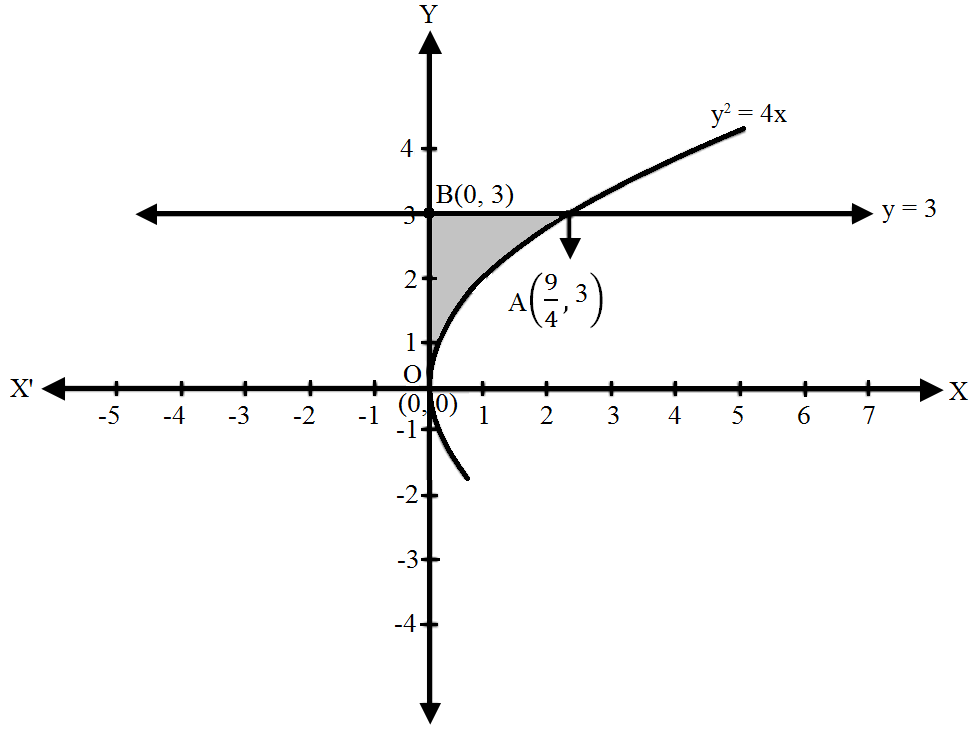
$y^2 = 4x$ represents a parabola with vertex at origin $O(0, 0)$ and symmetric about $+ve\ x-$axis
$y = 3$ is a straight line parallel to the $x-$axis
Point of intersection of the line and the parabola is given by
substituting $y = 3$ in the equation of the parabola
$y^2 = 4x$
$\Rightarrow 3^2 = 4x$
$\Rightarrow\text{x}=\frac{9}{4}$
Thus$, \text{A}=\Big(\frac{9}{4},3\Big)$ is the point of intersection of the parabola and straight line.
Required area is the shaded area $\text{OABO}$
Using the horizontal strip method,
Area $\text{(OABO)}= \int\limits^3_0|\text{x}|\text{ dy}$
$= \int\limits^3_0\frac{\text{y}^2}{4}\text{dy}$
$=\Big[\frac{1}{4}\Big(\frac{\text{y}^2}{3}\Big)\Big]^3_0$
$= \frac{3^3}{12}$
$=\frac{9}{4}\text{ sq. units}$ View full question & answer→MCQ 281 Mark
The area of the region bounded by $y = | x – 1 |$ and $y = 1$ is:
- A
$2$
- ✓
$1$
- C
$\frac{1}{2}$
- D
$\frac{1}{4}$
View full question & answer→MCQ 291 Mark
The area of the region bounded by the curve $\text{y}=\sin\text{x}$ between the ordinates $\text{x}=0,\text{x}=\frac{\pi}{2}$ and the $x-$axis is:
- A
$\text{2 sq. units}$
- B
$\text{4 sq. units}$
- C
$\text{3 sq. units}$
- ✓
$\text{1 sq. unit}$
AnswerCorrect option: D. $\text{1 sq. unit}$
View full question & answer→MCQ 301 Mark
The area bounded by the curve $x^2 = 4y$ and straight line $x = 4y - 2$ is:
- A
$\frac{3}{8}$
- B
$\frac{5}{8}$
- C
$\frac{7}{8}$
- ✓
$\frac{9}{8}$
AnswerCorrect option: D. $\frac{9}{8}$
The area bounded by the curve, $x^2 = 4y$, and line, $x = 4y - 2$, is represented by the shaded area $\text{OBAO}.$
Let $A$ and $B$ be the points of intersection of the line and parabola.
Coordinates of point $A$ are $\Big(-1,\frac{1}{4}\Big)$
Coordinates of point $B$ are $(2,1).$
We draw $AL$ and $BM$ perpendicular to $x-$axis.
It can be observed that, Area $\text{OBAO} =$ Area $\text{OBCO} +$ Area $\text{OACO} ...(1)$
Then, Area $\text{OBCO} =$ Area $\text{OMBC} -$ Area $\text{OMBO}$
$=\int\limits^2_0\frac{\text{x}+2}{4}\text{dx}-\int\limits^2_0\frac{\text{x}^2}{4}\text{dx}$
$=\frac{1}{4}\Big[\frac{\text{x}^2}{2}+2\text{x}\Big]^2_0-\frac{1}{4}\Big[\frac{\text{x}^3}{3}\Big]^2_0$
$=\frac{1}{4}[2+4]-\frac{1}{4}\Big[\frac{8}{3}\Big]$
$=\frac{3}{2}-\frac{2}{3}=\frac{5}{6}$
Similarly, Area $\text{OACO} =$ Area $\text{OLAC} -$ Area $\text{OLAO}$
$=\int\limits^0_{-1}\frac{\text{x}+2}{4}\text{dx}-\int\limits^0_{-1}\frac{\text{x}^2}{4}\text{dx}$
$=\frac{1}{4}\Big[\frac{\text{x}^2}{2}+2\text{x}\Big]^0_{-1}\frac{1}{4}\Big[\frac{\text{x}^3}{3}\Big]^0_{-1}$
$=-\frac{1}{4}\Big[\frac{(-1)^2}{2}+2(-1)\Big]-\Big[-\frac{1}{4}\Big(\frac{(-1)^3}{3}\Big)\Big]$
$=-\frac{1}{4}\Big[\frac{1}{2}-2\Big]-\frac{1}{12}$
$=\frac{1}{2}-\frac{1}{8}-\frac{1}{12}=\frac{7}{24}$
Therefore, required area, $=\Big(\frac{5}{6}+\frac{7}{24}\Big)=\frac{9}{8}\text{ sq}.\text{ units}$
View full question & answer→MCQ 311 Mark
The area bounded by the curve $y = x^4 - 2x^3 + x^2 + 3$ with $x-$axis and ordinates corresponding to the minima of $y$ is:
- A
$1$
- B
$\frac{91}{30}$
- C
$\frac{30}{9}$
- ✓
$4$
Answer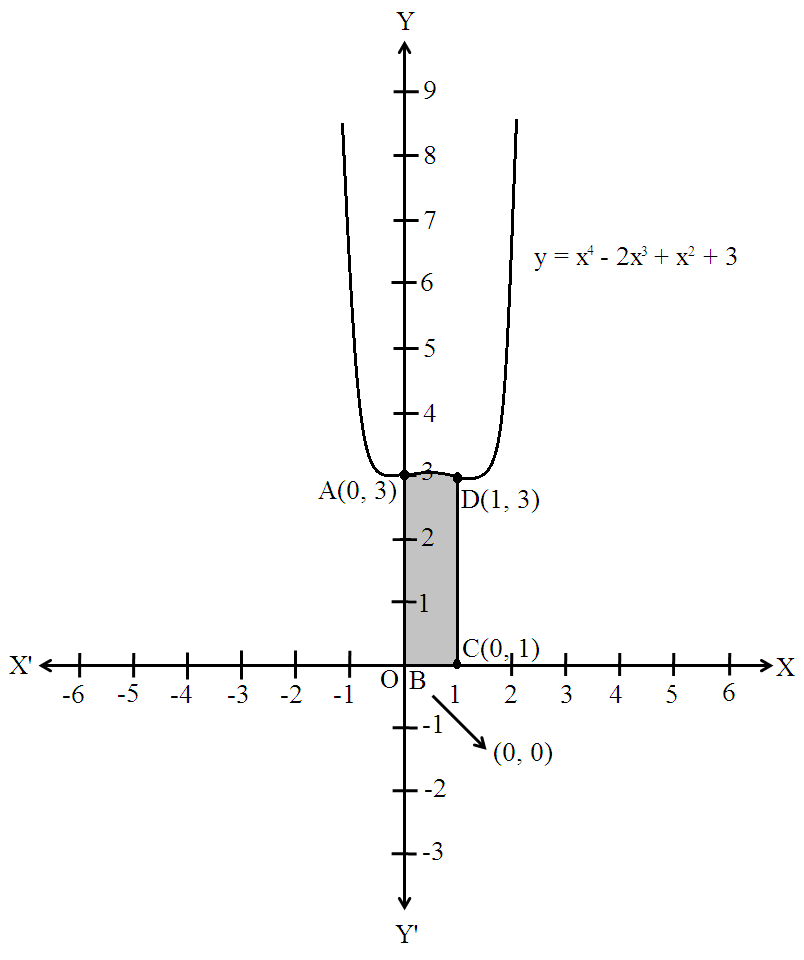
Clearly, from the figure the minimum value of $y$ is $3$ when $x=0$ or $1.$
Therefore, the required area $\text{ABCD},$
$\text{A} = \int\limits^1_0\text{y}\text{ dx} ($Where, $y = x^4 - 2x^3 + x^2 + 3)$
$= \int\limits^1_0(\text{x}^4-2\text{x}^3+\text{x}^2+3)\text{dx}$
$=\bigg[\frac{\text{x}^5}{5}-\frac{2\text{(x})^4}{4}+\frac{\text{x}^3}{3}+3\text{x}\bigg]^1_0$
$=\bigg[\frac{(1)^5}{5}-\frac{2(1)^4}{4}+\frac{(1)^3}{3}+3(1)\bigg]-\bigg[\frac{(0)^5}{5}-\frac{2(0)^4}{4}+\frac{(0)^3}{3}+3(0)\bigg]$
$=\big[\frac{1}{5}-\frac{1}{2}+\frac{1}{3}+3\big]- 0$
$=\frac{6-15+10+90}{3}$
$=\frac{91}{30}\text{ square units}$ View full question & answer→MCQ 321 Mark
The area bounded by $\text{f(x)}=\text{x}^2,0\leq\text{x}\leq1,\text{g(x)}=\text{x}+2,1\leq\text{x}\leq2$ and $x –$ axis is:
- A
$\frac{3}{2}$
- B
$\frac{4}{3}$
- C
$\frac{8}{3}$
- ✓
View full question & answer→MCQ 331 Mark
The ratio of the areas between the curves $\text{y}=\cos\text{x}$ and $\text{y}=\cos2\text{x}$ and x-axis from x = 0 to x = 0 to $\text{x}=\frac{\pi}{3}$
- A
$1:2$
- B
$2:1$
- C
$\sqrt{3}:1$
- ✓
AnswerThe line $\text{x} = \pi3$ meets the curve $\text{y} = \cos\text {x}\text{ at}\text { B}\pi3,12$
Area between the curve y = cos x and x - axis from x = 0 and $\text{x} = 3\pi$ is,
$=\Big[2-\frac{1}{2}-\frac{1}{3}\Big]-\Big[-4-2+\frac{8}{3}\Big]$
$= 2 -\frac{1}{2}-\frac{1}{3}+4+2-\frac{8}{3}$
$=8-\frac{1}{2}-\frac{9}{3}$
$=5-\frac{1}{2}$
$=\frac{9}{2}\text{ square units}$
The line $\text{x}=\frac{\pi}{3}$ meets the curve y = cos 2x at $\text{B}'\pi3, -12$ Area between the curve y = cos 2x and x -axis from x = 0 and $\text{x}=\frac{\pi}{3}$ is,
$= \text{A}_2 = \int\limits^\frac{\pi}{4}_0\text{y}_2\text{ dx}-\int\limits^\frac{\pi}{3}_\frac{\pi}{4}\text{y}_2\text{dx}$ $\big[\text{where}, \text{y}_2 = \cos(2\text{x})\big]$
$=\int\limits^\frac{\pi}{4}_0\cos(2\text{x})\text{dx}-\int\limits^\frac{\pi}{3}_\frac{\pi}{4}\cos(2\text{x})\text{ dx}$
$=\Big[\frac{1}{2}\sin(2\text{x})\Big]^\frac{\pi}{4}_0-\Big[\frac{1}{2}\sin(2\text{x})\Big]^\frac{\pi}{3}_\frac{\pi}{4}$
$=\frac{1}{2}\Big[\sin\Big(\frac{\pi}{2}\Big)-\sin(0)\Big]-\frac{1}{2}\Big[\sin\Big(\frac{2\pi}{3}\Big)-\sin\Big]$
$= \frac{1}{2}-\frac{1}{2}\Big[\frac{\sqrt{3}}{2}-1\Big]$
$= \frac{1}{2}-\frac{\sqrt{3}}{4}+\frac{1}{2}$
$= 1-\frac{\sqrt{3}}{4}$
$=\frac{4-\sqrt{3}}{4}$
Therefore the retios will be
$\text{A}_1:\text{A}_2=\frac{\text{A}_1}{\text{A}_2}=\frac{\frac{\sqrt{3}}{2}}{\frac{4-\sqrt{3}}{4}}=\frac{2\sqrt{3}}{4-\sqrt{3}}$
View full question & answer→MCQ 341 Mark
The area enclosed by the curves $y^2 = x$ and $y = |x|$ is:
- A
$\frac{2}{3}$
- B
$1$
- ✓
$\frac{1}{6}$
- D
$\frac{1}{3}$
AnswerCorrect option: C. $\frac{1}{6}$
Required area $=\text{A}=\int\limits^1_0\big(\sqrt{\text{x}}-\text{x}\big)\text{dx}$
$=\Big[\frac{2}{3}\text{x}^{\frac{3}{2}}-\frac{\text{x}^2}{2}\Big]^1_0$
$=\frac{2}{3}-\frac{1}{2}$
$=\frac{1}{6}$
View full question & answer→MCQ 351 Mark
The area bounded by the curve $\text{y}=\sin\text{x}$ between the ordinates $\text{x}=0,\text{x}=\pi$ and the x-axis is:
- ✓
$2\text{ sq. units}$
- B
$4\text{ sq. units}$
- C
$3\text{ sq. units}$
- D
$1\text{ sq. units}$
AnswerCorrect option: A. $2\text{ sq. units}$
$\text{A}=\int^\limits{\pi}_0\text{y}\text{ dx}$
$=\int^\limits{\pi}_0\sin(\text{x})\text{dx}$
$=\big[-\cos(\text{x})\big]^{\pi}_0$
$= -\cos(\pi)+\cos(0)$
$= 1 + 1$
$= 2 \text{ square units}$
View full question & answer→MCQ 361 Mark
Choose the correct answer from the given four options:
The area of the region bounded by the curve $\text{y}=\sin\text{x}$ between the ordinates x = 0, $\text{x}=\frac{\pi}{2}$ and the x-axis is:
- A
$2\text{ sq. units}$
- B
$4\text{ sq. units}$
- C
$3\text{ sq. units}$
- ✓
$1\text{ sq. units}$
AnswerCorrect option: D. $1\text{ sq. units}$
Area of the region bounded by the curve $\text{y}=\sin\text{x}$ between the ordinates x = 0, $\text{x}=\frac{\pi}{2}$ and the X-axis is
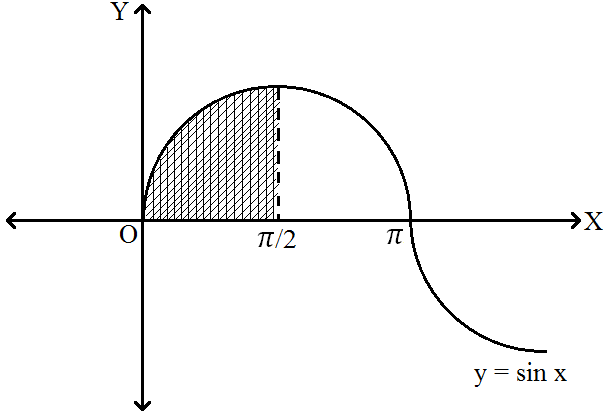
$\text{A}=\int\limits^{\frac{\pi}{2}}_0\sin\text{x dx}$
$=-\Big[\cos\text{x}\Big]^{\frac{\pi}{2}}_0=-\Big[\cos\frac{\pi}{2}-\cos0\Big]$
$=-[0-1]=1\text{ sq. units}$ View full question & answer→MCQ 371 Mark
For the area bounded by the curve $y = ax,$ the line $x = 2$ and $x -$ axis to be $2 \ sq.$ units, the value of a must be equal to:
View full question & answer→MCQ 381 Mark
The area bounded by the curve y = f(x), x-axis, and the ordinates x = 1 and $(\text{b}-1)\sin(3\text{b}+4)$ Then, f(x) is:
AnswerCorrect option: C. $\sin(3\text{x}+4)+3(\text{x}-1)\cos(3\text{x}+4)$
sin (3x + 4) + 3 (x - 1) cos (3x + 4)
y = fx
If A is the area bound by the curve, x-axis, x = 1 and x = b
$\Rightarrow \int\limits^\text{b}_1\text{f}(\text{x})\text{dx}=\big[\text{A}\big]^\text{b}_1 = (\text{b - 1})\sin(3\text{b} + 4)$ {given}
$\Rightarrow \text{f}(\text{x})=\frac{\text{d}}{\text{dx}}((\text{x} - 1)\sin(3\text{x}+ 4))$
$= \sin (3\text{x} + 4)\frac{\text{d}}{\text{dx}}(\text{x} - 1) + (\text{x} - 1)\frac{\text{d}}{\text{dx}}\sin(3\text{x} + 4)$
$= \sin (3\text{x} + 4) + 3(\text{x} - 1)\cos(3\text{x} + 4)$
View full question & answer→MCQ 391 Mark
Area bounded by the curve $\text{y}=\sin\text{x}$ and the x-axis between $\text{x}=0$ and $\text{x}=2\pi$ is:
Answer(d), as $\text{x}=\sin$ is positive in 1st and 2nd quadrant and negative is 3rd and 4th quadrant.
$=\text{Area}=\int\limits^{2\pi}_0\sin\text{x}\text{ dx}$
$=\int\limits^\pi_0\sin\text{x}+\int\limits^{2\pi}_\pi(-\sin\text{x})\text{dx}$
$=4\text{sq}\text{ units}$
View full question & answer→MCQ 401 Mark
The area of the region formed by $\text{x}^2+\text{y}^2-6\text{x}-4\text{y}+12\leq0,\text{ y}\leq\text{x}$ and $\text{x}\leq\frac{5}{2}$
- A
$\frac{\pi}{6}-\frac{\sqrt{3}+1}{8}$
- B
$\frac{\pi}{6}+\frac{\sqrt{3}+1}{8}$
- ✓
$\frac{\pi}{6}-\frac{\sqrt{3}-1}{8}$
- D
AnswerCorrect option: C. $\frac{\pi}{6}-\frac{\sqrt{3}-1}{8}$
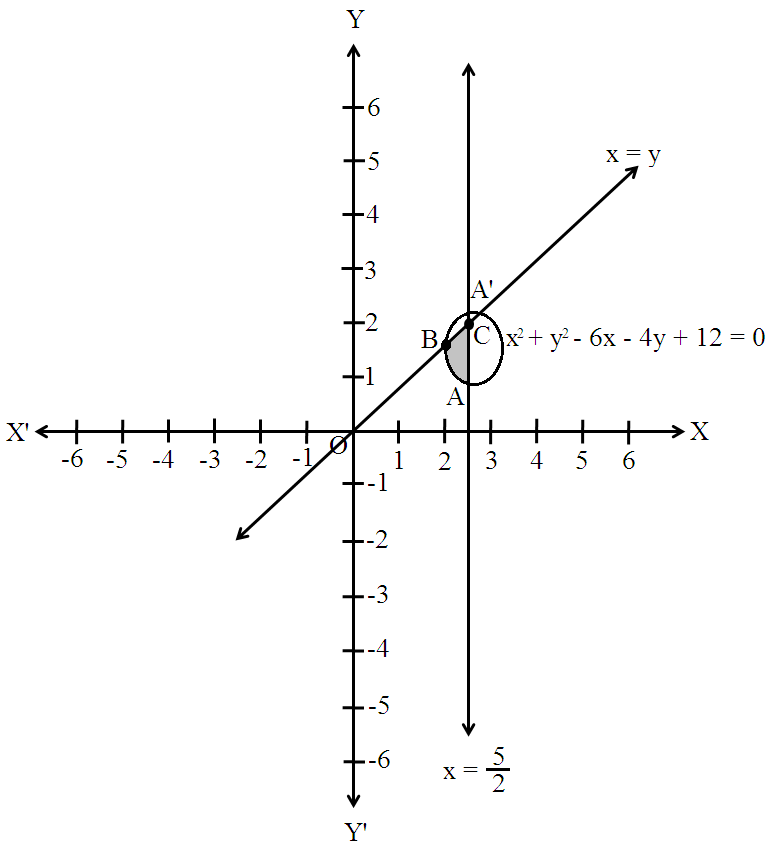
We have,
$\text{x}^{2} + \text{y}^{2}-6\text{x}-4\text{y}+\leq0$
$\text{y}\leq\text{x}$
$\text{x}\leq\frac{5}{2}$
Following are the corresponding equations of the given inequation.
$x^2 + y^2 -6x -4y +12 = 0 ...(i)$
$y = x ...(ii)$
$\text{x} = \frac{5}{2}\ ...(\text{iii})$
Here, $\text{ABC}$ is our required region in which point $A$ is intersection of $(i)$ and $(iii),$ point $B$ is intersection of $(i)$ and $(ii)$ and point $C$ is intersection of $(ii)$ and $(iii)$ By solving $ (i), (ii)$ and $(iii)$ we get the coordinates of $B$ and $C$ as $B = (2, 2) \text{C} = \Big(\frac{5}{2}, \frac{5}{2}\Big)$ Now, the equation of the circle is,
$x^2 + y^2 - 6x - 4y +12 = 0$
$\Rightarrow (x-3)^2 + (y-2)^2 = 1$
$\Rightarrow (y - 2)^2 = 1 - (x - 3)^2$
$\Rightarrow\text{y}-2 = \pm\sqrt{1-(\text{x}-3)^{2}}$
$\Rightarrow\text{y} = \pm\sqrt{1-(\text{x}-3})^{2}+2$
$\Rightarrow\text{y} = \sqrt{1-(\text{x}-3)^{2}}+2 \text{ or }-\sqrt{1-(\text{x}{-3})^{2}}+2$
$\text{y}= \sqrt{1-(\text{x}-3)^{2}}+2$ is not possible,
Therefore $\text {y}= -\sqrt{1-(\text{x}-3)^{2}}+2$
The area of the required region $\text{ABC}$,
$\text{A}= \int\limits^\frac{5}{2}_{2}(\text{y}_2-\text{y}_1)\text{ dx} \big(\text{where},\text{ y}_1 = -\sqrt{1-(\text{x}-3)^2} +2\text{ and}\text{ y}^2 = \text{x}\big)$
$= \int\limits^\frac{5}{2}_{2}\big[\text {x}-\big(-\sqrt{1(\text{x}-3)^{2}}+2\big)\big]\text{dx}$
$= \int^\limits\frac{5}{2}_2\big[\text{x}+\sqrt{1-(\text{x}-3)^{2}}\big]\text{dx}$
$= \bigg[\frac{\text{x}^{2}}{2}+\frac{(\text{x}-3)}{2}\sqrt{1-(\text{x}-3)^{2}}+\frac{1}{2}\sin^{-1}(\text{x}-3)-2\text{x}\bigg]^{\frac{5}{2}}_{2}$
$=\Bigg[\frac{\big(\frac{5}{2}\big)^{2}}{2}+\frac{\frac{5}{2}-3}{2}\sqrt{1-\Big\{\Big(\frac{5}{2}\Big)-3\Big\}^2}+\frac{1}{2}\sin^{-1}=\Big(\frac{5}{2}-3\Big)-2\Big(\frac{5}{2}\Big)\Bigg]\\-\bigg[\frac{2^{2}}{2}+\frac{2-3}{2}\sqrt{1-(2-3)^2}+\frac{1}{2}\sin^{-1}(2-3)-2(2)\bigg]$
$= \bigg[\frac{25}{8}-\frac{1}{4}\sqrt{1-\frac{1}{4}}+\frac{1}{2}\sin^{-1}\Big(-\frac{1}{2}\Big)-5\bigg]\\- \bigg[2-\frac{1}{2}\times0+\frac{1}{2}\sin^{-1}(-1)-4\bigg]$
$= \Big[-\frac{15}{8}-\frac{\sqrt{3}}{8}+\frac{1}{2}\times\Big(-\frac{\pi}{6}\Big)\Big]-\Big[+\frac{1}{2}\times\Big(-\frac{\pi}{2}\Big)-2\Big]$
$= -\frac{15}{8}-\frac{\sqrt{3}}{8}-\frac{\pi}{12}+\frac{\pi}{4}+2$
$=\frac{\pi}{6}-\frac{\sqrt{3}-1}{8}$ View full question & answer→MCQ 411 Mark
Choose the correct answer from the given four options:The area of the region bounded by the curve $x^2 = 4y$ and the straight line $x = 4y - 2$ is:
- A
$\frac{3}{8}\text{ sq. units}$
- B
$\frac{5}{8}\text{ sq. units}$
- C
$\frac{7}{8}\text{ sq. units}$
- ✓
$\frac{9}{8}\text{ sq. units}$
AnswerCorrect option: D. $\frac{9}{8}\text{ sq. units}$
We have parabola $x^2 - 4y$ and the straight line $x = 4y - 2$
Solving we get
$x^2 = x + 2$
$\Rightarrow x^2 - x - 2 = 0$
$\Rightarrow (x - 2)(x + 1) = 0$
$\Rightarrow x = -1, 2$
For $x = -1, \text{y}=\frac{1}{4}$
and for $x = 2, y = 1$
Thus point of intersection are $\Big(-1,\frac{1}{4}\Big)$ and $(2,1)$
Grapha of parabola $x^2 = 4y$ and $x = 4y - 2$ are as show in the following figure.
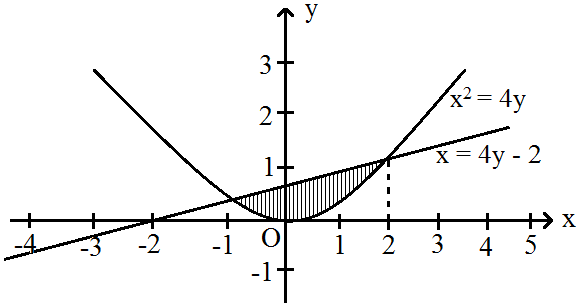
$\therefore$ From the figure, area of shaded region
$\text{A}=\int\limits^2_{-1}\Big(\frac{\text{x}+2}{4}-\frac{\text{x}^2}{4}\Big)\text{dx}$
$=\frac{1}{4}\Big[\frac{\text{x}^2}{2}+2\text{x}-\frac{\text{x}^3}{3}\Big]^2_{-1}$
$=\frac{1}{4}\bigg[\Big(\frac{4}{2}+4-\frac{8}{3}\Big)-\Big(\frac{1}{2}-2+\frac{1}{3}\Big)\bigg]$ $=\frac{1}{4}\bigg[8-\frac{1}{2}-3\bigg]=\frac{9}{8}\text{ sq. units}$ View full question & answer→MCQ 421 Mark
The area bounded by the lines $y = |x – 2|, x = 1, x = 3$ and the $x-$ axis is:
- ✓
$1 \ sq.$ unit
- B
$2 \ sq.$ units
- C
$3 \ sq.$ units
- D
$4 \ sq.$ units
AnswerCorrect option: A. $1 \ sq.$ unit
View full question & answer→MCQ 431 Mark
Choose the correct answer from the given four options:The area of the region bounded by parabola $y^2 = x$ and the straight line $2y = x$ is:
- ✓
$\frac{4}{3}\text{ sq. units}$
- B
$1\text{ sq. units}$
- C
$\frac{2}{3}\text{ sq. units}$
- D
$\frac{1}{3}\text{ sq. units}$
AnswerCorrect option: A. $\frac{4}{3}\text{ sq. units}$
Solving $y^2 = x$ and $2y = x$, we get
$\Big(\frac{\text{x}}{2}\Big)^2=\text{x}$
$\Rightarrow\ \text{x}^2=4^{\frac{3}{2}}$
$\Rightarrow\ \text{x(x}-4)=0$
$\Rightarrow\ \text{x}=4,0$
When $x = 0, y = 0$ and when $x = 4, y = 2$
So, the intersection points are $(0, 0)$ and $(4, 2).$
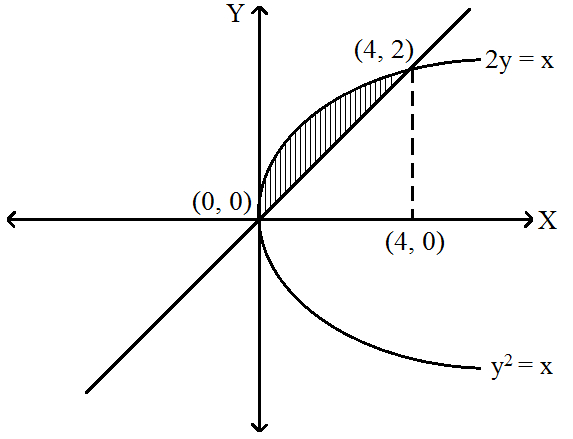
Thus required area of shaded region,
$\text{A}=\int\limits^4_0\Big[\sqrt{\text{x}}-\frac{\text{x}}{2}\Big]\text{dx}$
$=\Bigg[\frac{\text{x}^{\frac{1}{2}+1}}{\frac{1}{2}+1}-\frac{1}{2}\cdot\frac{\text{x}^2}{2}\Bigg]^4_0=\bigg[2\cdot\frac{\text{x}^{\frac{3}{2}}}{3}-\frac{\text{x}^2}{4}\bigg]^4 _0$
$=\frac{2}{3}4^{\frac{3}{2}}-\frac{16}{4}\frac{2}{3}\cdot+\frac{1}{4}\cdot0$
$=\frac{16}{3}-\frac{32}{12}=\frac{48-32}{12}$
$=\frac{16}{12}=\frac{4}{3}\text{ sq. units}$ View full question & answer→MCQ 441 Mark
The area bounded by the lines $y = |x| - 1$ and $y = -|x| + 1$ is:
AnswerCorrect option: B. $\text{2 sq. unit}$
View full question & answer→MCQ 451 Mark
Area of the region bounded by the curve $\text{y}=\cos\text{x}$ between $x = 0$ and $\text{x}=\pi$ is:
- ✓
$2 \ sq$. units
- B
$4 \ sq.$ units
- C
$3 \ sq.$ units
- D
$1 \ sq.$ units
AnswerCorrect option: A. $2 \ sq$. units
View full question & answer→MCQ 461 Mark
The area bounded by the curvey $=\sqrt{\text{x}}$ the line 2y + 3 = x and the x - axis in the first quadrant is:
- ✓
$9$
- B
$\frac{27}{4}$
- C
$36$
- D
$18$
AnswerGiven curves are $\text{y}=\sqrt{\text{x}}$ ...(1)and 2y - x + 3 = 0 ...(2)
Solving (1) and (2), we get
$=\sqrt{2}-(\sqrt{\text{x}})^2+3=0$
$\Rightarrow(\sqrt{\text{x}})^2-2\sqrt{\text{x}}-3=0$
$\Rightarrow(\sqrt{\text{x}}-3)(\sqrt{\text{x}}-3=0$
$\Rightarrow\sqrt{\text{x}}-3$
$\because\sqrt{\text{x}}=-1 \text{ is}\text{ not}\text{ possible}$
$\therefore\text{y}=3$
Hence required area
$=\int\limits^3_0(\text{x}_2-\text{x}_1\text{dy}$
$=\int\limits^3_0((2\text{y}+3)-\text{y}^2)\text{dy}$
$=\Big[\text{y}^2+3\text{y}-\frac{\text{y}^3}{3}\Big]^3_0$
$=9+9-9=9$
View full question & answer→MCQ 471 Mark
The area bounded by the line $y = 2x – 2, y = – x$ and $x-$axis is given by:
- A
$\frac{9}{2}\text{ sq.}\text{ units}$
- B
$\frac{43}{6}\text{ sq.}\text{ units}$
- C
$\frac{35}{6}\text{ sq.}\text{ units}$
- ✓
View full question & answer→MCQ 481 Mark
The area bounded by $y - 1 = |x|, y = 0$ and $|x| =\frac{1}{2}$ will be:
- A
$\frac{3}{4}$
- B
$\frac{3}{2}$
- ✓
$\frac{5}{4}$
- D
AnswerCorrect option: C. $\frac{5}{4}$
View full question & answer→MCQ 491 Mark
Area lying first quadrant and bounded by the circle $x^2 + y^2 = 4$ and the line $x = 0$ and $x = 2,$ is:
- ✓
$\pi$
- B
$\frac{\pi}{2}$
- C
$\frac{\pi}{3}$
- D
$\frac{\pi}{4}$
Answer$x^2 + y^2 = 4$ represents a circle with centre at origion $O(0, 0)$ and radius $2$ units,
cutting the coordinate axis at $A, A\ ', B$ and $B\ ', x =2$
represents a straight line parallel to the $y-$axis,
intersecting the circle at $A(2, 0)x = 0$ respresents the $y-$axis
Area bounded by the circle and the two given lines in the first quadrant is the shaded area $\text{OBCAO}$
Area$\text{(OBCAO)}=\int\limits^2_0|\text{y}|\text{dx}$
$=\int\limits^2_0\sqrt{4-\text{x}^2}\text{dx}$
$=\bigg[\frac{1}{2}\text{x}\sqrt{4-\text{x}^2}+\frac{1}{2}\times4\sin^{-1}\Big(\frac{\text{x}}{2}\Big)\bigg]^2_0$
$= \frac{1}{2}\times2\sqrt{4-2^2}+\frac{1}{2}\times4\sin^{-1}\Big(\frac{2}{2}\Big)-0$
$= 0 + 2 \sin^{-1}(1)$
$= 2\times\frac{\pi}{2}$
$= \pi\text{ sq. units}$
View full question & answer→MCQ 501 Mark
Choose the correct answer from the given four options:
The area of the region bounded by the y-axis, $\text{y}=\cos\text{x}$ and $\text{y}=\sin\text{x},0\leq\text{x}\leq\frac{\pi}{2}$ is:
- A
$\sqrt{2}\text{ sq. units}$
- B
$\big(\sqrt{2}+1)\text{ sq. units}$
- ✓
$\big(\sqrt{2}-1)\text{ sq. units}$
- D
$\big(2\sqrt{2}-1)\text{ sq. units}$
AnswerCorrect option: C. $\big(\sqrt{2}-1)\text{ sq. units}$
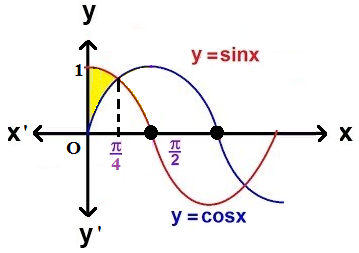
We have, Y-axis i.e., x = 0, $\text{y}=\cos\text{x}$ and $\text{y}=\sin\text{x},$ where $0\leq\text{x}\leq\frac{\pi}{2}$ View full question & answer→