Questions

M.C.Q (1 Marks)

Take a timed test

26 questions · auto-graded multiple-choice test.

MCQ 11 Mark
If $s = t^3- 4t^2+ 5$ describes the motion of a particle, then its velocity when the acceleration vanishes, is :
  • A
    $\frac{16}{2}\ \text{unit}/\text{sec}.$
  • B
    $\frac{\text{-32}}{3}\ \text{unit}/\text{sec}.$
  • C
    $\frac{4}{3}\ \text{unit}/\text{sec}.$
  • $-\frac{16}{3}\ \text{unit}/\text{sec}.$
Answer
Correct option: D.
$-\frac{16}{3}\ \text{unit}/\text{sec}.$
According to the question,
$\text{s}=\text{t}^{3}-4\text{t}^{2}+5$
$\Rightarrow\frac{\text{ds}}{\text{dt}}=3\text{t}^{2}-8\text{t}$
$\Rightarrow\frac{\text{d}^{2}\text{s}}{\text{dt}^{2}}=6\text{t}-8$
$\Rightarrow6\text{t}-8=0$
$\Big[$As velocity diminish, then $\frac{\text{d}^{2}\text{s}}{\text{dt}^{2}}=0\Big]$
$\Rightarrow\text{t}=\frac{4}{3}$
Now, $\Big(\frac{\text{ds}}{\text{dt}}\Big)_{\text{t}=\frac{4}{3}}=3\Big(\frac{4}{3}\Big)^{2}-8\Big(\frac{4}{3}\Big)$
$\Rightarrow\frac{\text{ds}}{\text{dt}}=\frac{16}{3}-\frac{32}{3}$
$\Rightarrow\frac{\text{ds}}{\text{dt}}=-\frac{16}{3}\ \text{unit}/\text{sec}.$
View full question & answer
MCQ 21 Mark
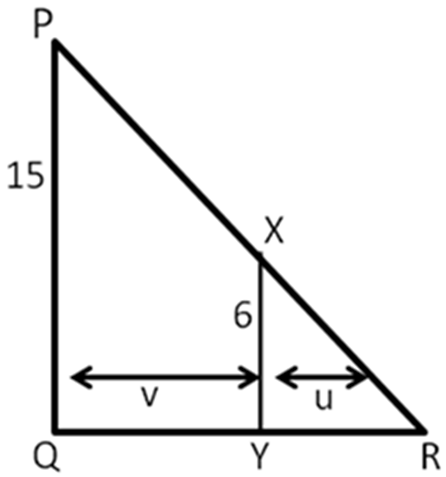
A man of height 6ft walks at a uniform speed of 9ft/sec. from a lamp fixed at 15ft height. The length of his shadow is increasing at the rate of:
  • A
    $15\text{ft}/\text{sec}.$
  • B
    $9\text{ft}/\text{sec}.$
  • $6\text{ft}/\text{sec}.$
  • D
    None of these.
Answer
Correct option: C.
$6\text{ft}/\text{sec}.$

$\frac{15}{6}=\frac{\text{u+v}}{\text{u}}$
$\Rightarrow\frac{15}{6}=\frac{\text{v}}{\text{u}}+1$
$\Rightarrow\frac{\text{v}}{\text{u}}=\frac{3}{2}$
$\Rightarrow\text{u}=\frac{2\text{v}}{3}$
$\Rightarrow\frac{\text{du}}{\text{du}}=\frac{2}{3}\frac{\text{dv}}{\text{dt}}$
$\Rightarrow\frac{\text{du}}{\text{dt}}=\frac{2}{3}\times9$
$=6\text{ft}/\text{sec}.$
View full question & answer
MCQ 31 Mark
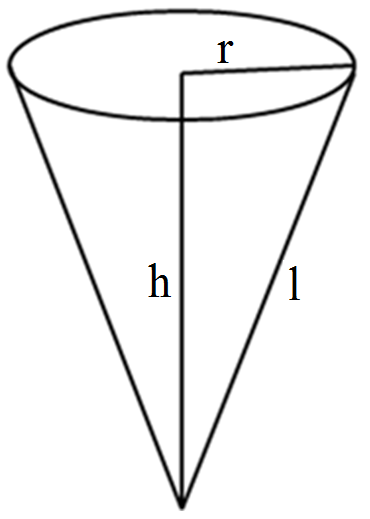
The radius of the base of a cone is increasing at the rate of 3cm/minute and the altitude is decreasing at the rate of 4cm/minute. The rate of change of lateral surface when the radius = 7cm and altitude 24cm is:
  • $54\pi \text{cm}^{2}/\text{min}$
  • B
    $7\pi\text{cm}^{2}/\text{min}$
  • C
    $27\text{cm}^{2}/\text{min}$
  • D
    $\text{none of these }$
Answer
Correct option: A.
$54\pi \text{cm}^{2}/\text{min}$

Given that $\frac{\text{dr}}{\text{dt}}=3\text{cm}/\text{min}, \frac{\text{dh}}{\text{dt}}=-4\text{cm}/\text{min}$
$\text{h}=24\text{cm}, \text{r}=7\text{cm}$
$\text{l}^{2}=\text{h}^{2}+\text{r}^{2}$
$\Rightarrow\text{l}^{2}=24^{2}+7^{2}$
$\Rightarrow\text{l}=25$
$\text{s}=\pi\text{r}\text{l}$
$\Rightarrow\text{s}^{2}=\pi\text{r}^{2}\text{l}^{2}$
$\Rightarrow\text{s}^{2}=\pi\text{r}^{2}(\text{h}^{2}+\text{r}^{2})$
$\Rightarrow\text{s}=\pi\text{r}^{2}\text{h}^{2}+\pi\text{r}^{4}$
$\Rightarrow2\text{s}\frac{\text{ds}}{\text{dt}}=2\pi^{2}\text{r}^{2}\text{h}\frac{\text{dh}}{\text{dt}}+2\pi^{2}\text{h}^{2}\text{r}\frac{\text{dr}}{\text{dt}}+4\pi^{2}\text{r}^{3}\frac{\text{dr}}{\text{dt}}$
$\Rightarrow2\pi\text{r}\text{l}\frac{\text{ds}}{\text{dt}}=2\pi^{2}\text{r}\text{h}\Bigg(\text{r}+\frac{\text{dh}}{\text{dt}}+\text{h}\frac{\text{dr}}{\text{dt}}+\frac{2\text{r}^{2}}{\text{h}}\frac{\text{dr}}{\text{dt}}\bigg)$
$\Rightarrow\pi\text{r}\text{l}\frac{\text{ds}}{\text{dt}}=\pi^{2}\text{r}\text{h}\Bigg(\text{r}+\frac{\text{dh}}{\text{dt}}+\text{h}\frac{\text{dr}}{\text{dt}}+\frac{2\text{r}^{2}}{\text{h}}\frac{\text{dr}}{\text{dt}}\Bigg)$
$\Rightarrow25\frac{\text{ds}}{\text{dt}}=\pi\text{r}\text{h}\Bigg(\text{r}+\frac{\text{dh}}{\text{dt}}+\text{h}\frac{\text{dr}}{\text{dt}}+\frac{2\text{r}^{2}}{\text{h}}\frac{\text{dr}}{\text{dt}}\Bigg)$
$\Rightarrow25\frac{\text{ds}}{\text{dt}}=\pi\text{h}\Bigg(\text{r}+\frac{\text{dh}}{\text{dt}}+\text{h}\frac{\text{dr}}{\text{dt}}+\frac{2\text{r}^{2}}{\text{h}}\frac{\text{dr}}{\text{dt}}\Bigg)$
$\Rightarrow25\frac{\text{ds}}{\text{dt}}=24\pi\Bigg(7\times(-4)+24\times3+\frac{2\times(7)^{2}}{24}\times3\bigg)$
$\Rightarrow\frac{\text{ds}}{\text{dt}}=54\pi\text{cm}^{2}/\text{sec}$
View full question & answer
MCQ 41 Mark
Side of an equilateral triangle expands at the rate of $2\text{cm}/ \text{sec}.$ The rate of increase of its area when each side is 10cm is:
  • A
    $10\sqrt{2}\text{cm}^2/\sec.$
  • $10\sqrt{3}\text{cm}^2/\sec.$
  • C
    $10\text{cm}^2/\sec.$
  • D
    $5\text{cm}^2/\sec.$
Answer
Correct option: B.
$10\sqrt{3}\text{cm}^2/\sec.$
$\text{A}=\frac{\sqrt{3}}{4}\text{x}^2$
$\frac{\text{dA}}{\text{dt}}=\frac{\sqrt{3}}{2}\text{x}\frac{\text{dx}}{\text{dt}}$
$\Rightarrow\frac{\text{dA}}{\text{dt}}=\frac{\sqrt{3}}{2}\times2\times10=10\sqrt{3}\text{cm}^2/\sec.$
View full question & answer
MCQ 51 Mark
The equation of motion of a particle is $\text{s} = \text{2t}^2 + \sin \text{2t,}$ where $s$ is in metres and $t$ is in seconds. The velocity of the particle when its acceleration is $2m/\sec^2$, is :
  • A
    $\pi+\sqrt{3}\text{m}/\text{sec}.$
  • $\frac{\pi}{3}+\sqrt{3}\text{m}/\text{sec}.$
  • C
    $\frac{2\pi}{3}+\sqrt{3}\text{m}/\text{sec}.$
  • D
    $\frac{\pi}{3}+\frac{1}{\sqrt{3}}\text{m}/\text{sec}.$
Answer
Correct option: B.
$\frac{\pi}{3}+\sqrt{3}\text{m}/\text{sec}.$
$\text{s}=2\text{t}^{2}+\sin2\text{t}$
$\text{v}=\frac{\text{ds}}{\text{dt}}=4\text{t}+2\cos2\text{t}$
$\text{a}=\frac{\text{d}^{2}\text{s}}{\text{dt}^{2}}=4-4\sin2\text{t}$
Given that $\text{a}=2\text{m}/\text{sec}^{2}$
$\Rightarrow4-4\sin2\text{t}=2$
$\Rightarrow2-2\sin2\text{t}=1$
$\Rightarrow2\sin2\text{t}=1$
$\Rightarrow\sin2\text{t}=\frac{1}{2}$
$\Rightarrow2\text{t}=\frac{\pi}{6}$
$\Rightarrow\text{t}=\frac{\pi}{12}$
$\text{v}=4\text{t}+2\cos2\text{t}$ at $\text{t}=\frac{\pi}{12},$
$\text{v}=4\text{t}\times\frac{\pi}{12}+2\cos\frac{\pi}{6}=\frac{\pi}{3}+\sqrt{3}\text{m}/\text{sec}.$
View full question & answer
MCQ 61 Mark
The radius of a circular plate is increasing at the rate of 0.01cm/sec. The rate of increase of its area when the radius is 12cm, is:
  • A
    $144\pi\text{cm}^{2}/\text{sec}.$
  • B
    $2.4\pi\text{cm}^{2}/\text{sec}.$
  • $0.24\pi\text{cm}^{2}/\text{sec}.$
  • D
    $0.024\pi\text{cm}^{2}/\text{sec}.$
Answer
Correct option: C.
$0.24\pi\text{cm}^{2}/\text{sec}.$
$\text{A}=\pi\text{r}^{2}$
$\frac{\text{dA}}{\text{dt}}=2\pi\text{r}\frac{\text{dr}}{\text{dt}}$
$\Rightarrow\frac{\text{dA}}{\text{dt}}=2\pi\times12\times0.01$
$=0.24\pi\text{cm}^{2}/\text{sec}.$
View full question & answer
MCQ 71 Mark
If the rate of chage of volume of sphere is equal to the rate of change of its radius, then its radius is equal to:
  • A
    $1\ \text{unit}$
  • B
    $\sqrt{2\pi}\ \text{units}$
  • C
    $\sqrt{2\pi}\ \text{units}$
  • $\frac{1}{2\sqrt{\pi}}\ \text{unit}$
Answer
Correct option: D.
$\frac{1}{2\sqrt{\pi}}\ \text{unit}$
Let r be the radius and V be the volume of the sphere at any time t. Then,$\text{v}=\frac{4}{3}\pi\text{r}^{3}$
$\Rightarrow\frac{\text{dv}}{\text{dt}}=\frac{4}{3}(3\pi\text{r}^{2})\frac{\text{dr}}{\text{dt}}$
$\Rightarrow\frac{\text{dv}}{\text{dt}}=4\pi\text{r}^{2}\frac{\text{dr}}{\text{dt}}$
$\Rightarrow4\pi\text{r}^{2}=1\ [\therefore\frac{\text{dv}}{\text{dt}}=\frac{\text{dr}}{\text{dt}}]$
$\Rightarrow\text{r}^{2}=\frac{1}{4\pi}$
$\Rightarrow\text{r}=\sqrt{\frac{1}{4\pi}}$
$\Rightarrow\text{r}=\frac{1}{2\sqrt{\pi}}\text{unit}$
View full question & answer
MCQ 81 Mark
The distance moved by a particle travelling in straight line in $t$ seconds is given by $s = 45t + 11t^2- t^3$. The time taken by the particle to come to rest is :
  • $9\ \text{sec}.$
  • B
    $\frac{5}{3}\ \text{sec}.$
  • C
    $\frac{3}{5}\ \text{sec}.$
  • D
    $2\ \text{sec}.$
Answer
Correct option: A.
$9\ \text{sec}.$
$\text{s}=45\text{t}+11\text{t}^{2}-\text{t}^{3}$
$\frac{\text{ds}}{\text{dt}}=45+22\text{t}-3\text{t}^{2}$
Given that particle moves in a straight line.
$\Rightarrow\frac{\text{ds}}{\text{dt}}=0$
$\Rightarrow3\text{t}^{2}-22\text{t}-45=0$
$\Rightarrow\text{t}=9 $ or $\ \text{t}\neq\frac{-5}{3}$
$\text{t}=9\ \text{sec}.$
View full question & answer
MCQ 91 Mark
The volume of a sphere is increasing at $3\ cm^3/ \sec$. The rate at which the radius increases when radius is $2\ cm$, is :
  • A
    $\frac{3}{32\pi}\text{cm}/\text{sec}.$
  • $\frac{3}{16\pi}\text{cm}/\text{sec}.$
  • C
    $\frac{3}{48\pi}\text{cm}/\text{sec}.$
  • D
    $\frac{1}{24\pi}\text{cm}/\text{sec}.$
Answer
Correct option: B.
$\frac{3}{16\pi}\text{cm}/\text{sec}.$
Let $r$ be the radius and $V$ be the volume of the sphere at any time $t$.
Then, $\text{v}=\frac{4}{3}\pi\text{r}^{3}$
$\Rightarrow\frac{\text{dv}}{\text{dt}}=4\pi\text{r}^{2}\frac{\text{dr}}{\text{dt}}$
$\Rightarrow\frac{\text{dr}}{\text{dt}}=\frac{1}{4\pi\text{r}^{2}}\frac{\text{dv}}{\text{dt}}$
$\Rightarrow\frac{\text{dr}}{\text{dt}}=\frac{3}{4\pi(2)^{2}}$
$\Rightarrow\frac{\text{dr}}{\text{dt}}=\frac{3}{16\pi}\text{cm}/\text{sec}.$
View full question & answer
MCQ 101 Mark
The distance moved by the particle in time $t$ is given by $x = t^3- 12t^2 + 6t + 8$. At the instant when its acceleration is zero, the velocity is :
  • A
    $42$
  • $-42$
  • C
    $48$
  • D
    $-48$
Answer
Correct option: B.
$-42$
$\text{x}=\text{t}^{3}-12\text{t}^{2}+6\text{t}+8$
$\Rightarrow\frac{\text{dx}}{\text{dt}}=3\text{t}^{2}-24\text{t}+8$
$\Rightarrow\frac{\text{d}^{2}\text{x}}{\text{dt}^{2}}=6\text{t}-24$
$\Rightarrow6\text{t}-24=0 \ [\therefore$ acceleration is zero$]$
$\Rightarrow\text{t}=4$
So, Velocity at $\text{t}=4$
$\Rightarrow\frac{\text{dx}}{\text{dt}}=3(4)^{2}-24\times4+6$
$\Rightarrow\frac{\text{dx}}{\text{dt}}=48-96+6$
$\Rightarrow\frac{\text{dx}}{\text{dt}}=-42$
View full question & answer
MCQ 111 Mark
The diameter of a circle is increasing at the rate of 1cm/sec. When its radius is $\pi$ the rate of increase of its area is:
  • A
    $\pi\text{cm}^{2}/\text{sec}.$
  • B
    $2\pi\text{cm}^{2}/\text{sec}.$
  • $\pi^{2}\text{cm}^{2}/\text{sec}.$
  • D
    $2\pi^{2}\text{cm}^{2}/\text{sec}^{2}.$
Answer
Correct option: C.
$\pi^{2}\text{cm}^{2}/\text{sec}.$
Let D be the diameter and A be the area of the cricle at any time t. Then,
$\text{A}=\pi\text{r}^{2}$ (where r is the radius of the circle)
$\Rightarrow\text{A}=\pi\frac{\text{D}^{2}}{4} \ \Big[\therefore\text{r}=\frac{\text{D}}{2}\Big]$
$\Rightarrow\frac{\text{dA}}{\text{dt}}=2\pi\frac{\text{D}}{4}\frac{\text{dD}}{\text{dt}}$ $\Big[\therefore\frac{\text{dD}}{\text{dt}}=1\text{cm}/\text{sec}\Big]$
$\Rightarrow\frac{\text{dA}}{\text{dt}}=\pi^{2}\text{cm}^{2}/\text{sec}.$
View full question & answer
MCQ 121 Mark
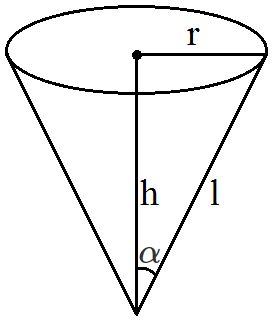
The altitude of a cone is 20cm and its semi-vertical angle is 30°. If the semi-vertical angle is increasing at the rate of 2° per second, then the radius of the base is increasing at the rate of:
  • A
    $30\text{cm}/\text{sec}.$
  • B
    $\frac{160}{3}\text{cm}/\text{sec}.$
  • $10\text{cm}/\text{sec}.$
  • D
    $160\text{cm}/\text{sec}.$
Answer
Correct option: C.
$10\text{cm}/\text{sec}.$
Let r be the radius, h be the height and $\alpha$ be the semi-vertical angle of the cone.


Then, $\tan\alpha = \text{rh}$

$\Rightarrow\sec2\alpha\text{d}\alpha\text{dt}=\text{dr}\text{h }\text{dt}$

$\Rightarrow\text{dr }\text{dt}=\text{h}\times\sec2\alpha\text{d}\alpha\text{dt}$

$\Rightarrow\text{dr }\text{dt}=20\times\sec230\times2 $

$\therefore\text{h}=20, \alpha=30^{\circ}$ and per second

$\Rightarrow\text{dr }\text{dt}=40\times232$

$\Rightarrow\text{dr }\text{dt}=\frac{160}{3}\text{cm}/\text{sec}.$
View full question & answer
MCQ 131 Mark
The radius of a sphere is changing at the rate of $0.1\text{cm}/\sec.$ The rate of change of its surface area when the radius is 200cm is:
  • A
    $8\pi\text{ cm}^2/\sec.$
  • B
    $12\pi\text{ cm}^2/\sec.$
  • $160\pi\text{ cm}^2/\sec.$
  • D
    $200\text{cm}^2/\sec.$
Answer
Correct option: C.
$160\pi\text{ cm}^2/\sec.$
Let r be the radius nad S be the surface area of the sphere at any time t. Then,
$\text{S}=4\pi\text{r}^2$
$\Rightarrow\frac{\text{dS}}{\text{dt}}=8\pi\text{r}\frac{\text{dr}}{\text{dt}}$
$\Rightarrow\frac{\text{dS}}{\text{dt}}=8\pi(200)(0.1)$
$\Rightarrow\frac{\text{dS}}{\text{dt}}=160\pi\text{ cm}^2/\sec.$
View full question & answer
MCQ 141 Mark
The volume of a sphere is increasing at the rate of $4\pi\text{cm}^{3}/\text{sec}$. The rate of increase of the radius when the volume is $288\pi\text{cm}^{3}/\text{sec}$ is:
  • A
    $\frac{1}{4}$
  • B
    $\frac{1}{12}$
  • $\frac{1}{36}$
  • D
    $\frac{1}{9}$
Answer
Correct option: C.
$\frac{1}{36}$
$\text{v}=\frac{4}{3}\pi\text{r}^{3}$
$\frac{4}{3}\pi\text{r}^{3}=288\pi$
$\text{r}^{3}=288\times\frac{3}{4}$
$\text{r}^{3}=216$
$\text{v}=\frac{4}{3}\pi\text{r}^{3}$
$\frac{\text{dv}}{\text{dt}}=4\pi \text{r}^{2}\frac{\text{dr}}{\text{dt}}$
$\frac{\text{dv}}{\text{dt}}=4\pi(6)^{2}\frac{\text{dr}}{\text{dt}}$
$4\pi=144\pi\frac{\text{dr}}{\text{dt}}$
$\frac{\text{dr}}{\text{dt}}=\frac{4}{144}$
$=\frac{1}{36}$
View full question & answer
MCQ 151 Mark
The coordinates of the point on the ellipse $16x^2+ 9y^2= 400$ where the ordinate decreases at the same rate at which the abscissa increases, are :
  • $ (3, \frac{16}{3})$
  • B
    $ (-3, \frac{16}{3})$
  • C
    $ (3, -\frac{16}{3})$
  • D
    $ (3, -3)$
Answer
Correct option: A.
$ (3, \frac{16}{3})$
According to the question,
$\frac{\text{dy}}{\text{dt}}=\frac{-\text{dx}}{\text{dt}}$
$16\text{x}^{2}+9\text{y}^{2}=400$
$\Rightarrow32\text{x}\frac{\text{dx}}{\text{dt}}+18\text{y}\frac{\text{dy}}{\text{dt}}=0$
$\Rightarrow32\text{x}\frac{\text{dx}}{\text{dt}}=-18\text{y}\frac{\text{dy}}{dt}$
$\Rightarrow32\text{x}=18\text{y}$
$\Rightarrow\text{x}=\frac{9\text{y}}{16} ...(\text{i}) $
Now,
$16\Big(\frac{9\text{y}}{16}\Big)^{2}+9\text{y}^{2}=400$
$\Rightarrow\frac{81\text{y}^{2}}{16}+9\text{y}^{2}=400$
$\Rightarrow81\text{y}^{2}+144\text{y}^{2}=6400$
$\Rightarrow225\text{y}^{2}=6400$
$\Rightarrow\text{y}^{2}=\frac{6400}{225}$
$\Rightarrow\text{y}=\sqrt{\frac{6400}{225}}$
$\Rightarrow\text{y}=\frac{16}{3}$ and $-\frac{16}{3}$
So, $\text{x}=\frac{9}{16}\times\frac{16}{3}\ [$Using $(1)]$
Or $\text{x}=-\frac{9}{16}\times\frac{16}{3}$
$\Rightarrow\text{x}=3 $ or $ -3$
So, the required point is $(3, \frac{16}{3}).$
View full question & answer
MCQ 161 Mark
For what valuse of $x$ is the rate of increase of $x^3 - 5x^2 + 5x + 8$ is twice the rate of increase of $x\ ?$
  • A
    $-3, -\frac{1}{3}$
  • B
    $-3, \frac{1}{3}$
  • C
    $3, -\frac{1}{3}$
  • $3, \frac{1}{3}$
Answer
Correct option: D.
$3, \frac{1}{3}$
Let, $\text{y}=\text{x}^{3}-5\text{x}^{2}+5\text{x}+8$
Differentiating with respect yo $t,$
$\frac{\text{dy}}{\text{dt}}=(3\text{x}^{2}-10\text{x}+5)\frac{\text{dx}}{\text{dt}}$
Given that twice of rate of increase in $x$ euals rate of increase in $x,$
$\Rightarrow\frac{\text{dx}}{\text{dt}}=2\frac{\text{dx}}{\text{dt}}$
$\Rightarrow(3\text{x}^{2}-10\text{x}+5)\frac{\text{dx}}{\text{dt}}=2\frac{\text{dx}}{\text{dt}}$
$\Rightarrow3\text{x}^{2}-10\text{x}+5=2$
$\Rightarrow\text{x}=3$ or $\text{x}=\frac{1}{3}$
View full question & answer
MCQ 171 Mark
In a sphere the rate of change of surface area is:
  • A
    $8\pi$ times the rate of change of diameter.
  • B
    $2\pi$ times the rate of change of diameter.
  • C
    $2\pi$ times the rate of change of radius.
  • $8\pi$ times the rate of change of radius.
Answer
Correct option: D.
$8\pi$ times the rate of change of radius.
$\text{S}=4\pi\text{r}^{2}$
$\frac{\text{dS}}{\text{dt}}=8\pi\frac{\text{dr}}{\text{dt}}$
The rate of surface area is $8\pi$ times the rate of change of the radius.
View full question & answer
MCQ 181 Mark
A cone whose height is always equal to its diameter is increasing in volume at the rate of $40\ cm^3/ \sec$. At what rate is the radius increasing when its circular base area is $1m^2\ ?$
  • A
    $1\ mm/ \sec.$
  • B
    $0.001\ cm/ \sec.$
  • C
    $2\ mm/ \sec.$
  • $0.002\ cm/ \sec.$
Answer
Correct option: D.
$0.002\ cm/ \sec.$
$\text{V} = \frac{1}{3} \pi \text{r}^{2}\text{h}$
Given that height is equals diamiter.
$\Rightarrow \text{h} = 2\text{r}$
$\text{V} = \frac{1}{3} \pi\text{r}^{2}\text{2r}$
$\text{V} = \frac{2}{3} \pi\text{r}^{3}$
$\Rightarrow \frac{\text{dV}}{\text{dt}} = 2\pi\text{r}^{2} \frac{\text{dr}}{\text{dt}}$
$\Rightarrow \frac{\text{dr}}{\text{dt}} = \frac{1}{2\times10^{4}} \times40 \ \ \begin{pmatrix}\because \pi\text{r}^{2} = 1\text{m}^{2}\\\Rightarrow1\text{m}^{2} = 10^{4} \text{cm}^{2} \end{pmatrix}$
$\Rightarrow \frac{\text{dr}}{\text{dt}} = \frac{1}{2\times10^{4}} \times40 = 0.002\text{cm}/\sec.$
View full question & answer
MCQ 191 Mark
A cylindrical tank of radius 10m is being filled with wheat at the rate of 314 cubic metre per hour. Then the depth of the wheat is increasing at the rate of:
  • $1\text{m}/\text{hr}$
  • B
    $0.1\text{m}/\text{hr}$
  • C
    $1.1\text{m}/\text{hr}$
  • D
    $0.5\text{m}/\text{hr}$
Answer
Correct option: A.
$1\text{m}/\text{hr}$
$\text{V}=\pi\text{r}^{2}\text{h}$
$\Rightarrow\frac{\text{dV}}{\text{dt}}=\pi\text{r}^{2}\frac{\text{dh}}{dt}$
$\Rightarrow314=3.14\times100\times\frac{\text{dh}}{\text{dt}}$
$\Rightarrow\frac{\text{dh}}{\text{dt}}=1\text{m}/\text{hr}$
View full question & answer
MCQ 201 Mark
If the rate of change of area of a circle is equal to the rate of change of its diameter, then its radius is equal to:
  • A
    $\frac{2}{\pi}\ \text{unit}$
  • $\frac{1}{\pi}\ \text{unit}$
  • C
    $\frac{\pi}{2}\ \text{unit}$
  • D
    $\pi \ \text{unit}$
Answer
Correct option: B.
$\frac{1}{\pi}\ \text{unit}$
$\text{A}=\pi\text{r}^{2}$$\frac{\text{dA}}{\text{dt}}=2\pi\text{r}\frac{\text{dr}}{\text{dt}} ...(\text{i})$
$\text{D}=2\text{r}$ (D is diameter of the circle.)
$\frac{\text{dD}}{\text{dt}}=2\frac{\text{dr}}{\text{dt}} ...(\text{ii})$
Given that $\frac{\text{dA}}{\text{dt}}=\frac{\text{dD}}{\text{dt}}$
$2\pi\text{r}\frac{\text{dr}}{\text{dt}}=2\frac{\text{dD}}{\text{dt}}$
$2\pi\text{r}=2$
$\text{r}=\frac{1}{\pi}\ \text{unit}$
View full question & answer
MCQ 211 Mark
Each side of equilateral is increasing at the rate of 8cm/hr. The rate of increase of its area when side 2cm, is:
  • $8\sqrt{3}\text{cm}^{2}/\text{hr}$
  • B
    $4\sqrt{3}\text{cm}^{2}/\text{hr}$
  • C
    $\frac{\sqrt{3}}{8}\text{cm}^{2}/\text{hr}$
  • D
    $\text{None of these.}$
Answer
Correct option: A.
$8\sqrt{3}\text{cm}^{2}/\text{hr}$
$\text{A}=\frac{\sqrt{3}}{4}\times2$

$\frac{\text{dA}}{\text{dt}}=\frac{\sqrt{3}}{2}\times\frac{\text{dx}}{\text{dt}}$

$\frac{\text{dA}}{\text{dt}}=\frac{\sqrt{3}}{2}\times2\times8$

$=8\sqrt{3}\text{cm}^{2}/\text{hr}$
View full question & answer
MCQ 221 Mark
A cylindrical vessel of radius 0.5m is filled with oil at the rate of $0.25\pi/\text{minute}$. The rate at which the surface of the oil is rising, is:
  • 1m/ minute
  • B
    2m/ minute
  • C
    5m/ minute
  • D
    0.25m/ minute
Answer
Correct option: A.
1m/ minute
$\text{V}=\pi\text{r}^2\text{h}$
$\Rightarrow\frac{\text{dV}}{\text{dt}}=\pi\text{r}^2\frac{\text{dh}}{\text{dt}}$
$\Rightarrow\frac{\text{dh}}{\text{dt}}=\frac{1}{\pi\text{r}^2}\frac{\text{dV}}{\text{dt}}$
$\Rightarrow\frac{\text{dh}}{\text{dt}}=\frac{1}{\pi(0.5)^2}\times(0.5)^2\pi$
$\Rightarrow\frac{\text{dh}}{\text{dt}}=1\text{m}/\sec.$
View full question & answer
MCQ 231 Mark
In a sphere the rate of change of volume is:
  • A
    $\pi$ times the rate of change of radius.
  • B
    Surface area times the rate of change of diameter.
  • Surface area times the rate of change of radius.
  • D
    None of these.
Answer
Correct option: C.
Surface area times the rate of change of radius.
Let r be the redius V be the volume of sphere at any time t. Then, $\text{V}=\frac{4}{3}\pi\text{r}^{3}$
$\Rightarrow\frac{\text{dv}}{\text{dt}}=\frac{4}{3}(3\pi\text{r}^{2})\Big(\frac{\text{dr}}{\text{dt}}\Big)$
$\Rightarrow\frac{\text{dv}}{\text{dt}}=4\pi\text{r}^{2}\Big(\frac{\text{dr}}{\text{dt}}\Big)$
Thus, the rate of change of volume is surface area times the rate of change of the radius.
View full question & answer
MCQ 241 Mark
The radius of a sphere is increasing at the rate of 0.2cm/sec. The rate at which the volume of the sphere increase when radius is 15cm, is:
  • A
    $12\pi\ \text{cm}^{3}/\text{sec}.$
  • $180\pi\ \text{cm}^{3}/\text{sec}.$
  • C
    $225\pi\ \text{cm}^{3}/\text{sec}.$
  • D
    $3\pi\ \text{cm}^{3}/\text{sec}.$
Answer
Correct option: B.
$180\pi\ \text{cm}^{3}/\text{sec}.$
$\text{v}=\frac{4}{3}\pi\text{r}^{3}$
$\Rightarrow\frac{\text{dv}}{\text{dt}}=4\pi\text{r}^{2}\frac{\text{dr}}{\text{dt}}$
$\Rightarrow\frac{\text{dv}}{\text{dt}}=4\pi(15)^{2}\times0.2$
$=180\pi \ \text{cm}^{3}/\text{sec}.$
View full question & answer
MCQ 251 Mark
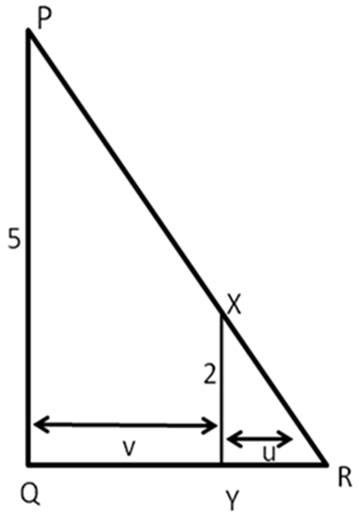
A man 2 metres tall walks away from a lamp post 5 metres height at the rate of 4.8km/hr. The rate of increase of the length of his shadow is:
  • A
    $1.6\text{km}/\text{hr}$
  • B
    $6.3\text{km}/\text{hr}$
  • C
    $5\text{km}/\text{hr}$
  • $3.2\text{km}/\text{hr}$
Answer
Correct option: D.
$3.2\text{km}/\text{hr}$

Since, $\triangle\text{P}\text{Q}\text{R}$ and $\triangle\text{X}\text{Y}\text{R}$ are similar.
$\Rightarrow\frac{\text{PQ}}{\text{XY}}=\frac{\text{QR}}{\text{YR}}$
$\Rightarrow\frac{5}{2}=\frac{\text{u+v}}{\text{u}}$
$\Rightarrow\frac{5}{2}=1-\frac{\text{v}}{\text{u}}$
$\Rightarrow\frac{\text{v}}{\text{u}}=\frac{3}{2}$
$\Rightarrow\text{u}=\frac{2}{3}\text{v}$
$\Rightarrow\frac{\text{du}}{\text{dt}}=\frac{2}{3}\frac{\text{dv}}{\text{dt}}$
$\Rightarrow\frac{\text{du}}{\text{dt}}=\frac{2}{3}\times4.8$
$=3.2\text{km}/\text{hr}$
View full question & answer
MCQ 261 Mark
If $\text{V}=\frac{4}{3}\pi\text{r}^3,$ at What rate in cubic units is $V$ increasing when $\text{r}=10\frac{\text{dr}}{\text{dt}}=0.01?$
  • A
    $\pi$
  • $4\pi$
  • C
    $40\pi$
  • D
    $4=\frac{\pi}{3}$
Answer
Correct option: B.
$4\pi$
Given: $\text{V}=\frac{4}{3}\pi\text{r}^3, $ and $ \frac{\text{dr}}{\text{dt}}=0.01$
$\frac{\text{dV}}{\text{dt}}=4\pi\text{r}^2\frac{\text{dr}}{\text{dt}}$
$\frac{\text{dV}}{\text{dt}}=4\pi(10)^2\times0.01$
$\frac{\text{dV}}{\text{dt}}=4\pi$
View full question & answer