Questions · Page 2 of 2

1 Marks

Question 511 Mark
Family y = Ax + A4 of curves is represented by the differential equation of degree:
  1. 3
  2. 2
  3. 4
  4. 1
Answer
  1. 1

Solution:

Y = Ax + A4

This equation is a linear Differential equation

$=\frac{\text{dy}}{\text{dx}}=\text{A}$

Here the highest order Derivative is y

The Degree of this Derivative is 1

View full question & answer
Question 521 Mark
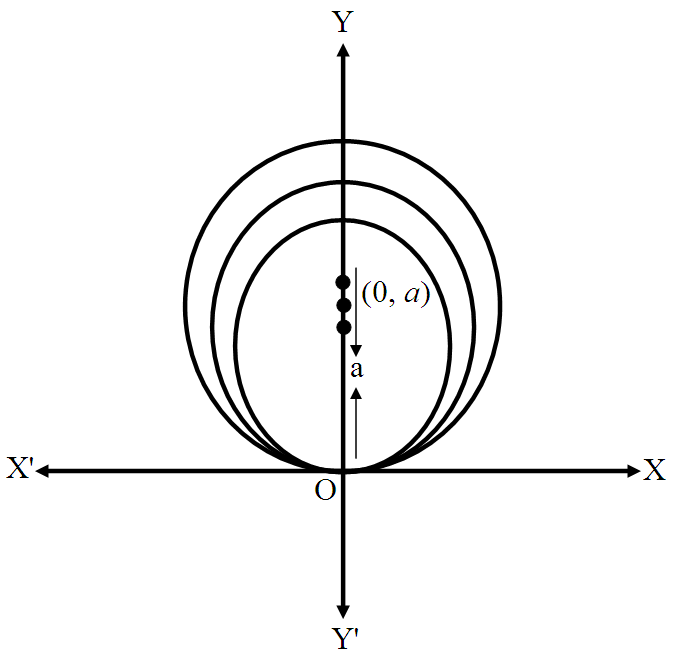
 Write the order of the differential equation of the family of circles touching X-axis at the origin.
Answer

The equation of the famliy of circles touching x-axis at the origin is 

$(\text{x}-0)^{2}+(\text{y}-\text{a})^{2}=\text{a}^{2}$

$\text{x}^{2}+\text{y}^{2}-2\text{ay}=0\ ...(\text{i})$

Here, a is the parameter.

Since, this equation contain only one conatant, we differentiate it only once.

 $2\text{x}+2\text{y}\frac{\text{dy}}{\text{dx}}-2\text{a}\frac{\text{dy}}{\text{dx}}=0$

$\text{a}=\frac{\text{x}+\text{y}(\frac{\text{dy}}{\text{dx}})}{\frac{\text{dy}}{\text{dx}}}\ ...(\text{ii})$

Putting the value of a from (i) in (i), we get

$\text{x}^{2}+\text{y}^{2}=2\text{y}\left\{\frac{\text{x}+\text{y}(\frac{\text{dy}}{\text{dx}})}{\frac{\text{dy}}{\text{dx}}}\right\}$

$(\text{x}^{2}+\text{y}^{2})\frac{\text{dy}}{\text{dx}}=2\text{xy}$

So, this is the differential equation.

Here, order of the diffrential equation is 1.

View full question & answer
Question 531 Mark
How many arbitray constants are there in the genral solution of the differential equation of orader 3.
Answer
The arbitrary constants in the general solution of the differential equation is equal to the order of the differntial equation.
Hence, the number of arbitrary constant in the general solution of the order 3 are 3.
View full question & answer
Question 541 Mark
Determine order and degree (if defined) of differential equations given in Exercise.
$\frac{\text{d}^{4}{\text{y}}}{\text{d}\text{x}^{4}}+\text{sin}(\text{y"'})=0$
Answer
The given differential equation is

$\frac{\text{d}^{4}{\text{y}}}{\text{d}\text{x}^{4}}+\text{sin}(\text{y"'})=0$

The highest order derivative present in the differential equation is $\frac{\text{d}^{4}\text{y}}{​​\text{dx}^{4}}$

$\therefore$ its order is 4

The given differential equation is not a polynomial equation in its derivative and so its degree is not defined.

View full question & answer
Question 551 Mark
Write the degree of the differrntial equation $\frac{\text{d}^{2}\text{y}}{\text{dx}^{2}}+\text{e}^{\frac{\text{dy}}{\text{dx}}}=0.$ 
Answer
The given differential equation is not a polynomial equation in derivaties.
Hence, the degree for this differential equation is not defined.
View full question & answer
Question 561 Mark
Write the degree of the differrntial equation $\frac{\text{d}^{2}\text{y}}{\text{dx}^{2}}+3\Big(\frac{\text{dy}}{\text{dx}}\Big)^{2}=\text{x}^{2}\log\Big(\frac{\text{d}^{2}\text{y}}{\text{dx}^{2}}\Big).$ 
Answer
The given differential equation is not a polnomial equation in derivaties.
Hence, the degree for this differential equation is not defind.
View full question & answer
Question 571 Mark
Write the degree of the differrntial equation $\Big(1+\frac{\text{dy}}{\text{dx}}\Big)^{3}=\Big(\frac{\text{d}^{2}\text{y}}{\text{dx}^{2}}\Big)^{2}.$ 
Answer
$\Big(1+\frac{\text{dy}}{\text{dx}}\Big)^{3}=\Big(\frac{\text{d}^{2}\text{y}}{\text{dx}^{2}}\Big)^{2}$
Here, the highest 2 order derivative is $\frac{\text{d}^{2}\text{y}}{\text{dx}^{2}}$ and its power is 2.
View full question & answer
Question 581 Mark
Write the degree of the differrntial equation $\text{x}^{3}\Big(\frac{\text{d}^{2}\text{y}}{\text{dx}^{2}}\Big)^{2}+\text{x}\Big(\frac{\text{dy}}{\text{dx}}\Big)^{4}=0.$ 
Answer
$\text{x}^{3}\Big(\frac{\text{d}^{2}\text{y}}{\text{dx}^{2}}\Big)^{2}+\text{x}\Big(\frac{\text{dy}}{\text{dx}}\Big)^{4}=0$
Here, the highest order derivative is $\frac{\text{d}^{2}\text{y}}{\text{dx}^{2}}$ and its power is 2.
Therefore, degree of given differential equation is 2.
View full question & answer
Question 591 Mark
Write the degree of the differrntial equation $\Big(\frac{\text{d}^{2}\text{y}}{\text{dx}^{2}}\Big)^{2}+\Big(\frac{\text{dy}}{\text{dx}}\Big)^{2}=\text{x}\sin\Big(\frac{\text{dy}}{\text{dx}}\Big).$ 
Answer
The given differential equation is not a polnomial equation in derivaties.
Hence, the degree for this differential equation is not defind.
View full question & answer
Question 601 Mark
Find the sum of the order and degree of the differential equation $\text{y}=\text{x}\Big(\frac{\text{dy}}{\text{dx}}\Big)^{3}+\frac{\text{d}^{2}\text{y}}{\text{dx}^{2}}.$ 
Answer
The order is 2 as the highest derivative is 2.
The degree is 1 as the highest derivative is of order 1.
Hence, the sum of the order and dergree of the differential equation $\text{y}=\text{x}\Big(\frac{\text{dy}}{\text{dx}}\Big)^{3}+\frac{\text{d}^{2}\text{y}}{\text{dx}^{2}}$ is 2 + 1 = 3.
View full question & answer
Question 611 Mark
Write the differrntial equation representing famliy of curve y = mx, where m is arbitrary constant.
Answer
We have,
$\text{y}=\text{mx}\ ...(\text{i})$
Differentiating with respect to x,
$\Rightarrow \frac{\text{dy}}{\text{dx}}=\text{m}$
Substituting the value of  $\frac{\text{dy}}{\text{dx}}=\text{m}$ in equation (i),
$\text{y}=\text{x}\frac{\text{dy}}{\text{dx}}$
Hence, $\text{y}=\text{x}\frac{\text{dy}}{\text{dx}}$ is the required differential equation.
View full question & answer
Question 621 Mark
Determine the order and degree of the following differential equations. state also whether they are linear or non linear.
$\Big(\frac{\text{d}^2\text{y}}{\text{dx}^2}\Big)^2+\Big(\frac{\text{dy}}{\text{dx}}\Big)^2=\text{x}\sin\Big(\frac{\text{d}^2\text{y}}{\text{dx}}\Big)$
Answer
$\Big(\frac{\text{d}^2\text{y}}{\text{dx}^2}\Big)^2+\Big(\frac{\text{dy}}{\text{dx}}\Big)^2=\text{x}\sin\Big(\frac{\text{d}^2\text{y}}{\text{dx}}\Big)$

In this differential equation, the order of the highest order derivative is 2.

Clearly, the R.H.S. of the differential equation cannot be expressed as a polynomial in $\frac{\text{d}^2\text{y}}{\text{dx}^2}$ So, its degree is not defined.

The order of the differential equation is 2 and its degree is not defined.

It is a non-linear differential equation, as one of its differential co-efficients, that is, $\Big(\frac{\text{dy}}{\text{dx}}\Big)$ has exponent 2, which is more than 1.

View full question & answer
Question 631 Mark
Write the degree of the differrntial equation $\frac{\text{d}^{2}\text{y}}{\text{dx}^{2}}+\Big(\frac{\text{dy}}{\text{dx}}\Big)^{\frac{1}{4}}+\text{x}^{\frac{1}{5}}=0.$ 
Answer
The order is 2 as the highest derivative is 2.
The given differential equation is not a polynomial equation in derivaties.
Hence, the degree for this differential equation is not defined.
View full question & answer
1 Marks - Page 2 - Maths STD 12 Science Questions - Vidyadip