Questions · Page 1 of 6

4 Marks

🎯

Test yourself on this topic

50 questions · timed · auto-graded

Question 14 Marks
Solve the following differential equation
$\frac{\text{dy}}{\text{dx}}=\text{x}^2+\text{x}-\frac{1}{\text{x}},\text{x}\ne0$
Answer
$\frac{\text{dy}}{\text{dx}}=\text{x}^2+\text{x}-\frac{1}{\text{x}}$
$\Rightarrow\text{dy}=\Big(\text{x}^2+\text{x}-\frac{1}{\text{x}}\Big)\text{dx}$
Intergrating both sides, we get
$\Rightarrow\int\text{dy}=\int\Big(\text{x}^2+\text{x}-\frac{1}{\text{x}}\Big)\text{dx}$
$\Rightarrow\text{y}=\frac{\text{x}^3}{3}+\frac{\text{x}^2}{3}-\log|\text{x}|+\text{C}$
Clearly, $\Rightarrow\text{y}=\frac{\text{x}^3}{3}+\frac{\text{x}^2}{3}-\log|\text{x}|+\text{C}$ is defined for all $\text{x}\in\text{R}$ except x = 0
Hence,  $\Rightarrow\text{y}=\frac{\text{x}^3}{3}+\frac{\text{x}^2}{3}-\log|\text{x}|+\text{C}$, where $\text{x}\in\text{R}-\{0\},$ is the solution o the given differential equation.
View full question & answer
Question 24 Marks
Represent the following families of curves by forming the corresponding differential equation:
$\text{x}^2+\text{y}^2=\text{ax}^3$
Answer

The equation of the family of curves is

$\text{x}^2+\text{y}^2=\text{ax}^3\ ...(1)$

where a is a parameter.

As this equation has only one arbitrary constant, we shall get a differential equation of first order.

Differentiating (1) with respect to x, we get

$2\text{x}+2\text{y}\frac{\text{dy}}{\text{dx}}=3\text{ax}^2$

$\Rightarrow2\text{x}+2\text{y}\frac{\text{dy}}{\text{dx}}=3\Big(\frac{\text{x}^2+\text{y}^2}{\text{x}^3}\Big)\text{x}^2$

$\Rightarrow2\text{x}+2\text{y}\frac{\text{dy}}{\text{dx}}=3\frac{\text{x}^2+\text{y}^2}{\text{x}^3}$

$\Rightarrow2\text{x}^2+2\text{xy}​​=3\text{x}^2+3\text{y}^2$

$2\text{xy}​​=\text{x}^2+3\text{y}^2$

It is the required differential equation.

View full question & answer
Question 34 Marks
Solve the following differential equation
$(1+\text{x}^2)\text{dy}=\text{xy dx}$
Answer
 We have

$(1+\text{x}^2)\text{dy}=\text{xy dx}$

$\Rightarrow\frac{1}{\text{y}}\text{dy}=\frac{\text{x}}{1+\text{x}^2}\ \text{dx}$

Integrating both sides, we get

$\int\frac{1}{\text{y}}\text{dy}=\int\frac{\text{x}}{1+\text{x}^2}\ \text{dx}$

Substituting 1+ x2 = t, we get

$2\text{x dx}=\text{dt}$

$\therefore\int\frac{1}{\text{y}}\text{dy}=\frac{1}{2}\int\frac{1}{\text{t}}\text{dt}$

$\Rightarrow\log|\text{y}|=\frac{1}{2}\log|\text{t}|+\log\text{C}$

$\Rightarrow\log|\text{y}|=\frac{1}{2}\log|1+\text{x}^2|+\log\text{C}$

$\Rightarrow\log|\text{y}|=\log\Big[\text{C}\sqrt{1+\text{x}^2}\Big]$

$\Rightarrow\text{y}=\text{C}\sqrt{1+\text{x}^2}$

Hence, $\text{y}=\text{C}\sqrt{1+\text{x}^2}$ is the required solution. 

View full question & answer
Question 44 Marks
Form the differential equation of all the circle which pass through the origin and whose centres lies in x-axis.
Answer

The equation of the family of circles that pass through the origin (0, 0) and whose centres lie on the x-axis is given by

$(\text{x}-\text{a})^2+\text{y}^2=\text{a}^2\ ...(1)$

 where a are arbitrary constants.

As this equation has only one arbitrary constant, we shall get a first order differential equation.

Differentiating (1) with respect to x, we get

$2(\text{x}-\text{a})+2\text{y}\frac{\text{dy}}{\text{dx}}=0$

$\Rightarrow\text{x}-\text{a}+\text{y}\frac{\text{dy}}{\text{dx}}=0$

$\Rightarrow\text{x}+\text{y}\frac{\text{dy}}{\text{dx}}=\text{a}$

Substituting the value of a in equation (2), we get

$\Big(\text{x}-\text{x}-\text{y}​​\frac{\text{dy}}{\text{dx}}\Big)^2+\text{y}^2=\Big(\text{x}+\text{y}​​\frac{\text{dy}}{\text{dx}}\Big)^2$

$\Rightarrow\text{y}^2\Big(​​\frac{\text{dy}}{\text{dx}}\Big)^2+\text{y}^2=\text{x}^2+2\text{xy}​​\frac{\text{dy}}{\text{dx}}+\text{y}^2\Big(​​\frac{\text{dy}}{\text{dx}}\Big)^2$

$\Rightarrow2\text{xy}​​\frac{\text{dy}}{\text{dx}}+\text{x}^2=\text{y}^2$

It is the required differential equation.

View full question & answer
Question 54 Marks
Solve the following differential equation
$\frac{\text{dy}}{\text{dx}}=\frac{\text{x e }^\text{x}\log\text{x}+\text{e}^\text{x}}{\text{x}\cos\text{y}}$
Answer
We have,

$\frac{\text{dy}}{\text{dx}}=\frac{\text{x e }^\text{x}\log\text{x}+\text{e}^\text{x}}{\text{x}\cos\text{y}}$

$\Rightarrow\text{x}\cos\text{y dy}=(\text{x e}^\text{x}\log\text{x}+\text{e}^\text{x})\ \text{dx}$

$\Rightarrow\cos\text{y dy}=\Big(\text{e}^\text{x}\log\text{x}+\frac{1}{\text{x}}\text{e}^\text{x}\Big)\ \text{dx}$

Integrating both sides, we get

$\int\cos\text{y dy}=\int\Big(\text{e}^\text{x}\log\text{x}+\frac{1}{\text{x}}\text{e}^\text{x}\Big)\text{dx}$

$\Rightarrow\sin\text{y}=\log\text{x}\int\text{e} ^\text{x}\text{dx}-\int\frac{1}{\text{x}}\text{e}^\text{x}\text{dx}+\int\frac{1}{\text{x}}\text{e}^\text{x}\text{dx}$

$\Rightarrow\sin\text{y}=\text{e}^\text{x}\log\text{x}+\text{C}$

Hence, $\sin\text{y}=\text{e}^\text{x}\log\text{x}+\text{C}$ is the required solution.

View full question & answer
Question 64 Marks
The slope of a curve at each of its points is equal to the square of the abscissa of the point. Find the particular curve through the point (−1, 1).
Answer
Given, 
Slope of tangent at (x, y) = x2
$\frac{\text{dy}}{\text{dx}}=\text{x}^{2}$
$\text{dy}=\text{x}^{2}\text{dx}$
$\int \text{dy}=\int\text{x}^{2}\text{dx}$
$\text{y}=\frac{\text{x}^{3}}{3}+\text{C}\ ...(\text{i})$
It is passing through (-1, 1)
$1=\frac{(-1)}{3}+\text{C}$
$1=-\frac{1}{3}+\text{C}$
$\text{C}=\frac{4}{3}$
Put is equation,
$\text{y}=\frac{\text{x}^{3}}{3}+\frac{4}{3}$
$3\text{y}=\text{x}^{3}+{4}$
View full question & answer
Question 74 Marks
Solve the following differential equation:
$\frac{\text{dy}}{\text{dx}}=(\text{x}+\text{y}+1)^{2}$
Answer
We have,
$\frac{\text{dy}}{\text{dx}}=(\text{x}+\text{y}+1)^{2}$
Putting $\text{x}+\text{y}+1=\text{v}$
$\Rightarrow 1+\frac{\text{dy}}{\text{dx}}=\frac{\text{dv}}{\text{dx}}$
$\Rightarrow \frac{\text{dy}}{\text{dx}}=\frac{\text{dv}}{\text{dx}}-1$
$\Rightarrow \frac{\text{dv}}{\text{dx}}-1=\text{v}^{2}$
$\Rightarrow \frac{\text{dv}}{\text{dx}}=\text{v}^{2}+1$
$\Rightarrow \frac{1}{\text{v}^{2}+1}\text{dv}=\text{dx}$
Integrating both sides, we get
$\int \frac{1}{\text{v}^{2}+1}\text{dv}=\int\text{dx}$
$\Rightarrow \tan^{-1}\text{v}=\text{x}+\text{C}$
$\Rightarrow \tan^{-1}(\text{x}+\text{y}+1)=\text{x}+\text{C}$
View full question & answer
Question 84 Marks
Find one-parameter families of solution curves of the following differential equation: (or solve the following differential equation)

$\text{x}\frac{\text{dy}}{\text{dx}}-\text{y}=(\text{x}+1)\text{e}^{-\text{x}}$

Answer
We have,
$\text{x}\frac{\text{dy}}{\text{dx}}-\text{y}=(\text{x}+1)\text{e}^{-\text{x}}$
$\Rightarrow\ \frac{\text{dy}}{\text{dx}}-\frac{1}{\text{x}}\text{y}=\Big(\frac{\text{x}+1}{\text{x}}\Big)\text{e}^{-\text{x}}\ \dots(1)$
Clearly, it is a linear differential equation of the form
$\frac{\text{dy}}{\text{dx}}+\text{Py = Q}$
where
$\text{P}=-\frac{1}{\text{x}}$
$\text{Q}=\Big(\frac{\text{x}+1}{\text{x}}\Big)\text{e}^{-\text{x}}$
$\therefore$ I.F. $=\text{e}^{\int\text{Pdx}}$
$=\text{e}^{-\int\frac{1}{\text{x}}\text{dx}}$
$=\text{e}^{-\log\text{x}}$
$=\frac{1}{\text{x}}$
Multiplying both sides of (1) by $\frac{1}{\text{x}},$ we get
$\frac{1}{\text{x}}\Big(\frac{\text{dy}}{\text{dx}}-\frac{1}{\text{x}}\text{y}\Big)=\frac{1}{\text{x}}\Big(\frac{\text{x}+1}{\text{x}}\Big)\text{e}^{-\text{x}}$
$\Rightarrow\ \frac{1}{\text{x}}\frac{\text{dy}}{\text{dx}}-\frac{1}{\text{x}^2}\text{y}=\Big(\frac{\text{x}+1}{\text{x}^2}\Big)\text{e}^{-\text{x}}$
Integrating both sides with respect to x, we get
$\frac{1}{\text{x}}\text{y}=\int\Big(\frac{1}{\text{x}}+\frac{1}{\text{x}^2}\Big)\text{e}^{-\text{x}}\text{dx + C}\ \dots(2)$
Putting $\frac{1}{\text{x}}\text{e}^{-\text{x}}=\text{t}$
$\Rightarrow\ \Big(-\frac{1}{\text{x}}\text{e}^{-\text{x}}-\frac{1}{\text{x}^2}\text{e}^{-\text{x}}\Big)\text{dx = dt}$
$\Rightarrow\ \Big(\frac{1}{\text{x}}+\frac{1}{\text{x}^2}\Big)\text{e}^{-\text{x}}\text{dx}=-\text{dt}$
Therefore (2) becomes
$\frac{1}{\text{x}}\text{y}=-\int\text{dt + C}$
$\Rightarrow\frac{1}{\text{x}}\text{y}=-\text{t + C}$
$\Rightarrow\ \frac{1}{\text{x}}\text{y}=-\frac{1}{\text{x}}\text{e}^{-\text{x}}+\text{C}$
$\Rightarrow\ \text{y}=-\text{e}^{-\text{x}}+\text{Cx}$
Hence, $\text{y}=-\text{e}^{-\text{x}}+\text{Cx}$ is the required solution.
View full question & answer
Question 94 Marks
Solve the following differential equations:
$\frac{\text{dy}}{\text{dx}}=2\text{e}^{\text{x}}\text{y}^3,\text{y}(0)=\frac{1}{2}$
Answer
We have,
$\frac{\text{dy}}{\text{dx}}=2\text{e}^{\text{x}}\text{y}^3,\text{y}(0)=\frac{1}{2}$
$\Rightarrow\frac{1}{\text{y}^3}\text{dy}=2\text{e}^{\text{x}}\text{dx}$
Integrating both sides, we get
$\int\frac{1}{\text{y}^3}\text{dy}=\int2\text{e}^{\text{x}}\text{dx}$
$\Rightarrow-\frac{1}{2\text{y}^3}=2\text{e}^{\text{x}}+\text{C}...(1)$
Given: at $\text{x}=0,\text{y}=\frac{1}{2}$
Substituting the valuse of x and y in (1), we get
$-\frac{1}{2\times\frac{1}{4}}=2\text{e}^{0}+\text{C}$
$\Rightarrow\text{C}=-2-2$
$\Rightarrow\text{C}=-4$
Substituting the value of C in (1), we get
$\Rightarrow-\frac{1}{2\text{y}^2}=2\text{e}^{\text{x}}-4$
$\Rightarrow\text{y}^{2}(8-4\text{e}^{\text{x}})=1$
Hence, $\text{y}^{\text{x}}(8-4\text{e}^{\text{x}})=1$ is the required solution.
View full question & answer
Question 104 Marks
Solve the following differential equation
$\frac{\text{dy}}{\text{dx}}-\text{x}\text{e}^\text{x}-\frac{5}{2}+\cos^2\text{x}$
Answer
$\frac{\text{dy}}{\text{dx}}-\text{x}\text{e}^\text{x}-\frac{5}{2}+\cos^2\text{x}$
$\text{dy}=\Big(\text{xe}^\text{x}-\frac{5}{2}+\cos^2\text{x}\Big)\text{dx}$
$\int\text{dy}=\int\text{xe}^\text{x}\text{dx}-\frac{5}{2}\int\text{dx}+\cos^2\text{x dx}$
$\int\text{dy}=\int\text{xe}^\text{x}\text{dx}-\frac{5}{2}\int\text{dx}+\int\Big(\frac{1+\cos2\text{x}}{2}\Big)\text{dx}$
$=\int\text{xe}^\text{x}-\frac{5}{2}\int\text{dx}+\frac{1}{2}\int\text{dx}+\frac{1}{2}\int\cos2\text{x dx}$
$\int\text{dy}=\int\text{xe}^\text{x}-2\int\text{dx}+\frac{1}{2}\int\cos2\text{x dx}$
$\text{y}=[\text{x}\times\int\text{e}^\text{x}\text{dx}-\int(1\times\int\text{e}^\text{x}\text{dx})\text{dx}]-2\text{x}+\frac{1}{2}\frac{\sin2\text{x}}{2}+\text{C}$
Using integration by parts
$\text{y}=\text{xe}^\text{x}-\text{e}^\text{x}-2\text{x}+\frac{1}{4}\sin2\text{x}+\text{C}$
View full question & answer
Question 114 Marks
Solve the following differential equation
$\frac{\text{dy}}{\text{dx}}-\text{x}\log\text{x}$
Answer
We have
$\frac{\text{dy}}{\text{dx}}-\text{x}\log\text{x}$
$\Rightarrow\text{dy}=(\text{x}\log\text{x})$
Integrating boh sides we get,
$\int\text{dy}=\int(\text{x}\log\text{x})\text{dx}$
$\Rightarrow\text{y}=\int\text{x}\times\log\text{x dx}$
$\Rightarrow\text{y}=\log\text{x}\int\text{x dx}-\int\Big[\frac{\text{d}}{\text{dx}}(\log\text{x})\int\text{x dx}\Big]\text{dx}$
$\Rightarrow\text{y}=\log\text{x}\times\frac{\text{x}^2}{2}-\int\Big(\frac{1}{\text{x}}\times\frac{\text{x}^2}{2}\Big)\text{dx}$
$\Rightarrow\text{y}=\frac{1}{2}\text{x}^2\log\text{x}-\int\frac{\text{x}}{2}\text{ dx}$
$\Rightarrow\text{y}=\frac{1}{2}\text{x}^2\log\text{x}-\frac{\text{x}^2}{4}+\text{C}$
hence, $\text{y}=\frac{1}{2}\text{x}^2\log\text{x}-\frac{\text{x}^2}{4}+\text{C}$ is the solutin to the given differential equation.
View full question & answer
Question 124 Marks
Represent the following families of curves by forming the corresponding differential equation:
$\frac{\text{x}^2}{\text{a}^2}-\frac{\text{y}^2}{\text{b}^2}=1$
Answer

The equation of the family of curves is

$\frac{\text{x}^2}{\text{a}^2}-\frac{\text{y}^2}{\text{b}^2}=1$

where a is a parameter.

As this equation has only one arbitrary constant, we shall get a differential equation of first order.

Differentiating (1) with respect to x, we get

$\frac{2\text{x}}{\text{a}^2}-\frac{2\text{y}}{\text{b}^2}\frac{\text{dy}}{\text{dx}}=0\ ...(2)$

Differentiating (2) with respect to x, we get

$\frac{2}{\text{a}^2}-\frac{2}{\text{b}^2}\Big(\frac{\text{dy}}{\text{dx}}\Big)^2-\frac{2\text{y}}{\text{b}^2}\frac{\text{d}^2\text{y}}{\text{dx}^2}=0$

$\Rightarrow\frac{2}{\text{a}^2}=\frac{2}{\text{b}^2}\Big[\text{y}\frac{\text{d}^2\text{y}}{\text{dx}^2}+\Big(\frac{\text{dy}}{\text{dx}}\Big)^2\Big]$

$\Rightarrow\frac{\text{b}^2}{\text{a}^2}=\Big[\text{y}\frac{\text{d}^2\text{y}}{\text{dx}^2}+\Big(\frac{\text{dy}}{\text{dx}}\Big)^2\Big]\ ...(3)$

Now, from (2), we get

$\frac{2\text{x}}{\text{a}^2}=\frac{2\text{y}}{\text{b}^2}\frac{\text{dy}}{\text{dx}}$

$\Rightarrow\frac{\text{b}^2}{\text{a}^2}=\frac{\text{y}^2}{\text{x}}\frac{\text{dy}}{\text{dx}}$

From (3), (4), we get

$\frac{\text{y}}{\text{x}}\frac{\text{dy}}{\text{dx}}=\Big[\text{y}\frac{\text{d}^2\text{y}}{\text{dx}^2}+\Big(\frac{\text{dy}}{\text{dx}}\Big)^2\Big]$

$\Rightarrow\text{x}\Big[\text{y}\frac{\text{d}^2\text{y}}{\text{dx}^2}+\Big(\frac{\text{dy}}{\text{dx}}\Big)^2\Big]=\text{y}\frac{\text{dy}}{\text{dx}}$

It is the required differential equation.

View full question & answer
Question 134 Marks
Form the differential equation of the family of hyperebolas having foci on x- axis and centre at the origine.
Answer

The equation of the family of hyperbolas having the centre at the origin and foci on the x-axis is

$\frac{\text{x}^2}{\text{a}^2}-\frac{\text{y}^2}{\text{b}^2}=1\ ...(1)$

where a and b are parameters. As this equation contains two parameters, we shall get a second-order differential equation.

Differentiating equation (1) with respect to x, we get

$\frac{2\text{x}}{\text{a}^2}-\frac{2\text{y}}{\text{b}^2}\frac{\text{dy}}{\text{dx}}=0\ ...(2)$

Differentiating equation (2) with respect to x, we get

$\frac{2}{\text{a}^2}-\frac{2}{\text{b}^2}\Big[\text{y}\frac{\text{d}^2\text{y}}{\text{dx}^2}+\Big(\frac{\text{dy}}{\text{dx}}\Big)^2\Big]=0$

$\Rightarrow\frac{1}{\text{a}^2}=\frac{1}{\text{b}^2}\Big[\text{y}\frac{\text{d}^2\text{y}}{\text{dx}^2}+\Big(\frac{\text{dy}}{\text{dx}}\Big)^2\Big]$

$\Rightarrow\frac{\text{b}^2}{\text{a}^2}=\Big[\text{y}\frac{\text{d}^2\text{y}}{\text{dx}^2}+\Big(\frac{\text{dy}}{\text{dx}}\Big)^2\Big]$

Now, from equation (2), we get

$\frac{2\text{x}}{\text{a}^2}=\frac{2\text{y}}{\text{b}^2}\frac{\text{dy}}{\text{dx}}$

$\Rightarrow\frac{\text{b}^2}{\text{a}^2}=\frac{\text{y}}{\text{x}}\frac{\text{dy}}{\text{dx}}\ ...(4)$

From (3) and (4), we get

$\frac{\text{y}}{\text{x}}\frac{\text{dy}}{\text{dx}}=\Big[\text{y}\frac{\text{d}^2\text{y}}{\text{dx}^2}+\Big(\frac{\text{dy}}{\text{dx}}\Big)^2\Big]$

$\Rightarrow\text{y}\frac{\text{dy}}{\text{dx}}=\text{xy}\frac{\text{d}^2\text{y}}{\text{dx}^2}+\text{x}\Big(\frac{\text{dy}}{\text{dx}}\Big)^2$

$\Rightarrow\text{xy}\frac{\text{d}^2\text{y}}{\text{dx}^2}+\text{x}\Big(\frac{\text{dy}}{\text{dx}}\Big)^2-\text{y}\frac{\text{dy}}{\text{dx}}=0$

It is the required differential equation.

View full question & answer
Question 144 Marks
Show that $\text{y}=4\text{ax}$ is a solution of the differential equation $\text{y}=\text{x}\frac{\text{d}\text{y}}{\text{dx}}+\text{a}\frac{\text{dx}}{\text{dy}}.$
Answer

We have,

$\text{y}=4\text{ax}\ ...(1)$

Differentiating both sides of equation (1) with respect to 3, we get

$2\text{y}\frac{\text{dy}}{\text{dx}}=4\text{a}$

$\Rightarrow\frac{\text{dy}}{\text{dx}}=\frac{2\text{a}}{\text{y}}\ ...(2)$

now, differentiating both sided of (1) with respect to y, we get

$2\text{y}=4\text{a}\frac{\text{dy}}{\text{dx}}$

$\Rightarrow\frac{\text{dy}}{\text{dx}}=\frac{\text{y}}{2\text{a}}\ ...(3)$

$\therefore\text{x}\frac{\text{dy}}{\text{dx}}+\text{a}\frac{\text{dy}}{\text{dx}}=\text{x}\Big(\frac{2\text{a}}{\text{y}}\Big)+\text{a}\Big(\frac{\text{y}}{2\text{a}}\Big)$

$\Rightarrow\text{x}\frac{\text{dy}}{\text{dx}}+\text{a}\frac{\text{dy}}{\text{dx}}=\frac{2\text{ax}}{\text{y}}+\frac{\text{y}}{2}$

$\Rightarrow\text{x}\frac{\text{dy}}{\text{dx}}+\text{a}\frac{\text{dy}}{\text{dx}}=\frac{\text{y}^2}{2\text{y}}+\frac{\text{y}}{2}$

$\Rightarrow\text{x}\frac{\text{dy}}{\text{dx}}+\text{a}\frac{\text{dy}}{\text{dx}}=\frac{\text{y}}{2}+\frac{\text{y}}{2}$

$\Rightarrow\text{x}\frac{\text{dy}}{\text{dx}}+\text{a}\frac{\text{dy}}{\text{dx}}=\text{y}$

$\Rightarrow\text{y}=\text{x}\frac{\text{dy}}{\text{dx}}+\text{a}\frac{\text{dy}}{\text{dx}}$

Hence, the given function is the solution to the given differential equation.

View full question & answer
Question 154 Marks
Form the differential equation corresponding to $\text{y}^2-2\text{ay}+\text{x}^2=\text{a}^2$ by eliminating a.
Answer

The equation of the family of curves is

y2 - 2ay + 2+ = a...(1)

 where a is a parameter.

This equation contains only one arbitrary constant, so we shall get a differential equation of first order.

Differentiating equation (1) with respect to x, we get

$2\text{y}\frac{\text{dy}}{\text{dx}}-2\text{a}\frac{\text{dy}}{\text{dx}}+2\text{x}=0$

$\Rightarrow2\text{y}\frac{\text{dy}}{\text{dx}}+2\text{x}=2\text{a}\frac{\text{dy}}{\text{dx}}$

$\Rightarrow\text{y}+\frac{\text{x}}{\frac{\text{dy}}{\text{dx}}}=\text{a}$

Substituting the value of a in equation (2), we get

$\text{y}^2-2\Bigg(\text{y}+\frac{\text{x}}{\frac{\text{dy}}{\text{dx}}}\Bigg)\text{y}+\text{x}^2=\Bigg(\text{y}+\frac{\text{x}}{\frac{\text{dy}}{\text{dx}}}\Bigg)^2$

$\Rightarrow\frac{\text{y}^2\frac{\text{dy}}{\text{dx}}-2\Big(\text{y}\frac{\text{dy}}{\text{dx}}+\text{x}\Big)\text{y}+\text{x}^2\frac{\text{dy}}{\text{dx}}}{\frac{\text{dy}}{\text{dx}}}=\frac{\Big(\text{y}\frac{\text{dy}}{\text{dx}}+\text{x}\Big)}{\Big(\frac{\text{dy}}{\text{dx}}\Big)^2}$

$\Rightarrow\text{y}^2\Big(\frac{\text{dy}}{\text{dx}}\Big)^2-2\text{y}^2\Big(\frac{\text{dy}}{\text{dx}}\Big)^2-2\text{xy}\Big(\frac{\text{dy}}{\text{dx}}\Big)+\text{x}\Big(\frac{\text{dy}}{\text{dx}}\Big)^2\\=\text{y}^2\Big(\frac{\text{dy}}{\text{dx}}\Big)^2+2\text{xy}\Big(\frac{\text{dy}}{\text{dx}}\Big)+\text{x}^2$

$\Rightarrow(\text{x}^2-2\text{y}^2)\Big(\frac{\text{dy}}{\text{dx}}\Big)^2-4\text{xy}\Big(\frac{\text{dy}}{\text{dx}}\Big)-\text{x}^2=0$

It is the required differential equation.

View full question & answer
Question 164 Marks
Find the differential equation of all the parabolas with latus rectum '4a' and whose axes are parallel to x-axis.
Answer

The equation of the family of parabolas with latus rectum 4a and axis parallel to the x-axis is given by

$(\text{y}-\beta)^2=4\text{a}(\text{x}-\text{a})\ ...(1)$

where a and Bare two arbitrary constants.

As this equation has two arbitrary constants, we shall get second order differential equation.

Differentiating equation (1) with respect to x, we get

$2(\text{y}-\beta)\frac{\text{dy}}{\text{dx}}=4\text{a}\ ...(2)$

 Differentiating equation (2) with respect to x, we get

$(\text{y}-\beta)\frac{\text{d}^2\text{y}}{\text{dx}^2}+\Big(\frac{\text{dy}}{\text{dx}}\frac{\text{dy}}{\text{dx}}\Big)=0$

Now, from equation (2) we get,

$(\text{y}-\beta)=\frac{4\text{a}}{\frac{\text{dy}}{\text{dx}}}$

From (3) and (4), we get

$\frac{2\text{a}}{\frac{\text{dy}}{\text{dx}}}\frac{\text{d}^2\text{y}}{\text{dx}^2}+\Big(\frac{\text{dy}}{\text{dx}}\Big)^2=0$

$\Rightarrow2\text{a}\frac{\text{d}^2\text{y}}{\text{dx}^2}+\Big(\frac{\text{dy}}{\text{dx}}\Big)^3=0$

It is the required differential equation.

View full question & answer
Question 174 Marks
Solve the following equation
$\text{x}\cos^2\text{y dx}=\text{y}\cos^2\text{x dx}$
Answer
We have,

$\text{x}\cos^2\text{y dx}=\text{y}\cos^2\text{x dx}$

$\Rightarrow\frac{\text{x}}{\cos^2\text{x}}\ \text{dx}=\frac{\text{y}}{\cos^2\text{y}}\ \text{dy}$

$\Rightarrow\text{x}\sec^2\text{x dx}=\text{y}\sec^2\text{y dy}$

Integrating both sides, we get

$\int\text{x}\sec^2\text{x dx}=\int\text{y}\sec^2\text{y dy}$

$\Rightarrow\text{x}\int\sec\text{x dx}-\int\Big\{\frac{\text{d}}{\text{dx}}(\text{x})\int\sec^2\text{x dx}\Big\}\text{dx}\\=\text{y}\int\sec^2\text{y dy}-\int\Big\{\frac{\text{d}}{\text{dy}}(\text{y})\int\sec^2\text{y dy}\Big\}\text{dy}$

$\Rightarrow\text{x}\tan\text{x}-\int\int\tan\text{x dx}=\text{y}\tan\text{y}-\int\tan\text{y dy}$

$\Rightarrow\text{x}\tan\text{x}-\log|\sec\text{x}|=\text{y}\tan\text{y}-\log|\sec\text{y}|+\text{C}$

$\Rightarrow\text{x}\tan\text{x}-\text{y}\tan\text{y}=\log|\sec\text{x}|-\log|\sec\text{y}|+\text{C}$

Hence, $\text{x}\tan\text{x}-\text{y}\tan\text{y}=\log|\sec\text{x}|-\log|\sec\text{y}|+\text{C}$ is the required solution.

View full question & answer
Question 184 Marks
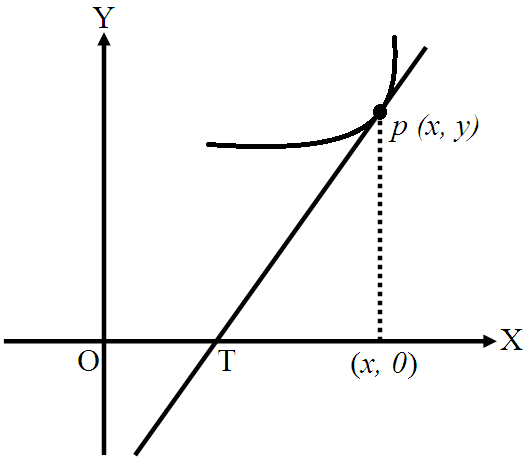
Find the equation of the curve such that the portion of the x-axis cut off between the origin and the tangent at a point is twice the abscissa and which passes through the point (1, 2).
Answer

Portion of the x-axis cut off between the origin and tangent at a point  $=\text{x}-\text{y}\frac{\text{dx}}{\text{dy}}=\text{OT}$

It is given, $\text{OT}=2\text{x}$ 

$\therefore \ \text{x}-\text{y}\frac{\text{dx}}{\text{dy}}=2\text{x}$

$-\text{x}=\text{y}\frac{\text{dx}}{\text{dy}}$

$-\int\frac{\text{dx}}{\text{dy}}=\int\frac{\text{dy}}{\text{y}}$

$\therefore\ \text{xy}=\text{k}$

Since the curve passes through the point (1, 2)

at  $\text{x}=1, \text{y}=2$

$\therefore \text{k}=2$

$\therefore \text{xy}=2$

View full question & answer
Question 194 Marks
Form the differential equation of all the circle which pass through the origin and whose centres lies in y-axis.
Answer

We know that, equation of a dide with centre at (h, k) and radius r is given by,

(x - h2) + (y - k)2 = r2 ...(1)

Here, entre lies, on y-axis, so h = 0

x2 + (y - k)2 = r...(2)

Also given that circle is passing through origin, so

0 + k2 = r2

k2 = r2

So, equation (2) becomes

x2 +  (y - k)2 =  k2

x2 + y2 - 2yk = 0

2yk = x+ y2

$\text{k}=\frac{\text{x}^2+\text{y}^2}{2\text{y}}$

Differentiating with respect to x,

$0=\frac{\Big(2\text{y}2\text{x}+2\text{y}\frac{\text{dy}}{\text{dx}}\Big)-(\text{x}^2+\text{y}^2)2\frac{\text{dy}}{\text{dx}}}{(2\text{y})^2}$

$0=4\text{xy}+4\text{y}^2\frac{\text{dy}}{\text{dx}}-2\text{x}^2\frac{\text{dy}}{\text{dx}}-2\text{y}^2\frac{\text{dy}}{\text{dx}}$

$0=2\text{y}^2\frac{\text{dy}}{\text{dx}}-2\text{x}^2\frac{\text{dy}}{\text{dx}}+4\text{xy}$

$\text{x}^2\frac{\text{dy}}{\text{dx}}-\text{y}^2\frac{\text{dy}}{\text{dx}}=2\text{xy}$

$(\text{x}^2-\text{y}^2)\frac{\text{dy}}{\text{dx}}=2\text{xy}$

View full question & answer
Question 204 Marks
Form the differential equation corresponding to $(\text{x}-\text{a})^2+(\text{y}-\text{b})^2=\text{r}^2$ by eliminating a and b.
Answer

The equation of the family of curves is

$(\text{x}-\text{a})^2+(\text{y}-\text{b})^2=\text{r}^2\ ...(1)$

 where a and b is a parameter.

This equation contains only one arbitrary constant, so we shall get a differential equation of first order.

Differentiating equation (1) with respect to x, we get

$2(\text{x}-\text{a})+2(\text{y}-\text{b})\frac{\text{dy}}{\text{dx}}=0\ ...(2)$

Differentiating equation (1) with respect to x, we get

$2+2\Big(\frac{\text{dy}}{\text{dx}}\Big)^2+2(\text{y}-\text{b})\frac{\text{d}^2\text{y}}{\text{dx}^2}=0$

$\Rightarrow1+\Big(\frac{\text{dy}}{\text{dx}}\Big)^2+(\text{y}-\text{b})\frac{\text{d}^2\text{y}}{\text{dx}^2}=0$

$\Rightarrow(\text{y}-\text{b})=\frac{1+\Big(\frac{\text{dy}}{\text{dx}}\Big)^2}{\frac{\text{d}^2\text{y}}{\text{dx}^2}}$

From (2) and (3), we get

$(\text{x}-\text{a})-\frac{1+\Big(\frac{\text{dy}}{\text{dx}}\Big)^2}{\frac{\text{d}^2\text{y}}{\text{dx}^2}}\frac{\text{dy}}{\text{dx}}=0\Rightarrow(\text{x}-\text{a})=\frac{\frac{\text{dy}}{\text{dx}}+\Big(\frac{\text{dy}}{\text{dx}}\Big)^3}{\frac{\text{d}^2\text{y}}{\text{dx}^2}}\ ...(4)$

From (1) and (3), we get

$\frac{\Big[\frac{\text{dy}}{\text{dz}}+\Big(\frac{\text{dy}}{\text{dz}}\Big)^2\Big]^2}{\Big(\frac{\text{d}^2\text{y}^2}{\text{dz}^2}\Big)^2}+\frac{\Big[1+\Big(\frac{\text{dy}}{\text{dx}}\Big)^2\Big]^2}{\Big(\frac{\text{d}^2\text{y}}{\text{dx}^2}\Big)^2}=\text{r}^2$

$\Rightarrow\frac{\Bigg[\Big(\frac{\text{dy}}{\text{dx}}\Big)^2+2\Big(\frac{\text{dy}}{\text{dx}}\Big)^4+\Big(\frac{\text{dy}}{\text{dx}}\Big)^6\Bigg]+\Bigg[1+2\Big(\frac{\text{dy}}{\text{dx}}\Big)^2+\Big(\frac{\text{dy}}{\text{dx}}\Big)^4\Bigg]}{\Big(\frac{\text{d}^2\text{y}}{\text{dx}}\Big)^2}$

$\Rightarrow\Big(\frac{\text{dy}}{\text{dx}}\Big)^2+2\Big(\frac{\text{dy}}{\text{dx}}\Big)^4+\Big(\frac{\text{dy}}{\text{dx}}\Big)^6+1+2\Big(\frac{\text{dy}}{\text{dx}}\Big)^2+\Big(\frac{\text{dy}}{\text{dx}}\Big)^4=\text{r}^2\Big(\frac{\text{d}^2\text{y}}{\text{dx}^2}\Big)$

$\Rightarrow1+3\Big(\frac{\text{dy}}{\text{dx}}\Big)^2+3\Big(\frac{\text{dy}}{\text{dx}}\Big)^4+\Big(\frac{\text{dy}}{\text{dx}}\Big)^6=\text{r}^2\Big(\frac{\text{d}^2\text{y}}{\text{dx}^2}\Big)$

$\Rightarrow\Bigg[1+\Big(\frac{\text{dy}}{\text{dx}}\Big)^2\Bigg]^3=\text{r}^3\Big(\frac{\text{d}^2\text{y}}{\text{dx}^2}\Big)^2$

It is the required differential equation.

View full question & answer
Question 214 Marks
Show that $\text{y}=\text{A}\cos2\text{x}+\text{B}\sin2\text{x}$ is a solution of the differential equation $\frac{\text{d}^2\text{y}}{\text{dx}^2}+4\text{y}=0$
Answer

We have,

$\text{y}=\text{A}\cos2\text{x}+\text{B}\sin2\text{x}\ ...(1)$

Differentiating both sides of equation (1) with respect to 3, we get

$\frac{\text{dy}}{\text{dx}}=-2\text{A}\sin2\text{x}-\text{B}\cos2\text{x}\ ...(2)$

Differentiating both sides of equation (2) with respect to 3, we get

$\frac{\text{d}^2\text{y}}{\text{dx}^2}=-4\text{A}\cos2\text{x}+4\text{B}\sin2\text{x}$

$\Rightarrow\frac{\text{d}^2\text{y}}{\text{dx}^2}=-4(\text{A}\cos2\text{x}+4\text{B}\sin2\text{x})$

$\Rightarrow\frac{\text{d}^2\text{y}}{\text{dx}^2}=-4\text{y}$

$\Rightarrow\frac{\text{d}^2\text{y}}{\text{dx}^2}+4\text{y}=0$

Hence, the given function is the solution to the given differential equation.

View full question & answer
Question 224 Marks
Show that $\text{y}=\text{ae}^{2\text{x}}+\text{be}^{-\text{x}}$ is a solution of the differential equation $\frac{\text{d}^2\text{y}}{\text{dx}^2}-\frac{\text{dy}}{\text{dx}}-2\text{y}=0$
Answer

We have,

$\text{y}=\text{ae}^{2\text{x}}+\text{be}^{-\text{x}}\ ...(1)$

Differentiating both sides of equation (1) with respect to 3, we get

$\frac{\text{dy}}{\text{dx}}=\text{ae}^{2\text{x}}+\text{be}^{-\text{x}}\ ...(2)$

Differentiating both sides of equation (2) with respect to 3, we get

$\frac{\text{d}^2\text{y}}{\text{dx}^2}=4\text{ae}^{2\text{x}}+\text{be}^{-\text{x}}$

$\Rightarrow\frac{\text{d}^2\text{y}}{\text{dx}^2}=2\text{ae}^{2\text{x}}-\text{be}^{-\text{x}}+2\text{ae}^{2\text{x}}+2\text{be}^{-\text{x}}$

$\Rightarrow\frac{\text{d}^2\text{y}}{\text{dx}^2}=\big(2\text{ae}^{2\text{x}}-\text{be}^{-\text{x}}\big)+2\big(\text{ae}^{2\text{x}}+2\text{be}^{-\text{x}}\big)$

$\Rightarrow\frac{\text{d}^2\text{y}}{\text{dx}^2}=\frac{\text{dy}}{\text{dx}}+2\text{y}$

$\Rightarrow\frac{\text{d}^2\text{y}}{\text{dx}^2}-\frac{\text{dy}}{\text{dx}}-2\text{y}=0$

Hence, the given function is the solution to the given differential equation.

View full question & answer
Question 234 Marks
Form the differential equation representing the family of ellipses having centre at the origin and foci on x-axis.
Answer

we know that the equation of said family of ellopsis is

$\frac{\text{x}^2}{\text{a}^2}+\frac{\text{y}^2}{\text{b}^2}=1\ ...(1)$

Differentiating (1) w..r.t.x, we get

$\frac{2\text{x}}{\text{a}^2}+\frac{2\text{y}}{\text{b}^2}.\frac{\text{dy}}{\text{dx}}=0$

$\Rightarrow\frac{\text{y}}{\text{x}}\Big(\frac{\text{dy}}{\text{dx}}\Big)=\frac{-\text{b}^2}{\text{a}^2}\ ...(2)$

Differentiating (2) w..r.t.x, we get

$\frac{\text{y}}{\text{x}}\Big(\frac{\text{d}^2\text{y}}{\text{dx}^2}\Big)+\bigg(\frac{\text{x}\frac{\text{dy}}{\text{dx}}-\text{y}}{\text{x}^2}\bigg)\frac{\text{dy}}{\text{dx}}=0$

$\Rightarrow\text{xy}\frac{\text{d}^2\text{y}}{\text{dx}^2}+\text{x}\Big(\frac{\text{dy}}{\text{dx}}\Big)^2-\text{y}\frac{\text{dy}}{\text{dx}}$

Which is the required difeerential equation.

View full question & answer
Question 244 Marks
Solve the following differential equations:
$\frac{\text{dy}}{\text{dx}}=\frac{\text{x + y}}{\text{x}-\text{y}}$
Answer
We have,

$\frac{\text{dy}}{\text{dx}}=\frac{\text{x + y}}{\text{x}-\text{y}}$

This is a homogeneous differential equation.

Put y = vx and $\frac{\text{dy}}{\text{dx}}=\text{v + x}\frac{\text{dv}}{\text{dx}}$, we get

$\text{v + x}\frac{\text{dv}}{\text{dx}}=\frac{{\text{x}}+\text{vx}}{\text{x}-\text{vx}}$

$\Rightarrow\ \text{v + x}\frac{\text{dv}}{\text{dx}}=\frac{1+\text{v}}{1-\text{v}}$

$\Rightarrow\ \text{x}\frac{\text{dv}}{\text{dx}}=\frac{1+\text{v}}{1-\text{v}}-\text{v}$

$\Rightarrow\ \text{x}\frac{\text{dv}}{\text{dx}}=\frac{1+\text{v}^2}{1-\text{v}}$

$\frac{1-\text{v}}{1+\text{v}^2}\text{dv}=\frac{1}{\text{x}}\text{dx}$

Integrating both sides, we get

$\int\frac{1-\text{v}}{1+\text{v}^2}\text{dv}=\int\frac{1}{\text{x}}\text{dx}$

$\Rightarrow\ \int\frac{1}{1+\text{v}^2}\text{dv}-\int\frac{\text{v}}{1+\text{v}^2}\text{dv}=\int\frac{1}{\text{x}}\text{dx}$

$\Rightarrow\ \int\frac{1}{1+\text{v}^2}\text{dv}-\frac{1}2\int\frac{2\text{v}}{1+\text{v}^2}\text{dv}=\int\frac{1}{\text{x}}\text{dx}$

$\tan^{-1}\text{v}-\frac{1}2\log\big|1+\text{v}^2\big|=\log|\text{x}|+\text{C}$

Putting $\text{v}=\frac{\text{y}}{\text{x}}$, we get

$\Rightarrow\ \tan^{-1}\Big(\frac{\text{y}}{\text{x}}\Big)-\frac{1}2\log\Big|1+\frac{\text{y}^2}{\text{x}^2}\Big|=\log|\text{x}|+\text{C}$

$\Rightarrow\ \tan^{-1}\Big(\frac{\text{y}}{\text{x}}\Big)=\frac{1}2\log\Big|1+\frac{\text{y}^2}{\text{x}^2}\Big|+\log|\text{x}|+\text{C}$

$\Rightarrow\ \tan^{-1}\Big(\frac{\text{y}}{\text{x}}\Big)=\frac{1}2\log\Big|\frac{\text{x}^2+\text{y}^2}{\text{x}^2}\Big|+\log|\text{x}|+\text{C}$

$\Rightarrow\ \tan^{-1}\Big(\frac{\text{y}}{\text{x}}\Big)=\frac{1}2\log\Big|\text{x}^2+\text{y}^2\Big|-\frac{1}2\log|\text{x}^2|+\log|\text{x}|+\text{C}$

$\Rightarrow\ \tan^{-1}\Big(\frac{\text{y}}{\text{x}}\Big)=\frac{1}2\log\Big|\text{x}^2+\text{y}^2\Big|-\log|\text{x}|+\log|\text{x}|+\text{C}$

$\Rightarrow\ \tan^{-1}\Big(\frac{\text{y}}{\text{x}}\Big)=\frac{1}2\log\Big|\text{x}^2+\text{y}^2\Big|+\text{C}$

Hence, $\tan^{-1}\Big(\frac{\text{y}}{\text{x}}\Big)=\frac{1}2\log\Big|\text{x}^2+\text{y}^2\Big|+\text{C}$ is the required solution.

View full question & answer
Question 254 Marks
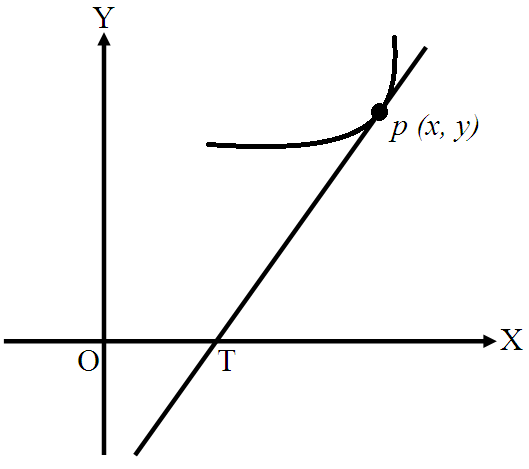
Find the equation of the curve which passes through the point (1, 2) and the distance between the foot of the ordinate of the point of contact and the point of intersection of the tangent with x-axis twice abscissa of the pont of contact.
Answer

It is given that the distance between the foot of ordinate of point of contanct (A) and the point of intersection of tangent with x-axis (T) = 2x

Coordinate of  $\text{T}=\big(\text{x}-\text{y}\frac{\text{dx}}{\text{dy}}, 0\big)$

$\text{AT}=\Big[\text{x}-\Big(\text{x}-\text{y}\frac{\text{dx}}{\text{dy}}, 0\Big)\Big]=2\text{x}$

Equation of tangent, 

$\text{y}-\text{y}=\frac{\text{dy}}{\text{dx}}(\text{x}-\text{x})$

$\Rightarrow\text{y}-\text{0}=\frac{\text{dy}}{\text{dx}}\Big(\text{x}-\big(\text{x}-\text{y}\frac{\text{dx}}{\text{dy}}\big)\Big)$

$\Rightarrow \text{y}\frac{\text{dx}}{\text{dy}}=2\text{x}$

$\Rightarrow \int\frac{\text{dx}}{\text{x}}=2\int\frac{\text{dy}}{\text{y}}$

$\Rightarrow \log\text{x}=\log\text{y}^{2}+\log\text{C}$

$\text{x}=\text{Cy}^{2}$

As the circle passes through (1, 2)

$1=\text{C}\times2^{2}$

$\Rightarrow \text{C}=\frac{1}{4}$

$\Rightarrow 4\text{x}=\text{y}^{2}$

View full question & answer
Question 264 Marks
Show that $\text{y}=\frac{\text{a}}{\text{x}}+\text{b}$ is a solution of the differential equation $\frac{\text{d}^2\text{y}}{\text{dx}^2}=\frac{2}{\text{x}}\Big(\frac{\text{dy}}{\text{dx}}\Big)=0$
Answer

We have,

$\text{y}=\frac{\text{a}}{\text{x}}+\text{b}\ ...(1)$

Differentiating both sides of equation (1) with respect to 3, we get

$\frac{\text{dy}}{\text{dx}}=-\frac{\text{a}}{\text{x}^2}\ ...(2)$

Differentiating both sides of equation (2) with respect to 3, we get

$\frac{\text{d}^2\text{y}}{\text{dx}^2}=2\frac{\text{a}}{\text{x}^3}$

$\frac{\text{d}^2\text{y}}{\text{dx}^2}=-\frac{2}{\text{x}}\Big(-\frac{\text{a}}{\text{x}^2}\Big)$

$\frac{\text{d}^2\text{y}}{\text{dx}^2}=-\frac{2}{\text{x}}\Big(\frac{\text{dy}}{\text{dx}}\Big)$

$\Rightarrow\frac{\text{d}^2\text{y}}{\text{dx}^2}+\frac{2}{\text{x}}\Big(\frac{\text{dy}}{\text{dx}}\Big)=0$

Hence, the given function is the solution to the given differential equation.

View full question & answer
Question 274 Marks
Solve the following differential equations:
$\frac{\text{dy}}{\text{dx}}=\frac{\text{y}^2-\text{x}^2}{2\text{xy}}$
Answer
Here, $\frac{\text{dy}}{\text{dx}}=\frac{\text{y}^2-\text{x}^2}{2\text{xy}}$

It is homogeneous equation

Put y = vx

$\frac{\text{dy}}{\text{dx}}=\text{v + x}\frac{\text{dv}}{\text{dx}}$

So,

$\text{v + x}\frac{\text{dv}}{\text{dx}}=\frac{\text{v}^2\text{x}^2-\text{x}^2}{2\text{xvx}}$

$\text{x}\frac{\text{dv}}{\text{dx}}=\frac{\text{v}^2-1}{2\text{v}}-\frac{\text{v}}1$

$=\frac{\text{v}^2-1-2\text{v}^2}{2\text{v}}$

$\text{x}\frac{\text{dv}}{\text{dx}}=\frac{-1-\text{v}^2}{2\text{v}}$

$\int\frac{2\text{v}}{1+\text{v}^2}\text{dv}=-\int\frac{\text{dx}}{\text{x}}$

$\log\big|1+\text{v}^2\big|=-\log|\text{x}|+\log|\text{C}|$

$1+\text{v}^2=\frac{\text{C}}{\text{x}}$

$1+\frac{\text{y}^2}{\text{x}^2}=\frac{\text{C}}{\text{x}}$

$\text{x}^2+\text{y}^2=\text{Cx}$

View full question & answer
Question 284 Marks
Solve the following differential equation
$\text{C}(\text{x})=2+0.15\text{x},\text{C}(0)=100$
Answer
 $\text{C}(\text{x})=2+0.15\text{x},\text{C}(0)=100$

$\text{C}'(\text{x})\text{dx}=(2+0.15\text{x})\text{dx}$

$\int\text{C}'(\text{x})\text{dx}=\int2\text{dx}+0.15\int\text{x dx}$

$\text{C}(\text{x})=2\text{x}+0.15\frac{\text{x}^2}{2}+\text{C}\ ...(1)$

Put x = 0, c(x) = 100

100 = 2(0) + 0 + c

100 = c

Put c = 100 in equation 1

$\text{c}(\text{x})=2\text{x}+(0.15)\frac{\text{x}^2}{2}+100$ 

View full question & answer
Question 294 Marks
Show that $\text{y}=\text{A}\cos\text{x}+\text{B}\sin\text{x}$ is a solution of the differential equation $\frac{\text{d}^2\text{y}}{\text{dx}^2}+\text{y}=0$
Answer

We have,

$\text{y}=\text{A}\cos\text{x}+\text{B}\sin\text{x}\ ...(1)$

Differentiating both sides of equation (1) with respect to 3, we get

$\frac{\text{dy}}{\text{dx}}=\text{A}\cos\text{x}+\text{B}\sin\text{x}\ ...(2)$

Differentiating both sides of equation (2) with respect to 3, we get

$\frac{\text{d}^2\text{y}}{\text{dx}^2}=\text{A}\cos\text{x}-\text{B}\sin\text{x}$

$\frac{\text{d}^2\text{y}}{\text{dx}^2}=(\text{A}\cos\text{x}+\text{B}\sin\text{x})$

$\Rightarrow\frac{\text{d}^2\text{y}}{\text{dx}^2}=-\text{y}$

$\Rightarrow\frac{\text{d}^2\text{y}}{\text{dx}^2}+\text{y}=0$

Hence, the given function is the solution to the given differential equation.

View full question & answer
Question 304 Marks
Solve the following differential equation
$\frac{\text{dy}}{\text{dx}}=\text{x}^5\tan^{-1}(\text{x}^3)$
Answer
$\frac{\text{dy}}{\text{dx}}=\text{x}^5\tan^{-1}(\text{x}^3)$

$\text{dy}=\text{x}^5\tan^{-1}(\text{x}^3)\text{dx}$

$\int\text{dy}=\int\text{x}^5\tan^{-1}(\text{x}^3)\text{dx}$

put $\text{x}^3=\text{t}$

$\Rightarrow3\text{x}^2\text{dx}=\text{dt}$

$\Rightarrow\text{x}^2\text{dx}=\frac{\text{dt}}{3}$

So,

$\int\text{dy}=\frac{1}{3}\Big[\tan^{-1}\text{t}\int\text{t dt}=\int\Big(\frac{1}{1+\text{t}^2}\Big)\times\int\text{t dx}\Big)\Big]\text{dt}+\text{C}$

Using integration by parts

$\text{y}=\frac{1}{3}\Big[\frac{\text{t}^2}{2}+\tan^{-1}-\int\frac{\text{t}^2}{2(\text{t}^2+1)}\text{dt}\Big]+\text{C}$

$=\frac{1}{6}\text{t}^2\tan^{-1}\text{t}-\frac{1}{6}\int\Big(\frac{\text{t}^2}{\text{t}^2+1}\Big)\text{dt}+\text{C}$

$\text{y}=\frac{1}{6}\text{t}^2\tan^{-1}\text{t}-\frac{1}{6}\int\Big(1-\frac{1}{\text{t}^2+1}\Big)\text{dt}+\text{C}$

$=\frac{1}{6}\text{t}^2\tan^{-1}\text{t}-\frac{1}{6}\text{t}+\frac{1}{6}\tan^{-1}\text{t}+\text{C}$

$\text{y}=\frac{1}{6}(\text{t}^2+1)\tan^{-1}\text{t}-\frac{1}{6}\text{t}+\text{C}$

$\text{y}=\frac{1}{6}[(\text{t}^2+1)\tan^{-1}\text{t}-\text{t}]+\text{C}$

So,

$\text{y}=\frac{1}{6}[(\text{x}^6+1)\tan^{-1}(\text{x}^3)-\text{x}^3]+\text{C}$

View full question & answer
Question 314 Marks
Assume that a rain drop evaporates at a rate proportional to its surface area. Form a differential equation involving the rate of change of the radius of the rain drop.
Answer

Let A be the surface area of rain drain, v be its volume, and r be the radius of rain drop.

Given:

$\frac{\text{dV}}{\text{dt}}=\text{A}$

$\frac{\text{dV}}{\text{dt}}=-\text{KA}$ [negative because V decrease with increase in t]

Where K is the constant of proportionality.

So,

$\frac{\text{d}}{\text{dt}}\Big(\frac{4\pi}{3}\text{r}^3\Big)=-\text{K}(4\pi\text{r}^2)$

$4\pi\text{r}^2\frac{\text{dr}}{\text{dt}}=-\text{K}(4\pi\text{r}^2)$

$\frac{\text{dr}}{\text{dt}}=-\text{K}$

View full question & answer
Question 324 Marks
Solve the following differential equation
$(\sin\text{x}+\cos\text{x})\text{dy}+(\cos\text{x}+\sin\text{x})\text{dx}=0$
Answer
 We have,

$(\sin\text{x}+\cos\text{x})\text{dy}+(\cos\text{x}+\sin\text{x})\text{dx}=0$

$\Rightarrow{\text{dy}}=-\Big(\frac{\cos\text{x}-\sin\text{x}}{\sin\text{x}-\cos\text{x}}\Big)\text{dx}$

Integrating both sides, we get

$\int{\text{dy}}=-\int\Big(\frac{\cos\text{x}-\sin\text{x}}{\sin\text{x}-\cos\text{x}}\Big)\text{dx}$

$\Rightarrow\text{y}=-\int\Big(\frac{\cos\text{x}-\sin\text{x}}{\sin\text{x}-\cos\text{x}}\Big)\text{dx}$

Putting $\sin\text{x}+\cos\text{x}=\text{t}$

$\Rightarrow(\cos\text{x}-\sin\text{x})\text{dx}=\text{dt}$

$\therefore\text{y}=-\int\frac{\text{dt}}{\text{t}}$

$\Rightarrow\text{y}=-\log|\text{t}|+\text{C}$

$\Rightarrow\text{y}=-\log|\sin\text{x}+\cos\text{x}|+\text{C}$

$\Rightarrow\text{y}=+\log|\sin\text{x}+\cos\text{x}|=\text{C}$

Hence, $\text{y}=+\log|\sin\text{x}+\cos\text{x}|=\text{C}$ is the solution to the given differential equation. 

View full question & answer
Question 334 Marks
show that the differential equation of which $\text{y}=2(\text{x}^2-1)+\text{ce}^{-\text{x}^{2}}$ is a solution, is $\frac{\text{dy}}{\text{dx}}+2\text{xy}=4\text{x}^3$
Answer

The given equation is

$\text{y}=2(\text{x}^2-1)+\text{ce}^{-\text{x}^{2}} ...(1)$

Where c is a parameter.

As this equation has one arbitrary constant, we shall get a differential equation of first order.

Differentiating equation (1) with respect to x, we get

$\frac{\text{dy}}{\text{dx}}=2(2\text{x})+\text{ce}^{-\text{x}^{2}}(-2\text{x})$

$\Rightarrow\frac{\text{dy}}{\text{dx}}=4\text{x}-2\text{xce}^{-\text{x}^{2}}$

From (1) and (2), we get

$\frac{\text{dy}}{\text{dx}}=4\text{x}-2\text{x}[\text{y}-2\text{x}^2+2]$

$\Rightarrow\frac{\text{dy}}{\text{dx}}=4\text{x}-2\text{xy}+4\text{x}^3-4\text{x}$

$\Rightarrow\frac{\text{dy}}{\text{dx}}+2\text{xy}=4\text{x}^3$

Hence, $\text{y}=2(\text{x}^2-1)+\text{ce}^{-\text{x}^{2}}$ is the solution to the differential equation $\frac{\text{dy}}{\text{dx}}+2\text{xy}=4\text{x}^3.$

View full question & answer
Question 344 Marks
Solve the following differential equation:

$\frac{\text{dy}}{\text{dx}}+\text{y}=\text{e}^{-2\text{x}}$

Answer
Here, $\frac{\text{dy}}{\text{dx}}+\text{y}=\text{e}^{-2\text{x}}$

This is a linear differential equation, comparing it with

$\frac{\text{dy}}{\text{dx}}+\text{Py}=\text{Q}$

$\text{P}=1,\text{Q}=\text{e}^{-2\text{x}}$

I.F. $=\text{e}^{\int\text{Pdx}}$

$=\text{e}^{\int2\text{dx}}$

$=\text{e}^{\text{x}}$

Solution of the equation is given by,

$\text{y}\times(\text{I.F.})=\int\text{Q}\times(\text{I.F.})\text{dx + C}$

$\text{y}\times\text{e}^{\text{x}}=\int\text{e}^{-2\text{x}}\times\text{e}^{\text{x}}\text{dx + C}$

$=\int\text{e}^{-\text{x}}+\text{C}$

$\text{y}\text{e}^{\text{x}}=\frac{\text{e}^{-\text{x}}}{-1}+\text{C}$

$\text{y}=-\text{e}^{-2\text{x}}+\text{C}\text{e}^{-\text{x}}$

View full question & answer
Question 354 Marks
Form the differential equation of the family of circle in the secound qudrant and touching the coordinate axes.
Answer

Let C denote the family of circles in the second qwdrant and touching the coordinate axes.

Let (-a, a) be the coordinate of the centre of any member of this family,

Equation representing the family C is

$(\text{x}+\text{a})^2+(\text{y}-\text{a})^2=\text{a}^2\ ...(1)$

$\text{x}^2+\text{y}^2+2\text{ax}-2\text{ay}+\text{a}^2=0\ ...(2)$

Differentiating eqn (i) w.r.t.x, we get

$2\text{x}+2\text{y}\frac{\text{dy}}{\text{dx}}+2\text{a}-2\text{a}\frac{\text{dy}}{\text{dx}}=0$

$\Rightarrow\text{x}+\text{y}\frac{\text{dy}}{\text{dx}}=\text{a}\Big(\frac{\text{dy}}{\text{dx}}-1\Big)$

$\Rightarrow\text{a}=\frac{\text{x}+\text{yy'}}{\text{y}-1}$

Substituting the value of a in (ii), we get

$\Big[\text{x}+\frac{\text{x}+\text{yy}'}{\text{y}-1}\Big]^2+\Big[\text{y}-\frac{\text{x}+\text{yy}'}{\text{y}-1}\Big]^2=\Big[\frac{\text{x}+\text{yy}'}{\text{y}-1}\Big]^2$

$\Rightarrow[\text{xy}-\text{x}+\text{x}+\text{yy'}]^2+[\text{yy}'-\text{y}-\text{x}-\text{yy}']^2=[\text{x}+\text{yy'}]^2$

$\Rightarrow(\text{x}+\text{y})^2\text{y}^2+(\text{x}+\text{y})^2=[\text{x}+\text{yy'}]$

$(\text{x}+\text{y})^2\Big[(\text{y})^2+1\Big]=[\text{x}+\text{yy'}]^2$

which is the differential equation representing the given family of circles.

View full question & answer
Question 364 Marks
Form the differential equation of the family of curves represented by the equation (a being the perimeter):

$(2\text{x}-\text{a})^2-\text{y}^2=\text{a}^2$

Answer

The equation of the family of curves is

$(2\text{x}-\text{a})^2-\text{y}^2=\text{a}^2 ...(1)$

where a is a parameter.

As this equation has only one parameter, we shall get a differential equation of first order.

Differentiating (1) with respect to x, we get

$8\text{x}-4\text{a}-2\text{y}\frac{\text{dy}}{\text{dx}}=0\ ...(2)$

$\Rightarrow-\text{y}\frac{\text{dy}}{\text{dx}}+4\text{x}=2\text{a}$

Now, from (1), we get

$2\text{a}=\frac{4\text{x}^2-\text{y}^2}{2\text{x}}\ ...(3)$

From (2) and (3), we get

$-\text{y}\frac{\text{dy}}{\text{dx}}+4\text{x}=\frac{4\text{x}^2-\text{y}^2}{2\text{x}}$

$\Rightarrow-2\text{xy}\frac{\text{dy}}{\text{dx}}+8\text{x}^2=4\text{x}^2-\text{y}^2$

$\Rightarrow-2\text{xy}\frac{\text{dy}}{\text{dx}}+4\text{x}^2+\text{y}^2=0$

$\Rightarrow2\frac{\text{dy}}{\text{dx}}=4\text{x}^2+\text{y}^2$

It is the required differential equation.

View full question & answer
Question 374 Marks
Find one-parameter families of solution curves of the following differential equation: (or solve the following differential equation)

$(\text{x + y})\frac{\text{dy}}{\text{dx}}=1$

Answer
We have,
$(\text{x + y})\frac{\text{dy}}{\text{dx}}=1$
$\Rightarrow\ \frac{\text{dy}}{\text{dx}}=\frac{1}{\text{x + y}}$
$\Rightarrow\ \frac{\text{dx}}{\text{dy}}=\text{x + y}$
$\Rightarrow\ \frac{\text{dx}}{\text{dy}}-\text{x}=\text{y}\ \dots(1)$
Clearly, it is a linear differential equation of the form
$\frac{\text{dx}}{\text{dy}}+\text{Px = Q}$
where
$\text{P}=-1$
$\text{Q}=\text{y}$
$\therefore$ I.F. $=\text{e}^{\int\text{Pdx}}$
$=\text{e}^{\int-1\text{dy}}$
$=\text{e}^{-\text{y}}$
Multiplying both sides of (1) by $​​\text{e}^{-\text{y}},$ we get
$\text{e}^{-\text{y}}\Big(\frac{\text{dx}}{\text{dy}}-\text{x}\Big)=\text{e}^{-\text{y}}\text{y}$
$\Rightarrow\ \text{e}^{-\text{y}}\frac{\text{dx}}{\text{dy}}-\text{e}^{-\text{y}}\text{x}=\text{e}^{-\text{y}}\text{y}$
Integrating both sides with respect to x, we get
$\text{e}^{-\text{y}}\text{x}=\int\text{ye}^{-\text{y}}\text{dy + C}$
$\Rightarrow\ \text{e}^{-\text{y}}\text{x}=\text{y}\int\text{e}^{-\text{y}}\text{dy}-\int\Big[\frac{\text{d}}{\text{dy}}(\text{y})\int\text{e}^{-\text{y}}\text{dy}\Big]\text{dy + C}$
$\Rightarrow\ \text{e}^{-\text{y}}\text{x}=-\text{ye}^{-\text{y}}-\text{e}^{-\text{y}}+\text{C}$
$\Rightarrow\ \text{e}^{-\text{y}}\text{x}+\text{ye}^{-\text{y}}+\text{e}^{-\text{y}}=\text{C}$
$\Rightarrow\ (\text{x + y}+1)\text{e}^{-\text{y}}=\text{C}$
$\Rightarrow\ (\text{x + y}+1)=\text{Ce}^{\text{y}}$
Hence, $(\text{x + y}+1)=\text{Ce}^{\text{y}}$ is
the required solution.
View full question & answer
Question 384 Marks
Find one-parameter families of solution curves of the following differential equation: (or solve the following differential equation)

$\text{x}\frac{\text{dy}}{\text{dx}}+\text{y}=\text{x}^4$

Answer
We have,
$\text{x}\frac{\text{dy}}{\text{dx}}+\text{y}=\text{x}^4$
$\Rightarrow\ \frac{\text{dy}}{\text{dx}}+\frac{1}{\text{x}}\text{y}=\text{x}^3\ \dots(1)$
Clearly, it is a linear differential equation of the form
$\frac{\text{dy}}{\text{dx}}+\text{Py = Q}$
where
$\text{P}=\frac{1}{\text{x}}$
$\text{Q}=\text{x}^3$
$\therefore$ I.F. $=\text{e}^{\int\text{Pdx}}$
$=\text{e}^{\int\frac{1}{\text{x}}\text{dx}}$
$=\text{e}^{\log\text{x}}$
$={\text{x}}$
Multiplying both sides of (1) by x, we get
${\text{x}}\Big(\frac{\text{dy}}{\text{dx}}+\frac{1}{\text{x}}\text{y}\Big)=\text{x}.\text{x}^3$
$\Rightarrow\ {\text{x}}\frac{\text{dy}}{\text{dx}}+\text{x}=\text{x}^4$
Integrating both sides with respect to x, we get
$\text{xy}=\int\text{x}^4\text{dx + C}$
$\Rightarrow\ \text{xy}=\frac{\text{x}^5}{5}+\text{C}$
$\Rightarrow\ \text{y}=\frac{\text{x}^4}{5}+\frac{\text{C}}{\text{x}}$
Hence, $\text{y}=\frac{\text{x}^4}{5}+\frac{\text{C}}{\text{x}}$ is the required solution.
View full question & answer
Question 394 Marks
Find one-parameter families of solution curves of the following differential equation: (or solve the following differential equation)

$\frac{\text{dy}}{\text{dx}}+\text{y}\cos\text{x}=\text{e}^{\sin\text{x}}\cos\text{x}$

Answer
We have,
$\frac{\text{dy}}{\text{dx}}+\text{y}\cos\text{x}=\text{e}^{\sin\text{x}}\cos\text{x}\ \dots(1)$
Clearly, it is a linear differential equation of the form
$\frac{\text{dy}}{\text{dx}}+\text{Py = Q}$
where
$\text{P}=\cos\text{x}$
$\text{Q}=\text{e}^{\sin\text{x}}\cos\text{x}$
$\therefore$ I.F. $=\text{e}^{\int\text{Pdx}}$
$=\text{e}^{\int\cos\text{xdx}}$
$=\text{e}^{\sin\text{x}}$
Multiplying both sides of (1) by $​​\text{e}^{\sin\text{x}},$ we get
$\text{e}^{\sin\text{x}}\Big(\frac{\text{dy}}{\text{dx}}+\text{y}\cos\text{x}\Big)=\text{e}^{\sin\text{x}}\times\text{e}^{\sin\text{x}}\cos\text{x}$
$\Rightarrow\ \text{e}^{\sin\text{x}}\frac{\text{dy}}{\text{dx}}+\text{y}\text{e}^{\sin\text{x}}\cos\text{x}=\text{e}^{2\sin\text{x}}\cos\text{x}$
Integrating both sides with respect to x, we get
$\text{e}^{\sin\text{x}}\text{y}=\int\text{e}^{\sin\text{x}}\cos \text{x}\text{dx + C}$
$\Rightarrow\ \text{e}^{\sin\text{x}}\text{y}=\text{I + C}\ \dots(2)$
where,
$\text{I}=\int\text{e}^{\sin\text{x}}\cos\text{xdx}$
Putting $\text{t}=\sin\text{x},$ we get
$\text{dt}=\cos\text{xdx}$
$\therefore\ \text{I}=\int\text{e}^{2\text{t}}\text{dt}$
$=\frac{\text{e}^{2\text{t}}}{2}$
$=\frac{\text{e}^{2\sin\text{x}}}{2}$
Putting the value of I in (2), we get
$\text{e}^{\sin\text{x}}\text{y}=\frac{\text{e}^{2\sin\text{x}}}{2}+\text{C}$
$\Rightarrow\ \text{y}=\frac{\text{e}^{\sin\text{x}}}{2}+\text{C}\text{e}^{-\sin\text{x}}$
Hence, $\text{y}=\frac{\text{e}^{\sin\text{x}}}{2}+\text{C}\text{e}^{-\sin\text{x}}$ is the required solution.
View full question & answer
Question 404 Marks
Find one-parameter families of solution curves of the following differential equation: (or solve the following differential equation)

$\frac{\text{dy}}{\text{dx}}+3\text{y}=\text{e}^{\text{mx}},$ m is given real number.

Answer
We have,

$\frac{\text{dy}}{\text{dx}}+3\text{y}=\text{e}^{\text{mx}}\ \dots(1)$

Clearly, it is a linear differential equation of the form

$\frac{\text{dy}}{\text{dx}}+\text{Py = Q}$

where

$\text{P}=3$

$\text{Q}=\text{e}^{\text{mx}}$

$\therefore$ I.F. $=\text{e}^{\int\text{Pdx}}$

$=\text{e}^{\int3\text{dx}}$

$=\text{e}^{3\text{x}}$

Multiplying both sides of (1) by e3x, we get

$​​\text{e}^{3\text{x}}\Big(\frac{\text{dx}}{\text{dy}}+3\text{y}\Big)=\text{e}^{3\text{x}}\text{e}^{\text{mx}}$

$\Rightarrow\ \text{e}^{\text{3x}}\frac{\text{dx}}{\text{dy}}+3\text{e}^{3\text{x}}\text{y}=\text{e}^{(\text{m}+3)\text{x}}$

Integrating both sides with respect to x, we get

$\text{ye}^{\text{3x}}=\int\text{e}^{(\text{m}+3)\text{x}}\text{dx + C}$ (when $\text{m}+3\neq0$)

$\Rightarrow\ \text{ye}^{\text{3x}}=\frac{\text{e}^{(\text{m}+3)\text{x}}}{\text{m}+3}+\text{C}$

$\Rightarrow\ \text{y}=\frac{\text{e}^{\text{mx}}}{\text{m}+3}+\text{Ce}^{-3\text{x}}$

$\text{ye}^{3\text{x}}=\int\text{e}^{0\times\text{x}}\text{dx + C}$ (when $\text{m}+3=0$)

$\Rightarrow\ \text{ye}^{3\text{x}}=\int\text{dx + C}$

$\Rightarrow\ \text{ye}^{3\text{x}}=\text{x + C}$

$\Rightarrow\ \text{y}=(\text{x + C})\text{e}^{-3\text{x}}$

Hence,

$\text{y}=\frac{\text{e}^{\text{mx}}}{\text{m}+3}+\text{Ce}^{-3\text{x}},$ where $\text{m}+3\neq0$

and

$\text{y}=(\text{x + C})\text{e}^{-3\text{x}},$ where $\text{m}+3=0$ are required solutions.

View full question & answer
Question 414 Marks
Find one-parameter families of solution curves of the following differential equation: (or solve the following differential equation)

$\text{x}\frac{\text{dy}}{\text{dx}}+2\text{y}=\text{x}^2\log\text{x}$

Answer
We have

$\text{x}\frac{\text{dy}}{\text{dx}}+2\text{y}=\text{x}^2\log\text{x}$

Dividing both sides by x, we get

$\frac{\text{dy}}{\text{dx}}+\frac{2\text{y}}{\text{x}}=2\log\text{x}$

Comparing with $\frac{\text{dy}}{\text{dx}}+\text{Py}=\text{Q},$ we get

$\text{P}=\frac{2}{\text{x}}$

$\text{Q}=\text{x}\log\text{x}$

Now,

$\text{I.F}=\text{e}^{\int\text{Pdx}}$

$=\text{e}^{\int\frac{2\text{}}{\text{x}}}\text{ dx}$

$=\text{e}^{2\log|\text{x}|}$

$=\text{x}^2$

So, the solution is given by

$\text{y}\times\text{I.F.}=\int\text{Q}\times\text{I.F.}\text{ dx}+\text{C}$

$\Rightarrow\text{x}^2\text{y}=\int\text{x}^3\log\text{x dx}+\text{C}$

$\Rightarrow\text{x}^2\text{y}=\log\text{x}\int\text{x}^3\text{dx}-\int\Big[\frac{\text{d}}{\text{dx}}(\log\text{x})\int\text{x}^3\text{dx}\Big]\text{dx}+\text{C}$

$\Rightarrow\text{x}^2\text{y}=\frac{\text{x}^4\log\text{x}}{4}-\int\frac{\text{x}^3}{4}\text{dx}+\text{C}$

$\Rightarrow\text{x}^2\text{y}=\frac{\text{x}^4\log\text{x}}{4}-\frac{\text{x}^3}{16}\text{dx}+\text{C}$

$\Rightarrow\text{y}=\frac{\text{x}^2\log\text{x}}{4}-\frac{\text{x}^2}{16}+\frac{\text{C}}{\text{x}^2}$

$\Rightarrow\text{y}=\frac{\text{x}^2}{16}(4\log\text{x}-1)+\frac{\text{C}}{\text{x}^2}$

View full question & answer
Question 424 Marks
Form the differential equation of the family of curves represented by the equation (a being the perimeter):

$(2\text{x}+\text{a})^2+\text{y}^2=\text{a}^2$

Answer

The equation of the family of curves is

$(2\text{x}+\text{a})^2+\text{y}^2=\text{a}^2\ ...(1)$

where a is a parameter.

As this equation has only one parameter, we shall get a differential equation of first order.

Differentiating (1) with respect to x, we get

$2(2\text{x}+\text{a})\times2+2\text{y}\frac{\text{dy}}{\text{dx}}=0\ ...(2)$

Now, from (1), we get

$4\text{x}^2+4\text{ax}+\text{a}^2+\text{y}^2=\text{a}^2$

$\Rightarrow4\text{ax}=-\text{y}^2-4\text{x}^2$

$\Rightarrow\text{a}=-\frac{(4\text{x}^2+\text{y}^2)}{4\text{x}}$

putting the value of a in (2), we get

$4\Big(2\text{x}-\frac{4\text{x}^2+\text{y}^2}{4\text{x}}\Big)+2\text{y}\frac{\text{dy}}{\text{dx}}=0$

$\Rightarrow4\Big(\frac{8\text{x}^2-4\text{x}^2-\text{y}^2}{4\text{x}}\Big)+2\text{y}\frac{\text{dy}}{\text{dx}}=0$

$\Rightarrow4\text{x}^2-\text{y}^2+2\text{xy}\frac{\text{dy}}{\text{dx}}=0$

$\Rightarrow\text{y}^2-4\text{x}^2-2\text{xy}\frac{\text{dy}}{\text{dx}}=0$

It is the required differential equation.

View full question & answer
Question 434 Marks
Find one-parameter families of solution curves of the following differential equation: (or solve the following differential equation)

$\frac{\text{dy}}{\text{dx}}-\frac{2\text{xy}}{1+\text{x}^2}=\text{x}^2+2$

Answer
We have,
$\frac{\text{dy}}{\text{dx}}-\frac{2\text{xy}}{1+\text{x}^2}=\text{x}^2+2\ \dots(1)$
Clearly, it is a linear differential equation of the form
$\frac{\text{dy}}{\text{dx}}+\text{Py = Q}$
where
$\text{P}=-\frac{2\text{x}}{1+\text{x}^2}$
$\text{Q}=\text{x}^2+2$
$\therefore$ I.F. $=\text{e}^{\int\text{Pdx}}$
$=\text{e}^{-\int\frac{2\text{x}}{1+\text{x}^2}\text{dx}}$
$=\text{e}^{-\log|1+\text{x}^2|}$
$=\frac{1}{1+\text{x}^2}$
Multiplying both sides of (1) by $\frac{1}{1+\text{x}^2},$ we get
$\frac{1}{1+\text{x}^2}\Big(\frac{\text{dy}}{\text{dx}}-\frac{2\text{xy}}{1+\text{x}^2}\Big)=\frac{1}{1+\text{x}^2}(\text{x}^2+2)$
$\Rightarrow\ \frac{1}{1+\text{x}^2}\frac{\text{dy}}{\text{dx}}-\frac{2\text{xy}}{(1+\text{x}^2)^2}=\frac{\text{x}^2+2}{\text{x}^2+1}$
Integrating both sides with respect to x, we get
$\frac{1}{1+\text{x}^2}\text{y}=\int\frac{\text{x}^2+2}{\text{x}^2+1}\text{dx + C}$
$\Rightarrow\ \frac{1}{1+\text{x}^2}\text{y}=\int\frac{\text{x}^2+1+1}{\text{x}^2+1}\text{dx + C}$
$\Rightarrow\ \frac{1}{1+\text{x}^2}\text{y}=\int\text{dx}+\int\frac{1}{\text{x}^2+1}\text{dx + C}$
$\Rightarrow\ \frac{1}{1+\text{x}^2}\text{y}=\text{x}+\tan^{-1}\text{x}+\text{C}$
$\Rightarrow\ \text{y}=(1+\text{x}^2)(\text{x}+\tan^{-1}+\text{C})$
Hence, $\text{y}=(1+\text{x}^2)(\text{x}+\tan^{-1}+\text{C})$ is the required solution.
View full question & answer
Question 444 Marks
Form the differential equation of the family of curves represented by the equation (a being the perimeter):

$(\text{x}-\text{a})^2+2\text{y}^2=\text{a}^2$

Answer

The equation of the family of curves is

$(\text{x}-\text{a})^2+2\text{y}^2=\text{a}^2\ ...(1)$

where a is a parameter.

As this equation has only one parameter, we shall get a differential equation of first order.

Differentiating (1) with respect to x, we get

$2\text{x}-2\text{a}+4\text{y}\frac{\text{dy}}{\text{dx}}=0\ ...(2)$

Now, from (1), we get

$2\text{a}=\frac{\text{x}^2-2\text{y}^2}{\text{x}}\ ...(3)$

From (2) and (3), we get

$2\text{x}-\frac{\text{x}^2+2\text{y}^2}{\text{x}}+4\text{y}\frac{\text{dy}}{\text{dx}}=0$

$\Rightarrow2\text{x}^2-\text{x}^2-2\text{y}^2+4\text{xy}\frac{\text{dy}}{\text{dx}}=0$

$\Rightarrow4\text{xy}\frac{\text{dy}}{\text{dx}}+\text{x}^2-2\text{y}^2=0$

$\Rightarrow4\text{xy}\frac{\text{dy}}{\text{dx}}=2\text{y}^2-\text{x}^2$

It is the required differential equation.

View full question & answer
Question 454 Marks
Solve the following differential equations:

$\frac{\text{dy}}{\text{dx}}=\text{y}\tan\text{ x, y}(0)=1$

Answer
$\frac{\text{dy}}{\text{dx}}=\text{y}\tan\text{ x, y}(0)=1$
$\Rightarrow\frac{1}{\text{y}}\text{dy}=\tan\text{ x dx}$
Integrating both sides, we get
$\int \frac{1}{\text{y}}\text{dy}=\int\tan\text{ x dx}$
$\Rightarrow\log|\text{y}|=\log|\sec\text{x}|+\text{C}...(1)$
We know that at $\text{x}=0$ and $\text{y}=1.$
Substituting the values of x and y in (1), we get
$\log|1|=\log|1|+\text{C}$
$\Rightarrow\text{C}=0$
substituting the value of C in (1), we get
$\log|\text{y}|=\log|\sec\text{x}|+0$
$\Rightarrow\text{y}=\sec\text{x}$
Hence, $\text{y}=\sec\text{x},$ where $\text{x}\in\Big(\frac{-\pi}{2},\frac{\pi}{2}\Big),$ is the required solution.
View full question & answer
Question 464 Marks
Solve the following differential equations:

$\frac{\text{dy}}{\text{dx}}=\text{y}\tan2\text{x, y}(0)=2$

Answer
We have,
$\frac{\text{dy}}{\text{dx}}=\text{y}\tan2\text{x, y}(0)=2$
$\Rightarrow\frac{1}{\text{y}}\text{dy}=\tan2\text{x dx}$
Integrating both sides, we get
$\int\frac{1}{\text{y}}\text{dy}=\int\tan2\text{x dx}$
$\Rightarrow\log|\text{y}|=\frac{1}{2}\log|\sec2\text{x}|+\frac{1}{2}\log\text{C}$
$\Rightarrow\text{y}^2=\text{C}\sec2\text{x}\dots(1)$
It is given that at $\text{x}=0,\text{y}=2.$
$\therefore\text{C}=4$
Substituting the value of C in (1), we get
$\therefore\text{y}^2=\frac{4}{\cos2\text{x}}$
$\Rightarrow\text{y}=\frac{2}{\sqrt{\cos2\text{x}}}$
Hence, $\text{y}=\frac{2}{\sqrt{\cos2\text{x}}}$ is the required solution.
View full question & answer
Question 474 Marks
Find one-parameter families of solution curves of the following differential equation: (or solve the following differential equation)

$(\text{x}\log\text{x})\frac{\text{dy}}{\text{dx}}+\text{y}=\log\text{x}$

Answer
Here, $(\text{x}\log\text{x})\frac{\text{dy}}{\text{dx}}+\text{y}=\log\text{x}$

$\frac{\text{dy}}{\text{dx}}+\frac{\text{y}}{\text{x}\log\text{x}}=\frac{1}{\text{x}}$

It is a linear differential equation.Comparing it with,

$\frac{\text{dy}}{\text{dx}}+\text{Py = Q}$

$\text{P}=\frac{1}{\text{x}\log\text{x}},\text{Q}=\frac{1}{\text{x}}$

I.F. $=\text{e}^{\int\text{Pdx}}$

$=\text{e}^{\int\frac{1}{\text{x}\log\text{x}}\text{dx}}$

$=\text{e}^{\log|\log\text{x}|}$

$=\log\text{x}$

Solution of the equaion is given by,

$\text{y}\times(\text{I.F.})=\int\text{Q}\times(\text{I.F.})\text{dx + C}$

$\text{y}(\log\text{x})=\int\frac{1}{\text{x}}(\log\text{x})\text{dx + C}$

$\text{y}(\log\text{x})=\frac{(\log\text{x})^2}{2}+\text{C}$

$\text{y}=\frac{1}{2}\log\text{x}+\frac{\text{C}}{\log\text{x}},\text{x}>0,\text{x}\neq1$

View full question & answer
Question 484 Marks
Solve the following differential equations:

$\text{cosec x}\log\text{y}\frac{\text{dy}}{\text{dx}}+\text{x}^2\text{y}^2=0$

Answer
$\text{cosec x}\log\text{y}\frac{\text{dy}}{\text{dx}}+\text{x}^2\text{y}^2=0$
$\Rightarrow\text{cosec x }\log\text{y}\frac{\text{dy}}{\text{dx}}=-\text{x}^2\text{y}^2$
$\Rightarrow\frac{1}{\text{y}^2}\log\text{ y dy}=-\frac{\text{x}^2}{\text{cosec x}}\text{dx}$
$\Rightarrow\frac{1}{\text{y}^2}\log\text{ y dy}=-\text{x}^2\sin\text{x dx}$
$\Rightarrow\int\frac{1}{\text{y}^2}\log\text{ y dy}=-\int\text{x}^2\sin\text{x dx}$
$\Rightarrow-\frac{\log\text{y}}{\text{y}}+\int\frac{1}{\text{y}}\times\frac{1}{\text{y}}=-\Big[-\text{x}^2\cos\text{x}+\int2\text{x}\cos\text{x dx}\Big]+\text{C}$
$\Rightarrow-\frac{\log\text{y}}{\text{y}}-\frac{1}{\text{y}}=-\Big[-\text{x}^2\cos\text{x}+2\text{x}\sin\text{x}-2\int\sin\text{x dx}\Big]+\text{C}$
$\Rightarrow-\Big(\frac{1+\log\text{y}}{\text{y}}\Big)=-\big[-\text{x}^2\cos\text{x}+2\text{x}\sin\text{x}+2\cos\text{x dx}\big]+\text{C}$
$\Rightarrow-\Big(\frac{1+\log\text{y}}{\text{y}}\Big)-\text{x}^2\cos\text{x}+2(\text{x}\sin\text{x}+\cos\text{x})=\text{C}$
View full question & answer
Question 494 Marks
Solve the following differential equations:

$(1+\text{x})(1+\text{y}^2)\text{dx}+(1+\text{y})(1+\text{x}^2)\text{dy}=0$

Answer
We have,
$(1+\text{x})(1+\text{y}^2)\text{dx}+(1+\text{y})(1+\text{x}^2)\text{dy}=0$
$\Rightarrow(1+\text{x})(1+\text{y}^2)\text{dx}=-(1+\text{y})(1+\text{x}^2)\text{dy}$
$\Rightarrow\frac{1+\text{x}}{1+\text{x}^2}\text{dx}=-\frac{1+\text{y}}{1+\text{y}^2}\text{dy}$
Integrating both sides, we get
$\Rightarrow\frac{1+\text{x}}{1+\text{x}^2}\text{dx}=-\frac{1+\text{y}}{1+\text{y}^2}\text{dy}$
$\Rightarrow\int\frac{1}{1+\text{x}^2}\text{dx}+\int\frac{\text{x}}{1+\text{x}^2}\text{dx}=-\int\frac{1}{1+\text{y}^2}\text{dy}-\int\frac{\text{y}}{1+\text{y}^2}\text{dy}$
Substituting $1+\text{x}^2=\text{t}$ in the second integral of LHS and $1+\text{y}^2=\text{u}$ in the second integral of RHS, we get
$2\text{x dx = dt}$ and $2\text{y dy = du}$
$\therefore\int \frac{1}{1+\text{x}^2}\text{dx}+\frac{1}{2}\int\text{dt}=-\int\frac{1}{1+\text{y}^2}\text{dy}-\frac{1}{2}\int\frac{1}{\text{u}}\text{du}$
$\Rightarrow\tan^{-1}\text{x}+\frac{1}{2}\log|\text{t}|=-\tan^{-1}\text{y}-\frac{1}{2}\log|\text{u}|+\text{C}$
$\Rightarrow\tan^{-1}\text{x}+\frac{1}{2}\log|1+\text{x}^2|=-\tan^{-1}\text{y}-\frac{1}{2}\log|1+\text{y}^2|+\text{C}$
$\Rightarrow\tan^{-1}\text{x}+\tan^{-1}\text{y}+\frac{1}{2}\log|1+\text{x}^2|+\frac{1}{2}\log|1+\text{y}^2|=\text{C}$
$\Rightarrow\tan^{-1}\text{x}+\tan^{-1}\text{y}+\frac{1}{2}\log\big|(1+\text{x}^2)(1+\text{y}^2)\big|=\text{C}$
Hence, $\tan^{-1}\text{x}+\tan^{-1}\text{y}+\frac{1}{2}\log\big|(1+\text{x}^2)(1+\text{y}^2)\big|=\text{C}$ is the required solution.
View full question & answer
Question 504 Marks
Solve the following differential equation:

$\frac{\text{dy}}{\text{dx}}+\frac{4\text{x}}{\text{x}^2+1}\text{y}+\frac{1}{(\text{x}^2+1)^2}=0$

Answer
We have,
$\frac{\text{dy}}{\text{dx}}+\frac{4\text{x}}{\text{x}^2+1}\text{y}+\frac{1}{(\text{x}^2+1)^2}=0$
$\frac{\text{dy}}{\text{dx}}+\frac{4\text{x}}{\text{x}^2+1}\text{y}=-\frac{1}{(\text{x}^2+1)^2}\ \dots(1)$
Clearly, it is a linear differential equation of the form
$\frac{\text{dy}}{\text{dx}}+\text{Py}=\text{Q}$
where
$\text{P}=\frac{4\text{x}}{\text{x}^2+1}$
$\text{Q}=-\frac{1}{(\text{x}^2+1)^2}$
$\therefore$ I.F. $=\text{e}^{\int\text{Pdx}}$
$=\text{e}^{2\int\frac{2\text{x}}{\text{x}^2+1}\text{dx}}$
$=\text{e}^{2\log|\text{x}^2+1|}$
$=(\text{x}^2+1)^2$
Multiplying both sides of (1) by (x2 + 1)2, we get
$(\text{x}^2+1)^2\Big(\frac{\text{dy}}{\text{dx}}+\frac{4\text{x}}{\text{x}^2+1}\text{y}\Big)=(\text{x}^2+1)^2\Big[-\frac{1}{(\text{x}^2+1)^2}\Big]$
$\Rightarrow\ (\text{x}^2+1)^2\frac{\text{dy}}{\text{dx}}+4\text{x}(\text{x}^2+1)\text{y}=-1$
Integrating both sides with respect to x, we get
$(\text{x}^2+1)^2\text{y}=-\int\text{dx + C}$
$\Rightarrow\ (\text{x}^2+1)^2\text{y}=-\text{x + C}$
Hence, $(\text{x}^2+1)^2\text{y}=-\text{x + C}$ is the required solution.
View full question & answer