Questions

M.C.Q (1 Marks)

Take a timed test

13 questions · self-marked practice — reveal the answer and mark yourself.

Question 11 Mark
If O is the origin, OP = 3 with direction ratios proportional to -1, 2, -2 then the coordinates of P are:
  1. $(-1, 2,-2)$
  2. $(1, 2, 2)$
  3. $\Big(\frac{-1}{9},\frac{2}{9},\frac{-2}{9}\Big)$
  4. $(3,6,-9)$
Answer
  1. $(-1, 2,-2)$

Solution:

Let the coordinates of P be (x, y, z). Then,

Direction ratios of OP = Coordinates of P-Coordinates of O-1, 2, 2 = (x - 0), (y - 0), (z - 0)

Thus, coordinates of P are (-1, 2, -2).

View full question & answer
Question 21 Mark
A(3, 2, 0), B(5, 3, 2) and  C(-9, 6, -3) are the vertices of a tringle ABC. if the bisector of $\angle\text{ABC}$ meets BC at D, then coordinates of D are:
  1. $\Big(\frac{19}{8},\frac{57}{16},\frac{17}{16}\Big)$
  2. $\Big(-\frac{19}{8},\frac{57}{16},\frac{17}{16}\Big)$
  3. $\Big(\frac{19}{8},-\frac{57}{16},\frac{17}{16}\Big)$
  4. $\text{none of these}$
Answer
  1. $\Big(\frac{19}{8},\frac{57}{16},\frac{17}{16}\Big)$

Solution:

Since the bisector of $\angle\text{ABC}$ cannot meet BC, the solution of this quation is not possible.

Disclaimer: This quation is wrong, so the solution has not been provide.

View full question & answer
Question 31 Mark
A parallelopiped is formed by planes drawn through the point (2, 3, 5) and (5, 9, 7) parallel to the coordinate planes. The length of a diagonal of the parallelopiped is:
  1. $7$
  2. $\sqrt{38}$
  3. $\sqrt{155}$
  4. $\text{none of these}$
Answer
  1. 7

Solution:

The given point (2, 3, 5) and (5, 9, 7) are two diagonally opposite vertices of the parallelopiped as all of theire coordinates are different.

$\therefore$ Edges of the paralleloppiped

= |2 - 5|, |3 - 9| and |5 - 7|

=3, 6 and 2.

Now,

Length of the diagonal of the parallelopiped

$=\sqrt{3^2+6^2+2^2}$

$=\sqrt{9+36+4}$

$=\sqrt{49}$

$=7$

Hence, length of the diagonal of the parallelepiped formed by the planes

Parallel to coordinate planes and drawn through point (2, 3, 5)and (5, 9, 7) is 7 units.

View full question & answer
Question 41 Mark
Ratio in which the xy-plane divided the join of (1, 2, 3) and (4, 2, 1) is:
  1. 3 : 1 internally
  2. 3 : 1 externally
  3. 2 : 1 internally
  4. 2 : 1 externally
Answer
  1. 3 : 1 externally

Solution:

Suppose the XY-plane divides the line segment joining the points P(1, 2, 3) and Q(4, 2, 1) in the ratio k : 1.

Using the section formula, the coordinates of the point of intersection are given by

$\Big(\frac{\text{k}(4)+1}{\text{k}+1},\frac{\text{k}(2)+2}{\text{k}+1},\frac{\text{k}(1)+3}{\text{k}+1}\Big)$

The Z-coordinate of any point on the XY-plane is zero

$\Rightarrow\frac{\text{k}(1)+3}{\text{k}+1}=0$

$\Rightarrow\text{k}+3=0$

$\Rightarrow\text{k}=-3=\frac{-3}{1}$

Thus, the XY-plane divided the line segment joining the given points in the ratio 3 : 1 externally.

View full question & answer
Question 51 Mark
The distance of the point P(a, b, c) from the x-axis is:
  1. $\sqrt{\text{b}^2+\text{c}^2}$
  2. $\sqrt{\text{a}^2+\text{c}^2}$
  3. $\sqrt{\text{a}^2+\text{b}^2}$
  4. $\text{none of these}$
Answer
  1. $\sqrt{\text{b}^2+\text{c}^2}$

Solution:

The projection of the point P(a, b, c) on the x-axis is a, (0, 0) as both Y and Z coordinates on any point on the x-axis are equal to zero.

$\therefore$ Distance of P(a, b, c) from x-axis = Distance of P(a, b, c) from a, (0, 0)

$=\sqrt{(\text{a}-\text{a})^2+(\text{b}-0)^2+(\text{c}-0)^2}$

$=\sqrt{\text{b}^2+\text{c}^2}$

View full question & answer
Question 61 Mark
If a line makes angles $\alpha,\beta,\gamma,\delta$ with four diagonals of a cube, then $\cos^2\alpha+\cos^2\beta+\cos^2\gamma+\cos^2\delta$ is equal to:
  1. $\frac{1}{3}$
  2. $\frac{2}{3}$
  3. $\frac{4}{3}$
  4. $\frac{8}{3}$
Answer
  1. $\frac{4}{3}$

Solution:

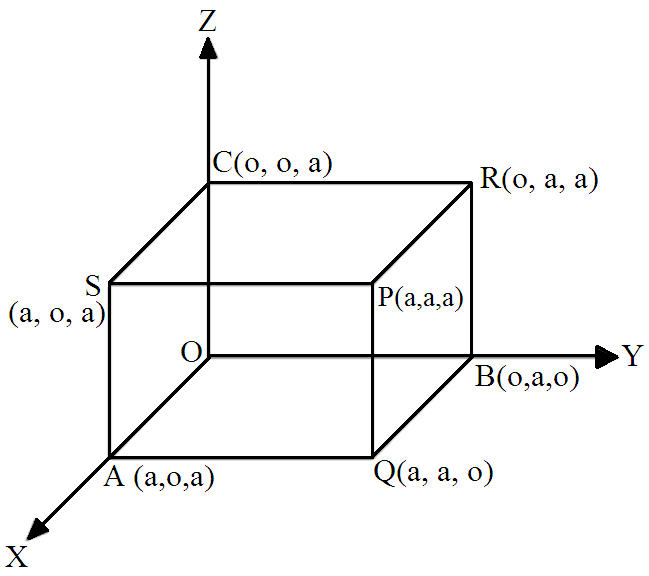
Let a be the length of an edge of the cube and let one corner be at the origin as shown in the figure. Clearly, OP, AR

The direction ratiosm of OP, AR, BS and CQ are

a - 0, a - 0, a - 0, i.e. a, a, a

0 - a, a - 0, a - 0, i.e. -a, a, a

a - 0, 0 - a, a - 0, i.e. a, -a, a

a - 0, a - 0, 0 -  a, i.e. a, a, -a

Let the direction ratios of a line be proportional to l, m and n. Suppose this line makes angles $\alpha,\beta,\gamma$ and $\delta$ with OP, AR.

Now, $\alpha$ is the angle between OP and the line whose direction ratios are proportional to l, m and n.

$\cos\alpha=\frac{\text{a}.\text{l}+\text{a}.\text{m}+\text{a}.\text{n}}{\sqrt{\text{a}^2+\text{a}^2+\text{a}^2}\sqrt{\text{l}^2+\text{m}^2+\text{n}^2}}\Rightarrow\cos\alpha=\frac{\text{l}+\text{m}+\text{n}}{\sqrt{3}\sqrt{\text{l}^2+\text{m}^2+\text{n}^2}}$

Since $\beta$ is the angle between AR and the line with direction ratios proportional to l, m and n, we get

$\cos\beta=\frac{-\text{a}.\text{l}+\text{a}.\text{m}+\text{a}.\text{n}}{\sqrt{\text{a}^2+\text{a}^2+\text{a}^2}\sqrt{\text{l}^2+\text{m}^2+\text{n}^2}}\Rightarrow\cos\beta=\frac{-\text{l}+\text{m}+\text{n}}{\sqrt{3}\sqrt{\text{l}^2+\text{m}^2+\text{n}^2}}$

Similarly,

$\cos\gamma=\frac{\text{a}.\text{l}-\text{a}.\text{m}+\text{a}.\text{n}}{\sqrt{\text{a}^2+\text{a}^2+\text{a}^2}\sqrt{\text{l}^2+\text{m}^2+\text{n}^2}}\Rightarrow\cos\gamma=\frac{\text{l}-\text{m}+\text{n}}{\sqrt{3}\sqrt{\text{l}^2+\text{m}^2+\text{n}^2}}$

$\cos\delta=\frac{\text{a}.\text{l}+\text{a}.\text{m}-\text{a}.\text{n}}{\sqrt{\text{a}^2+\text{a}^2+\text{a}^2}\sqrt{\text{l}^2+\text{m}^2+\text{n}^2}}\Rightarrow\cos\delta=\frac{\text{l}+\text{m}-\text{n}}{\sqrt{3}\sqrt{\text{l}^2+\text{m}^2+\text{n}^2}}$

$\cos^2\alpha+\cos^2\beta+\cos^2\gamma+\cos^2\delta$

$=\frac{(\text{l}+\text{m}+\text{n})^2}{3(\text{l}^2+\text{m}^2+\text{n}^2)}+\frac{(-\text{l}+\text{m}+\text{n})^2}{3(\text{l}^2+\text{m}^2+\text{n}^2)}+\frac{(\text{l}-\text{m}+\text{n})^2}{3(\text{l}^2+\text{m}^2+\text{n}^2)}+\frac{(\text{l}+\text{m}-\text{n})^2}{\sqrt{3}\sqrt{\text{l}^2+\text{m}^2+\text{n}^2}}$

$=\frac{1}{3(\text{l}^2+\text{m}^2+\text{n}^2)}\Big\{(\text{l}+\text{m}+\text{n})^2+(-\text{l}+\text{m}+\text{n})^2+(\text{l}-\text{m}+\text{n})^2+(\text{l}+\text{m}-\text{n})^2\Big\}$

$=\frac{1}{3(\text{l}^2+\text{m}^2+\text{n}^2)}4\big(\text{l}^2+\text{m}^2+\text{n}^2\big)=\frac{4}{3}$.
View full question & answer
Question 71 Mark
The xy-plane divided the line joining the point (-1, 3, 4) and (2, -5, 6)
  1. Internally in the ratio 2 : 3
  2. Externally in the ratio 2 : 3
  3. Internally in the ratio 3 : 2
  4. Externally in the ratio 3 : 2
Answer
  1. Externally in the ratio 2 : 3

Solution:

Let the XY-plane divide the line segment joining points

P(-1, 3, 4) and Q(2, -5, 6) in the ratio k : 1.

Using the section formula, the coordinates of the point of intersection are given by

$\Big(\frac{\text{k}(2)-1}{\text{k}+1},\frac{\text{k}(-5)+3}{\text{k}+1},\frac{\text{k}(6)+4}{\text{k}+1}\Big) $

On the XY-plane, the Z-coordinate of any point is zero.

$\Rightarrow\frac{\text{k}(6)+4}{\text{k}+1}=0$

$\Rightarrow6\text{k}+4=0$

$\Rightarrow\text{k}=\frac{-2}{3}$

Thus, the XY-plane divides the line segment joining the given points in the ratio 2 : 3 externally.

View full question & answer
Question 81 Mark
For every point P(x, y, z) on the x-axis (except the origin),
  1. x = 0, y = 0, z ≠ 0
  2. y = 0, z = 0, y ≠ 0
  3. y = 0, z = 0, x ≠ 0
  4. x = y = z = 0
Answer
  1. y = 0, z = 0, x ≠ 0

Solution:

Both Y and Z coordinates on each point of the x-axis are equal to zero.

The X-coordinate on the origin is also equal to zero.

Therefore, the Y and Z coordinates on each point of the x-axis, except the origin, are equal to zero,

While the X-coordinate is non-zero.

View full question & answer
Question 91 Mark
The angle between the two diagonals of a cube is:
  1. $30^\circ$
  2. $45^\circ$
  3. $\cos^{-1}\Big(\frac{1}{\sqrt{3}}\Big)$
  4. $\cos^{-1}\Big(\frac{1}{{3}}\Big)$
Answer
  1. $\cos^{-1}\Big(\frac{1}{{3}}\Big)$

Solution:

Let a be the length of an edge of the cube and let one corner be at the origin as shown in the figure. Clearly, OP, AR, Consider the diagonals OP and AR.

Direction ratios of OP and AR are proportional to a - 0, a - 0, a - 0 and 0 - a, a - 0, a - 0, e.i. a, a, a and -a, a, a, respectivelly.

Let $\theta$ be the angle between OP and AR. Then,

$\cos\theta=\frac{\text{a}\times-\text{a}+\text{a}\times\text{a}+\text{a}\times\text{a}}{\sqrt{\text{a}^2+\text{a}^2+\text{a}^2}\sqrt{(-\text{a})^2+\text{a}^2+\text{a}^2}}$

$\Rightarrow\cos\theta=\frac{-\text{a}+\text{a}^2+\text{a}^2}{\sqrt{3\text{a}^2}\sqrt{3\text{a}^2}}$

$\Rightarrow\cos\theta=\frac{1}{3}$

$\Rightarrow\theta=\cos^{-1}\Big(\frac{1}{3}\Big)$

Similarly, the angles between other pairs of the diagonals are equal to $\cos^{-1}\Big(\frac{1}{3}\Big)$ as the angle between any two diagonals.

View full question & answer
Question 101 Mark
If the x-coordinate of a point P on the join of Q(2, 2, 1) and R(5, 1, -2) is 4, then its z-coordinate is:
  1. 2
  2. 1
  3. -1
  4. -2
Answer
  1. -1

Solution:

Suppose the point P divided the line segment joining the point Q(2, 2, 1) and R(5, 1, -2) in the ratio k : 1.

Using the section formula, the coordinates of the point of intersection are given by

$\Big(\frac{\text{k}(5)+2}{\text{k}+2},\frac{\text{k}(1)+2}{\text{k}+1},\frac{\text{k}(-2)+1}{\text{k}+1}\Big) $

On the XY-plane, the Z-coordinate of any point is zero.

$\Rightarrow\frac{\text{k}(5)+2}{\text{k}+2}=4$

$\Rightarrow5\text{k}+2=4(\text{k}+1)$

$\Rightarrow\text{k}=2$

Now,

Z-coordinate of P $=\frac{\text{k}(-2)+1}{\text{k}+1}$ 

$\frac{2(-2)+1}{2+1}\ [\text{Substituting} \text{ k}=2]$

$=-1$

View full question & answer
Question 111 Mark
If P(3, 2, -4), Q(5, 4, -6) and R(9, 8, -10) are collinear, then R divided PQ in the ratio:
  1. 3 : 2 internally
  2. 3 : 2 externally
  3. 2 : 1 internally
  4. 2 : 1 externally
Answer
  1. 3 : 2 externally

Solution:

Suppose the point R divides PQ in the ratio $\lambda:1$.

Coordinates of R are $\Big(\frac{5\lambda+3}{\lambda+1},\frac{4\lambda+2}{\lambda+1},\frac{-6\lambda-4}{\lambda+1}\Big)$.

But the coordinates of R are (9, 8, -10).

$\therefore\frac{5\lambda+3}{\lambda+1}=9,\frac{4\lambda+2}{\lambda+1}=8$ and $\frac{-6\lambda-4}{\lambda+1}=-10$

From each of these equations, we get

$\lambda=-\frac{3}{2}$

$\therefore$ R divided PQ in the ratio 3 : 2 externally.

View full question & answer
Question 121 Mark
For every point P(x, y, z) on the xy-plane,
  1. x = 0
  2. y = 0
  3. z = 0
  4. x = y = z = 0
Answer
  1. z = 0

Solution:

The Z-coordinate of every point on the XY-plane is zero.

View full question & answer
Question 131 Mark
A rectangular parallelopiped is formed by planes drawn through the point (5, 7, 9) and (2, 3, 7) parallel to the coordinate planes. The length of an edge of this rectangular parallelopiped is:
  1. 2
  2. 3
  3. 4
  4. all of these
Answer
  1. all of these

Solution:

The give point (5, 7, 9) and (2, 3, 7) are two diagonally opposite vertices of the parallelopiped as all of theire coordinates.

Edges of the paralleloppiped = |5 - 2|, |7 - 3|, |9 - 7|

=3, 4, 2.

View full question & answer