Questions · Page 4 of 4

3 Marks

Question 1513 Marks
Find the principal values of the following:
$\tan^{-1}\Big(-\frac{1}{\sqrt3}\Big)$
Answer
We have $\tan^{-1}\Big(-\frac{1}{\sqrt3}\Big)=-\tan^{-1}\Big(\frac{1}{\sqrt3}\Big)$$[\because\tan^{-1}(-\text{x})=-\tan^{-1}\text{x}]$

Let $\tan^{-1}\Big(\frac{1}{\sqrt3}\Big)=\text{y}$

Then,

$\tan\text{y}=\frac{1}{\sqrt3}$

We know that the range of the principal value branch is $\Big(-\frac{\pi}{2},\frac{\pi}{2}\Big).$

Thus,

$\tan\text{y}=\frac{1}{\sqrt3}=\tan\Big(\frac{\pi}{6}\Big)$

$\Rightarrow\text{y}=\frac{\pi}{6}$

$\therefore\tan^{-1}\Big(-\frac{1}{\sqrt3}\Big)=-\tan^{-1}\Big(\frac{1}{\sqrt3}\Big)$

$=-\text{y}$

$=-\frac{\pi}{6}\in\Big(-\frac{\pi}{2},\frac{\pi}{2}\Big)$

Hence, the principal value of $\tan^{-1}\Big(-\frac{1}{\sqrt3}\Big)$ is $-\frac{\pi}{6}.$
View full question & answer
Question 1523 Marks
If $4\sin^{-1}\text{x}+\cos^{-1}\text{x}=\pi,$ then what is the value of x?
Answer
Given,
$4\sin^{-1}\text{x}+\cos^{-1}\text{x}=\pi$
$\Rightarrow4\sin^{-1}\text{x}+\frac{\pi}{2}-\sin^{-1}\text{x}=\pi$ $\Big\{\text{Since},\cos^{-1}\text{x}=\frac{\pi}{2}-\sin^{-1}\text{x}\Big\}$
$\Rightarrow3\sin^{-1}\text{x}=\pi-\frac{\pi}{2}$
$\Rightarrow3\sin^{-1}\text{x}=\frac{\pi}{2}$
$\Rightarrow\sin^{-1}\text{x}=\frac{\pi}{6}$
$\Rightarrow\sin^{-1}\text{x}=\sin^{-1}\Big(\frac{1}{2}\Big)$
$\Rightarrow\text{x}=\frac{1}{2}$
Hence,
$\text{x}=\frac{1}{2}$
View full question & answer
Question 1533 Marks
If $\sin^{-1}\text{x}+\sin^{-1}\text{y}+\sin^{-1}\text{z}=\frac{3\pi}{2},$ then write the values of x + y + z.
Answer
Given,
$\sin^{-1}\text{x}+\sin^{-1}\text{y}+\sin^{-1}\text{z}=\frac{3\pi}{2}$
We know that maximum and minimum values of $\sin^{-1}\text{x}$ are $\frac{\pi}{2}$ and $-\frac{\pi}{2}$ respectively.
$\sin^{-1}\text{x}+\sin^{-1}\text{y}+\sin^{-1}\text{z}=\frac{\pi}{2}+\frac{\pi}{2}+\frac{\pi}{2}$
$\Rightarrow\sin^{-1}\text{x}=\frac{\pi}{2},\sin^{-1}\text{y}=\frac{\pi}{2},\sin^{-1}\text{z}=\frac{\pi}{2}$
⇒ x = 1, y = 1, z = 1
So,
x + y + z = 1 + 1 + 1
= 3
Hence,
x + y + z = 3
View full question & answer
Question 1543 Marks
Write the value of $\cos^{-1}\Big(\tan\frac{3\pi}{4}\Big).$
Answer
We have
$\cos^{-1}\Big(\tan\frac{3\pi}{4}\Big)=\cos^{-1}\Big\{-\tan\Big(-\pi-\frac{3\pi}{4}\Big)\Big\}$ $[\because\ \tan(\pi-\text{x}=-\tan\text{x})]$
$=\cos^{-1}\Big\{\tan\Big(-\frac{\pi}{4}\Big)\Big\}$
$=\cos^{-1}\Big\{-\tan\Big(\frac{\pi}{4}\Big)\Big\}$
$=\cos^{-1}(-1)$
$=\cos^{-1}(\cos\pi)$ $[\therefore\ \cos\pi=-1]$
$=\pi$
$\therefore\ \cos^{-1}\Big(\tan\frac{3\pi}{4}\Big)=\pi$
View full question & answer
Question 1553 Marks
Solve:
$\tan^{-1}\text{x}+2\cot^{-1}\text{x}=\frac{2\pi}{3}$
Answer
$\tan^{-1}\text{x}+2\cot^{-1}\text{x}=\frac{2\pi}{3}$
$\Rightarrow\tan^{-1}\text{x}+2\Big(\frac{\pi}{2}-\tan^{-1}\text{x}\Big)=\frac{2\pi}{3}$
$\Big[\because\ \cot^{-1}\text{x}=\frac{\pi}{2}-\tan^{-1}\text{x}\Big]$
$\Rightarrow\tan^{-1}\text{x}+\pi-2\tan^{-1}\text{x}=\frac{2\pi}{3}$
$\Rightarrow\tan^{-1}\text{x}=\frac{\pi}{3}$
$\Rightarrow\text{x}=\tan\frac{\pi}{3}=\sqrt3$
View full question & answer
Question 1563 Marks
Write the following in the simplest form:
$\cot^{-1}\frac{\text{a}}{\sqrt{\text{x}^2-\text{a}^2}},|\text{x}|>\text{a}$
Answer
$\cot^{-1}\frac{\text{a}}{\sqrt{\text{x}^2-\text{a}^2}},|\text{x}|>\text{a}$

Let, $\text{x}=\text{a}\sec\theta$

$\cot^{-1}\bigg(\frac{\text{a}}{\sqrt{\text{a}^2\sec^{2}\theta-\text{a}^2}}\bigg)$

$=\cot^{-1}\begin{pmatrix}\frac{\text{a}}{\sqrt{\text{a}^2\big(\sec^{2}\theta-1\big)}}\end{pmatrix}$

$=\cot^{-1}\frac{1}{\sqrt{\tan^2\theta}}$ $\{\text{since},\sec^2\theta-1=\tan^2\theta\}$

$=\cot^{-1}(\cot\theta)$

$=\theta$

$=\sec^{-1}\Big(\frac{\text{x}}{\text{a}}\Big)$

Hence,

$\cot^{-1}\frac{a}{\sqrt{\text{x}^2-\text{a}^2}}=\sec^{-1}\Big(\frac{\text{x}}{\text{a}}\Big)$

View full question & answer
Question 1573 Marks
Solve the following equation for x:
$\tan^{-1}(2+\text{x})+\tan^{-1}(2-\text{x})=\tan^{-1}\frac{2}{3},$ where $\text{x}<-\sqrt3$ or, $\text{x}>\sqrt3$
Answer
We know
$ \tan^{-1}\text{x}+\tan^{-1}\text{y}=\tan^{-1}\Big(\frac{\text{x}+\text{y}}{1-\text{xy}}\Big)$
$\therefore\ \tan^{-1}(2+\text{x})+\tan^{-1}(2-\text{x})=\tan^{-1}\frac{2}{3},$
$\Rightarrow\tan^{-1}\Big(\frac{2+\text{x}+2-\text{x}}{1-(2+\text{x})(2-\text{x})}\Big)=\tan^{-1}\frac{2}{3}$
$\Rightarrow\frac{4}{1-4+\text{x}^2}=\tan\frac{2}{3}$
$\Rightarrow-6+2\text{x}^2=12$
$\Rightarrow2\text{x}^2=18$
$\Rightarrow\text{x}^2=9$
$\Rightarrow\text{x}=\pm3$
View full question & answer
Question 1583 Marks
Write the value of $\tan^{-1}\frac{\text{a}}{\text{b}}-\tan^{-1}\Big(\frac{\text{a}-\text{b}}{\text{a}+\text{b}}\Big).$
Answer
$\tan^{-1}\frac{\text{a}}{\text{b}}-\tan^{-1}\Big(\frac{\text{a}-\text{b}}{\text{a}+\text{b}}\Big)$
$=\tan^{-1}\begin{bmatrix}\frac{\frac{\text{a}}{\text{b}}-\frac{\text{a}-\text{b}}{\text{a}+\text{b}}}{1+\Big(\frac{\text{a}}{\text{b}}\Big)-\Big(\frac{\text{a}-\text{b}}{\text{a}+\text{b}}\Big)}\end{bmatrix}$
$\Big\{\text{Since},\tan^{-1}\text{x}-\tan^{-1}\text{y}=\tan^{-1}\Big(\frac{\text{x}-\text{y}}{1+\text{xy}}\Big)\Big\}$
$=\tan^{-1}\begin{bmatrix}\frac{\frac{\text{a}^2+\text{ab}-\text{ab}+\text{b}^2}{\text{b}(\text{a}+\text{b})}}{\frac{\text{ba}+\text{b}^2+\text{a}^2-\text{ab}}{{\text{b}(\text{a}+\text{b})}}}\end{bmatrix}$
$=\tan^{-1}\Big[\frac{\text{a}^2+\text{b}^2}{\text{a}^2+\text{b}^2}\Big]$
$=\tan^{-1}(1)$
$=\frac{\pi}{4}$
Hence,
$\tan^{-1}\frac{\text{a}}{\text{b}}-\tan^{-1}\Big(\frac{\text{a}-\text{b}}{\text{a}+\text{b}}\Big)=\frac{\pi}{4}$
View full question & answer
Question 1593 Marks
If $\tan^{-1}\text{x}+\tan^{-1}\text{y}=\frac{\pi}{4},$ then write the value of x + y + xy.
Answer
Given,
$\tan^{-1}\text{x}+\tan^{-1}\text{y}=\frac{\pi}{4}$
$\Rightarrow\tan^{-1}\Big(\frac{\text{x}+\text{y}}{1-\text{xy}}\Big)=\frac{\pi}{4}$ $\Big\{\text{Since},\tan^{-1}\text{x}+\tan^{-1}\text{y}=\tan^{-1}\Big(\frac{\text{x}+\text{y}}{1-\text{xy}}\Big)\Big\}$
$\Rightarrow\tan^{-1}\Big(\frac{\text{x}+\text{y}}{1-\text{xy}}\Big)=\tan^{-1}(1)$
$\Rightarrow\frac{\text{x}+\text{y}}{1-\text{xy}}=1$
$\Rightarrow\text{x}+\text{y}=1-\text{xy}$
$\Rightarrow\text{x}+\text{y}+\text{xy}=1$
So,
$\Rightarrow\text{x}+\text{y}+\text{xy}=1$
View full question & answer
Question 1603 Marks
Prove the following results:
$\sin^{-1}\frac{4}{5}+2\tan^{-1}\frac{1}{3}=\frac{\pi}{2}$
Answer
$\text{L.H.S}=\sin^{-1}\frac{4}{5}+2\tan^{-1}\frac{1}{3}$
$=\sin^{-1}\frac{4}{5}+\tan^{-1}\Bigg\{\frac{2\times\frac{1}{2}}{1-\big(\frac{1}{3}\big)^2}\Bigg\}$ $\Big[\because\ 2\tan^{-1}\text{x}=\tan^{-1}\Big\{\frac{2\text{x}}{1-\text{x}^2}\Big\}\Big]$
$=\sin^{-1}\frac{4}{5}+\tan^{-1}\Bigg\{\frac{\frac{2}{3}}{\frac{8}{9}}\Bigg\}$
$=\sin^{-1}\frac{4}{5}+\tan^{-1}\frac{3}{4}$
$=\sin^{-1}\frac{4}{5}+\cos^{-1}\frac{1}{\sqrt{1+\frac{9}{16}}}$ $\Big[\because\ \tan^{-1}\text{x}=\cos^{-1}\frac{1}{\sqrt{1+\text{x}^2}}\Big]$
$=\sin^{-1}\frac{4}{5}+\cos^{-1}\frac{1}{\frac{5}{4}}$
$=\sin^{-1}\frac{4}{5}+\cos^{-1}\frac{4}{5}$
$=\frac{\pi}{2}=\text{R.H.S}$
View full question & answer
Question 1613 Marks
Find the values:
If $\tan^{-1}\frac{x-1}{x-2}+\tan^{-1}\tan\frac{x+1}{x+2}=\frac{\pi}{4},$ then find the value of x
Answer
Given: $\tan^{-1}\frac{x-1}{x-2}+\tan^{-1}\frac{x+1}{x+2}=\frac{\pi}{4}$
$\Rightarrow\tan^{-1}\frac{\frac{x-1}{x-2}+\frac{x+1}{x+2}}{1-\left(\frac{x-1}{x-2}\right)\left(\frac{x+1}{x+2}\right)}=\frac{\pi}{4}$ $\bigg[\because\tan^{-1}x+\tan^{-1}y=\tan^{-1}\frac{x+y}{1-xy}\bigg]$
$\Rightarrow\tan^{-1}\frac{\left(x-1\right)\left(x+2\right)+\left(x+1\right)\left(x-2\right)}{\left(x-2\right)\left(x+2\right)-\left(x-1\right)\left(x+1\right)}=\frac{\pi}{4}$
$\Rightarrow\tan^{-1}\frac{x^2+2x-x-2+x^2-2x+x-2}{x^2-4-\left(x^2-1\right)}=\frac{\pi}{4}$
$\Rightarrow\frac{2x^2-4}{x^2-4-x^2+1}=\tan\frac{\pi}{4}$ $\Rightarrow\frac{2x^2-4}{-3}=1$
$ \Rightarrow\ 2x^2-4=-3$ $\Rightarrow\ 2x^2=1$
$\Rightarrow\ x^2=\frac{1}{2}$ $ \Rightarrow\ x=\pm\frac{1}{\sqrt{2}}$
View full question & answer
Question 1623 Marks
Write the following in the simplest form:
$\tan^{-1}\Big\{\frac{\sqrt{1+\text{x}^2}+1}{\text{x}}\Big\},\text{x}\neq0$
Answer
Let $\text{x}=\tan\theta$

Now,

$\tan^{-1}\Big\{\frac{\sqrt{1+\text{x}^2}+1}{\text{x}}\Big\}$

$=\tan^{-1}\Big\{\frac{\sqrt{1+\tan^2\theta}+1}{\tan\theta}\Big\}$

$=\tan^{-1}\Big\{\frac{\sqrt{1+\sec^2\theta}+1}{\tan\theta}\Big\}$

$=\tan^{-1}\Big\{\frac{\sec\theta+1}{\tan\theta}\Big\}$

$=\tan^{-1}\Big\{\frac{\cos\theta+1}{\sin\theta}\Big\}$

$=\tan^{-1}\Bigg\{\frac{2\cos^2\frac{\theta}{2}}{2\sin\frac{\theta}{2}\cos\frac{\theta}{2}}\Bigg\}$

$=\tan^{-1}\Big(\frac{\cot\theta}{2}\Big)$

$=\tan^{-1}\Big\{\tan\Big(\frac{\pi}{2}-\frac{\theta}{2}\Big)\Big\}$

$=\Big(\frac{\pi}{2}-\frac{\theta}{2}\Big)$

$=\frac{\pi}{2}-\frac{\tan^{-1}\text{x}}{2}$

View full question & answer
Question 1633 Marks
Write the following in the simplest form:
$\tan^{-1}\Big\{\sqrt{1+\text{x}^2}-\text{x}\Big\},\text{x}\in\text{R}$
Answer
Let $\text{x}=\cot\theta$
Now,
$\tan^{-1}\Big\{\sqrt{1+\text{x}^2}-\text{x}\Big\}$
$\tan^{-1}\Big\{\sqrt{1+\cot^2\theta}-\cot\theta\Big\}$
$=\tan^{-1}\{\text{cosec }\theta-\cot\theta\}$
$=\tan^{-1}\Big\{\frac{1-\cos\theta}{\sin\theta}\Big\}$
$=\tan^{-1}\Bigg\{\frac{2\sin^2\frac{\theta}{2}}{2\sin\frac{\theta}{2}\cos\frac{\theta}{2}}\Bigg\}$
$=\tan^{-1}\Big\{\tan\Big(\frac{\theta}{2}\Big)\Big\}$
$=\frac{\theta}{2}$
$=\frac{\cot^{-1}\text{x}}{2}$
View full question & answer
Question 1643 Marks
Write the following in the simplest form:
$\sin\Big\{2\tan^{-1}\sqrt{\frac{1-\text{x}}{1+\text{x}}}\Big\}$
Answer
$\sin\Big\{2\tan^{-1}\sqrt{\frac{1-\text{x}}{1+\text{x}}}\Big\}$
$=\sin\begin{Bmatrix}\sin^{-1}\begin{pmatrix}\frac{2\sqrt{\frac{1-\text{x}}{1+\text{x}}}}{1+\Big(\sqrt{\frac{1-\text{x}}{1+\text{x}}}\Big)^2}\end{pmatrix}\end{Bmatrix}$ $\Big\{\text{Since},2\tan^{-1}\text{x}=\sin^{-1}\frac{2\text{x}}{1+\text{x}^2}\Big\}$
$=\sin\begin{Bmatrix}\sin^{-1}\begin{pmatrix}\frac{2\sqrt{\frac{1-\text{x}}{1+\text{x}}}}{\frac{1+\text{x}+1-\text{x}}{1+\text{x}}}\end{pmatrix}\end{Bmatrix}$
$=2\sqrt{\frac{1-\text{x}}{1+\text{x}}}\times\frac{1+\text{x}}{2}$
$=\sqrt{1-\text{x}}\sqrt{1+\text{x}}$
$=\sqrt{1-\text{x}^2}$
Hence, $\sin\Big\{2\tan^{-1}\sqrt{\frac{1-\text{x}}{1+\text{x}}}\Big\}=\sqrt{1-\text{x}^2}$
View full question & answer
Question 1653 Marks
Evaluate the following:
$\tan\frac{1}{2}\Big(\cos^{-1}\frac{\sqrt5}{3}\Big)$
Answer
Let $\frac{1}{2}\sin^{-1}\frac{3}{4}=\text{x}$
$ \sin^{-1}\frac{3}{4}=2\text{x}$
$ \sin2\text{x}=\frac{3}{4}$
$\cos2\text{x}=\frac{\sqrt7}{4}$
$\tan\Big(\frac{1}{2}\sin^{-1}\frac{3}{4}\Big)$
$=\tan\text{x}$
$ =\sqrt{\frac{1-\cos2\text{x}}{1+\cos2\text{x}}}$
$=\sqrt{\frac{1-\frac{\sqrt7}{4}}{1+\frac{\sqrt7}{4}}}$
$=\sqrt{\frac{4-\sqrt7}{4+\sqrt7}}$
$=\sqrt{\frac{\big(4-\sqrt7\big)\big(4-\sqrt7\big)}{\big(4+\sqrt7\big)\big(4-\sqrt7\big)}}$
$=\sqrt{\frac{\big(4-\sqrt7\big)^2}{9}}$
$ =\frac{4-\sqrt7}{3}$
View full question & answer
Question 1663 Marks
Find the value:
$\cos^{-1}\bigg(\cos\frac{13\pi}{6}\bigg)$
Answer
We know that $\cos^{-1}(\cos x)=x$ if $x\in[0,\pi]$, which is the principal value branch of $\cos^{-1}x.$
Here, $\frac{13\pi}{6}\notin[0,\pi].$
Now, $\cos^{-1}\bigg(\cos\frac{13\pi}{6}\bigg)$ can be written as:
$\cos^{-1}\left(\cos\frac{13\pi}{6}\right)=\cos^{-1}\left[\cos\left(2\pi+\frac{\pi}{6}\right)\right]$
$=\cos^{-1}\left[\cos\left(\frac{\pi}{6}\right)\right],\text{where}\frac{\pi}{6}\in\left[0,\pi\right]$
$\therefore\cos^{-1}\bigg(\cos\frac{13\pi}{6}\bigg)=\cos^{-1}\bigg[\cos\bigg(\frac{\pi}{6}\bigg)\bigg]=\frac{\pi}{6}$
View full question & answer
Question 1673 Marks
For the principal values, evaluate the following:
$\sin^{-1}[\cos\{2\text{cosec}^{-1}(-2)\}]$
Answer
$\text{cosec}^{-1}\text{x}$ represents an angle in $\Big[-\frac{\pi}{2},0\Big)\cup\Big(0,\frac{\pi}{2}\Big]$ whose cosecant is x.

Let $\text{x}=\text{cosec}^{-1}(-2)$

$\Rightarrow\text{cosec x}=-2=\text{cosec c}\Big(-\frac{\pi}{6}\Big)$

$\Rightarrow\text{x}=-\frac{\pi}{6}$

$\sin^{-1}[\cos\{2\text{cosec}^{-1}(-2)\}]=\sin^{-1}\Big[\cos\Big\{2\times\Big(-\frac{\pi}{6}\Big)\Big\}\Big]$

$=\sin^{-1}\Big[\cos\Big(-\frac{\pi}{3}\Big)\Big]=\sin^{-1}\Big[\frac{1}{2}\Big]$

$\sin^{-1}\text{x}$ represents an angle in $\Big[-\frac{\pi}{2},\frac{\pi}{2}\Big]$ whose sin is x.

Let $\text{x}=\sin^{-1}\Big[\frac{1}{2}\Big]$

$\Rightarrow\sin\text{x}=\frac{1}{2}=\sin\Big(\frac{\pi}{6}\Big)$

$\Rightarrow\text{x}=\frac{\pi}{6}$

View full question & answer
Question 1683 Marks
Prove the following results:
$\tan^{-1}\frac{1}{7}+2\tan^{-1}\frac{1}{3}=\frac{\pi}{4}$
Answer
$\tan^{-1}\Big(\frac{1}{7}\Big)+2\tan^{-1}\Big(\frac{1}{3}\Big)=\frac{\pi}{4}$

$\text{L.H.S}=\tan^{-1}\Big(\frac{1}{7}\Big)+2\tan^{-1}\Big(\frac{1}{3}\Big)$

$=\tan^{-1}\Big(\frac{1}{7}\Big)=\tan^{-1}\Bigg(\frac{2\big(\frac{1}{3}\big)}{1-\big(\frac{1}{3}\big)^2}\Bigg)$

$\Big\{\text{Since }2\tan^{-1}\text{x}=\frac{1}{2}\tan^{-1}\Big(\frac{2\text{x}}{1-\text{x}^2}\Big)\Big\}$

$=\tan^{-1}\Big(\frac{1}{7}\Big)+\tan^{-1}\Big(\frac{2}{3}\times\frac{9}{8}\Big)$

$=\tan^{-1}\Big(\frac{1}{7}\Big)+=\tan^{-1}\Big(\frac{3}{4}\Big)$

$=\tan^{-1}\Bigg(\frac{\frac{1}{7}+\frac{3}{4}}{1-\frac{1}{7}\times\frac{3}{4}}\Bigg)$

$\Big\{\text{Since}\tan^{-1}\text{x}+\tan^{-1}\text{y}=\tan^{-1}\Big(\frac{\text{x}+\text{y}}{1-\text{xy}}\Big)\Big\}$

$=\tan^{-1}\Bigg(\frac{\frac{25}{20}}{\frac{25}{20}}\Bigg)$

$=\tan^{-1}(1)$

$=\frac{\pi}{4}$

$=\text{R.H.S}$

Hence, proved

View full question & answer
Question 1693 Marks
Solve the following equation for x:
$\tan^{-1}2\text{x}+\tan^{-1}3\text{x}=\text{n}\pi+\frac{3\pi}{4}$
Answer
Given

$\tan^{-1}2\text{x}+\tan^{-1}3\text{x}=\text{n}\pi+\frac{3\pi}{4}....(1)$

$\Rightarrow\tan^{-1}\Big(\frac{2\text{x}+3\text{x}}{1-2\text{x}\times3\text{x}}\Big)=\text{n}\pi+\frac{3\pi}{4}$

$\Big\{\text{Since}\tan^{-1}\text{x}+\tan^{-1}\text{y}=\tan^{-1}\Big(\frac{\text{x+y}}{1-\text{xy}}\Big)\text{ if }\text{xy}<1\Big\}$

$\Rightarrow\tan^{-1}\Big(\frac{5\text{x}}{1-6\text{x}^2}\Big)=\text{n}\pi+\frac{3\pi}{4},6\text{x}^2<1$

$\Rightarrow\frac{5\text{x}}{1-6\text{x}^2}=\tan\Big(\text{n}\pi+\frac{3\pi}{4}\Big),6\text{x}^2<1$

$\Rightarrow\frac{5\text{x}}{1-6\text{x}^2}-1,6\text{x}^2<1$

$\Rightarrow5\text{x}=-1+6\text{x}^2,6\text{x}^2<1$

$\Rightarrow6\text{x}^2-5\text{x}-1=0,\text{x}^2<\frac{1}{6}$

$\Rightarrow6\text{x}^2-6\text{x}+\text{x}-1=0,-\frac{1}{\sqrt6}<\text{x}<\frac{1}{6}$

$\Rightarrow6\text{x}(\text{x}-1)+1(\text{x}-1)=0,-\frac{1}{\sqrt6}<\text{x}<\frac{1}{6}$

$\Rightarrow(6\text{x}+1)(\text{x}-1)=0$

$\Rightarrow6\text{x}+1=0$ or $\text{x}-1=0$

$\Rightarrow\text{x}=-\frac{1}{6}$ or $\text{x}=1$

Since, $\text{x}=1\notin\Big(-\frac{1}{\sqrt6},\frac{1}{\sqrt6}\Big)$

So,

x = 1 is not root of the given equation (i).

Since,

$\text{x}=1\in\Big(-\frac{1}{\sqrt6},\frac{1}{\sqrt6}\Big)$

So,

$\text{x}=-\frac{1}{6}$ is the root of the given equation (i).

Hence,

$\text{x}=-\frac{1}{6}$

View full question & answer
Question 1703 Marks
Solve the following equation $\cos(\tan^{-1}\text{x})=\sin\Big(\cot^{-1}\frac{3}{4}\Big).$
Answer

We have, $\cos(\tan^{-1}\text{x})=\sin\Big(\cot^{-1}\frac{3}{4}\Big)$

L.H.S. $=\cos(\tan^{-1}\text{x})$

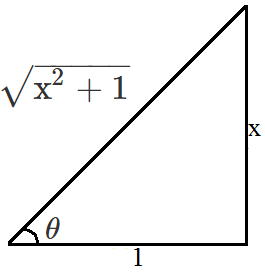
$=\cos\Big(\cos^{-1}\frac{1}{\sqrt{\text{x}^2+1}}\Big)$

$=\frac{1}{\sqrt{\text{x}^2+1}}$

$(\because\ \cos(\cos^{-1}\text{x})=\text{x},\ \text{x}\in[-1,1])$


R.H.S. $=\sin\Big(\cot^{-1}\frac{3}{4}\Big)$

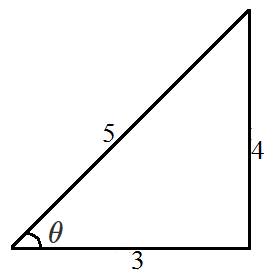
$=\sin\Big(\sin^{-1}\frac{4}{5}\Big)$

$=\frac{4}{5}$

$(\because\ \sin(\sin^{-1}\text{x})=\text{x},\ \text{x}\in[-1,1])$

$\therefore$ From given equation we get $\frac{1}{\sqrt{\text{x}^2+1}}=\frac{4}{5}$

$\Rightarrow\ 16(\text{x}^2+1)=25$

$\Rightarrow\ 16\text{x}^2=9$

$\Rightarrow\ \text{x}^2=\frac{9}{16}$

$\therefore\ \text{x}=\pm\frac{3}{4}$

View full question & answer
Question 1713 Marks
Find the value of the expression $\sin\Big(2\tan^{-1}\frac{1}{3}\Big)+\cos(\tan^{-1}2\sqrt{2}).$
Answer

We have, $\sin\Big(2\tan^{-1}\frac{1}{3}\Big)+\cos(\tan^{-1}2\sqrt{2})$

$\sin\Big(2\tan^{-1}\frac{1}{3}\Big)=\sin\begin{pmatrix}\sin^{-1}\frac{2\times\frac{1}{3}}{1+\big(\frac{1}{3}\big)^2}\end{pmatrix}$

$\Big(\because\ 2\tan^{-1}\text{x}=\sin^{-1}\frac{2\text{x}}{1+\text{x}^2}\Big)$

$=\sin\Bigg(\sin^{-1}\frac{\frac{2}{3}}{\frac{10}{9}}\Bigg)$

$=\sin\Big(\sin^{-1}\frac{3}{5}\Big)=\frac{3}{5}$

$(\because\ \sin(\sin^{-1}\text{x})=\text{x},\ \text{x}\in[-1,1])$

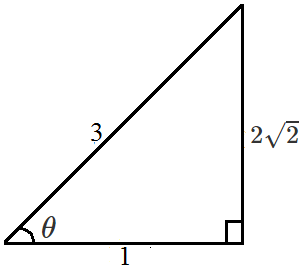
$\cos(\tan^{-1}2\sqrt{2})=\cos\Big(\cos^{-1}\frac{1}{3}\Big)=\frac{1}{3}$

$(\because\ \cos(\cos^{-1}\text{x})=\text{x},\ \text{x}\in[-1,1])$

$\therefore\ \sin\Big(2\tan^{-1}\frac{1}{3}\Big)+\cos(\tan^{-1}2\sqrt{2})$

$=\frac{3}{5}+\frac{1}{3}=\frac{9+5}{15}=\frac{14}{15}$

View full question & answer
Question 1723 Marks
Find the principal values of the following:
$\tan^{-1}\Big(\cos\frac{\pi}{2}\Big)$
Answer
Let $\tan^{-1}\Big(-\frac{1}{\sqrt3}\Big)=\text{y}$

Then,

$\tan\text{y}=\cos\frac{\pi}{2}$

We know that the range of the principal value branch is $\Big(-\frac{\pi}{2},\frac{\pi}{2}\Big).$

Thus,

$\tan\text{y}=\cos\frac{\pi}{2}=0=\tan(0)$

$\Rightarrow\text{y}=0\in\Big(-\frac{\pi}{2},\frac{\pi}{2}\Big)$

Hence, the principal value of $\tan^{-1}\Big(\cos\frac{\pi}{2}\Big)$ is 0.

View full question & answer
Question 1733 Marks
Show that $2\tan^{-1}(-3)=\frac{-\pi}{2}+\tan^{-1}\Big(\frac{-4}{3}\Big).$
Answer
LHS $=2\tan^{-1}(-3)=-2\tan^{-1}3$

$[\because\ \tan^{-1}(-\text{x})=-\tan^{-1}\text{x},\ \text{x}\in\text{R}]$

$=-\Big[\cos^{-1}\frac{1-3^2}{1+3^2}\Big]$

$\Big[\because\ 2\tan^{-1}\text{x}=\cos^{-1}\frac{1-\text{x}^2}{1+\text{x}^2},\ \text{x}\geq0\Big]$

$=-\Big[\cos^{-1}\Big(\frac{-8}{10}\Big)\Big]=-\Big[\cos^{-1}\Big(\frac{-4}{5}\Big)\Big]$

$=-\Big[\pi-\cos^{-1}\Big(\frac{4}{5}\Big)\Big]$

$\{\because\ \cos^{-1}(-\text{x})=\pi-\cos^{-1}\text{x},\ \text{x}\in[-1,1]\}$

$=-\pi+\cos^{-1}\Big(\frac{4}{5}\Big)$

$\Big[\text{let}\ \cos^{-1}\Big(\frac{4}{5}\Big)=\theta\Rightarrow\ \cos\theta=\frac{4}{5}\Rightarrow\ \tan\theta=\frac{3}{4}\Rightarrow\ \theta=\tan^{-1}\frac{3}{4}\Big]$

$=-\pi+\tan^{-1}\Big(\frac{3}{4}\Big)=-\pi+\Big[\frac{\pi}{2}-\cot^{-1}\Big(\frac{3}{4}\Big)\Big]$

$=-\frac{\pi}{2}-\cot^{-1}\frac{3}{4}=-\frac{\pi}{2}-\tan^{-1}\frac{4}{3}$

$=-\frac{\pi}{2}+\tan^{-1}\Big(\frac{-4}{3}\Big)$

$[\because\ \tan^{-1}(-\text{x})=-\tan^{-1}\text{x}]$

= RHS (Hence proved)

View full question & answer