Questions

2 Marks

🎯

Test yourself on this topic

12 questions · timed · auto-graded

Question 12 Marks
Probability of solving specific problem independently by A and B are $\frac{1}{2}$ and $\frac{1}{3}$ respectively. If both try to solve the problem independently, find the probability that, exactly one of them solve the problem.
Answer
$A$ and $B$ are independently try to solve problem with probability
$\begin{array}{l}
P(A)=\frac{1}{2} \\
P(B)=\frac{1}{3}
\end{array}$
Which are independent events.
$\therefore P(A \cap B)=P(A) \cdot P(B)$
$\rightarrow$ Exactly one of them solves the problem
$\begin{array}{l}
=P\left(A \cap B^{\prime}\right)+P\left(A^{\prime} \cap B\right) \\
=P(A)-P(A \cap B)+P(B)-P(A \cap B) \\
=P(A)+P(B)-2 P(A) P(B) \\
=\frac{1}{2}+\frac{1}{3}-2 \times \frac{1}{2} \times \frac{1}{3} \\
=\frac{1}{2}+\frac{1}{3}-\frac{1}{3} \\
=\frac{1}{2}
\end{array}$
View full question & answer
Question 22 Marks
Given that the two numbers appearing on throwing two dices are different. Find the probability of the event 'the sum of numbers on the dice is $4^{\prime}$.
Answer
Two dice are thrown $n=36$
$\begin{array}{l}
S=\{(1,1),(1,2),(1,3),(1,4),(1,5) \text {, } \\
(1,6),(2,1),(2,2),(2,3),(2,4) \text {, } \\
(2,5),(2,6),(3,1),(3,2),(3,3) \text {, } \\
(3,4),(3,5),(3,6),(4,1),(4,2) \text {, } \\
(4,3),(4,4),(4,5),(4,6),(5,1) \text {, } \\
(5,2),(5,3),(5,4),(5,5),(5,6) \text {, } \\
(6,1),(6,2),(6,3),(6,4),(6,5),(6,6)\}
\end{array}$
Event A: Two numbers appearing on throwing two dice are different.
$\begin{array}{l} 
\therefore \quad r=30 \\
\therefore \quad P(A)=\frac{30}{36} \\
=\frac{5}{6}
\end{array}$
Event B: The sum of numbers on the dice is 4 .
$\begin{array}{l} 
B=\{(1,3),(2,2),(3,1)\} \\
A \cap B=\{(1,3),(3,1)\} \\
\therefore \quad r=2 \\
\therefore \quad P(A \cap B)=\frac{2}{36}=\frac{1}{18} \\
\therefore \quad P(B \mid A)=\frac{P(A \cap B)}{P(A)} \\
=\frac{\frac{1}{18}}{\frac{5}{6}} \\
=\frac{1}{15}
\end{array}$
View full question & answer
Question 32 Marks
Show that the line through the points $(4,7,8)$, $(2,3,4)$ is parallel to the line through the points $(-1,-2,1),(1,2,5)$.
Answer
Suppose, $A (4,7,8), B (2,3,4)$,
$P (-1,-2,1), Q (1,2,5)$ are given points.
$\begin{array}{l}
\overrightarrow{AB}=-2 \hat{i}-4 \hat{j}-4 \hat{k} \\
\overrightarrow{PQ}=2 \hat{i}+4 \hat{j}+4 \hat{k}
\end{array}$
Now, $\overrightarrow{ AB }=\lambda \overrightarrow{ PQ }$
$\begin{array}{l}
\therefore(-2 \hat{i}-4 \hat{j}-4 \hat{k})=\lambda(2 \hat{i}+4 \hat{j}+4 \hat{k}), \lambda \in R \\
\therefore-2=2 \lambda,-4=4 \lambda,-4=4 \lambda \\
\therefore \lambda=-1, \lambda=-1, \lambda=-1
\end{array}$
$\therefore$ Direction ratio of $\overrightarrow{ AB }$ and $\overrightarrow{ PQ }$ are equal.
$\therefore$ Given both the lines are parallel.
View full question & answer
Question 42 Marks
Find the vector equation of the line passing through the point $(1,2,-4)$ and perpendicular to the two lines
$\begin{array}{l}\frac{x-8}{3}=\frac{y+19}{-16}=\frac{z-10}{-7} \text { and } \\ \frac{x-15}{3}=\frac{y-29}{8}=\frac{z+5}{-5} .\end{array}$
Answer
Line $L _1: \frac{x-8}{3}=\frac{y+19}{-16}=\frac{z-10}{7}$
$\vec{r}=(8 \hat{i}-19 \hat{j}+10 \hat{k})+\lambda(3 \hat{i}-16 \hat{j}+7 \hat{k})$
Direction of line $\overrightarrow{b_1}=3 \hat{i}-16 \hat{j}+7 \hat{k}$
Line $L _2: \frac{x-15}{3}=\frac{y-29}{8}=\frac{z-5}{-5}$
$\overrightarrow{r_2}=(15 \hat{i}+29 \hat{j}+5 \hat{k})+\lambda(3 \hat{i}+8 \hat{j}-5 \hat{k})$
Direction of line $\overrightarrow{b_2}=3 \hat{i}+8 \hat{j}-5 \hat{k}$
$\begin{aligned} \overrightarrow{b_1} \times \overrightarrow{b_2} & =\left|\begin{array}{ccc}\hat{i} & \hat{j} & \hat{k} \\ 3 & -16 & 7 \\ 3 & 8 & -5\end{array}\right| \\ & =24 \hat{i}+36 \hat{j}+72 \hat{k} \\ & =12(2 \hat{i}+3 \hat{j}+6 \hat{k})\end{aligned}$
$\therefore$ Direction of given line $\vec{b}=2 \hat{i}+3 \hat{j}+6 \hat{k}$
$A (\vec{a})=\hat{i}+2 \hat{j}-4 \hat{k}$ line of the line
Vector equation of line,
$\begin{array}{l}
\therefore \vec{r}=\vec{a}+\lambda \vec{b}, \lambda \in R \\
\therefore \vec{r}=(\hat{i}+2 \hat{j}-4 \hat{k})+\lambda(2 \hat{i}+3 \hat{j}+6 \hat{k})
\end{array}$
View full question & answer
Question 52 Marks
If $\vec{a}, \vec{b}, \vec{c}$ are unit vectors such that $\vec{a}+\vec{b}+\vec{c}=\overrightarrow{0}$, find the value of $\vec{a} \cdot \vec{b}+\vec{b} \cdot \vec{c}+\vec{c} \cdot \vec{a}$.
View full question & answer
Question 62 Marks
Find the general solution of the differential equation $x \frac{d y}{d x}+2 y=x^2 \log x$.
Answer
$\begin{array}{l}x \frac{d y}{d x}+2 y=x^2 \log x \\ \therefore \frac{d y}{d x}+\frac{2}{x} y=x \log x \ldots(1)\end{array}$
Compare given equation with $\frac{d y}{d x}+ P (x) y= Q (x)$,
$\begin{array}{l}
P(x)=\frac{2}{x} \\
Q(x)=x \log x
\end{array}$
$\text { Integrating factor I.F. } \quad=e^{\int P(x) d x}$
$\begin{array}{l}=e^{\int \frac{2}{x} d x} \\ =e^{2 \log x} \\ =e^{\log x^2} \\ =x^2\end{array}$
Multiply equation (1) by $x^2$,
$\begin{array}{l}
\therefore \frac{d y}{d x} x^2+2 x y=x^3 \log x \\
\therefore \frac{d}{d x}\left(y x^2\right)=\int x^3 \log x d x \\
\rightarrow u=\log x, v=x^3 \\
\quad \frac{d u}{d x}=\frac{1}{x}
\end{array}$
$\begin{array}{l}
\therefore \quad y \cdot x^2=\log x \int x^3 d x-\int\left[\frac{1}{x} \int x^3 d x\right] d x \\
=\log x \cdot \frac{x^4}{4}-\int \frac{1}{x} \cdot \frac{x^4}{4} d x \\
\therefore y \cdot x^2=\log x \cdot \frac{x^4}{4}-\frac{x^4}{16}+c \\
\therefore \quad y=\log x \frac{x^2}{4}-\frac{x^2}{16}+c x^{-2} \\
\therefore \quad y=\frac{x^2}{16}(4 \log x-1)+c x^{-2} \text {; }
\end{array}$
Which is required general solution of given differential equation.
View full question & answer
Question 72 Marks
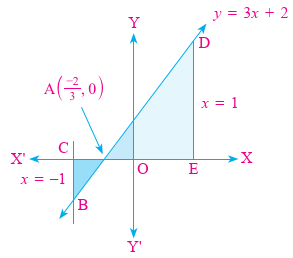
Find the area of the region bounded by the line $y=3 x+2$, the X-axis and the ordinates $x=-1$ and $x=1$.
View full question & answer
Question 82 Marks
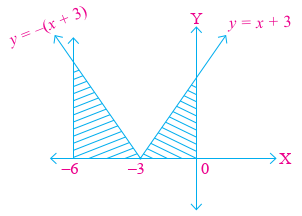
Sketch the graph of $y=|x+3|$ and evaluate
$\int_{-6}^0|x+3| d x .$
View full question & answer
Question 92 Marks
Integrate the rational function : $\frac{1}{\left(e^x-1\right)}$
Answer

$\begin{array}{l} I =\int \frac{d x}{\left(e^x-1\right)} \\ =\int \frac{e^x}{e^x\left(e^x-1\right)} d x \\ \rightarrow \text { Take, } e^x=t \\ \therefore e^x \cdot d x=d t \\ \text { I }=\int \frac{d t}{t(t-1)} \\ \text { I }=\int \frac{t-(t-1)}{t(t-1)} d t \\ =\int \frac{d t}{t-1}-\int \frac{d t}{t} \\ =\log |t-1|-\log |t|+c\end{array}$
$\begin{array}{l} I =\log \left|e^x-1\right|-\log \left|e^x\right|+c \\ I =\log \left|\frac{e^x-1}{e^x}\right|+c\end{array}$
View full question & answer
Question 102 Marks
Find the values of $k$ so that the function $f$ is continuous at $x=\frac{\pi}{2}$
$f(x)=\left\{\begin{array}{cc}
\frac{k \cos x}{\pi-2 x}, & x \neq \frac{\pi}{2} \\
3, & x=\frac{\pi}{2}
\end{array}\right.$
Answer
$f$ is continuous at $x=\frac{\pi}{2}$
$\therefore \lim _{x \rightarrow \frac{\pi}{2}} f(x)=f\left(\frac{\pi}{2}\right)$
Now, $\lim _{x \rightarrow \frac{\pi}{2}}\left(\frac{k \cos x}{\pi-2 x}\right)=3$
$\therefore \lim _{x \rightarrow \frac{\pi}{2}} \frac{k \cos x}{2\left(\frac{\pi}{2}-x\right)}=3$
$\begin{array}{l}\therefore \lim _{\frac{\pi}{2}-x \rightarrow 0} \frac{k}{2} \frac{\sin \left(\frac{\pi}{2}-x\right)}{\left(\frac{\pi}{2}-x\right)}=3\binom{\because x \rightarrow \frac{\pi}{2}}{\Rightarrow \frac{\pi}{2}-x \rightarrow 0} \\ \therefore \frac{k(1)}{2}=3 \\ \therefore k=6\end{array}$
View full question & answer
Question 112 Marks
Prove that : $\tan ^{-1} \sqrt{x}=\frac{1}{2} \cos ^{-1}\left[\frac{1-x}{1+x}\right] ; x \in[0,1] .$
Answer
$\begin{array}{l}\text { R.H.S. }=\frac{1}{2} \cos ^{-1}\left[\frac{1-x}{1+x}\right] \\ \text { Suppose, } x=\tan ^2 \theta \\ \tan \theta=\sqrt{x}\end{array}$
$\begin{array}{l}
\therefore \theta=\tan ^{-1} \sqrt{x}, \theta \in\left(-\frac{\pi}{2}, \frac{\pi}{2}\right) \\
=\frac{1}{2} \cos ^{-1}\left[\frac{1-\tan ^2 \theta}{1+\tan ^2 \theta}\right] \\
=\frac{1}{2} \cdot \cos ^{-1}(\cos 2 \theta)
\end{array}$
Here, $0 \leq x \leq 1$
$\begin{array}{l}
\therefore \tan 0 \leq \tan \theta \leq \tan \frac{\pi}{4} \\
\therefore 0 \leq \theta \leq \frac{\pi}{4} \\
\therefore 0 \leq 2 \theta \leq \frac{\pi}{2}
\end{array}$
$2 \theta \in\left[0, \frac{\pi}{2}\right] \subset[0, \pi] \ldots(1)$
$=\frac{1}{2}(2 \theta) \quad(\because$ From equation $(1))$
$\begin{array}{l}=\theta \\ =\tan ^{-1} \sqrt{x} \\ =\text { L.H.S. }\end{array}$
View full question & answer
Question 122 Marks
Prove that : $3 \cos ^{-1} x=\cos ^{-1}\left(4 x^3-3 x\right) ; x \in\left[\frac{1}{2}, 1\right] .$
Answer
$\text { R.H.S. }=\cos ^{-1}\left(4 x^3-3 x\right)$
Suppose, $x=\cos \theta$
$\begin{array}{l}
\therefore \theta=\cos ^{-1} x, \theta \in[0, \pi] \\
\therefore \text { R.H.S. }=\cos ^{-1}\left(4 \cos ^3 \theta-3 \cos \theta\right) \\
\quad=\cos ^{-1}(\cos 3 \theta)
\end{array}$
Here, $\frac{1}{2} \leq x \leq 1$
$\therefore \cos \frac{\pi}{3} \geq \cos \theta \geq \cos 0$
$(\because \cos \theta$ is decreasing function in first quadrant $)$
$\begin{array}{l}\therefore 0 \leq \theta \leq \frac{\pi}{3} \\ \therefore 0 \leq 3 \theta \leq \pi\end{array}$
$3 \theta \in[0, \pi] \ldots(1)$
$\therefore$ R.H.S. $=\cos ^{-1}(\cos 3 \theta)$
$=3 \theta \quad(\because$ From equation $(1))$
$\begin{array}{l}=3 \cos ^{-1} x \\ = L \cdot H \cdot S .\end{array}$
View full question & answer
2 Marks - Maths STD 12 Science Questions - Vidyadip