Questions

3 Marks

Take a timed test

9 questions · self-marked practice — reveal the answer and mark yourself.

Question 13 Marks
In a factory which manufactures bolts, machines A, B and C manufacture respectively $25 \%, 35 \%$ and $40 \%$ of the bolts. Of their outputs, 5,4 and 2 percent are respectively defective bolts. A bolt is drawn at random from the product and is found to be defective. What is the probability that it is manufactured by the machine B ?
Answer
Let events $B_1, B_2, B_3$ be the following :
$B_1$ : the bolt is manufactured by machine $A$
$B_2$ : the bolt is manufactured by machine $B$
$B_3$ : the bolt is manufactured by machine $C$
Clearly, $B_1, B_2, B_3$ are mutually exclusive and exhaustive events and hence, they represent a partition of the sample space.
Let the event $E$ be 'the bolt is defective'.
The event $E$ occurs with $B_1$ or with $B_2$ or with $B_3$.
Given that,
$\begin{array}{l}
P\left(B_1\right)=25 \%=0.25, \\
P\left(B_2\right)=0.35 \text { and } \\
P\left(B_3\right)=0.40
\end{array}$
Again
$P \left( E \mid B _1\right)=$ Probability that the bolt drawn is defective given that it is manufactured by machine
$A=5 \%=0.05$
Similarly, $P\left(E \mid B_2\right)=0.04$,
$P\left(E \mid B_3\right)=0.02$
Hence, by Bayes' Theorem, we have,
$\begin{aligned}
P\left(B_2 \mid E\right) & =\frac{P\left(B_2\right) \cdot P\left(E \mid B_2\right)}{P\left(B_1\right) P\left(E \mid B_1\right)+P\left(B_2\right) P\left(E \mid B_2\right)+P\left(B_3\right) P\left(E \mid B_3\right)} \\
& =\frac{0.35 \times 0.04}{0.25 \times 0.05+0.35 \times 0.04+0.40 \times 0.02} \\
& =\frac{0.0140}{0.0345} \\
& =\frac{28}{69}
\end{aligned}$
View full question & answer
Question 23 Marks
Find maximum and minimum values of $Z =-3 x+4 y$ as per following constraints :
$x+2 y \leq 8,3 x+2 y \leq 12 . x \geq 0, y \geq 0$.
Answer

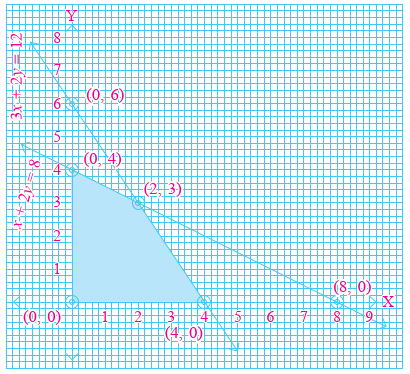
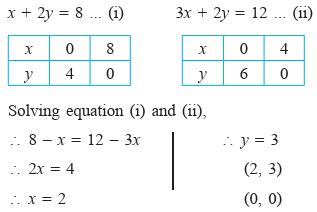
$\begin{array}{l}x+2 y \leq 8 \\ 3 x+2 y \leq 12 \\ x \geq 0 \\ y \geq 0 \\ \text { objective function } Z=-3 x+4 y\end{array}$
Image
Image
The shaded region in fig. is feasible region determined by the system of constraints which is bounded. The coordinates of corner point $(0,0),(4,0),(2,3)$ and $(0,4)$.
Corner PointCorresponding value of $Z=-3 x+4 y$
(0, 4)$Z=16$
(4, 0)$Z =-12 \leftarrow$ Minimum
(2, 3)$Z=6$
(0, 0)$Z=0$
Thus, the Minimum value of 2 is -12 at point $(4,0)$.
View full question & answer
Question 33 Marks
Find the shortest distance between the lines
$\begin{array}{l}
\frac{x+1}{7}=\frac{y+1}{-6}=\frac{z+1}{1} \text { and } \\
\frac{x-3}{1}=\frac{y-5}{-2}=\frac{z-7}{1}
\end{array}$
Answer

$\begin{array}{l}\frac{x+1}{7}=\frac{y+1}{-6}=\frac{z+1}{1} \\ L: \vec{r}=(-\hat{i}-\hat{j}-\hat{k})+\lambda(7 \hat{i}-6 \hat{j}+\hat{k}) \\ \text { and } \frac{x-3}{1}=\frac{y-5}{-2}=\frac{z-7}{1}\end{array}$
$\begin{aligned} M : \vec{r} & =(3 \hat{i}+5 \hat{j}+7 \hat{k})+\mu(\hat{i}-2 \hat{j}+\hat{k}) \\ \overrightarrow{a_1} & =-\hat{i}-\hat{j}-\hat{k} \\ \overrightarrow{b_1} & =7 \hat{i}-6 \hat{j}+\hat{k}\end{aligned}$
and $\begin{aligned} \overrightarrow{a_2} & =3 \hat{i}+5 \hat{j}+7 \hat{k} ; \\ \overrightarrow{b_2} & =\hat{i}-2 \hat{j}+\hat{k}\end{aligned}$
Now,
$\begin{aligned}
\overrightarrow{b_1} \times \overrightarrow{b_2} & =\left|\begin{array}{ccc}
\hat{i} & \hat{j} & \hat{k} \\
7 & -6 & 1 \\
1 & -2 & 1
\end{array}\right| \\
\overrightarrow{b_1} \times \overrightarrow{b_2} & =-4 \hat{i}-6 \hat{j}-8 \hat{k} \\
& \neq \overrightarrow{0}
\end{aligned}$
$\therefore$ Lines are intersecting lines are skew lines.
Now,
$\begin{aligned}
\left|\overrightarrow{b_1} \times \overrightarrow{b_2}\right| & =\sqrt{16+36+64} \\
& =\sqrt{116} \\
& =2 \sqrt{29} \\
\overrightarrow{a_2}-\overrightarrow{a_1} & =4 \hat{i}+6 \hat{j}+8 \hat{k}
\end{aligned}$
$\begin{aligned} \therefore \quad & \left(\overrightarrow{a_2}-\overrightarrow{a_1}\right) \cdot\left(\overrightarrow{b_1} \times \overrightarrow{b_2}\right) \\ & =(4 \hat{i}+6 \hat{j}+8 \hat{k}) \cdot(-4 \hat{i}-6 \hat{j}-8 \hat{k}) \\ & =-16-36-64 \\ & =-116 \\ & \neq 0\end{aligned}$
$\therefore$ Lines are skew line.
Shortest distance between two lines,
$\begin{array}{l}
=\frac{\left|\left(\overrightarrow{a_2}-\overrightarrow{a_1}\right) \cdot \overrightarrow{b_1} \times \overrightarrow{b_2}\right|}{\overrightarrow{b_1} \times \overrightarrow{b_2}} \\
=\frac{|-116|}{\sqrt{116}} \\
=\sqrt{116} \\
=\sqrt{4 \times 29} \\
=2 \sqrt{29} \text { unit }
\end{array}$
View full question & answer
Question 43 Marks
The scalar product of the vector $\hat{i}+\hat{j}+\hat{k}$ with a unit vector along the sum of vectors $2 \hat{i}+4 \hat{j}-5 \hat{k}$ and $\lambda \hat{i}+2 \hat{j}+3 \hat{k}$ is equal to one. Find the value of $\lambda$.
Answer

$\begin{array}{l}
\vec{a}=2 \hat{i}+4 \hat{j}-5 \hat{k} \\
\vec{b}=\lambda \hat{i}+2 \hat{j}+3 \hat{k} \\
\therefore \vec{a}+\vec{b} \quad=(2+\lambda) \hat{i}+6 \hat{j}-2 \hat{k}
\end{array}$
Now,
$\begin{aligned}
|\vec{a}+\vec{b}| & =\sqrt{(2+\lambda)^2+36+4} \\
& =\sqrt{4+4 \lambda+\lambda^2+40} \\
& =\sqrt{\lambda^2+4 \lambda+44}
\end{aligned}$
Unit vector in the direction of sum of vectors $\vec{a}$ and $\vec{b}$
$\begin{array}{l}=\frac{\vec{a}+\vec{b}}{|\vec{a}+\vec{b}|} \\ =\frac{(2+\lambda) \hat{i}+6 \hat{j}-2 \hat{k}}{\sqrt{\lambda^2+4 \lambda+44}}\end{array}$
Now, The scalar product of $\frac{(2+\lambda) \hat{i}+6 \hat{j}-2 \hat{k}}{\sqrt{\lambda^2+4 \lambda+44}}$
$\hat{i}+\hat{j}+\hat{k} \text { with }$
is equal to 1 .
$\begin{array}{l}
\therefore\left(\frac{(2+\lambda) \hat{i}+6 \hat{j}-2 \hat{k}}{\sqrt{\lambda^2+4 \lambda+44}}\right) \cdot(\hat{i}+\hat{j}+\hat{k})=1 \\
\therefore\left(\frac{1}{\sqrt{\lambda^2+4 \lambda+44}}\right)(2+\lambda+6-2)=1 \\
\therefore(\lambda+6)=\sqrt{\lambda^2+4 \lambda+44} \\
\therefore(\lambda+6)^2=\lambda^2+4 \lambda+44 \\
\therefore \lambda^2+12 \lambda+36=\lambda^2+4 \lambda+44 \\
\therefore 8 \lambda=8 \\
\therefore \lambda=1
\end{array}$
View full question & answer
Question 53 Marks
Find the maximum value of $2 x^3-24 x+107$ in the interval $[1,3]$. Find the maximum value of the same function in $[-3,-1]$.
Answer
$\begin{aligned}
f(x) & =2 x^3-24 x+107 \\
\therefore f^{\prime}(x) & =6 x^2-24
\end{aligned}$
$\rightarrow$ For finding maximum and minimum value,
$\begin{aligned} f^{\prime}(x) & =0 \\ \therefore \quad 6 x^2-24 & =0\end{aligned}$
$\begin{array}{rlrl}\therefore & 6 x^2  =24 \\ \therefore &  x^2  =4 \\ \therefore & x  = \pm 2\end{array}$
$\therefore \quad x=2 \in(1,3)$ yLku $x=-2 \in(-3,-1)$
$\begin{aligned} f(2) & =2(2)^3-24(2)+107 \\ & =16-48+107 \\ & =75\end{aligned}$
$\begin{array}{l}\rightarrow a=1, b=3 \\ \qquad \begin{aligned} f(a) & =f(1) \\ & =2(1)^3-24(1)+107 \\ & =2-24+107 \\ & =85 \\ f(b) & =f(3) \\ & =2(3)^3-24(3)+107 \\ & =54-72+107=89\end{aligned}\end{array}$
$\begin{aligned} \text { Absolute maximum value } & =\max \{85,89,75\} \\ & =89\end{aligned}$
$\begin{aligned} \rightarrow-2 & \in(-3,-1) \\ f(-2) & =2(-2)^3-24(-2)+107 \\ & =139\end{aligned}$
$\begin{aligned} \rightarrow \text { òu } a & =-3, b=-1 \\ f(a) & =f(-3) \\ & =2(-3)^3-24(-3)+107 \\ & =-54+72+107 \\ & =125\end{aligned}$
$\begin{aligned} f(b) & =f(-1) \\ & =2(-1)^3-24(-1)+107 \\ & =-2+24+107 \\ & =129\end{aligned}$
$\begin{aligned} \text { Absolute maximum value } & =\max \{139,125,129\} \\ & =139\end{aligned}$
View full question & answer
Question 63 Marks
If $y=\left(\tan ^{-1} x\right)^2$, then show that
$\left(x^2+1\right)^2 \frac{d^2 y}{d x^2}+2 x\left(x^2+1\right) \frac{d y}{d x}-2=0$.
Answer
$y=\left(\tan ^{-1} x\right)^2 Lkwt$
Differentiate w.r.t. $x$,
$\frac{d y}{d x}=2 \tan ^{-1} x \cdot \frac{1}{1+x^2}$
$\begin{array}{l}
\therefore y_1=\frac{2 \tan ^{-1} x}{1+x^2} \\
\therefore\left(1+x^2\right) y_1=2 \tan ^{-1} x
\end{array}$
Differentiate again w.r.t. $x$,
$\begin{array}{l}
\therefore\left(1+x^2\right) y_2+y_1 \cdot 2 x=\frac{2}{\left(1+x^2\right)} \\
\therefore\left(1+x^2\right)^2 y_2+2 x\left(1+x^2\right) y_1=2
\end{array}$
View full question & answer
Question 73 Marks
Using the cofactor of elements of third column.
evaluate $\Delta=\left[\begin{array}{ccc}1 & x & y z \\ 1 & y & z x \\ 1 & z & x y\end{array}\right]$.
Answer
$\Delta=\left|\begin{array}{lll}
1 & x & y z \\
1 & y & z x \\
1 & z & x y
\end{array}\right|$
Co-factor of the element $y z \quad A_{13}=(-1)^4\left|\begin{array}{ll}1 & y \\ 1 & z\end{array}\right|$
$\begin{array}{l}=(1)(z-y) \\ =(z-y)\end{array}$
Co-factor of the element $z x \quad A_{23}=(-1)^5\left|\begin{array}{ll}1 & x \\ 1 & z\end{array}\right|$
$\begin{array}{l}=(-1)(z-x) \\ =x-z\end{array}$
Co-factor of the element $x y \quad A_{33}=(-1)^6\left|\begin{array}{ll}1 & x \\ 1 & y\end{array}\right|$
$\begin{array}{l}=(1)(y-x) \\ =y-x\end{array}$
$\begin{aligned} \Delta & =a_{13} A_{13}+a_{23} A_{23}+a_{33} A_{33} \\ & =(y z)(z-y)+(z x)(x-z)+(x y)(y-x) \\ & =y z^2-y^2 z+z x^2-z^2 x+x y^2-x^2 y \\ & =z\left(x^2-y^2\right)+z^2(y-x)+x y(y-x) \\ & =z[(x-y)(x+y)]+z^2(y-x)+x y(y-x) \\ & =(y-x)\left(-z(x+y)+z^2+x y\right) \\ & =(y-x)\left(-z x-y z+z^2+x y\right) \\ & =(y-x)(z(z-x)-y(z-x)) \\ & =(y-x)(z-x)(z-y) \\ & =(x-y)(y-z)(z-x)\end{aligned}$
View full question & answer
Question 83 Marks
If $A=\left[\begin{array}{lll}1 & 0 & 2 \\ 0 & 2 & 1 \\ 2 & 0 & 3\end{array}\right]$ then, prove that $A^3=6 A^2-7 A-21$
Answer

$\begin{aligned} A ^2 & = A \cdot A \\ & =\left[\begin{array}{lll}1 & 0 & 2 \\ 0 & 2 & 1 \\ 2 & 0 & 3\end{array}\right]\left[\begin{array}{lll}1 & 0 & 2 \\ 0 & 2 & 1 \\ 2 & 0 & 3\end{array}\right] \\ & =\left[\begin{array}{lll}1+0+4 & 0+0+0 & 2+0+6 \\ 0+0+2 & 0+4+0 & 0+2+3 \\ 2+0+6 & 0+0+0 & 4+0+9\end{array}\right]=\left[\begin{array}{lll}5 & 0 & 8 \\ 2 & 4 & 5 \\ 8 & 0 & 13\end{array}\right]\end{aligned}$
$\begin{aligned} A ^3 & = A ^2 \cdot A \\ & =\left[\begin{array}{ccc}5 & 0 & 8 \\ 2 & 4 & 5 \\ 8 & 0 & 13\end{array}\right]\left[\begin{array}{lll}1 & 0 & 2 \\ 0 & 2 & 1 \\ 2 & 0 & 3\end{array}\right] \\ & =\left[\begin{array}{ccc}5+0+16 & 0+0+0 & 10+0+24 \\ 2+0+10 & 0+8+0 & 4+4+15 \\ 8+0+26 & 0+0+0 & 16+0+39\end{array}\right] \\ & =\left[\begin{array}{lll}21 & 0 & 34 \\ 12 & 8 & 23 \\ 34 & 0 & 55\end{array}\right]\end{aligned}$
Now, L.H.S. $=A^3-6 A^2+7 A+2 I$
$\begin{array}{l}
=\left[\begin{array}{lll}
21 & 0 & 34 \\
12 & 8 & 23 \\
34 & 0 & 55
\end{array}\right]-6\left[\begin{array}{ccc}
5 & 0 & 8 \\
2 & 4 & 5 \\
8 & 0 & 13
\end{array}\right]+7\left[\begin{array}{lll}
1 & 0 & 2 \\
0 & 2 & 1 \\
2 & 0 & 3
\end{array}\right]+2\left[\begin{array}{lll}
1 & 0 & 0 \\
0 & 1 & 0 \\
0 & 0 & 1
\end{array}\right] \\
=\left[\begin{array}{lll}
21 & 0 & 34 \\
12 & 8 & 23 \\
34 & 0 & 55
\end{array}\right]+\left[\begin{array}{ccc}
-30 & 0 & -48 \\
-12 & -24 & -30 \\
-48 & 0 & -78
\end{array}\right]+\left[\begin{array}{ccc}
7 & 0 & 14 \\
0 & 14 & 7 \\
14 & 0 & 21
\end{array}\right]+\left[\begin{array}{lll}
2 & 0 & 0 \\
0 & 2 & 0 \\
0 & 0 & 2
\end{array}\right] \\
=\left[\begin{array}{ccc}
21-30+7+2 & 0+0+0+0 & 34-48+14+0 \\
12-12+0+0 & 8-24+14+2 & 23-30+7+0 \\
34-48+14+0 & 0+0+0+0 & 55-78+21+2
\end{array}\right] \\
=\left[\begin{array}{lll}
0 & 0 & 0 \\
0 & 0 & 0 \\
0 & 0 & 0
\end{array}\right]=O=\text { R.H.S. }
\end{array}$
View full question & answer
Question 93 Marks
Check whether the relation $R$ defined on $R$ by $R =\left\{(a, b): a \leq b^3\right\}$ is reflexive, symmetric or transitive.
Answer
Relation defined on $R$,
$S=\left\{(a, b): a \leq b^3\right\}$
For $a=\frac{1}{2},\left(\frac{1}{2}, \frac{1}{2}\right) \notin S \left(\because \frac{1}{2} \nless \frac{1}{8}\right)$
$\therefore \quad\left(\frac{1}{2}, \frac{1}{2}\right) \notin S \quad \therefore S$ is not reflexive.
Suppose, $(1,5) \in S$
Then, $(5,1) \notin S \quad(\because 5 \not \leq 1)$
$\therefore S$ is not symmetric.
Suppose, $(a, b) \in S$ and $(b, c) \in S$
$\begin{array}{l}
\therefore \quad a \leq b^3 \text { and } b \leq c^3 \\
\therefore \quad b^3 \leq c^9
\end{array}$
Thus, $a \leq b^3 \leq c^9$
$\begin{array}{ll}
\therefore & a \leq c^9 \\
\therefore & (a, c) \notin S
\end{array}$
$\therefore \quad S$ is not transitive.
Hence, S is not reflexive, symmetric, transitive.
View full question & answer