Questions

5 Marks Questions

Take a timed test

6 questions · self-marked practice — reveal the answer and mark yourself.

Question 15 Marks
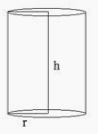
Show that the right circular cylinder of given surface and maximum volume is such that its height is equal to the diameter of the base.
Answer
Image
$s=2 \pi r h+2 \pi r^2$
$\Rightarrow \frac{s-2 \pi r^2}{2 \pi r}=h$
Now volume of cylinder is, $v=\pi r^2 h$
$\Rightarrow v=\pi \cdot r^2\left(\frac{s-2 \pi r^2}{2 \pi r}\right)$
$\Rightarrow v=\frac{1}{2}\left[s r-2 \pi r^3\right]$
$\text { Now, } \frac{d v}{d r}=\frac{1}{2}\left[s-6 \pi r^2\right]$
$\Rightarrow \frac{d^2 v}{d r^2}=\frac{1}{2}[0-12 \pi r]$
For maximum/minimum
$\frac{d v}{d r}=0$
$\Rightarrow s=6 \pi r^2$
From equ $(1)$
$\Rightarrow 2 \pi r h+2 \pi r^2=6 \pi r^2$
$\Rightarrow r=\frac{h}{2}$
${\left[\frac{d^2 v}{d r^2}\right]_{r=\frac{4}{2}}=\frac{1}{2}\left[0-12 \pi \times \frac{h}{2}\right]}$
$=-3 \pi h<0$
$\Rightarrow s$  is maximum at  $r=\frac{h}{2}$
Hence $h=2 r$
View full question & answer
Question 25 Marks
Three shopkeepers $A, B$ and $C$ go to a store to buy stationery. $A$ purchases $12$ dozen notebooks, $5$ dozen pens and $6$ dozen pencils. $B$ purchases $10$ dozen notebooks, $6$ dozen pens and $7$ dozen pencils. $C$ purchases $11$ dozen notebooks, $13$ dozen pens and $8$ dozen pencils. $A$ notebook costs $40$ paise, a pen costs $₹ 1.25$ and a pencil costs $35$ paise. Use matrix multiplication to calculate each individual's bill.
Answer
Given the purchase details of three shopkeeper $A, B$, and $C$.
$A: 12$ dozen notebooks, $5$ dozen pens, and $6$ dozen pencils
$B: 10$ dozen notebooks, $6$ dozen pens, and $7$ dozen pencils
$C: 11$ dozen notebooks, $13$ dozen pens, and $8$ dozen pencils
Hence, the items purchased by $A, B,$ and $C$ can be represented in matrix $X$ of order $3 x 3$ where the rows denoting the e shopkeeper and columns denoting the number of dozens of items as $-$
$X=\left[\begin{array}{ccc} 12 & 5 & 6 \\ 10 & 6 & 7 \\ 11 & 13 & 8 \end{array}\right] $
The price of each of the items is also given.
Cost of one notebook $=40$ paise
$\Rightarrow$ Cost of one dozen notebooks $=12 \times 40$ paise
$\Rightarrow$ Cost of one dozen notebooks $=480$ paise
$\therefore$ Cost of one dozen notebooks $=₹4.80$
Cost of one pen $=₹ 1.25$
$\Rightarrow$ Cost of one dozen pens $=12 x ₹ 1.25$
$\therefore$ Cost of one dozen pens $=₹ 15$
Cost of one pencil $= 35$ paise
$\Rightarrow$ Cost of one dozen notebooks $=12 \times 35$ paise
$\Rightarrow$ Cost of one dozen notebooks $=420$ paise
$\therefore$ Cost of one dozen notebooks $= ₹ 4.20$
Hence, the cost of purchasing one dozen of the items can be represented in matrix form with each row corresponding to an item as
$Y=\left[\begin{array}{c} 4.80 \\ 15 \\ 4.20 \end{array}\right]$
Now, the individual bill for each shopkeeper can be found by taking the product of the matrices $X$ and $Y$ .
The product is feasible because the order of $X$ is $3 x 3$ and that of $Y$ is $3 x 1$, which makes the number of columns of $x$ is equal to the number of the columns of $Y$.
The product is given as follows.
$X Y=\left[\begin{array}{lll} 12 & 5 & 6 \\ 10 & 6 & 7 \\ 11 & 13 & 8 \end{array}\right]\left[\begin{array}{c} 4.80 \\ 15 \\ 4.20 \end{array}\right] $
$\Rightarrow X Y=\left[\begin{array}{c} 12 \times 4.80+5 \times 15+6 \times 4.20 \\ 10 \times 4.80+6 \times 15+7 \times 4.20 \\ 11 \times 4.80+13 \times 15+8 \times 4.20 \end{array}\right] $
$\Rightarrow\left[\begin{array}{c} 57.60+75+25.20 \\ 48+90+29.40 \\ 52.80+195+33.60 \end{array}\right] $
$\therefore X Y=\left[\begin{array}{l} 157.80 \\ 167.40 \\ 281.40 \end{array}\right]$
Thus, the bills of shopkeepers $ A, B$ and $C$ are $₹  157.80, ₹ 167.40$ and $₹ 281.40$ respectively.
View full question & answer
Question 35 Marks
Show that the semi $-$ vertical angle of a cone of maximum volume and given slant height is $\tan ^{-1} \sqrt{2}$ or $\cos ^{-1} \frac{1}{\sqrt{3}}$.
Answer
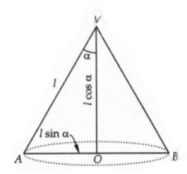
Let $\alpha$ be the semi $-$ vertical angle of a cone $\text{VAB}$ of given slant height $1$ .
$\text { In } \triangle AOV,$
Image
$\cos \alpha=\frac{V O}{V A} $ and $ \sin \alpha=\frac{O A}{V A}$
$\Rightarrow \cos \alpha=\frac{V O}{l} $ and $ \sin \alpha=\frac{O A}{l}$
$\Rightarrow V O=1 \cos a, OA=1 \sin \alpha$
Let $V$ be the volume of the cone, Then,
$V=\frac{1}{3} \pi(OA)^2(VO)$
$\Rightarrow V=\frac{1}{3} \pi(1 \sin \alpha)^2(1 \cos \alpha)$
$\Rightarrow V=\frac{1}{3} \pi 1^3 \sin ^2 \alpha \cos \alpha$
$\Rightarrow \frac{d V}{d \alpha}=\frac{\pi}{3} 1^3\left(-\sin ^3 \alpha+2 \sin \alpha \cos ^2 \alpha\right)$
$\Rightarrow \frac{d V}{d \alpha}=\frac{\pi l^3}{3} \sin \alpha\left(-\sin ^2 \alpha+2 \cos ^2 \alpha\right) \ldots $
The critical points of $V$ are given by $\frac{d V}{d \alpha}=0$.
$\because \frac{d V}{d \alpha}=0$
$\Rightarrow \frac{\pi l^3}{3} \sin \alpha\left(-\sin ^2 \alpha+2 \cos ^2 \alpha\right)=0$
$\Rightarrow 2 \cos ^2 \alpha=\sin ^2 \alpha$
$\Rightarrow \tan ^2 \alpha=2 $
$\Rightarrow \tan \alpha=\sqrt{2}[\because \text { a is acute } \because \sin \alpha \neq 0]$
$\because \cos \alpha=\frac{1}{\sqrt{1+\tan ^2 \alpha}}=\frac{1}{\sqrt{3}}[\because \tan \alpha=\sqrt{21}]$
Differentiating $(i)$ with respect to a, we get
$\frac{d^2 V}{d \alpha^2}=\frac{\pi l^3}{3}\left(-3 \sin ^2 \alpha \cos \alpha+2 \cos ^3 \alpha-4 \sin ^2 \alpha \cos \alpha\right)$
$=\frac{\pi l^3}{3} \cos ^3 \alpha\left(2-7 \tan ^2 \alpha\right)$
$\because\left(\frac{d^2 V}{d \alpha^2}\right)_{\tan \alpha=\sqrt{2}}$
$=\frac{1}{3} \pi l^3\left(\frac{1}{\sqrt{3}}\right)^3(2-7 \times 2)=\frac{-4 \pi l^3}{3 \sqrt{3}}<0$
Thus, $V$ is maximum, when $\tan \alpha=\sqrt{2}$ or $\alpha=\tan ^{-1} \sqrt{2}$
i.e.when the semi-vertical angle of the cone is $\tan ^{-1} \sqrt{2}$.
View full question & answer
Question 45 Marks
Let $A =\{1,2,3\}$ and $R =\left( a , b ): a , b \in A\right.$ and $\left|a^2-b^2\right| \leq 5$. Write $R$ as set of ordered pairs. Mention whether $R$ is $i.$ reflexive
$ii$. symmetric
$iii$. transitive
Give reason in each case.
Answer
Given: $f : W \rightarrow W$ defined as $f(n)=\left\{\begin{array}{ll}n-1, & \text { if } n \text { is odd } \\ n+1, & \text { if } n \text { is even }\end{array}\right.$
Injectivity: Let $n, m$ be any two odd real numbers, then $f(n)=f(m)$
$\Rightarrow n-1=m-1$
$\Rightarrow n=m$
Again, let $n, m$ be any two even whole numbers, then $f(n)=f(m)$
$\Rightarrow n+1=m+1$
$\Rightarrow n=m$
If $n$ is even and $m$ is odd, then $n \neq m$.
Now $n$ is even implies $f(n)=n+1$ and $f(m)=m-1$.
Therefore, $f ( n ) \neq f ( m )$
Similarly $n$ is odd and $m$ is even gives $f(n) \neq f(m)$
Therefore in all cases $f$ is one $-$ one.
Surjectivity: Let $n$ be an arbitrary whole number.
If $n$ is an odd number, then there exists an even whole number $(n+1)$ such that
$f(n+1)=n+1-1=n$
If $n$ is an even number, then there exists an odd whole number $(n-1)$ such that
$f(n-1)=n-1+1=n$
Therefore, every $n \in W$ has its pre $-$ image in $W$.
So, $f: W \rightarrow W$ is a surjective.
Thus $f$ is invertible and $f^{-1}$ exists.
For $f^{-1}: y=n-1$
$\Rightarrow n=y+1$ and $ y=n+1 $
$\Rightarrow n=y-1$
$\therefore f^{-1}(n)=\left\{\begin{array}{ll} n-1, & \text { if } n \text { is odd } \\ n+1, & \text { if } n \text { is even }
\end{array}\right.$
Hence, $f^{-1}(y)=y$
View full question & answer
Question 55 Marks
Let $f: W \rightarrow W$ be defined as $f(n)=n-1,$ if $n$ is odd and $f(n)=n+1,$ if $n$ is even. Show that $f$ is invertible. Find the inverse of $f$. Here, $W$ is the set of all whole numbers.
Answer
Given: $f : W \rightarrow W$ defined as $f(n)=\left\{\begin{array}{ll}n-1, & \text { if } n \text { is odd } \\ n+1, & \text { if } n \text { is even }\end{array}\right.$
Injectivity: Let $n$, $m$ be any two odd real numbers, then $f(n)=f(m)$
$\Rightarrow n-1=m-1$
$\Rightarrow n=m$
Again, let $n$, $m$ be any two even whole numbers, then $f(n)=f(m)$
$\Rightarrow n+1=m+1$
$\Rightarrow n=m$
If $n$ is even and $m$ is odd, then $n \neq m$.
Now $n$ is even implies $f(n)=n+1$ and $f(m)=m-1$.
Therefore, $f ( n ) \neq f ( m )$
Similarly $n$ is odd and $m$ is even gives $f(n) \neq f(m)$
Therefore in all cases f is one $-$ one.
Surjectivity: Let n be an arbitrary whole number.
If $n$ is an odd number, then there exists an even whole number $(n+1)$ such that $
f(n+1)=n+1-1=n$
If $n$ is an even number, then there exists an odd whole number $(n-1)$ such that $
f(n-1)=n-1+1=n$
Therefore, every $n \in W$ has its pre $-$ image in $W$.
So, $f: W \rightarrow W$ is a surjective.
Thus f is invertible and $f ^{-1}$ exists.
For $f ^{-1}: y=n-1$
$\Rightarrow n=y+1 $ and $ y=n+1$
$\Rightarrow n=y-1 $
$ \therefore f^{-1}(n)=\left\{\begin{array}{ll} n-1, & \text { if } n \text { is odd } \\ n+1, & \text { if } n \text { is even }
\end{array}\right.$
Hence, $f^{-1}(y)=y$
View full question & answer
Question 65 Marks
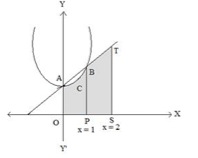
Find the area of the region $\left\{(x, y): 0 \leqslant y \leqslant\left(x^2+1\right), 0 \leqslant y \leqslant(x+1), 0 \leqslant x \leqslant 2\right\}$
Answer

Image
There are three curves respectively,
$C_1=\left\{(x, y): 0 \leq y \leq x^2+1\right\}$
$C_2=\{(x, y): 0 \leq y \leq x+1\}$
$C_3=\{(x, y): 0 \leq x \leq 2\}$
The points of intersection of, $y=x^2$ and $y=x+1 y$ are $A(0,1)$ and $B(1,2)$.
The required area of shaded region $=\int_0^1 y_1 d x+\int_1^2 y_2 d x$
where $y _1= x ^2+1$ and $y _2= x +1$
$\therefore A=\int_0^1\left(x^2+1\right) d x+\int_1^2(x+1) d x$
$=\left[\frac{x^3}{3}+x\right]_0^1+\left[\frac{x^2}{2}+x\right]_1^2$
$=\left(\frac{4}{3}-0\right)+\left(4-\frac{3}{2}\right)=\frac{8+24-9}{6}=\frac{23}{6} \text { sq. units }$
View full question & answer