Questions

3 Marks Question

Take a timed test

9 questions · self-marked practice — reveal the answer and mark yourself.

Question 13 Marks
A random variable $X$ can take all non negative integral values and the probability that $X$ takes the value is proportional to $5^{-r}$. Find $P(X<3)$
Answer
Given $P(X=r) \alpha \frac{1}{5^r}$
$P(X=r)=k \frac{1}{5^r}($ where $k$  is a non$-$zero constant$)$
$P(r=0)=k \cdot \frac{1}{5^0}$
$P(r=1)=k \cdot \frac{1}{5^1}$
$P(r=2)=k \cdot \frac{1}{5^2}$
$P(r=3)=k \cdot \frac{1}{5^3}$
We have, $P(X=0)+P(X=1)+P(X=2)+\ldots \ldots \ldots \ldots=1$
$\Rightarrow k\left(1+\frac{1}{5}+\frac{1}{5^2}+\frac{1}{5^3}+\ldots \ldots \ldots\right)=1$
$\Rightarrow k\left(\frac{1}{1-\frac{1}{5}}\right)=1$
$\Rightarrow k=\frac{4}{5} $
So, $P(X<3)=P(X=0)+P(X=1)+P(X=2)$
$=\frac{4}{5}\left(1+\frac{1}{5}+\frac{1}{5^2}\right)$
$=\frac{4}{5}\left(\frac{25+5+1}{25}\right)$
$=\frac{124}{125} .$
View full question & answer
Question 23 Marks
Evaluate : $\int_0^1 x(1-x)^n d x$; $($ where $n \in N)$
Answer
$\int_0^1 x(1-x)^n d x$
$\begin{array}{c}=\int_0^1(1-x)\{1-(1-x)\}^n d x,\left(a s, \int_0^a f(x) d x=\int_0^a f(a-x) d x\right) \\ =\int_0^1 x^n(1-x) d x \\ =\int_0^1 x^n d x-\int_0^1 x^{n+1} d x \\ =\frac{1}{n+1}\left[x^{n+1}\right]_0^1-\frac{1}{n+2}\left[x^{n+2}\right]_0^1 \\ =\frac{1}{n+1}-\frac{1}{n+2}=\frac{1}{(n+1)(n+2)}\end{array}$
View full question & answer
Question 33 Marks
Find the vector and the cartesian equation of the line that passes through through (-1, 2, 7) and is perpendicular to the lines $\vec{r}=2 \hat{\imath}+\hat{\jmath}-3 \hat{ k }+\lambda(\hat{\imath}+2 \hat{\jmath}+5 \hat{ k })$ and $\vec{r}=3 \hat{\imath}+3 \hat{\jmath}-7 \hat{ k }+\mu(3 \hat{\imath}-2 \hat{\jmath}+5 \hat{ k })$.
Answer
Line perpendicular to the lines $\vec{r}=2 \hat{\imath}+\hat{\jmath}-3 \hat{k}+\lambda(\hat{\imath}+2 \hat{\jmath}+5 \hat{k}) \text { and } \vec{r}=3 \hat{\imath}+3 \hat{\jmath}-7 \hat{k}+\mu(3 \hat{\imath}-2 \hat{\jmath}+5 \hat{k}) \text {. }$
has a vector parallel it is given by $\vec{b}=\overrightarrow{b_1} \times \overrightarrow{b_2}=\left|\begin{array}{ccc}\hat{\imath} & \hat{\jmath} & \hat{k} \\ 1 & 2 & 5 \\ 3 & -2 & 5\end{array}\right|=20 \hat{\imath}+10 \hat{\jmath}-8 \hat{k}$
$\therefore$ equation of line in vector form is $\vec{r}=-\hat{\imath}+2 \hat{\jmath}+7 \hat{k}+a(10 \hat{i}+5 \hat{\jmath}-4 \hat{k})$
and equation of line in cartesian form is $\frac{x+1}{10}=\frac{y-2}{5}=\frac{z-7}{-4}$
View full question & answer
Question 43 Marks
The probability that it rains today is 0.4. If it rains today, the probability that it will rain tomorrow is 0.8. If it does not rain today, the probability that it will rain tomorrow is 0.7. If
P1: denotes the probability that it does not rain today.
P2: denotes the probability that it will not rain tomorrow, if it rains today.
P3: denotes the probability that it will rain tomorrow, if it does not rain today.
P4: denotes the probability that it will not rain tomorrow, if it does not rain today.
(i) Find the value of $P_1 \times P_4-P_2 \times P_3$
(ii) Calculate the probability of raining tomorrow.
Answer
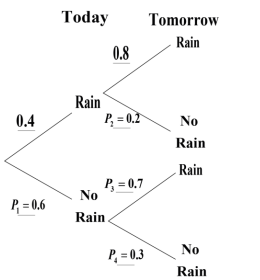
Since the event of raining today and not raining today are complementary events so if the probability that it rains today is 0.4 then the probability that it does not rain today is $1-0.4=0.6 \Rightarrow P_1=0.6$
If it rains today, the probability that it will rain tomorrow is 0.8 then the probability that it will not rain tomorrow is 1-0.8-0.2.
If it does not rain today, the probability that it will rain tomorrow is 0.7 then the probability that it will not rain tomorrow is 1-0.7-0.3
Image
(i) $P_1 \times P_4-P_2 \times P_3=0.6 \times 0.3-0.2 \times 0.7=0.04$.
(ii) Let $E_1$ and $E_2$ be the events that it will rain today and it will not rain today respectively.
$P\left(E_1\right)=0.4 \& P\left(E_2\right)=0.6$$A$ be the event that it will rain tomorrow. $P\left(\frac{A}{E_1}\right)=0.8 \& P\left(\frac{A}{E_2}\right)=0.7$
We have, $P(A)=P\left(E_1\right) P\left(\frac{A}{E_1}\right)+P\left(E_2\right) P\left(\frac{A}{E_2}\right)=0.4 \times 0.8+0.6 \times 0.7=0.74$.
The probability of rain tomorrow is $0 . 7 4$.
View full question & answer
Question 53 Marks
Consider the following Linear Programming Problem:
Minimise Z = x + 2y
Subject to $2 x+y \geq 3, x+2 y \geq 6, x, y \geq 0$
Show graphically that the minimum of Z occurs at more than two points
Answer
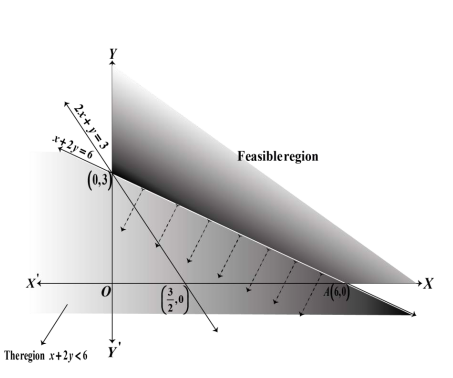
The feasible region determined by the constraints$2 x+y \geq 3, x+2 y \geq 6, x \geq 0, y \geq 0$ is as shown.
Image
The corner points of the unbounded feasible region are A(6, 0) and B(0, 3) The values of Z at these corner points are as follows:

 Corner point Value of the objective function z = x + 2y
 A(6, 0) 6
 B(0, 3) 6

We observe the region x + 2y < 6 have no points in common with the unbounded feasible region. Hence the minimum value of z = 6
It can be seen that the value of Z at points A and B is same. If we take any other point on the line x + 2y = 6 such as (2,2) on line x+ y = 6 then Z = 6
Thus, the minimum value of Z occurs for more than 2 points, and is equal to 6.

View full question & answer
Question 63 Marks
Evaluate: $\int\left\{\frac{1}{\log x}-\frac{1}{(\log x)^2}\right\} d x; ($where $\left.x>1\right)$.
Answer
$ \int\left\{\frac{1}{\log _e x}-\frac{1}{\left(\log _e x\right)^2}\right\} d x$
$=\int \frac{d x}{\log _e x}-\int \frac{1}{\left(\log _e x\right)^2} d x=\frac{1}{\log _e x} \int d x-\int\left\{\frac{d}{d x}\left(\frac{1}{\log _e x}\right) \int d x\right\} d x-\int \frac{1}{\left(\log _e x\right)^2} d x$
$=\frac{x}{\log _e x}+\int \frac{1}{\left(\log _e x\right)^2} \frac{1}{x} \cdot x \cdot d x-\int \frac{1}{\left(\log _e x\right)^2} d x$
$=\frac{x}{\log _e x}+\int \frac{1}{\left(\log _e x\right)^2} d x-\int \frac{d x}{\left(\log _e x\right)^2}=\frac{x}{\log _e x}+c $where' $c$ 'is any arbitary constant of integration.
View full question & answer
Question 73 Marks
An ant is moving along the vector $\overrightarrow{l_1}=\hat{\imath}-2 \hat{\jmath}+3 \hat{k}$ Few sugar crystals are kept along the vector $\overrightarrow{l_2}=3 \hat{\imath}-2 \hat{j}+\hat{k}$ which is inclined at an angle $\theta$ with the vector $\overrightarrow{l_1}$. Then find the angle $\theta$. Also find the scalar projection of $\overrightarrow{l_1}$ on $\overrightarrow{l_2}$
Answer
$(i)  \theta=\cos ^{-1}\left(\frac{\overrightarrow{l_1} \cdot \overrightarrow{l_2}}{\left|\overrightarrow{l_1}\right| \cdot\left|\overrightarrow{l_2}\right|}\right)$
$=\cos ^{-1}\left(\frac{(\hat{i}-2 \hat{\jmath}+3 \hat{k}) \cdot(3 \hat{i}-2 \hat{\jmath}+\hat{k})}{|(\hat{i}-2 \hat{\jmath}+3 \hat{k})||(3 \hat{i}-2 \hat{\jmath}+\hat{k})|}\right)$
$=\cos ^{-1}\left(\frac{3+4+3}{\sqrt{1+4+9} \sqrt{9+4+1}}\right)$
$=\cos ^{-1}\left(\frac{10}{14}\right)$
$=\cos ^{-1}\left(\frac{5}{7}\right)$
$(ii)$ Scalar projection of $\overrightarrow{l_1}$ on $\overrightarrow{l_2}$
$=\frac{\overrightarrow{l_1} \cdot \overrightarrow{l_2}}{\left|\overrightarrow{l_2}\right|}$
$=\frac{(\hat{\imath}-2 \hat{\jmath}+3 \hat{ k }) \cdot(3 \hat{i}-2 \hat{\jmath}+\hat{k})}{|(3 \hat{\imath}-2 \hat{\jmath}+\hat{k})|}$
$=\frac{3+4+3}{\sqrt{9+4+1}}=\frac{10}{\sqrt{14}}$.
View full question & answer
Question 83 Marks
According to a psychologist, the ability of a person to understand spatial concepts is given by
$A=\frac{1}{3} \sqrt{t}$, where $t$ is the age in years, $t \in[5,18]$. Show that the rate of increase of the ability to understand spatial concepts decreases with age in between $5$ and $18.$
Answer
$A=\frac{1}{3} \sqrt{t}: \frac{d A}{d t}=\frac{1}{6} t^{-\frac{1}{2}}$
$=\frac{1}{6 \sqrt{t}} ; \forall t \in(5,18)$
$\frac{d A}{d t}=\frac{1}{6 \sqrt{t}} $
$\therefore \frac{d^2 A}{d t^2}=-\frac{1}{12 t \sqrt{t}}$
$\text { So, } \frac{d^2 A}{d t^2}<0, \forall t \in(5,18)$
This means that the rate of change of the ability to understand spatial concepts decreases $($slows down$)$ with age.
View full question & answer
Question 93 Marks
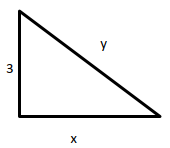
A kite is flying at a height of 3 metres and 5 metres of string is out. If the kite is moving away horizontally at the rate of 200 cm/s, find the rate at which the string is being released.
Answer

Image
$x^2+3^2=y^2$
When $y=5$ then $x=4$, now $2 x \frac{d x}{d t}=2 y \frac{d y}{d t}$
$4(200)=5 \frac{d y}{d t} \Rightarrow\frac{d y}{d t}=160 cm / s$
View full question & answer