Questions

5 Marks Questions

Take a timed test

6 questions · self-marked practice — reveal the answer and mark yourself.

Question 15 Marks
A window is in the form of a rectangle surmounted by a semicircular opening. The total perimeter of the window is $10 m.$ Find the dimensions of the window to admit maximum light through the whole opening
Answer
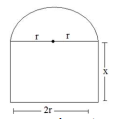
Image
Let $P$ be the perimeter of window
$P=2 x+2 r+\frac{1}{2} \times 2 \pi r$
$10=2 x+2 r+\pi r[ P =10]$
$x=\frac{10-2 r-\pi r}{2}$
Let $A$ be area of window
$A=2 r x+\frac{1}{2} \pi r^2$
$=2 r\left[\frac{10-2 r-\pi r}{2}\right]+\frac{1}{2} \pi r^2$
$=10 r-2 r^2-\pi r^2+\frac{1}{2} \pi r^2$
$=10 r-2 r^2-\frac{\pi r^2}{2}$
$\frac{d A}{d r}=10-4 r-\pi r$
$\frac{d^2 A}{d r^2}=-(\pi+4)$
$\frac{d A}{d r}=0$
$r=\frac{10}{\pi+4}$
$\frac{d^2 A}{d r^2}<0 \text { maximum }$
$x=\frac{10-2 r-\pi r}{2}$
$x=\frac{10}{\pi+4}$
Length of rectangle $=2 r =\frac{20}{\pi+4}$
width $=\frac{10}{\pi+4}$
View full question & answer
Question 25 Marks
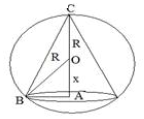
Prove that the volume of the largest cone that can be inscribed in a sphere of radius $R$ is $\frac{8}{27}$ of the volume of the sphere
Answer

Image
$v=\frac{1}{3} \pi r^2 h\left[r^2=\sqrt{R^2-x^2}\right]$
$V=\frac{1}{2} \pi \cdot\left(R^2-x^2\right) \cdot(R+x)$
$\frac{d y}{d x}=\frac{1}{3} \pi\left[\left(R^2-x^2\right)(1)+(R+x)(-2 x)\right]$
$=\frac{1}{3} \pi[(R+x)(R-x)-2 x(R+x)]$
$=\frac{1}{3} \pi(R+x)[R-x-2 x]$
$=\frac{1}{3} \pi(R+x)(R-3 x) \ldots(1)$
$\text { Put } \frac{d v}{d v}=0$
$R =- x ($ neglecting $)$
$R =3 x$
$\frac{R}{3}=x$
On again differentiating equation $(1)$
$\frac{d^2 v}{d x^2}=\frac{1}{3} \pi[(R+x)(-3)+(R-3 x)(1)]$
$\left.=\frac{d^2 v}{d x^2}\right]_{x=\frac{R}{3}}=\frac{1}{3} \pi\left[\left(R+\frac{R}{3}\right)(-3)+\left(R-3 \cdot \frac{R}{3}\right)\right]$
$\frac{1}{3} \pi\left[\frac{4 R}{3} \times-3+0\right]$
$=\frac{-1}{3} \pi 4 R$
$\frac{d^2 v}{d x^2}<0$ Hence maximum 
Now $v=\frac{1}{3} \pi\left[\left(R^2-x^2\right)(R+x)\right]\left[x=\frac{R}{3}\right]$
$v=\frac{1}{3} \pi\left[\left(R^2-\left(\frac{R}{3}\right)^2\right)\left(R+\left(\frac{R}{3}\right)\right)\right]$
$=\frac{1}{3} \pi\left[\frac{8 R^2}{9} \times \frac{4 R}{3}\right]$
$v=\frac{8}{27}\left(\frac{4}{3}\right) \pi R^3$
$v=\frac{8}{27}$ Volume of sphere
Volume of cone $=\frac{8}{27}$ of volume of sphere.
View full question & answer
Question 35 Marks
If $A=\left[\begin{array}{cc}3 & 1 \\ -1 & 2\end{array}\right]$ then show that $A^2-5 A+7 I=0$ and hence find $A$
Answer
Given $A^2-5 A+7 I=0$
$\begin{array}{l}\text { L.H.S }=\left[\begin{array}{cc}8 & 5 \\ -5 & 3\end{array}\right]-\left[\begin{array}{cc}15 & 5 \\ -5 & 10\end{array}\right]+\left[\begin{array}{ll}7 & 0 \\ 0 & 7\end{array}\right]
\\ =\left[\begin{array}{ll}0 & 0 \\ 0 & 0\end{array}\right]=\text { R.H.S }\end{array}$
$A^2=5 A-7 I$
$A^3=A^2 \cdot A$
$=5 A^2-7 A I$
$=5 A^2-7 A(\text { Since } A I=A)$
$=5(5 A-7 I )-7 A$
$=25 A-35 I -7 A$
$A ^3=18 A-35 I$
$A ^4= A ^3 \cdot A$
$=(18 A-35 I ) \cdot A$
$=18 A^2-35 IA$
$=18(5 A-7 I )-35 A$
$=90 A-126 I -35 A$
$=55 A-126 I $
$=55\left[\begin{array}{cc}3 & 1 \\ -1 & 2\end{array}\right]-126\left[\begin{array}{ll}1 & 0 \\ 0 & 1\end{array}\right] $
$=\left[\begin{array}{cc}165 & 55 \\ -55 & 110\end{array}\right]+\left[\begin{array}{cc}-126 & 0 \\ 0 & -126\end{array}\right] $
$ A^4=\left[\begin{array}{cc}39 & 55 \\ -55 & -16\end{array}\right]$
View full question & answer
Question 45 Marks
Let $A = R -\{3\}$ and $B = R -\{1\}$. Consider the function $f : A \Rightarrow B$ defined by $f(x)=\left(\frac{x-2}{x-3}\right)$. Is f one$-$one and onto? Justify your answer.
Answer
$A = R -\{3\}$ and $B = R -\{1\}$ and $f(x)=\left(\frac{x-2}{x-3}\right)$
Let $x_1, x_2 \in A$, then $f\left(x_1\right)=\frac{x_1-2}{x_1-3}$ and $f\left(x_2\right)=\frac{x_2-2}{x_2-3}$
Now, for $f\left(x_1\right)=f\left(x_2\right)$
$\Rightarrow \frac{x_1-2}{x_1-3}=\frac{x_2-3}{x_2-3}$
$\Rightarrow\left(x_1-2\right)\left(x_2-3\right)=\left(x_2-2\right)\left(x_1-3\right)$
$\Rightarrow x_1 x_2-3 x_1-2 x_2+6=x_1 x_2-2 x_1-3 x_2+6$
$\Rightarrow-3 x_1-2 x_2=-2 x_1-3 x_2$
$=x_1=x_2$
$\therefore f$ is one$-$one function.
Now $y=\frac{x-2}{x-3}$
$\Rightarrow y(x-3)=x-2$
$\Rightarrow x y-3 y=x-2$
$\Rightarrow x(y-1)=3 y-2$
$\Rightarrow x=\frac{3 y-2}{y-1}$
$\therefore f\left(\frac{3 y-2}{y-1}\right)=\frac{\frac{3 y-2}{y-1}-2}{\frac{3 y-2}{y-1}-3}=\frac{3 y-2-2 y+2}{2 y-2-3 y+3}=y$
$\Rightarrow f(x)=y$
Therefore, $f$ is an onto function
View full question & answer
Question 55 Marks
Let $A=\{1,2,3, \ldots .9\}$ and $R$ be the relation in $A \times A$ defined by $(a, b) R(c, d)$ if $a+d=b+c$ for $(a, b),(c, d)$ in $A \times A$. Prove that R is an equivalence relation and also obtain the equivalence class $[(2,5)]$.
Answer
Given that $A=\{1,2,3, \ldots .9\}(a, b) R(c, d) a+d=b+c$ for $(a, b) \in A \times A$ and $(c, d) \in A \times A$.
Let $( a , b ) R ( a , b )$
$\Rightarrow a+b=b+a, \forall a, b \in A$
Which is true for any a, b ∈ A Hence, R is reflexive.
Let (a, b) R (c, d)
a+d = b+c
c+b=d+a (c, d) R (a, b)
So, R is symmetric.
Let (a, b) R (c, d) and (c, d) R (e, f)
a+d=b+c and c+f=d+e
a+d=b+c and d+e = c +f(a+d)-(d+e) = (b+c)-(c+f)
(a-e) = b-f
a+f=b+e
(a, b) R (e, f)
So, R is transitive.
Hence R is an equivalence relation.
Let (a,b) R (2,5), then a+5=b+2 a-b-3
If b < 3then a does not belong to A.
Therefore, possible values of b are ;3.
For b=4,5,6,7,8,9
a=1,2,3,4,5,6
Therefore, equivalence class of (2,5) is
(1,4),(2,5),(3,6),(4,7),(5,8),(6,9).
View full question & answer
Question 65 Marks
Find the area of the region $\left\{(x, y): x^2+y^2 \leq 4, x+y \geq 2\right\}$
Answer
According to Given question, Region is $\left\{(x, y): x^2+y^2 \leq 4, x+y \geq 2\right\}$
The above region has a circle with equation $x^2+y^2=4$
centre of the given circle is $(0, 0)$
Radius of given circle $= 2$
The above region consists of line whose equation is
$x+y=2........ (ii)$
Point of intersection of line and circle is
$\Rightarrow x^2+(2-x)^2=4 \text { [from Eq. (ii)] }$
$\Rightarrow x^2+4+x^2-4 x=4$
$\Rightarrow 2 x^2-4 x=0$
$\Rightarrow 2 x(x-2)=0$
$\Rightarrow x=0 \text { or } 2$
When $x = 0$ then $y = 2 + 0 = 2$
When $x = 2$ then $y = 2 - 2 = 0$
So, points of intersection are $(0, 2)$ and $(2, 0).$
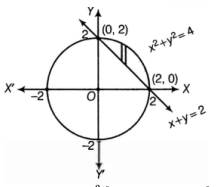
On drawing the graph, we get the shaded region as shown below:
Image
Required area $=\int_0^2\left[y_{\text {(circle) }}-y_{(\text {line })}\right] d x$
$=\int_0^2\left[\sqrt{4-x^2}-(2-x)\right] d x[\text { From Eq(i) and (ii) }]$
$=\int_0^2 \sqrt{4-x^2} d x-\int_0^2(2-x) d x$
$=\left[\frac{x}{2} \sqrt{4-x^2}+\frac{4}{2} \sin ^{-1} \frac{x}{2}\right]_0^2-\left[2 x-\frac{x^2}{2}\right]_0^2\left[\because \sqrt{a^2-x^2} d x=\frac{x}{2} \sqrt{a^2-x^2}+\frac{a^2}{2} \sin ^{-1}\left(\frac{x}{a}\right)\right]$
$=\left[0+2 \sin ^{-1}\left(\frac{2}{2}\right)-0-2 \sin ^{-1} 0\right]-\left(4-\frac{4}{2}-0\right)$
$=\left(2 \sin ^{-1}-0\right)-\left(4-\frac{4}{2}\right)$
$=2 \cdot \frac{\pi}{2}-2$
$=(\pi-2) \text { sq units }$
View full question & answer