Questions

5 Marks Questions

Take a timed test

6 questions · self-marked practice — reveal the answer and mark yourself.

Question 15 Marks
Find the image of the point $(0, 2, 3)$ in the line $\frac{x+3}{5}=\frac{y-1}{2}=\frac{z+4}{3}$
Answer
We have, $\frac{x+3}{5}=\frac{y-1}{2}=\frac{z+4}{3}=\lambda$
Therefore, the foot of the perpendicular is $(5 \lambda-3,2 \lambda+1,3 \lambda-4)$
The direction ratios of the perpendicular is
$(5 \lambda-3-0):(2 \lambda+1-2):(3 \lambda-4-3)$
$\Rightarrow(5 \lambda-3):(2 \lambda-1):(3 \lambda-7)$
Direction ratio of the line is $5:2:3$
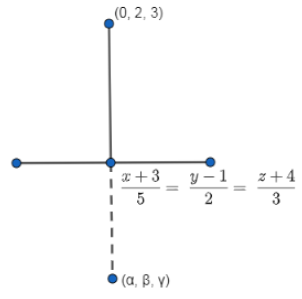
Image
From the direction ratio of the line and direction ratio of its perpendicular, we have
$5(5 \lambda-3)+2(2 \lambda-1)+3(3 \lambda-7)=0$
$\Rightarrow 25 \lambda-15+4 \lambda-2+9 \lambda-21=0$
$\Rightarrow 38 \lambda=38$
$\Rightarrow \lambda=1$
Therefore, the foot of the perpendicular is $(2, 3, -1)$
The foot of the perpendicular is the mid$-$point of the line joining $(0, 2, 3)$ and $(a, ß, y)$
Therefore, we have
$\frac{\alpha+0}{2}=2$
$\Rightarrow \alpha=4$
$\frac{\beta+2}{2}=3$
$\Rightarrow \beta=4$
$\frac{\gamma+3}{2}=-1$
$\Rightarrow \gamma=-5$
Thus, the imgae is $(4, 4, -5)$
View full question & answer
Question 25 Marks
Find the length shortest distance between the lines $\frac{x-3}{3}=\frac{y-8}{-1}=z-3$ and $\frac{x+3}{-3}=\frac{y+7}{2}=\frac{z-6}{4}$
Answer
Here, it is given that the equation of lines $L1: \frac{x-3}{3}=\frac{y-8}{-1}=\frac{z-3}{1}$
$L 2=\frac{x+3}{-3}=\frac{y+7}{2}=\frac{z-6}{4}$
Direction ratios of $L_1$ and $L_2$ are $(3,-1,1)$ and $(-3,2,4)$ respectively.
Suppose general point on line $L _1$ is $P =\left( x _1, y _1, z _1\right)$
$x_1=3 s+3, y_1=-s+8, z_1=s+3$
and suppose general point on line $L_2$ is $Q =\left( x _2, y _2, z _2\right)$
$x _2=-3 t -3, y _2=2 t -7, z _2=4 t +6$
$\therefore \overrightarrow{ PQ }=\left( x _2- x _1\right) \hat{ i }+\left( y _2- y _1\right) \hat{ j }+\left(z_2-z_1\right) \hat{k}$
$=(-3 t-3-3 s-3) \hat{i}+(2 t-7+s-8) j+(4 t+6-s-3) \hat{k}$
$\therefore \overrightarrow{ PQ }=(-3 t -3 s-6) \hat{ i }+(2 t+s-15) j+(4 t-s+3) \hat{k}$
Direction ratios of $\overrightarrow{P Q}$ are $((-3 t-3 s-6,(2 t+s-15),(4 t-s+3))$
$PQ$ will be the shortest distance if it perpendicular to both the given lines
Thus, by the condition of perpendicularity.
$\Longrightarrow 3(-3 t -3 s-6)-1(2 t + s -15)+1(4 t - s +3)=0 \text { and }$
$\Longrightarrow-3(-3 t -3 s-6)+2(2 t + s -15)+4(4 t - s +3)=0$
$\Rightarrow-9 t -9 s-18-2 t - s +15+4 t - s +3=0 \text { and }$
$9 t+9 s+18+4 t+2 s-30+16 t-4 s+12=0$
$\Rightarrow-7 t -11 s=0$ and
$29 t+7 s=0$
$29t + 7s = 0$
Solving above two equations, we get,
$t = 0$ and $s = 0$
therefore,
$P = (3, 8, 3)$ and $Q = (- 3, - 7, 6)$
Now distance between points $P$ and $Q$ is
$d=\sqrt{(3+3)^2+(8+7)^2+(3-6)^2}$
$=\sqrt{(6)^2+(15)^2+(-3)^2}$
$=\sqrt{36+225+9}$
$=\sqrt{270} $
$=3 \sqrt{30}$
Thus, the shortest distance between two given lines is
$d=3 \sqrt{30}$ units
Now, equation of line passing through points $P$ and $Q$ is,
$\frac{x-x_1}{x_1-x_2}=\frac{y-y_1}{y_1-y_2}=\frac{z-z_1}{z_1-z_2}$
$\therefore \frac{x-3}{3+3}=\frac{y-8}{8+7}=\frac{z-3}{3-6}$
$\therefore \frac{x-3}{6}=\frac{y-8}{15}=\frac{z-3}{-3}$
$\therefore \frac{x-3}{2}=\frac{y-8}{5}=\frac{z-3}{-1}$
Thus, equation of line of shortest distance between two given lines is
$\frac{x-3}{2}=\frac{y-8}{5}=\frac{z-3}{-1}$
View full question & answer
Question 35 Marks
Two schools $P$ and $Q$ want to award their selected students on the values of Tolerance, Kindness, and Leadership. The school $P$ wants to award $Rs. x$ each, $Rs. y$ each and $Rs. z$ each for the three respective values to $3, 2$ and $1$ students respectively with total award money of $Rs. 2200$.
School $Q$ wants to spend $Rs. 3100$ to award its $4, 1$ and $3$ students on the respective values $($by giving the sameaward money to the three values as school $P)$. If the total amount of award for one prize on each value is $Rs.1200,$ using matrices, find the award money for each value
Answer
Three equations are formed from the given statements:
$3x + 2y + z = 2200$
$4x + y + 3z = 3100$ and
$x + y + z = 1200$
Converting the system of equations in matrix form we get,
$\left[\begin{array}{lll}3 & 2 & 1 \\ 4 & 1 & 3 \\ 1 & 1 & 1\end{array}\right]\left[\begin{array}{l}x \\ y \\ z\end{array}\right]=\left[\begin{array}{l}2200 \\ 3100 \\ 1200\end{array}\right]$
i.e. $AX = B$
where $A =\left[\begin{array}{lll}3 & 2 & 1 \\ 4 & 1 & 3 \\ 1 & 1 & 1\end{array}\right], X =\left[\begin{array}{l}x \\ y \\ z\end{array}\right]$ and $B =\left[\begin{array}{l}2200 \\ 3100 \\ 1200\end{array}\right]$
$\begin{array}{l}\Rightarrow X = A ^{-1} B \\ A ^{-1}=\frac{1}{|A|}(\operatorname{Adj} A ) \\ | A |=3(1-3)-2(4-3)+1(4-1)=-6-2+3=-5\end{array}$
$\text{Adj } A=\left[\begin{array}{ccc}-2 & -1 & 5 \\ -1 & 2 & -5 \\ 3 & -1 & -5\end{array}\right]$
$\therefore A^{-1}=\frac{1}{-5}\left[\begin{array}{ccc}-2 & -1 & 5 \\ -1 & 2 & -5 \\ 3 & -1 & -5\end{array}\right]$
$=\frac{1}{5}\left[\begin{array}{ccc}2 & 1 & -5 \\ 1 & -2 & 5 \\ -3 & 1 & 5\end{array}\right]$
$\Rightarrow X =\frac{1}{5}\left[\begin{array}{ccc}2 & 1 & -5 \\ 1 & -2 & 5 \\ -3 & 1 & 5\end{array}\right]\left[\begin{array}{l}2200 \\ 3100 \\ 1200\end{array}\right]$
$=\frac{1}{5}\left[\begin{array}{c}4400+3100-6000 \\ 2200-6200+6000 \\ -6600+3100+6000\end{array}\right]$
$=\left[\begin{array}{l}300 \\ 400 \\ 500\end{array}\right]$
$\Rightarrow x=300, y=400$ and $z=500$
i.e. The award money for each value are $Rs. 300$ for Tolerance, $Rs. 400$ for Kindness and $Rs. 500$ for Leadership.
View full question & answer
Question 45 Marks
Show that the function $f: R \rightarrow\{x \in R:-1 < x<1\}$ defined by $f(x)=\frac{x}{1+|x|}, x \in R$ is one$-$one and onto function.
Answer
$f$ is one$-$one: For any $x, y \in R -\{+1\}$, we have $f(x)=f(y)$
$\Rightarrow \frac{x}{1+|x|}=\frac{y}{|y|+1}$
$\Rightarrow x y+x=x y+y$
$\Rightarrow x=y$
Therefore, $f$ is one$-$one function.
If $f$ is one$-$one, let $y = R -\{1\}$, then $f( x )= y$
$\Rightarrow \frac{x}{x+1}=y$
$\Rightarrow x=\frac{y}{1-y}$
It is cleat that $x \in R$ for all $y=R-\{1\}$, also $x=\neq-1$
Because $x=-1$
$\Rightarrow \frac{y}{1-y}=-1$
$\Rightarrow y =-1+ y $
which is not possible.
Thus for each $R -\{1\}$ there exists $x=\frac{y}{1-y} \in R -\{1\}$ such that
$f(x)=\frac{x}{x+1}=\frac{\frac{y}{1-y}}{\frac{y}{1-y}+1}=y$
Therefore $f$ is onto function.
View full question & answer
Question 55 Marks
Show that the relation $R$ in the set $A=\{1,2,3,4,5\}$ given by $R=\{(a, b):|a-b|$ is divisible by 2$\}$ is an equivalence relation. Write all the equivalence classes of $R$.
Answer
$R =\{( a , b )=| a . b |$ is divisible by 2 .
where $a, b \in A=\{1,2,3,4,5\}$
reflexivty
For any $a \in A,|a-a|=0$ Which is divisible by 2 .
$\therefore(a, a) \in r$ for all $a \in A$
So , R is Reflexive
Symmetric :
Let $(a, b) \in R$ for all $a , b \in R$
$| a - b |$ is divisible by 2
|b-a| is divisible by 2
$(a, b) \in r \Rightarrow(b, a) \in R$
So, R is symmetirc .
Transitive :
Let $(a, b) \in R$ and $(b, c) \in R$ then $(a, b) \in R$ and $(b, c) \in R$
$| a - b |$ is divisible by 2
|b-c| is divisible by 2
Two cases :
Case 1:
When $b$ is even
$(a, b) \in R$ and $(b, c) \in R$
$| a - c |$ is divisible by 2
$| b - c |$ is divisible by 2
$|a-c|$ is divisible by 2
$\therefore( a , c ) \in R$
Case 2:
When $b$ is odd
$(a, b) \in R$ and $(b, c) \in R$
$|a-c|$ is divisible by 2
$| b - c |$ is divisible by 2
$| a - c |$ is divisible by 2
Thus, $(a, b) \in R$ and $(b, c) \in R \Rightarrow(a, c) \in R$
So $R$ is transitive.
Hence, $R$ is an equivalence relation
View full question & answer
Question 65 Marks
Using integration, find the area of the region in the first quadrant enclosed by the $Y-$ axis, the line $y = x$ and the circle $x^2+y^2=32$
Answer
According to the question,
Given, equation of circle is $x^2+y^2=32$
Given , equation of line is $y=x$
Consider $x^2+y^2=32$,
$\Rightarrow x^2+y^2=(4 \sqrt{2})^2$
Given circle has centre at $(0, 0)$ and
radius of circle is $=4 \sqrt{2}$
To find the point of intersection,
On substituting $y=x$ in Eq. $(i),$ we get
$2 x^2=32$
$ \Rightarrow x^2=16$
$ \Rightarrow x= \pm 4$
When $x = 4$ then $y = 4$
When $x = - 4$ then $y = - 4$
Thus, the points of intersection are $(4, 4)$ and $(-4,-4)$
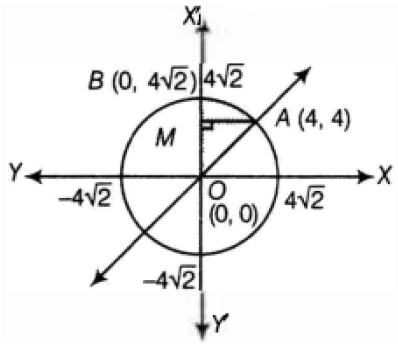
So, given line and the circle intersect in the first quadrant at point $A(4, 4)$ and
The circle cut the $Y-$ axis at point $B (0,4 \sqrt{2})$.
Now, let us sketch the graph of given curves, we get
Image
Let us draw $AM$ perpendicular to $Y-$ axis.
Required area $=$ Area of shaded region $\text{OABO}$
$=\int_0^4 x_{\text {(line) }} d y+\int_4^{4 \sqrt{2}} x_{\text {(circle) }} d y$
$\because x^2+y^2=32$
$ \Rightarrow x= \pm \sqrt{32-y^2},$
but we need area of region enclosed in the first quadrant only,
so $x =\sqrt{32-y^2}$
$=\int_0^4 y\ d y+\int_4^{4 \sqrt{2}} \sqrt{32-y^{-2}} d y$
$=\left[\frac{y^2}{2}\right]_0^4+\int_4^{4 \sqrt{2}} \sqrt{(4 \sqrt{2})^2-y^2} d y$
$=\frac{1}{2}(16-0)+\left[\frac{y}{2} \sqrt{32-y^2}+\frac{32}{2} \sin ^{-1}\left(\frac{y}{4 \sqrt{2}}\right)\right]_4^{4 \sqrt{2}}$
$=8+\left[16 \sin ^{-1}(1)-\left\{2 \times 4+16 \sin ^{-1}\left(\frac{1}{\sqrt{2}}\right)\right\}\right]$
$=8+\left[16 \cdot \frac{\pi}{2}-8-16 \cdot \frac{\pi}{4}\right]$
$=16\left(\frac{\pi}{2}-\frac{\pi}{4}\right)$
$=16 \cdot \frac{\pi}{4}$
$=4 \pi \text { sq units }$
View full question & answer