Questions

5 Marks Questions

Take a timed test

6 questions · self-marked practice — reveal the answer and mark yourself.

Question 15 Marks
Find the perpendicular distance of the point $(1,0,0)$ from the line $\frac{x-1}{2}=\frac{y+1}{-3}=\frac{z+10}{8}$. Also, find the coordinates of the foot of the perpendicular and the equation of the perpendicular.
Answer
Suppose the point $(1, 0, 0)$ be $P$ and the point through which the line passes be $Q(1,-1,-10)$.
The line is parallel to the vector
$\vec{b}=2 \hat{i}-3 \hat{j}+8 \hat{k}$
Now,
$\overrightarrow{P Q}=0 \hat{i}-\hat{j}-10 \hat{k}$
$\therefore \vec{b} \times \overrightarrow{P Q}=\left|\begin{array}{ccc}\hat{i} & \hat{j} & \hat{k} \\2 & -3 & 8
\\0 & -1 & -10\end{array}\right|$
$=38 \hat{i}+20 \hat{j}-2 \hat{k}$
$\Rightarrow|\vec{b} \times \overrightarrow{P Q}|=\sqrt{38^2+20^2+2^2}$
$=\sqrt{1444+400+4}$
$=\sqrt{1848}$
$d=\frac{\mid \vec{b} \times \overrightarrow{P Q \mid}}{\overrightarrow{\mid \vec{b}}}$
$=\frac{\sqrt{1848}}{\sqrt{77}}$
$=\sqrt{24}$
$=2 \sqrt{6}$
Suppose $L$ be the foot of the perpendicular drawn from the point $P(1,0,0)$ to the given line $-$
Image
The coordinates of a general point on the line
$\frac{x-1}{2}=\frac{y+1}{-3}=\frac{z+10}{8} \text { are given by }$
$\frac{x-1}{2}=\frac{y+1}{-3}=\frac{z+10}{8}=\lambda$
$\Rightarrow x=2 \lambda+1$
$y=-3 \lambda-1$
$z=8 \lambda-10$
Suppose the coordinates of $L$ be
$(2 \lambda+1,-3 \lambda-1,8 \lambda-10)$
Since, The direction ratios of $PL$ are proportional to,
$2 \lambda+1-1,-3 \lambda-1-0,8 \lambda-10-0 \text {, i.e., } 2 \lambda,-3 \lambda-1,8 \lambda-10$
Since, The direction ratios of the given line are proportional to $2,-3,8$, but $PL$ is perpendicular to the given line.
$\therefore 2(2 \lambda)-3(-3 \lambda-1)+8(8 \lambda-10)=0$
$\Rightarrow \lambda=1$ Substituting $\lambda=1$ in $(2 \lambda+1,-3 \lambda-1,8 \lambda-10)$ we get the coordinates of L as $(3,-4,-2)$.
Equation of the line $PL$ is given by
$\frac{x-1}{3-1}=\frac{y-0}{-4-0}=\frac{z-0}{-2-0}$
$=\frac{x-1}{1}=\frac{y}{-2}=\frac{z}{-1}$
$\Rightarrow \vec{r}=\hat{i}+\lambda(\hat{i}-2 \hat{j}-\hat{k})$
View full question & answer
Question 25 Marks
Find the shortest distance between the given lines. $\vec{r}=(\hat{i}+2 \hat{j}-4 \hat{k})+\lambda(2 \hat{i}+3 \hat{j}+6 \hat{k})$, $\vec{r}=(3 \hat{i}+3 \hat{j}-5 \hat{k})+\mu(-2 \hat{i}+3 \hat{j}+8 \hat{k})$
Answer
Given
$\vec{r}=(\hat{i}+2 \hat{j}-4 \hat{k})+\lambda(2 \hat{i}+3 \hat{j}+6 \hat{k})
$
$\vec{r}=(3 \hat{i}+3 \hat{j}-5 \hat{k})+\mu(-2 \hat{i}+3 \hat{j}+8 \hat{k})$
Here, we have
$\vec{a}_1=\hat{\imath}+2 \hat{j}-4 \hat{k}
$
$\overrightarrow{b_1}=2 \hat{\imath}+3 \hat{j}+6 \hat{k}
$
$\overrightarrow{a_2}=3 \hat{i}+3 \hat{j}-5 \hat{k}
$
$\overrightarrow{b_2}=-2 \hat{\imath}+3 \hat{j}+8 \hat{k}$
Thus,
$\overrightarrow{b_1} \times \overrightarrow{b_2}=\left|\begin{array}{ccc}\hat{i} & \hat{j} & \hat{k} \\2 & 3 & 6 \\-2 & 3 & 8\end{array}\right|$
$=\hat{i}(24-18)-\hat{j}(16+12)+\hat{k}(6-6)$
$\overrightarrow{b_1} \times \overrightarrow{b_2}=6 \hat{i}-28 \hat{j}+0 \hat{k}$
$\therefore\left|b_1 \times \overrightarrow{b_2}\right|=\sqrt{6^2+(-28)^2+0^2}$
$=\sqrt{36+784+9}$
$=\sqrt{820}$
$\overrightarrow{a_2}-\overrightarrow{a_1}=(3-1) \hat{i}+(3-2) \hat{j}+(-5+4) \hat{k}$
$\therefore \overrightarrow{a_2}-\overrightarrow{a_1}=2 \hat{\imath}+\hat{j}-\hat{k}$
Now, we have
$\left(\overrightarrow{b_1} \times \overrightarrow{b_2}\right) \cdot\left(\overrightarrow{a_2}-\overrightarrow{a_1}\right)=(6 \hat{\imath}-28 \hat{\jmath}+0 \hat{k}) \cdot(2 \hat{\imath}+\hat{\jmath}-\hat{k})$
$=(6 \times 2)+((-28) \times 1)+(0 \times(-1))$
$=12-28+0$
$=-16$
Thus, the shortest distance between the given lines is
$ d =\left|\frac{\left(\overrightarrow{ b _1} \times \overrightarrow{ b _2}\right)\cdot\left(\overrightarrow{a_2}-\overrightarrow{a_1}\right)}{\left|\overrightarrow{b_1} \times \overrightarrow{b_2}\right|}\right|$
$\Rightarrow d =\left|\frac{-16}{\sqrt{820}}\right|$
$\therefore d=\frac{16}{\sqrt{820}} \text { units }$
View full question & answer
Question 35 Marks
Given $A=\left[\begin{array}{ccc}1 & -1 & 1 \\ 1 & -2 & -2 \\ 2 & 1 & 3\end{array}\right]$ and $B=\left[\begin{array}{ccc}-4 & 4 & 4 \\ -7 & 1 & 3 \\ 5 & -3 & -1\end{array}\right]$ find $AB$ and use this result in solving the following system of equations. $x - y + z =4 , x - 2y - 2z = 9 , 2x + y + 3z = 1$
Answer
$x-y+z=4$
$x-2 y-2 z=9$
$2 x+y+3 z=1$
Let $A=\left[\begin{array}{ccc} 1 & -1 & 1 \\ 1 & -2 & -2 \\ 2 & 1 & 3 \end{array}\right] \quad X=\left[\begin{array}{l} x \\ y \\ z \end{array}\right] C=\left[\begin{array}{l} 4 \\ 9 \\ 1 \end{array}\right]$
Then, given system of equations can be rewritten as,
$AX=C$
Now, $A B=\left[\begin{array}{ccc}1 & -1 & 1 \\ 1 & -2 & -2 \\ 2 & 1 & 3\end{array}\right]\left[\begin{array}{ccc}-4 & 4 & 4 \\ -7 & 1 & 3 \\ 5 & -3 & -1\end{array}\right]$
$ =\left[\begin{array}{lll} 8 & 0 & 0 \\ 0 & 8 & 0 \\ 0 & 0 & 8 \end{array}\right]$
$AB=8 $
$A^{-1}=\frac{1}{8} B\left[\begin{array}{c} \because A^{-1} A B=8 A^{-1} I \\ B=8 A^{-1} \end{array}\right] $
$\Rightarrow A^{-1}=\frac{1}{8}\left[\begin{array}{ccc} \frac{-1}{2} & \frac{1}{2} & \frac{1}{2} \\ \frac{-7}{8} & \frac{1}{8} & \frac{3}{8} \\ \frac{5}{8} & \frac{-3}{8} & \frac{-1}{8} \end{array}\right]$
Now, $AX = C$,
$ \Rightarrow X=A^{-1} C \\ \Rightarrow\left[\begin{array}{c} x \\ y \\ z \end{array}\right]=\left[\begin{array}{ccc} \frac{-1}{2} & \frac{1}{2} & \frac{1}{2} \\ \frac{-7}{8} & \frac{1}{8} & \frac{3}{8} \\ \frac{5}{8} & \frac{-3}{8} & \frac{-1}{8} \end{array}\right]\left[\begin{array}{l} 4 \\ 9 \\ 1 \end{array}\right] $
$=\left[\begin{array}{c} \frac{-4}{2}+\frac{9}{2}+\frac{1}{2} \\ \frac{-28}{8}+\frac{9}{8}+\frac{3}{8} \\ \frac{20}{8}+\frac{-27}{8}+\frac{-1}{8} \end{array}\right]=\left[\begin{array}{c} 3 \\ -2 \\ -1 \end{array}\right] $
$\Rightarrow x=3, y=-2, z=-1$
View full question & answer
Question 45 Marks
Show that the function $f : R _0 \rightarrow R _0$, defined as $f ( x )=\frac{1}{x}$, is one-one onto, where $R _0$ is the set non-zero real numbers.
Is the result true, if the domain $R _0$ is replaced by N with co-domain being same as $R _0$ ?
Answer
We observe the following properties of $f$.
Injectivity: Let $x, y \in R_0$ such that $f(x)=f(y)$. Then,
$f(x)=f(y) \Rightarrow \frac{1}{x}=\frac{1}{y} \Rightarrow x=y$
So, $f : R _0 \rightarrow R _0$ is one-one.
Surjectivity: Let $y$ be an arbitrary element of $R_0$ (co-domain) such that $f(x)=y$.Then,
$f(x)=y \Rightarrow \frac{1}{x}=y \Rightarrow x=\frac{1}{y}$
Clearly, $x=\frac{1}{y} \in R_0$ (domain) for all $y \in R _0$ (co-domain).
Thus, for each $y \in R _0$ (co-domain) there exits $x=\frac{1}{y} \in R_0$ (domain) such that $f(x)=\frac{1}{x}=y$
So, $f : R _0 \rightarrow R _0$ is onto.
Hence, $f : R _0 \rightarrow R _0$ is one-one onto.
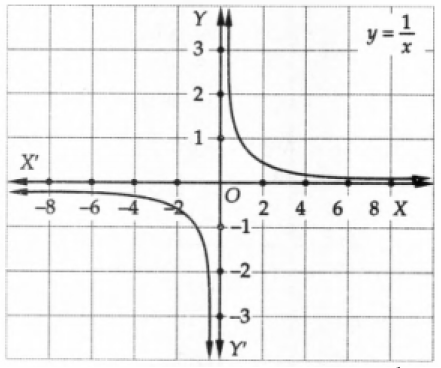
This is also evident from the graph of $f(x)$ as shown in fig.
Image
Let us now consider $f : N \rightarrow R _0$ given by $f(x)=\frac{1}{x}$
For any $x, y \in N$, we find that
$f(x)=f(y) \Rightarrow \frac{1}{x}=\frac{1}{y} \Rightarrow x=y$
So, $f : N \rightarrow R _0$ is one-one.
We find that $\frac{2}{3}, \frac{3}{5}$ etc. in co-domain $R _0$ do not have their pre-image in domain N . So, f : $N \rightarrow R _0$ is not onto.
Thus, $f : N \rightarrow R _0$ is one-one but not onto.
View full question & answer
Question 55 Marks
Let $R$ be relation defined on the set of natural number $N$ as follows:
$R=\{(x, y): x \in N, y \in N, 2 x+y=41\}$ Find the domain and range of the relation $R.$ Also verify whether $R$ is reflexive, symmetric and transitive.
Answer
Given that,
$R=\{(1,39),(2,37),(3,35) \ldots(19,3),(20,1)\}$
$\text { Domain }=\{1,2,3, \ldots \ldots, 20\}$
$\text { Range }=\{1,3,5,7 \ldots \ldots, 39\}$
$R$ is not reflexive as $(2,2) \notin R$ as
$2 \times 2+2 \neq 41$
$R$ is not symmetric
$\text { as }(1,39) \in R \text { but }(39,1) \notin R$
$R$ is not transitive
as $(11,19) \in R,(19,3) \in R$
 But $(11,3) \notin R$
Hence, $R$ is neither reflexive, nor symmetric and nor transitive.
View full question & answer
Question 65 Marks
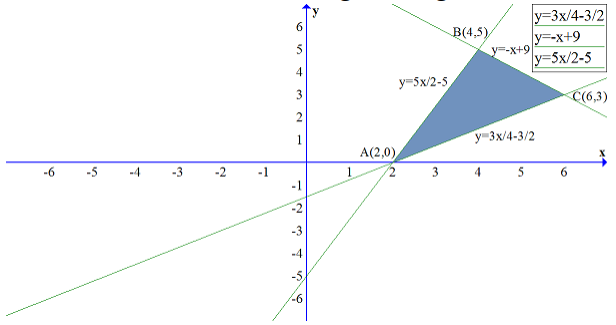
Using method of integration find the area of the triangle $\text{ABC,}$ co$-$ordinates of whose vertices are $A (2, 0), B (4, 5)$ and $C(6,3)$
Answer
Points in the form of line in the given diagram
Image
The equation of side $AB$ is,
$y-0=\frac{5-0}{4-2}(x-2)$
$\Rightarrow y=\frac{5}{2}(x-2)$
The equation of side $BC$ is,
$y-3=\frac{5-3}{4-6}(x-6)$
$\Rightarrow y-3=\frac{2}{-2}(x-6)$
$\Rightarrow y-3=-1(x-6)$
$\Rightarrow y=-x+9$
The equation of side $AC$ is,
$y-0=\frac{3-0}{6-2}(x-2)$
$\Rightarrow y=\frac{3}{4}(x-2)$
$\text { Area }=\frac{5}{2} \int_2^4(x-2) d x+\int_4^6-(x-9) d x-\frac{3}{4} \int_2^6(x-2) d x$
$A=\int_2^4 \frac{5}{2}(x-2) d x+\int_0^1-(x+9) d x+\int_6^2 \frac{3}{4}(x-2) d x$
On integrating we get,
$A=\frac{5}{2}\left(\frac{x^2}{2}-2 x\right)_2^4+\left(\frac{-x^2}{2}+9 x\right)_1^0-\frac{3}{4}\left(\frac{x^2}{2}-2 x\right)_2^6$
On applying limits we get,
$A=\frac{5}{2}(8-8-2+4)+(-18+54+8-36)-\frac{3}{4}(18-12-2+4)$
$A=5-8-\frac{3}{4}(8)$
$=13-6=7 \text { sq. units. }$
Hence the required area is $7\text { sq. units. }$
View full question & answer