Sample QuestionsModel Paper 8 questions
One sample from each question group in this chapter. Select any group above to see the full set with answer keys.
If the direction cosines of a line are $\left(\frac{1}{a}, \frac{1}{a}, \frac{1}{a}\right)$, then:
- A
$0 < a < 1$
- B
$a > 2$
- ✓
$a = \pm \sqrt{3}$
- D
$a > 0$
Answer: C.
View full solution →The value of p and q for which the function $f ( x )=\left\{\begin{array}{cl}\frac{\sin (p+1) x+\sin x}{x} & , x<0 \\ \frac{q}{x^2} & , x=0 \\ \frac{\sqrt{x+b x^2}-\sqrt{x}}{x^{\frac{3}{2}}} & , x>0\end{array}\right.$ is continuous for all $x \in R$, are
- ✓
$p =-\frac{3}{2}, q =\frac{1}{2}$
- B
$p=-\frac{3}{2}, q=-\frac{1}{2}$
- C
$p =\frac{5}{2}, q =\frac{7}{2}$
- D
$p=\frac{1}{2}, q=\frac{3}{2}$
Answer: A.
View full solution →If $\vec{a} \cdot \vec{b}=0$ and $\vec{a} \times \vec{b}=0$, then which one of the following is correct?
- A
$\vec{a}$ is parallel to $\vec{b}$
- ✓
$\vec{a}=0$ or $\vec{b}=0$
- C
$\vec{a}$ is perpendicular to $\vec{b}$
- D
$\vec{a}$ and $\vec{b} \neq 0$
Answer: B.
View full solution →A solution of the differential equation $\left(\frac{d y}{d x}\right)^2-x \frac{d y}{d x}+y=0$ is
- A
$y=2 x^2-4$
- B
$y =2 x$
- C
$y=2$
- ✓
$y=2 x-4$
Answer: D.
View full solution →Let A and B be independent events with P(A) = 0.3 and P(B) = 0.4 Find P( A |B)
Answer: B.
View full solution →Assertion (A): The modulus function $f : R \rightarrow R$ given by $f ( x )=| x |$ is neither one-one nor onto.
Reason (R): The signum function $f : R \rightarrow R$ given by $f ( x )=\left\{\begin{array}{cl}1, & x>0 \\ 0, & x=0 \\ -1, & x<0\end{array}\right.$ is bijective.
- A
Both A and R are true and R is the correct explanation of A.
- B
Both A and R are true but R is not the correct explanation of A
- C
A is true but R is false.
- D
A is false but R is true.
View full solution →Assertion (A): The function $f(x)=x^2-4 x+6$ is strictly increasing in the interval $(2, \infty)$.
Reason (R): The function $f(x)=x^2-4 x+6$ is strictly decreasing in the interval $(-\infty, 2)$.
- A
Both A and R are true and R is the correct explanation of A.
- B
Both A and R are true but R is not the correct explanation of A
- C
A is true but R is false.
- D
A is false but R is true.
View full solution →Find the maximum and minimum values of $f ( x )=\sin x$ in the interval $[\pi, 2 \pi]$.
View full solution →Evaluate: $\int \frac{x^2 \tan ^{-1} x}{\left(1+x^2\right)} d x$
View full solution →The total revenue in Rupees received from the sale of $x$ units of a product is given by $R(x)=3 x^2+36 x+5$. Find the marginal revenue, when $x=5$, where by marginal revenue we mean the rate of change of total revenue with respect to the number of items sold at any instant.
View full solution →The volume of a cube is increasing at the rate of $9 \ cm^3 / \sec$. How fast is the surface area increasing when the length of an edge is $10 \ cm ?$
View full solution →Find the least value of a such that the function $f$ given by $f(x)=x^2+a x+1$ is strictly increasing on $(1,2)$.
View full solution →If $x ^{ x }+ y ^{ x }=1$, prove that $\frac{d y}{d x}=-\left\{\frac{x^x(1+\log x)+y^x \cdot \log y}{x \cdot y^{(x-1)}}\right\}$
View full solution →Find the maximum value of $Z=7 x+7 y$ subject to the constraints $x \geq 0, y \geq 0, x+y \geq 2$ and $2 x+3 y \leq 6$
View full solution →The feasible region for a LPP is shown in Figure. Evaluate Z = 4x + y at each of the corner points of this region. Find the minimum value of Z, if it exists.
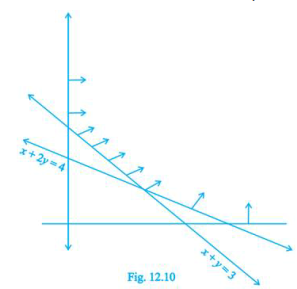
Solve the differential equation $\left(1+y^2\right)(1+\log x) d x+x d y=0$ given that when $x=1, y=1$
View full solution →The population of a village increases continuously at the rate proportional to the number of its inhabitants present at any time. If the population of the village was $20,000$ in $1999$ and $25000$ in the year $2004,$ what will be the population of the village in $2009$?
View full solution →Show that the lines $\vec{r}=(\hat{i}+2 \hat{j}+3 \hat{k})+\lambda(2 \hat{i}+3 \hat{j}+4 \hat{k})$ and $\vec{r}=(4 \hat{i}+\hat{j})+\mu(5 \hat{i}+2 \hat{j}+\hat{k})$ intersect. Also, find their point intersection.
View full solution →Find the distance of a point $(2,4,-1)$ from the line $\frac{x+5}{1}=\frac{y+3}{4}=\frac{z-6}{-9}$.
View full solution →Show that the matrix, $A=\left[\begin{array}{ccc}1 & 0 & -2 \\ -2 & -1 & 2 \\ 3 & 4 & 1\end{array}\right]$ satisfies the equation,
$A ^3- A ^2-3 A- I _3= O$. Hence, find $A ^{-1}$
View full solution →Show that the function $f : R -\{3\} \rightarrow R -\{1\}$ given by $f(x)=\frac{x-2}{x-3}$ is a bijection.
View full solution →Let $R$ be relation defined on the set of natural number $N$ as follows: $R=\{(x, y): x \in N, y \in N, 2 x+y=41\}$. Find the domain and range of the relation $R$. Also verify whether $R$ is reflexive, symmetric and transitive.
View full solution →Read the following text carefully and answer the questions that follow:
A tank, as shown in the figure below, formed using a combination of a cylinder and a cone, offers better drainage as compared to a flat bottomed tank.
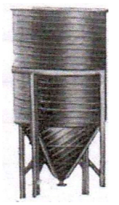
A tap is connected to such a tank whose conical part is full of water. Water is dripping out from a tap at the
bottom at the uniform rate of $2 \ cm^3 / s$. The semi $-$ vertical angle of the conical tank is $45^{\circ}$.
$i$. Find the volume of water in the tank in terms of its radius $r. \ (1)$
$ii$. Find rate of change of radius at an instant when $r =2 \sqrt{2} \ cm. (1)$
$iii$. Find the rate at which the wet surface of the conical tank is decreasing at an instant when radius $r =2 \sqrt{2} \ cm.(2)$
OR
Find the rate of change of height h at an instant when slant height is $4 \ cm. (2)$ View full solution →Read the following text carefully and answer the questions that follow:
If two vectors are represented by the two sides of a triangle taken in order, then their sum is represented by the third side of the triangle taken in opposite order and this is known as triangle law of vector addition
$i$. If $\vec{p}, \vec{q}, \vec{r}$ are the vectors represented by the sides of a triangle taken in order, then find $\vec{q}+\vec{r}. (1)$
$ii$. If $\text{ABCD}$ is a parallelogram and $A C$ and $B D$ are its diagonals, then find the value of $\overrightarrow{A C}+\overrightarrow{B D}$.
$iii$. If $\text{ABCD}$ is a parallelogram, where $\overrightarrow{A B}=2 \vec{a}$ and $\overrightarrow{B C}=2 \vec{b}$, then find the value of $\overrightarrow{A C}-\overrightarrow{B D}. (2)$
OR
If $T$ is the mid point of side $YZ$ of $\triangle XYZ,$ then what is the value of $\overrightarrow{X Y}+\overrightarrow{X Z}. (2)$
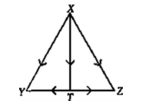
View full solution →Read the following text carefully and answer the questions that follow:
There are different types of Yoga which involve the usage of different poses of Yoga Asanas, Meditation and Pranayam as shown in the figure below:

The Venn diagram below represents the probabilities of three different types of Yoga,$ A, B$ and $C$ performed by the people of a society. Further, it is given that probability of a member performing type $C$ Yoga is$ 0.44.$
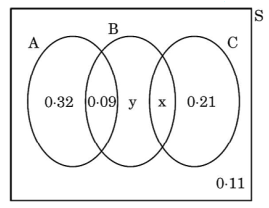
$i$. Find the value of $x. (1)$
$ii$. Find the value of $y. (1)$
$iii$. Find $P \left(\frac{ C }{ B }\right)$.
OR
Find the probability that a randomly selected person of the society does Yoga of type $A$ or $B$ but not $C.\ (2)$ View full solution →