Question 514 Marks
If O is the origin and the coordinates of A are (a, b, c) Find the direction cosines of OA and the equation of the plane through A at right angles to OA.
AnswerIt is given that O is the origin and the coordinates of A are (a, b, c)
The direction of OA are proportional to
a - 0, b - 0, c - 0 or a, b, c
$\therefore$ Direction cosines of OA are
$\frac{\text{a}}{\sqrt{\text{a}^2+\text{b}^2+\text{c}^2}},\frac{\text{b}}{\sqrt{\text{a}^2+\text{b}^2+\text{c}^2}},\frac{\text{c}}{\sqrt{\text{a}^2+\text{b}^2+\text{c}^2}}$
The normal vector to the required plane is $(\text{a}\hat{\text{i}}+\text{b}\hat{\text{j}}+\text{c}\hat{\text{k}})$
The vector equation of the plane through A(a, b, c) and perpendicular to OA is
$\big[\vec{\text{r}}-(\text{a}\hat{\text{i}}+\text{b}\hat{\text{j}}+\text{c}\hat{\text{k}})\big]\cdot(\text{a}\hat{\text{i}}+\text{b}\hat{\text{j}}+\text{c}\hat{\text{k}})=0$
$\Rightarrow\vec{\text{r}}-(\text{a}\hat{\text{i}}+\text{b}\hat{\text{j}}+\text{c}\hat{\text{k}})=(\text{a}\hat{\text{i}}+\text{b}\hat{\text{j}}+\text{c}\hat{\text{k}})\cdot(\text{a}\hat{\text{i}}+\text{b}\hat{\text{j}}+\text{c}\hat{\text{k}})$
$\Rightarrow\vec{\text{r}}-(\text{a}\hat{\text{i}}+\text{b}\hat{\text{j}}+\text{c}\hat{\text{k}})=\text{a}^2+\text{b}^2+\text{c}^2$
The cartesian equation of this plane is
$(\text{x}\hat{\text{i}}+\text{y}\hat{\text{j}}+\text{z}\hat{\text{k}})\cdot(\text{a}\hat{\text{i}}+\text{b}\hat{\text{j}}+\text{c}\hat{\text{k}})=\text{a}^2+\text{b}^2+\text{c}^2$
Or $\text{ax}+\text{by}+\text{cz}=\text{a}^2+\text{b}^2+\text{c}^2$
View full question & answer→Question 524 Marks
Find the vector equation of the following planes in non-parametric form.
$\vec{\text{r}}=(\lambda-2\mu)\hat{\text{i}}+(3-\mu)\hat{\text{j}}+(2\lambda+\mu)\hat{\text{k}}$
AnswerThe given equation of the plane is,
$\vec{\text{r}}=(\lambda-2\mu)\hat{\text{i}}+(3-\mu)\hat{\text{j}}+(2\lambda+\mu)\hat{\text{k}}$
$\Rightarrow\vec{\text{r}}=(0\hat{\text{i}}+3\hat{\text{j}}+0\hat{\text{k}})+\lambda(\hat{\text{i}}+0\hat{\text{j}}+2\hat{\text{k}})+\mu(-2\hat{\text{i}}-\hat{\text{j}}+\hat{\text{k}})$
We know that equation $\vec{\text{r}}=\vec{\text{a}}+\lambda\vec{\text{b}}+\mu\vec{\text{c}} $ represents a plane passing through a point whose position vector is $\vec{\text{a}}$ and parallel to t.
Here, $\vec{\text{a}}=0\hat{\text{i}}+3\hat{\text{j}}+0\hat{\text{k}},\vec{\text{b}}=\hat{\text{i}}+0\hat{\text{j}}+2\hat{\text{k}},\hat{\text{c}}=-2\hat{\text{i}}-\hat{\text{j}}+\hat{\text{k}}$
Normal vector, $\vec{\text{n}}=\vec{\text{b}}\times\vec{\text{c}}$
$=\begin{vmatrix}\hat{\text{i}}&\hat{\text{j}}&\hat{\text{k}}\\1&0&2\\-2&-1&1\end{vmatrix}$
$=2\hat{\text{i}}-5\hat{\text{j}}-\hat{\text{k}}$
The vector equation of the plane in scalar product form is,
$\vec{\text{r}}\cdot\vec{\text{n}}=\vec{\text{a}}\cdot\vec{\text{n}}$
$\Rightarrow\vec{\text{r}}\cdot(2\hat{\text{i}}-5\hat{\text{j}}-\hat{\text{k}})=(0\hat{\text{i}}+3\hat{\text{j}}+0\hat{\text{k}})(2\hat{\text{i}}-5\hat{\text{j}}-\hat{\text{k}})$
$\Rightarrow\vec{\text{r}}\cdot(2\hat{\text{i}}-5\hat{\text{j}}-\hat{\text{k}})=0-15+0$
$\Rightarrow\vec{\text{r}}\cdot(2\hat{\text{i}}-5\hat{\text{j}}-\hat{\text{k}})+15=0$
View full question & answer→Question 534 Marks
Show that the lines $\vec{\text{r}}=(2\hat{\text{i}}-3\hat{\text{k}})+\lambda(\hat{\text{i}}+2\hat{\text{j}}+3\hat{\text{k}})$ and $\vec{\text{r}}=(2\hat{\text{i}}+6\hat{\text{j}}+3\hat{\text{k}})+\mu(2\hat{\text{i}}+3\hat{\text{j}}+4\hat{\text{k}})$ are coplanar. Also, find the equation of the plane containing them.
AnswerWe know that the lines $\vec{\text{r}}=\vec{\text{a}}_1+\lambda\vec{\text{b}}_1$ and $\vec{\text{r}}=\vec{\text{a}}_2+\mu\vec{\text{b}}_2$ are coplanar if
$\vec{\text{a}}_1\cdot(\vec{\text{b}}_1\times\vec{\text{b}}_2)=\vec{\text{a}}_2\cdot(\vec{\text{b}}_1\times\vec{\text{b}}_2)$ and the equation of the plane containing them is
$\vec{\text{r}}\cdot(\vec{\text{b}}_1\times\vec{\text{b}}_2)=\vec{\text{a}}_1\cdot(\vec{\text{b}}_1\times\vec{\text{b}}_2)$
Here,
$\vec{\text{a}}_1=0\hat{\text{i}}+2\hat{\text{j}}-3\hat{\text{k}},\vec{\text{b}}_1=\hat{\text{i}}+2\hat{\text{j}}+3\hat{\text{k}}$
$\vec{\text{a}}_2=2\hat{\text{i}}+6\hat{\text{j}}+3\hat{\text{k}},\vec{\text{b}}_2=2\hat{\text{i}}+3\hat{\text{j}}+4\hat{\text{k}}$
$\vec{\text{b}}_1\times\vec{\text{b}}_2=\begin{vmatrix}\hat{\text{i}}&\hat{\text{j}}&\hat{\text{k}}\\1&2&3\\2&3&4\end{vmatrix}$
$=-\hat{\text{i}}+2\hat{\text{j}}-\hat{\text{k}}$
$\vec{\text{a}}_1\cdot(\vec{\text{b}}_1\times\vec{\text{b}}_2)=(0\hat{\text{i}}+2\hat{\text{j}}-3\hat{\text{k}})\cdot(-\hat{\text{i}}+2\hat{\text{j}}-\hat{\text{k}})$
$=0+4+3=7$
$\vec{\text{a}}_2\cdot(\vec{\text{b}}_1\times\vec{\text{b}}_2)=(2\hat{\text{i}}+6\hat{\text{j}}+3\hat{\text{k}})\cdot(-\hat{\text{i}}+2\hat{\text{j}}-\hat{\text{k}})$
$=-2+12-3=7$
Clearly, $\vec{\text{a}}_1\cdot(\vec{\text{b}}_1\times\vec{\text{b}}_2)=\vec{\text{a}}_2\cdot(\vec{\text{b}}_1\times\vec{\text{b}}_2)$
Hence, the given lines are coplanar.
The equation of the plane containing the given lines is
$\vec{\text{r}}\cdot(\vec{\text{b}}_1\times\vec{\text{b}}_2)=\vec{\text{a}}_1\cdot(\vec{\text{b}}_1\times\vec{\text{b}}_2)$
$\Rightarrow\vec{\text{r}}\cdot(-\hat{\text{i}}+2\hat{\text{j}}-\hat{\text{k}})=(0\hat{\text{i}}+2\hat{\text{j}}-3\hat{\text{k}})\cdot(-\hat{\text{i}}+2\hat{\text{j}}-\hat{\text{k}})$
$\Rightarrow\vec{\text{r}}\cdot(-\hat{\text{i}}+2\hat{\text{j}}-\hat{\text{k}})=7$
$\Rightarrow\vec{\text{r}}\cdot(-\hat{\text{i}}+2\hat{\text{j}}-\hat{\text{k}})+7=0$
View full question & answer→Question 544 Marks
Find the vector equation of the plane passing through points $3\hat{\text{i}}+4\hat{\text{j}}+2\hat{\text{k}},2\hat{\text{i}}-2\hat{\text{j}}-\hat{\text{k}}$ and $7\hat{\text{i}}+6\hat{\text{k}}.$
Answer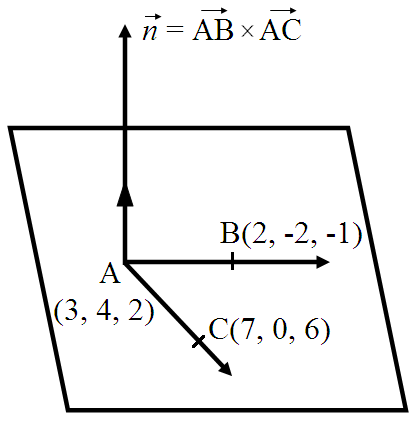 Let A(3, 4, 2), B(2, -2, -1) and C(7, 0, 6) be the points respresented by the given position vectors.
 The required plane passes through the point A(3, 4, 2) whose
position vector is $\vec{\text{a}}=3\hat{\text{i}}+4\hat{\text{j}}+2\hat{\text{k}}$ and is normal to the vector $\vec{\text{n}}$ given by $\vec{\text{n}}=\overrightarrow{\text{AB}}\times\overrightarrow{\text{AC}}$ Clearly, $\overrightarrow{\text{AB}}=\overrightarrow{\text{OB}}-\overrightarrow{\text{OA}}$ $=(2\hat{\text{i}}-2\hat{\text{j}}-\hat{\text{k}})-(3\hat{\text{i}}+4\hat{\text{j}}+2\hat{\text{k}})$ $=-\hat{\text{i}}-6\hat{\text{j}}-3\hat{\text{k}}$ $\overrightarrow{\text{AC}}=\overrightarrow{\text{OC}}-\overrightarrow{\text{OA}}$ $=(7\hat{\text{i}}+0\hat{\text{j}}+6\hat{\text{k}})-(3\hat{\text{i}}+4\hat{\text{j}}+2\hat{\text{k}})$ $=4\hat{\text{i}}-4\hat{\text{j}}+4\hat{\text{k}}$ $\vec{\text{n}}=\overrightarrow{\text{AB}}\times\overrightarrow{\text{AC}}$ $=\begin{vmatrix}\hat{\text{i}}&\hat{\text{j}}&\hat{\text{k}}\\-1&-6&-3\\4&-4&4\end{vmatrix}$ $=-36\hat{\text{i}}-8\hat{\text{j}}+28\hat{\text{k}}$ The vector equation of the required plane is $\vec{\text{r}}\cdot\vec{\text{n}}=\vec{\text{a}}\cdot\vec{\text{n}}$ $\Rightarrow\vec{\text{r}}\cdot(36\hat{\text{i}}-8\hat{\text{j}}+28\hat{\text{k}})=(3\hat{\text{i}}+4\hat{\text{j}}+2\hat{\text{k}})\cdot(36\hat{\text{i}}-8\hat{\text{j}}+28\hat{\text{k}})$ $\Rightarrow\vec{\text{r}}\cdot\Big[-4(9\hat{\text{i}}+2\hat{\text{j}}+7\hat{\text{k}})\Big]=-108-32+56$ $\Rightarrow\vec{\text{r}}\cdot\Big[-4(9\hat{\text{i}}+2\hat{\text{j}}+7\hat{\text{k}})\Big]=-84$ $\Rightarrow\vec{\text{r}}\cdot(9\hat{\text{i}}+2\hat{\text{j}}+7\hat{\text{k}})=21$ View full question & answer→Question 554 Marks
Reduce the equation $\vec{\text{r}}\cdot(\hat{\text{i}}-2\hat{\text{j}}+2\hat{\text{k}})+6=0$ to the normal form and, hence, find the length of the perpendicular from the origin to the plane.
AnswerThe given equation of the plane is,
$\vec{\text{r}}\cdot(\hat{\text{i}}-2\hat{\text{j}}+2\hat{\text{k}})+6=0$
$\Rightarrow\vec{\text{r}}\cdot(\hat{\text{i}}-2\hat{\text{j}}+2\hat{\text{k}})=-6$ or $\vec{\text{r}}\cdot\vec{\text{n}}=-6,$ where $\vec{\text{n}}=\hat{\text{i}}-2\hat{\text{j}}+2\hat{\text{k}}$
$|\vec{\text{n}}|=\sqrt{1+4+4}=3$
For reducing the given equation to normal form, we need to divide it by $|\vec{\text{n}}|$ Then, we get
$|\vec{\text{r}}|\cdot\frac{\vec{\text{n}}}{|\vec{\text{n}}|}=\frac{-6}{|\vec{\text{n}}|}$
$\Rightarrow\vec{\text{r}}\cdot\Big(\frac{\hat{\text{i}}-2\hat{\text{j}}+2\hat{\text{k}}}{3}\Big)=\frac{-6}{3}$
$\Rightarrow\vec{\text{r}}\cdot\Big(\frac{1}{3}\hat{\text{i}}-\frac{2}{3}\hat{\text{j}}+\frac{2}{3}\hat{\text{k}}\Big)=-2$
Dividing both sides by -1 we get
$\vec{\text{r}}\cdot\Big(-\frac{1}{3}\hat{\text{i}}+\frac{2}{3}\hat{\text{j}}-\frac{2}{3}\hat{\text{k}}\Big)=2\ ...(\text{i})$
The equation of the plane in normal form is
$\vec{\text{r}}\cdot\vec{\text{n}}=\text{d}\ ...(\text{ii})$
(where d is distance of the plane from the origin)
Comparing (i) and (ii)
length of the perpendicular from the origin to the plane = d = 2 units
View full question & answer→Question 564 Marks
Find the vector equations of the coordinate planes.
AnswerWe have to find vector equation of coordinate planes.
For xy-plane.
It passes through origin and is perpendicular to z-axis, so
Put $\vec{\text{a}}=0\hat{\text{i}}+0\hat{\text{j}}+0\hat{\text{k}}$ and $\vec{\text{n}}=\hat{\text{k}}$ in the vector equation of plane passing through point $\vec{\text{a}}$ and perpendicular to vector $\vec{\text{n}}$
$(\vec{\text{r}}-\vec{\text{n}})\vec{\text{n}}=0$
$(\vec{\text{r}}-0\hat{\text{i}}-0\hat{\text{j}}-0\hat{\text{k}})\hat{\text{k}}=0$
$\vec{\text{r}}\cdot\vec{\text{k}}=0\ ...(\text{i})$
For xz-plane,
It passes throught origin and perpendicular to y-axis, so
$\vec{\text{a}}=0\hat{\text{i}}+0\hat{\text{j}}+0\hat{\text{k}}$ and $\vec{\text{n}}=\hat{\text{j}}$
Equation of xz-plane is given by
$(\vec{\text{r}}-\vec{\text{a}})\vec{\text{n}}=0$
$(\vec{\text{r}}-0\hat{\text{i}}-0\hat{\text{j}}-0\hat{\text{k}})\hat{\text{j}}=0$
$\vec{\text{r}}\cdot\hat{\text{j}}=0$
For yz-plane,
It passes throught origin and is perpendicular to x-axis, so
$\vec{\text{a}}=0\hat{\text{i}}+0\hat{\text{j}}+0\hat{\text{k}},\vec{ \text{n}}=\hat{\text{i}}$
$(\vec{\text{r}}-\vec{\text{a}})\vec{\text{n}}=0$
$(\vec{\text{r}}-0\hat{\text{i}}-0\hat{\text{j}}-0\hat{\text{k}})\hat{\text{i}}=0$
$\vec{\text{r}}\cdot\hat{\text{i}}=0$
Hence, equation of xy, yz, zx-plane are given by
$\vec{\text{r}}\cdot\vec{\text{k}}=0$
$\vec{\text{r}}\cdot\hat{\text{i}}=0$
$\vec{\text{r}}\cdot\hat{\text{j}}=0$
View full question & answer→Question 574 Marks
Find the distance of the point (3, 3, 3) from the plane $\vec{\text{r}}\cdot(5\hat{\text{i}}+2\hat{\text{j}}-7\hat{\text{k}})+9=0$
AnswerThe given plane is
$\vec{\text{r}}\cdot(5\hat{\text{i}}+2\hat{\text{j}}-7\hat{\text{k}})+9=0$
$\vec{\text{r}}\cdot(5\hat{\text{i}}+2\hat{\text{j}}-7\hat{\text{k}})=9$
We know that the perpendicular distance of a point P of position vector $\vec{\text{a}}$ from the plane $\vec{\text{r}}\cdot\vec{\text{n}}=\text{d}$ is given by
$\text{p}=\frac{\big|\vec{\text{a}}\cdot\vec{\text{n}}-\text{d}\big|}{|\vec{\text{n}}|}$
Finding the distance from (3, 3, 3) $($which means $3\hat{\text{i}}+3\hat{\text{j}}+3\hat{\text{k}})$ to the given plane
Here, $\vec{\text{a}}=3\hat{\text{i}}+3\hat{\text{j}}+3\hat{\text{k}},\vec{\text{n}}=5\hat{\text{i}}+2\hat{\text{j}}-7\hat{\text{k}},\text{d}=9$
So, the required distance p
$=\frac{\big|(3\hat{\text{i}}+3\hat{\text{j}}+3\hat{\text{k}})\cdot(5\hat{\text{i}}+2\hat{\text{j}}-7\hat{\text{k}})-9\big|}{\big|3\hat{\text{i}}+3\hat{\text{j}}+3\hat{\text{k}}\big|}$
$=\frac{|-15-6+21-9|}{\sqrt{25+4+49}}$
$=\frac{-9}{\sqrt{78}}$
$=\frac{-9}{\sqrt{78}}\text{ units}$
View full question & answer→Question 584 Marks
Find the vector equation of the plane which is at a distance of $\frac{6}{\sqrt{29}}$ from the origin and its normal vector from the origin is $2\hat{\text{i}}-3\hat{\text{j}}+4\hat{\text{k}}$ Also, find its cartesian form.
AnswerGiven, normal vector, $\vec{\text{n}}=2\hat{\text{i}}-3\hat{\text{j}}+4\hat{\text{k}}$
Now, $\hat{\text{n}}=\frac{\vec{\text{n}}}{|\vec{\text{n}}|}$
$=\frac{2\hat{\text{i}}-3\hat{\text{j}}+4\hat{\text{k}}}{\sqrt{29}}$
$=\frac{2}{\sqrt{29}}\hat{\text{i}}-\frac{3}{\sqrt{29}}\hat{\text{j}}+\frac{4}{\sqrt{29}}\hat{\text{k}}$
The equation of the plane in normal from is
$\vec{\text{r}}\cdot\hat{\text{n}}={\text{d}}$ (where d is distance of the plane from the origin)
Substituting, $\hat{\text{n}}=\frac{2}{\sqrt{29}}\hat{\text{i}}-\frac{3}{\sqrt{29}}\hat{\text{j}}+\frac{4}{\sqrt{29}}\hat{\text{k}}$ and $\text{d}=\frac{6}{\sqrt{29}}$ here, we get
$\vec{\text{r}}\cdot\Big(\frac{2}{\sqrt{29}}\hat{\text{i}}-\frac{3}{\sqrt{29}}\hat{\text{j}}+\frac{4}{\sqrt{29}}\hat{\text{k}}\Big)=\frac{6}{\sqrt{29}}\ ...(\text{i})$
Cartesian form
For cartesian form, substituting $\vec{\text{r}}=\text{x}\hat{\text{i}}+\text{y}\hat{\text{j}}+\text{z}\hat{\text{k}}$ in (i) we get
$(\text{x}\hat{\text{i}}+\text{y}\hat{\text{j}}+\text{z}\hat{\text{k}})\cdot\Big(\frac{2}{\sqrt{29}}\hat{\text{i}}-\frac{3}{\sqrt{29}}\hat{\text{j}}+\frac{4}{\sqrt{29}}\hat{\text{k}}\Big)=\frac{6}{\sqrt{29}}$
$\Rightarrow\frac{2\text{x}-3\text{y}+4\text{z}}{\sqrt{29}}=\frac{6}{\sqrt{29}}$
$\Rightarrow2\text{x}-3\text{y}+4\text{z}=6$
View full question & answer→Question 594 Marks
Find the coordinates of the point where the line $\frac{\text{x}-2}{3}=\frac{\text{y}+1}{4}=\frac{\text{z}-2}{2}$ intersect the plane x - y + z - 5 = 0. Also, find the angle between the line and the plane.
AnswerThe coordinates of any point on this line are of the form
$\frac{\text{x}-2}{3}=\frac{\text{y}+1}{4}=\frac{\text{z}-2}{2}=\lambda$
$\Rightarrow\text{x}=3\lambda+2,\text{ y}=4\lambda-1,\text{ z}=2\lambda+2$
So, the coordinates of the point on the given line are $(3\lambda+2,4\lambda-1,2\lambda+2).$ This point lies on the plane x - y + z - 5 = 0
$\Rightarrow3\lambda+2-4\lambda+1+2\lambda+2-5=0$
$\Rightarrow\lambda=0$
So, the coordinates of the point are
$(3\lambda+2,4\lambda-1,2\lambda+2)$
$=\big(3(0)+2,4(0)-1,2(0)+2\big)$
$=(2,-1,2)$
Finding the angle between the line and the plane.
The given line is parallel to the vector $\vec{\text{b}}=3\hat{\text{i}}+4\hat{\text{j}}+2\hat{\text{k}}$ and the given plane is normal to the vector $\vec{\text{n}}=\hat{\text{i}}-\hat{\text{j}}+\hat{\text{k}}$
We know that the angle $\theta$ between the linr and the plane is given by
$\sin\theta=\frac{\vec{\text{b}}\cdot\vec{\text{n}}}{|\vec{\text{b}}||\vec{\text{n}}|}$
$=\frac{(3\hat{\text{i}}+4\hat{\text{j}}+2\hat{\text{k}})\cdot(\hat{\text{i}}-\hat{\text{j}}+\hat{\text{k}})}{|3\hat{\text{i}}+4\hat{\text{j}}+2\hat{\text{k}}||\hat{\text{i}}-\hat{\text{j}}+\hat{\text{k}}|}$
$=\frac{3-4+2}{\sqrt{9+16+4}\sqrt{1+1+1}}$
$=\frac{1}{\sqrt{87}}$
$\theta=\sin^{-1}\Big(\frac{1}{\sqrt{87}}\Big)$
View full question & answer→Question 604 Marks
Find the equation of the plane passing through (a, b, c) and parallel to the plane $\vec{\text{r}}\cdot(\hat{\text{i}}+\hat{\text{j}}+\hat{\text{k}})=2.$
AnswerSubstituting $\vec{\text{r}}=\text{x}\hat{\text{i}}+\text{y}\hat{\text{j}}+\text{z}\hat{\text{k}}$ in the given equation of the plane, we get
$(\text{x}\hat{\text{i}}+\text{y}\hat{\text{j}}+\text{z}\hat{\text{k}})\cdot(\hat{\text{i}}+\hat{\text{j}}+\hat{\text{k}})=2$
x + y + z - 2 = 0 ....(i)
The equation of a plane which is parallel to plane (i) is of the form
x + y + z = k ....(ii)
It is given that plane (ii) is passing through the point (a, b, c). So,
a + b + c = k
Substituting this value of k in (ii) we get
x + y + z = a + b + c, which is the required of the plane.
View full question & answer→Question 614 Marks
Find the equation of the plane through the points (2, 2, -1) and (3, 4, 2) and parallel to the line whose direction ratios are 7, 0, 6.
AnswerThe equation of the plane through (2, 2, -1) is
a(x - 2) + b(y - 2) + c(z + 1) = 0 ....(i)
This plane passes through (3, 4, 2). so,
a(3 - 2) + b(4 - 2) + c(2 + 1) = 0
⇒ a + 2b + 3c = 0 ....(ii)
Again plane (i) is parallel to the line whose direction ratios are 7, 0, 6.
It means that the normal of plane (i) is perpendicular to the line whose direction ratios are 7, 0, 6
⇒ 7a + 0b + 6c = 0 (Because a1a2 + b1b2 + c1c2 = 0)
Solving (i), (ii) and (iii), we get
$\begin{vmatrix}\text{x}-2&\text{y}-2&\text{z}+1\\1&2&3\\7&0&6\end{vmatrix}=0$
⇒ 12(x - 2) + 15(y - 2) - 14(z + 1) = 0
⇒ 12x + 15y - 14z - 68 = 0
View full question & answer→Question 624 Marks
Find the equation of the plane passing through the point (2, 3, 1), given that the direction ratios of the normal to the plane are proportional to 5, 3, 2.
AnswerGiven that, the plane is passing throught p(2, 3, 1) having 5, 3, 2 as the direction ratio of the normal to the plane.
We know that,
Equation of a plane passing through a point $\vec{\text{a}}$ and $\vec{\text{n}}$ is a vector normal to the plane, is given by,
$(\vec{\text{r}}-\vec{\text{a}})\vec{\text{n}}=0\ ...(\text{i})$
So, $\vec{\text{a}}=2\hat{\text{i}}+3\hat{\text{j}}+2\hat{\text{k}}$
$\vec{\text{n}}=5\hat{\text{i}}+3\hat{\text{j}}+2\hat{\text{k}}$
Put, $\vec{\text{a}}$ and $\vec{\text{n}}$ in equation (i),
$\Big[\vec{\text{r}}-(2\hat{\text{i}}+\hat{\text{j}}+\hat{\text{k}})\Big](5\hat{\text{i}}+3\hat{\text{j}}+2\hat{\text{k}})=0$
$\vec{\text{r}}(5\hat{\text{i}}+3\hat{\text{j}}+2\hat{\text{k}})-(2\hat{\text{i}}+3\hat{\text{j}}+\hat{\text{k}})(5\hat{\text{i}}+3\hat{\text{j}}+2\hat{\text{k}})=0$
$\vec{\text{r}}(5\hat{\text{i}}+3\hat{\text{j}}+2\hat{\text{k}})-\big[(2)(5)+(3)(3)+(1)(2)\big]=0$
$\vec{\text{r}}(5\hat{\text{i}}+3\hat{\text{j}}+2\hat{\text{k}})-[10+9+2]=0$
$\vec{\text{r}}(5\hat{\text{i}}+3\hat{\text{j}}+2\hat{\text{k}})-21=0$
Put, $\vec{\text{r}}=\text{x}\hat{\text{i}}+\text{y}\hat{\text{j}}+\text{z}\hat{\text{k}}$
$(\text{x}\hat{\text{i}}+\text{y}\hat{\text{j}}+\text{z}\hat{\text{k}})(5\hat{\text{i}}+3\hat{\text{j}}+2\hat{\text{k}})-21=0$
$(\text{x})(5)+(\text{y})(3)+(\text{z})(2)=21$
$5\text{x}+3\text{y}+2\text{z}=21$
View full question & answer→Question 634 Marks
Find the equation of the plane determined by the intersection of the lines $\frac{\text{x}+3}{3}=\frac{\text{y}}{-2}=\frac{\text{z}-7}{6}$ and $\frac{\text{x}+6}{1}=\frac{\text{y}+5}{-3}=\frac{\text{z}-1}{2}$
AnswerLet $\text{L}_1:=\frac{\text{x}+3}{3}=\frac{\text{y}}{-2}=\frac{\text{z}-7}{6}$ and $\text{L}_2:\frac{\text{x}+6}{1}=\frac{\text{y}+5}{-3}=\frac{\text{z}-1}{2}$ be the equation of two lines.
Let the plane be ax + by + cz + d = 0 ....(i)
Given that the required plane passes through the intersection of the lines L1 and L2
Hence the normal to the plane is perpendicular to the lines L1 and L2
$\therefore$ 3a - 2b + 6c = 0
a - 3b + 2c = 0
Using cross-multiplication we get
$\frac{\text{a}}{-4+18}=\frac{\text{b}}{6-6}=\frac{\text{c}}{-9+2}$
$\Rightarrow\frac{\text{a}}{14}=\frac{\text{b}}{0}=\frac{\text{c}}{-7}$
$\Rightarrow\frac{\text{a}}{2}=\frac{\text{b}}{0}=\frac{\text{c}}{-1}$
View full question & answer→Question 644 Marks
Find the equation of a plane which is at a distance of $3\sqrt{3}\text{ units}$ from the origin and the normal to which is equally inclined to the coordinate axes.
AnswerLet $\alpha,\beta$ and $\gamma$ be the angle made by $\vec{\text{n}}$ with x, y and z-axes, respectively.
It is given that
$\alpha=\beta=\gamma$
$\Rightarrow\cos\alpha=\cos\beta=\cos\gamma$
$\Rightarrow\text{l}=\text{m}=\text{n},$ where l, m, n are direction cosines of $\vec{\text{n}}$
But $\text{l}^2+\text{m}^2+\text{n}^2=1$
$\Rightarrow\text{l}^2+\text{l}^2+\text{l}^2=1$
$\Rightarrow3\text{l}^2=1$
$\Rightarrow\text{l}^2=\frac{1}{3}$
$\Rightarrow\text{l}=\frac{1}{\sqrt{3}}$
So, $\text{l}=\text{m}=\text{n}=\frac{1}{\sqrt{3}}$
It is given that the length of the perpendicular of the plane from the origin, $\text{p}=3\sqrt{3}$
The normal from of the plane is lx + my + nz = p
$\Rightarrow\frac{1}{\sqrt{3}}\text{x}+\frac{1}{\sqrt{3}}\text{y}+\frac{1}{\sqrt{3}}\text{z}=3\sqrt{3}$
$\Rightarrow\text{x}+\text{y}+\text{z}=3\sqrt{3}(\sqrt{3})$
$\Rightarrow\text{x}+\text{y}+\text{z}=9$
View full question & answer→Question 654 Marks
Show that the points $\hat{\text{i}}-\hat{\text{j}}+3\hat{\text{k}}$ and $3\hat{\text{i}}+3\hat{\text{j}}+3\hat{\text{k}}$ are equidistant from the plane $\vec{\text{r}}\cdot(5\hat{\text{i}}+2\hat{\text{j}}-7\hat{\text{k}})+9=0$
AnswerWe know that, distance of a point P of position vector $\vec{\text{a}}$ from the plane $\vec{\text{r}}\cdot\hat{\text{n}}=\text{d}$ is given by
$\text{p}=\frac{\big|\vec{\text{a}}\cdot\vec{\text{n}}-\text{d}\big|}{|\vec{\text{n}}|}\ ...(\text{i})$
Let D1 be the distance of point $(\hat{\text{i}}-\hat{\text{j}}+\hat{\text{k}})$ from the plane $\vec{\text{r}}\cdot(5\hat{\text{i}}+2\hat{\text{j}}-7\hat{\text{k}})+9=0,$ then
$\text{D}_1=\Bigg|\frac{(\hat{\text{i}}-\hat{\text{j}}+3\hat{\text{k}})\cdot(5\hat{\text{i}}+2\hat{\text{j}}-7\hat{\text{k}})+9}{\sqrt{(5)^2+(2)^2+(-7)^2}}\Bigg|$ [Using equation (i)]
$=\Bigg|\frac{(1)(5)+(-1)(2)+(3)(-7)+9}{\sqrt{25+4+49}}\Bigg|$
$=\Big|\frac{5-2-21+9}{\sqrt{78}}\Big|$
$=\Big|-\frac{9}{\sqrt{78}}\Big|$
$\text{D}_1=\frac{9}{\sqrt{78}}\text{ units}\ ...(\text{ii})$
Again, let D2 be the distance of point $(3\hat{\text{i}}-3\hat{\text{j}}+3\hat{\text{k}})$ from the plane $\vec{\text{r}}\cdot(5\hat{\text{i}}+2\hat{\text{j}}-7\hat{\text{k}})+9=0,$ then using equation (i) we get,
$\text{D}_2=\Bigg|\frac{(3\hat{\text{i}}-3\hat{\text{j}}+3\hat{\text{k}})\cdot(5\hat{\text{i}}+2\hat{\text{j}}-7\hat{\text{k}})+9}{\sqrt{(5)^2+(2)^2+(-7)^2}}\Bigg|$
$=\Bigg|\frac{(3)(5)+(3)(2)+(3)(-7)+9}{\sqrt{25+4+49}}\Bigg|$
$=\Big|\frac{15+6-21+9}{\sqrt{78}}\Big|$
$=\Big|\frac{9}{\sqrt{78}}\Big|$
$\text{D}_2=\frac{9}{\sqrt{78}}\text{ units}\ ...(\text{iii})$
From equation (i) and (iii)
$\text{D}_1=\text{D}_2$
Distance of point $(\hat{\text{i}}-\hat{\text{j}}+3\hat{\text{k}})$ from plane $\vec{\text{r}}\cdot(5\hat{\text{i}}+2\hat{\text{j}}-7\hat{\text{k}})+9=0$ = Distance of point $(3\hat{\text{i}}-3\hat{\text{j}}+3\hat{\text{k}})$ from plane $\vec{\text{r}}\cdot(5\hat{\text{i}}+2\hat{\text{j}}-7\hat{\text{k}})+9=0$
View full question & answer→Question 664 Marks
Find the vector equation of the plane passing through the points P(2, 5, -3), Q(-2, -3, 5) and R(5, 3, -3).
Answer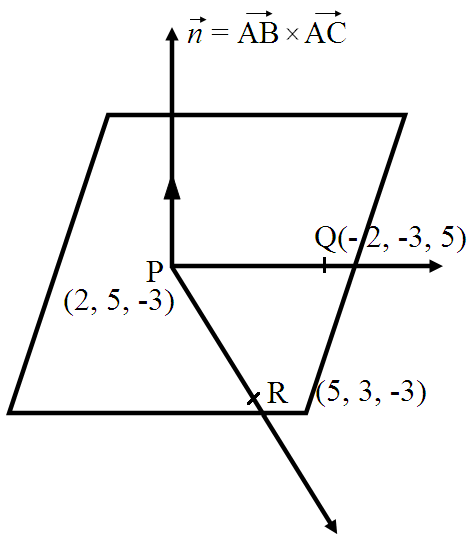
The required plane passes through the point P(2, 5, -3), whose position vector is $\vec{\text{a}}=2\hat{\text{i}}+5\hat{\text{j}}-3\hat{\text{k}}$ and is normal to the vector $\vec{\text{n}}$ given by
$\overrightarrow{\text{PQ}}=\overrightarrow{\text{OQ}}-\overrightarrow{\text{OP}}$
$=(-2\hat{\text{i}}-3\hat{\text{j}}+5\hat{\text{k}})-(2\hat{\text{i}}+5\hat{\text{j}}-3\hat{\text{k}})$
$=-4\hat{\text{i}}-8\hat{\text{j}}+8\hat{\text{k}}$
$\overrightarrow{\text{PR}}=\overrightarrow{\text{OR}}-\overrightarrow{\text{OP}}$
$=(5\hat{\text{i}}+3\hat{\text{j}}-3\hat{\text{k}})-(2\hat{\text{i}}+5\hat{\text{j}}-3\hat{\text{k}})$
$=3\hat{\text{i}}-2\hat{\text{j}}-0\hat{\text{k}}$
$\vec{\text{n}}=\overrightarrow{\text{PQ}}\times\overrightarrow{\text{PR}}$
$=\begin{vmatrix}\hat{\text{i}}&\hat{\text{j}}&\hat{\text{k}}\\-4&-8&8\\3&-2&0\end{vmatrix}$
$=16\hat{\text{i}}+24\hat{\text{j}}+32\hat{\text{k}}$
The vector equation of the required plane is
$\vec{\text{r}}\cdot\vec{\text{n}}=\vec{\text{a}}\cdot\vec{\text{n}}$
$\Rightarrow\vec{\text{r}}\cdot(16\hat{\text{i}}+24\hat{\text{j}}+32\hat{\text{k}})=(2\hat{\text{i}}+5\hat{\text{j}}-3\hat{\text{k}})\cdot(16\hat{\text{i}}+24\hat{\text{j}}+32\hat{\text{k}})$
$\Rightarrow\vec{\text{r}}\cdot\Big[8(2\hat{\text{i}}+3\hat{\text{j}}+4\hat{\text{k}})\Big]=32+120-96$
$\Rightarrow\vec{\text{r}}\cdot\Big[8(2\hat{\text{i}}+3\hat{\text{j}}+4\hat{\text{k}})\Big]=56$
$\Rightarrow\vec{\text{r}}\cdot(2\hat{\text{i}}+3\hat{\text{j}}+4\hat{\text{k}})=7$
View full question & answer→Question 674 Marks
Find the value of $\lambda$ for which the lines $\frac{\text{x}-1}{1}=\frac{\text{y}-2}{2}=\frac{\text{z}+3}{\lambda^2}$ and $\frac{\text{x}-3}{1}=\frac{\text{y}-2}{\lambda^2}=\frac{\text{z}-1}{2}$ are coplanar.
AnswerThe lines $\frac{\text{x}-\text{x}_1}{\text{a}_1}=\frac{\text{y}-\text{y}_1}{\text{b}_1}=\frac{\text{z}-\text{z}_1}{\text{c}_1}$ and $\frac{\text{x}-\text{x}_2}{\text{a}_2}=\frac{\text{y}-\text{y}_2}{\text{b}_2}=\frac{\text{z}-\text{z}_2}{\text{c}_2}$ are coplanar if
$\begin{vmatrix}\text{x}_2-\text{x}_1&\text{y}_2-\text{y}_1&\text{z}_2-\text{z}_1\\\text{a}_1&\text{b}_1&\text{c}_1\\\text{a}_2&\text{b}_2&\text{c}_2\end{vmatrix}=0$
The given lines $\frac{\text{x}-1}{1}=\frac{\text{y}-2}{2}=\frac{\text{z}+3}{\lambda^2}$ and $\frac{\text{x}-3}{1}=\frac{\text{y}-2}{\lambda^2}=\frac{\text{z}-1}{2}$ are coplanar.
$\therefore\ \begin{vmatrix}\text{x}_2-\text{x}_1&\text{y}_2-\text{y}_1&\text{z}_2-\text{z}_1\\\text{a}_1&\text{b}_1&\text{c}_1\\\text{a}_2&\text{b}_2&\text{c}_2\end{vmatrix}=0$
$\Rightarrow\begin{vmatrix}3-1&2-2&1-(-3)\\1&2&\lambda^2\\1&\lambda^2&2\end{vmatrix}=0$
$\Rightarrow\begin{vmatrix}2&0&4\\1&2&\lambda^2\\1&\lambda^2&2\end{vmatrix}=0$
$\Rightarrow2(4-\lambda^4)-0+4(\lambda^4-2)=0$
$\Rightarrow-2\lambda^4+4\lambda^2=0$
$\Rightarrow\lambda^2(\lambda^2-2)=0$
$\Rightarrow\lambda^2=0\text{ or }\lambda^2-2=0$
$\Rightarrow\lambda=0\text{ or }\lambda=\pm\sqrt{2}$
Thus, the values of $\lambda$ are $0,-\sqrt{2}$ and $\sqrt{2}$
View full question & answer→Question 684 Marks
Find the equation of the plane through (2, 3, -4) and (1, -1, 3) and parallel to x-axis.
AnswerThe equation of the plane through (2, 3, -4) is
a(x - 2) + b(y - 3) + c(z + 4) = 0 ....(i)
This plane passes through (1, -1, 3). So,
a(1 - 2) + b(-1 - 3) + c(3 + 4) = 0
⇒ -a - 4b + 7c = 0 ....(ii)
Again plane (i) is parallel to x-axis. It means that plane (i) is perpendicular to the yz-plane whose equation is x = 0 or 1x + 0y + 0z = 0
⇒ a(1) + b(0) + c(0) = 0 ....(iii) (Because a1a2 + b1b2 + c1c2 = 0)
Solving (i), (ii) and (iii), we get
$\begin{vmatrix}\text{x}-3&\text{y}-3&\text{z}+4\\-1&-4&7\\1&0&0\end{vmatrix}=0$
$\Rightarrow0(\text{x}-3)+7(\text{y}-3)+4(\text{z}+4)=0$
$\Rightarrow7\text{y}+4\text{z}-5=0$
View full question & answer→Question 694 Marks
$\overrightarrow{\text{n}}$ is a vector of magnitude $\sqrt{3}$ and is equally inclined to an acute angle with the coordinate axes. Find the vector and cartesian form of the equation of a plane which passes through (2, 1, -1) and is normal to $\overrightarrow{\text{n}}$
AnswerHere, it is given that $\vec{\text{n}}=\sqrt{3}$ and $\vec{\text{n}}$ makes equal angle with coordinate axes.
Let, $\vec{\text{n}}$ has direction cosine as l. m and n and it makes angle of $\alpha,\beta$ and $\gamma$ with the coordinate axes, so
Here, $\alpha=\beta=\gamma$
$\Rightarrow\cos\alpha=\cos\beta=\cos\gamma$
$\Rightarrow\text{l}=\text{m}=\text{n}=\text{p}(\text{say})$
We know that,
$\text{l}^2+\text{m}^2+\text{n}^2=1$
$\text{p}^2+\text{p}^2+\text{p}^2=1$
$3\text{p}^2=1$
$\text{p}^2=\frac{1}{3}$
$\text{p}=\pm\frac{1}{\sqrt{3}}$
So,
$\text{l}=\pm\frac{1}{\sqrt{3}}$
$\cos\alpha=\pm\frac{1}{\sqrt{3}}$
Now, $\alpha=\cos^{-1}\Big(-\frac{1}{\sqrt{3}}\Big)$
It gives, $\alpha$ is an obtuse angle so, neglect it.
Again, $\alpha=\cos^{-1}\Big(-\frac{1}{\sqrt{3}}\Big)$
It gives, $\alpha$ is an acute angle, so
$\cos\alpha=\frac{1}{\sqrt{3}}$
$\therefore\ \text{l}=\text{m}=\text{n}=\frac{1}{\sqrt{3}}$
So,
$\vec{\text{n}}=|\vec{\text{n}}|(\text{l}\hat{\text{i}}+\text{m}\hat{\text{j}}+\text{n}\hat{\text{k}})$
$=\sqrt{3}\Big(\frac{1}{\sqrt{3}}\hat{\text{i}}+\frac{1}{\sqrt{3}}\hat{\text{j}}+\frac{1}{\sqrt{3}}\hat{\text{k}}\Big)$
$\vec{\text{n}}=\hat{\text{i}}+\hat{\text{j}}+\hat{\text{k}}$
And, $\vec{\text{a}}=2\hat{\text{i}}+\hat{\text{j}}-\hat{\text{k}}$
We know that, vector equation of a plane passing through the point $\vec{\text{a}}$ and perpendicular to the vector $\vec{\text{n}}$ is given by,
$(\vec{\text{r}}-\vec{\text{a}}){\vec{\text{n}}}=0$
$\big[\vec{\text{r}}-(2\hat{\text{i}}+\hat{\text{j}}-\hat{\text{k}})\big]\cdot(\hat{\text{i}}+\hat{\text{j}}+\hat{\text{k}})=0$
$\vec{\text{r}}\cdot(\hat{\text{i}}+\hat{\text{j}}+\hat{\text{k}})-(2\hat{\text{i}}+\hat{\text{j}}-\hat{\text{k}})(\hat{\text{i}}+\hat{\text{j}}+\hat{\text{k}})=0$
$\vec{\text{r}}\cdot(\hat{\text{i}}+\hat{\text{j}}+\hat{\text{k}})-[(2)(1)+(1)(1)+(-1)(1)]=0$
$\vec{\text{r}}\cdot(\hat{\text{i}}+\hat{\text{j}}+\hat{\text{k}})-[2+1-1]=0$
$\vec{\text{r}}\cdot(\hat{\text{i}}+\hat{\text{j}}+\hat{\text{k}})-2=0$
$\vec{\text{r}}\cdot(\hat{\text{i}}+\hat{\text{j}}+\hat{\text{k}})=2$
Put, $\vec{\text{r}}=(\text{x}\hat{\text{i}}+\text{y}\hat{\text{j}}+\text{z}\hat{\text{k}})$
$(\text{x}\hat{\text{i}}+\text{y}\hat{\text{j}}+\text{z}\hat{\text{k}})(\hat{\text{i}}+\hat{\text{j}}+\hat{\text{k}})=2$
$(\text{x})(1)+(\text{y})(1)+(\text{z})(1)=2$
$\text{x}+\text{y}+\text{z}=2$
So, vector and cartesian equation of the plane is,
$\vec{\text{r}}\cdot(\hat{\text{i}}+\hat{\text{j}}+\hat{\text{k}})=2$
$\text{x}+\text{y}+\text{z}=2$
View full question & answer→Question 704 Marks
Find the vector equation of the plane passing through the points (1, 1, 1), (1, -1, 1) and (-7, -3, -5)
Answer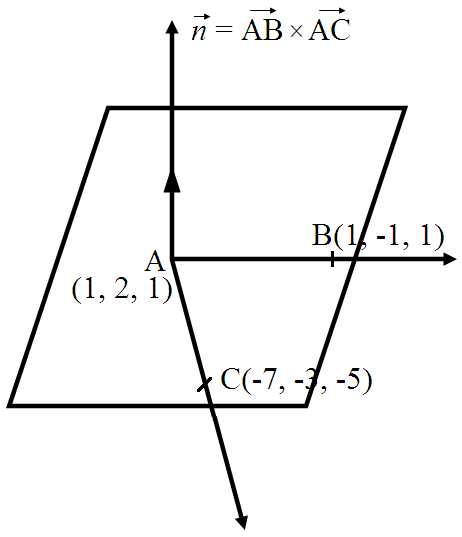
Let A(1, 1, 1), B(1, -1, 1) and C(-7, -3, -5) be the coordinates.
The required plane passes through the point A(1, 1, 1)
Whose position vector is $\vec{\text{a}}=\hat{\text{i}}+\hat{\text{j}}+\hat{\text{k}}$ and is normal to the vector $\vec{\text{n}}$ given by
$\vec{\text{n}}=\overrightarrow{\text{AB}}\times\overrightarrow{\text{AC}}$
Clearly, $\overrightarrow{\text{AB}}=\overrightarrow{\text{OB}}-\overrightarrow{\text{OA}}$
$=(\hat{\text{i}}-\hat{\text{j}}+\hat{\text{k}})-(\hat{\text{i}}+\hat{\text{j}}+\hat{\text{k}})$
$=0\hat{\text{i}}-2\hat{\text{j}}+0\hat{\text{k}}$
$\overrightarrow{\text{AC}}=\overrightarrow{\text{OC}}-\overrightarrow{\text{OA}}$
$=(-7\hat{\text{i}}-3\hat{\text{j}}-5\hat{\text{k}})-(\hat{\text{i}}+\hat{\text{j}}+\hat{\text{k}})$
$=-8\hat{\text{i}}-4\hat{\text{j}}-6\hat{\text{k}}$
$\vec{\text{n}}=\overrightarrow{\text{AB}}\times\overrightarrow{\text{AC}}$
$=\begin{vmatrix}\hat{\text{i}}&\hat{\text{j}}&\hat{\text{k}}\\0&-2&0\\-8&-4&-6\end{vmatrix}$
$=12\hat{\text{i}}+0\hat{\text{j}}-16\hat{\text{k}}$
The vector equation of the required plane is,
$\vec{\text{r}}\cdot\vec{\text{n}}=\vec{\text{a}}\cdot\vec{\text{n}}$
$\Rightarrow\vec{\text{r}}\cdot(12\hat{\text{i}}+0\hat{\text{j}}-16\hat{\text{k}})=(\hat{\text{i}}+\hat{\text{j}}+\hat{\text{k}})(12\hat{\text{i}}+0\hat{\text{j}}-16\hat{\text{k}})$
$\Rightarrow\vec{\text{r}}\cdot\Big[4(3\hat{\text{i}}-4\hat{\text{k}})\Big]=12+0-16$
$\Rightarrow\vec{\text{r}}\cdot\Big[4(3\hat{\text{i}}-4\hat{\text{k}})\Big]=-4$
$\Rightarrow\vec{\text{r}}\cdot(3\hat{\text{i}}-4\hat{\text{k}})=-1$
$\Rightarrow\vec{\text{r}}\cdot(3\hat{\text{i}}-4\hat{\text{k}})+1=0$
View full question & answer→Question 714 Marks
Find the equation of the plane that bisects the line segment joining the points (1, 2, 3) and (3, 4, 5) and is at right angle to it.
AnswerWe know to find the equation pf plane that bisects A(1, 2, 3) and B(3, 4, 5) perpendicularly
We know that, equation of plane passing through the point $\vec{\text{a}}$ and perpendicular to vector $\vec{\text{n}}$ is given by,
$(\vec{\text{r}}-\vec{\text{a}})\vec{\text{n}}=0\ ...(\text{i})$
Here, $\vec{\text{a}}=\text{mid-point of AB}$
$=\frac{\text{position vector of A}+\text{position vector of B}}{2}$
$=\frac{\hat{\text{i}}+2\hat{\text{j}}+3\hat{\text{k}}+3\hat{\text{i}}+4\hat{\text{j}}+5\hat{\text{k}}}{2}$
$\vec{\text{a}}=\frac{4\hat{\text{i}}+6\hat{\text{j}}+8\hat{\text{k}}}{2}$
$\vec{\text{a}}=2\hat{\text{i}}+3\hat{\text{j}}+4\hat{\text{k}}$
And, $\vec{\text{n}}=\overrightarrow{\text{AB}}$
= Position vector of B - Position vector of A
$=(3\hat{\text{i}}+4\hat{\text{j}}+5\hat{\text{k}})-(\hat{\text{i}}+2\hat{\text{j}}+3\hat{\text{k}})$
$=3\hat{\text{i}}+4\hat{\text{j}}+5\hat{\text{k}}-\hat{\text{i}}-2\hat{\text{j}}-3\hat{\text{k}}$
$\vec{\text{n}}=2\hat{\text{i}}+2\hat{\text{j}}+2\hat{\text{k}}$
Put, the value of $\vec{\text{a}}$ and $\vec{\text{n}}$ in equation (i),
$\vec{\text{r}}-(2\hat{\text{i}}+3\hat{\text{j}}+4\hat{\text{k}})(2\hat{\text{i}}+2\hat{\text{j}}+2\hat{\text{k}})=0$
$\vec{\text{r}}(2\hat{\text{i}}+2\hat{\text{j}}+2\hat{\text{k}})-\big[(2\hat{\text{i}}+3\hat{\text{j}}+4\hat{\text{k}})(2\hat{\text{i}}+2\hat{\text{j}}+2\hat{\text{k}})\big]=0$
$\vec{\text{r}}(2\hat{\text{i}}+2\hat{\text{j}}+2\hat{\text{k}})-[(2)(2)+(3)(2)+(4)(2)]=0$
$\vec{\text{r}}(2\hat{\text{i}}+2\hat{\text{j}}+2\hat{\text{k}})-[4+6+8]=0$
$\vec{\text{r}}(2\hat{\text{i}}+2\hat{\text{j}}+2\hat{\text{k}})-18=0$
$\vec{\text{r}}(2\hat{\text{i}}+2\hat{\text{j}}+2\hat{\text{k}})=18$
View full question & answer→Question 724 Marks
If the line $\frac{\text{x}-3}{2}=\frac{\text{y}+2}{-1}=\frac{\text{z}+4}{3}$ lies in the plane lx + my - z = 9, then find the value of l2 + m2.
AnswerThe line $\frac{\text{x}-\text{x}_1}{\text{a}}=\frac{\text{y}-\text{y}_1}{\text{b}}=\frac{\text{z}-\text{z}_1}{\text{c}}$ lies in the plane Ax + By + Cz + D = 0 if (i) Ax1 + By1 + Cz1 + D = 0 and (ii) aA + bB + cC = 0
It is given that the line $\frac{\text{x}-3}{2}=\frac{\text{y}+2}{-1}=\frac{\text{z}+4}{3}$ lies in the plane lx + my - z = 9
$\therefore$ l × 3 + m × (-2) - (-4) = 9
⇒ 3l - 2m = 5 ....(i)
Also,
2 × l + (-1) × m + 3 × (-1) = 0
⇒ 2l - m = 3 ....(ii)
Solving (i) and (ii) we get
l = 1 and m = -1
$\therefore$ l2 + m2 = 12 + (-1)2 = 1 + 1 = 2
Thus, the value of l2 + m2 is 2
View full question & answer→Question 734 Marks
If the product of the distances of the point (1, 1, 1) from the origin and the plane x - y + z + λ = 0 be 5, find the value of λ.
AnswerWe know that the distance of the point (x1, y1, z1) from the plane ax + by + cz + d = 0 is given by
$\frac{|\text{ax}_1+\text{by}_1+\text{cz}_1+\text{d}|}{\sqrt{\text{a}^2+\text{d}^2+\text{c}^2}}$
Distance of the point (1, 1, 1) from the plane $\text{x}-\text{y}+\text{z}+\lambda=0$
The required distance,
$=\frac{|1-1+1+\lambda|}{\sqrt{1^2+(-1)^2+1^2}}$
$=\frac{|1+\lambda|}{\sqrt{3}}\text{ units}\ ...(\text{i})$
Distance of the point (0, 0, 0) from the plane $\text{x}-\text{y}+\text{z}+\lambda=0$
The required distance,
$=\frac{|0-0+0+\lambda|}{\sqrt{1^2+(-1)^2+1^2}}$
$=\frac{|\lambda|}{\sqrt{3}}\text{ units}\ ...(\text{ii})$
It is given that the product of the distance (i) and (ii) is 5
$\frac{|1+\lambda|}{\sqrt{3}}\times\frac{|\lambda|}{\sqrt{3}}=5$
$\lambda^2+\lambda-15=0$
View full question & answer→Question 744 Marks
Find the vector equation (in scalar product form) of the plane containing the line of intersection of the planes x - 3y + 2z - 5 = 0 and 2x - y + 3z - 1 = 0 and passing through (1, -2, 3).
AnswerThe equation of the plane passing through the line of intersection of the given planes is
$\text{x}-3\text{y}+2\text{z}-5+\lambda(2\text{x}-\text{y}+3\text{z}-1)=0\ ...(\text{i})$
This passing through (1, -2, 3). So,
$1+6+6-5+\lambda(2+2+9-1)$
$\Rightarrow8+12\lambda=0$
$\Rightarrow\lambda=\frac{-2}{3}$
Substituting this in (i) we get
$\text{x}-3\text{y}+2\text{z}-5-\frac{2}{3}(2\text{x}-\text{y}+3\text{z}-1)=0$
$\Rightarrow-\text{x}-7\text{y}-13=0$
$\Rightarrow\text{x}+7\text{y}+13=0$
$\Rightarrow\vec{\text{r}}\cdot(\hat{\text{i}}+7\hat{\text{j}})+13=0,$ Which is the required vector equation of the plane.
View full question & answer→Question 754 Marks
Find the equation of the plane through the point $2\hat{\text{i}}+\hat{\text{j}}-\hat{\text{k}}$ and passing throught the line of intersection of the planes $\vec{\text{r}}\cdot(\hat{\text{i}}+3\hat{\text{j}}-\hat{\text{k}})=0$ and $\vec{\text{r}}\cdot(\hat{\text{j}}+2\hat{\text{k}})=0.$
AnswerThe equation of the plane passing through the line of intersection of the given planes is,
$\vec{\text{i}}(\hat{\text{i}}+3\hat{\text{j}}-\hat{\text{k}})+\lambda\big(\vec{\text{r}}(\hat{\text{j}}+2\hat{\text{k}})\big)=0$
$\vec{\text{r}}\cdot\Big[\hat{\text{i}}+(3+\lambda)\hat{\text{j}}+(-1+2\lambda)\hat{\text{k}}\Big]=0\ ...(\text{i})$
This passes through $2\hat{\text{i}}+\hat{\text{j}}-\hat{\text{k}}$ So,
$(2\hat{\text{i}}+\hat{\text{j}}-\hat{\text{k}})\Big[\hat{\text{i}}+(3+\lambda)\hat{\text{j}}+(-1+2\lambda)\hat{\text{k}}\Big]=0$
$\Rightarrow2+3+\lambda+1-2\lambda=0$
$\Rightarrow\lambda=6$
Substituting this in (i), we get
$\vec{\text{r}}\cdot\Big[\hat{\text{i}}+(3+6)\hat{\text{j}}+(-1+12)\hat{\text{k}}\Big]=0$
$\Rightarrow\vec{\text{r}}(\hat{\text{i}}+9\hat{\text{j}}+11\hat{\text{k}})=0$
View full question & answer→Question 764 Marks
If the lines $\text{x}=5,\frac{\text{y}}{3-\alpha}=\frac{\text{z}}{-2}$ and $\text{x}=\alpha,\frac{\text{y}}{-1}=\frac{\text{z}}{2-\alpha}$ are coplanar, find the values of $\alpha.$
AnswerThe lines $\frac{\text{x}-\text{x}_1}{\text{a}_1}=\frac{\text{y}-\text{y}_1}{\text{b}_1}=\frac{\text{z}-\text{z}_1}{\text{c}_1}$ and $\frac{\text{x}-\text{x}_2}{\text{a}_2}=\frac{\text{y}-\text{y}_2}{\text{b}_2}=\frac{\text{z}-\text{z}_2}{\text{c}_2}$ are coplanar if
$\begin{vmatrix}\text{x}_2-\text{x}_1&\text{y}_2-\text{y}_1&\text{z}_2-\text{z}_1\\\text{a}_1&\text{b}_1&\text{c}_1\\\text{a}_2&\text{b}_2&\text{c}_2\end{vmatrix}=0$
The given lines $\frac{\text{x}-5}{0}=\frac{\text{y}}{3-\alpha}=\frac{\text{z}}{-2}$ and $\frac{\text{x}-\alpha}{0}=\frac{\text{y}}{-1}=\frac{\text{z}}{2-\alpha}$ are coplanar.
$\therefore\ \begin{vmatrix} \alpha-5&0-0&0-0\\0&3-\alpha&-2\\0&-1&2-\alpha\end{vmatrix}=0$
$\Rightarrow\begin{vmatrix} \alpha-5&0-0&0-0\\0&3-\alpha&-2\\0&-1&2-\alpha\end{vmatrix}=0$
$\Rightarrow(\alpha-5)\Big[(3-\alpha)\times(2-\alpha)-2\Big]-0+0=0$
$\Rightarrow(\alpha-5)(\alpha-1)(\alpha-4)=0$
$\Rightarrow\alpha-1=0\text{ or }\alpha-4=0\text{ or }\alpha-5=0$
$\Rightarrow\alpha=1\text{ or }\alpha=4\text{ or }\alpha=5$
Thus, the values of $\alpha$ are 1, 4 and 5.
View full question & answer→Question 774 Marks
Find the distance of the point P(3, 4, 4) from the point, where the line joining the points A(3, -4, -5) and B(2, -3, 1) intersects the plane 2x + y + z = 7.
AnswerThe equation of a line joining the points A(3, -4, -5) and B(2, -3, 1) is
$\frac{\text{x}-3}{2-3}=\frac{\text{y}+4}{-3+4}=\frac{\text{z}+5}{1+5}=\text{r}$
$\Rightarrow\text{x}=3-\text{r},\text{ y}=-4+\text{r},\text{ z}=-5+6\text{r}$
Substituting this into the given plane equation we get
$2(3-\text{r})+(-4+\text{r})+(-5+6\text{r})=7$
$\Rightarrow\text{r}=2$
$\Rightarrow\text{x}=1,\text{ y}=-2,\text{ z}=7$
Distance of (1, -2, 7) from (3, 4, 4) is
$=\sqrt{(3-1)^2+(4+2)^2+(4-7)^2}$
$=\sqrt{4+36+9}$
$=\sqrt{49}$
$=7$
View full question & answer→Question 784 Marks
Find the cartesian form of the equations of the following planes.
$\vec{\text{r}}=(1+\text{s}+\text{t})\hat{\text{i}}+(2-\text{s}+\text{t})\hat{\text{j}}+(3-2\text{s}+2\text{t})\hat{\text{k}}$
AnswerThe given equation of the plane is,
$\vec{\text{r}}=(1+\text{s}+\text{t})\hat{\text{i}}+(2-\text{s}+\text{t})\hat{\text{j}}+(3-2\text{s}+2\text{t})\hat{\text{k}}$
$\Rightarrow\vec{\text{r}}=(\hat{\text{i}}+2\hat{\text{j}}+3\hat{\text{k}})+\text{s}(\hat{\text{i}}-\hat{\text{j}}-2\hat{\text{k}})+\text{t}(\hat{\text{i}}+\hat{\text{j}}+2\hat{\text{k}})$
Normal vector, $\vec{\text{n}}=\vec{\text{b}}\times\vec{\text{c}}$
$=\begin{vmatrix}\hat{\text{i}}&\hat{\text{j}}&\hat{\text{k}}\\1&-1&-2\\1&1&2\end{vmatrix}$
$=0\hat{\text{i}}-4\hat{\text{j}}+2\hat{\text{k}}$
$=-4\hat{\text{j}}+2\hat{\text{k}}$
The vector equation of the plane in scalar product from is
$\vec{\text{r}}\cdot\vec{\text{n}}=\vec{\text{a}}\cdot\vec{\text{n}}$
$\Rightarrow\vec{\text{r}}\cdot(-4\hat{\text{j}}+2\hat{\text{k}})=(\hat{\text{i}}+2\hat{\text{j}}+3\hat{\text{k}})(-4\hat{\text{j}}+2\hat{\text{k}})$
$\Rightarrow\vec{\text{r}}\cdot\Big[-2(2\hat{\text{j}}-\hat{\text{k}})\Big]=0-8+6$
$\Rightarrow\vec{\text{r}}\cdot\Big[-2(2\hat{\text{j}}-\hat{\text{k}})\Big]=-2$
$\Rightarrow\vec{\text{r}}\cdot(2\hat{\text{j}}-\hat{\text{k}})=1$
For cartesian form, let us substitute $\vec{\text{r}}=\text{x}\hat{\text{i}}+\text{y}\hat{\text{j}}+\text{z}\hat{\text{k}}$ here. Then, we get
$(\text{x}\hat{\text{i}}+\text{y}\hat{\text{j}}+\text{z}\hat{\text{k}})\cdot(2\hat{\text{j}}-\hat{\text{k}})=1$
$\Rightarrow2\text{y}-\text{z}=1$
View full question & answer→Question 794 Marks
Find the equation of a plane passing through the points (0, 0, 0) and (3, -1,2) and parallel to the line $\frac{\text{x}-4}{1}=\frac{\text{y}+3}{-4}=\frac{\text{z}+1}{7}$
AnswerThe equation of the plane through (0, 0, 0) is
a(x - 0) + b(y - 0) + c(z - 0) = 0
ax + by + cz = 0 ...(i)
This plane passes through (3, -1, 2) So,
3a - b + 2c = 0 ....(ii)
Again plane (i) is parallel to the given line.
It means that the normal to plane (i) is perpendicular to the line.
⇒ a(1) + b(-4) + c(7) = 0 ....(iii) (Because a1a2 + b1b2 + c1c2 = 0)
Solving (i), (ii) and (iii) we get
$\begin{vmatrix}\text{x}&\text{y}&\text{z}\\3&-1&2\\1&-4&7\end{vmatrix}=0$
⇒ x - 19y - 11z = 0
View full question & answer→Question 804 Marks
Find the equation of the plane through the line of intersection of the planes x + 2y + 3z + 4 = 0 and x - y + z + 3 = 0 and passing through the origin.
AnswerWe know that, equation of a plane passing through the line of intersection of planes a1x + b1y + c1z + d1 = 0 and a2x + b2y + c2z + d2 = 0 is given by,
$(\text{a}_1\text{x}+\text{b}_1\text{y}+\text{c}_1\text{z}+\text{d}_1)+\lambda(\text{a}_2\text{x}+\text{b}_2\text{y}+\text{c}_2\text{z}+\text{d}_2)=0$
So, equation of plane passing through the line of intersection of planes x + 2y + 3z + 4 = 0 and x - y + z + 3 = 0 is
$(\text{x}+2\text{y}+3\text{z}+4)+\lambda(\text{x}-\text{y}+\text{z}+3)=0$
$\text{x}(1+\lambda)+\text{y}(2-\lambda)+\text{z}(3+\lambda)+4+3\lambda=0\ ...(\text{i})$
Equation (i) is passing through origin, so
$(0)(1+\lambda)+(0)(2-\lambda)+(0)(3+\lambda)+4+3(\lambda)=0$
$0+0+0+4+3\lambda=0$
$3\lambda=-4$
$\lambda=-\frac{4}{3}$
Put the value of $\lambda$ in equation (i),
$\text{x}(1+\lambda)+\text{y}(2-\lambda)+\text{z}(3+\lambda)+4+3\lambda=0$
$\text{x}\Big(1-\frac{4}{3}\Big)+\text{y}\Big(2+\frac{4}{3}\Big)+\text{z}\Big(3-\frac{4}{3}\Big)+4-\frac{12}{3}=0$
$\text{x}\Big(\frac{3-4}{3}\Big)+\text{y}\Big(\frac{6+4}{3}\Big)+\text{z}\Big(\frac{9-4}{3}\Big)+4-4=0$
$-\frac{\text{x}}{3}+\frac{10\text{y}}{3}+\frac{5\text{z}}{3}=0$
Multiplying by 3, we get
-x + 10y + 5z = 0
x - 10y - 5z = 0
The equation of required plane is,
x - 10y - 5z = 0
View full question & answer→Question 814 Marks
Find the equations of the planes parallel to the plane x - 2y + 2z - 3 = 0 and which are at a unit distance from the point (1, 1, 1).
AnswerThe equation of the plane parallel to the given plane is
x - 2y + 2z + k = 0 ...(i)
It is given the plane (i) is at a distance of 1 unit from (1, 1, 1)
$\Rightarrow\frac{|1-2+2+\text{k}|}{\sqrt{1^2+(-2)^2+2^2}}=1$
$\Rightarrow\frac{|1+\text{k}|}{3}=1$
⇒ |1 + k| = 3
⇒ 1 + k = 3, 1 + k = -3
Substituting these two values one by one in (i) we get
x - 2y + 2z + 2 = 0 and x - 2y + 2z - 4 = 0, which are the equations of the required planes.
View full question & answer→Question 824 Marks
Find the value of $\lambda$ such that the line $\frac{\text{x}-2}{6}=\frac{\text{y}-1}{\lambda}=\frac{\text{z}+5}{-4}$ is perpendicular to the plane 3x - y - 2z = 7.
AnswerHere, given mid line $\frac{\text{x}-2}{6}=\frac{\text{y}-1}{\lambda}=\frac{\text{z}+5}{-4}$ is parpendicular to plane 3x - y - 2z = 7 so, normal vector of plane is parallel to line so,
Direction ratios of normal to plane are proparional to the direction ratios of line.
Here,
$\frac{6}{3}=\frac{\lambda}{-1}=\frac{-4}{-2}$
cross multiplying the last two
$-2\lambda=4$
$\lambda=\frac{4}{-2}$
$\lambda=-2$
View full question & answer→Question 834 Marks
Find the equatoion of the passing through the points (1, -1, 2) and (2, -2, 2) and which is perpendicular to the plane 6x - 2y + 2z = 9.
AnswerThe equation of any plane passing through (1, -1, 2) is
a(x - 1) + b(y + 1) + c(z - 2) = 0 ....(i)
It is given that (i) is passing through (2, -2, 2). So,
a(2 - 1) + b(-2 + 1) + c(2 - 2) = 0
⇒ a - b + 0c = 0 ...(ii)
It is given that (i) is perpendicular to the plane 6x - 2y + 2z = 9. So,
6a - 2b + 2c = 0
⇒ 3a - b + c = 0 ...(iii)
Solving (i), (ii) and (iii) we get,
$\begin{vmatrix}\text{x}-1&\text{y}+1&\text{z}-2\\1&-1&0\\3&-1&1\end{vmatrix}=0$
⇒ -1(x - 1) - 1(y + 1) + 2(z - 2) = 0
⇒ -x + 1 - y - 1 + 2z - 4= 0
⇒ x + y - 2z + 4 = 0
View full question & answer→Question 844 Marks
Find the equation of the plane passing through the line of intersection of the planes x + 2y +3z - 4 = 0 and 2x + y - z + 5 = 0 and perpendicular to the plane 5x + 3y - 6z + 8 = 0.
AnswerThe equationof the planepassing the line of intersection of the given planes is,
$\text{x}+2\text{y}+3\text{z}-4+\lambda(2\text{x}+\text{y}-\text{z}+5)=0$
$(1+2\lambda)\text{x}+(2+\lambda)\text{y}+(3-\lambda)\text{z}-4+5\lambda=0\ ...(\text{i})$
The plane is perpendicular to 5x + 3y - 6z + 8 = 0. So,
$5(1+2\lambda)+3(2+\lambda)-6(3-\lambda)=0$ (Because a1a2 + b1b2 + c1c2 = 0)
$\Rightarrow5+10\lambda+6+3\lambda-18+6\lambda=0$
$\Rightarrow19\lambda-7=0$
$\Rightarrow\lambda=\frac{7}{19}$
Substituting this in (i), we get
$\Big(1+2\Big(\frac{7}{19}\Big)\Big)\text{x}+\Big(2+\frac{7}{19}\Big)\text{y}+\Big(3-\frac{7}{19}\Big)\text{z}-4+5\Big(\frac{7}{19}\Big)=0$
$\Rightarrow33\text{x}+45\text{y}+50\text{z}-41=0$
View full question & answer→Question 854 Marks
Find the equation of the plane that contains the point (1, -1, 2) and is perpendicular to each of the planes 2x + 3y - 2z = 5 and x + 2y - 3z = 8.
AnswerThe equation of any plane passing through (1, -1, 2) is,
a(x - 1) + b(y + 1) + c(z - 2) = 0 ....(i)
It is given that (i) is perpendicular to the plane 2x + 3y - 3z = 5. So,
2a + 3b - 3c = 0 ....(ii)
It is given that (i) is perpendicular to the plane x + 2y - 3z = 8. So,
a + 2b - 3c = 0 ....(iii)
Solving (i), (ii) and (iii) we get,
$\begin{vmatrix}\text{x}-1&\text{y}+1&\text{z}-2\\2&3&-2\\1&2&-3\end{vmatrix}=0$
⇒ -5(x - 1) + 4(y + 1) + 1(z - 2) = 0
⇒ 5x - 4y - z = 7
View full question & answer→Question 864 Marks
Find the intercepts made on the coordinate axes by the plane 2x + y - 2z = 3 and also find the direction cosines of the normal to the plane.
AnswerHere, given equation of plane is,
2x + y - 2z = 3
Dividing by 3 on both the sides,
$\frac{2\text{x}}{3}+\frac{\text{y}}{3}-\frac{2\text{z}}{3}=\frac{3}{3}$
$\frac{\text{x}}{\frac{3}{2}}+\frac{\text{y}}{3}+\frac{\text{z}}{-\frac{3}{2}}=1\ ...(\text{i})$
We know that, if a, b, c are the intercepts by a plane on the coordinate axes,
new equation of the plane is,
$\frac{\text{x}}{\text{a}}+\frac{\text{y}}{\text{b}}+\frac{\text{z}}{\text{c}}=1\ ....(\text{ii})$
Comparing the equation (i) and (ii),
$\text{a}=\frac{3}{2},\text{b}=3,\text{c}=-\frac{3}{2}$
Again, given equation of plane is,
2x + y - 2z = 3
$(\text{x}\hat{\text{i}}+\text{y}\hat{\text{j}}+\text{z}\hat{\text{k}})(2\hat{\text{i}}+\hat{\text{j}}-2\hat{\text{k}})=3$
$\vec{\text{r}}(2\hat{\text{i}}+\hat{\text{j}}-2\hat{\text{k}})=3$
So, vector normal to the plane is given by
$\vec{\text{n}}=2\hat{\text{i}}+\hat{\text{j}}-2\hat{\text{k}}$
$|\vec{\text{n}}|=\sqrt{(2)^2+(1)^2+(-2)^2}$
$=\sqrt{4+1+4}$
$=\sqrt{9}$
$|\vec{\text{n}}|=3$
Direction vector of $\vec{\text{n}}=2,1,-2$
Direction vector $\vec{\text{n}}=\frac{2}{|\vec{\text{n}}|},\frac{1}{|\vec{\text{n}}|},\frac{-2}{|\vec{\text{n}}|}$
$=\frac{2}{3},\frac{1}{3},-\frac{2}{3}$
So,
Intercepts by the plane on coordinaye axes are $=\frac{3}{2},3,-\frac{3}{2}$
Direction cosine of normal to the plane are $=\frac{2}{3},\frac{1}{3},-\frac{2}{3}$
View full question & answer→Question 874 Marks
Find the position vector of the food of perpendicular and the perpendicular distance from the point P with position vector $2\hat{\text{i}}+3\hat{\text{j}}+4\hat{\text{k}}$ to the plane $\vec{\text{r}}.(2\hat{\text{i}}+\hat{\text{j}}+3\hat{\text{k}})-26=0.$ Also find image or P in the plane.
AnswerLet M be the foot of the perpendicular drawn from the point P(2, 3, 4) in the plane
$\vec{\text{r}}.(2\hat{\text{i}}+\hat{\text{j}}+3\hat{\text{k}})-26=0$ or 2x + y + 3z - 26 = 0
Then, PM is the normal to the plane. So, the direction rations of PM are proportional to 2, 1, 3.
Since PM passes throught P(2, 3, 4) and has direction rations proportional to 2, 1, 3 so the equation or PM is
$\frac{\text{x}-2}{2}=\frac{\text{y}-3}{1}=\frac{\text{z}-4}{3}=\text{r (say)}$
Let the coordinates or M be (2r + 2, r + 3, 3r + 4). Since M lies in the plane 2x + y + 3z - 26 = 0, So
2(2r + 2) + r + 3 + 3(3r + 4) - 26 = 0
⇒ 4r + 4 + r + 3 + 9r + 12 - 26 = 0
⇒ 14r - 7 = 0
$\Rightarrow\text{r}=\frac{1}{2}$
Therefore, the coordinates of M are
$(2\text{r}+2,\text{r}+3,3\text{r}+4)\\=\Big(2\times\frac{1}{2}+2,\frac{1}{2}+3,3\times\frac{1}{2}+4\Big)\\=\Big(3,\frac{7}{2},\frac{11}{2}\Big)$
Thus, the position vector of the foot of perpendicular are $3\hat{\text{i}}+\frac{7}{2}\hat{\text{j}}+\frac{11}{2}\hat{\text{k}}.$
Now,
Length of the perpendicular from P on to the given plane
$=\Big|\frac{2\times2+1\times3+3\times4-26}{\sqrt{4+1+9}}\Big|$
$=\frac{7}{\sqrt{14}}$
$=\sqrt{\frac{7}{2}}\text{ units}$
Let Q(x1, y1, z1) be the image of point P in the given plane.
Then, the coordinates of M are $\Big(\frac{\text{x}_1+2}{2},\frac{\text{y}_1+3}{2},\frac{\text{z}_1+4}{2}\Big)$
But, the coordinate or M are $\Big(3,\frac{7}{2},\frac{11}{2}\Big)$
$\therefore\Big(\frac{\text{x}_1+2}{2},\frac{\text{y}_1+3}{2},\frac{\text{z}_1+4}{2}\Big)=\Big(3,\frac{7}{2},\frac{11}{2}\Big)$
$\Rightarrow \frac{\text{x}_1+2}{2}=3,\frac{\text{y}_1+3}{2}=\frac{7}{2},\frac{\text{z}_1+4}{2}=\frac{11}{2}$
$\Rightarrow\text{x}_1=4,\text{y}_1=4,\text{z}_1=7$
Thus, the coordinates of the image of the point P in the given plane are (4, 4, 7).
View full question & answer→Question 884 Marks
Find the angle between the line joining the points (3, -4, -2) and (12, 2, 0) and the plane 3x - y + z = 1.
AnswerIt is given that the line passes through A(3, -4, -2) and B(12, 2, 0)
So, $\vec{\text{b}}=\overrightarrow{\text{AB}}=\overrightarrow{\text{OB}}-\overrightarrow{\text{OA}}$
$=12\hat{\text{i}}+2\hat{\text{j}}+0\hat{\text{k}}-(3\hat{\text{i}}-4\hat{\text{j}}-2\hat{\text{k}})$
$=9\hat{\text{i}}+6\hat{\text{j}}+2\hat{\text{k}}$
The given line is parallel to the vector $\vec{\text{b}}=9\hat{\text{i}}+6\hat{\text{j}}+2\hat{\text{k}}$ and the given plane is normal to the vector $\vec{\text{n}}=3\hat{\text{i}}-\hat{\text{j}}+\hat{\text{k}}$
We know that the angle $\theta$ between the line and the plane is given by
$\sin\theta=\frac{\vec{\text{b}}\cdot\vec{\text{n}}}{|\vec{\text{b}}||\vec{\text{n}}|}$
$=\frac{(9\hat{\text{i}}+6\hat{\text{j}}+2\hat{\text{k}})\cdot(3\hat{\text{i}}-\hat{\text{j}}+\hat{\text{k}})}{|9\hat{\text{i}}+6\hat{\text{j}}+2\hat{\text{k}}||3\hat{\text{i}}-\hat{\text{j}}+\hat{\text{k}}|}$
$=\frac{27-6+2}{\sqrt{81+36+4}\sqrt{9+1+1}}=\frac{23}{11\sqrt{11}}$
$\theta=\sin^{-1}\Big(\frac{23}{11\sqrt{11}}\Big)$
View full question & answer→Question 894 Marks
Find the vector equations of the following planes in scalar product form $(\vec{\text{r}}\cdot\vec{\text{n}}=\text{d}):$
$\vec{\text{r}}=(\hat{\text{i}}+\hat{\text{j}})+\lambda(\hat{\text{i}}+2\hat{\text{j}}-\hat{\text{k}})+\mu(-\hat{\text{i}}+\hat{\text{j}}-2\hat{\text{k}})$
AnswerGiven, equation of plane,
$\vec{\text{r}}=(\hat{\text{i}}+\hat{\text{j}})+\lambda(\hat{\text{i}}+2\hat{\text{j}}-\hat{\text{k}})+\mu(-\hat{\text{i}}+\hat{\text{j}}-2\hat{\text{k}})$
We know that, $\vec{\text{r}}=\vec{\text{a}}+\lambda\vec{\text{b}}+\mu\vec{\text{c}}$ represent a plane passing through a point having position vector $\vec{\text{a}}$ and parallel to vectors $\vec{\text{b}}$ and $\vec{\text{c}}.$
Here, $\vec{\text{a}}=\hat{\text{i}}+\hat{\text{j}},\vec{\text{b}}=\hat{\text{i}}+2\hat{\text{j}}-\hat{\text{k}},\vec{\text{c}}=-\hat{\text{i}}+\hat{\text{j}}-2\hat{\text{k}}$
The given plane is perpendicular to a vector
$\vec{\text{n}}=\vec{\text{b}}\times\vec{\text{c}}$
$=\begin{vmatrix}\hat{\text{i}}&\hat{\text{j}}&\hat{\text{k}}\\1&2&-1\\-1&1&-2\end{vmatrix}$
$=\hat{\text{i}}(-4+1)-\hat{\text{j}}(-2-1)+\hat{\text{k}}(1+2)$
$=-3\hat{\text{i}}+3\hat{\text{j}}+3\hat{\text{k}}$
We know that, the equation of plane in scalar product form is given by,
$\vec{\text{r}}\cdot\vec{\text{n}}=\vec{\text{a}}\cdot\vec{\text{n}}$
$\vec{\text{r}}\cdot(-3\hat{\text{i}}+3\hat{\text{j}}+3\hat{\text{k}})=(\hat{\text{i}}+\hat{\text{j}})(-3\hat{\text{i}}+3\hat{\text{j}}+3\hat{\text{k}})$
$\vec{\text{r}}\cdot(-3\hat{\text{i}}+3\hat{\text{j}}+3\hat{\text{k}})=(-1)(-3)+(1)(3)+(0)+(3)$
$\vec{\text{r}}\cdot(-3\hat{\text{i}}+3\hat{\text{j}}+3\hat{\text{k}})=-3+3$
$\vec{\text{r}}\cdot(-3\hat{\text{i}}+3\hat{\text{j}}+3\hat{\text{k}})=0$
Dividing by 3, we get
$\vec{\text{r}}\cdot(-\hat{\text{i}}+\hat{\text{j}}+\hat{\text{k}})=0$
Equation in required form is,
$\vec{\text{r}}\cdot(-\hat{\text{i}}+\hat{\text{j}}+\hat{\text{k}})=0$
View full question & answer→Question 904 Marks
Find the vector equation of the plane passing through the points (1, 1, -1), (6, 4, -5) and (-4, -2, 3).
AnswerLet P(1, 1, -1), Q(6, 4, -5) and R(-4, -2, 3) be three points on a plane having position vectors $\vec{\text{p}},\vec{\text{q}}$ and $\vec{\text{s}}$ respectively. Then the vectors $\overrightarrow{\text{PQ}}$ and $\overrightarrow{\text{PR}}$ are in the same plane.
Therefore, $\overrightarrow{\text{PQ}}\times\overrightarrow{\text{PR}}$ is a vector perpendicular to the plane.
Let $\vec{\text{n}}=\overrightarrow{\text{PQ}}\times\overrightarrow{\text{PR}}$
$\overrightarrow{\text{PQ}}=(6-1)\hat{\text{i}}+(4-1)\hat{\text{j}}+(-5-(-1))\hat{\text{k}}$
$\Rightarrow\overrightarrow{\text{PQ}}=5\hat{\text{i}}+3\hat{\text{j}}-4\hat{\text{k}}$
Similarly,
$\Rightarrow\overrightarrow{\text{PR}}=(-4-1)\hat{\text{i}}+(-2-1)\hat{\text{j}}+(3-(-1))\hat{\text{k}}$
$\Rightarrow\overrightarrow{\text{PR}}=-5\hat{\text{i}}-3\hat{\text{j}}+4\hat{\text{k}}$
Thus,
Here, $\overrightarrow{\text{PQ}}=-\overrightarrow{\text{PR}}$
Therefore, the given points are collinear.
Thus, $\vec{\text{n}}=\text{a}\hat{\text{i}}+\text{b}\hat{\text{j}}+\text{c}\hat{\text{k}}$ where, 5a + 3b - 4c = 0
The plane passes through the point P with position vector $\vec{\text{p}}=\hat{\text{i}}+\hat{\text{j}}-\hat{\text{k}}$
Thus, its vector equation is,
$\big\{\vec{\text{r}}-(\hat{\text{i}}+\hat{\text{j}}-\hat{\text{k}})\big\}\cdot(\text{a}\hat{\text{i}}+\text{b}\hat{\text{j}}+\text{c}\hat{\text{k}})=0$ Where, 5x + 3b - 4c = 0
View full question & answer→Question 914 Marks
If the line drawn from (4, -1, 2) meets a plane at right at the point (-10, 5, 4) find the equation of the plane.
AnswerThe normal is passing through the point A(4, -1, 2) and B(-10, 5, 4) So,
$\overrightarrow{\text{n}}=\overrightarrow{\text{AB}}=\overrightarrow{\text{OB}}-\overrightarrow{\text{OA}}$
$=(-10\hat{\text{i}}+5\hat{\text{j}}+4\hat{\text{k}})-(4\hat{\text{i}}-\hat{\text{j}}+2\hat{\text{k}})$
$=-14\hat{\text{i}}+6\hat{\text{j}}+2\hat{\text{k}}$
Since the plane passes through (-10, 5, 4), $\vec{\text{a}}=-10\hat{\text{i}}+5\hat{\text{j}}+4\hat{\text{k}}$
We know that the vector equation of the plane passing through a point $\vec{\text{a}}$ and normal to $\vec{\text{n}}$ is
$\vec{\text{r}}\cdot(-14\hat{\text{i}}+6\hat{\text{j}}+2\hat{\text{k}})=(-10\hat{\text{i}}+5\hat{\text{j}}+4\hat{\text{k}})(-14\hat{\text{i}}+6\hat{\text{j}}+2\hat{\text{k}})$
$\Rightarrow\vec{\text{r}}\cdot(-14\hat{\text{i}}+6\hat{\text{j}}+2\hat{\text{k}})=140+30+8$
$\Rightarrow\vec{\text{r}}\cdot\big(-2(7\hat{\text{i}}-3\hat{\text{j}}-\hat{\text{k}})\big)=178$
$\Rightarrow\vec{\text{r}}\cdot(7\hat{\text{i}}-3\hat{\text{j}}-\hat{\text{k}})=-89$
Substituting $\vec{\text{r}}=\text{x}\hat{\text{i}}+\text{y}\hat{\text{j}}+\text{z}\hat{\text{k}}$ in the vector equation, we get
$(\text{x}\hat{\text{i}}+\text{y}\hat{\text{j}}+\text{z}\hat{\text{k}})\cdot(7\hat{\text{i}}-3\hat{\text{j}}-\hat{\text{k}})=-89$
$\Rightarrow7\text{x}-3\text{y}-\text{z}=-89$
$\Rightarrow7\text{x}-3\text{y}-\text{z}+89=0$
View full question & answer→Question 924 Marks
Find the angle between line $\frac{\text{x}-1}{1}=\frac{\text{y}-2}{-1}=\frac{\text{z}+1}{1}$ and the plane 2x + y - z = 4.
AnswerWe know that the angle $\theta$ between the line $\frac{\text{x}-\text{x}_1}{\text{a}_1}=\frac{\text{y}-\text{y}_1}{\text{b}_1}=\frac{\text{z}-\text{z}_1}{\text{c}_1}$ and plane a2x + b2y + c2z + d2 = 0 is given by
$\sin\theta=\frac{\text{a}_1\text{a}_2+\text{b}_1\text{b}_2+\text{c}_1\text{c}_2}{\sqrt{\text{a}^2_1+\text{b}^2_1+\text{c}^2_1}\sqrt{\text{a}^2_2+\text{b}^2_2+\text{c}^2_2}}\ ...(\text{i})$
Given, equation of line is
$\frac{\text{x}-1}{1}=\frac{\text{y}-2}{-1}=\frac{\text{z}+1}{1}$
So, a1 = 1, b1 = -1, c1 = 1
Given equation of plane is 2x + y - z - 4 = 0
So, a2 = 2, b2 = 1, c2 = -1
Put these value in equation (i),
$\sin\theta=\frac{\text{a}_1\text{a}_2+\text{b}_1\text{b}_2+\text{c}_1\text{c}_2}{\sqrt{\text{a}^2_1+\text{b}^2_1+\text{c}^2_1}\sqrt{\text{a}^2_2+\text{b}^2_2+\text{c}^2_2}}$
$\sin\theta=\frac{(1)(2)+(-1)(1)+(1)(-1)}{\sqrt{(1)^2+(-1)^2+(1)^2}\sqrt{(2)^2+(1)^2+(-1)^2}}$
$\sin\theta=\frac{2-1-1}{\sqrt{1+1+1}\sqrt{4+1+1}}$
$\sin\theta=\frac{0}{\sqrt{3}\sqrt{6}}$
$\sin\theta=0$
$\theta=0^{\circ}$
angle between plane and line $=0^{\circ}$
View full question & answer→Question 934 Marks
Find the vector equation of the line passing through the point (1, -1, 2) and perpendicular to the plane 2x - y + 3z - 5 = 0.
AnswerLet a, b, c be the direction ratios of the given line.
Since the line passes through the point (1, -1, 2) is
$\frac{\text{x}-1}{\text{a}}=\frac{\text{y}+1}{\text{b}}=\frac{\text{z}-2}{\text{c}}\ ...(\text{i})$
$\text{a}=2\lambda,\text{ b}=-\lambda,\text{ c}=3\lambda$
Substituting these values in (i) we get
$\frac{\text{x}-1}{2}=\frac{\text{y}+1}{-1}=\frac{\text{z}-2}{3},$ which is the cartesian from of the line.
Vector form
The given line passes through a point whose position vector is $\vec{\text{a}}=\hat{\text{i}}-\hat{\text{j}}+2\hat{\text{k}}$ and is parallel to the vector $\vec{\text{b}}=2\hat{\text{i}}-\hat{\text{j}}+3\hat{\text{k}}$
So, its equation in vector form is
$\vec{\text{r}}=\vec{\text{a}}+\lambda\vec{\text{b}}$
$\vec{\text{r}}=(\hat{\text{i}}-\hat{\text{j}}+2\hat{\text{k}})+\lambda(\hat{2\text{i}}-\hat{\text{j}}+3\hat{\text{k}})$
View full question & answer→Question 944 Marks
Find the distance of the point (-1, -5, -10) from the point of intersection of the line $\vec{\text{r}}=(2\hat{\text{i}}-\hat{\text{j}}+2\hat{\text{k}})+\lambda(3\hat{\text{i}}+4\hat{\text{j}}+2\hat{\text{k}})$ and the plane $\vec{\text{r}}\cdot(\hat{\text{i}}-\hat{\text{j}}+\hat{\text{k}})=5.$
AnswerThe given equation of the line is
$\vec{\text{r}}=(2\hat{\text{i}}-\hat{\text{j}}+2\hat{\text{k}})+\lambda(3\hat{\text{i}}+4\hat{\text{j}}+2\hat{\text{k}})$
$\Rightarrow\vec{\text{r}}=(2+3\lambda)\hat{\text{i}}+(-1+4\lambda)\hat{\text{j}}+(2+2\lambda)\hat{\text{k}}$
The coordinates of any point on this line are of the form
$(2+3\lambda)\hat{\text{i}}+(-1+4\lambda)\hat{\text{j}}+(2+2\lambda)\hat{\text{k}}$
or $(2+3\lambda,-1+4\lambda,2+2\lambda)$
Since this point lies on the plane $\vec{\text{r}}\cdot(\hat{\text{i}}-\hat{\text{j}}+\hat{\text{k}})=5,$
$\Big[(2+3\lambda)\hat{\text{i}}+(-1+4\lambda)\hat{\text{j}}+(2+2\lambda)\hat{\text{k}}\Big]\cdot(\hat{\text{i}}-\hat{\text{j}}+\hat{\text{k}})=5$
$\Rightarrow2+3\lambda+1-4\lambda+2+2\lambda-5=0$
$\Rightarrow\lambda=0$
So, the coordinates of the point are
$(2+3\lambda,-1+4\lambda,2+2\lambda)$
$=(2+0,-1+0,2+0)$
$=(2,-1,2)$
Distance between (2, -1, 2) and (-1, -5, -10)
$=\sqrt{(-1-2)^2+(-5+1)^2+(-10-2)^2}$
$=\sqrt{9+16+144}$
$=13\text{ units}$
View full question & answer→Question 954 Marks
The direction ratios of the perpendicular from the origin to a plane are 12, -3, 4 and the length of the perpendicular is 5. Find the equation of the plane.
AnswerGiven, direction ratios of perpendicular from origin to a plane is 12, -3, 4
So,
Normal vector $=12\hat{\text{i}}-3\hat{\text{j}}+4\hat{\text{k}}$
$\vec{\text{n}}=12\hat{\text{i}}-3\hat{\text{j}}+4\hat{\text{k}}$
$|\vec{\text{n}}|=\sqrt{(12)^2+(-3)^2+(4)^2}$
$=\sqrt{144+9+16}$
$=\sqrt{169}$
$|\vec{\text{n}}|=13$
Normal unit vector $\hat{\text{n}}=\frac{\vec{\text{n}}}{|\vec{\text{n}}|}$
$=\frac{1}{13}(12\hat{\text{i}}-3\hat{\text{j}}+4\hat{\text{k}})$
Given that, perpendicular distance of plane from origin is 5 unit.
$\Rightarrow\text{d}=5\text{ unit}$
We know that, equation of a plane at a distance d from origin and normal unit vector $\hat{\text{n}}$ is,
$\vec{\text{r}}\cdot\hat{\text{n}}={\text{d}}$
So, vector equation of required plane is,
$\vec{\text{r}}\cdot\Big(\frac{12}{13}\hat{\text{i}}-\frac{3}{13}\hat{\text{j}}+\frac{4}{13}\hat{\text{k}}\Big)=5$
Put $\vec{\text{r}}=\text{x}\hat{\text{i}}+\text{y}\hat{\text{j}}+\text{z}\hat{\text{k}}$
$(\text{x}\hat{\text{i}}+\text{y}\hat{\text{j}}+\text{z}\hat{\text{k}})\Big(\frac{12}{13}\hat{\text{i}}-\frac{3}{13}\hat{\text{j}}+\frac{4}{13}\hat{\text{k}}\Big)=5$
$(\text{x})\Big(\frac{12}{13}\Big)+(\text{y})\Big(-\frac{3}{13}\Big)+(\text{z})\Big(\frac{4}{13}\Big)=5$
$\frac{12}{13}\text{x}-\frac{3}{13}\text{y}+\frac{4}{13}\text{z}=5$
View full question & answer→Question 964 Marks
Show that the four points (0, -1, -1), (4, 5, 1), (3, 9, 4) and (-4, 4, 4) are coplanar and find the equation of the common plane.
AnswerThe equation of the plane passing through points (0, -1, -1), (4, 5, 1) and (3, 9, 4) is given by,
$\begin{vmatrix}\text{x}-0&\text{y}+1&\text{z}+1\\4-0&5+1&1+1\\3-0&9+1&4+1\end{vmatrix}=0$
$\Rightarrow\begin{vmatrix}\text{x}&\text{y}+1&\text{z}+1\\4&6&2\\3&10&5\end{vmatrix}=0$
$\Rightarrow10\text{x}-14(\text{y}+1)+22(\text{z}+1)=0$
$\Rightarrow5\text{x}-7(\text{y}+1)+11(\text{z}+1)=0$
$\Rightarrow5\text{x}-7\text{y}+11\text{z}+4=0$
Substituting the last points (-4, 4, 4) (it means x = -4; y = 4; z = 4) in this plane equation, we get
5(-4) - 7(4) + 11(4) + 4 = 0
⇒ -48 + 48 = 0
So, the plane equation is satisfied by the points (-4, 4, 4)
So, the given pointsa are coplanar and the equation of the common plane (as we already founded) is
5x - 7y + 11z + 4 = 0
View full question & answer→Question 974 Marks
Find the vector equation of the line through the origin which is perpendicular to the plane $\vec{\text{r}}\cdot(\hat{\text{i}}+2\hat{\text{j}}+3\hat{\text{k}})=3$
AnswerRequired line is perpendicular to plane $\vec{\text{r}}\cdot(\hat{\text{i}}+2\hat{\text{j}}+3\hat{\text{k}})=3,$ so line is parallel to the normal vector $\vec{\text{n}}=\hat{\text{i}}+2\hat{\text{j}}+3\hat{\text{k}}$ of plane.
And it is passing through point $\vec{\text{a}}=0\hat{\text{i}}+0\hat{\text{j}}+0\hat{\text{k}}$
We know that equation of a passing through $\vec{\text{a}}$ and parallel to vector $\vec{\text{b}}$ is,
$\vec{\text{r}}=\vec{\text{a}}+\lambda\vec{\text{b}}\ ...(\text{i})$
Here, $\vec{\text{a}}=0\hat{\text{i}}+0\hat{\text{j}}+0\hat{\text{k}}$ and $\vec{\text{b}}=\vec{\text{n}}=\hat{\text{i}}+2\hat{\text{j}}+3\hat{\text{k}}$
So, $\vec{\text{r}}=(0\hat{\text{i}}+0\hat{\text{j}}+0\hat{\text{k}})+\lambda(\hat{\text{i}}+2\hat{\text{j}}+3\hat{\text{k}})$
Hence, equation required line is
$\vec{\text{r}}=\lambda(\hat{\text{i}}+2\hat{\text{j}}+3\hat{\text{k}})$
View full question & answer→Question 984 Marks
Find the equation of a plane which passes through the point (3, 2, 0) and contains the line $\frac{\text{x}-3}{1}=\frac{\text{y}-6}{5}=\frac{\text{z}-4}{4}$
AnswerRequired equation of plane is passing through the point (3, 2, 0)
$\therefore$ a(x - 3) + b(y - 2) + c(z - 0) = 0
⇒ a(x - 3) + b(y - 2) + cz = 0 ....(i)
Required equation of plane also contains the line $\frac{\text{x}-3}{1}=\frac{\text{y}-6}{5}=\frac{\text{z}-4}{4},$ so it passes through the point (3, 2, 0)
⇒ a(3 - 3) + b(6 - 2) + c(4) = 0
⇒ 4b + 4c = 0 ...(ii)
Also plane will be parallel to,
a(1) + b(5) + c(4) = 0
a + 5b + 4c = 0 ....(iii)
Solving (ii) and (iii) by cross multiplication,
$\frac{\text{a}}{16-20}=\frac{\text{b}}{4-0}=\frac{\text{c}}{0-4}=\lambda(\text{say})$
$-\frac{\text{a}}{4}=\frac{\text{b}}{4}=-\frac{\text{c}}{4}=\lambda(\text{say})$
$\Rightarrow\text{a}=-\lambda,\text{ b}=\lambda,\text{ c}=-\lambda$
Put $\text{a}=-\lambda,\text{ b}=\lambda,\text{ c}=-\lambda$ in equation (i) we get
$(-\lambda)(\text{x}-3)+(\lambda)(\text{y}-2)+(-\lambda)\text{z}=0$
$\Rightarrow-\text{x}+3+\text{y}-2-\text{z}=0$
$\Rightarrow\text{x}-\text{y}+\text{z}-1=0$
View full question & answer→Question 994 Marks
Find the equation of the plane which is parallel to 2x - 3y + z = 0 and which passes through (1, -1, 2).
AnswerGiven, equation of plane is,
2x - 3y + z = 0 ....(i)
We know that equation of a plane parallel the plane (i) is given by
$2\text{x}-3\text{y}+\text{z}+\lambda=0\ ....(\text{ii})$
Given that, plane (ii) is passing through the point (1, -1, 2) so it must satisfy the equation (ii),
$2(1)-3(-1)+(2)+\lambda=0$
$2+3+2+\lambda=0$
$7+\lambda=0$
$\lambda=-7$
Put the value of $\lambda$ in equation (ii),
2x - 3y + z - 7 = 0
So, equation of the required plane is,
2x - 3y + z = 7
View full question & answer→Question 1004 Marks
Find the equation of the plane which bisects the line segment joining the points (-1, 2, 3) and (3, -5, 6) at right angles.
AnswerThe normal is passing through the point A(-1, 2, 3) and B(3, -5, 6) So,
$\overrightarrow{\text{n}}=\overrightarrow{\text{AB}}=\overrightarrow{\text{OB}}-\overrightarrow{\text{OA}}$
$=(3\hat{\text{i}}-5\hat{\text{j}}+6\hat{\text{k}})-(-\hat{\text{i}}+2\hat{\text{j}}+3\hat{\text{k}})$
$=14\hat{\text{i}}-7\hat{\text{j}}+3\hat{\text{k}}$
$\text{Mid}-\text{point of AB} =\Big(\frac{-1+3}{2},\frac{2-5}{2},\frac{3+6}{2}\Big)$
$=\Big(1,\frac{-3}{2},\frac{9}{2}\Big)$
Since the plane passes through $\Big(1,\frac{-3}{2},\frac{9}{2}\Big)$
$\vec{\text{a}}=\hat{\text{i}}-\frac{3}{2}\hat{\text{j}}+\frac{9}{2}\hat{\text{k}}$
We know that the vector equation of the plane passing through a point $\vec{\text{a}}$ and normal to $\vec{\text{n}}$ is,
$\vec{\text{r}}\cdot\vec{\text{n}}=\vec{\text{a}}\cdot\vec{\text{n}}$
Substituting $\vec{\text{a}}=\hat{\text{i}}-\hat{\text{j}}+\hat{\text{k}}$ and $\vec{\text{n}}=4\hat{\text{i}}-7\hat{\text{j}}+3\hat{\text{k}},$ we get
$(\text{x}\hat{\text{i}}+\text{y}\hat{\text{j}}+\text{z}\hat{\text{k}})\cdot(4\hat{\text{i}}-7\hat{\text{j}}+3\hat{\text{k}})=28$
$\Rightarrow4\text{x}-7\text{y}+3\text{z}=28$
$\Rightarrow4\text{x}-7\text{y}+3\text{z}-28=0$
View full question & answer→