Question 15 Marks
Find the vector equation of the plane passing through the point (3, 4, 2) and (7, 0, 6) and perpendicular to the plane 2x - 5y - 15 = 0. Also, show that the plane thus obtaines contains the line
AnswerLet the equation of the plane be $\frac{\text{x}}{\text{a}}+\frac{\text{y}}{\text{b}}+\frac{\text{z}}{\text{c}}=1\ ...(\text{i})$
Plane is passing through (3, 4, 2) and (7, 0, 6)
$\frac{3}{\text{a}}+\frac{4}{\text{b}}+\frac{2}{\text{c}}=1$
$\frac{7}{\text{a}}+\frac{0}{\text{b}}+\frac{6}{\text{c}}=1$
Required plane is perpendicular to 2x - 5y - 15 = 0
$\frac{2}{\text{a}}+\frac{-5}{\text{b}}+\frac{0}{\text{c}}=0$
$\Rightarrow2\text{b}=5\text{a}$
$\therefore\text{ b}=2.5\text{a}$
$\frac{3}{\text{a}}+\frac{4}{\text{2.5a}}+\frac{2}{\text{c}}=1$
$\frac{7}{\text{a}}+\frac{6}{\text{b}}=1$
Solving the above 2 equations,
$\text{a}=3.4=\frac{17}{5},\text{ b}=8.5=\frac{17}{2}$ and $\text{c}=\frac{-34}{6}=-\frac{17}{3}$
Substituting the values in (i)
$\frac{\text{x}}{\frac{17}{5}}+\frac{\text{y}}{\frac{17}{2}}+\frac{\text{z}}{-\frac{17}{3}}=1$
$\Rightarrow\frac{5\text{x}}{17}+\frac{2\text{y}}{17}-\frac{3\text{z}}{17}=1$
$\Rightarrow2\text{x}+2\text{y}-3\text{z}=17$
$\Rightarrow(\text{x}\hat{\text{i}}+\text{y}\hat{\text{j}}+\text{z}\hat{\text{k}})\cdot(5\hat{\text{i}}+2\hat{\text{j}}-3\hat{\text{k}})=17$
$\Rightarrow\vec{\text{r}}\cdot(5\hat{\text{i}}+2\hat{\text{j}}-3\hat{\text{k}})=17$
Vector equation of the plane is $\vec{\text{r}}\cdot(5\hat{\text{i}}+2\hat{\text{j}}-3\hat{\text{k}})=17$
The line passes through B(1, 3, -2)
5(1) + 2(3) - 3(-2) = 17
The point B lies on the plane.
$\therefore$ The line $\vec{\text{r}}=\hat{\text{i}}+3\hat{\text{j}}-2\hat{\text{k}}+\lambda(\hat{\text{i}}-\hat{\text{j}}+\hat{\text{k}})$ lies on the plane $\vec{\text{r}}\cdot(5\hat{\text{i}}+2\hat{\text{j}}-3\hat{\text{k}})=17$
View full question & answer→Question 25 Marks
Find the length and the foot ofo perpendicular from the point $\Big(1,\frac{3}{2},2\Big)$ to the plane 2x - 2y + 4z + 5 = 0
AnswerLet M be the foot of the perpendicular from $\text{P}\Big(1,\frac{3}{2},2\Big)$ on the plane 2x - 2y + 4z + 5 = 0
Then, PM is the normal to the plane. So, its directions rations are proportional to 2, -2, 4.
Since PM passes through $\text{P}\Big(1,\frac{3}{2},2\Big)$, therefore, its equation is
$\frac{\text{x}-1}{2}=\frac{\text{y}-\frac{3}{2}}{-2}=\frac{\text{z}-2}{4}=\lambda\text{ (say)}$
Let the coordinates of M be $\Big(2\lambda+1,-2\lambda+\frac{3}{2},4\lambda+2\Big).$
Now, M lies on the plane 2x - 2y + 4z + 5 = 0.
$\therefore\ 2(2\lambda+1)-2\Big(-2\lambda+\frac{3}{2}\Big)+4(4\lambda+2)+5=0$
$\Rightarrow 24\lambda+12=0$
$\Rightarrow \lambda=-\frac{1}{2}$
So, the coordinates of M are $\Big(2\times\Big(-\frac{1}{2}\big)+1,-2\times\Big(-\frac{1}{2}\Big)+\frac{3}{2},4\times\Big(-\frac{1}{2}\Big)+2\Big)$ or $\Big(0,\frac{5}{2},0\Big)$
Thus, the coordinates of the foot of the perpendicular are $\Big(0,\frac{5}{2},0\Big).$
Now,
$\text{PM}=\sqrt{(1-0)^2+\Big(\frac{3}{2}-\frac{5}{2}\Big)^2+(2-0)^2}$
$=\sqrt{1+1+4}$
$=\sqrt{6}$
Thus, the length of the perpendicular from the given point to the plane is $\sqrt{6}$ units.
View full question & answer→Question 35 Marks
Find the equation of the plane through the line of intersection of the planes $\vec{\text{r}}\cdot(\hat{\text{i}}+3\hat{\text{j}})+6=0$ and $\vec{\text{r}}\cdot(3\hat{\text{i}}-\hat{\text{j}}-4\hat{\text{k}})=0,$ which is at a unit distance from the origin.
AnswerThe equation of the plane passing through the line intersection of the given planes is,
$\vec{\text{r}}\cdot(\hat{\text{i}}+3\hat{\text{j}})+6+\lambda\big(\vec{\text{r}}\cdot(3\hat{\text{i}}-\hat{\text{j}}-4\hat{\text{k}})\big)$
$\vec{\text{r}}\cdot\Big[(1+3\lambda)\hat{\text{i}}+(3-\lambda)\hat{\text{j}}-4\lambda\hat{\text{k}}\Big]+6=0\ ...(\text{i})$
$\vec{\text{r}}\cdot\Big[(1+3\lambda)\hat{\text{i}}+(3-\lambda)\hat{\text{j}}-4\lambda\hat{\text{k}}\Big]=-6$
$\vec{\text{r}}\cdot\Big[(-1-3\lambda)\hat{\text{i}}+(\lambda-3)\hat{\text{j}}-4\lambda\hat{\text{k}}\Big]=6$
Dividing both sides by $\sqrt{(-1-3\lambda^2)+(\lambda-3)^2+16\lambda^2},$ we get
$\vec{\text{r}}\cdot\frac{\Big[-1-3\lambda)\hat{\text{i}}+(\lambda-3)\hat{\text{j}}-4\lambda\hat{\text{k}}\Big]}{\sqrt{(-1-3\lambda^2)+(\lambda-3)^2+16\lambda^2}}=\frac{6}{\sqrt{(-1-3\lambda^2)+(\lambda-3)^2+16\lambda^2}}$
Which is the normal form of plane (i), where
The perpendicular distance of plane (i) from the origin
$=\frac{6}{\sqrt{(-1-3\lambda^2)+(\lambda-3)^2+16\lambda^2}}$
$\Rightarrow1=\frac{6}{\sqrt{(-1-3\lambda^2)+(\lambda-3)^2+16\lambda^2}}\text{ (Given})$
$\Rightarrow\sqrt{(-1-3\lambda^2)+(\lambda-3)^2+16\lambda^2}=6$
$\Rightarrow1+9\lambda^2+6\lambda+\lambda^2+9-6\lambda+16\lambda^2=36$
$\Rightarrow26\lambda^2-26=0$
$\Rightarrow\lambda^2=1$
$\Rightarrow\lambda=1,-1$
Case 1: Substituting $\lambda=1$ in (i) we get
$\vec{\text{r}}\cdot\Big[4\hat{\text{i}}+2\hat{\text{j}}-4\hat{\text{k}}\Big]+6=0$
Case 2: Substituting $\lambda=-1$ in (i) we get
$\vec{\text{r}}\cdot\Big[-2\hat{\text{i}}+4\hat{\text{j}}+4\hat{\text{k}}\Big]+6=0$
View full question & answer→Question 45 Marks
Find the equatoion of the plane passing through the points $(2, 2, 1)$ and $(9, 3, 6)$ and perpendicular to the plane $2x + 6y + 6z = 1.$
AnswerWe know that, equation of plane passing through the point $(x_1, y_1, z_1)$ is given by,
$a(x - x_1) + b(y - y_1) + c(z - z_1) = 0$
Here, the plane is pasing through $(2, 2, 1)$
$a(x - 2) + b(y - 2) + c(z - 1) = 0 ....(i)$
It is also passing through (9, 3, 6), so it must satisfy the equation (i),
$a(9 - 2) + b(3 - 2) + c(6 - 1) = 0$
$7a + b + 5c = 0 ....(ii)$
We know that, plane $a_1x + b_1y + c_1z + d_1 = 0$ and $a_2x + b_2y + c_2z + d_2 = 0$ are perpendicular if
$a_1a_2 + b_1b_2 + c_1c_2= 0 ....(iii)$
Given that, plane (i) is perpendicular to plane
$2x + 6y + 6z = 1 ....(iv)$
Using plane (i), (iv) in equation (iii),
$a_1a_2 + b_1b_2 + c_1c_2= 0$
$(a)(2) + (b)(6) + (c)(6) = 0$
$2a + 6b + 6c = 0 ....(v)$
Solving (ii) and (v) by cross-multiplication,
$\frac{\text{a}}{(1)(6)-(5)(6)}=\frac{\text{b}}{(2)(5)-(7)(6)}=\frac{\text{c}}{(7)(6)-(2)(1)}$
$\frac{\text{a}}{6-30}=\frac{\text{b}}{10-42}=\frac{\text{c}}{42-2}$
$\frac{\text{a}}{-24}=\frac{\text{b}}{-32}=\frac{\text{c}}{40}=\lambda(\text{say})$
$\text{a}=-24\lambda,\text{b}=-32\lambda,\text{c}=40\lambda$
Put $a, b, c$ in equation (i),
$\text{a}(\text{x}-2)+\text{b}(\text{y}-2)+\text{c}(\text{z}-1)=0$
$(-24\lambda)(\text{x}-2)+(-32\lambda)(\text{y}-2)+(40\lambda)(\text{z}-1)=0$
$-24\lambda\text{x}+48\lambda-32\lambda\text{y}+64\lambda+40\lambda\text{z}-40\lambda=0$
$-24\lambda\text{x}-32\lambda\text{y}+40\lambda\text{z}+72\lambda=0$
Dividing by $(-8\lambda),$
$3x + 4y - 5z - 9 = 0$
Equation of required plane is,
$3x + 4y - 5z = 9$
View full question & answer→Question 55 Marks
Find the equation of the plane passing through the line of intersection of the planes $2x - y = 0$ and $3z - y= 0$ and perpendicular to the plane $4x + 5y - 3z = 8$.
AnswerWe know that, equation of a plane passing through the line of intersection of $a_1x + b_1y + c_1z + d_1 = 0$ and $a_2x + b_2y + c_2z + d_2 = 0$ is given by,
$(\text{a}_1\text{x}+\text{b}_1\text{y}+\text{c}_1\text{z}+\text{d}_1)+\lambda(\text{a}_2\text{x}+\text{b}_2\text{y}+\text{c}_2\text{z}+\text{d}_2)=0$
So, equation of plane passing through the line of intersection of plane $2x - y = 0$ and $3z - y = 0$ is,
$(2\text{x}-\text{y})+\lambda(3\text{z}-\text{y})=0$
$2\text{x}-\text{y}+3\lambda\text{z}-\lambda\text{y}=0$
$\text{x}(2)+\text{y}(-1-\lambda)+\text{z}(3\lambda)=0\ ...(\text{i})$
We know that, two planes are perpendicular if,
$\text{a}_1\text{a}_2+\text{b}_1\text{b}_2+\text{c}_1\text{c}_2=0\ ...(\text{ii})$
Given, plane (i) is parpendicular to plane
$4\text{x}+5\text{y}-3\text{z}=8\ ...(\text{iii})$
Using (i) and (iii) in equation (ii),
$(2)(4)+(-1-\lambda)(5)+(3\lambda)(-3)=0$
$8-5-5\lambda-9\lambda=0$
$3-14\lambda=0$
$\lambda=\frac{3}{14}$
Put the value of $\lambda$ in equation (i),
$2\text{x}+\text{y}(-1-\lambda)+\text{z}(3\lambda)=0$
$2\text{x}+\text{y}\Big(-1-\frac{3}{14}\Big)+3\text{z}\Big(\frac{3}{14}\Big)=0$
$2\text{x}+\text{y}\Big(\frac{-14-3}{14}\Big)+\frac{9\text{z}}{14}=0$
$2\text{x}+\text{y}\Big(-\frac{17}{14}\Big)+\frac{9\text{z}}{14}=0$
Multiplying with $14,$ we get
$28x - 17y + 9z = 0$
Equation of required plane is,
$28x - 17y + 9z = 0$
View full question & answer→Question 65 Marks
Find the equation of the plane that is perpendicular to the plane $5x + 3y + 6z + 8 = 0$ and which contains the line of intersection of the planes $x + 2y + 3z - 4 = 0, 2x + y - z + 5 = 0.$
AnswerWe know that, equation of plane passing through the line of intersection of planes $a_1x + b_1y + c_1z + d_1 = 0$ and $a_2x + b_2y + c_2z + d_2 = 0$ is given by,
$(\text{a}_1\text{x}+\text{b}_1\text{y}+\text{c}_1\text{z}+\text{d}_1)+\lambda(\text{a}_2\text{x}+\text{b}_2\text{y}+\text{c}_2\text{z}+\text{d}_2)=0$
So, equation of plane passing through the line of intersection of given two planes is $x + 2y + 3z - 4 = 0$ and $2x + y - z + 5 = 0$ is given by,
$(\text{x}+2\text{y}+3\text{z}-4)+\lambda(2\text{x}+\text{y}-\text{z}+5)=0$
$\text{x}(1+2\lambda)+\text{y}(2+\lambda)+\text{z}(3-\lambda)+4+5\lambda=0\ ...(\text{i})$
We know that two planes are perpendicular if
$\text{a}_1\text{a}_2+\text{b}_1\text{b}_2+\text{c}_1\text{c}_2=0\ ...(\text{ii})$
Given that plane (i) is perpendicular to plane,
$5\text{x}+3\text{y}+6\text{z}+8=0\ ...(\text{iii})$
Using (i) and (iii) in equation (ii),
$(5)(1+2\lambda)+(3)(2+\lambda)+(6)(3-\lambda)=0$
$5+10\lambda+6+3\lambda+18-6\lambda=0$
$29+7\lambda=0$
$7\lambda=-29$
$\lambda=-\frac{29}{7}$
Put the value of $\lambda$ in equation (i),
$\text{x}(1+2\lambda)+\text{y}(2+\lambda)+\text{z}(3-\lambda)-4+5\lambda=0$
$\text{x}\Big(1-\frac{58}{7}\Big)+\text{y}\Big(2-\frac{29}{7}\Big)+\text{z}\Big(3+\frac{29}{7}\Big)-4-\frac{145}{7}=0$
$\text{x}\Big(\frac{7-58}{7}\Big)+\text{y}\Big(\frac{14-29}{7}\Big)+\text{z}\Big(\frac{21+29}{7}\Big)\frac{-28-145}{7}=0$
$\text{x}\Big(-\frac{51}{7}\Big)+\text{y}\Big(-\frac{15}{7}\Big)+\text{z}\Big(\frac{50}{7}\Big)-\frac{173}{7}=0$
View full question & answer→Question 75 Marks
Find the image of the point with position vector $3\hat{\text{i}}+\hat{\text{j}}+2\hat{\text{k}}$ in the plane $\vec{\text{r}}. (2\hat{\text{i}}-\hat{\text{j}}+\hat{\text{k}})=4.$ Also, find the position vectors of the foot of the prependicular and the equation of the perpendicular line through $3\hat{\text{i}}+\hat{\text{j}}+2\hat{\text{k}}.$
AnswerLet Q be the image the point $\text{P}(3\hat{\text{i}}+\hat{\text{j}}+2\hat{\text{k}})$ in the plane $\vec{\text{r}}.(2\hat{\text{i}}-\hat{\text{j}}+\hat{\text{k}})=4$
Since PQ passes through P and is normal to the given plane, it is parallel to the normal vector $2\hat{\text{i}}-\hat{\text{j}}+\hat{\text{k}}$. So, the equation of PQ is
$\vec{\text{r}}=\big(3\hat{\text{i}}+\hat{\text{j}}+2\hat{\text{k}}\big)+\lambda\big(2\hat{\text{i}}-\hat{\text{j}}+\hat{\text{k}}\big)$
As Q lies on PQ, let the position vector of Q be $(3+2\lambda)\hat{\text{i}}+(1-\lambda)\hat{\text{j}}+(2+\lambda)\hat{\text{k}}.$
$=\frac{\Big[(3+2\lambda)\hat{\text{i}}+(1-\lambda)\hat{\text{j}}+(2+\lambda)\hat{\text{k}}\Big]+\Big[3\hat{\text{i}}+\hat{\text{j}}+2\hat{\text{k}}\Big]}{2}$
$=\frac{(6+2\lambda)\hat{\text{i}}+(2-\lambda)\hat{\text{j}}+(4+\lambda)\hat{\text{k}}}{2}$
$=(3+\lambda)\hat{\text{i}}+\Big(1-\frac{\lambda}{2}\Big)\hat{\text{j}}+\Big(2+\frac{\lambda}{2}\Big)\hat{\text{k}}$
Since R lies in the plane $\vec{\text{r}}.\big(2\hat{\text{i}}-\hat{\text{j}}+\hat{\text{k}}\big)=4$
$=\Big[(3+\lambda)\hat{\text{i}}+\Big(1-\frac{\lambda}{2}\Big)\hat{\text{j}}+\Big(2+\frac{\lambda}{2}\Big)\hat{\text{k}}\Big].\Big(2\hat{\text{i}}-\hat{\text{j}}+\hat{\text{k}}\Big)=4$
$\Rightarrow 6+2\lambda-1+\frac{\lambda}{2}+2+\frac{\lambda}{2}=4$
$\Rightarrow 7+2\lambda+\frac{\lambda}{2}+\frac{\lambda}{2}=4$
$\Rightarrow 14+6\lambda=8$
$\Rightarrow 6\lambda=8-14$
$\Rightarrow \lambda=-1$
Putting $\lambda=-1$ in Q, we get
$\text{Q}=(3+2(-1))\hat{\text{i}}+(1-(-1))\hat{\text{j}}+(2+(-1))\hat{\text{k}}$
$=\hat{\text{i}}+2\hat{\text{j}}+\hat{\text{h}}$ or (1, 2, 1)
Therefore, by putting $\lambda=-1$ in R, we get
$\text{R}=(3+(-1))\hat{\text{i}}+\Big(1-\frac{(-1)}{2}\Big)\hat{\text{j}}+\Big(2+\frac{(-1)}{2}\Big)\hat{\text{k}}$
$=2\hat{\text{i}}+\frac{3}{2}\hat{\text{j}}+\frac{3}{2}\hat{\text{k}}$
View full question & answer→Question 85 Marks
Find the equation of the plane passing through the line of intersection of the planes $2x - 7y + 4z = 0, 3x - 5y + 4z + 11 = 0$ and the point $(-2, 1, 3).$
AnswerWe know that, equation of a plane passing through the line of intersection of two planes $a_1x + b_1y + c_1z + d_1 = 0$ and $a_2x + b_2y + c_2z + d_2 = 0$ is given by
$(\text{a}_1\text{x}+\text{b}_1\text{y}+\text{c}_1\text{z}+\text{d}_1)+\lambda(\text{a}_2\text{x}+\text{b}_2\text{y}+\text{c}_2\text{z}+\text{d}_2)=0$
Given, equation of plane is,
$2x - 7y + 4z - 3 = 0$ and
$3x - 5y + 4z + 11 = 0$
So, equation of plane passing through the line of intersection of given two planes is,
$(-2)(2+3\lambda)+(1)(-7-5\lambda)+(3)(4+4\lambda)-3+11\lambda=0$
$-4-6\lambda-7-5\lambda+12+12\lambda-3+11\lambda=0$
$-2+12\lambda=0$
$12\lambda=2$
$\lambda=\frac{2}{12}$
$\lambda=\frac{1}{6}$
Put $\lambda$ in equation (i),
$\text{x}(2+3\lambda)+\text{y}(-7+5\lambda)+\text{z}(4+4\lambda)-3+11\lambda=0$
$\text{x}\Big(2+\frac{3}{6}\Big)+\text{y}\Big(-7-\frac{5}{6}\Big)+\text{z}\Big(4+\frac{4}{6}\Big)-3+\frac{11}{6}=0$
$\text{x}\Big(\frac{12+3}{6}\Big)+\text{y}\Big(\frac{-42-5}{6}\Big)+\text{z}\Big(\frac{24+4}{6}\Big)-\frac{18+11}{6}=0$
$\frac{15}{6}\text{x}-\frac{47}{6}\text{y}+\frac{28}{6}\text{z}-\frac{7}{6}=0$
Multiplying by $6$, we get
$15x - 47y + 28z - 7 = 0$
Therefore, equation of required plane is,
$15x - 47y + 28z = 7$
View full question & answer→Question 95 Marks
Find the equation of the containing the line $\frac{\text{x}+1}{-3}=\frac{\text{y}-3}{2}=\frac{\text{z}+2}{1}$ and the point $(0, 7, -7)$ and show that the line $\frac{\text{x}}{1}=\frac{\text{y}-7}{-3}=\frac{\text{z}+7}{2}$ also lies in the same plane.
AnswerWe know that plane through $(x_1, y_1, z_1)$ is given by
$a(x - x_1) + b(y - y_1) + c(z - z_1) = 0 ...(i)$
Required plane is passing through $(0, 7, -7), $ so
$a(x - 0) + b(y - 7) + c(z + 7) = 0$
$ax + b(y - 7) + c(z + 7) = 0 ....(ii)$
Plane (ii) also contains line $\frac{\text{x}+1}{-3}=\frac{\text{y}-3}{2}=\frac{\text{z}+2}{1}$ so, it passes through point $(-1, 3, -2),$
$a(-1) + b(3 - 7) + c(-2 + 7) = 0$
$-a - 4b + 5c = 0 ....(iii)$
Also, plane (iii) will be parallel to line
So, $a_1a_2 + b_1b_2 + c_1c_2 = 0$
$(a)(-3) + (b)(2) + (c)(1) = 0$
$-3a + 2b + c = 0 .....(iv)$
Solving (iii) and (iv) by cross-multiplication,
$\frac{\text{a}}{(-4)(1)-(5)(2)}=\frac{\text{b}}{(-3)(5)-(-1)(1)}=\frac{\text{c}}{(-1)(2)-(-4)(-3)}$
$\frac{\text{a}}{-4-10}=\frac{\text{b}}{-15+1}=\frac{\text{c}}{-2-12}$
$\frac{\text{a}}{-14}=\frac{\text{b}}{-14}=\frac{\text{c}}{14}=\lambda(\text{say})$
$\text{a}=-14\lambda,\text{b}=-14\lambda,\text{c}=-14\lambda$
Put a, b, c in equation (ii),
$\text{ax}+\text{b}(\text{y}-7)+\text{c}(\text{z}+7)=0$
$(-14\lambda)\text{x}+(-14\lambda)(\text{y}-7)+(-14\lambda)(\text{z}+7)=0$
Dividing by $(-14\lambda),$ we get
$\text{x}+\text{y}-7+\text{z}+7=0$
$\text{x}+\text{y}+\text{z}=0$
So, equation of plane containing the given point and line is $x + y + z = 0$
The other line is $\frac{\text{x}}{1}=\frac{\text{y}-7}{-3}=\frac{\text{z}+7}{2}$
So, $a_1a_2 + b_1b_2 + c_1c_2 = 0$
$(1)(1) + (1)(-3) + (1)(2) = 0$
$1 - 3 + 2 = 0$
$0 = 0$
LHS = RHS
So, $\frac{\text{x}}{1}=\frac{\text{y}-7}{-3}=\frac{\text{z}+7}{2}$ lie on plane $x + y + z = 0$
View full question & answer→Question 105 Marks
Find the shortest distance between the lines $\frac{\text{x}-2}{-1}=\frac{\text{y}-5}{2}=\frac{\text{z}-0}{3}$ and $\frac{\text{x}-0}{2}=\frac{\text{y}+5}{-1}=\frac{\text{z}-1}{2}.$
AnswerConsider,
$\text{l}_1:\frac{\text{x}-2}{-1}=\frac{\text{y}-5}{2}=\frac{\text{z}-0}{3}$
$\text{l}_2:\frac{\text{x}-0}{2}=\frac{\text{y}+1}{-1}=\frac{\text{z}-1}{2}$
Clearly line l_1 passes through the point $P(2, 5, 0)$
The equation of a plane containing line $l_2 $ is
$a(x - 0) + b(y + 1) + c(z - 1) = 0 .....(i)$
Where $2a - b + 2c = 0$
If it is paralle to line $l_1$_ then
$-a + 2b + 3c = 0$
Therefore
$\frac{\text{a}}{-7}=\frac{\text{b}}{-8}=\frac{\text{c}}{3}$
Substituting values of a, b, c in the equation (i) we obtain
$a(x - 0) + b(y + 1) + c(z - 1) = 0$
$-7(x - 0) - 8(y + 1) + 3(z - 1) = 0$
$-7x - 8y - 8 + 3z - 3 = 0$
$7x + 8y - 3z + 11 = 0 .....(ii)$
This is the equation of the plane contaning line $22$ and paralle to line $l1$
Shortest distance between $l_1 $ and $l_2 =$ Distance between point $P(2, 5, 0)$ and plane $(ii)$
$=\bigg|\frac{14+40+11}{\sqrt{7^2+8^2+(-3)^2}}\bigg|=\frac{65}{\sqrt{122}}$
View full question & answer→Question 115 Marks
Find the equation of the plane passing through the point (-1, 3, 2) and perpendicular to each of the planes x + 2y + 3z = 5 and 3x + 3y + z = 0.
AnswerThe equation of any plane passing through (-1, 3, 2) is
Given (x + 1) + b(y - 3) + c(z - 2) = 0 ...(i)
Given that, plane (i) is perpendicular to the planes
x + 2y + 3z = 5
and
3x + 3y + z = 0
Therefore, we have,
a + 2b + 3c = 0 ...(ii)
Solving equations (ii) and (iii) by cross multiplication, we have
$\frac{\text{a}}{2\times1-3\times3}=\frac{\text{b}}{3\times3-1\times1}=\frac{\text{c}}{1\times3-3\times2}=\lambda(\text{say})$
$\Rightarrow\frac{\text{a}}{2-9}=\frac{\text{b}}{9-1}=\frac{\text{c}}{3-6}=\lambda$
$\Rightarrow\frac{\text{a}}{-7}=\frac{\text{b}}{8}=\frac{\text{c}}{-3}=\lambda$
Thus, we have
$\text{a}=-7\lambda,\text{b}=8\lambda$ and $\text{c}=-3\lambda$
Substituting the above values in equation (i), we get
$7\lambda(\text{x}+1)+8\lambda(\text{y}-3)-3\lambda(\text{z}-2)=0$
Since $\lambda\neq0,$ we get
-7(x + 1) + 8(y - 3) - 3(z - 2) = 0
⇒ -7x - 7 + 8y - 24 - 3z + 6 = 0
⇒ -7x + 8y - 3z - 25 = 0
⇒ 7x - 8y + 3z + 25 = 0
Thus the required of the plane is 7x - 8y + 3z + 25 = 0
View full question & answer→Question 125 Marks
Find the equation of the plane passing through the point (2, 1, -1) and (-1, 3, 4) and perpendicular to the plane x - 2y + 4z = 10.
AnswerThe equation of any plane passing through (2, 1, -1) is,
a(x - 2) + b(y - 1) + c(z + 1) = 0 ....(i)
It is given that (i) is passing through (-1, 3, 4). So,
a(-1 - 2) + b(3 - 1) + c(4 + 1) = 0
⇒ -3a + 2b + 5c ....(ii)
It is given that (i) is perpendicular to the plane x - 2y + 4z = 10. So,
a + 2b + 4c = 0 ....(iii)
Solving (i), (ii) and (iii) we get,
$\begin{vmatrix}\text{x}-2&\text{y}-1&\text{z}+1\\-3&2&5\\1&-2&4\end{vmatrix}=0$
⇒ 18(x - 2) + 17(y - 1) + 4(z + 1) = 0
⇒ 18x + 17y + 4z - 49 = 0
View full question & answer→Question 135 Marks
Find the equation of the plane passing through the intersection of the planes $2x + 3y - z + 1 = 0$ and $x + y - 2z + 3 = 0$ and perpendicular to the plane $3x - y - 2z - 4 = 0.$
AnswerWe know that equation of a plane passing through the line of intersection of two planes $a_1x + b_1y + c_1z + d_1 = 0$ and $a_2x + b_2y + c_2z + d_2 = 0$ is given by,
$(\text{a}_1\text{x}+\text{b}_1\text{y}+\text{c}_1\text{z}+\text{d}_1)+\lambda(\text{a}_2\text{x}+\text{b}_2\text{y}+\text{c}_2\text{z}+\text{d}_2)=0$
So, equation of plane passing through the planes $2x + 3y - z + 1 = 0$ and $x + y - 2z + 3 = 0$ is,
$(2\text{x}+3\text{y}-\text{z}+1)+\lambda(\text{x}+\text{y}-2\text{z}+3)=0$
$\text{x}(2+\lambda)\text{y}(3+\lambda)+\text{z}(-1-2\lambda)+1+3\lambda=0\ ...(\text{i})$
We know that two planes are perpendicular if
$\text{a}_1\text{a}_2+\text{b}_1\text{b}_2+\text{c}_1\text{c}_2=0\ ...(\text{ii})$
Given, plane (i) is perpendicular to the plane,
$3\text{x}-\text{y}-2\text{z}-4=0\ ...(\text{iii})$
Using (i) and (iii) in equation (ii),
$(3)(2+\lambda)+(-1)(3+\lambda)+(-2)(-1-2\lambda)=0$
$6+3\lambda-3-\lambda+2+4\lambda=0$
$6\lambda+5=0$
$6\lambda=-5$
$\lambda=-\frac{5}{6}$
Put the value of $\lambda$ in equation (i),
$\text{x}(2+\lambda)+\text{y}(3+\lambda)+\text{z}(-1-2\lambda)+1+3\lambda=0$
$\text{x}\Big(2-\frac{5}{6}\Big)+\text{y}\Big(3-\frac{5}{6}\Big)+\text{z}\Big(1+\frac{10}{6}\Big)+1-\frac{15}{6}=0$
$\text{x}\Big(\frac{12-5}{6}\Big)+\text{y}\Big(\frac{18-5}{6}\Big)+\text{z}\Big(\frac{-6+10}{6}\Big)+\frac{6-15}{6}=0$
$\frac{7\text{x}}{6}+\frac{13\text{y}}{6}+\frac{4\text{z}}{6}-\frac{9}{6}=0$
View full question & answer→Question 145 Marks
Find the coordinates of the foot of the perpendicular from the point (2, 3, 7) to the plane 3x - y - z = 7. Also, find the length of the perpendicular.
AnswerLet Q be the foot of the perpendicular.
Here, Direction ratios of normal to plane is 3, -1, -1
⇒ Line PQ is parallel to normal to plane
⇒ Direction ratios of PQ are proportional to 3, -1, -1 and PQ is passing through P(2, 3, 7).
So,
$\frac{\text{x}-\text{x}_1}{\text{a}}=\frac{\text{y}-\text{y}_1}{\text{b}}=\frac{\text{z}-\text{z}_1}{\text{c}}$
$\frac{\text{x}-2}{3}=\frac{\text{y}-3}{-1}=\frac{\text{z}-7}{-1}=\lambda\text{ (say)}$
General ponit on line PQ
$=(3\lambda+2,-\lambda+3,-\lambda+7)$
Coordinates of Q be $(3\lambda+2,-\lambda+3,-\lambda+7)$
Point Q lies on the plane 3x - y - z = 7.
So,
$3(3\lambda+2)-(-\lambda+3)-(-\lambda+7)=7$
$9\lambda+6+\lambda-3+\lambda-7=7$
$11\lambda=7+4$
$11\lambda=11$
$\lambda=\frac{11}{11}$
$\lambda=1$
$\therefore$ Coordinate of Q $=(3\lambda+2,-\lambda+3,-\lambda+7)$
$=\big(3(1)+2,-(1)+3,-(1)+7\big)$
$=(5,2,6)$
Length of the perpendicular PQ
$=\sqrt{(\text{x}_1-\text{x}_2)^2+(\text{y}_1-\text{y}_2)^2+(\text{z}_1-\text{z}_2)^2}$
$=\sqrt{(2-5)^2+(3-2)^2+(7-6)^2}$
$=\sqrt{9+1+1}$
$=\sqrt{11}$
View full question & answer→Question 155 Marks
Find the equation of the plane passing through the intersection of the planes $\vec{\text{r}}\cdot(2\hat{\text{i}}+\hat{\text{j}}+3\hat{\text{k}})=7,\vec{\text{r}}\cdot(2\hat{\text{i}}+5\hat{\text{j}}+3\hat{\text{k}})=9$ and the point (2, 1, 3).
AnswerThe equation of the plane passing through the line of intersection of the given planes is,
$\vec{\text{r}}\cdot(2\hat{\text{i}}+\hat{\text{j}}+3\hat{\text{k}})-7+\lambda\big(\vec{\text{r}}\cdot(2\hat{\text{i}}+5\hat{\text{j}}+3\hat{\text{k}})-9\big)=0$
$\vec{\text{r}}\cdot\Big[(2-2\lambda)\hat{\text{i}}+(1+5\lambda)\hat{\text{j}}+(3+3\lambda)\hat{\text{k}}\Big]-7-9\lambda=0\ ...(\text{i})$
This passes through $(2\hat{\text{i}}+\hat{\text{j}}+3\hat{\text{k}})$
$\big(2\hat{\text{i}}+\hat{\text{j}}+3\hat{\text{k}}\big)\Big[(2-2\lambda)\hat{\text{i}}+(1+5\lambda)\hat{\text{j}}+(3+3\lambda)\hat{\text{k}}\Big]-7-9\lambda=0$
$\Rightarrow4+4\lambda+1+5\lambda+9+9\lambda-7-9\lambda=0$
$\Rightarrow9+\lambda+7=0$
$\Rightarrow\lambda=\frac{-7}{9}$
Substituting this in (i) we get
$\vec{\text{r}}\cdot\Big[\Big(2+2\Big(\frac{-7}{9}\Big)\Big)\hat{\text{i}}+\Big(1+5\Big(\frac{-7}{9}\Big)\Big)\hat{\text{j}}+\Big(3+3\Big(\frac{-7}{9}\Big)\hat{\text{k}}\Big]-7-9\Big(\frac{-7}{9}\Big)=0$
$\Rightarrow\vec{\text{r}}\cdot(4\hat{\text{i}}-26\hat{\text{j}}+6\hat{\text{k}})=0$
$\Rightarrow\vec{\text{r}}\cdot(2\hat{\text{i}}-13\hat{\text{j}}+3\hat{\text{k}})=0$
View full question & answer→Question 165 Marks
Find the shortest distance between the lines $\frac{\text{x}-1}{2}=\frac{\text{y}-3}{4}=\frac{\text{z}+2}{1}$ and 3x - y - 2z + 4 = 0 = 2x + y + z + 1.
AnswerThe equationg of the plane containing the line 3x - y - 2z + 4 = 0 = 2x + y + z + 1 is
$(3\text{x}-\text{y}-2\text{z}+4)+\lambda(2\text{x}+\text{y}+\text{z}+1)=0$
Or $(3+2\lambda)\text{x}+(\lambda-1)\text{y}+(\lambda-2)\text{z}+(\lambda+4)=0\ .....(\text{i})$
If it is parallel to the line $\frac{\text{x}-1}{2}=\frac{\text{y}-3}{4}=\frac{\text{x}+2}{1},$ then
$2(3+2\lambda)+4(\lambda-1)+(\lambda-2)=0$
$\Rightarrow 9\lambda = 0$
$\Rightarrow\ \lambda=0$
Putting $\lambda=0$ in (i), we get
3x - y - 2z + 4 = 0 ......(ii)
This is the equation of the plane containing the second line and parallel to the first line.
Now, the line $\frac{\text{x}-1}{2}=\frac{\text{y}-3}{4}=\frac{\text{x}+2}{4}$ passes through (1, 3, -2)
$\therefore$ Shortest distance between the given lines
= Lnegth of the perpendicular from (1, 3, -2) to the plane 3x - y - 2z + 4 = 0
$=\bigg|\frac{3\times1-3-2\times(-2)+4}{\sqrt{3^2+(-1)^2+(-2)^2}}\bigg|$
$=\bigg|\frac{3-3+4+4}{\sqrt{9+1+4}}\bigg|$
$=\frac{8}{\sqrt{14}}\text{ units}$
View full question & answer→Question 175 Marks
Prove that the line of section of the planes $5x + 2y - 4z + 2 = 0$ and $2x + 8y + 2z - 1 = 0$ is parallel to the plane $4x - 2y - 5z - 2 = 0.$
AnswerFirstly we have to find that line of section of planes $5x + 2y - 4z + 2 = 0$ and $2x + 8y + 2z - 1 = 0$
Let $a_1, b_1, c_1 $ be the direction ratios of the line $5x + 2y - 4z + 2 = 0$ and $2x + 8y + 2z - 1 = 0$
Since, line lies in both the planes, so it is perpendicular to both planes, so
$5a_1 + 2b_1- 4c_1 = 0 ...(i)$
$2a_1 + 8b_1 + 2c_1 = 0 ....(ii)$
Solving equation (i) and (ii), by cross-multiplication
$\frac{\text{a}_1}{(2)(2)-(-4)(8)}=\frac{\text{b}_1}{(2)(-4)-(5)(2)}=\frac{\text{c}_1}{(5)(8)-(2)(2)}$
$\frac{\text{a}_1}{4+32}=\frac{\text{b}_1}{-8-10}=\frac{\text{c}_1}{40-4}$
$\frac{\text{a}_1}{36}=\frac{\text{b}_1}{-18}=\frac{\text{c}_1}{36}$
$\frac{\text{a}_1}{2}=\frac{\text{b}_1}{-1}=\frac{\text{c}_1}{2}=\lambda(\text{say})$
$\Rightarrow\text{a}_1=2\lambda,\text{b}_1=-\lambda,\text{c}_1=2\lambda$
We know that, line $\frac{\text{x}-\text{x}_1}{\text{a}_1}=\frac{{\text{y}}-{\text{y}_1}}{\text{b}_1}=\frac{\text{z}-\text{z}_1}{\text{c}_1}$ is parallel to plane $a_2x + b_2y + c_2z + d_2= 0$ if
$a_1a_2 + b_1b_2 + c_1c_2= 0 ....(iii)$
Here line with direction ratio $a_1, b_1, c_1$ is parallel to plane $4x - 2y - 5z - 2 = 0,$
$a_1a_2 + b_1b_2 + c_1c_2$
$= (2)(4) + (-1)(-2) + (2)(-5)$
$= 8 + 2 - 10$
$= 0$
Therefore, line of section is parallel to the plane.
View full question & answer→Question 185 Marks
Find the vector equation of the plane passing through three point with position vectors $\hat{\text{i}}+\hat{\text{j}}-2\hat{\text{k}},2\hat{\text{i}}-\hat{\text{j}}+\hat{\text{k}}$ and $\hat{\text{i}}+2\hat{\text{j}}+\hat{\text{k}}.$ Also, find coordinates of the point of intersection of this plane and the line $\vec{\text{r}}=3\hat{\text{i}}-\hat{\text{j}}-\hat{\text{k}}+\lambda(2\hat{\text{i}}-2\hat{\text{j}}+\hat{\text{k}}).$
AnswerLet A(1, 1, -2), B(2, -1, 1) and C(1, 2, 1) be the point represented by the given position vectors.
The required planes through the point A(1, 1, -1) whose position vector is
$\vec{\text{a}}=\hat{\text{i}}+\hat{\text{j}}-2\hat{\text{k}}$ and is normal to the vector $\vec{\text{n}}$ given by
$\vec{\text{n}}=\overrightarrow{\text{AB}}\times\overrightarrow{\text{AC}}$
Clearly, $\overrightarrow{\text{AB}}=\overrightarrow{\text{OB}}-\overrightarrow{\text{OA}}$
$=(2\hat{\text{i}}-\hat{\text{j}}+\hat{\text{k}})-(\hat{\text{i}}+\hat{\text{j}}-2\hat{\text{k}})$
$=\hat{\text{i}}-2\hat{\text{j}}+3\hat{\text{k}}$
$\overrightarrow{\text{AC}}=\overrightarrow{\text{OC}}-\overrightarrow{\text{OA}}$
$=(\hat{\text{i}}+2\hat{\text{j}}+\hat{\text{k}})-(\hat{\text{i}}+\hat{\text{j}}-2\hat{\text{k}})$
$=0\hat{\text{i}}+\hat{\text{j}}+3\hat{\text{k}}$
$\vec{\text{n}}=\overrightarrow{\text{AB}}\times\overrightarrow{\text{AC}}$
$=\begin{vmatrix}\hat{\text{i}}&\hat{\text{j}}&\hat{\text{k}}\\1&-2&3\\0&1&3\end{vmatrix}$
$=-9\hat{\text{i}}-3\hat{\text{j}}+\hat{\text{k}}$
The vector equation of the required plane is
$\vec{\text{r}}\cdot\vec{\text{n}}=\vec{\text{a}}\cdot\vec{\text{n}}$
$\Rightarrow\vec{\text{r}}\cdot(-9\hat{\text{i}}-3\hat{\text{j}}+\hat{\text{k}})=(\hat{\text{i}}+\hat{\text{j}}-2\hat{\text{k}})\cdot(-9\hat{\text{i}}-3\hat{\text{j}}+\hat{\text{k}})$
$\Rightarrow\vec{\text{r}}\cdot(9\hat{\text{i}}+3\hat{\text{j}}-\hat{\text{k}})=14$
To find the point of intersection of the plane
The given equation of the line is
$\vec{\text{r}}=(3\hat{\text{i}}-\hat{\text{j}}-\hat{\text{k}})+\lambda(2\hat{\text{i}}-2\text{j}+\hat{\text{k}})$
$\vec{\text{r}}=(3+2\lambda)\hat{\text{i}}+(-1-2\lambda)\hat{\text{j}}+(-1+\lambda)\hat{\text{k}}$
The coordinates of any point on this line are in the form of
$(3+2\lambda)\hat{\text{i}}+(-1-2\lambda)\hat{\text{j}}+(-1+\lambda)\hat{\text{k}}$
Since this point lies on the plane $\vec{\text{r}}\cdot(9\hat{\text{i}}+3\hat{\text{j}}-\hat{\text{k}})=14,$
$\Big[(3+2\lambda)\hat{\text{i}}+(-1-2\lambda)\hat{\text{j}}+(-1+\lambda)\hat{\text{k}}\Big]\cdot\big(9\hat{\text{i}}+3\hat{\text{j}}-\hat{\text{k}}\big)=14$
$\Rightarrow27+18\lambda-3-6\lambda+1-\lambda=14$
$\Rightarrow11\lambda=-11$
$\Rightarrow\lambda=-1$
So, the coordinates of the point are
$\Rightarrow\vec{\text{r}}\cdot(-9\hat{\text{i}}-3\hat{\text{j}}+\hat{\text{k}})=-9-3-2$
$\Rightarrow\vec{\text{r}}\cdot\Big[-\big(9\hat{\text{i}}+3\hat{\text{j}}-\hat{\text{k}}\big)\Big]=-14$
Or $(3+2\lambda,-1-2\lambda,-1+\lambda)$
$(3+2\lambda,-1-2\lambda,-1+\lambda)$
$=(3-2,-1+2,-1-1)$
$=(1,1,-2)$
View full question & answer→Question 195 Marks
Find the equation of the plane passing through the points whose coordinates are $(-1, 1, 1)$ and $(1, -1, 1)$ and perpendicular to the plane $x + 2y + 2z = 5.$
AnswerWe know that, equation of plane passing through the point $(x_1, y_1, z_1)$ is given by,
$a(x - x_1) + b(y - y_1) + c(z - z_1) = 0$
Here, the required plane is pasing through$ (-1, 1, 1)$
$a(x + 1) + b(y - 1) + c(z - 1) = 0 ....(i)$
It is also passing through (-1, 1, 1), so it must satisfy the equation $(i),$
$a(1 + 1) + b(1 - 1) + c(1 - 1) = 0$
$2a - 2b = 0 ....(ii)$
We know that, plane $a_1x + b_1y + c_1z + d_1 = 0$ and $a_2x + b_2y + c_2z + d_2 = 0$ are perpendicular if
$a_1a_2 + b_1b_2 + c_1c_2= 0 ....(iii)$
Given that, plane (i) is perpendicular to plane
$x + 2y + 2z = 5 ....(iv)$
Using plane (i), (iv) in equation $(iii),$
$a_1a_2 + b_1b_2 + c_1c_2= 0$
$(a)(1) + (b)(2) + (c)(2) = 0$
$a + 2b + 2c = 0 ....(v)$
Solving (ii) and (v) by cross-multiplication,
$\frac{\text{a}}{(-2)(2)-(2)(0)}=\frac{\text{b}}{(1)(0)-(2)(2)}=\frac{\text{c}}{(2)(2)-(1)(-2)}$
$\frac{\text{a}}{-4-0}=\frac{\text{b}}{0-4}=\frac{\text{c}}{4+2}$
$\frac{\text{a}}{-4}=\frac{\text{b}}{-4}=\frac{\text{c}}{6}=\lambda(\text{say})$
$\text{a}=-4\lambda,\text{b}=-4\lambda,\text{c}=6\lambda$
Put a, b, c in equation (i),
$\text{a}(\text{x}+1)+\text{b}(\text{y}-1)+\text{c}(\text{z}-1)=0$
$(-4\lambda)(\text{x}+1)+(-4\lambda)(\text{y}-1)+(6\lambda)(\text{z}-1)=0$
$-4\lambda\text{x}+4\lambda-4\lambda\text{y}+4\lambda+6\lambda\text{z}-6\lambda=0$
$-4\lambda\text{x}-4\lambda\text{y}+6\lambda\text{z}-6\lambda=0$
Dividing by $(-2\lambda),$ we get
$2x + 2y - 3z + 3 = 0$
The equation of required plane is,
$2x + 2y - 3z + 3 = 0$
View full question & answer→Question 205 Marks
Find the equation of the plane through the points $(3, 4, 1)$ and $(0, 1, 0)$ and parallel to the line $\frac{\text{x}+3}{2}=\frac{\text{y}-3}{7}=\frac{\text{z}-2}{5}.$
AnswerWe know that equation of a line passing through $(x_1, y_1, z_1)$ is given by
$a(x - x_1) + b(y - y_1) + c(z - z_1) ....(i)$
Given that, requaired equation of plane is passing through $(3, 4, 1),$ so
$a(x - 3) + b(y - 4) + c(z - 1) = 0 ....(ii)$
Plane (ii) is also passing through $(0, 1, 0)$, so
$a(0 - 3) + b(1 - 4) + c(0 - 1) = 0$
$-3a - 3b - c = 0$
$3a + 3b + c = 0 ....(iii)$
We know that, plane $a_1x + b_1y + c_1z + d_1 = 0$ and line $\frac{\text{x}-\text{x}_1}{\text{a}_1}=\frac{\text{y}-\text{y}_1}{\text{b}_1}=\frac{\text{z}-\text{z}_1}{\text{c}_1}$ are parallel if $a_1a_2 + b_1b_2 + c_1c_2= 0$
Here, line $\frac{\text{x}+3}{2}=\frac{\text{y}-3}{7}=\frac{\text{z}-2}{5}$ is parallel to plane (ii), so
$(2)(\text{a})+(7)(\text{b})+(\text{c})(5)=0$
$2\text{a}+7\text{b}+5\text{c}=0\ ...(\text{iv})$
Solving (iii) and (iv) by croaa-multiplication,
$\frac{\text{a}}{(3)(5)-(7)(1)}=\frac{\text{b}}{(2)(1)-(3)(5)}=\frac{\text{c}}{(3)(7)-(2)(3)}$
$=\frac{\text{a}}{15-7}=\frac{\text{b}}{2-15}=\frac{\text{c}}{21-6}$
$\frac{\text{a}}{8}=\frac{\text{b}}{-13}=\frac{\text{c}}{15}=\lambda(\text{ say})$
$\text{a}=8\lambda,\text{d}=-13\lambda,\text{c}=15\lambda$
Put $a, b, c $ in equation (ii),
$\text{a}(\text{x}-3)+\text{b}(\text{y}-4)+\text{c}(\text{z}-1)=0$
$8\lambda(\text{x}-3)+(-13\lambda)(\text{y}-4)+(15\lambda)(\text{z}-1)=0$
$8\lambda\text{x}-24\lambda-13\lambda\text{y}+52\lambda+15\lambda\text{z}-15\lambda=0$
$8\lambda\text{x}-13\lambda\text{y}+15\lambda\text{z}+13\lambda=0$
Dividing by $\lambda,$ equation of required plane is,
$8\text{x}-13\text{y}+15\text{z}+13=0$
View full question & answer→Question 215 Marks
Find the equation of the plane passing through the points (-1, 2, 0), (2, 2, -1) and parallel to the line $\frac{\text{x}-1}{1}=\frac{2\text{y}+1}{2}=\frac{\text{z}+1}{-1}.$
AnswerThe general equation of the plane passing through the point (-1, 2, 0) is given by
a(x + 1) + b(y - 2) + c(z - 0) = 0 ....(i)
If this plane passes through the point (2, 2, -1) we have
a(2 + 1) + b(2 - 2) + c(-1 - 0) = 0
⇒ 3a - c = 0 ....(ii)
Direction ratio's of the normal to the plane (i) are a, b, c
The equation of the given line is $\frac{\text{x}-1}{1}=\frac{2\text{y}+1}{2}=\frac{\text{z}+1}{-1}$
This can be re-written as $\frac{\text{x}-1}{1}=\frac{\text{y}+\frac{1}{2}}{1}=\frac{\text{z}+1}{-1}$
Direction ratio's of line are 1, 1, -1
The required plane is parallel to the given line when the normal to his plane is perpendicular to the line.
$\therefore$ a × 1 + b × 1 + c × (-1) = 0
⇒ a + b - c = 0 ...(iii)
Solving (ii) and (iii) we get
$\frac{\text{a}}{0+1}=\frac{\text{b}}{-1+3}=\frac{\text{c}}{3-0}$
$\Rightarrow\frac{\text{a}}{1}=\frac{\text{b}}{2}=\frac{\text{c}}{3}=\lambda(\text{say})$
$\Rightarrow\text{a}=\lambda ,\text{ b}=2\lambda,\text{ c}=3\lambda$
Putting these values of a, b, c in (i) we get
$\lambda(\text{x}+1)+2\lambda(\text{y}-2)+3\lambda(\text{z}-0)=0$
⇒ x + 1 + 2y - 4 + 3z = 0
⇒ x + 2y + 3z = 3
Thus the equation of the required plane is x + 2y + 3z = 3
View full question & answer→Question 225 Marks
Show that the line whose vector equation is $\vec{\text{r}}=2\hat{\text{i}}+5\hat{\text{j}}+7\hat{\text{k}}+\lambda(\hat{\text{i}}+3\hat{\text{j}}+4\hat{\text{k}})$ is parallel to the plane whose vector equation is $\vec{\text{r}}\cdot(\hat{\text{i}}+\hat{\text{j}}-\hat{\text{k}})=7$ Also, find the distance between thetm.
AnswerThe given plane passes through the point with position vector $\vec{\text{a}}=2\hat{\text{i}}+5\hat{\text{j}}+7\hat{\text{k}}$ and is parallel to the vector $\vec{\text{b}}=\hat{\text{i}}+3\hat{\text{j}}+4\hat{\text{k}}$
The given plane is $\vec{\text{r}}\cdot(\hat{\text{i}}+\hat{\text{j}}-\hat{\text{k}})=7$ or
So, the normal vector, $\vec{\text{n}}=\hat{\text{i}}+\hat{\text{j}}-\hat{\text{k}}$ and d = 7
Now, $\vec{\text{b}}\cdot\vec{\text{n}}=(\hat{\text{i}}+3\hat{\text{j}}+4\hat{\text{k}})\cdot(\hat{\text{i}}+\hat{\text{j}}-\hat{\text{k}})$
$=1+3-4$
$=4-4$
$=0$
So, $\vec{\text{b}}$ is perpendicular to $\vec{\text{n}}$
So, the given line is parallel to the given plane.
The distance between the line and the parallel plane. Then,
d = length of the perpendicular from the point $\vec{\text{a}}=2\hat{\text{i}}+5\hat{\text{j}}+7\hat{\text{k}}$ to the plane $\vec{\text{r}}\cdot\vec{\text{n}}=\text{d}$
$\text{d}=\frac{\big|\vec{\text{a}}\cdot\vec{\text{n}}-\text{d}\big|}{|\vec{\text{n}}|}$
$=\frac{\big|(2\hat{\text{i}}+5\hat{\text{j}}+7\hat{\text{k}})\cdot(\hat{\text{i}}+\hat{\text{j}}-\hat{\text{k}})-7\big|}{|\hat{\text{i}}+\hat{\text{j}}-\hat{\text{k}}|}$
$=\frac{|2+5-7-7|}{\sqrt{1+1+1}}$
$=\frac{7}{\sqrt{3}}\text{ units}$
View full question & answer→Question 235 Marks
Find the vector and cartesian forms of the plane passing through the point (1, 2, -4) and parallel to the lines $\vec{\text{r}}=(\hat{\text{i}}+2\hat{\text{j}}-4\hat{\text{k}})+\lambda(2\hat{\text{i}}+3\hat{\text{j}}+6\hat{\text{k}})$ and $\vec{\text{r}}=(\hat{\text{i}}-3\hat{\text{j}}+5\hat{\text{k}})+\mu(\hat{\text{i}}+\hat{\text{j}}-\hat{\text{k}}).$ Also, find the distance of the point (9, -8, -10) from the plane thus obtained.
AnswerThe plane passes through the point $\vec{\text{a}}(1,2,-4)$ a vector in a direction perpendicular to
$\vec{\text{r}}=(\hat{\text{i}}+2\hat{\text{j}}-4\hat{\text{k}})+\lambda(2\hat{\text{i}}+3\hat{\text{j}}+6\hat{\text{k}})$ and $\vec{\text{r}}=(\hat{\text{i}}-3\hat{\text{j}}+5\hat{\text{k}})+\mu(\hat{\text{i}}+\hat{\text{j}}-\hat{\text{k}})$
is $\vec{\text{n}}=(2\hat{\text{i}}+3\hat{\text{j}}+6\hat{\text{k}})\times(\hat{\text{i}}+\hat{\text{j}}-\hat{\text{k}})$
$\Rightarrow\vec{\text{n}}=\begin{vmatrix}\hat{\text{i}}&\hat{\text{j}}&\hat{\text{z}}\\2&3&6\\1&1&-1\end{vmatrix}$
$=-9\hat{\text{i}}+8\hat{\text{j}}-\hat{\text{k}}$
Equation of the plane is $(\vec{\text{r}}-\vec{\text{a}})\cdot\vec{\text{n}}=0$
$\big(\vec{\text{r}}-(\hat{\text{i}}+2\hat{\text{j}}-4\hat{\text{k}})\big)\cdot(-9\hat{\text{i}}+8\hat{\text{j}}-\hat{\text{k}})=0$
$\Rightarrow\vec{\text{r}}\cdot(-9\hat{\text{i}}+8\hat{\text{j}}-\hat{\text{k}})=11$
Substituting $\vec{\text{r}}=\text{x}\hat{\text{i}}+\text{y}\hat{\text{j}}-\text{z}\hat{\text{k}},$ we get the cartesian form as
$-9\text{x}+8\text{y}-\text{z}=11$
The distance of the point (9, -8, -10) from the plane
$=\bigg|\frac{-9(9)+8(-8)-(-10)-11}{\sqrt{9^2+8^2+1^2}}\bigg|$
$=\frac{146}{\sqrt{146}}$
$=\sqrt{146}$
View full question & answer→Question 245 Marks
Find the distance of the point (1, -2, 3) from the plane x - y + z = 5 measured along a line parallel to $\frac{\text{x}}{2}=\frac{\text{y}}{3}=\frac{\text{z}}{-6}.$
AnswerHere, we have to find distance of the point P(1, -2, 3) from the plane
x - y + z = 5 measured parallel to line AB, $\frac{\text{x}}{2}=\frac{\text{y}}{3}=\frac{\text{z}}{-6}$
Let Q be the mid point of the line joining P to plane.
Here PQ is parallel to line AB
⇒ Direction ratios of line PQ are proportional to direction ratios of line AB.
⇒ Direction ratios of line PQ are 2, 3, -6 and PQ is passing through P(1, -2, 3)
So equation of PQ is given by
$\frac{\text{x}-\text{x}_1}{\text{a}}=\frac{\text{y}-\text{y}_1}{\text{b}}=\frac{\text{z}-\text{z}_1}{\text{c}}$
$\frac{\text{x}-1}{2}=\frac{\text{y}+2}{3}=\frac{\text{z}-3}{-6}=\lambda\ (\text{say})$
General point on line PQ is $(2\lambda+1,3\lambda-2,-6\lambda+3)$
Suppose coordinates of Q be $(2\lambda+1,3\lambda-2,-6\lambda+3)$
General point on line PQ is $(2\lambda+1,3\lambda-2,-6\lambda+3)$
Suppose coordinates off Q be $(2\lambda+1,3\lambda-2,-6\lambda+3)$
Since Q lies on the plane x - y + z = 5
$(2\lambda+1)-(3\lambda-2)+(-6\lambda+3)=5$
$2\lambda+1-3\lambda+2-6\lambda+3=5$
$-7\lambda=5-6$
$-7\lambda=-1$
$\lambda=\frac{1}{7}$
Coordinate of $\text{Q}=(2\lambda+1,3\lambda-2,-6\lambda+3)=\Big(\frac{9}{7},\frac{-11}{7},\frac{15}{7}\Big)$
Distance Between (1, -2, 3) and plane = PQ
$=\sqrt{(\text{x}_1-\text{x}_2)^2+(\text{y}_1-\text{y}_2)^2+(\text{z}_1-\text{z}_2)^2}$
$=\sqrt{\Big(1-\frac{9}{7}\Big)^2+\Big(-2+\frac{11}{7}\Big)^2+\Big(3-\frac{15}{7}\Big)^2}$
$=\sqrt{\frac{4}{49}+\frac{9}{49}+\frac{36}{49}}$
$=\sqrt{\frac{49}{49}}$
$=1$
Required distance = 1 unit.
View full question & answer→Question 255 Marks
Find the distance of the point (1, -2, 4) from plane passing throuhg the point (1, 2, 2) and perpendicular of the planes x - y + 2z = 3 and 2x - 2y + z + 12 = 0
AnswerLet the equation of plane passing through the point (1, 2, 2) be
a(x - 1) + b(y - 2) + c(z - 2) = 0 ....(i)
Here, a, b, c are the direction ratio of the normal to the plane.
The equation of the given planes are x - y + 2z = 3 and 2x - 2y + z + 12 = 0
Plane (i) is perpendicular to the given planes.
a - b + 2c = 0 ...(ii)
2a - 2b + c = 0 ....(iii)
Eliminating a, b and c from (i), (ii) and (iii) we get
$\begin{vmatrix}\text{x}-1&\text{y}-2&\text{z}-2\\1&-1&2\\2&-2&1\end{vmatrix}=0$
$\Rightarrow(\text{x}-1)(-1+4)-(\text{y}-2)(1-4)+(\text{z}-2)(-2+2)=0$
$\Rightarrow3\text{x}+3\text{y}-9=0$
$\Rightarrow\text{x}+\text{y}-3=0$
$\therefore$ Distance of the point (1, -2, 4) from the plane x + y - 3 = 0
$=\bigg|\frac{1-2-3}{\sqrt{1^2+1^2+0^2}}\bigg|$
$=\Big|\frac{-4}{2}\Big|$
$=2\sqrt{2}\text{ units}$
View full question & answer→Question 265 Marks
Find the vector equation of the plane passing through points A(a, 0, 0), B(0, b, 0) and C(0, 0, c). Reduce in to normal form. If plane ABC is at a distance p from the origin, prov that $\frac{1}{\text{p}^2}=\frac{1}{\text{a}^2}+\frac{1}{\text{b}^2}+\frac{1}{\text{c}^2}$
AnswerLet A(a, 0, 0), B(0, b, 0) and C(0, 0, c) be three
Points on a plane having their position vector $\vec{\text{a}},\vec{\text{b}}$ and $\vec{\text{c}}$ respectively. Then vectors $\overrightarrow{\text{AB}}$ and $\overrightarrow{\text{AC}}$ are in the same plane.
Therefore, $\overrightarrow{\text{AB}}\times\overrightarrow{\text{AC}}$ is a vector perpendicular to the plane.
Let $\vec{\text{n}}=\overrightarrow{\text{AB}}\times\overrightarrow{\text{AC}}$
$\overrightarrow{\text{AB}}=(0-\text{a})\hat{\text{i}}+(\text{b}-0)\hat{\text{j}}+(0-0)\hat{\text{k}}$
$\overrightarrow{\text{AB}}=-\text{a}\hat{\text{i}}+\text{b}\hat{\text{j}}+0\hat{\text{k}}$
Similarly,
$\overrightarrow{\text{AC}}=(0-\text{a})\hat{\text{i}}+(0-0)\hat{\text{j}}+(\text{c}-0)\hat{\text{k}}$
$\overrightarrow{\text{AC}}=-\text{a}\hat{\text{i}}+0\hat{\text{j}}+\text{c}\hat{\text{k}}$
Thus,
$\vec{\text{n}}=\overrightarrow{\text{AB}}\times\overrightarrow{\text{AC}}$
$=\begin{vmatrix}\hat{\text{i}}&\hat{\text{j}}&\hat{\text{k}}\\-\text{a}&\text{b}&0\\-\text{a}&0&\text{c}\end{vmatrix}$
$\vec{\text{n}}=\text{bc}\hat{\text{i}}+\text{ac}\hat{\text{j}}+\text{ab}\hat{\text{k}}$
$\hat{\text{n}}=\frac{\text{bc}\hat{\text{i}}+\text{ac}\hat{\text{j}}+\text{ab}\hat{\text{k}}}{\sqrt{\text{b}^2\text{c}^2+\text{a}^2\text{c}^2+\text{a}^2\text{b}^2}}$
The plane passes through the point P with position vector $\vec{\text{a}}=\text{a}\hat{\text{i}}+0\hat{\text{j}}+0\hat{\text{k}}$
Thus, the vector equation in the normal form is,
$\big\{\vec{\text{r}}-(\text{a}\hat{\text{i}}+0\hat{\text{j}}+0\hat{\text{k}})\big\}\cdot\bigg(\frac{\text{bc}\hat{\text{i}}+\text{ac}\hat{\text{j}}+\text{ab}\hat{\text{k}}}{\sqrt{\text{b}^2\text{c}^2+\text{a}^2\text{c}^2+\text{a}^2\text{b}^2}}\bigg)=0$
$\Rightarrow\vec{\text{r}}\cdot\frac{\big(\text{bc}\hat{\text{i}}+\text{ac}\hat{\text{j}}+\text{ab}\hat{\text{k}}\big)}{\sqrt{\text{b}^2\text{c}^2+\text{a}^2\text{c}^2+\text{a}^2\text{b}^2}}=\frac{\text{abc}}{\sqrt{\text{b}^2\text{c}^2+\text{a}^2\text{c}^2+\text{a}^2\text{b}^2}}$
$\Rightarrow\vec{\text{r}}\cdot\frac{\big(\text{bc}\hat{\text{i}}+\text{ac}\hat{\text{j}}+\text{ab}\hat{\text{k}}\big)}{\sqrt{\text{b}^2\text{c}^2+\text{a}^2\text{c}^2+\text{a}^2\text{b}^2}}=\frac{1}{\sqrt{\frac{\text{b}^2\text{c}^2+\text{a}^2\text{c}^2+\text{a}^2\text{b}^2}{\text{a}^2\text{b}^2\text{c}^2}}}$
$\Rightarrow\vec{\text{r}}\cdot\frac{\big(\text{bc}\hat{\text{i}}+\text{ac}\hat{\text{j}}+\text{ab}\hat{\text{k}}\big)}{\sqrt{\text{b}^2\text{c}^2+\text{a}^2\text{c}^2+\text{a}^2\text{b}^2}}=\frac{1}{\sqrt{\frac{1}{\text{a}^2}+\frac{1}{\text{b}^2}+\frac{1}{\text{c}^2}}}\ ...(\text{i})$
The vector equation of a plane normal to the unit vector $\hat{\text{n}}$ and at a distance 'd' from the origin is $\vec{\text{r}}\cdot\hat{\text{n}}=\text{d}\ ...(\text{ii})$
Given that the plane is at a distance 'p' from the origin.
Comparing equation (i) and (ii) we get
$\text{d}=\text{p}=\frac{1}{\sqrt{\frac{1}{\text{a}^2}+\frac{1}{\text{b}^2}+\frac{1}{\text{c}^2}}}$
$\frac{1}{\text{p}^2}=\frac{1}{\text{a}^2}+\frac{1}{\text{b}^2}+\frac{1}{\text{c}^2}$
View full question & answer→Question 275 Marks
Find the equation of the plane passing through the intersection of the planes x - 2y + z = 1 and 2x + y + z= 8 and parallel to the line with direction ratios proportional to 1, 2, 1. Also, find the perpendicular distance of (1, 1, 1) from this plane.
AnswerThe equation of the plane passing through the intersection of the given planes is
$(\text{x}-2\text{y}+\text{z}-1)+\lambda(2\text{x}+\text{y}+\text{z}-8)=0$
$(1+2\lambda)\text{x}+(-2+\lambda)\text{y}+(1+\lambda)\text{z}-1-8\lambda=0\ ...(\text{i})$
This plane is parallel to the line whose direction ratios are proportional to 1, 2, 1.
So, the normal to the planes is perpendicular to the line whose direction ratios are proportional to 1, 2, 1.
$\Rightarrow(1+2\lambda)1+(-2+\lambda)+(1+\lambda)1=0$
$\Rightarrow1+2\lambda-4+2\lambda+1+\lambda=0$
$\Rightarrow5\lambda-2=0$
$\Rightarrow\lambda=\Big(\frac{2}{5}\Big)$
Substituting this in (i) we get
$\Big(1+2\Big(\frac{2}{5}\Big)\Big)\text{x}+\Big(-2+\Big(\frac{2}{5}\Big)\Big)\text{y}+\Big(1+\Big(\frac{2}{5}\Big)\Big)\text{z}-1-8\Big(\frac{2}{5}\Big)=0$
$\Rightarrow9\text{x}-8\text{y}+7\text{z}-21=0\ ...(\text{ii}),$ which is the required equation of the plane.
Perpendicular distance of plane (ii) from (1, 1, 1)
$=\frac{\big|9(1)-8(1)+7(1)-21\big|}{\sqrt{9^2+(8)^2+7^2}}$
$=\frac{|-13|}{\sqrt{194}}$
$=\frac{13}{\sqrt{194}}\text{ units}$
View full question & answer→Question 285 Marks
Find the coordinates of the foot of the perpendicular and the perpendicular distance of the point P(3, 2, 1) from the plane 2x - y + z + 1 = 0. Also, find the image of the point in the plane.
Answer2x - y + z + 1 = 0
(3, 2, 1)
$=\Big|\frac{6-2+1+1}{\sqrt{4+1+1}}\Big|=\frac{6}{\sqrt{6}}=\sqrt{6}$
Let the foot of perpendicular be (x, y, z). So, DR's are in proportional
$\frac{\text{x}-3}{2}=\frac{\text{y}-2}{-1}=\frac{\text{z}-1}{1}=\text{k}$
$\text{x}=2\text{k}+3$
$\text{y}=-\text{k}+2$
$\text{z}=\text{k}-1$
Subsititute (x, y, z) = (2k + 3, -k + 2, k - 1) in plane equation
2x - y + z + 1 = 0
4k + 6 + k - 2 + k - 1 + 1 = 0
6k = -4
$\text{k}=\frac{-4}{6}=\frac{-2}{3}$
$(\text{x},\text{y},\text{z})=\Big(\frac{5}{3},\frac{8}{3},\frac{-5}{3}\Big)$
View full question & answer→Question 295 Marks
Find the reflection of the point (1, 2, -1) in the plane 3x - 5y + 4z = 5.
AnswerHere, we have to find reflection of the point P(1, 2, -1) in the plane 3x - 5y + 4z = 5
Let Q be the reflection of the point P and R be the mid-point of PQ.
Then, R lien on the plane 3x - 5y + 4z = 5
Direction rations or PQ are propaortional to 3, -5, 4 and PQ is passing through (1, 2, -1).
So, equation of PQ is given by,
$\frac{\text{x}-1}{3}=\frac{\text{y}-2}{-5}=\frac{\text{z}+1}{4}=\lambda \ (\text{Say})$
Let Q be $(3\lambda+1, -5\lambda+2, 4\lambda-1)$
The coordinated of R are $\Big(\frac{3\lambda+1+1}{2},\frac{-5\lambda+2+2}{2},\frac{4\lambda-1-1}{2}\Big)=\Big(\frac{3\lambda+2}{2},\frac{-5\lambda+4}{2},\frac{4\lambda-2}{2}\Big)$
Since, R lies on the given plane 3x - 5y + 4z = 5
$\therefore\ 3\Big(\frac{3\lambda+2}{2}\Big)-5\Big(\frac{-5\lambda+4}{2}\Big)+4\Big(\frac{4\lambda-2}{2}\Big)=5$
View full question & answer→Question 305 Marks
Find the vector equation of the line passing through $(1, 2, 3)$ and parallel to the planes $\vec{\text{r}}\cdot(\hat{\text{i}}-\hat{\text{j}}+2\hat{\text{k}})=5$ and $\vec{\text{r}}\cdot(3\hat{\text{i}}+\hat{\text{j}}+\hat{\text{k}})=6.$
AnswerWe know that, equation of line passing through $(x_1, y_1, z_1)$ is given by
$\frac{\text{x}-\text{x}_1}{\text{a}_1}=\frac{\text{y}-\text{y}_1}{\text{b}_1}=\frac{\text{z}-\text{z}_1}{\text{c}_1}\ ...(\text{i})$
Given that, required line is passing through $(1, 2, 3),$ so
$\frac{\text{x}-1}{\text{a}_1}=\frac{\text{y}-2}{\text{b}_1}=\frac{\text{z}-3}{\text{c}_1}\ ....(\text{ii})$
We know that, line $\frac{\text{x}-\text{x}_1}{\text{a}_1}=\frac{\text{y}-\text{y}_1}{\text{b}_1}=\frac{\text{z}-\text{z}_1}{\text{c}_1}$ and plane $a_2x + b_2y + c_2z + d_2= 0$ are parallel if $a_1a_2 + b_1b_2 + c_1c_2= 0 ....(iii)$
Given line (ii) is parallel to
$\vec{\text{r}}\cdot(\hat{\text{i}}-\hat{\text{j}}+2\hat{\text{k}})=5$
$\text{x}-\text{y}+2\text{z}-5=0,$ so
$\text{a}_1\text{a}_2+\text{b}_1\text{b}_2+\text{c}_1\text{c}_2=0$
$(\text{a}_1)(1)+(\text{b}_1)(-1)+(\text{c}_1)(2)=0$
$\text{a}_1-\text{b}_1+2\text{c}_1=0\ ...(\text{iii})$
Line (ii) is also parallel to plane
$\vec{\text{r}}\cdot(3\hat{\text{i}}+\hat{\text{j}}+\hat{\text{k}})=6$
$3\text{x}+\text{y}+\text{z}-6=0,$ so
$\text{a}_1\text{a}_2+\text{b}_1\text{b}_2+\text{c}_1\text{c}_2=0$
$(\text{a}_1)(3)+(\text{b}_1)(1)+(\text{c}_1)(1)=0$
$3\text{a}_1+\text{b}_1+\text{c}_1=0\ ...(\text{iv})$
Solving equation (ii) and (iv) by cross-multiplication,
$\frac{\text{a}_1}{(-1)(1)-(2)(1)}=\frac{\text{b}_1}{(3)(2)-(1)(1)}=\frac{\text{c}_1}{(1)(1)-(3)(-1)}$
$\frac{\text{a}_1}{-1-2}=\frac{\text{b}_1}{6-1}=\frac{\text{c}_1}{1+3}$
$\frac{\text{a}_1}{-3}=\frac{\text{b}_1}{5}=\frac{\text{c}_1}{4}=\lambda(\text{say})$
$\text{a}_1=-3\lambda,\text{b}_1=5\lambda,\text{c}_1=4\lambda$
Put $a_1, b_1, c_1 $ in equation (ii), so equation line is given by
$\frac{\text{x}-1}{-3\lambda}=\frac{\text{y}-2}{5\lambda}=\frac{\text{z}-3}{4\lambda}$
$\frac{\text{x}-1}{-3}=\frac{\text{y}-2}{5}=\frac{\text{z}-3}{4}$
So, vector equation of required line is,
$\vec{\text{r}}=(\hat{\text{i}}+2\hat{\text{j}}+3\hat{\text{k}})+\lambda(-3\hat{\text{i}}+5\hat{\text{j}}+4\hat{\text{k}})$
View full question & answer→Question 315 Marks
Find the image of the point (0, 0, 0) in the plane 3x + 4y - 6z + 1 = 0.
Answer3x + 4y - 6z + 1 = 0. Line passing through orgin and perpendicular to plane is given by $\frac{\text{x}}{6}=\frac{\text{y}}{4}=\frac{\text{z}}{-6}=\gamma\text{ say}$ So let the image of (0, 0, 0) is (3r, 4r, -6r) Midpoint of (0, 0, 0) and (3r, 4r, -6r) lies on plane. $3\Big(\frac{3\text{r}}{2}\Big)+2(4\gamma)-3(-6\gamma)+1=0$ $30.5\gamma=-1$ $\gamma=\frac{-2}{61}$So image is $\Big(\frac{-6}{61},\frac{-8}{61},\frac{12}{61}\Big).$
View full question & answer→Question 325 Marks
Find the coordinates of the foot of the perpendicular from the point (1, 1, 2) to the plane 2x - 2y + 4z + 5 = 0. Also, find the length of the perpendicular.
AnswerLet M be the foor of the perpendicular of the point P(1, 1, 2) in the plane 2x - 2y + 4z + 5 = 0
Then, PM is normal to the plane. So, the direction ratios of PM are proportional to 2, -2, 4.
Since PM passes through P(1, 1, 2) and has direction ratios proportional to 2, -2 and 4, equation of PQ is
$\frac{\text{x}-1}{2}=\frac{\text{y}-1}{-2}=\frac{\text{z}-2}{4}=\text{r (say)}$
Let the coordiantes of M be (2r + 1, -2r + 1, 4r + 2).
Since M lies in the plane 2x - 2y + 4z + 5 = 0
2(2r + 1) - 2(-2r + 1) + 4(4r + 2) + 5 = 0
⇒ 4r + 2 + 4r - 2 + 16r + 8 + 5 = 0
⇒ 24r + 13 = 0
$\Rightarrow\ \text{r}=\frac{-13}{24}$
Substituting this in the coordinates of M, we get
$\text{M}=(2\text{r}+1,-2\text{r}+1,4\text{r}+2)\\=\Big(2\Big(\frac{-13}{24}\Big)+1,-2\Big(\frac{-13}{24}\Big)+1,4\Big(\frac{-13}{24}\Big)+2\Big)\\=\Big(\frac{-1}{12},\frac{25}{12},\frac{-1}{6}\Big)$
Now, the length of the perpendicular from P onto the given plane
$=\frac{|2(1)-2(1)+4(2)+5|}{\sqrt{4+4+16}}$
$=\frac{13}{\sqrt{24}}\text{ units}$
View full question & answer→Question 335 Marks
Find the vector and cartesian equations of the line passing through $(1, 2, 3)$ and parallel to the planes $\vec{\text{r}}\cdot(\hat{\text{i}}-\hat{\text{j}}+2\hat{\text{k}})=5$ and $\vec{\text{r}}\cdot(3\hat{\text{i}}+\hat{\text{j}}+2\hat{\text{k}})=6$
AnswerWe know that equation of a line passing through $(x_1, y_1, z_1)$ is given by
$\frac{\text{x}-\text{x}_1}{\text{a}_1}=\frac{{\text{y}}-{\text{y}_1}}{\text{b}_1}=\frac{\text{z}-\text{z}_1}{\text{c}_1}\ ...(\text{i})$
Here, required line is passing through (1, 2, 3), is given by, [Using (i)]
$\frac{\text{x}-1}{\text{a}_1}=\frac{{\text{y}}-2}{\text{b}_1}=\frac{\text{z}-3}{\text{c}_1}\ ...(\text{ii})$
We know that, line $\frac{\text{x}-\text{x}_1}{\text{a}_1}=\frac{{\text{y}}-{\text{y}_1}}{\text{b}_1}=\frac{\text{z}-\text{z}_1}{\text{c}_1}$ is parallel to plane $a_2x + b_2y + c_2z + d_2 = 0$ if
$a_1a_2 + b_1b_2 + c_1c_2= 0 ....(iii)$
Given, line (ii) is parallel to plane $x - y + 2z = 5$
So, $a_1a_2 + b_1b_2 + c_1c_2= 0$
$(a_1)(1) + (b_1)(-1) + (c_1)(2) = 0$
$a_1 + b_1 + 2c_1 = 0 ....(iv)$
Also, given line (ii) is parallel to plane $3x + y + z = 6$
So, $a_1a_2 + b_1b_2 + c_1c_2= 0$
$(a_1)(3) + (b_1)(1) + (c_1)(1) = 0$
$3a_1 + b_1 + c_1 = 0 ....(v)$
Solving $(iv) $ and $(v)$ by cross-multiplication,
$\frac{\text{a}_1}{(-1)(1)-(1)(2)}=\frac{\text{b}_1}{(3)(2)-(1)(1)}=\frac{\text{c}_1}{(1)(1)-(3)(-1)}$
$\frac{\text{a}_1}{-1-2}=\frac{\text{b}_1}{6-1}=\frac{\text{c}_1}{1+3}$
$\frac{\text{a}_1}{-3}=\frac{\text{b}_1}{5}=\frac{\text{c}_1}{4}=\lambda(\text{ say})$
$\text{a}_1=-3\lambda,\text{b}_1=5\lambda,\text{c}_1=4\lambda$
Put $a_1, b_1, c_1 $ in equation (ii),
$\frac{\text{x}-1}{-3\lambda}=\frac{\text{y}-2}{5\lambda}=\frac{\text{z}-3}{4\lambda}$
Multiplying by $\lambda,$
$\frac{\text{x}-1}{-3}=\frac{\text{y}-2}{5}=\frac{\text{z}-3}{4}$
Equation of required line is,
$\frac{\text{x}-1}{-3}=\frac{\text{y}-2}{5}=\frac{\text{z}-3}{4}$
The vector equation of the line is
$\vec{\text{r}}=\hat{\text{i}}+2\hat{\text{j}}+3\hat{\text{k}}+\lambda(-3\hat{\text{i}}+5\hat{\text{j}}+4\hat{\text{k}})$
View full question & answer→Question 345 Marks
Find the equation of the plane through the line of intersection of the planes x + y + z = 1 and 2x + 3y + 4z = 5 and twice of its y-intercept is equal to three times its z-intercept.
Answerx + y + z = 1
2x + 3y + 4z = 5
Required equation of plane is $\text{x}+\text{y}-1+\text{z}+\lambda(2\text{x}+3\text{y}+4\text{z}-5)=0$ for same $\lambda.$
i.e., $(1+2\lambda)\text{x}+(1+3\lambda)\text{y}+(1+4\lambda)\text{z}=1+5\lambda$
According to question,
$2\Big(\frac{1+5\lambda}{1+3\lambda}\Big)=3\Big(\frac{1+5\lambda}{1+4\lambda}\Big)$
Solving we get $\lambda=-1$
Thus the equation of required plane is,
-x - 2y - 3z = -4
Or x + 2y + 3z = 4
View full question & answer→Question 355 Marks
Find the equation of the plane which contains planes is the line of intersection of the planes x + 2y + 3z - 4 = 0 and 2x + y - z + 5 = 0 and whose x-intercept is twice its z-intercept.
AnswerHence write the vector equation of a plane passing through the point (2, 3, -1) and parallel to the plane obtained above.Solution:
Given, eqcation of planes are
$\text{x}+2\text{y}+3\text{z}-4=0$ . . .(i)
and $2\text{x}+\text{y}+\text{z}+5=0$ . . . (ii)
Clearly, the equation of the plan which contains the line of intersection of planes (i)and (ii), is
$(\text{x}+2\text{y}+3\text{z}-4)+\lambda(2\text{x}+\text{y}+\text{z}+5)=0$
or $(1+2\lambda)\text{x}+(2+\lambda)\text{y}+(3-\lambda)\text{z}+5\lambda-4=0$ . . .(iii)
This equation can be written in intercept form as
$\frac{\text{x}}{\frac{4-5\lambda}{1+2\lambda}}+\frac{\text{y}}{\frac{4-5\lambda}{2+\lambda}}+\frac{\text{z}}{\frac{4-5\lambda}{3+\lambda}}=1$
Since, it is given that the x-intercept of plane (iii) is twice its z-intercept.
$\therefore \frac{4-5\lambda}{1+2\lambda}=2\bigg(\frac{4-5\lambda}{3-\lambda}\bigg) $
or $3-5\lambda=2+4\lambda$
or $5\lambda=1 $or $ \lambda=\frac{1}{5}$
So,the required equation of plane is
$\bigg(1+\frac{2}{5}\bigg)\text{x}+\bigg(2+\frac{1}{5}\bigg)\text{y}+\bigg(3-\frac{1}{5}\bigg)\text{z}=4-5.\frac{1}{5} $
or $\frac{7}{5}\text{x}+\frac{11}{5}\text{y}+\frac{14}{5}\text{z}=\frac{15}{5}$
or $7\text{x}+11\text{y}+14\text{z}=15$ ...(iii)
Clearly the Dr's of normal to the plane , which is parallel to the plane (iv), are 7, 11 and 14.
$\therefore$ The vector equation of a plane passing through the (2, 3, -1) and parallel to the plane (iv), is
$\big[\overrightarrow{\text{r}}-(2\hat{\text{i}}+3\hat{\text{j}}-\hat{\text{k}})\big].(7\hat{\text{i}}+11\hat{\text{j}}+\hat{\text{14k}})=0$
or $\overrightarrow{\text{r}}.(7\hat{\text{i}}+11\hat{\text{j}}+\hat{\text{14k}})=(2\hat{\text{i}}+3\hat{\text{j}}-\hat{\text{k}}).(7\hat{\text{i}}+11\hat{\text{j}}+\hat{\text{14k}})$
or $\overrightarrow{\text{r}}(7\hat{\text{i}}+11\hat{\text{j}}+\hat{\text{14k}})=14+33-14$
or $\overrightarrow{\text{r}}(7\hat{\text{i}}+11\hat{\text{j}}+\hat{\text{14k}})=33$\
View full question & answer→Question 365 Marks
Show that the lines $\frac{\text{x}+4}{3}=\frac{\text{y}+6}{5}=\frac{\text{z}-1}{-2}$ and 3x - 2y + z + 5 = 0 = 2x + 3y + 4z - 4 intersect. Find the equation of the plane in which they lie and also their of intersection.
AnswerThe equation of the given line is
$\frac{\text{x}+4}{3}=\frac{\text{y}+6}{5}=\frac{\text{z}-1}{-2}$
The coordinates of any point on this line are of the form
$\frac{\text{x}+4}{3}=\frac{\text{y}+6}{5}=\frac{\text{z}-1}{-2}=\lambda$
$\Rightarrow\text{x}=3\lambda-4,\text{ y}=5\lambda-6,\text{ z}=-2\lambda+1$
So, the coordinates of the point on the given line are $(3\lambda-4,5\lambda-6,-2\lambda+1).$ Since this point lies on the plane
$3\text{x}-2\text{y}+\text{z}+5=0$
$3(3\lambda-4)-2(5\lambda-6)+(-2\lambda+1)+5=0$
$\Rightarrow9\lambda-12-10\lambda+12-2\lambda+1+5=0$
$\Rightarrow-3\lambda+6=0$
$\Rightarrow\lambda=2$
So, the coordinates of the point are
$(3\lambda-4,5\lambda-6,-2\lambda+1)$
$=\big(3(2)-4,5(2)-6,-2(2)+1\big)$
$=(2,4,-3)$
Substituting this point in another plane equation 2x + 3y + 4z - 4 = 0, we get
2(2) + 3(4) + 4(-3) - 4 = 0
⇒ 4 + 12 - 12 - 4 = 0
⇒ 0 = 0
So, the point (2, 4, -3) lies on another plane too. So, this point pf intersection of the lines.
Finding the plane equation
Let the direction ratios be proportional to a, b, c.
Since the plane contains the line $\frac{\text{x}+4}{3}=\frac{\text{y}+6}{5}=\frac{\text{z}-1}{-2},$ it must pass through the point (-4, -6, 1) and is parallel to this line.
So, the equation of plane is
a(x + 4) + b(y + 6) + c(z - 1) = 0 ....(i)
and 3a + 5b - 2c = 0 ....(ii)
Since the given plane contains the planes 3x - 2y + z + 5 = 0 = 2x + 3y + 4z - 4,
3a - 2b + c = 0 ...(iii)
2a + 3b + 4z = 0 ....(iv)
Solving (iii) and (iv) using cross-multiplication, we get
$\frac{\text{a}}{-11}=\frac{\text{b}}{-10}=\frac{\text{c}}{13}\ ....(\text{v})$
Using (i), (ii) and (v), the equation of plane is
$\begin{vmatrix}\text{x}+4&\text{y}+6&\text{z}-1\\3&-5&-2\\11&10&-13 \end{vmatrix}=0$
⇒ -45(x + 4) + 17(y + 6) - 25(z - 1) = 0
⇒ 45(x + 4) - 17(y + 6) + 25(z - 1) = 0
⇒ 45x - 17y + 25z + 53 = 0
View full question & answer→Question 375 Marks
Find an equation for the set all points that are equidistant from the planes $3x - 4y + 12z = 6$ and $4x + 3z = 7$
AnswerConsider,
$3x - 4y + 12z - 6 = 0 ....(i)$
$4x + 3z - 7 = 0 ....(ii)$
The distance of a point $(x_1, y_1, z_1)$ from plane $3x - 4y + 12z - 6 = 0$ is,
$\text{D}_1=\Bigg|\frac{\text{ax}_1+\text{by}_1+\text{cz}_1+\text{d}}{\sqrt{\text{a}^2+\text{d}^2+\text{c}^2}}\Bigg|$
$=\Bigg|\frac{3\text{x}_1-4\text{y}_1+12\text{z}_1-6}{\sqrt{3^2+(-4)^2+12^2}}\Bigg|$
$=\Bigg|\frac{3\text{x}_1-4\text{y}_1+12\text{z}_1-6}{\sqrt{169}}\Bigg|$
$=\Bigg|\frac{3\text{x}_1-4\text{y}_1+12\text{z}_1-6}{13}\Bigg|$
The distance of the point $(x_1, y_1, z_1)$ from the plane $4x + 3z - 7 = 0$ is
$\text{D}_2=\Bigg|\frac{\text{ax}_1+\text{by}_1+\text{cz}_1+\text{d}}{\sqrt{\text{a}^2+\text{d}^2+\text{c}^2}}\Bigg|$
$=\bigg|\frac{4\text{x}_1+3\text{z}_1-7}{\sqrt{4^2+3^2}}\bigg|$
$=\bigg|\frac{4\text{x}_1+3\text{z}_1-7}{\sqrt{25}}\bigg|$
$=\bigg|\frac{4\text{x}_1+3\text{z}_1-7}{5}\bigg|$
Since the point $(x_1, y_1, z_1)$ are equidistant from the planes $3x - 4y + 12z - 6 = 0$ and $4x + 3z - 7 = 0$
So, $D_1= D_2$
$\Bigg|\frac{3\text{x}_1-4\text{y}_1+12\text{z}_1-6}{13}\Bigg|=\bigg|\frac{4\text{x}_1+3\text{z}_1-7}{5}\bigg|$
$\frac{3\text{x}_1-4\text{y}_1+12\text{z}_1-6}{13}=\pm\frac{4\text{x}_1+3\text{z}_1-7}{5}$
Taking positive sign
$\frac{3\text{x}_1-4\text{y}_1+12\text{z}_1-6}{13}=\frac{4\text{x}_1+3\text{z}_1-7}{5}$
$15\text{x}_1-20\text{y}_1+60\text{z}_1-30=52\text{x}_1+39\text{z}_1-91$
$37\text{x}_1+20\text{y}_1-21\text{z}_1-61=0$
Taking negative sign,
$\frac{3\text{x}_1-4\text{y}_1+12\text{z}_1-6}{13}=-\frac{4\text{x}_1+3\text{z}_1-7}{5}$
$15\text{x}_1-20\text{y}_1+60\text{z}_1-30=-52\text{x}_1-39\text{z}_1+91$
$67\text{x}_1-20\text{y}_1+99\text{z}_1-121=0$
View full question & answer→Question 385 Marks
Find the corrdinates of the points P where the line throught A(3, -4,-5) and B(2, -3, 1) crosses the plane passing throught three points L(2, 2, 1), M(3, 0, 1) and N(4, -1, 0). Also, find the ratio in which P diveides the line segment AB.
AnswerEquation of the plane passing throught the points L(2, 2, 1), M(3, 0, 1) and N(4, -1, 0) is,
$\Big[\vec{\text{r}}-\big(2\hat{\text{i}}+2\hat{\text{j}}+\hat{\text{k}}\big)\Big]\cdot\Big[\big(\hat{\text{i}}-2\hat{\text{j}})\times\big(\hat{\text{i}}-2\hat{\text{j}}\big)\times(\hat{\text{i}}-\hat{\text{j}}-\hat{\text{k}}\big)\Big]=0$
$\Rightarrow\Big[\vec{\text{r}}-\big(2\hat{\text{i}}+2\hat{\text{j}}+\hat{\text{k}}\big)\Big]\cdot\big(2\hat{\text{i}}+\hat{\text{j}}+\hat{\text{k}})=0$
$\Rightarrow\vec{\text{r}}\cdot\big(2\hat{\text{i}}+\hat{\text{j}}+\hat{\text{k}})=\big(2\hat{\text{i}}+\hat{\text{j}}+\hat{\text{k}})\cdot\big(2\hat{\text{i}}+\hat{\text{j}}+\hat{\text{k}})$
$\Rightarrow\vec{\text{r}}\cdot\big(2\hat{\text{i}}+\hat{\text{j}}+\hat{\text{k}})=4+2+1$
$\Rightarrow\vec{\text{r}}\cdot\big(2\hat{\text{i}}+\hat{\text{j}}+\hat{\text{k}})=7\ ...(\text{i})$
The equation of the line segment through A(3, - 4, 5) and B(2, -3, 1) is,
$\frac{\text{x}-3}{2-3}=\frac{\text{y}+4}{-3+4}=\frac{\text{z}+5}{1+5}$
i.e., $\frac{\text{x}-3}{-1}=\frac{\text{y}+4}{1}=\frac{\text{z}+5}{6}$
Any point on this line is of the form $(-\lambda+3,\lambda-4,6\lambda-5)$
This point lies on the plane (i)
$\therefore\Big[(-\lambda+3)\hat{\text{i}}+(\lambda-4)\hat{\text{j}}+(6\lambda-5)\hat{\text{k}}\Big]\cdot\big(2\hat{\text{i}}+\hat{\text{j}}+\hat{\text{k}}\big)=7$
$\Rightarrow2(-\lambda+3)+(\lambda-4)+(6\lambda-5)=7$
$\Rightarrow5\lambda=10$
$\Rightarrow\lambda=2$
Thus, the corrdinates of the points P are (-2 + 3, 2 - 4, 6 × 2 - 5) i.e., (1, -2, 7)
Suppose P divides the line segment AB in the ratio $\mu:1$
$\therefore (1,-2,7)=\Big(\frac{2\mu+3}{\mu+1},\frac{-3\mu-4}{\mu+1},\frac{\mu-5}{\mu+1}\Big)$
$\Rightarrow\frac{2\mu+3}{\mu+1}=1,\frac{-3\mu-4}{\mu+1}=-2,\frac{\mu-5}{\mu+1}=7$
$\Rightarrow2\mu=\mu+1,-3\mu-4=-2\mu-2,\mu-5=7\mu+7$
$\Rightarrow\mu=-2$
Thus, the point P divides the line segmenty AB externally in the ratio 2 : 1
View full question & answer→Question 395 Marks
Find the shortest distance between the lines $\frac{\text{x}+1}{7}=\frac{\text{y}+1}{-6}=\frac{\text{z}+1}{0}$ and $\frac{\text{x}-3}{1}=\frac{\text{y}-5}{-2}=\frac{\text{z}-7}{1}.$
AnswerThe given equations of the lines are,
$\frac{\text{x}+1}{7}=\frac{\text{y}+1}{-6}=\frac{\text{z}+1}{1}\ .....(\text{i})$
$\frac{\text{x}-3}{1}=\frac{\text{y}-5}{-2}=\frac{\text{z}-7}{1}\ .....(\text{ii})$
Clearly (ii) passes through the point P (3, 5, 7).
Let the direction ratios of the plane be proportional to a, b, c.
Since the plane contains line (i), it should pass through (-1, -1, -1) and is parallel to the line (i).
Equation of the plane through (i) is
a(x + 1) + b(y + 1) + c(z + 1) = 0 .....(iii),
Where 7a - 6b + c = 0 .....(iv)
Since the plane is parallel to the line (ii),
a - 2b + c = 0...(v)
Solving (iv) and (v)
Using cross-multiplication, we get
$\frac{\text{a}}{-4}=\frac{\text{b}}{-6}=\frac{\text{c}}{\text{-8}}$
$\Rightarrow\frac{\text{a}}{2}=\frac{\text{b}}{3}=\frac{\text{c}}{\text{4}}$
Substituting a, b and c in (3), we get
2(x + 1) + 3(v + 1) + 4(z + 1) = 0
2x + 3y + 4z + 9 = 0... (vi)
Which is the equation of the plane containing line (i) and parallel to line (ii).
Shortest distance between (i) and (ii)
= Distance between the point P(3, 5, 7) and plane (vi)
$=\bigg|\frac{2(3)+3(5)+4(7)+9}{\sqrt{4+9+16}}\bigg|$
$=\frac{58}{\sqrt{29}}$
$=2\sqrt{29} \text{ units}$
View full question & answer→Question 405 Marks
Show that the plane vector equation is $\vec{\text{r}}\cdot(\hat{\text{i}}+2\hat{\text{j}}-\hat{\text{k}})=1$ and the line whose vector equation is $\vec{\text{r}}=(-\hat{\text{i}}+\hat{\text{j}}+\hat{\text{k}})+\lambda(2\hat{\text{i}}+\hat{\text{j}}+4\hat{\text{k}})$ are parallel. Also, find the distance between them.
AnswerThe given plane passes through the point with position vector $\vec{\text{a}}=-\hat{\text{i}}+\hat{\text{j}}+\hat{\text{k}}$ and is parallel to the vector $\vec{\text{b}}=2\hat{\text{i}}+\hat{\text{j}}+4\hat{\text{k}}$
The given plane is $\vec{\text{r}}\cdot(\hat{\text{i}}+2\hat{\text{j}}-\hat{\text{k}})=1$ or $\vec{\text{r}}\cdot\vec{\text{n}}=\text{d}.$
So, normal vector $\vec{\text{n}}=\hat{\text{i}}+2\hat{\text{j}}-\hat{\text{k}}$ and d = 1
Now, $\vec{\text{b}}\cdot\vec{\text{n}}=(2\hat{\text{i}}+\hat{\text{j}}+4\hat{\text{k}})\cdot(\hat{\text{i}}+2\hat{\text{j}}-\hat{\text{k}})$
$=2+2-4=0$
So, $\vec{\text{b}}$ is perpendicular to $\vec{\text{n}}.$
So, the given line is parallel to the given plane.
$\text{d}=\frac{\big|\vec{\text{a}}\cdot\vec{\text{n}}-\text{d}\big|}{|\vec{\text{n}}|}$
$=\frac{(-\hat{\text{i}}+\hat{\text{j}}+\hat{\text{k}})\cdot(\hat{\text{i}}+2\hat{\text{j}}-\hat{\text{k}})-1}{|\hat{\text{i}}+2\hat{\text{j}}-\hat{\text{k}}|}$
$=\frac{|-1+2-1-1|}{\sqrt{1+4+1}}$
$=\frac{1}{\sqrt{6}}\text{ units}$
View full question & answer→Question 415 Marks
Find the coordinates of the point where the line $\frac{\text{x}-2}{3}=\frac{\text{y}+1}{4}=\frac{\text{z}-2}{2}$ intersectscts the plane x - y + z - 5 = 0. Also, find the angle between the line and the plane.
AnswerLet $\frac{\text{x}-2}{3}=\frac{\text{y}+1}{4}=\frac{\text{z}-2}{2}=\lambda(\text{say})$
$\text{x}=3\lambda+2,\text{ y}=4\lambda-1,\text{ z}=2\lambda+2\ ...(\text{i})$
Since (x, y, z) intersects the plane x - y + z - 5 = 0,
$3\lambda+2-(4\lambda-1)+2\lambda+2-5=0$
$3\lambda+2-4\lambda+1+2\lambda+2-5=0$
$\lambda=0$
Substituting this in (i) we get
$\text{x}=2,\text{ y}=-1,\text{ z}=2$
So, $(\text{x},\text{y},\text{z})=(2,-1,2)$
Finding the angle
The given line is parallel to the vector $\vec{\text{b}}=3\hat{\text{i}}+4\hat{\text{j}}+2\hat{\text{k}}$ and the given plane is normal to the vector $\vec{\text{n}}=\hat{\text{i}}-\hat{\text{j}}+\hat{\text{k}}$
We know that the angle $\theta$ between a line and a plane is given by
$\sin\theta=\frac{\vec{\text{b}}\cdot\vec{\text{n}}}{|\vec{\text{b}}||\vec{\text{n}}|}$
$=\frac{(3\hat{\text{i}}+4\hat{\text{j}}+2\hat{\text{k}})\cdot(\hat{\text{i}}-\hat{\text{j}}+\hat{\text{k}})}{|3\hat{\text{i}}+4\hat{\text{j}}+2\hat{\text{k}}||\hat{\text{i}}-\hat{\text{j}}+\hat{\text{k}}|}$
$=\frac{3-4+2}{\sqrt{9+16+4}\sqrt{1+1+1}}=\frac{1}{\sqrt{87}}$
$\theta=\sin^{-1}\Big(\frac{1}{\sqrt{87}}\Big)$
View full question & answer→Question 425 Marks
Find the equation of the plane through the intersection of the planes 3x - 4y + 5z = 10 and 2x + 2y - 3z = 4 and parallel to the line x = 2y = 3z.
AnswerThe equation of the plane passing through the intersection of the given planes is
$(3\text{x}-4\text{y}+5\text{z}-10)+\lambda(2\text{x}+2\text{y}-3\text{z}-4)=0$
$\Rightarrow(3+2\lambda)\text{x}+(-4+2\lambda)\text{y}+(5-3\lambda)\text{z}-10-4\lambda=0\ ...(\text{i})$
The given line is
$\text{x}=2\text{y}=3\text{z}$
Dividing this equation by 6, we get
$\frac{\text{x}}{6}=\frac{\text{y}}{3}=\frac{\text{z}}{2}$
The direction ratios of this line are proportional to 6, 3, 2
So, the normal to the plane is perpendicular to the line whose direction ratios are proportional to 6, 3, 2.
$\Rightarrow(3+2\lambda)6+(-4+2\lambda)3+(5-3\lambda)2=0$
$\Rightarrow18+12\lambda-12+6\lambda+10-6\lambda=0$
$\Rightarrow12\lambda+16=0$
$\Rightarrow\lambda=\Big(\frac{-4}{3}\Big)$
Substituting this in (i) we get
$\Big(3+2\Big(\frac{-4}{3}\Big)\Big)\text{x}+\Big(-4+2\Big(\frac{-4}{3}\Big)\Big)\text{y}+\Big(5-3\Big(\frac{-4}{3}\Big)\Big)\text{z}-10-4\Big(\frac{-4}{3}\Big)=0$
$\Rightarrow\text{x}-20\text{y}+27\text{z}=14$
View full question & answer→Question 435 Marks
Find the equation of the passing throught the point (1, 2, 1) and perpendicular to the joining the point (1, 4, 2) and (2, 3, 5). Find also the perpendicular distance of the origin from this plane.
AnswerHere, we have to find equation a plane passing throught A(1, 2, 1) and perpendicular to line joining B(1, 4, 2) and C(2, 3, 5)
We know that, the vector equation of a plane passing through a point $\vec{\text{a}}$ and perpendicular to vector $\vec{\text{n}}$ is given by,
$(\vec{\text{r}}-\vec{\text{a}})\vec{\text{n}}=0\ ...(\text{i})$
Here, $\vec{\text{a}}=\hat{\text{i}}-2\hat{\text{j}}+\hat{\text{k}}$
$\vec{\text{n}}=\overrightarrow{\text{BC}}$
= Position vector of C - Position vector of B
$=2\hat{\text{i}}+3\hat{\text{j}}+5\hat{\text{k}}-\hat{\text{i}}-4\hat{\text{j}}-2\hat{\text{k}}$
$\vec{\text{n}}=\hat{\text{i}}-\hat{\text{j}}+3\hat{\text{k}}$
Put, $\vec{\text{a}}$ and $\vec{\text{n}}$ in equation (i),
vector equation of plane is
$\Big[\vec{\text{r}}-(\hat{\text{i}}+2\hat{\text{j}}+\hat{\text{k}})\Big]\cdot(\hat{\text{i}}-\hat{\text{j}}+3\hat{\text{k}})=0$
$\vec{\text{r}}\cdot(\hat{\text{i}}-\hat{\text{j}}+3\hat{\text{k}})-(\hat{\text{i}}+2\hat{\text{j}}+\hat{\text{k}})(\hat{\text{i}}-\hat{\text{j}}+3\hat{\text{k}})=0$
$\vec{\text{r}}\cdot(\hat{\text{i}}-\hat{\text{j}}+3\hat{\text{k}})-\big[(1)(1)+(2)(-1)+(1)(3)\big]=0$
$\vec{\text{r}}\cdot(\hat{\text{i}}-\hat{\text{j}}+3\hat{\text{k}})-\big[1-2+3\big]=0$
$\vec{\text{r}}\cdot(\hat{\text{i}}-\hat{\text{j}}+3\hat{\text{k}})-(4-2)=0$
$\vec{\text{r}}\cdot(\hat{\text{i}}-\hat{\text{j}}+3\hat{\text{k}})-2=0$
$\vec{\text{r}}\cdot(\hat{\text{i}}-\hat{\text{j}}+3\hat{\text{k}})=2\ ....(\text{ii})$
$|\vec{\text{n}}|=\sqrt{(1)^2+(-1)^2+(3)^2}$
$=\sqrt{1+1+9}$
$=\sqrt{11}$
Dividing equation (i) by $\sqrt{11},$
$\vec{\text{r}}\cdot\Big(\frac{1}{\sqrt{11}}\hat{\text{i}}-\frac{1}{\sqrt{11}}\hat{\text{j}}+\frac{3}{\sqrt{11}}\hat{\text{k}}\Big)=\frac{2}{\sqrt{11}}$
$\hat{\text{r}}\cdot\hat{\text{n}}={\text{d}}$
So, perpendicular distance of plane from origin $=\frac{2}{\sqrt{11}}\text{ units}$
Equation of plane, $\vec{\text{r}}(\hat{\text{i}}-\hat{\text{j}}+3\hat{\text{k}})=2$
Equation of plane, x - y + 3z - 2 = 0
View full question & answer→Question 445 Marks
If the lines $\frac{\text{x}-1}{-3}=\frac{\text{y}-2}{-2\text{k}}=\frac{\text{z}-3}{2}$ and $\frac{\text{x}-1}{\text{k}}=\frac{\text{y}-2}{1}=\frac{\text{z}-3}{5}$ are perpendicular, find the value of k and, hence find the equation of the plane containing these lines.
AnswerWe know that the lines $\frac{\text{x}-\text{x}_1}{\text{l}_1}=\frac{\text{y}-\text{y}_1}{\text{m}_1}=\frac{\text{z}-\text{z}_1}{\text{n}_1}$ and $\frac{\text{x}-\text{x}_2}{\text{l}_2}=\frac{\text{y}-\text{y}_2}{\text{m}_2}=\frac{\text{z}-\text{z}_2}{\text{n}_2}$ are perpendicular if
$l_1l_2 + m_1m_2 + n_1n_2= 0$
Here,
$l_1 = -3, m_1 = -2k, n_1 = 2, l_2 = k, m_2 = 1, n_2 = 5$
It is given that given are perpendicular.
$\Rightarrow l_1l_2 + m_1m_2 + n_1n_2= 0$
$\Rightarrow (-3)(k) + (-2k)(1) + (2)(5) = 0$
$\Rightarrow -3k - 2k + 10 = 0$
$\Rightarrow -5k = -10$
$\Rightarrow k = 2$
Substituting this value in the given equation of the lines, we get
$\frac{\text{x}-1}{-3}=\frac{\text{y}-2}{-4}=\frac{\text{z}-3}{2}\ ...(\text{i})$
$\frac{\text{x}-1}{2}=\frac{\text{y}-2}{1}=\frac{\text{z}-3}{5}\ ...(\text{ii})$
Finding the equation of the plane
Let the direction ratios of the required plane be proporional to $a, b, c.$
We know from (i) and (ii) that lines $(i)$ and $(ii)$ pass through the point $(1, 2, 3)$ and the direction ratios of $(i)$ and $(ii)$ are proportional to $-3, -4, 2$ and $2, 1, 5$ respectively.
Since the plane contains the lines (i) and (ii), the plane must pass through the point $(1, 2, 3)$ and it must be parallel to the line.
So, the equation of the plane is
$a(x - 1) + b(y - 2) + c(z - 3) = 0 ....(iii)$
$-3a - 4b + 2c = 0 ....(iv)$
$2a + b + 5c = 0 ....(v)$
Solving (i), (ii) and (iii) we get
$\begin{vmatrix}\text{x}-1&\text{y}-2&\text{z}-3\\-3&-4&2\\2&1&5 \end{vmatrix}=0$
$⇒ -22(x - 1) + 19(y - 2) + 5(z - 3) = 0$
$⇒ -22x + 19y + 5z = 31$
View full question & answer→Question 455 Marks
Find the image of the point (1, 3, 4) in the plane 2x - y + z + 3 = 0.
AnswerLet Q be the image of the point P(1, 3, 4) in the plane 2x - y + z + 3 = 0.
Then PQ is normal to the plane. So, the direction ratios or PQ are proportional to 2, -1, 1.
Since PQ passes through P(1, 3, 4) and has direction ratios proportional to 2, -1 and 1. equation ot PQ is
$\frac{\text{x}-1}{2}=\frac{\text{y}-3}{-1}=\frac{\text{z}-4}{1}=\text{r (say)}$
Let the coordinates of Q be (2r + 1, -r + 3, r + 4)
Let R be the mid-point or PQ. Then,
$\text{R}=\Big(\frac{2\text{r}+1+1}{2},\frac{-\text{r}+3+3}{2},\frac{\text{r}+4+4}{2}\Big)=\Big(\text{r}+1,\frac{-\text{r}+6}{2},\frac{\text{r}+8}{2}\Big)$
Since R lies in the plane 2x - y + z + 3 = 0
$2(\text{r}+1)-\Big(\frac{-\text{r}+6}{2}\Big)+\frac{\text{r}+8}{2}+3=0$
$\Rightarrow 4\text{r}+4+\text{r}-6+\text{r}+8+6=0$
$\Rightarrow 6\text{r}+12=0$
$\Rightarrow \text{r}=-2$
Substituting this in the coordinates of Q, we get
$\text{Q}=(2\text{r}+1,-\text{r}+3,\text{r}+4)$
$=(2(-2))+1,2+3,-2+4)=(-3,5,2)$
View full question & answer→Question 465 Marks
State when the line $\vec{\text{r}}=\vec{\text{a}}+\lambda\vec{\text{b}}$ is parallel to the plane $\vec{\text{r}}\cdot\vec{\text{n}}=\text{d}.$ Show that the line $\vec{\text{r}}=\hat{\text{i}}+\hat{\text{j}}+\lambda(3\hat{\text{i}}-\hat{\text{j}}+2\hat{\text{k}})$ is parallel to the plane $\vec{\text{r}}\cdot(2\hat{\text{i}}+\hat{\text{k}})=3.$ Also, find the distance between the line and the plane.
AnswerWe know that line $\vec{\text{r}}=\vec{\text{a}}+\lambda\vec{\text{b}}$ is paralle to plane $\vec{\text{r}}\cdot\vec{\text{n}}=\text{d}$ if
$\vec{\text{b}}\cdot\vec{\text{n}}=0$
Given, line is $\vec{\text{r}}=(\hat{\text{i}}+\hat{\text{j}})+\lambda(3\hat{\text{i}}-\hat{\text{j}}+2\hat{\text{k}})$ and plane is $\vec{\text{r}}\cdot(2\hat{\text{i}}+\hat{\text{k}})=3,$
$\vec{\text{b}}=3\hat{\text{i}}-\hat{\text{j}}+2\hat{\text{k}},\vec{\text{a}}=(\hat{\text{i}}+\hat{\text{j}})$ and $\vec{\text{n}}=(2\hat{\text{j}}+\hat{\text{k}})$
Now, $\vec{\text{b}}\cdot\vec{\text{n}}=(3\hat{\text{i}}-\hat{\text{j}}+2\hat{\text{k}})(2\hat{\text{j}}+\hat{\text{k}})$
$=(3)(0)+(-1)(2)+(2)(1)$
$=0-2+2$
$=0$
Since, $\vec{\text{b}}\cdot\vec{\text{n}}=0$ So line is parallel to plane.
Distance between point $\vec{\text{a}}$ and plane $\vec{\text{r}}\cdot\vec{\text{n}}-\text{d}=0$ is given by
$\text{D}=\Bigg|\frac{\vec{\text{a}}\vec{\text{n}}-\text{d}}{|\vec{\text{n}}|}\Bigg|\ ...(\text{i})$
$\vec{\text{a}}$ is a point on the line. So diatance between line and plane is equal to the distance between $\vec{\text{a}}=(\hat{\text{i}}+\hat{\text{j}})$ and plane $\vec{\text{r}}\cdot(2\hat{\text{i}}+\hat{\text{k}})=3,$ so using (i)
$\text{D}=\Bigg|\frac{(\hat{\text{i}}+\hat{\text{j}})(2\hat{\text{j}}+\hat{\text{k}})-3}{\sqrt{(2)^2+(1)^2}}\Bigg|$
$=\bigg|\frac{(1)(0)+(1)(2)+(0)(1)-3}{\sqrt{4+1}}\bigg|$
$=\Big|\frac{0+2+0-3}{\sqrt{5}}\Big|$
$=\Big|\frac{-1}{\sqrt{5}}\Big|$
$=\frac{1}{\sqrt{5}}\text{ unit}$
So, required distance $=\frac{1}{\sqrt{5}}\text{ unit}$
View full question & answer→Question 475 Marks
Find the equation of the plane which contains two parallel lines $\frac{\text{x}-4}{1}=\frac{\text{y}-3}{-4}=\frac{\text{z}-2}{5}$ and $\frac{\text{x}-3}{1}=\frac{\text{y}+2}{-4}=\frac{\text{z}}{5}.$
AnswerWe know that the equation of the plane containing two parallel lines $\frac{\text{x}-\text{x}_1}{\text{a}}=\frac{\text{y}-\text{y}_1}{\text{b}}=\frac{\text{z}-\text{z}_1}{\text{c}}$ and $\frac{\text{x}-\text{x}_2}{\text{a}}=\frac{\text{y}-\text{y}_2}{\text{b}}=\frac{\text{z}-\text{z}_2}{\text{c}}$ is
$\begin{vmatrix}\text{x}-\text{x}_1&\text{y}-\text{y}_1&\text{z}-\text{z}_1\\\text{x}_2-\text{x}_1&\text{y}_2-\text{y}_1&\text{z}_2-\text{z}_1\\\text{a}&\text{b}&\text{c} \end{vmatrix}=0$
Here, $\text{x}_1=4,\text{ y}_1=3,\text{ z}_1=2,\text{ x}_2=3,\text{ y}_2=-2,\text{ z}_2=0$
$\text{l}_1=1,\text{ m}_1=-4,\text{ n}_1=5,\text{ l}_2=1,\text{ m}+2=-4,\text{ n}_2=5$
Now, $\begin{vmatrix}\text{x}-4&\text{y}-3&\text{z}-2\\3-4&-2-3&0-2\\1&-4&5 \end{vmatrix}=0$
$\Rightarrow\begin{vmatrix}\text{x}-4&\text{y}-3&\text{z}-2\\3-4&-2-3&0-2\\1&-4&5 \end{vmatrix}=0$
$\Rightarrow-33(\text{x}-4)+3(\text{y}-3)+9(\text{z}-2)=0$
$\Rightarrow11(\text{x}-4)-(\text{y}-3)-3(\text{z}-2)=0$
$\Rightarrow11\text{x}-\text{y}-3\text{z}=35$
View full question & answer→Question 485 Marks
Find the distance between the point (7, 2, 4) and the plane determined by the points A(2, 5, -3), B(-2, -3, 5) nad C(5, 3, -3).
AnswerThe given points are A(2, 5, -3), B(-2, -3, -3). The equation of the plane ABC is given by
$\begin{vmatrix}\text{x}-\text{x}_1&\text{y}-\text{y}_1&\text{z}-\text{z}_1\\\text{x}_2-\text{x}_1&\text{y}_2-\text{y}_1&\text{z}_2-\text{z}_1\\\text{x}_3-\text{x}_1&\text{y}_3-\text{y}_1&\text{z}_3-\text{z}_1\end{vmatrix}=0$
$\Rightarrow\begin{vmatrix}\text{x}-2&\text{y}-5&\text{z}-(-3)\\-2-2&-3-5&5-(-3)\\5-2&3-5&-3-(-3)\end{vmatrix}=0$
$\Rightarrow\begin{vmatrix}\text{x}-2&\text{y}-5&\text{z}+3\\-4&-8&8\\3&-2&0\end{vmatrix}=0$
$\Rightarrow\begin{vmatrix}\text{x}-2&\text{y}-5&\text{z}+3\\1&2&-2\\3&-2&0\end{vmatrix}=0$
$\Rightarrow-4(\text{x}-2)-6(\text{y}-5)-8(\text{z}+3)=0$
$\Rightarrow2(\text{x}-2)+3(\text{y}-5)+4(\text{z}+3)=0$
$\Rightarrow2\text{x}+3\text{y}+4\text{z}-7=0$
Distance between the point (7, 2, 4) and the plane 2x + 3y + 4z - 7 = 0
Distance between the point (7, 2, 4) to the plane 2x + 3y + 4z - 7 = 0
$=\bigg|\frac{2\times7+3\times2+4\times4-7}{\sqrt{2^2+3^2+4^2}}\bigg|$
$=\bigg|\frac{14+16-16-7}{\sqrt{4+9+16}}\bigg|$
$=\Big|\frac{29}{\sqrt{29}}\Big|$
$=\sqrt{29}\text{ units}$
Thus, the required distance between the given point is $\sqrt{29}\text{ units}.$
View full question & answer→Question 495 Marks
Find the equation of the plane that contains the line of intersection of the planes $\vec{\text{r}}\cdot(\hat{\text{i}}+2\hat{\text{j}}+3\hat{\text{k}})-4=0$ and $\vec{\text{r}}\cdot(2\hat{\text{i}}+\hat{\text{j}}-\hat{\text{k}})+5=0$ and which is perpendicular to the plane $\vec{\text{r}}\cdot(5\hat{\text{i}}+3\hat{\text{j}}-6\hat{\text{k}})+8=0.$
AnswerThe equation of the plane passing through the line of intersection of the given planes is
$\vec{\text{r}}\cdot(\hat{\text{i}}+2\hat{\text{j}}+3\hat{\text{k}})-4+\lambda\Big[\vec{\text{r}}\cdot(2\hat{\text{i}}+\hat{\text{j}}-\hat{\text{k}})+5\Big]=0$
$\vec{\text{r}}\cdot\Big[(1+2\lambda)\hat{\text{i}}+(2+\lambda)\hat{\text{j}}+(3-\lambda)\hat{\text{k}}\Big]-4+5\lambda=0\ ...(\text{i})$
The plane is perpendicular to $\vec{\text{r}}(5\hat{\text{i}}+3\hat{\text{j}}-6\hat{\text{k}})+8=0$ So,
$5(1+2\lambda)+3(2+\lambda)-6(3-\lambda)=0$ $($Because $a_1a_2 + b_1b_2 + c_1c_2= 0)$
$\Rightarrow5+10\lambda+6+3\lambda-18+6\lambda=0$
$\Rightarrow19\lambda-7=0$
$\Rightarrow\lambda=\frac{7}{19}$
Substituting this in (i) we get
$\vec{\text{r}}\cdot\Big[\Big(1+2\Big(\frac{7}{19}\Big)\Big)\hat{\text{i}}+\Big(2+\frac{7}{19}\Big)\hat{\text{j}}+\Big(3-\frac{7}{19}\Big)\hat{\text{k}}\Big]-4+5\Big(\frac{7}{19}\Big)=0$
$\Rightarrow\vec{\text{r}}(33\hat{\text{i}}+45\hat{\text{j}}+50\hat{\text{k}})-41=0$
$\Rightarrow(\text{x}\hat{\text{i}}+\text{y}\hat{\text{j}}+\text{z}\hat{\text{k}})\cdot(33\hat{\text{i}}+45\hat{\text{j}}+50\hat{\text{k}})-41=0$
$\Rightarrow33\text{x}+45\text{y}+50\text{z}-41=0$
View full question & answer→Question 505 Marks
Show that the line $\frac{\text{x}+3}{-3}=\frac{\text{y}-1}{1}=\frac{\text{z}-5}{5}$ and $\frac{\text{x}+1}{-1}=\frac{\text{y}-2}{2}=\frac{\text{z}-5}{5}$ are coplanar. Hence, find the equation of the plane containing these lines.
AnswerThe lines $\frac{\text{x}-\text{x}_1}{\text{a}_1}=\frac{\text{y}-\text{y}_1}{\text{b}_1}=\frac{\text{z}-\text{z}_1}{\text{c}_1}$ and $\frac{\text{x}-\text{x}_2}{\text{a}_2}=\frac{\text{y}-\text{y}_2}{\text{b}_2}=\frac{\text{z}-\text{z}_2}{\text{c}_2}$ are coplanar if
$\begin{vmatrix}\text{x}_2-\text{x}_1&\text{y}_2-\text{y}_1&\text{z}_2-\text{z}_1\\\text{a}_1&\text{b}_1&\text{c}_1\\\text{a}_2&\text{b}_2&\text{c}_2\end{vmatrix}=0$
The given lines are $\frac{\text{x}+3}{-3}=\frac{\text{y}-1}{1}=\frac{\text{z}-5}{5}$ and $\frac{\text{x}+1}{-1}=\frac{\text{y}-2}{2}=\frac{\text{z}-5}{5}$
Now, $\begin{vmatrix}-1-(-3)&2-1&5-5\\-3&1&5\\-1&2&5\end{vmatrix}=\begin{vmatrix}2&1&0\\-3&1&5\\-1&2&5\end{vmatrix}$
$=2(5-10)-1(-15+15)+0=-10+10+0=0$
So, the given lines are coplanar.
The equation of the containing the given lines is
$\begin{vmatrix}\text{x}-(-3)&\text{y}-1&\text{z}-5\\-3&1&5\\-1&2&5\end{vmatrix}=0$
$\Rightarrow\begin{vmatrix}\text{x}+3&\text{y}-1&\text{z}-5\\-3&1&5\\-1&2&5\end{vmatrix}=0$
$\Rightarrow(\text{x}+3)(5-10)-(\text{y}-1)(-15+5)+(\text{z}-5)(-6+1)=0$
$\Rightarrow-5(\text{x}+3)+10(\text{y}-1)-5(\text{z}-5)=0$
$\Rightarrow\text{x}-2\text{y}+\text{z}=0$
Thus, the equation of the containing the given lines is x - 2y + z = 0.
View full question & answer→Question 515 Marks
Show that the points $(1, 1, 1)$ and $(-3, 0, 1)$ are equidistant from the plane $3x + 4y - 12z + 13 = 0.$
AnswerWe know that the distance of the point $(x_1, y_1, z_1)$ from the plane $ax + by + cz + d = 0$ is given by
$\text{D}=\frac{\text{ax}_1+\text{by}_1+\text{cz}_1+\text{d}}{\sqrt{\text{a}^2+\text{b}^2+\text{c}^2}}\ ...(\text{i})$
Let $D_1 $ be the distance of the point $(1, 1, 1)$ from plane $3x + 4y - 12z + 13 = 0,$
So, using $(i)$ we get
$\text{D}_1=\Bigg|\frac{(3)(1)+(4)(1)-12(1)+(13)}{\sqrt{(3)^2+(4)^2+(-12)^2}}\Bigg|$
$=\Big|\frac{3+4-12+13}{\sqrt{9+16+144}}\Big|$
$=\Big|\frac{8}{\sqrt{169}}\Big|$
$\text{D}_1=\frac{8}{13}\text{ units}\ ...(\text{ii})$
Let $D_1 $ be the distance of the point $(-3, 0, 1)$ from plane $3x + 4y - 12z + 13 = 0,$
So, using equation (i)
$\text{D}_2=\Bigg|\frac{(3)(-3)+(4)(0)-12(1)+(13)}{\sqrt{(3)^2+(4)^2+(-12)^2}}\Bigg|$
$=\Big|\frac{-9+0-12+13}{\sqrt{9+4+144}}\Big|$
$=\Big|-\frac{8}{\sqrt{169}}\Big|$
$\text{D}_2=\frac{8}{13}\text{ units}\ ...(\text{iii})$
Hence, from equation (ii) and (iii)
$\text{D}_1=\text{D}_2$
View full question & answer→Question 525 Marks
Show that the lines $\frac{\text{x}+1}{-3}=\frac{\text{y}-3}{2}=\frac{\text{z}+2}{1}$ and $\frac{\text{x}}{1}=\frac{\text{y}-7}{-3}=\frac{\text{z}+7}{2}$ are coplanar. Also, find the equation of the plane containing them.
AnswerWe know that lines $\frac{\text{x}-\text{x}_1}{\text{l}_1}=\frac{\text{y}-\text{y}_1}{\text{m}_1}=\frac{\text{z}-\text{z}_1}{\text{n}_1}$ and $\frac{\text{x}-\text{x}_2}{\text{l}_2}=\frac{\text{y}-\text{y}_2}{\text{m}_2}=\frac{\text{z}-\text{z}_2}{\text{n}_2}$ are coplanar if
$\begin{vmatrix}\text{x}_2-\text{x}_1&\text{y}_2-\text{y}_1&\text{z}_2-\text{z}_1\\\text{l}_1&\text{m}_1&\text{n}_1\\\text{l}_2&\text{m}_2&\text{n}_2\end{vmatrix}=0$
And equation of plane containing them is
$\begin{vmatrix}\text{x}-\text{x}_1&\text{y}-\text{y}_1&\text{z}-\text{z}_1\\\text{l}_1&\text{m}_1&\text{n}_1\\\text{l}_2&\text{m}_2&\text{n}_2\end{vmatrix}=0$
Here, equation of lines are
$\frac{\text{x}+1}{-3}=\frac{\text{y}-3}{2}=\frac{\text{z}+2}{1}$ and $\frac{\text{x}}{1}=\frac{\text{y}-7}{-3}=\frac{\text{z}+7}{2}$
So, $\text{x}_1=-1,\text{ y}_1=3,\text{ z}_1=-2,\text{ l}_1=-3,\text{ m}_1=2,\text{ n}_1=1$
$\text{x}_2=0,\text{ y}_2=7,\text{ z}_2=-7,\text{ l}_2=1,\text{ m}_1=-3,\text{ n}_1=2$
So, $\begin{vmatrix}\text{x}_2-\text{x}_1&\text{y}_2-\text{y}_1&\text{z}_2-\text{z}_1\\\text{l}_1&\text{m}_1&\text{n}_1\\\text{l}_2&\text{m}_2&\text{n}_2 \end{vmatrix}=0$
$=\begin{vmatrix}0+1&7-3&-7+2\\-3&2&1\\1&-3&2\end{vmatrix}$
$=\begin{vmatrix}1&4&-5\\-3&2&1\\1&-3&2\end{vmatrix}$
$=1(4+3)-4(6-1)-5(9-2)$
$=7+28-35$
$=0$
So, lines are coplanar.
Equation of plane containing line is
$\begin{vmatrix}\text{x}+1&\text{y}-3&\text{z}+2\\-3&2&1\\1&-3&2\end{vmatrix}=0$
$(\text{x}+1)(4+3)-(\text{y}-3)(-6-1)+(\text{z}+2)(9-2)=0$
$7\text{x}+7+7\text{y}-21+7\text{z}+14=0$
$7\text{x}+7\text{y}+7\text{z}=0$
View full question & answer→Question 535 Marks
Show that the normal vector to the plane 2x + 2y + 2z = 3 is equally inclined to the coordinate axes.
AnswerGiven, equation of plane is,
2x + 2y + 2z = 3
$(\text{x}\hat{\text{i}}+\text{y}\hat{\text{j}}+\text{z}\hat{\text{k}})(2\hat{\text{i}}+2\hat{\text{j}}+2\hat{\text{k}})=3$
$\vec{\text{r}}\cdot(2\hat{\text{i}}+2\hat{\text{j}}+2\hat{\text{k}})=3$
$\vec{\text{r}}\cdot\vec{\text{n}}=\vec{\text{d}}$
Normal to the plane $\vec{\text{n}}=2\hat{\text{i}}+2\hat{\text{j}}+2\hat{\text{k}}$
Direction ratio of $\vec{\text{n}}=2,2,2$
Direction cosine of $\vec{\text{n}}=\frac{2}{|\vec{\text{n}}|},\frac{2}{|\vec{\text{n}}|},\frac{2}{|\vec{\text{n}}|}$
$|\vec{\text{n}}|=\sqrt{(2)^2+(2)^2+(2)^2}$
$=\sqrt{4+4+4}$
$=\sqrt{12}$
$|\vec{\text{n}}|=2\sqrt{3}$
Direction cosine of $|\vec{\text{n}}|=\frac{2}{2\sqrt{3}},\frac{2}{2\sqrt{3}},\frac{ 2}{ 2\sqrt{3}}$
$=\frac{1}{\sqrt{3}},\frac{1}{\sqrt{3}},\frac{1}{\sqrt{3}}$
So, $\text{l}=\frac{1}{\sqrt{3}},\text{ m}=\frac{1}{\sqrt{3}},\text{ n}=\frac{1}{\sqrt{3}}$
Let $\alpha,\beta,\gamma$ be the angle that normal $\vec{\text{n}}$ makes with the coordinate axes respectively.
$\text{l}=\cos\alpha=\frac{1}{\sqrt{3}}$
$\alpha=\cos^{-1}\Big(\frac{1}{\sqrt{3}}\Big)\ ...(\text{i})$
$\text{m}=\cos\beta=\frac{1}{\sqrt{3}}$
$\beta=\cos^{-1}\Big(\frac{1}{\sqrt{3}}\Big)$
$\text{n}=\cos\gamma=\frac{1}{\sqrt{3}}$
$\gamma=\cos^{-1}\Big(\frac{1}{\sqrt{3}}\Big)\ ...(\text{ii})$
From equation (i), (ii), (iii),
$\alpha=\beta=\gamma$
So, normal to the plane, $\vec{\text{n}}$ is equally inclined with the coordinate axes.
View full question & answer→Question 545 Marks
Show that the plane whose vector equation is $\vec{\text{r}}\cdot(\hat{\text{i}}+2\hat{\text{j}}-\hat{\text{k}})=3$ contains the line whose vector equation is $\vec{\text{r}}=\hat{\text{i}}+\hat{\text{j}}+\lambda(2\hat{\text{i}}+\hat{\text{j}}+4\hat{\text{k}}).$
AnswerThe line $\vec{\text{r}}=(\hat{\text{i}}+\hat{\text{j}}+0\hat{\text{k}})+\lambda(2\hat{\text{i}}+\hat{\text{j}}+4\hat{\text{k}})\ ...(\text{i})$
Passes through a point whose posotion vector is $\vec{\text{a}}=\hat{\text{i}}+\hat{\text{j}}+0\hat{\text{k}}$ and is parallel to the vector $\vec{\text{b}}=2\hat{\text{i}}+\hat{\text{j}}+4\hat{\text{k}}$
If the plane $\vec{\text{r}}\cdot(\hat{\text{i}}+2\hat{\text{j}}-\hat{\text{k}})=3$ contains the given line, then
It should passes through the point $\hat{\text{i}}+\hat{\text{j}}+0\hat{\text{k}}.$
It should be parallel to the line.
Now, the plane passes through the point $\hat{\text{i}}+\hat{\text{j}}+0\hat{\text{k}}.$
So, the plane vector to the given plane is $\vec{\text{n}}=\hat{\text{i}}+2\hat{\text{j}}-\hat{\text{k}}.$
We observe that
$\vec{\text{b}}\cdot\vec{\text{n}}=(2\hat{\text{i}}+\hat{\text{j}}+4\hat{\text{k}})\cdot(\hat{\text{i}}+2\hat{\text{j}}-\hat{\text{k}})$
$=2+2-4=0$
Therefore, the plane is parallel to the line.
Hence, the given plane contains the given line.
View full question & answer→Question 555 Marks
Find the length and the foot of the perpendicular from the point (1, 1, 2) to the plane $\vec{\text{r}}.\big(\hat{\text{i}}-2\hat{\text{j}}+4\hat{\text{k}}\big)+5=0.$
AnswerThe Cartesian equation of the given plane is $2x - 2y + 4z + 5 = 0$
Let $P(x_1, y_1, z_1)$ be the foot of perpendicular formula $(1, 1, 2)$ to the plane $2x - 2y + 4z + 5 = 0$
Direction ratios of the line PQ are proportional to the direction ratios of the given plane
$\frac{\text{x}_1-1}{1}=\frac{\text{y}_1-1}{-2}=\frac{\text{z}_1-2}{4}=\lambda$
$\Rightarrow\ \text{x}_1=2\lambda+1,\text{y}_1=-2\lambda+1,\text{z}_1=4\lambda+2$
$\text{P}(2\lambda+1,-2\lambda+1,4\lambda+2)$ lies on the plane $2x - 2y + 4z + 5 = 0$
$\therefore\ 2(2\lambda+1) -2(2\lambda+1)+4(4\lambda+2)+5=0$
$\Rightarrow 4\lambda+2+4\lambda-2+16\lambda+8+5=0$
$\Rightarrow 24\lambda+13=0$
$\Rightarrow\lambda=-\frac{13}{24}$
$\therefore\ \text{x}_1=2\Big(\frac{-13}{24}\Big)+1=-\frac{-13}{12}+\frac{-1}{12}$
$\text{y}_1=-2\Big(\frac{-13}{24}\Big)+1=\frac{13}{12}+1=\frac{25}{12}$
$\text{z}_1=4\lambda+2=4\Big(\frac{-13}{24}\Big)+4=\frac{-7}{6}$
$\therefore$ Coordinates of foot of perpendicular are $\Big(\frac{-1}{12},\frac{25}{12},\frac{-7}{6}\Big)$
Length of perpendicular from $(1, 1, 2)$ to the plane $2x - 2y + 4z + 5 = 0$
$=\Bigg|\frac{2\times1-2\times1+4\times2+5}{\sqrt{(2)^2+(-2)^2+(4)^2}}\Bigg|\ \begin{pmatrix} \text{Length of perpendicular from P}(\text{x}_1,\text{y}_1,\text{z}_1)\text{ to the plane}\\ \text{ax}+\text{by}+\text{cz}+\text{d}=0=\Bigg|\frac{\text{ax}_1+\text{by}_1+\text{cz}_1+\text{d}}{\sqrt{\text{a}^2+\text{b}^2+\text{c}^2}}\bigg| \end{pmatrix}$
$=\Big|\frac{2-2+8+5}{\sqrt{24}}\Big|$
$=\frac{13}{\sqrt{24}}$
View full question & answer→Question 565 Marks
Find the distance between the planes $\vec{\text{r}}\cdot(\hat{\text{i}}+2\hat{\text{j}}+3\hat{\text{k}})+7=0$ and $\vec{\text{r}}\cdot(2\hat{\text{i}}+4\hat{\text{j}}+6\hat{\text{k}})+7=0$
AnswerThe given plane are,
$\vec{\text{r}}\cdot(\hat{\text{i}}+2\hat{\text{j}}+3\hat{\text{k}})=-7$
$\Rightarrow\text{x}+2\text{y}+3\text{z}=-7$
Multiplying this equation of the plane by 2, we get
$2\text{x}+4\text{y}+6\text{z}=-14\ ...(\text{i})$
and
$\vec{\text{r}}\cdot(2\hat{\text{i}}+4\hat{\text{j}}+6\hat{\text{k}})=-7$
$2\text{x}+4\text{y}+6\text{z}=-7\ ...(\text{ii})$
We know that distance between two planes $ax + by + cz = d_1$ and $ax + by + cz = d_2$ is $\frac{\big|\text{d}_2-\text{d}_1\big|}{\sqrt{\text{a}^2+\text{b}^2+\text{c}^2}}$
So, the required distance
$=\frac{|-7-(-14)|}{\sqrt{2^2+4^2+6^2}}$
$=\frac{|7|}{\sqrt{4+16+36}}$
$=\frac{7}{\sqrt{56}}\text{ units}$
View full question & answer→Question 575 Marks
Find the distance of the point (2, 12, 5) from the point of intersection of the line $\vec{\text{r}}=2\hat{\text{i}}-4\hat{\text{j}}+2\hat{\text{k}}+\lambda(3\hat{\text{i}}+4\hat{\text{j}}+2\hat{\text{k}})$ and $\vec{\text{r}}\cdot(\hat{\text{i}}-2\hat{\text{j}}+\hat{\text{k}})=0.$
AnswerThe equation of the given line is $\vec{\text{r}}=2\hat{\text{i}}-4\hat{\text{j}}+2\hat{\text{k}}+\lambda(3\hat{\text{i}}+4\hat{\text{j}}+2\hat{\text{k}})$
The position vector of any point on the line is
$\vec{\text{r}}=(2+3\lambda)\hat{\text{i}}+(-4+4\lambda)\hat{\text{j}}+(2-2\lambda)\hat{\text{k}}$
If this lies on the plane $\vec{\text{r}}\cdot(\hat{\text{i}}-2\hat{\text{j}}+\hat{\text{k}})=0,$ then
$\Big[(2+3\lambda)\hat{\text{i}}+(-4+4\lambda)\hat{\text{j}}+(2-2\lambda)\hat{\text{k}}\Big]\cdot(\hat{\text{i}}-2\hat{\text{j}}+\hat{\text{k}})=0$
$\Rightarrow(2+3\lambda)-2(-4+4\lambda)+(2+2\lambda)=0$
$\Rightarrow2+3\lambda+8-8\lambda+2+2\lambda=0$
$\Rightarrow3\lambda=12$
$\Rightarrow\lambda=4$
View full question & answer→Question 585 Marks
Find the distance of the point (1, -5, 9) from the plane x - y + z = 5 measured along the line x = y = z.
AnswerThe equation of line parallel to the line x = y = z and passing through the point (1, -5, 9) is
$\frac{\text{x}-1}{1}=\frac{\text{y}+5}{1}=\frac{\text{z}-9}{1}\ ...(\text{i})$
Any point on this line is of the form (k + 1, k - 5, k + 9)
If (k + 1, k - 5, k + 9) be the point of intersection of line (i) and the given plane, then
(k + 1) - (k - 5) + (k + 9) = 5
⇒ k = -10
So, the point of intersection of line (i) and the given plane is (-10 + 1, -10 - 5, -10 + 9) i.e., (-9, -15, -1).
$\therefore$ Required distance = Distance between (1, -5. 9) and (-9, -15, -1)
$=\sqrt{(1+9)^2+(-5+15)^2+(9+1)^2}$
$=\sqrt{3\times10^2}$
$=10\sqrt{3}\text{ units}$
View full question & answer→Question 595 Marks
Find the vector equation of the line passing through (1, 2, 3) and perpendicular to the plane $\vec{\text{r}}\cdot(\hat{\text{i}}+2\hat{\text{j}}-5\hat{\text{k}})+9=0.$
AnswerLet a, b, c be the direction ratios of the given line.
Since the line passes through the point (1, 2, 3) is,
$\frac{\text{x}-1}{\text{a}}=\frac{\text{y}-2}{\text{b}}=\frac{\text{z}-3}{\text{c}}\ ...(\text{i})$
Since this line is perpendicular to the planer $\vec{\text{r}}\cdot(\hat{\text{i}}+2\hat{\text{j}}-5\hat{\text{k}})+9=0$ or x + 2y - 5z + 9 = 0, this line is parallel to the normal of the plane.
So, the direction ratios of the line are proportional to the direction ratios of the given plane.
So, $\frac{\text{a}}{1}=\frac{\text{b}}{2}=\frac{\text{c}}{-5}=\lambda$
$\text{a}=\lambda,\text{ b}=2\lambda,\text{ c}=-5\lambda$
Substituting these value in (i) we get
$\frac{\text{x}-1}{1}=\frac{\text{y}+1}{2}=\frac{\text{z}-2}{-5},$ which is the cartesian form of the line.
vector from
The given line passes through a point whose position vector is $\vec{\text{a}}=\hat{\text{i}}+2\hat{\text{j}}+3\hat{\text{k}}$ and is parallel to the vector $\vec{\text{b}}=\hat{\text{i}}+2\hat{\text{j}}-5\hat{\text{k}}.$ So, its equation in vector form is
$\vec{\text{r}}=\vec{\text{a}}+\lambda\vec{\text{b}}$
$\vec{\text{r}}=(\hat{\text{i}}+2\hat{\text{j}}+3\hat{\text{k}})+\lambda(\hat{\text{i}}+2\hat{\text{j}}-5\hat{\text{k}})$
View full question & answer→Question 605 Marks
Find the distance of the point with position vector $-\hat{\text{i}}-5\hat{\text{j}}-10\hat{\text{k}}$ from the point of intersection of the line $\vec{\text{r}}=(2\hat{\text{i}}-\hat{\text{j}}+2\hat{\text{k}})+\lambda(3\hat{\text{i}}+4\hat{\text{j}}+12\hat{\text{k}})$ with the plane $\vec{\text{r}}.(\hat{\text{i}}-\hat{\text{j}}+\hat{\text{k}})=5.$
AnswerThe given equation of the line is,
$\vec{\text{r}}=(2\hat{\text{i}}-\hat{\text{j}}+2\hat{\text{k}})+\lambda(3\hat{\text{i}}+4\hat{\text{j}}+12\hat{\text{k}})$
$\Rightarrow\vec{\text{r}}=(2+3\lambda)\hat{\text{i}}+(-1+4\lambda)\hat{\text{j}}+(2+2\lambda)\hat{\text{k}}$
The coordinated of any point on line are of the form $(2+3\lambda)\hat{\text{i}}+(-1+4\lambda)\hat{\text{j}}+(2+2\lambda)\hat{\text{k}}$ or $(2+3\lambda,-1+4\lambda,2+2\lambda)$
Since this point lies on the plane $\vec{\text{r}}.(\hat{\text{i}}-\hat{\text{j}}+\hat{\text{k}})=5$
$\big[(2+3\lambda)\hat{\text{i}}+(-1+4\lambda)\hat{\text{j}}+(2+2\lambda)\hat{\text{k}}\big].(\hat{\text{i}}-\hat{\text{j}}+\hat{\text{k}})=5$
$\Rightarrow 2+3\lambda+1-4\lambda+2+2\lambda-5=0$
$\Rightarrow \lambda=0$
So, the coordinates ofthe point are
$(2+3\lambda,-4+4\lambda,2+2\lambda)$
$=(2+1,-1+0,2+0)$
$=(2,-1,2)$
The coordinated of the point corresponding to the position vector $-\hat{\text{i}}-5\hat{\text{j}}-10\hat{\text{k}}$ are (-1, -5, -10).
Distance between (2, -1, 2) and (-1, -5, -10)
$=\sqrt{(-1-2)^2+(-5+1)^2+(-10-2)^2}$
$=\sqrt{9+16+144}$
$=13\text{ units}$
View full question & answer→Question 615 Marks
Show that the lines $\frac{5-\text{x}}{-4}=\frac{\text{y}-7}{4}=\frac{\text{z}+3}{-5}$ and $\frac{\text{x}-8}{7}=\frac{2\text{y}-8}{2}=\frac{\text{z}-5}{3}$ are coplanar.
Answer$\frac{5-\text{x}}{-4}=\frac{\text{y}-7}{4}=\frac{\text{z}+3}{-5}$
$\frac{\text{x}-5}{4}=\frac{\text{y}-7}{4}=\frac{\text{z}+3}{-5}\ ...(\text{i})$
$\frac{\text{x}-8}{7}=\frac{2\text{y}-8}{2}=\frac{\text{z}-5}{3}$
$\frac{\text{x}-8}{7}=\frac{\text{y}-4}{1}=\frac{\text{z}-5}{3}\ ....(\text{ii})$
Here, a_$_1 = 4, b_1 = 4, c_1 = -5$
$a_2 = 7, b_2 = 1, c_2= 3$
$x_1= 5, y_1 = 7, z_1 = -3$
$x_2 = 8, y_2= 4, z_2 = 5$
Condition for two lines to be coplanar,
$\begin{vmatrix}\text{x}_2-\text{x}_1&\text{y}_2-\text{y}_1&\text{z}_2-\text{z}_1\\\text{a}_1&\text{b}_1&\text{c}_1\\\text{a}_2&\text{b}_2&\text{c}_2 \end{vmatrix}=0$
$\therefore\begin{vmatrix}8-5&4-7&5+3\\4&4&-5\\7&1&3\end{vmatrix}$
$=\begin{vmatrix}3&-3&8\\4&4&-5\\7&1&3\end{vmatrix}$
$=3(12+5)+3(12+35)+8(4-28)$
$=3\times17+3\times47+8\times(-24)$
$=51+141-192$
$=192-192$
$=0$
$\therefore$ The lines are coplanar to each other.
View full question & answer→Question 625 Marks
If O be the origin and the coordinates of P be (1, 2, -3), then find the equation of the plane passing through P and perpendicular to OP.
AnswerThe normal is passing through the points O(0, 0, 0) and P(1, 2, -3) So,
$\vec{\text{n}}=\overrightarrow{\text{OP}}$
$=(\hat{\text{i}}+2\hat{\text{j}}-3\hat{\text{k}})-(0\hat{\text{i}}+0\hat{\text{j}}+0\hat{\text{k}})$
$=\hat{\text{i}}+2\hat{\text{j}}-3\hat{\text{k}}$
Since the plane passes through P(1, 2, -3), $\vec{\text{a}}=\hat{\text{i}}+2\hat{\text{j}}-3\hat{\text{k}}$
We know that the vector equation of the plane passing through a point $\vec{\text{a}}$ and normal to $\vec{\text{n}}$ is,
$\vec{\text{r}}\cdot\vec{\text{n}}=\vec{\text{a}}\cdot\vec{\text{n}}$
Substituting $\vec{\text{a}}=2\hat{\text{i}}+3\hat{\text{j}}-\hat{\text{k}}$ and $\vec{\text{n}}=\hat{\text{i}}+2\hat{\text{j}}-3\hat{\text{k}}$ in the relation, we get
$\vec{\text{r}}\cdot(\hat{\text{i}}+2\hat{\text{j}}-3\hat{\text{k}})=(\hat{\text{i}}+2\hat{\text{j}}-3\hat{\text{k}})\cdot(\hat{\text{i}}+2\hat{\text{j}}-3\hat{\text{k}})$
$\Rightarrow\vec{\text{r}}\cdot(\hat{\text{i}}+2\hat{\text{j}}-3\hat{\text{k}})=1+4+9$
$\Rightarrow\vec{\text{r}}\cdot(\hat{\text{i}}+2\hat{\text{j}}-3\hat{\text{k}})=14$
$\Rightarrow\vec{\text{r}}\cdot(\hat{\text{i}}+2\hat{\text{j}}-3\hat{\text{k}})=14$
Substituting $\overrightarrow{\text{r}}=\text{x}\hat{\text{i}}+\text{y}\hat{\text{j}}+\text{z}\hat{\text{k}}$ in the vector equation, we get
$(\text{x}\hat{\text{i}}+\text{y}\hat{\text{j}}+\text{z}\hat{\text{k}})\cdot(\hat{\text{i}}+2\hat{\text{j}}-3\hat{\text{k}})=14$
$\Rightarrow\text{x}+2\text{y}-3\text{z}=14$
View full question & answer→Question 635 Marks
Find the vector equations of the following planes in scalar product form $(\vec{\text{r}}\cdot\vec{\text{n}}=\text{d}):$
$\vec{\text{r}}=(2\hat{\text{i}}-\hat{\text{k}})+\lambda\hat{\text{i}}+\mu(\hat{\text{i}}-2\hat{\text{j}}-\hat{\text{k}})$
AnswerHere, $\vec{\text{r}}=(2\hat{\text{i}}-\hat{\text{k}})+\lambda\hat{\text{i}}+\mu(\hat{\text{i}}-2\hat{\text{j}}-\hat{\text{k}})$
We know that, $\vec{\text{r}}=\vec{\text{a}}+\lambda\vec{\text{b}}+\mu\vec{\text{c}}$ represent a plane passing throught a point having position vector $\vec{\text{a}}$ and parallel to vectors $\vec{\text{b}}$ and $\vec{\text{c}}$
Here, $\vec{\text{a}}=2\hat{\text{i}}-\hat{\text{k}},\vec{\text{b}}=\hat{\text{i}},\vec{\text{c}}=\hat{\text{i}}-2\hat{\text{j}}-\hat{\text{k}}$
The given plane is perpendicular to a vector
$\vec{\text{n}}=\vec{\text{b}}\times\vec{\text{c}}$
$=\begin{vmatrix}\hat{\text{i}}&\hat{\text{j}}&\hat{\text{k}}\\1&0&0\\1&-2&-1\end{vmatrix}$
$=\hat{\text{i}}(0-0)-\hat{\text{j}}(-1-0)+\hat{\text{k}}(-2-0)$
$=0\hat{\text{i}}+\hat{\text{j}}-2\hat{\text{k}}$
$\vec{\text{n}}=\hat{\text{j}}-2\hat{\text{k}}$
We know that vector equation of plane in scalar product form is,
$\vec{\text{r}}\cdot\vec{\text{n}}=\vec{\text{a}}\cdot\vec{\text{n}}\ ...(\text{i})$
Put $\vec{\text{n}}$ and $\vec{\text{a}}$ in equation (i),
$\vec{\text{r}}\cdot(\hat{\text{j}}-2\hat{\text{k}})=(2\hat{\text{i}}-\hat{\text{k}})(\hat{\text{j}}-2\hat{\text{k}})$
$\vec{\text{r}}\cdot(\hat{\text{j}}-2\hat{\text{k}})=(2)(0)+(0)+(1)+(-1)(-2)$
$\vec{\text{r}}\cdot(\hat{\text{j}}-2\hat{\text{k}})=0+0+2$
$\vec{\text{r}}\cdot(\hat{\text{j}}-2\hat{\text{k}})=2$
The equation in required form is,
$\vec{\text{r}}\cdot(\hat{\text{j}}-2\hat{\text{k}})=2$
View full question & answer→Question 645 Marks
If O is the origin and the coordinates of A are (a, b, c) Find the direction cosines of OA and the equation of the plane through A at right angles to OA.
AnswerIt is given that O is the origin and the coordinates of A are (a, b, c)
The direction of OA are proportional to
a - 0, b - 0, c - 0 or a, b, c
$\therefore$ Direction cosines of OA are
$\frac{\text{a}}{\sqrt{\text{a}^2+\text{b}^2+\text{c}^2}},\frac{\text{b}}{\sqrt{\text{a}^2+\text{b}^2+\text{c}^2}},\frac{\text{c}}{\sqrt{\text{a}^2+\text{b}^2+\text{c}^2}}$
The normal vector to the required plane is $(\text{a}\hat{\text{i}}+\text{b}\hat{\text{j}}+\text{c}\hat{\text{k}})$
The vector equation of the plane through A(a, b, c) and perpendicular to OA is
$\big[\vec{\text{r}}-(\text{a}\hat{\text{i}}+\text{b}\hat{\text{j}}+\text{c}\hat{\text{k}})\big]\cdot(\text{a}\hat{\text{i}}+\text{b}\hat{\text{j}}+\text{c}\hat{\text{k}})=0$
$\Rightarrow\vec{\text{r}}-(\text{a}\hat{\text{i}}+\text{b}\hat{\text{j}}+\text{c}\hat{\text{k}})=(\text{a}\hat{\text{i}}+\text{b}\hat{\text{j}}+\text{c}\hat{\text{k}})\cdot(\text{a}\hat{\text{i}}+\text{b}\hat{\text{j}}+\text{c}\hat{\text{k}})$
$\Rightarrow\vec{\text{r}}-(\text{a}\hat{\text{i}}+\text{b}\hat{\text{j}}+\text{c}\hat{\text{k}})=\text{a}^2+\text{b}^2+\text{c}^2$
The cartesian equation of this plane is
$(\text{x}\hat{\text{i}}+\text{y}\hat{\text{j}}+\text{z}\hat{\text{k}})\cdot(\text{a}\hat{\text{i}}+\text{b}\hat{\text{j}}+\text{c}\hat{\text{k}})=\text{a}^2+\text{b}^2+\text{c}^2$
Or $\text{ax}+\text{by}+\text{cz}=\text{a}^2+\text{b}^2+\text{c}^2$
View full question & answer→Question 655 Marks
Find the vector equations of the coordinate planes.
AnswerWe have to find vector equation of coordinate planes.
For xy-plane.
It passes through origin and is perpendicular to z-axis, so
Put $\vec{\text{a}}=0\hat{\text{i}}+0\hat{\text{j}}+0\hat{\text{k}}$ and $\vec{\text{n}}=\hat{\text{k}}$ in the vector equation of plane passing through point $\vec{\text{a}}$ and perpendicular to vector $\vec{\text{n}}$
$(\vec{\text{r}}-\vec{\text{n}})\vec{\text{n}}=0$
$(\vec{\text{r}}-0\hat{\text{i}}-0\hat{\text{j}}-0\hat{\text{k}})\hat{\text{k}}=0$
$\vec{\text{r}}\cdot\vec{\text{k}}=0\ ...(\text{i})$
For xz-plane,
It passes throught origin and perpendicular to y-axis, so
$\vec{\text{a}}=0\hat{\text{i}}+0\hat{\text{j}}+0\hat{\text{k}}$ and $\vec{\text{n}}=\hat{\text{j}}$
Equation of xz-plane is given by
$(\vec{\text{r}}-\vec{\text{a}})\vec{\text{n}}=0$
$(\vec{\text{r}}-0\hat{\text{i}}-0\hat{\text{j}}-0\hat{\text{k}})\hat{\text{j}}=0$
$\vec{\text{r}}\cdot\hat{\text{j}}=0$
For yz-plane,
It passes throught origin and is perpendicular to x-axis, so
$\vec{\text{a}}=0\hat{\text{i}}+0\hat{\text{j}}+0\hat{\text{k}},\vec{ \text{n}}=\hat{\text{i}}$
$(\vec{\text{r}}-\vec{\text{a}})\vec{\text{n}}=0$
$(\vec{\text{r}}-0\hat{\text{i}}-0\hat{\text{j}}-0\hat{\text{k}})\hat{\text{i}}=0$
$\vec{\text{r}}\cdot\hat{\text{i}}=0$
Hence, equation of xy, yz, zx-plane are given by
$\vec{\text{r}}\cdot\vec{\text{k}}=0$
$\vec{\text{r}}\cdot\hat{\text{i}}=0$
$\vec{\text{r}}\cdot\hat{\text{j}}=0$
View full question & answer→Question 665 Marks
Find the vector equation of the plane passing through the points (1, 1, 1), (1, -1, 1) and (-7, -3, -5)
Answer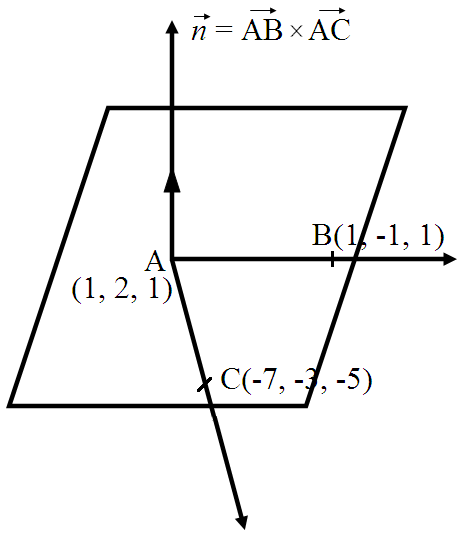
Let A(1, 1, 1), B(1, -1, 1) and C(-7, -3, -5) be the coordinates.
The required plane passes through the point A(1, 1, 1)
Whose position vector is $\vec{\text{a}}=\hat{\text{i}}+\hat{\text{j}}+\hat{\text{k}}$ and is normal to the vector $\vec{\text{n}}$ given by
$\vec{\text{n}}=\overrightarrow{\text{AB}}\times\overrightarrow{\text{AC}}$
Clearly, $\overrightarrow{\text{AB}}=\overrightarrow{\text{OB}}-\overrightarrow{\text{OA}}$
$=(\hat{\text{i}}-\hat{\text{j}}+\hat{\text{k}})-(\hat{\text{i}}+\hat{\text{j}}+\hat{\text{k}})$
$=0\hat{\text{i}}-2\hat{\text{j}}+0\hat{\text{k}}$
$\overrightarrow{\text{AC}}=\overrightarrow{\text{OC}}-\overrightarrow{\text{OA}}$
$=(-7\hat{\text{i}}-3\hat{\text{j}}-5\hat{\text{k}})-(\hat{\text{i}}+\hat{\text{j}}+\hat{\text{k}})$
$=-8\hat{\text{i}}-4\hat{\text{j}}-6\hat{\text{k}}$
$\vec{\text{n}}=\overrightarrow{\text{AB}}\times\overrightarrow{\text{AC}}$
$=\begin{vmatrix}\hat{\text{i}}&\hat{\text{j}}&\hat{\text{k}}\\0&-2&0\\-8&-4&-6\end{vmatrix}$
$=12\hat{\text{i}}+0\hat{\text{j}}-16\hat{\text{k}}$
The vector equation of the required plane is,
$\vec{\text{r}}\cdot\vec{\text{n}}=\vec{\text{a}}\cdot\vec{\text{n}}$
$\Rightarrow\vec{\text{r}}\cdot(12\hat{\text{i}}+0\hat{\text{j}}-16\hat{\text{k}})=(\hat{\text{i}}+\hat{\text{j}}+\hat{\text{k}})(12\hat{\text{i}}+0\hat{\text{j}}-16\hat{\text{k}})$
$\Rightarrow\vec{\text{r}}\cdot\Big[4(3\hat{\text{i}}-4\hat{\text{k}})\Big]=12+0-16$
$\Rightarrow\vec{\text{r}}\cdot\Big[4(3\hat{\text{i}}-4\hat{\text{k}})\Big]=-4$
$\Rightarrow\vec{\text{r}}\cdot(3\hat{\text{i}}-4\hat{\text{k}})=-1$
$\Rightarrow\vec{\text{r}}\cdot(3\hat{\text{i}}-4\hat{\text{k}})+1=0$ View full question & answer→Question 675 Marks
Find the vector equation of the following planes in non-parametric form.
$\vec{\text{r}}=(\lambda-2\mu)\hat{\text{i}}+(3-\mu)\hat{\text{j}}+(2\lambda+\mu)\hat{\text{k}}$
AnswerThe given equation of the plane is,
$\vec{\text{r}}=(\lambda-2\mu)\hat{\text{i}}+(3-\mu)\hat{\text{j}}+(2\lambda+\mu)\hat{\text{k}}$
$\Rightarrow\vec{\text{r}}=(0\hat{\text{i}}+3\hat{\text{j}}+0\hat{\text{k}})+\lambda(\hat{\text{i}}+0\hat{\text{j}}+2\hat{\text{k}})+\mu(-2\hat{\text{i}}-\hat{\text{j}}+\hat{\text{k}})$
We know that equation $\vec{\text{r}}=\vec{\text{a}}+\lambda\vec{\text{b}}+\mu\vec{\text{c}} $ represents a plane passing through a point whose position vector is $\vec{\text{a}}$ and parallel to t.
Here, $\vec{\text{a}}=0\hat{\text{i}}+3\hat{\text{j}}+0\hat{\text{k}},\vec{\text{b}}=\hat{\text{i}}+0\hat{\text{j}}+2\hat{\text{k}},\hat{\text{c}}=-2\hat{\text{i}}-\hat{\text{j}}+\hat{\text{k}}$
Normal vector, $\vec{\text{n}}=\vec{\text{b}}\times\vec{\text{c}}$
$=\begin{vmatrix}\hat{\text{i}}&\hat{\text{j}}&\hat{\text{k}}\\1&0&2\\-2&-1&1\end{vmatrix}$
$=2\hat{\text{i}}-5\hat{\text{j}}-\hat{\text{k}}$
The vector equation of the plane in scalar product form is,
$\vec{\text{r}}\cdot\vec{\text{n}}=\vec{\text{a}}\cdot\vec{\text{n}}$
$\Rightarrow\vec{\text{r}}\cdot(2\hat{\text{i}}-5\hat{\text{j}}-\hat{\text{k}})=(0\hat{\text{i}}+3\hat{\text{j}}+0\hat{\text{k}})(2\hat{\text{i}}-5\hat{\text{j}}-\hat{\text{k}})$
$\Rightarrow\vec{\text{r}}\cdot(2\hat{\text{i}}-5\hat{\text{j}}-\hat{\text{k}})=0-15+0$
$\Rightarrow\vec{\text{r}}\cdot(2\hat{\text{i}}-5\hat{\text{j}}-\hat{\text{k}})+15=0$
View full question & answer→Question 685 Marks
Find the equation of the plane through the points (2, 2, -1) and (3, 4, 2) and parallel to the line whose direction ratios are 7, 0, 6.
AnswerThe equation of the plane through $(2, 2, -1)$ is
$a(x - 2) + b(y - 2) + c(z + 1) = 0 ....(i)$
This plane passes through $(3, 4, 2)$. so,
$a(3 - 2) + b(4 - 2) + c(2 + 1) = 0$
$⇒ a + 2b + 3c = 0 ....(ii)$
Again plane (i) is parallel to the line whose direction ratios are 7, 0, 6.
It means that the normal of plane (i) is perpendicular to the line whose direction ratios are 7, 0, 6
$⇒ 7a + 0b + 6c = 0 ($Because $a_1a_2 + b_1b_2 + c_1c_2= 0)$
Solving (i), (ii) and (iii), we get
$\begin{vmatrix}\text{x}-2&\text{y}-2&\text{z}+1\\1&2&3\\7&0&6\end{vmatrix}=0$
$⇒ 12(x - 2) + 15(y - 2) - 14(z + 1) = 0$
$⇒ 12x + 15y - 14z - 68 = 0$
View full question & answer→Question 695 Marks
Find the equation of the plane passing through (a, b, c) and parallel to the plane $\vec{\text{r}}\cdot(\hat{\text{i}}+\hat{\text{j}}+\hat{\text{k}})=2.$
AnswerLet the equation of a plane parallel to the given plane be
$\vec{\text{r}}\cdot(\hat{\text{i}}+\hat{\text{j}}+\hat{\text{k}})=\text{k}$
$(\text{x}\hat{\text{i}}+\text{y}\hat{\text{j}}+\text{z}\hat{\text{k}})\cdot(\hat{\text{i}}+\hat{\text{j}}+\hat{\text{k}})=\text{k}\ ...(\text{i})$
This passes through (a, b, c). So,
$(\text{a}\hat{\text{i}}+\text{b}\hat{\text{j}}+\text{c}\hat{\text{k}})\cdot(\hat{\text{i}}+\hat{\text{j}}+\hat{\text{k}})=\text{k}$
$\Rightarrow\text{k}=\text{a}+\text{b}+\text{c}$
Substituting this in (i), we get
$(\text{x}\hat{\text{i}}+\text{y}\hat{\text{j}}+\text{z}\hat{\text{k}})\cdot(\hat{\text{i}}+\hat{\text{j}}+\hat{\text{k}})=\text{a}+\text{b}+\text{c}$
$\text{x}+\text{y}+\text{z}=\text{a}+\text{b}+\text{c},$ Which is the equation of the required plane.
View full question & answer→Question 705 Marks
A plane passes through the point (1, -2, 5) and is perpendicular to the line joining the origin to the point $2\hat{\text{i}}+\hat{\text{j}}-\hat{\text{k}}.$ Find the vector and cartesian forms of the equation of the plane.
AnswerThe normal is passing throught the point A(0, 0, 0) and B(3, 1, -1). So,
$\vec{\text{n}}=\overrightarrow{\text{OP}}$
$=(3\hat{\text{i}}+\hat{\text{j}}-\hat{\text{k}})-(0\hat{\text{i}}+0\hat{\text{j}}+0\hat{\text{k}})$
$=3\hat{\text{i}}+\hat{\text{j}}-\hat{\text{k}}$
Since the plane passes throught (1, -2, 5)
$\vec{\text{a}}=\hat{\text{i}}-2\hat{\text{j}}+5\hat{\text{k}}$
We know that the vector equation of the plane passing through a point $\vec{\text{a}}$ and normal to $\vec{\text{n}}$ is,
$\vec{\text{r}}\cdot\vec{\text{n}}=\vec{\text{a}}\cdot\vec{\text{n}}$
Substituting $\vec{\text{a}}=\hat{\text{i}}-\hat{\text{j}}+\hat{\text{k}}$ and $\vec{\text{n}}=4\hat{\text{i}}+2\hat{\text{j}}-3\hat{\text{k}},$ we get
$\vec{\text{r}}\cdot(3\hat{\text{i}}+\hat{\text{j}}-\hat{\text{k}})=(\hat{\text{i}}-2\hat{\text{j}}+5\hat{\text{k}})\cdot(3\hat{\text{i}}+\hat{\text{j}}-\hat{\text{k}})$
$\Rightarrow\vec{\text{r}}\cdot(3\hat{\text{i}}+\hat{\text{j}}-\hat{\text{k}})=3-2-5$
$\Rightarrow\vec{\text{r}}\cdot(3\hat{\text{i}}+\hat{\text{j}}-\hat{\text{k}})=-4$
Substituting $\vec{\text{r}}=\text{x}\hat{\text{i}}+\text{y}\hat{\text{j}}+\text{z}\hat{\text{k}}$ in the vector equation we get
$(\text{x}\hat{\text{i}}+\text{y}\hat{\text{j}}+\text{z}\hat{\text{k}})\cdot(3\hat{\text{i}}+\hat{\text{j}}-\hat{\text{k}})=-4$
$\Rightarrow3\text{x}+\text{y}-\text{z}=-4$
View full question & answer→Question 715 Marks
Find the vector equations of the following planes in scalar product form $(\vec{\text{r}}\cdot\vec{\text{n}}=\text{d}):$
$\vec{\text{r}}=(1+\text{s}-\text{t})\hat{\text{t}}+(2-\text{s})\hat{\text{j}}+(3-2\text{s}+2\text{t})\hat{\text{k}}$
AnswerHere, $\vec{\text{r}}=(1+\text{s}-\text{t})\hat{\text{t}}+(2-\text{s})\hat{\text{j}}+(3-2\text{s}+2\text{t})\hat{\text{k}}$
$\vec{\text{r}}=(\hat{\text{i}}+\hat{\text{j}}+3\hat{\text{k}})+\text{s}(\hat{\text{i}}-\hat{\text{j}}-2\hat{\text{k}})+\text{t}(-\hat{\text{i}}+2\hat{\text{k}})$
We know that, $\vec{\text{r}}=\vec{\text{a}}+\lambda\vec{\text{b}}+\mu\vec{\text{c}}$ represent a plane passing through a point having position vector $\vec{\text{a}}$ and parallel to vectors $\vec{\text{b}}$ and $\vec{\text{c}}.$
Here, $\vec{\text{a}}=\hat{\text{i}}+\hat{\text{j}}+3\hat{\text{k}},\vec{\text{b}}=\hat{\text{i}}-\hat{\text{j}}-2\hat{\text{k}},\vec{\text{c}}=-\hat{\text{i}}+2\hat{\text{k}}$
The given plane is perpendicular to a vector
$\vec{\text{n}}=\vec{\text{b}}\times\vec{\text{c}}$
$=\begin{vmatrix}\hat{\text{i}}&\hat{\text{j}}&\hat{\text{k}}\\1&-1&-2\\-1&0&2\end{vmatrix}$
$=\hat{\text{i}}(-2-0)-\hat{\text{j}}(2-2)+\hat{\text{k}}(0-1)$
$\vec{\text{n}}=-2\hat{\text{i}}-\hat{\text{k}}$
We know that vector equation of plane in scalar product form is,
$\vec{\text{r}}\cdot\vec{\text{n}}=\vec{\text{a}}\cdot\vec{\text{n}}\ ...(\text{i})$
Put $\vec{\text{n}}$ and $\vec{\text{a}}$ in equation (i),
$\vec{\text{r}}\cdot(-2\hat{\text{i}}-\hat{\text{k}})=(-2\hat{\text{i}}-\hat{\text{k}})(\hat{\text{i}}+2\hat{\text{j}}+3\hat{\text{k}})$
$\vec{\text{r}}\cdot(-2\hat{\text{i}}-\hat{\text{k}})=(-2)(1)+(0)(2)+(-1)(3)$
$\vec{\text{r}}\cdot(-2\hat{\text{i}}-\hat{\text{k}})=-2+0-3$
$\vec{\text{r}}\cdot(-2\hat{\text{i}}-\hat{\text{k}})=-5$
Multiplying both the sides by (-1),
$\vec{\text{r}}\cdot(2\hat{\text{i}}+\hat{\text{k}})=5$
The equation in required form,
$\vec{\text{r}}\cdot(2\hat{\text{i}}+\hat{\text{k}})=5$
View full question & answer→Question 725 Marks
Find the vector equation of the plane through the line of intersection of the planes $x + y + z = 1$ and $2x + 3y + 4z = 5$ which is perpendicular to the plane $x - y + z = 0.$
AnswerThe equation of the plane passing through the line of intersection of the given planes is,
$\text{x}+\text{y}+\text{z}-1+\lambda(2\text{x}+3\text{y}+4\text{z}-5)=0$
$(1+2\lambda)\text{x}+(1+3\lambda)\text{y}+(1+4\lambda)\text{z}-1-5\lambda=0\ ...(\text{i})$
This plane is perpendicular to $x - y + z = 0$. So,
$1+2\lambda-1(1+3\lambda)+1+4\lambda=0 ($Because $a_1a_2 + b_1b_2 + c_1c_2= 0)$
$\Rightarrow1+2\lambda-1-3\lambda+1+4\lambda=0$
$\Rightarrow3\lambda+1=0$
$\Rightarrow\lambda=\frac{-1}{3}$
Substituting this in (i), we get
$\Big(1+2\Big(\frac{-1}{3}\Big)\Big)\text{x}+\Big(1+3\Big(\frac{-1}{3}\Big)\Big)\text{y}+\Big(1+4\Big(\frac{-1}{3}\Big)\text{z}-1-5\Big(\frac{-1}{3}\Big)\Big)=0$
$\Rightarrow\text{x}-\text{z}+2=0$
View full question & answer→Question 735 Marks
Find the vector and Cartesian equations of the plane that passes through the point (5, 2, -4) and is perpendicular to the line with direction ratios 2, 3, -1.
AnswerWe know that the vector equation of the plane passing through a point $\vec{\text{a}}$ and normal to $\vec{\text{n}}$ is,
$\overrightarrow{\text{r}}\cdot\overrightarrow{\text{n}}=\overrightarrow{\text{a}}\cdot\overrightarrow{\text{n}}$
Substituting $\overrightarrow{\text{a}}=5\hat{\text{i}}+2\hat{\text{j}}-4\hat{\text{k}}$ and $\overrightarrow{\text{n}}=2\hat{\text{i}}+3\hat{\text{j}}-\hat{\text{k}}$ (because the direction ratios of $\vec{\text{n}}$ are 2, 3, -1), we get
$\overrightarrow{\text{r}}\cdot(2\hat{\text{i}}+3\hat{\text{j}}-\hat{\text{k}})=(5\hat{\text{i}}+2\hat{\text{j}}-4\hat{\text{k}})\cdot(2\hat{\text{i}}+3\hat{\text{j}}-\hat{\text{k}})$
$\Rightarrow\vec{\text{r}}\cdot(2\hat{\text{i}}+3\hat{\text{j}}-\hat{\text{k}})=10+6+4$
$\Rightarrow\vec{\text{r}}\cdot(2\hat{\text{i}}+3\hat{\text{j}}-\hat{\text{k}})=20$
For cartesian form, we need to substitute $\vec{\text{r}}=\text{x}\hat{\text{i}}+\text{y}\hat{\text{j}}+\text{z}\hat{\text{k}}$ in this equation. Then, we get
$(\text{x}\hat{\text{i}}+\text{y}\hat{\text{j}}+\text{z}\hat{\text{k}})\cdot(2\hat{\text{i}}+3\hat{\text{j}}-\hat{\text{k}})=20$
$\Rightarrow2\text{x}+3\text{y}-\text{z}=20$
View full question & answer→Question 745 Marks
If the straight lines $\frac{\text{x}-1}{2}=\frac{\text{y}+1}{\text{k}}=\frac{\text{z}}{2}$ and $\frac{\text{x}+1}{2}=\frac{\text{y}+1}{2}=\frac{\text{z}}{\text{k}}$ are coplanar, find the equation of the planes containing them.
AnswerThe lines $\frac{\text{x}-\text{x}_1}{\text{a}_1}=\frac{\text{y}-\text{y}_1}{\text{b}_1}=\frac{\text{z}-\text{z}_1}{\text{c}_1}$ and $\frac{\text{x}-\text{x}_2}{\text{a}_2}=\frac{\text{y}-\text{y}_2}{\text{b}_2}=\frac{\text{z}-\text{z}_2}{\text{c}_2}$ are coplanar if
$\begin{vmatrix}\text{x}_2-\text{x}_1&\text{y}_2-\text{y}_1&\text{z}_2-\text{z}_1\\\text{a}_1&\text{b}_1&\text{c}_1\\\text{a}_2&\text{b}_2&\text{c}_2\end{vmatrix}=0$
The given lines $\frac{\text{x}-1}{2}=\frac{\text{y}+1}{\text{k}}=\frac{\text{z}}{2}$ and $\frac{\text{x}+1}{2}=\frac{\text{y}+1}{2}=\frac{\text{z}}{\text{k}}$ are coplanar.
$\therefore\ \begin{vmatrix} -1-1&-1-(-1)&0-0\\2&\text{k}&2\\2&2&\text{k}\end{vmatrix}=0$
$\Rightarrow\begin{vmatrix} -2&0&0\\2&\text{k}&2\\2&2&\text{k}\end{vmatrix}=0$
$\Rightarrow-2(\text{k}^2-4)-0+0=0$
$\Rightarrow\text{k}^2-4=0$
$\Rightarrow\text{k}=\pm2$
The equation of the plane containing the given lines is $\begin{vmatrix} \text{x}-1&\text{y}+1&\text{z}\\2&\text{k}&2\\2&2&\text{k}\end{vmatrix}=0$
For k = 2, $\begin{vmatrix} \text{x}-1&\text{y}+1&\text{z}\\2&\text{k}&2\\2&2&\text{k}\end{vmatrix}=\begin{vmatrix} \text{x}-1&\text{y}+1&\text{z}\\2&\text{2}&2\\2&2&\text{2}\end{vmatrix}=0$
So, no plane exists for k = 2
For k = -2
$\begin{vmatrix} \text{x}-1&\text{y}+1&\text{z}\\2&\text{k}&2\\2&2&\text{k}\end{vmatrix}=0$
$\Rightarrow\begin{vmatrix} \text{x}-1&\text{y}+1&\text{z}\\2&-\text{2}&2\\2&2&-\text{2}\end{vmatrix}=0$
$\Rightarrow(\text{x})(4-4)-(\text{y}+1)(-4-4)+\text{z}(4+4)=0$
$\Rightarrow8(\text{y}+1)+8\text{z}=0$
$\Rightarrow\text{y}+\text{z}+1=0$
Thus, the equation of the plane containing the given lines is y + z + 1 = 0
View full question & answer→Question 755 Marks
Show that the lines $\vec{\text{r}}=(2\hat{\text{i}}-3\hat{\text{k}})+\lambda(\hat{\text{i}}+2\hat{\text{j}}+3\hat{\text{k}})$ and $\vec{\text{r}}=(2\hat{\text{i}}+6\hat{\text{j}}+3\hat{\text{k}})+\mu(2\hat{\text{i}}+3\hat{\text{j}}+4\hat{\text{k}})$ are coplanar. Also, find the equation of the plane containing them.
AnswerWe know that the lines $\vec{\text{r}}=\vec{\text{a}}_1+\lambda\vec{\text{b}}_1$ and $\vec{\text{r}}=\vec{\text{a}}_2+\mu\vec{\text{b}}_2$ are coplanar if
$\vec{\text{a}}_1\cdot(\vec{\text{b}}_1\times\vec{\text{b}}_2)=\vec{\text{a}}_2\cdot(\vec{\text{b}}_1\times\vec{\text{b}}_2)$ and the equation of the plane containing them is
$\vec{\text{r}}\cdot(\vec{\text{b}}_1\times\vec{\text{b}}_2)=\vec{\text{a}}_1\cdot(\vec{\text{b}}_1\times\vec{\text{b}}_2)$
Here,
$\vec{\text{a}}_1=0\hat{\text{i}}+2\hat{\text{j}}-3\hat{\text{k}},\vec{\text{b}}_1=\hat{\text{i}}+2\hat{\text{j}}+3\hat{\text{k}}$
$\vec{\text{a}}_2=2\hat{\text{i}}+6\hat{\text{j}}+3\hat{\text{k}},\vec{\text{b}}_2=2\hat{\text{i}}+3\hat{\text{j}}+4\hat{\text{k}}$
$\vec{\text{b}}_1\times\vec{\text{b}}_2=\begin{vmatrix}\hat{\text{i}}&\hat{\text{j}}&\hat{\text{k}}\\1&2&3\\2&3&4\end{vmatrix}$
$=-\hat{\text{i}}+2\hat{\text{j}}-\hat{\text{k}}$
$\vec{\text{a}}_1\cdot(\vec{\text{b}}_1\times\vec{\text{b}}_2)=(0\hat{\text{i}}+2\hat{\text{j}}-3\hat{\text{k}})\cdot(-\hat{\text{i}}+2\hat{\text{j}}-\hat{\text{k}})$
$=0+4+3=7$
$\vec{\text{a}}_2\cdot(\vec{\text{b}}_1\times\vec{\text{b}}_2)=(2\hat{\text{i}}+6\hat{\text{j}}+3\hat{\text{k}})\cdot(-\hat{\text{i}}+2\hat{\text{j}}-\hat{\text{k}})$
$=-2+12-3=7$
Clearly, $\vec{\text{a}}_1\cdot(\vec{\text{b}}_1\times\vec{\text{b}}_2)=\vec{\text{a}}_2\cdot(\vec{\text{b}}_1\times\vec{\text{b}}_2)$
Hence, the given lines are coplanar.
The equation of the plane containing the given lines is
$\vec{\text{r}}\cdot(\vec{\text{b}}_1\times\vec{\text{b}}_2)=\vec{\text{a}}_1\cdot(\vec{\text{b}}_1\times\vec{\text{b}}_2)$
$\Rightarrow\vec{\text{r}}\cdot(-\hat{\text{i}}+2\hat{\text{j}}-\hat{\text{k}})=(0\hat{\text{i}}+2\hat{\text{j}}-3\hat{\text{k}})\cdot(-\hat{\text{i}}+2\hat{\text{j}}-\hat{\text{k}})$
$\Rightarrow\vec{\text{r}}\cdot(-\hat{\text{i}}+2\hat{\text{j}}-\hat{\text{k}})=7$
$\Rightarrow\vec{\text{r}}\cdot(-\hat{\text{i}}+2\hat{\text{j}}-\hat{\text{k}})+7=0$
View full question & answer→Question 765 Marks
Find the vector equation of the plane passing through points $3\hat{\text{i}}+4\hat{\text{j}}+2\hat{\text{k}},2\hat{\text{i}}-2\hat{\text{j}}-\hat{\text{k}}$ and $7\hat{\text{i}}+6\hat{\text{k}}.$
Answer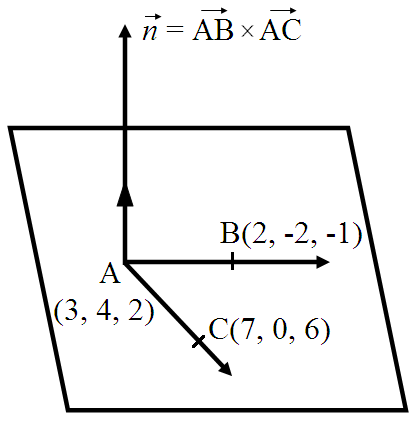 Let A(3, 4, 2), B(2, -2, -1) and C(7, 0, 6) be the points respresented by the given position vectors.The required plane passes through the point A(3, 4, 2) whose position vector is $\vec{\text{a}}=3\hat{\text{i}}+4\hat{\text{j}}+2\hat{\text{k}}$ and is normal to the vector $\vec{\text{n}}$ given by
$\vec{\text{n}}=\overrightarrow{\text{AB}}\times\overrightarrow{\text{AC}}$ Clearly, $\overrightarrow{\text{AB}}=\overrightarrow{\text{OB}}-\overrightarrow{\text{OA}}$ $=(2\hat{\text{i}}-2\hat{\text{j}}-\hat{\text{k}})-(3\hat{\text{i}}+4\hat{\text{j}}+2\hat{\text{k}})$ $=-\hat{\text{i}}-6\hat{\text{j}}-3\hat{\text{k}}$ $\overrightarrow{\text{AC}}=\overrightarrow{\text{OC}}-\overrightarrow{\text{OA}}$ $=(7\hat{\text{i}}+0\hat{\text{j}}+6\hat{\text{k}})-(3\hat{\text{i}}+4\hat{\text{j}}+2\hat{\text{k}})$ $=4\hat{\text{i}}-4\hat{\text{j}}+4\hat{\text{k}}$ $\vec{\text{n}}=\overrightarrow{\text{AB}}\times\overrightarrow{\text{AC}}$ $=\begin{vmatrix}\hat{\text{i}}&\hat{\text{j}}&\hat{\text{k}}\\-1&-6&-3\\4&-4&4\end{vmatrix}$ $=-36\hat{\text{i}}-8\hat{\text{j}}+28\hat{\text{k}}$ The vector equation of the required plane is $\vec{\text{r}}\cdot\vec{\text{n}}=\vec{\text{a}}\cdot\vec{\text{n}}$ $\Rightarrow\vec{\text{r}}\cdot(36\hat{\text{i}}-8\hat{\text{j}}+28\hat{\text{k}})=(3\hat{\text{i}}+4\hat{\text{j}}+2\hat{\text{k}})\cdot(36\hat{\text{i}}-8\hat{\text{j}}+28\hat{\text{k}})$ $\Rightarrow\vec{\text{r}}\cdot\Big[-4(9\hat{\text{i}}+2\hat{\text{j}}+7\hat{\text{k}})\Big]=-108-32+56$ $\Rightarrow\vec{\text{r}}\cdot\Big[-4(9\hat{\text{i}}+2\hat{\text{j}}+7\hat{\text{k}})\Big]=-84$ $\Rightarrow\vec{\text{r}}\cdot(9\hat{\text{i}}+2\hat{\text{j}}+7\hat{\text{k}})=21$ View full question & answer→Question 775 Marks
Reduce the equation $\vec{\text{r}}\cdot(\hat{\text{i}}-2\hat{\text{j}}+2\hat{\text{k}})+6=0$ to the normal form and, hence, find the length of the perpendicular from the origin to the plane.
AnswerThe given equation of the plane is,
$\vec{\text{r}}\cdot(\hat{\text{i}}-2\hat{\text{j}}+2\hat{\text{k}})+6=0$
$\Rightarrow\vec{\text{r}}\cdot(\hat{\text{i}}-2\hat{\text{j}}+2\hat{\text{k}})=-6$ or $\vec{\text{r}}\cdot\vec{\text{n}}=-6,$ where $\vec{\text{n}}=\hat{\text{i}}-2\hat{\text{j}}+2\hat{\text{k}}$
$|\vec{\text{n}}|=\sqrt{1+4+4}=3$
For reducing the given equation to normal form, we need to divide it by $|\vec{\text{n}}|$ Then, we get
$|\vec{\text{r}}|\cdot\frac{\vec{\text{n}}}{|\vec{\text{n}}|}=\frac{-6}{|\vec{\text{n}}|}$
$\Rightarrow\vec{\text{r}}\cdot\Big(\frac{\hat{\text{i}}-2\hat{\text{j}}+2\hat{\text{k}}}{3}\Big)=\frac{-6}{3}$
$\Rightarrow\vec{\text{r}}\cdot\Big(\frac{1}{3}\hat{\text{i}}-\frac{2}{3}\hat{\text{j}}+\frac{2}{3}\hat{\text{k}}\Big)=-2$
Dividing both sides by -1 we get
$\vec{\text{r}}\cdot\Big(-\frac{1}{3}\hat{\text{i}}+\frac{2}{3}\hat{\text{j}}-\frac{2}{3}\hat{\text{k}}\Big)=2\ ...(\text{i})$
The equation of the plane in normal form is
$\vec{\text{r}}\cdot\vec{\text{n}}=\text{d}\ ...(\text{ii})$
(where d is distance of the plane from the origin)
Comparing (i) and (ii)
length of the perpendicular from the origin to the plane = d = 2 units
View full question & answer→Question 785 Marks
Find the distance of the point (3, 3, 3) from the plane $\vec{\text{r}}\cdot(5\hat{\text{i}}+2\hat{\text{j}}-7\hat{\text{k}})+9=0$
AnswerThe given plane is
$\vec{\text{r}}\cdot(5\hat{\text{i}}+2\hat{\text{j}}-7\hat{\text{k}})+9=0$
$\vec{\text{r}}\cdot(5\hat{\text{i}}+2\hat{\text{j}}-7\hat{\text{k}})=9$
We know that the perpendicular distance of a point P of position vector $\vec{\text{a}}$ from the plane $\vec{\text{r}}\cdot\vec{\text{n}}=\text{d}$ is given by
$\text{p}=\frac{\big|\vec{\text{a}}\cdot\vec{\text{n}}-\text{d}\big|}{|\vec{\text{n}}|}$
Finding the distance from (3, 3, 3) $($which means $3\hat{\text{i}}+3\hat{\text{j}}+3\hat{\text{k}})$ to the given plane
Here, $\vec{\text{a}}=3\hat{\text{i}}+3\hat{\text{j}}+3\hat{\text{k}},\vec{\text{n}}=5\hat{\text{i}}+2\hat{\text{j}}-7\hat{\text{k}},\text{d}=9$
So, the required distance p
$=\frac{\big|(3\hat{\text{i}}+3\hat{\text{j}}+3\hat{\text{k}})\cdot(5\hat{\text{i}}+2\hat{\text{j}}-7\hat{\text{k}})-9\big|}{\big|3\hat{\text{i}}+3\hat{\text{j}}+3\hat{\text{k}}\big|}$
$=\frac{|-15-6+21-9|}{\sqrt{25+4+49}}$
$=\frac{-9}{\sqrt{78}}$
$=\frac{-9}{\sqrt{78}}\text{ units}$
View full question & answer→Question 795 Marks
Find the vector equation of the plane which is at a distance of $\frac{6}{\sqrt{29}}$ from the origin and its normal vector from the origin is $2\hat{\text{i}}-3\hat{\text{j}}+4\hat{\text{k}}$ Also, find its cartesian form.
AnswerGiven, normal vector, $\vec{\text{n}}=2\hat{\text{i}}-3\hat{\text{j}}+4\hat{\text{k}}$
Now, $\hat{\text{n}}=\frac{\vec{\text{n}}}{|\vec{\text{n}}|}$
$=\frac{2\hat{\text{i}}-3\hat{\text{j}}+4\hat{\text{k}}}{\sqrt{29}}$
$=\frac{2}{\sqrt{29}}\hat{\text{i}}-\frac{3}{\sqrt{29}}\hat{\text{j}}+\frac{4}{\sqrt{29}}\hat{\text{k}}$
The equation of the plane in normal from is
$\vec{\text{r}}\cdot\hat{\text{n}}={\text{d}}$ (where d is distance of the plane from the origin)
Substituting, $\hat{\text{n}}=\frac{2}{\sqrt{29}}\hat{\text{i}}-\frac{3}{\sqrt{29}}\hat{\text{j}}+\frac{4}{\sqrt{29}}\hat{\text{k}}$ and $\text{d}=\frac{6}{\sqrt{29}}$ here, we get
$\vec{\text{r}}\cdot\Big(\frac{2}{\sqrt{29}}\hat{\text{i}}-\frac{3}{\sqrt{29}}\hat{\text{j}}+\frac{4}{\sqrt{29}}\hat{\text{k}}\Big)=\frac{6}{\sqrt{29}}\ ...(\text{i})$
Cartesian form
For cartesian form, substituting $\vec{\text{r}}=\text{x}\hat{\text{i}}+\text{y}\hat{\text{j}}+\text{z}\hat{\text{k}}$ in (i) we get
$(\text{x}\hat{\text{i}}+\text{y}\hat{\text{j}}+\text{z}\hat{\text{k}})\cdot\Big(\frac{2}{\sqrt{29}}\hat{\text{i}}-\frac{3}{\sqrt{29}}\hat{\text{j}}+\frac{4}{\sqrt{29}}\hat{\text{k}}\Big)=\frac{6}{\sqrt{29}}$
$\Rightarrow\frac{2\text{x}-3\text{y}+4\text{z}}{\sqrt{29}}=\frac{6}{\sqrt{29}}$
$\Rightarrow2\text{x}-3\text{y}+4\text{z}=6$
View full question & answer→Question 805 Marks
Find the coordinates of the point where the line $\frac{\text{x}-2}{3}=\frac{\text{y}+1}{4}=\frac{\text{z}-2}{2}$ intersect the plane x - y + z - 5 = 0. Also, find the angle between the line and the plane.
AnswerThe coordinates of any point on this line are of the form
$\frac{\text{x}-2}{3}=\frac{\text{y}+1}{4}=\frac{\text{z}-2}{2}=\lambda$
$\Rightarrow\text{x}=3\lambda+2,\text{ y}=4\lambda-1,\text{ z}=2\lambda+2$
So, the coordinates of the point on the given line are $(3\lambda+2,4\lambda-1,2\lambda+2).$ This point lies on the plane x - y + z - 5 = 0
$\Rightarrow3\lambda+2-4\lambda+1+2\lambda+2-5=0$
$\Rightarrow\lambda=0$
So, the coordinates of the point are
$(3\lambda+2,4\lambda-1,2\lambda+2)$
$=\big(3(0)+2,4(0)-1,2(0)+2\big)$
$=(2,-1,2)$
Finding the angle between the line and the plane.
The given line is parallel to the vector $\vec{\text{b}}=3\hat{\text{i}}+4\hat{\text{j}}+2\hat{\text{k}}$ and the given plane is normal to the vector $\vec{\text{n}}=\hat{\text{i}}-\hat{\text{j}}+\hat{\text{k}}$
We know that the angle $\theta$ between the linr and the plane is given by
$\sin\theta=\frac{\vec{\text{b}}\cdot\vec{\text{n}}}{|\vec{\text{b}}||\vec{\text{n}}|}$
$=\frac{(3\hat{\text{i}}+4\hat{\text{j}}+2\hat{\text{k}})\cdot(\hat{\text{i}}-\hat{\text{j}}+\hat{\text{k}})}{|3\hat{\text{i}}+4\hat{\text{j}}+2\hat{\text{k}}||\hat{\text{i}}-\hat{\text{j}}+\hat{\text{k}}|}$
$=\frac{3-4+2}{\sqrt{9+16+4}\sqrt{1+1+1}}$
$=\frac{1}{\sqrt{87}}$
$\theta=\sin^{-1}\Big(\frac{1}{\sqrt{87}}\Big)$
View full question & answer→Question 815 Marks
Find the equation of the plane passing through (a, b, c) and parallel to the plane $\vec{\text{r}}\cdot(\hat{\text{i}}+\hat{\text{j}}+\hat{\text{k}})=2.$
AnswerSubstituting $\vec{\text{r}}=\text{x}\hat{\text{i}}+\text{y}\hat{\text{j}}+\text{z}\hat{\text{k}}$ in the given equation of the plane, we get
$(\text{x}\hat{\text{i}}+\text{y}\hat{\text{j}}+\text{z}\hat{\text{k}})\cdot(\hat{\text{i}}+\hat{\text{j}}+\hat{\text{k}})=2$
x + y + z - 2 = 0 ....(i)
The equation of a plane which is parallel to plane (i) is of the form
x + y + z = k ....(ii)
It is given that plane (ii) is passing through the point (a, b, c). So,
a + b + c = k
Substituting this value of k in (ii) we get
x + y + z = a + b + c, which is the required of the plane.
View full question & answer→Question 825 Marks
Find the equation of the plane which is parallel to 2x - 3y + z = 0 and which passes through (1, -1, 2).
AnswerGiven, equation of plane is,
2x - 3y + z = 0 ....(i)
We know that equation of a plane parallel the plane (i) is given by
$2\text{x}-3\text{y}+\text{z}+\lambda=0\ ....(\text{ii})$
Given that, plane (ii) is passing through the point (1, -1, 2) so it must satisfy the equation (ii),
$2(1)-3(-1)+(2)+\lambda=0$
$2+3+2+\lambda=0$
$7+\lambda=0$
$\lambda=-7$
Put the value of $\lambda$ in equation (ii),
2x - 3y + z - 7 = 0
So, equation of the required plane is,
2x - 3y + z = 7
View full question & answer→Question 835 Marks
Find the equation of the plane which bisects the line segment joining the points (-1, 2, 3) and (3, -5, 6) at right angles.
AnswerThe normal is passing through the point A(-1, 2, 3) and B(3, -5, 6) So,
$\overrightarrow{\text{n}}=\overrightarrow{\text{AB}}=\overrightarrow{\text{OB}}-\overrightarrow{\text{OA}}$
$=(3\hat{\text{i}}-5\hat{\text{j}}+6\hat{\text{k}})-(-\hat{\text{i}}+2\hat{\text{j}}+3\hat{\text{k}})$
$=14\hat{\text{i}}-7\hat{\text{j}}+3\hat{\text{k}}$
$\text{Mid}-\text{point of AB} =\Big(\frac{-1+3}{2},\frac{2-5}{2},\frac{3+6}{2}\Big)$
$=\Big(1,\frac{-3}{2},\frac{9}{2}\Big)$
Since the plane passes through $\Big(1,\frac{-3}{2},\frac{9}{2}\Big)$
$\vec{\text{a}}=\hat{\text{i}}-\frac{3}{2}\hat{\text{j}}+\frac{9}{2}\hat{\text{k}}$
We know that the vector equation of the plane passing through a point $\vec{\text{a}}$ and normal to $\vec{\text{n}}$ is,
$\vec{\text{r}}\cdot\vec{\text{n}}=\vec{\text{a}}\cdot\vec{\text{n}}$
Substituting $\vec{\text{a}}=\hat{\text{i}}-\hat{\text{j}}+\hat{\text{k}}$ and $\vec{\text{n}}=4\hat{\text{i}}-7\hat{\text{j}}+3\hat{\text{k}},$ we get
$(\text{x}\hat{\text{i}}+\text{y}\hat{\text{j}}+\text{z}\hat{\text{k}})\cdot(4\hat{\text{i}}-7\hat{\text{j}}+3\hat{\text{k}})=28$
$\Rightarrow4\text{x}-7\text{y}+3\text{z}=28$
$\Rightarrow4\text{x}-7\text{y}+3\text{z}-28=0$
View full question & answer→Question 845 Marks
Find the equation of the plane passing through the point (2, 3, 1), given that the direction ratios of the normal to the plane are proportional to 5, 3, 2.
AnswerGiven that, the plane is passing throught p(2, 3, 1) having 5, 3, 2 as the direction ratio of the normal to the plane.
We know that,
Equation of a plane passing through a point $\vec{\text{a}}$ and $\vec{\text{n}}$ is a vector normal to the plane, is given by,
$(\vec{\text{r}}-\vec{\text{a}})\vec{\text{n}}=0\ ...(\text{i})$
So, $\vec{\text{a}}=2\hat{\text{i}}+3\hat{\text{j}}+2\hat{\text{k}}$
$\vec{\text{n}}=5\hat{\text{i}}+3\hat{\text{j}}+2\hat{\text{k}}$
Put, $\vec{\text{a}}$ and $\vec{\text{n}}$ in equation (i),
$\Big[\vec{\text{r}}-(2\hat{\text{i}}+\hat{\text{j}}+\hat{\text{k}})\Big](5\hat{\text{i}}+3\hat{\text{j}}+2\hat{\text{k}})=0$
$\vec{\text{r}}(5\hat{\text{i}}+3\hat{\text{j}}+2\hat{\text{k}})-(2\hat{\text{i}}+3\hat{\text{j}}+\hat{\text{k}})(5\hat{\text{i}}+3\hat{\text{j}}+2\hat{\text{k}})=0$
$\vec{\text{r}}(5\hat{\text{i}}+3\hat{\text{j}}+2\hat{\text{k}})-\big[(2)(5)+(3)(3)+(1)(2)\big]=0$
$\vec{\text{r}}(5\hat{\text{i}}+3\hat{\text{j}}+2\hat{\text{k}})-[10+9+2]=0$
$\vec{\text{r}}(5\hat{\text{i}}+3\hat{\text{j}}+2\hat{\text{k}})-21=0$
Put, $\vec{\text{r}}=\text{x}\hat{\text{i}}+\text{y}\hat{\text{j}}+\text{z}\hat{\text{k}}$
$(\text{x}\hat{\text{i}}+\text{y}\hat{\text{j}}+\text{z}\hat{\text{k}})(5\hat{\text{i}}+3\hat{\text{j}}+2\hat{\text{k}})-21=0$
$(\text{x})(5)+(\text{y})(3)+(\text{z})(2)=21$
$5\text{x}+3\text{y}+2\text{z}=21$
View full question & answer→Question 855 Marks
Find the equation of the plane determined by the intersection of the lines $\frac{\text{x}+3}{3}=\frac{\text{y}}{-2}=\frac{\text{z}-7}{6}$ and $\frac{\text{x}+6}{1}=\frac{\text{y}+5}{-3}=\frac{\text{z}-1}{2}$
AnswerLet $\text{L}_1:=\frac{\text{x}+3}{3}=\frac{\text{y}}{-2}=\frac{\text{z}-7}{6}$ and $\text{L}_2:\frac{\text{x}+6}{1}=\frac{\text{y}+5}{-3}=\frac{\text{z}-1}{2}$ be the equation of two lines.
Let the plane be $ax + by + cz + d = 0 ....(i)$
Given that the required plane passes through the intersection of the lines $L_1$ and $L_2$
Hence the normal to the plane is perpendicular to the lines $L_1$ and $L_2$
$\therefore 3a - 2b + 6c = 0$
$a - 3b + 2c = 0$
Using cross-multiplication we get
$\frac{\text{a}}{-4+18}=\frac{\text{b}}{6-6}=\frac{\text{c}}{-9+2}$
$\Rightarrow\frac{\text{a}}{14}=\frac{\text{b}}{0}=\frac{\text{c}}{-7}$
$\Rightarrow\frac{\text{a}}{2}=\frac{\text{b}}{0}=\frac{\text{c}}{-1}$
View full question & answer→Question 865 Marks
If the product of the distances of the point (1, 1, 1) from the origin and the plane $x - y + z + λ = 0$ be 5, find the value of λ.
AnswerWe know that the distance of the point $(x_1, y_1, z_1)$ from the plane $ax + by + cz + d = 0$ is given by
$\frac{|\text{ax}_1+\text{by}_1+\text{cz}_1+\text{d}|}{\sqrt{\text{a}^2+\text{d}^2+\text{c}^2}}$
Distance of the point (1, 1, 1) from the plane $\text{x}-\text{y}+\text{z}+\lambda=0$
The required distance,
$=\frac{|1-1+1+\lambda|}{\sqrt{1^2+(-1)^2+1^2}}$
$=\frac{|1+\lambda|}{\sqrt{3}}\text{ units}\ ...(\text{i})$
Distance of the point (0, 0, 0) from the plane $\text{x}-\text{y}+\text{z}+\lambda=0$
The required distance,
$=\frac{|0-0+0+\lambda|}{\sqrt{1^2+(-1)^2+1^2}}$
$=\frac{|\lambda|}{\sqrt{3}}\text{ units}\ ...(\text{ii})$
It is given that the product of the distance (i) and (ii) is 5
$\frac{|1+\lambda|}{\sqrt{3}}\times\frac{|\lambda|}{\sqrt{3}}=5$
$\lambda^2+\lambda-15=0$
View full question & answer→Question 875 Marks
Find the equation of a plane which is at a distance of $3\sqrt{3}\text{ units}$ from the origin and the normal to which is equally inclined to the coordinate axes.
AnswerLet $\alpha,\beta$ and $\gamma$ be the angle made by $\vec{\text{n}}$ with x, y and z-axes, respectively.
It is given that
$\alpha=\beta=\gamma$
$\Rightarrow\cos\alpha=\cos\beta=\cos\gamma$
$\Rightarrow\text{l}=\text{m}=\text{n},$ where l, m, n are direction cosines of $\vec{\text{n}}$
But $\text{l}^2+\text{m}^2+\text{n}^2=1$
$\Rightarrow\text{l}^2+\text{l}^2+\text{l}^2=1$
$\Rightarrow3\text{l}^2=1$
$\Rightarrow\text{l}^2=\frac{1}{3}$
$\Rightarrow\text{l}=\frac{1}{\sqrt{3}}$
So, $\text{l}=\text{m}=\text{n}=\frac{1}{\sqrt{3}}$
It is given that the length of the perpendicular of the plane from the origin, $\text{p}=3\sqrt{3}$
The normal from of the plane is lx + my + nz = p
$\Rightarrow\frac{1}{\sqrt{3}}\text{x}+\frac{1}{\sqrt{3}}\text{y}+\frac{1}{\sqrt{3}}\text{z}=3\sqrt{3}$
$\Rightarrow\text{x}+\text{y}+\text{z}=3\sqrt{3}(\sqrt{3})$
$\Rightarrow\text{x}+\text{y}+\text{z}=9$
View full question & answer→Question 885 Marks
Show that the points $\hat{\text{i}}-\hat{\text{j}}+3\hat{\text{k}}$ and $3\hat{\text{i}}+3\hat{\text{j}}+3\hat{\text{k}}$ are equidistant from the plane $\vec{\text{r}}\cdot(5\hat{\text{i}}+2\hat{\text{j}}-7\hat{\text{k}})+9=0$
AnswerWe know that, distance of a point P of position vector $\vec{\text{a}}$ from the plane $\vec{\text{r}}\cdot\hat{\text{n}}=\text{d}$ is given by
$\text{p}=\frac{\big|\vec{\text{a}}\cdot\vec{\text{n}}-\text{d}\big|}{|\vec{\text{n}}|}\ ...(\text{i})$
Let $D_1$ be the distance of point $(\hat{\text{i}}-\hat{\text{j}}+\hat{\text{k}})$ from the plane $\vec{\text{r}}\cdot(5\hat{\text{i}}+2\hat{\text{j}}-7\hat{\text{k}})+9=0,$ then
$\text{D}_1=\Bigg|\frac{(\hat{\text{i}}-\hat{\text{j}}+3\hat{\text{k}})\cdot(5\hat{\text{i}}+2\hat{\text{j}}-7\hat{\text{k}})+9}{\sqrt{(5)^2+(2)^2+(-7)^2}}\Bigg|$ [Using equation (i)]
$=\Bigg|\frac{(1)(5)+(-1)(2)+(3)(-7)+9}{\sqrt{25+4+49}}\Bigg|$
$=\Big|\frac{5-2-21+9}{\sqrt{78}}\Big|$
$=\Big|-\frac{9}{\sqrt{78}}\Big|$
$\text{D}_1=\frac{9}{\sqrt{78}}\text{ units}\ ...(\text{ii})$
Again, let $D_2 $ be the distance of point $(3\hat{\text{i}}-3\hat{\text{j}}+3\hat{\text{k}})$ from the plane $\vec{\text{r}}\cdot(5\hat{\text{i}}+2\hat{\text{j}}-7\hat{\text{k}})+9=0,$ then using equation (i) we get,
$\text{D}_2=\Bigg|\frac{(3\hat{\text{i}}-3\hat{\text{j}}+3\hat{\text{k}})\cdot(5\hat{\text{i}}+2\hat{\text{j}}-7\hat{\text{k}})+9}{\sqrt{(5)^2+(2)^2+(-7)^2}}\Bigg|$
$=\Bigg|\frac{(3)(5)+(3)(2)+(3)(-7)+9}{\sqrt{25+4+49}}\Bigg|$
$=\Big|\frac{15+6-21+9}{\sqrt{78}}\Big|$
$=\Big|\frac{9}{\sqrt{78}}\Big|$
$\text{D}_2=\frac{9}{\sqrt{78}}\text{ units}\ ...(\text{iii})$
From equation (i) and (iii)
$\text{D}_1=\text{D}_2$
Distance of point $(\hat{\text{i}}-\hat{\text{j}}+3\hat{\text{k}})$ from plane $\vec{\text{r}}\cdot(5\hat{\text{i}}+2\hat{\text{j}}-7\hat{\text{k}})+9=0$ = Distance of point $(3\hat{\text{i}}-3\hat{\text{j}}+3\hat{\text{k}})$ from plane $\vec{\text{r}}\cdot(5\hat{\text{i}}+2\hat{\text{j}}-7\hat{\text{k}})+9=0$
View full question & answer→Question 895 Marks
The coordinates of the foot of the perpendicular drawn from the origin to a plane are (12, -4, 3). Find the equation of the plane.
AnswerThe given equation of the line are
$\frac{\text{x}+3}{3}=\frac{\text{y}}{-2}=\frac{\text{z}-7}{6}\ ....(\text{i})$
$\frac{\text{x}+6}{1}=\frac{\text{y}+5}{-3}=\frac{\text{z}-1}{2}\ ....(\text{ii})$
Let the directions of the plane be proportional to a, b, c.
Since the plane contains line (i), it should pass through (-3, 0, 7)
And is parallel to the line (i)
Equation of the plane through (i) is,
a(x + 3) + b(y) + c(z - 7) = 0 ....(iii)
Where 3a - 2b + 6c = 0 ...(iv)
Since the plane contains line (ii), the plane is parallel to line (ii) also
⇒ a - 3b + 2c = 0 ....(v)
Solving (iv) and (v) using cross-multiplication, we get
$\frac{\text{a}}{14}=\frac{\text{b}}{0}=\frac{\text{c}}{-7}$
Substituting a, b and c in (iii) we get
14(x + 3) + 0(y) - 7(z - 7) = 0
⇒ 2(x + 3) + 0(y) - 1(z - 7) = 0
⇒ 2x - z + 13 = 0
View full question & answer→Question 905 Marks
Find the distance between the parallel planes $2x - y + 3z − 4 = 0$ and $6x - 3y + 9z + 13 = 0.$
AnswerMultiplying the first equation of the plane by 3, we get
$6x - 3y + 9z - 12 = 0$
$6x - 3y + 9z = 12 ....(i)$
The second equation of the plane is
$6x - 3y + 9z = -13 ...(ii)$
We know that the distance between two planes $ax + by + cz = d_1$ and $ax + by + cz = d_2$ is $\frac{\big|\text{d}_2-\text{d}_1\big|}{\sqrt{\text{a}^2+\text{b}^2+\text{c}^2}}$
So, the required distance
$=\frac{|-13-12|}{\sqrt{6^2+(-3)^2+9^2}}$
$=\frac{|-25|}{\sqrt{39-9+81}}$
$=\frac{25}{\sqrt{126}}$
$=\frac{5}{3\sqrt{14}}\text{ units}$
View full question & answer→Question 915 Marks
Find the value of $\lambda$ such that the line $\frac{\text{x}-2}{6}=\frac{\text{y}-1}{\lambda}=\frac{\text{z}+5}{-4}$ is perpendicular to the plane 3x - y - 2z = 7.
AnswerHere, given mid line $\frac{\text{x}-2}{6}=\frac{\text{y}-1}{\lambda}=\frac{\text{z}+5}{-4}$ is parpendicular to plane 3x - y - 2z = 7 so, normal vector of plane is parallel to line so,
Direction ratios of normal to plane are proparional to the direction ratios of line.
Here,
$\frac{6}{3}=\frac{\lambda}{-1}=\frac{-4}{-2}$
cross multiplying the last two
$-2\lambda=4$
$\lambda=\frac{4}{-2}$
$\lambda=-2$
View full question & answer→Question 925 Marks
If the axes are rectangular and p is the point (2, 3, -1), find the equation of the plane throught p at right angles to OP.
AnswerThe normal is passing through the points O(0, 0, 0) and P(2, 3, -1). So,$\vec{\text{n}}=\overrightarrow{\text{OP}}$
$=(2\hat{\text{i}}+3\hat{\text{j}}-\hat{\text{k}})-(0\hat{\text{i}}+0\hat{\text{j}}+0\hat{\text{k}})$
$=2\hat{\text{i}}+3\hat{\text{j}}-\hat{\text{k}}$
Since the plane passes through the point (2, 3, -1)
$=2\hat{\text{i}}+3\hat{\text{j}}-\hat{\text{k}}$
We know that the vector equation of the plane passing through a point $\vec{\text{a}}$ and normal to $\vec{\text{n}}$ is
$\vec{\text{r}}\cdot\vec{\text{n}}=\vec{\text{a}}\cdot\vec{\text{n}}$
Substituting $\vec{\text{a}}=2\hat{\text{i}}+3\hat{\text{j}}-\hat{\text{k}}$ and $\vec{\text{n}}=2\hat{\text{i}}+3\hat{\text{j}}-\hat{\text{k}},$ we get
$\vec{\text{r}}\cdot(2\hat{\text{i}}+3\hat{\text{j}}-\hat{\text{k}})=(2\hat{\text{i}}+3\hat{\text{j}}-\hat{\text{k}})\cdot(2\hat{\text{i}}+3\hat{\text{j}}-\hat{\text{k}})$
$\Rightarrow\vec{\text{r}}\cdot(2\hat{\text{i}}+3\hat{\text{j}}-\hat{\text{k}})=4+9+1$
$\Rightarrow\vec{\text{r}}\cdot(2\hat{\text{i}}+3\hat{\text{j}}-\hat{\text{k}})=14$
Substituting $\vec{\text{r}}=\text{x}\hat{\text{i}}+\text{y}\hat{\text{j}}+\text{z}\hat{\text{k}}$ in the vector equation, we get
$(\text{x}\hat{\text{i}}+\text{y}\hat{\text{j}}+\text{z}\hat{\text{k}})\cdot(2\hat{\text{i}}+3\hat{\text{j}}-\hat{\text{k}})=14$
$\Rightarrow2\text{x}+3\text{y}-\text{z}=14$
View full question & answer→Question 935 Marks
Find the equatoion of the passing through the points (1, -1, 2) and (2, -2, 2) and which is perpendicular to the plane 6x - 2y + 2z = 9.
AnswerThe equation of any plane passing through (1, -1, 2) is
a(x - 1) + b(y + 1) + c(z - 2) = 0 ....(i)
It is given that (i) is passing through (2, -2, 2). So,
a(2 - 1) + b(-2 + 1) + c(2 - 2) = 0
⇒ a - b + 0c = 0 ...(ii)
It is given that (i) is perpendicular to the plane 6x - 2y + 2z = 9. So,
6a - 2b + 2c = 0
⇒ 3a - b + c = 0 ...(iii)
Solving (i), (ii) and (iii) we get,
$\begin{vmatrix}\text{x}-1&\text{y}+1&\text{z}-2\\1&-1&0\\3&-1&1\end{vmatrix}=0$
⇒ -1(x - 1) - 1(y + 1) + 2(z - 2) = 0
⇒ -x + 1 - y - 1 + 2z - 4= 0
⇒ x + y - 2z + 4 = 0
View full question & answer→Question 945 Marks
Show that the four points (0, -1, -1), (4, 5, 1), (3, 9, 4) and (-4, 4, 4) are coplanar and find the equation of the common plane.
AnswerThe equation of the plane passing through points (0, -1, -1), (4, 5, 1) and (3, 9, 4) is given by,
$\begin{vmatrix}\text{x}-0&\text{y}+1&\text{z}+1\\4-0&5+1&1+1\\3-0&9+1&4+1\end{vmatrix}=0$
$\Rightarrow\begin{vmatrix}\text{x}&\text{y}+1&\text{z}+1\\4&6&2\\3&10&5\end{vmatrix}=0$
$\Rightarrow10\text{x}-14(\text{y}+1)+22(\text{z}+1)=0$
$\Rightarrow5\text{x}-7(\text{y}+1)+11(\text{z}+1)=0$
$\Rightarrow5\text{x}-7\text{y}+11\text{z}+4=0$
Substituting the last points (-4, 4, 4) (it means x = -4; y = 4; z = 4) in this plane equation, we get
5(-4) - 7(4) + 11(4) + 4 = 0
⇒ -48 + 48 = 0
So, the plane equation is satisfied by the points (-4, 4, 4)
So, the given pointsa are coplanar and the equation of the common plane (as we already founded) is
5x - 7y + 11z + 4 = 0
View full question & answer→Question 955 Marks
Find the vector equation of the plane passing through the points P(2, 5, -3), Q(-2, -3, 5) and R(5, 3, -3).
Answer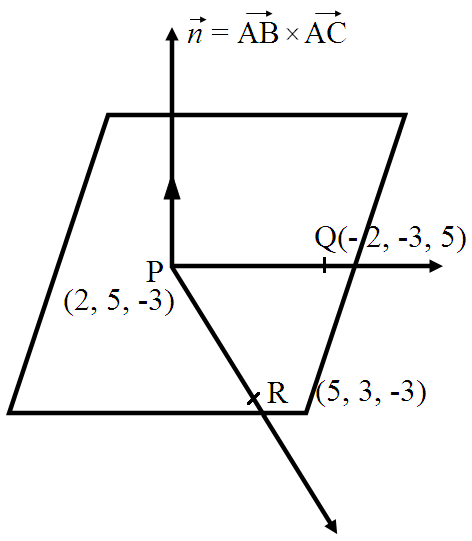
The required plane passes through the point P(2, 5, -3), whose position vector is $\vec{\text{a}}=2\hat{\text{i}}+5\hat{\text{j}}-3\hat{\text{k}}$ and is normal to the vector $\vec{\text{n}}$ given by
$\overrightarrow{\text{PQ}}=\overrightarrow{\text{OQ}}-\overrightarrow{\text{OP}}$
$=(-2\hat{\text{i}}-3\hat{\text{j}}+5\hat{\text{k}})-(2\hat{\text{i}}+5\hat{\text{j}}-3\hat{\text{k}})$
$=-4\hat{\text{i}}-8\hat{\text{j}}+8\hat{\text{k}}$
$\overrightarrow{\text{PR}}=\overrightarrow{\text{OR}}-\overrightarrow{\text{OP}}$
$=(5\hat{\text{i}}+3\hat{\text{j}}-3\hat{\text{k}})-(2\hat{\text{i}}+5\hat{\text{j}}-3\hat{\text{k}})$
$=3\hat{\text{i}}-2\hat{\text{j}}-0\hat{\text{k}}$
$\vec{\text{n}}=\overrightarrow{\text{PQ}}\times\overrightarrow{\text{PR}}$
$=\begin{vmatrix}\hat{\text{i}}&\hat{\text{j}}&\hat{\text{k}}\\-4&-8&8\\3&-2&0\end{vmatrix}$
$=16\hat{\text{i}}+24\hat{\text{j}}+32\hat{\text{k}}$
The vector equation of the required plane is
$\vec{\text{r}}\cdot\vec{\text{n}}=\vec{\text{a}}\cdot\vec{\text{n}}$
$\Rightarrow\vec{\text{r}}\cdot(16\hat{\text{i}}+24\hat{\text{j}}+32\hat{\text{k}})=(2\hat{\text{i}}+5\hat{\text{j}}-3\hat{\text{k}})\cdot(16\hat{\text{i}}+24\hat{\text{j}}+32\hat{\text{k}})$
$\Rightarrow\vec{\text{r}}\cdot\Big[8(2\hat{\text{i}}+3\hat{\text{j}}+4\hat{\text{k}})\Big]=32+120-96$
$\Rightarrow\vec{\text{r}}\cdot\Big[8(2\hat{\text{i}}+3\hat{\text{j}}+4\hat{\text{k}})\Big]=56$
$\Rightarrow\vec{\text{r}}\cdot(2\hat{\text{i}}+3\hat{\text{j}}+4\hat{\text{k}})=7$ View full question & answer→Question 965 Marks
Find the value of $\lambda$ for which the lines $\frac{\text{x}-1}{1}=\frac{\text{y}-2}{2}=\frac{\text{z}+3}{\lambda^2}$ and $\frac{\text{x}-3}{1}=\frac{\text{y}-2}{\lambda^2}=\frac{\text{z}-1}{2}$ are coplanar.
AnswerThe lines $\frac{\text{x}-\text{x}_1}{\text{a}_1}=\frac{\text{y}-\text{y}_1}{\text{b}_1}=\frac{\text{z}-\text{z}_1}{\text{c}_1}$ and $\frac{\text{x}-\text{x}_2}{\text{a}_2}=\frac{\text{y}-\text{y}_2}{\text{b}_2}=\frac{\text{z}-\text{z}_2}{\text{c}_2}$ are coplanar if
$\begin{vmatrix}\text{x}_2-\text{x}_1&\text{y}_2-\text{y}_1&\text{z}_2-\text{z}_1\\\text{a}_1&\text{b}_1&\text{c}_1\\\text{a}_2&\text{b}_2&\text{c}_2\end{vmatrix}=0$
The given lines $\frac{\text{x}-1}{1}=\frac{\text{y}-2}{2}=\frac{\text{z}+3}{\lambda^2}$ and $\frac{\text{x}-3}{1}=\frac{\text{y}-2}{\lambda^2}=\frac{\text{z}-1}{2}$ are coplanar.
$\therefore\ \begin{vmatrix}\text{x}_2-\text{x}_1&\text{y}_2-\text{y}_1&\text{z}_2-\text{z}_1\\\text{a}_1&\text{b}_1&\text{c}_1\\\text{a}_2&\text{b}_2&\text{c}_2\end{vmatrix}=0$
$\Rightarrow\begin{vmatrix}3-1&2-2&1-(-3)\\1&2&\lambda^2\\1&\lambda^2&2\end{vmatrix}=0$
$\Rightarrow\begin{vmatrix}2&0&4\\1&2&\lambda^2\\1&\lambda^2&2\end{vmatrix}=0$
$\Rightarrow2(4-\lambda^4)-0+4(\lambda^4-2)=0$
$\Rightarrow-2\lambda^4+4\lambda^2=0$
$\Rightarrow\lambda^2(\lambda^2-2)=0$
$\Rightarrow\lambda^2=0\text{ or }\lambda^2-2=0$
$\Rightarrow\lambda=0\text{ or }\lambda=\pm\sqrt{2}$
Thus, the values of $\lambda$ are $0,-\sqrt{2}$ and $\sqrt{2}$
View full question & answer→Question 975 Marks
Find the equation of the plane through (2, 3, -4) and (1, -1, 3) and parallel to x-axis.
AnswerThe equation of the plane through $(2, 3, -4)$ is
$a(x - 2) + b(y - 3) + c(z + 4) = 0 ....(i)$
This plane passes through (1, -1, 3). So,
$a(1 - 2) + b(-1 - 3) + c(3 + 4) = 0$
$⇒ -a - 4b + 7c = 0 ....(ii)$
Again plane (i) is parallel to x-axis. It means that plane (i) is perpendicular to the yz-plane whose equation is $x = 0$ or $1x + 0y + 0z = 0$
$⇒ a(1) + b(0) + c(0) = 0 ....(iii)$
$($Because $a_1a_2 + b_1b_2 + c_1c_2= 0)$
Solving (i), (ii) and (iii), we get
$\begin{vmatrix}\text{x}-3&\text{y}-3&\text{z}+4\\-1&-4&7\\1&0&0\end{vmatrix}=0$
$\Rightarrow0(\text{x}-3)+7(\text{y}-3)+4(\text{z}+4)=0$
$\Rightarrow7\text{y}+4\text{z}-5=0$
View full question & answer→Question 985 Marks
$\overrightarrow{\text{n}}$ is a vector of magnitude $\sqrt{3}$ and is equally inclined to an acute angle with the coordinate axes. Find the vector and cartesian form of the equation of a plane which passes through (2, 1, -1) and is normal to $\overrightarrow{\text{n}}$
AnswerHere, it is given that $\vec{\text{n}}=\sqrt{3}$ and $\vec{\text{n}}$ makes equal angle with coordinate axes.
Let, $\vec{\text{n}}$ has direction cosine as l. m and n and it makes angle of $\alpha,\beta$ and $\gamma$ with the coordinate axes, so
Here, $\alpha=\beta=\gamma$
$\Rightarrow\cos\alpha=\cos\beta=\cos\gamma$
$\Rightarrow\text{l}=\text{m}=\text{n}=\text{p}(\text{say})$
We know that,
$\text{l}^2+\text{m}^2+\text{n}^2=1$
$\text{p}^2+\text{p}^2+\text{p}^2=1$
$3\text{p}^2=1$
$\text{p}^2=\frac{1}{3}$
$\text{p}=\pm\frac{1}{\sqrt{3}}$
So,
$\text{l}=\pm\frac{1}{\sqrt{3}}$
$\cos\alpha=\pm\frac{1}{\sqrt{3}}$
Now, $\alpha=\cos^{-1}\Big(-\frac{1}{\sqrt{3}}\Big)$
It gives, $\alpha$ is an obtuse angle so, neglect it.
Again, $\alpha=\cos^{-1}\Big(-\frac{1}{\sqrt{3}}\Big)$
It gives, $\alpha$ is an acute angle, so
$\cos\alpha=\frac{1}{\sqrt{3}}$
$\therefore\ \text{l}=\text{m}=\text{n}=\frac{1}{\sqrt{3}}$
So,
$\vec{\text{n}}=|\vec{\text{n}}|(\text{l}\hat{\text{i}}+\text{m}\hat{\text{j}}+\text{n}\hat{\text{k}})$
$=\sqrt{3}\Big(\frac{1}{\sqrt{3}}\hat{\text{i}}+\frac{1}{\sqrt{3}}\hat{\text{j}}+\frac{1}{\sqrt{3}}\hat{\text{k}}\Big)$
$\vec{\text{n}}=\hat{\text{i}}+\hat{\text{j}}+\hat{\text{k}}$
And, $\vec{\text{a}}=2\hat{\text{i}}+\hat{\text{j}}-\hat{\text{k}}$
We know that, vector equation of a plane passing through the point $\vec{\text{a}}$ and perpendicular to the vector $\vec{\text{n}}$ is given by,
$(\vec{\text{r}}-\vec{\text{a}}){\vec{\text{n}}}=0$
$\big[\vec{\text{r}}-(2\hat{\text{i}}+\hat{\text{j}}-\hat{\text{k}})\big]\cdot(\hat{\text{i}}+\hat{\text{j}}+\hat{\text{k}})=0$
$\vec{\text{r}}\cdot(\hat{\text{i}}+\hat{\text{j}}+\hat{\text{k}})-(2\hat{\text{i}}+\hat{\text{j}}-\hat{\text{k}})(\hat{\text{i}}+\hat{\text{j}}+\hat{\text{k}})=0$
$\vec{\text{r}}\cdot(\hat{\text{i}}+\hat{\text{j}}+\hat{\text{k}})-[(2)(1)+(1)(1)+(-1)(1)]=0$
$\vec{\text{r}}\cdot(\hat{\text{i}}+\hat{\text{j}}+\hat{\text{k}})-[2+1-1]=0$
$\vec{\text{r}}\cdot(\hat{\text{i}}+\hat{\text{j}}+\hat{\text{k}})-2=0$
$\vec{\text{r}}\cdot(\hat{\text{i}}+\hat{\text{j}}+\hat{\text{k}})=2$
Put, $\vec{\text{r}}=(\text{x}\hat{\text{i}}+\text{y}\hat{\text{j}}+\text{z}\hat{\text{k}})$
$(\text{x}\hat{\text{i}}+\text{y}\hat{\text{j}}+\text{z}\hat{\text{k}})(\hat{\text{i}}+\hat{\text{j}}+\hat{\text{k}})=2$
$(\text{x})(1)+(\text{y})(1)+(\text{z})(1)=2$
$\text{x}+\text{y}+\text{z}=2$
So, vector and cartesian equation of the plane is,
$\vec{\text{r}}\cdot(\hat{\text{i}}+\hat{\text{j}}+\hat{\text{k}})=2$
$\text{x}+\text{y}+\text{z}=2$
View full question & answer→Question 995 Marks
Find the vector equation of the following planes in non-parametric form.
$\vec{\text{r}}=(2\hat{\text{i}}+2\hat{\text{j}}-\hat{\text{k}})+\lambda(\hat{\text{i}}+2\hat{\text{j}}+3\hat{\text{k}})+\mu(5\hat{\text{i}}-2\hat{\text{j}}+7\hat{\text{k}})$
AnswerWe know that equation $\vec{\text{r}}=\vec{\text{a}}+\lambda\vec{\text{b}}+\mu\vec{\text{c}} $ represents a plane passing through a point whose position vector is $\vec{\text{a}}$ and parallel to t.Here, $\vec{\text{a}}=2\hat{\text{i}}+2\hat{\text{j}}-\hat{\text{k}},\vec{\text{b}}=\hat{\text{i}}+2\hat{\text{j}}+3\hat{\text{k}},\hat{\text{c}}=5\hat{\text{i}}-2\hat{\text{j}}+7\hat{\text{k}}$
Normal vector, $\vec{\text{n}}=\vec{\text{b}}\times\vec{\text{c}}$
$=\begin{vmatrix}\hat{\text{i}}&\hat{\text{j}}&\hat{\text{k}}\\1&2&3\\5&-2&7\end{vmatrix}$
$=20\hat{\text{i}}+8\hat{\text{j}}-12\hat{\text{k}}$
The vector equation of the plane in scalar product form is,
$\vec{\text{r}}\cdot\vec{\text{n}}=\vec{\text{a}}\cdot\vec{\text{n}}$
$\Rightarrow\vec{\text{r}}\cdot(20\hat{\text{i}}+8\hat{\text{j}}-12\hat{\text{k}})=(2\hat{\text{i}}+2\hat{\text{j}}-\hat{\text{k}})(20\hat{\text{i}}+8\hat{\text{j}}-12\hat{\text{k}})$
$\Rightarrow\vec{\text{r}}\cdot\big(4(5\hat{\text{i}}+2\hat{\text{j}}-3\hat{\text{k}})\big)=40+16+12$
$\Rightarrow\vec{\text{r}}\cdot\big(4(5\hat{\text{i}}+2\hat{\text{j}}-3\hat{\text{k}})\big)=68$
$\Rightarrow\vec{\text{r}}\cdot(5\hat{\text{i}}+2\hat{\text{j}}-3\hat{\text{k}})=17$
View full question & answer→Question 1005 Marks
Find the equation of the plane that bisects the line segment joining the points (1, 2, 3) and (3, 4, 5) and is at right angle to it.
AnswerWe know to find the equation pf plane that bisects A(1, 2, 3) and B(3, 4, 5) perpendicularly
We know that, equation of plane passing through the point $\vec{\text{a}}$ and perpendicular to vector $\vec{\text{n}}$ is given by,
$(\vec{\text{r}}-\vec{\text{a}})\vec{\text{n}}=0\ ...(\text{i})$
Here, $\vec{\text{a}}=\text{mid-point of AB}$
$=\frac{\text{position vector of A}+\text{position vector of B}}{2}$
$=\frac{\hat{\text{i}}+2\hat{\text{j}}+3\hat{\text{k}}+3\hat{\text{i}}+4\hat{\text{j}}+5\hat{\text{k}}}{2}$
$\vec{\text{a}}=\frac{4\hat{\text{i}}+6\hat{\text{j}}+8\hat{\text{k}}}{2}$
$\vec{\text{a}}=2\hat{\text{i}}+3\hat{\text{j}}+4\hat{\text{k}}$
And, $\vec{\text{n}}=\overrightarrow{\text{AB}}$
= Position vector of B - Position vector of A
$=(3\hat{\text{i}}+4\hat{\text{j}}+5\hat{\text{k}})-(\hat{\text{i}}+2\hat{\text{j}}+3\hat{\text{k}})$
$=3\hat{\text{i}}+4\hat{\text{j}}+5\hat{\text{k}}-\hat{\text{i}}-2\hat{\text{j}}-3\hat{\text{k}}$
$\vec{\text{n}}=2\hat{\text{i}}+2\hat{\text{j}}+2\hat{\text{k}}$
Put, the value of $\vec{\text{a}}$ and $\vec{\text{n}}$ in equation (i),
$\vec{\text{r}}-(2\hat{\text{i}}+3\hat{\text{j}}+4\hat{\text{k}})(2\hat{\text{i}}+2\hat{\text{j}}+2\hat{\text{k}})=0$
$\vec{\text{r}}(2\hat{\text{i}}+2\hat{\text{j}}+2\hat{\text{k}})-\big[(2\hat{\text{i}}+3\hat{\text{j}}+4\hat{\text{k}})(2\hat{\text{i}}+2\hat{\text{j}}+2\hat{\text{k}})\big]=0$
$\vec{\text{r}}(2\hat{\text{i}}+2\hat{\text{j}}+2\hat{\text{k}})-[(2)(2)+(3)(2)+(4)(2)]=0$
$\vec{\text{r}}(2\hat{\text{i}}+2\hat{\text{j}}+2\hat{\text{k}})-[4+6+8]=0$
$\vec{\text{r}}(2\hat{\text{i}}+2\hat{\text{j}}+2\hat{\text{k}})-18=0$
$\vec{\text{r}}(2\hat{\text{i}}+2\hat{\text{j}}+2\hat{\text{k}})=18$
View full question & answer→Question 1015 Marks
If the line $\frac{\text{x}-3}{2}=\frac{\text{y}+2}{-1}=\frac{\text{z}+4}{3}$ lies in the plane $lx + my - z = 9$, then find the value of $l^2 + m^2.$
View full question & answer→Question 1025 Marks
Find the vector equation (in scalar product form) of the plane containing the line of intersection of the planes x - 3y + 2z - 5 = 0 and 2x - y + 3z - 1 = 0 and passing through (1, -2, 3).
AnswerThe equation of the plane passing through the line of intersection of the given planes is
$\text{x}-3\text{y}+2\text{z}-5+\lambda(2\text{x}-\text{y}+3\text{z}-1)=0\ ...(\text{i})$
This passing through (1, -2, 3). So,
$1+6+6-5+\lambda(2+2+9-1)$
$\Rightarrow8+12\lambda=0$
$\Rightarrow\lambda=\frac{-2}{3}$
Substituting this in (i) we get
$\text{x}-3\text{y}+2\text{z}-5-\frac{2}{3}(2\text{x}-\text{y}+3\text{z}-1)=0$
$\Rightarrow-\text{x}-7\text{y}-13=0$
$\Rightarrow\text{x}+7\text{y}+13=0$
$\Rightarrow\vec{\text{r}}\cdot(\hat{\text{i}}+7\hat{\text{j}})+13=0,$ Which is the required vector equation of the plane.
View full question & answer→Question 1035 Marks
Find the equation of the plane through the point $2\hat{\text{i}}+\hat{\text{j}}-\hat{\text{k}}$ and passing throught the line of intersection of the planes $\vec{\text{r}}\cdot(\hat{\text{i}}+3\hat{\text{j}}-\hat{\text{k}})=0$ and $\vec{\text{r}}\cdot(\hat{\text{j}}+2\hat{\text{k}})=0.$
AnswerThe equation of the plane passing through the line of intersection of the given planes is,
$\vec{\text{i}}(\hat{\text{i}}+3\hat{\text{j}}-\hat{\text{k}})+\lambda\big(\vec{\text{r}}(\hat{\text{j}}+2\hat{\text{k}})\big)=0$
$\vec{\text{r}}\cdot\Big[\hat{\text{i}}+(3+\lambda)\hat{\text{j}}+(-1+2\lambda)\hat{\text{k}}\Big]=0\ ...(\text{i})$
This passes through $2\hat{\text{i}}+\hat{\text{j}}-\hat{\text{k}}$ So,
$(2\hat{\text{i}}+\hat{\text{j}}-\hat{\text{k}})\Big[\hat{\text{i}}+(3+\lambda)\hat{\text{j}}+(-1+2\lambda)\hat{\text{k}}\Big]=0$
$\Rightarrow2+3+\lambda+1-2\lambda=0$
$\Rightarrow\lambda=6$
Substituting this in (i), we get
$\vec{\text{r}}\cdot\Big[\hat{\text{i}}+(3+6)\hat{\text{j}}+(-1+12)\hat{\text{k}}\Big]=0$
$\Rightarrow\vec{\text{r}}(\hat{\text{i}}+9\hat{\text{j}}+11\hat{\text{k}})=0$
View full question & answer→Question 1045 Marks
If the lines $\text{x}=5,\frac{\text{y}}{3-\alpha}=\frac{\text{z}}{-2}$ and $\text{x}=\alpha,\frac{\text{y}}{-1}=\frac{\text{z}}{2-\alpha}$ are coplanar, find the values of $\alpha.$
AnswerThe lines $\frac{\text{x}-\text{x}_1}{\text{a}_1}=\frac{\text{y}-\text{y}_1}{\text{b}_1}=\frac{\text{z}-\text{z}_1}{\text{c}_1}$ and $\frac{\text{x}-\text{x}_2}{\text{a}_2}=\frac{\text{y}-\text{y}_2}{\text{b}_2}=\frac{\text{z}-\text{z}_2}{\text{c}_2}$ are coplanar if
$\begin{vmatrix}\text{x}_2-\text{x}_1&\text{y}_2-\text{y}_1&\text{z}_2-\text{z}_1\\\text{a}_1&\text{b}_1&\text{c}_1\\\text{a}_2&\text{b}_2&\text{c}_2\end{vmatrix}=0$
The given lines $\frac{\text{x}-5}{0}=\frac{\text{y}}{3-\alpha}=\frac{\text{z}}{-2}$ and $\frac{\text{x}-\alpha}{0}=\frac{\text{y}}{-1}=\frac{\text{z}}{2-\alpha}$ are coplanar.
$\therefore\ \begin{vmatrix} \alpha-5&0-0&0-0\\0&3-\alpha&-2\\0&-1&2-\alpha\end{vmatrix}=0$
$\Rightarrow\begin{vmatrix} \alpha-5&0-0&0-0\\0&3-\alpha&-2\\0&-1&2-\alpha\end{vmatrix}=0$
$\Rightarrow(\alpha-5)\Big[(3-\alpha)\times(2-\alpha)-2\Big]-0+0=0$
$\Rightarrow(\alpha-5)(\alpha-1)(\alpha-4)=0$
$\Rightarrow\alpha-1=0\text{ or }\alpha-4=0\text{ or }\alpha-5=0$
$\Rightarrow\alpha=1\text{ or }\alpha=4\text{ or }\alpha=5$
Thus, the values of $\alpha$ are 1, 4 and 5.
View full question & answer→Question 1055 Marks
Find the distance of the point P(3, 4, 4) from the point, where the line joining the points A(3, -4, -5) and B(2, -3, 1) intersects the plane 2x + y + z = 7.
AnswerThe equation of a line joining the points A(3, -4, -5) and B(2, -3, 1) is
$\frac{\text{x}-3}{2-3}=\frac{\text{y}+4}{-3+4}=\frac{\text{z}+5}{1+5}=\text{r}$
$\Rightarrow\text{x}=3-\text{r},\text{ y}=-4+\text{r},\text{ z}=-5+6\text{r}$
Substituting this into the given plane equation we get
$2(3-\text{r})+(-4+\text{r})+(-5+6\text{r})=7$
$\Rightarrow\text{r}=2$
$\Rightarrow\text{x}=1,\text{ y}=-2,\text{ z}=7$
Distance of (1, -2, 7) from (3, 4, 4) is
$=\sqrt{(3-1)^2+(4+2)^2+(4-7)^2}$
$=\sqrt{4+36+9}$
$=\sqrt{49}$
$=7$
View full question & answer→Question 1065 Marks
Find the cartesian form of the equations of the following planes.
$\vec{\text{r}}=(1+\text{s}+\text{t})\hat{\text{i}}+(2-\text{s}+\text{t})\hat{\text{j}}+(3-2\text{s}+2\text{t})\hat{\text{k}}$
AnswerThe given equation of the plane is,
$\vec{\text{r}}=(1+\text{s}+\text{t})\hat{\text{i}}+(2-\text{s}+\text{t})\hat{\text{j}}+(3-2\text{s}+2\text{t})\hat{\text{k}}$
$\Rightarrow\vec{\text{r}}=(\hat{\text{i}}+2\hat{\text{j}}+3\hat{\text{k}})+\text{s}(\hat{\text{i}}-\hat{\text{j}}-2\hat{\text{k}})+\text{t}(\hat{\text{i}}+\hat{\text{j}}+2\hat{\text{k}})$
Normal vector, $\vec{\text{n}}=\vec{\text{b}}\times\vec{\text{c}}$
$=\begin{vmatrix}\hat{\text{i}}&\hat{\text{j}}&\hat{\text{k}}\\1&-1&-2\\1&1&2\end{vmatrix}$
$=0\hat{\text{i}}-4\hat{\text{j}}+2\hat{\text{k}}$
$=-4\hat{\text{j}}+2\hat{\text{k}}$
The vector equation of the plane in scalar product from is
$\vec{\text{r}}\cdot\vec{\text{n}}=\vec{\text{a}}\cdot\vec{\text{n}}$
$\Rightarrow\vec{\text{r}}\cdot(-4\hat{\text{j}}+2\hat{\text{k}})=(\hat{\text{i}}+2\hat{\text{j}}+3\hat{\text{k}})(-4\hat{\text{j}}+2\hat{\text{k}})$
$\Rightarrow\vec{\text{r}}\cdot\Big[-2(2\hat{\text{j}}-\hat{\text{k}})\Big]=0-8+6$
$\Rightarrow\vec{\text{r}}\cdot\Big[-2(2\hat{\text{j}}-\hat{\text{k}})\Big]=-2$
$\Rightarrow\vec{\text{r}}\cdot(2\hat{\text{j}}-\hat{\text{k}})=1$
For cartesian form, let us substitute $\vec{\text{r}}=\text{x}\hat{\text{i}}+\text{y}\hat{\text{j}}+\text{z}\hat{\text{k}}$ here. Then, we get
$(\text{x}\hat{\text{i}}+\text{y}\hat{\text{j}}+\text{z}\hat{\text{k}})\cdot(2\hat{\text{j}}-\hat{\text{k}})=1$
$\Rightarrow2\text{y}-\text{z}=1$
View full question & answer→Question 1075 Marks
Find the equation of the plane passing through the line of intersection of the planes $x + 2y +3z - 4 = 0$ and $2x + y - z + 5 = 0$ and perpendicular to the plane $5x + 3y - 6z + 8 = 0.$
AnswerThe equationof the planepassing the line of intersection of the given planes is,
$\text{x}+2\text{y}+3\text{z}-4+\lambda(2\text{x}+\text{y}-\text{z}+5)=0$
$(1+2\lambda)\text{x}+(2+\lambda)\text{y}+(3-\lambda)\text{z}-4+5\lambda=0\ ...(\text{i})$
The plane is perpendicular to $5x + 3y - 6z + 8 = 0$. So,
$5(1+2\lambda)+3(2+\lambda)-6(3-\lambda)=0 ($Because $a_1a_2 + b_1b_2 + c_1c_2= 0)$
$\Rightarrow5+10\lambda+6+3\lambda-18+6\lambda=0$
$\Rightarrow19\lambda-7=0$
$\Rightarrow\lambda=\frac{7}{19}$
Substituting this in (i), we get
$\Big(1+2\Big(\frac{7}{19}\Big)\Big)\text{x}+\Big(2+\frac{7}{19}\Big)\text{y}+\Big(3-\frac{7}{19}\Big)\text{z}-4+5\Big(\frac{7}{19}\Big)=0$
$\Rightarrow33\text{x}+45\text{y}+50\text{z}-41=0$
View full question & answer→Question 1085 Marks
Find the equation of a plane passing through the points (0, 0, 0) and (3, -1,2) and parallel to the line $\frac{\text{x}-4}{1}=\frac{\text{y}+3}{-4}=\frac{\text{z}+1}{7}$
AnswerThe equation of the plane through $(0, 0, 0)$ is
$a(x - 0) + b(y - 0) + c(z - 0) = 0$
$ax + by + cz = 0 ...(i)$
This plane passes through $(3, -1, 2)$ So,
$3a - b + 2c = 0 ....(ii)$
Again plane (i) is parallel to the given line.
It means that the normal to plane (i) is perpendicular to the line.
$⇒ a(1) + b(-4) + c(7) = 0 ....(iii) ($Because $a_1a_2 + b_1b_2 + c_1c_2= 0)$
Solving (i), (ii) and (iii) we get
$\begin{vmatrix}\text{x}&\text{y}&\text{z}\\3&-1&2\\1&-4&7\end{vmatrix}=0$
$⇒ x - 19y - 11z = 0$
View full question & answer→Question 1095 Marks
Find the equation of the plane through the line of intersection of the planes $ x + 2y + 3z + 4 = 0$ and $x - y + z + 3 = 0$ and passing through the origin.
AnswerWe know that, equation of a plane passing through the line of intersection of planes $a_1x + b_1y + c_1z + d_1 = 0$ and $a_2x + b_2y + c_2z + d_2 = 0$ is given by,
$(\text{a}_1\text{x}+\text{b}_1\text{y}+\text{c}_1\text{z}+\text{d}_1)+\lambda(\text{a}_2\text{x}+\text{b}_2\text{y}+\text{c}_2\text{z}+\text{d}_2)=0$
So, equation of plane passing through the line of intersection of planes $x + 2y + 3z + 4 = 0$ and $x - y + z + 3 = $0 is
$(\text{x}+2\text{y}+3\text{z}+4)+\lambda(\text{x}-\text{y}+\text{z}+3)=0$
$\text{x}(1+\lambda)+\text{y}(2-\lambda)+\text{z}(3+\lambda)+4+3\lambda=0\ ...(\text{i})$
Equation (i) is passing through origin, so
$(0)(1+\lambda)+(0)(2-\lambda)+(0)(3+\lambda)+4+3(\lambda)=0$
$0+0+0+4+3\lambda=0$
$3\lambda=-4$
$\lambda=-\frac{4}{3}$
Put the value of $\lambda$ in equation (i),
$\text{x}(1+\lambda)+\text{y}(2-\lambda)+\text{z}(3+\lambda)+4+3\lambda=0$
$\text{x}\Big(1-\frac{4}{3}\Big)+\text{y}\Big(2+\frac{4}{3}\Big)+\text{z}\Big(3-\frac{4}{3}\Big)+4-\frac{12}{3}=0$
$\text{x}\Big(\frac{3-4}{3}\Big)+\text{y}\Big(\frac{6+4}{3}\Big)+\text{z}\Big(\frac{9-4}{3}\Big)+4-4=0$
$-\frac{\text{x}}{3}+\frac{10\text{y}}{3}+\frac{5\text{z}}{3}=0$
Multiplying by 3, we get
$-x + 10y + 5z = 0$
$x - 10y - 5z = 0$
The equation of required plane is,
$x - 10y - 5z = 0$
View full question & answer→Question 1105 Marks
Find the equations of the planes parallel to the plane x - 2y + 2z - 3 = 0 and which are at a unit distance from the point (1, 1, 1).
AnswerThe equation of the plane parallel to the given plane is
x - 2y + 2z + k = 0 ...(i)
It is given the plane (i) is at a distance of 1 unit from (1, 1, 1)
$\Rightarrow\frac{|1-2+2+\text{k}|}{\sqrt{1^2+(-2)^2+2^2}}=1$
$\Rightarrow\frac{|1+\text{k}|}{3}=1$
⇒ |1 + k| = 3
⇒ 1 + k = 3, 1 + k = -3
Substituting these two values one by one in (i) we get
x - 2y + 2z + 2 = 0 and x - 2y + 2z - 4 = 0, which are the equations of the required planes.
View full question & answer→Question 1115 Marks
Find the cartesian form of the equations of the following planes.
$\vec{\text{r}}=(\hat{\text{i}}-\hat{\text{j}})+\text{s}(-\hat{\text{i}}+\hat{\text{j}}+2\hat{\text{k}})+\text{t}(\hat{\text{i}}+2\hat{\text{j}}+\hat{\text{k}})$
Answer$\vec{\text{r}}=(\hat{\text{i}}-\hat{\text{j}})+\text{s}(-\hat{\text{i}}+\hat{\text{j}}+2\hat{\text{k}})+\text{t}(\hat{\text{i}}+2\hat{\text{j}}+\hat{\text{k}})$We know that the equation $\vec{\text{r}}=\vec{\text{a}}+\text{s}\vec{\text{b}}+\text{t}\vec{\text{c}}$ represents a plane passing through a point whose position vector is $\vec{\text{a}}$ and parallel to the vectors $\vec{\text{b}}$ and $\vec{\text{c}}.$
Here, $\vec{\text{a}}=\hat{\text{i}}-\hat{\text{j}}+0\hat{\text{k}},\vec{\text{b}}=-\hat{\text{i}}+\hat{\text{j}}+2\hat{\text{k}},\vec{\text{c}}=\hat{\text{i}}+2\hat{\text{j}}+\hat{\text{k}}$
Normal vector, $\vec{\text{n}}=\vec{\text{b}}\times\vec{\text{c}}$
$=\begin{vmatrix}\hat{\text{i}}&\hat{\text{j}}&\hat{\text{k}}\\1&1&2\\1&2&1\end{vmatrix}$
$=-3\hat{\text{i}}+3\hat{\text{j}}-3\hat{\text{k}}$
The vector equation of the plane in scalar product form is,
$\vec{\text{i}}\cdot\vec{\text{n}}=\vec{\text{a}}\cdot\vec{\text{n}}$
$\Rightarrow\vec{\text{r}}\cdot(-3\hat{\text{i}}+3\hat{\text{j}}-3\hat{\text{k}})=(\hat{\text{i}}-\hat{\text{j}}+0\hat{\text{k}})\cdot(-3\hat{\text{i}}+3\hat{\text{j}}-3\hat{\text{k}})$
$\Rightarrow\vec{\text{r}}\cdot\Big[-3(\hat{\text{i}}-\hat{\text{j}}+\hat{\text{k}})\Big]=-3-3+0 $
$\Rightarrow\vec{\text{r}}\cdot\Big[-3(\hat{\text{i}}-\hat{\text{j}}+\hat{\text{k}})\Big]=-6$
$\Rightarrow\vec{\text{r}}\cdot(\hat{\text{i}}-\hat{\text{j}}+\hat{\text{k}})=2$
For cartesian form, let us substitute $\vec{\text{r}}=\text{x}\hat{\text{i}}+\text{y}\hat{\text{j}}+\text{z}\hat{\text{k}}$ here. Then we get
$(\text{x}\hat{\text{i}}+\text{y}\hat{\text{j}}+\text{z}\hat{\text{k}})(\hat{\text{i}}-\hat{\text{j}}+\hat{\text{k}})=2$
$\text{x}-\text{y}+\text{z}=2$
View full question & answer→Question 1125 Marks
Find the equation of the plane that contains the point (1, -1, 2) and is perpendicular to each of the planes 2x + 3y - 2z = 5 and x + 2y - 3z = 8.
AnswerThe equation of any plane passing through (1, -1, 2) is,
a(x - 1) + b(y + 1) + c(z - 2) = 0 ....(i)
It is given that (i) is perpendicular to the plane 2x + 3y - 3z = 5. So,
2a + 3b - 3c = 0 ....(ii)
It is given that (i) is perpendicular to the plane x + 2y - 3z = 8. So,
a + 2b - 3c = 0 ....(iii)
Solving (i), (ii) and (iii) we get,
$\begin{vmatrix}\text{x}-1&\text{y}+1&\text{z}-2\\2&3&-2\\1&2&-3\end{vmatrix}=0$
⇒ -5(x - 1) + 4(y + 1) + 1(z - 2) = 0
⇒ 5x - 4y - z = 7
View full question & answer→Question 1135 Marks
Find the intercepts made on the coordinate axes by the plane 2x + y - 2z = 3 and also find the direction cosines of the normal to the plane.
AnswerHere, given equation of plane is,
2x + y - 2z = 3
Dividing by 3 on both the sides,
$\frac{2\text{x}}{3}+\frac{\text{y}}{3}-\frac{2\text{z}}{3}=\frac{3}{3}$
$\frac{\text{x}}{\frac{3}{2}}+\frac{\text{y}}{3}+\frac{\text{z}}{-\frac{3}{2}}=1\ ...(\text{i})$
We know that, if a, b, c are the intercepts by a plane on the coordinate axes,
new equation of the plane is,
$\frac{\text{x}}{\text{a}}+\frac{\text{y}}{\text{b}}+\frac{\text{z}}{\text{c}}=1\ ....(\text{ii})$
Comparing the equation (i) and (ii),
$\text{a}=\frac{3}{2},\text{b}=3,\text{c}=-\frac{3}{2}$
Again, given equation of plane is,
2x + y - 2z = 3
$(\text{x}\hat{\text{i}}+\text{y}\hat{\text{j}}+\text{z}\hat{\text{k}})(2\hat{\text{i}}+\hat{\text{j}}-2\hat{\text{k}})=3$
$\vec{\text{r}}(2\hat{\text{i}}+\hat{\text{j}}-2\hat{\text{k}})=3$
So, vector normal to the plane is given by
$\vec{\text{n}}=2\hat{\text{i}}+\hat{\text{j}}-2\hat{\text{k}}$
$|\vec{\text{n}}|=\sqrt{(2)^2+(1)^2+(-2)^2}$
$=\sqrt{4+1+4}$
$=\sqrt{9}$
$|\vec{\text{n}}|=3$
Direction vector of $\vec{\text{n}}=2,1,-2$
Direction vector $\vec{\text{n}}=\frac{2}{|\vec{\text{n}}|},\frac{1}{|\vec{\text{n}}|},\frac{-2}{|\vec{\text{n}}|}$
$=\frac{2}{3},\frac{1}{3},-\frac{2}{3}$
So,
Intercepts by the plane on coordinaye axes are $=\frac{3}{2},3,-\frac{3}{2}$
Direction cosine of normal to the plane are $=\frac{2}{3},\frac{1}{3},-\frac{2}{3}$
View full question & answer→Question 1145 Marks
Find the equation of a plane which passes through the point (3, 2, 0) and contains the line $\frac{\text{x}-3}{1}=\frac{\text{y}-6}{5}=\frac{\text{z}-4}{4}$
AnswerRequired equation of plane is passing through the point (3, 2, 0)
$\therefore$ a(x - 3) + b(y - 2) + c(z - 0) = 0
⇒ a(x - 3) + b(y - 2) + cz = 0 ....(i)
Required equation of plane also contains the line $\frac{\text{x}-3}{1}=\frac{\text{y}-6}{5}=\frac{\text{z}-4}{4},$ so it passes through the point (3, 2, 0)
⇒ a(3 - 3) + b(6 - 2) + c(4) = 0
⇒ 4b + 4c = 0 ...(ii)
Also plane will be parallel to,
a(1) + b(5) + c(4) = 0
a + 5b + 4c = 0 ....(iii)
Solving (ii) and (iii) by cross multiplication,
$\frac{\text{a}}{16-20}=\frac{\text{b}}{4-0}=\frac{\text{c}}{0-4}=\lambda(\text{say})$
$-\frac{\text{a}}{4}=\frac{\text{b}}{4}=-\frac{\text{c}}{4}=\lambda(\text{say})$
$\Rightarrow\text{a}=-\lambda,\text{ b}=\lambda,\text{ c}=-\lambda$
Put $\text{a}=-\lambda,\text{ b}=\lambda,\text{ c}=-\lambda$ in equation (i) we get
$(-\lambda)(\text{x}-3)+(\lambda)(\text{y}-2)+(-\lambda)\text{z}=0$
$\Rightarrow-\text{x}+3+\text{y}-2-\text{z}=0$
$\Rightarrow\text{x}-\text{y}+\text{z}-1=0$
View full question & answer→Question 1155 Marks
Find the coordinates of the foot of the perependicular drawn from the origin to the plane 2x - 3y + 4z - 6 = 0.
AnswerLet M be the foot of the perpendicular of the origin P(0, 0, 0) in the plane 2x - 3y + 4z - 6 =0.
Then, PM is normal to the plane. So, the direction rations of PM are proportional to 2, -3, 4.
Since PM passes through P(0, 0, 0) and has direction ratios proportional to 2, -3, 4 the equation ot PQ is
$\frac{\text{x}-0}{2}=\frac{\text{y}-0}{-3}=\frac{\text{z}-0}{4}=\text{r (say)}$
Let the coordinted of M be (2r, -3r, 4r)
Since M lies in the plane 2x - 3y + 4z - 6 = 0,
2(2r) - 3(-3r) + 4(4r) - 6 = 0
⇒ 4r + 9r + 16r - 6 = 0
⇒ 29r - 6 = 0
$\Rightarrow\ \text{r}=\frac{6}{29}$
Substituting the value of r in the coordinated of Ml we get
$\text{M}=(2\text{r},-3\text{r},4\text{r})=\bigg(2\Big(\frac{6}{29}\Big),-3\Big(\frac{6}{29}\Big),4\Big(\frac{6}{29}\Big)\bigg)$
$=\Big(\frac{12}{29},\frac{-18}{29},\frac{24}{29}\Big)$
View full question & answer→Question 1165 Marks
Find the equation of the plane mid-parallel to the planes $2x - 2y + z + 3 = 0$ and $2x - 2y + z + 9 = 0$
AnswerWe know that the distance between two planes $ax + by + cz = d_1$_ and $ax + by + cz = d_2$_ is $\frac{\big|\text{d}_2-\text{d}_1\big|}{\sqrt{\text{a}^2+\text{b}^2+\text{c}^2}}$
The equation of plane thatb is mid-parallel to the planes
$2x - 2y + z + 3 = 0 ...(i)$
$2x - 2y + z + 9 = 0 ....(ii)$
is of the form $2x - 2y + z + k = 0 ...(iii)$
It meance that the distance between (i) and (iii) = distance between (i) and (ii)
$\Rightarrow\frac{|\text{k}-3|}{\sqrt{4+4+1}}=\frac{|\text{k}-9|}{\sqrt{4+4+1}}$
$⇒ |k - 3| = |k - 9|$
$⇒ k - 3 = k - 9 or k - 3 = -(k - 9)$
$⇒ 3 = 9 ($false$); k - 3 = -k + 9$
$⇒ 2k = 12$
$⇒ k = 6$
Substituting this in (iii) we get $2x - 2y + z + 6 = 0,$ which is the required equation of the plane.
View full question & answer→Question 1175 Marks
Find the vector equation of the line through the origin which is perpendicular to the plane $\vec{\text{r}}\cdot(\hat{\text{i}}+2\hat{\text{j}}+3\hat{\text{k}})=3$
AnswerRequired line is perpendicular to plane $\vec{\text{r}}\cdot(\hat{\text{i}}+2\hat{\text{j}}+3\hat{\text{k}})=3,$ so line is parallel to the normal vector $\vec{\text{n}}=\hat{\text{i}}+2\hat{\text{j}}+3\hat{\text{k}}$ of plane.
And it is passing through point $\vec{\text{a}}=0\hat{\text{i}}+0\hat{\text{j}}+0\hat{\text{k}}$
We know that equation of a passing through $\vec{\text{a}}$ and parallel to vector $\vec{\text{b}}$ is,
$\vec{\text{r}}=\vec{\text{a}}+\lambda\vec{\text{b}}\ ...(\text{i})$
Here, $\vec{\text{a}}=0\hat{\text{i}}+0\hat{\text{j}}+0\hat{\text{k}}$ and $\vec{\text{b}}=\vec{\text{n}}=\hat{\text{i}}+2\hat{\text{j}}+3\hat{\text{k}}$
So, $\vec{\text{r}}=(0\hat{\text{i}}+0\hat{\text{j}}+0\hat{\text{k}})+\lambda(\hat{\text{i}}+2\hat{\text{j}}+3\hat{\text{k}})$
Hence, equation required line is
$\vec{\text{r}}=\lambda(\hat{\text{i}}+2\hat{\text{j}}+3\hat{\text{k}})$
View full question & answer→Question 1185 Marks
Find the angle between line $\frac{\text{x}-1}{1}=\frac{\text{y}-2}{-1}=\frac{\text{z}+1}{1}$ and the plane $2x + y - z = 4.$
AnswerWe know that the angle $\theta$ between the line $\frac{\text{x}-\text{x}_1}{\text{a}_1}=\frac{\text{y}-\text{y}_1}{\text{b}_1}=\frac{\text{z}-\text{z}_1}{\text{c}_1}$ and plane $a_2x + b_2y + c_2z + d_2= 0$ is given by
$\sin\theta=\frac{\text{a}_1\text{a}_2+\text{b}_1\text{b}_2+\text{c}_1\text{c}_2}{\sqrt{\text{a}^2_1+\text{b}^2_1+\text{c}^2_1}\sqrt{\text{a}^2_2+\text{b}^2_2+\text{c}^2_2}}\ ...(\text{i})$
Given, equation of line is
$\frac{\text{x}-1}{1}=\frac{\text{y}-2}{-1}=\frac{\text{z}+1}{1}$
So, $a_1 = 1, b_1 = -1, c_1 = 1$
Given equation of plane is $2x + y - z - 4 = 0$
So, $a_2 = 2, b_2 = 1, c_2 = -1$
Put these value in equation (i),
$\sin\theta=\frac{\text{a}_1\text{a}_2+\text{b}_1\text{b}_2+\text{c}_1\text{c}_2}{\sqrt{\text{a}^2_1+\text{b}^2_1+\text{c}^2_1}\sqrt{\text{a}^2_2+\text{b}^2_2+\text{c}^2_2}}$
$\sin\theta=\frac{(1)(2)+(-1)(1)+(1)(-1)}{\sqrt{(1)^2+(-1)^2+(1)^2}\sqrt{(2)^2+(1)^2+(-1)^2}}$
$\sin\theta=\frac{2-1-1}{\sqrt{1+1+1}\sqrt{4+1+1}}$
$\sin\theta=\frac{0}{\sqrt{3}\sqrt{6}}$
$\sin\theta=0$
$\theta=0^{\circ}$
angle between plane and line $=0^{\circ}$
View full question & answer→Question 1195 Marks
The direction ratios of the perpendicular from the origin to a plane are 12, -3, 4 and the length of the perpendicular is 5. Find the equation of the plane.
AnswerGiven, direction ratios of perpendicular from origin to a plane is 12, -3, 4
So,
Normal vector $=12\hat{\text{i}}-3\hat{\text{j}}+4\hat{\text{k}}$
$\vec{\text{n}}=12\hat{\text{i}}-3\hat{\text{j}}+4\hat{\text{k}}$
$|\vec{\text{n}}|=\sqrt{(12)^2+(-3)^2+(4)^2}$
$=\sqrt{144+9+16}$
$=\sqrt{169}$
$|\vec{\text{n}}|=13$
Normal unit vector $\hat{\text{n}}=\frac{\vec{\text{n}}}{|\vec{\text{n}}|}$
$=\frac{1}{13}(12\hat{\text{i}}-3\hat{\text{j}}+4\hat{\text{k}})$
Given that, perpendicular distance of plane from origin is 5 unit.
$\Rightarrow\text{d}=5\text{ unit}$
We know that, equation of a plane at a distance d from origin and normal unit vector $\hat{\text{n}}$ is,
$\vec{\text{r}}\cdot\hat{\text{n}}={\text{d}}$
So, vector equation of required plane is,
$\vec{\text{r}}\cdot\Big(\frac{12}{13}\hat{\text{i}}-\frac{3}{13}\hat{\text{j}}+\frac{4}{13}\hat{\text{k}}\Big)=5$
Put $\vec{\text{r}}=\text{x}\hat{\text{i}}+\text{y}\hat{\text{j}}+\text{z}\hat{\text{k}}$
$(\text{x}\hat{\text{i}}+\text{y}\hat{\text{j}}+\text{z}\hat{\text{k}})\Big(\frac{12}{13}\hat{\text{i}}-\frac{3}{13}\hat{\text{j}}+\frac{4}{13}\hat{\text{k}}\Big)=5$
$(\text{x})\Big(\frac{12}{13}\Big)+(\text{y})\Big(-\frac{3}{13}\Big)+(\text{z})\Big(\frac{4}{13}\Big)=5$
$\frac{12}{13}\text{x}-\frac{3}{13}\text{y}+\frac{4}{13}\text{z}=5$
View full question & answer→Question 1205 Marks
Find a vector of magnitude 26 units normal to the plane 12x - 3y + 4z = 1
AnswerGiven, equation of plane is,
12x - 3y + 4z = 1
$(\text{x}\hat{\text{i}}+\text{y}\hat{\text{j}}+\text{z}\hat{\text{k}})(12\hat{\text{i}}-3\hat{\text{j}}-4\hat{\text{k}})=1$
$\vec{\text{r}}\cdot\vec{\text{n}}=1$
So, normal to the plane is
$\vec{\text{n}}=12\hat{\text{i}}-3\hat{\text{j}}+4\hat{\text{k}}$
$|\vec{\text{n}}|=\sqrt{(12)^2+(-3)^2+(4)^2}$
$=\sqrt{144+9+16}$
$=\sqrt{144+25}$
$=\sqrt{169}$
$=13$
$\text{unit vector}\hat{\text{ n}}=\frac{12\hat{\text{i}}-3\hat{\text{j}}+4\hat{\text{k}}}{13}$
$=\frac{12\hat{\text{i}}}{13}-\frac{3}{13}\hat{\text{j}}+4\hat{\text{k}}$
A vector to the plane with magnitude
$26=26\hat{\text{n}}$
$=26\Big(\frac{12\hat{\text{i}}}{13}-3\hat{\text{j}}+4\hat{\text{k}}\Big)$
Required vector $=24\hat{\text{i}}-6\hat{\text{j}}+8\hat{\text{k}}$
View full question & answer→Question 1215 Marks
Find the equation of the plane through (3, 4, -1) which is parallel to the plane $\vec{\text{r}}\cdot(2\hat{\text{i}}-3\hat{\text{j}}+5\hat{\text{k}})+2=0$
AnswerLet the equation of a plane parallel to the given plane be
$\vec{\text{r}}\cdot(2\hat{\text{i}}-3\hat{\text{j}}+5\hat{\text{k}})=\text{k}\ ...(\text{i})$
$(\text{x}\hat{\text{i}}+\text{y}\hat{\text{j}}+\text{z}\hat{\text{k}})(2\hat{\text{i}}-3\hat{\text{j}}+5\hat{\text{k}})=\text{k}$
This passes through (3, 4, -1). so,
$(3\hat{\text{i}}+4\hat{\text{j}}-\hat{\text{k}})(2\hat{\text{i}}-3\hat{\text{j}}+5\hat{\text{k}})=\text{k}$
$\text{k}=6-12-5=-11$
Substituting this in (i), we get
$\vec{\text{r}}\cdot(2\hat{\text{i}}-3\hat{\text{j}}+5\hat{\text{k}})=-11$
$\vec{\text{r}}\cdot(2\hat{\text{i}}-3\hat{\text{j}}+5\hat{\text{k}})+11=0,$ which is the equation of the required plane.
View full question & answer→Question 1225 Marks
If the line drawn from (4, -1, 2) meets a plane at right at the point (-10, 5, 4) find the equation of the plane.
AnswerThe normal is passing through the point A(4, -1, 2) and B(-10, 5, 4) So,
$\overrightarrow{\text{n}}=\overrightarrow{\text{AB}}=\overrightarrow{\text{OB}}-\overrightarrow{\text{OA}}$
$=(-10\hat{\text{i}}+5\hat{\text{j}}+4\hat{\text{k}})-(4\hat{\text{i}}-\hat{\text{j}}+2\hat{\text{k}})$
$=-14\hat{\text{i}}+6\hat{\text{j}}+2\hat{\text{k}}$
Since the plane passes through (-10, 5, 4), $\vec{\text{a}}=-10\hat{\text{i}}+5\hat{\text{j}}+4\hat{\text{k}}$
We know that the vector equation of the plane passing through a point $\vec{\text{a}}$ and normal to $\vec{\text{n}}$ is
$\vec{\text{r}}\cdot(-14\hat{\text{i}}+6\hat{\text{j}}+2\hat{\text{k}})=(-10\hat{\text{i}}+5\hat{\text{j}}+4\hat{\text{k}})(-14\hat{\text{i}}+6\hat{\text{j}}+2\hat{\text{k}})$
$\Rightarrow\vec{\text{r}}\cdot(-14\hat{\text{i}}+6\hat{\text{j}}+2\hat{\text{k}})=140+30+8$
$\Rightarrow\vec{\text{r}}\cdot\big(-2(7\hat{\text{i}}-3\hat{\text{j}}-\hat{\text{k}})\big)=178$
$\Rightarrow\vec{\text{r}}\cdot(7\hat{\text{i}}-3\hat{\text{j}}-\hat{\text{k}})=-89$
Substituting $\vec{\text{r}}=\text{x}\hat{\text{i}}+\text{y}\hat{\text{j}}+\text{z}\hat{\text{k}}$ in the vector equation, we get
$(\text{x}\hat{\text{i}}+\text{y}\hat{\text{j}}+\text{z}\hat{\text{k}})\cdot(7\hat{\text{i}}-3\hat{\text{j}}-\hat{\text{k}})=-89$
$\Rightarrow7\text{x}-3\text{y}-\text{z}=-89$
$\Rightarrow7\text{x}-3\text{y}-\text{z}+89=0$
View full question & answer→Question 1235 Marks
Find the vector equation of the line passing through the point (1, -1, 2) and perpendicular to the plane 2x - y + 3z - 5 = 0.
AnswerLet a, b, c be the direction ratios of the given line.
Since the line passes through the point (1, -1, 2) is
$\frac{\text{x}-1}{\text{a}}=\frac{\text{y}+1}{\text{b}}=\frac{\text{z}-2}{\text{c}}\ ...(\text{i})$
$\text{a}=2\lambda,\text{ b}=-\lambda,\text{ c}=3\lambda$
Substituting these values in (i) we get
$\frac{\text{x}-1}{2}=\frac{\text{y}+1}{-1}=\frac{\text{z}-2}{3},$ which is the cartesian from of the line.
Vector form
The given line passes through a point whose position vector is $\vec{\text{a}}=\hat{\text{i}}-\hat{\text{j}}+2\hat{\text{k}}$ and is parallel to the vector $\vec{\text{b}}=2\hat{\text{i}}-\hat{\text{j}}+3\hat{\text{k}}$
So, its equation in vector form is
$\vec{\text{r}}=\vec{\text{a}}+\lambda\vec{\text{b}}$
$\vec{\text{r}}=(\hat{\text{i}}-\hat{\text{j}}+2\hat{\text{k}})+\lambda(\hat{2\text{i}}-\hat{\text{j}}+3\hat{\text{k}})$
View full question & answer→Question 1245 Marks
Find the position vector of the food of perpendicular and the perpendicular distance from the point P with position vector $2\hat{\text{i}}+3\hat{\text{j}}+4\hat{\text{k}}$ to the plane $\vec{\text{r}}.(2\hat{\text{i}}+\hat{\text{j}}+3\hat{\text{k}})-26=0.$ Also find image or P in the plane.
AnswerLet M be the foot of the perpendicular drawn from the point P(2, 3, 4) in the plane
$\vec{\text{r}}.(2\hat{\text{i}}+\hat{\text{j}}+3\hat{\text{k}})-26=0$ or $2x + y + 3z - 26 = 0$
Then, PM is the normal to the plane. So, the direction rations of PM are proportional to 2, 1, 3.
Since PM passes throught P(2, 3, 4) and has direction rations proportional to 2, 1, 3 so the equation or PM is
$\frac{\text{x}-2}{2}=\frac{\text{y}-3}{1}=\frac{\text{z}-4}{3}=\text{r (say)}$
Let the coordinates or M be $(2r + 2, r + 3, 3r + 4)$. Since M lies in the plane $2x + y + 3z - 26 = 0,$ So
$2(2r + 2) + r + 3 + 3(3r + 4) - 26 = 0$
$⇒ 4r + 4 + r + 3 + 9r + 12 - 26 = 0$
$⇒ 14r - 7 = 0$
$\Rightarrow\text{r}=\frac{1}{2}$
Therefore, the coordinates of M are
$(2\text{r}+2,\text{r}+3,3\text{r}+4)\\=\Big(2\times\frac{1}{2}+2,\frac{1}{2}+3,3\times\frac{1}{2}+4\Big)\\=\Big(3,\frac{7}{2},\frac{11}{2}\Big)$
Thus, the position vector of the foot of perpendicular are $3\hat{\text{i}}+\frac{7}{2}\hat{\text{j}}+\frac{11}{2}\hat{\text{k}}.$
Now,
Length of the perpendicular from P on to the given plane
$=\Big|\frac{2\times2+1\times3+3\times4-26}{\sqrt{4+1+9}}\Big|$
$=\frac{7}{\sqrt{14}}$
$=\sqrt{\frac{7}{2}}\text{ units}$
Let $Q(x_1, y_1, z_1)$ be the image of point P in the given plane.
Then, the coordinates of M are $\Big(\frac{\text{x}_1+2}{2},\frac{\text{y}_1+3}{2},\frac{\text{z}_1+4}{2}\Big)$
But, the coordinate or M are $\Big(3,\frac{7}{2},\frac{11}{2}\Big)$
$\therefore\Big(\frac{\text{x}_1+2}{2},\frac{\text{y}_1+3}{2},\frac{\text{z}_1+4}{2}\Big)=\Big(3,\frac{7}{2},\frac{11}{2}\Big)$
$\Rightarrow \frac{\text{x}_1+2}{2}=3,\frac{\text{y}_1+3}{2}=\frac{7}{2},\frac{\text{z}_1+4}{2}=\frac{11}{2}$
$\Rightarrow\text{x}_1=4,\text{y}_1=4,\text{z}_1=7$
Thus, the coordinates of the image of the point P in the given plane are (4, 4, 7).
View full question & answer→Question 1255 Marks
Find the distance of the point (-1, -5, -10) from the point of intersection of the line $\vec{\text{r}}=(2\hat{\text{i}}-\hat{\text{j}}+2\hat{\text{k}})+\lambda(3\hat{\text{i}}+4\hat{\text{j}}+2\hat{\text{k}})$ and the plane $\vec{\text{r}}\cdot(\hat{\text{i}}-\hat{\text{j}}+\hat{\text{k}})=5.$
AnswerThe given equation of the line is
$\vec{\text{r}}=(2\hat{\text{i}}-\hat{\text{j}}+2\hat{\text{k}})+\lambda(3\hat{\text{i}}+4\hat{\text{j}}+2\hat{\text{k}})$
$\Rightarrow\vec{\text{r}}=(2+3\lambda)\hat{\text{i}}+(-1+4\lambda)\hat{\text{j}}+(2+2\lambda)\hat{\text{k}}$
The coordinates of any point on this line are of the form
$(2+3\lambda)\hat{\text{i}}+(-1+4\lambda)\hat{\text{j}}+(2+2\lambda)\hat{\text{k}}$
or $(2+3\lambda,-1+4\lambda,2+2\lambda)$
Since this point lies on the plane $\vec{\text{r}}\cdot(\hat{\text{i}}-\hat{\text{j}}+\hat{\text{k}})=5,$
$\Big[(2+3\lambda)\hat{\text{i}}+(-1+4\lambda)\hat{\text{j}}+(2+2\lambda)\hat{\text{k}}\Big]\cdot(\hat{\text{i}}-\hat{\text{j}}+\hat{\text{k}})=5$
$\Rightarrow2+3\lambda+1-4\lambda+2+2\lambda-5=0$
$\Rightarrow\lambda=0$
So, the coordinates of the point are
$(2+3\lambda,-1+4\lambda,2+2\lambda)$
$=(2+0,-1+0,2+0)$
$=(2,-1,2)$
Distance between (2, -1, 2) and (-1, -5, -10)
$=\sqrt{(-1-2)^2+(-5+1)^2+(-10-2)^2}$
$=\sqrt{9+16+144}$
$=13\text{ units}$
View full question & answer→Question 1265 Marks
Find the angle between the line joining the points (3, -4, -2) and (12, 2, 0) and the plane 3x - y + z = 1.
AnswerIt is given that the line passes through A(3, -4, -2) and B(12, 2, 0)
So, $\vec{\text{b}}=\overrightarrow{\text{AB}}=\overrightarrow{\text{OB}}-\overrightarrow{\text{OA}}$
$=12\hat{\text{i}}+2\hat{\text{j}}+0\hat{\text{k}}-(3\hat{\text{i}}-4\hat{\text{j}}-2\hat{\text{k}})$
$=9\hat{\text{i}}+6\hat{\text{j}}+2\hat{\text{k}}$
The given line is parallel to the vector $\vec{\text{b}}=9\hat{\text{i}}+6\hat{\text{j}}+2\hat{\text{k}}$ and the given plane is normal to the vector $\vec{\text{n}}=3\hat{\text{i}}-\hat{\text{j}}+\hat{\text{k}}$
We know that the angle $\theta$ between the line and the plane is given by
$\sin\theta=\frac{\vec{\text{b}}\cdot\vec{\text{n}}}{|\vec{\text{b}}||\vec{\text{n}}|}$
$=\frac{(9\hat{\text{i}}+6\hat{\text{j}}+2\hat{\text{k}})\cdot(3\hat{\text{i}}-\hat{\text{j}}+\hat{\text{k}})}{|9\hat{\text{i}}+6\hat{\text{j}}+2\hat{\text{k}}||3\hat{\text{i}}-\hat{\text{j}}+\hat{\text{k}}|}$
$=\frac{27-6+2}{\sqrt{81+36+4}\sqrt{9+1+1}}=\frac{23}{11\sqrt{11}}$
$\theta=\sin^{-1}\Big(\frac{23}{11\sqrt{11}}\Big)$
View full question & answer→Question 1275 Marks
Find the vector equations of the following planes in scalar product form $(\vec{\text{r}}\cdot\vec{\text{n}}=\text{d}):$
$\vec{\text{r}}=(\hat{\text{i}}+\hat{\text{j}})+\lambda(\hat{\text{i}}+2\hat{\text{j}}-\hat{\text{k}})+\mu(-\hat{\text{i}}+\hat{\text{j}}-2\hat{\text{k}})$
AnswerGiven, equation of plane,
$\vec{\text{r}}=(\hat{\text{i}}+\hat{\text{j}})+\lambda(\hat{\text{i}}+2\hat{\text{j}}-\hat{\text{k}})+\mu(-\hat{\text{i}}+\hat{\text{j}}-2\hat{\text{k}})$
We know that, $\vec{\text{r}}=\vec{\text{a}}+\lambda\vec{\text{b}}+\mu\vec{\text{c}}$ represent a plane passing through a point having position vector $\vec{\text{a}}$ and parallel to vectors $\vec{\text{b}}$ and $\vec{\text{c}}.$
Here, $\vec{\text{a}}=\hat{\text{i}}+\hat{\text{j}},\vec{\text{b}}=\hat{\text{i}}+2\hat{\text{j}}-\hat{\text{k}},\vec{\text{c}}=-\hat{\text{i}}+\hat{\text{j}}-2\hat{\text{k}}$
The given plane is perpendicular to a vector
$\vec{\text{n}}=\vec{\text{b}}\times\vec{\text{c}}$
$=\begin{vmatrix}\hat{\text{i}}&\hat{\text{j}}&\hat{\text{k}}\\1&2&-1\\-1&1&-2\end{vmatrix}$
$=\hat{\text{i}}(-4+1)-\hat{\text{j}}(-2-1)+\hat{\text{k}}(1+2)$
$=-3\hat{\text{i}}+3\hat{\text{j}}+3\hat{\text{k}}$
We know that, the equation of plane in scalar product form is given by,
$\vec{\text{r}}\cdot\vec{\text{n}}=\vec{\text{a}}\cdot\vec{\text{n}}$
$\vec{\text{r}}\cdot(-3\hat{\text{i}}+3\hat{\text{j}}+3\hat{\text{k}})=(\hat{\text{i}}+\hat{\text{j}})(-3\hat{\text{i}}+3\hat{\text{j}}+3\hat{\text{k}})$
$\vec{\text{r}}\cdot(-3\hat{\text{i}}+3\hat{\text{j}}+3\hat{\text{k}})=(-1)(-3)+(1)(3)+(0)+(3)$
$\vec{\text{r}}\cdot(-3\hat{\text{i}}+3\hat{\text{j}}+3\hat{\text{k}})=-3+3$
$\vec{\text{r}}\cdot(-3\hat{\text{i}}+3\hat{\text{j}}+3\hat{\text{k}})=0$
Dividing by 3, we get
$\vec{\text{r}}\cdot(-\hat{\text{i}}+\hat{\text{j}}+\hat{\text{k}})=0$
Equation in required form is,
$\vec{\text{r}}\cdot(-\hat{\text{i}}+\hat{\text{j}}+\hat{\text{k}})=0$
View full question & answer→Question 1285 Marks
Find the vector equation of the plane passing through the points (1, 1, -1), (6, 4, -5) and (-4, -2, 3).
AnswerLet P(1, 1, -1), Q(6, 4, -5) and R(-4, -2, 3) be three points on a plane having position vectors $\vec{\text{p}},\vec{\text{q}}$ and $\vec{\text{s}}$ respectively. Then the vectors $\overrightarrow{\text{PQ}}$ and $\overrightarrow{\text{PR}}$ are in the same plane.
Therefore, $\overrightarrow{\text{PQ}}\times\overrightarrow{\text{PR}}$ is a vector perpendicular to the plane.
Let $\vec{\text{n}}=\overrightarrow{\text{PQ}}\times\overrightarrow{\text{PR}}$
$\overrightarrow{\text{PQ}}=(6-1)\hat{\text{i}}+(4-1)\hat{\text{j}}+(-5-(-1))\hat{\text{k}}$
$\Rightarrow\overrightarrow{\text{PQ}}=5\hat{\text{i}}+3\hat{\text{j}}-4\hat{\text{k}}$
Similarly,
$\Rightarrow\overrightarrow{\text{PR}}=(-4-1)\hat{\text{i}}+(-2-1)\hat{\text{j}}+(3-(-1))\hat{\text{k}}$
$\Rightarrow\overrightarrow{\text{PR}}=-5\hat{\text{i}}-3\hat{\text{j}}+4\hat{\text{k}}$
Thus,
Here, $\overrightarrow{\text{PQ}}=-\overrightarrow{\text{PR}}$
Therefore, the given points are collinear.
Thus, $\vec{\text{n}}=\text{a}\hat{\text{i}}+\text{b}\hat{\text{j}}+\text{c}\hat{\text{k}}$ where, 5a + 3b - 4c = 0
The plane passes through the point P with position vector $\vec{\text{p}}=\hat{\text{i}}+\hat{\text{j}}-\hat{\text{k}}$
Thus, its vector equation is,
$\big\{\vec{\text{r}}-(\hat{\text{i}}+\hat{\text{j}}-\hat{\text{k}})\big\}\cdot(\text{a}\hat{\text{i}}+\text{b}\hat{\text{j}}+\text{c}\hat{\text{k}})=0$ Where, 5x + 3b - 4c = 0
View full question & answer→