MCQ 2011 Mark
How many lines through the origin in make equal angles with the coordinate axis:
- A1
- B4
- C8
- D2
Answer
View full question & answer→- 8
Solution:
As the points are collinear, the slope of the line joining
any two points, should be same as the slope of the line joining two other points.
Slope of the line passing through points (x1, y1) and $\text{x}_2,\text{y}_2=\frac{\text{y}_2-\text{y}_1}{\text{x}_2-\text{x}_1}$
So, slope of the line joining (p, 0), (0, q) = Slope of the line joining
(0, q) and (1, 1)
$\frac{\text{q}-0}{0-\text{p}}=\frac{1-\text{q}}{1-\text{p}}$
$-\frac{\text{q}}{\text{p}}=1-\text{q}$
Dividing both sides by q,
$-\frac{1}{\text{p}}=\frac{1}{\text{q}}-1$
$\Rightarrow\frac{1}{\text{p}}+\frac{1}{\text{q}}=1$
Solution:
The equation of the given lines are
$\frac{\text{x}}{1}=\frac{\text{y}}{2}=\frac{\text{z}}{3}\dots(1)$
$\frac{\text{x}-1}{-2}=\frac{\text{y}-2}{-4}=\frac{\text{z}-3}{-6}$
$=\frac{\text{x}-1}{1}=\frac{\text{y}-2}{2}=\frac{\text{z}-3}{3}\dots(2)$
Thus, the two lines are parallel to the vector $\vec{\text{b}}=\hat{\text{i}}+2\hat{\text{j}}+3\hat{\text{k}}$ and pass through the points (0, 0, 0) and (1, 2, 3).
Now,
$\big(\vec{\text{a}}_2-\vec{\text{a}}_1\big)\times\vec{\text{b}}=\big(\hat{\text{i}}+2\hat{\text{j}}+3\hat{\text{k}}\big)\times\big(\hat{\text{i}}+2\hat{\text{j}}+3\hat{\text{k}}\big)$
$=\vec{0}$ $\big[\because\vec{\text{a}}\times\vec{\text{a}}=\vec{0}\big]$
Solution:
The general equation of a plane in vector form is given by $\vec{\text{r}}\cdot\hat{\text{n}}=\text{d}$
Where d is the distance of the plane from the origin.
Comparing $\vec{\text{r}}\cdot\hat{\text{n}}=\text{d}$ and $\vec{\text{r}}\Big(\frac{2}{7}\hat{\text{i}}+\frac{3}{7}\hat{\text{j}}-\frac{6}{7}\hat{\text{k}}\Big)=1,$ we get
Therefore, the distance of the plane $\vec{\text{r}}\Big(\frac{2}{7}\hat{\text{i}}+\frac{3}{7}\hat{\text{j}}-\frac{6}{7}\hat{\text{k}}\Big)=1$ from the origin is 1.
Solution:
Required distance $=\sqrt{(\alpha-0)^2+(\beta-\beta)^2+(\gamma-0)^2}$
$=\sqrt{\alpha+\gamma^2}$
Solution:
The given points are A(−5, 1), B(1, p) and C(4, −2)
We have (x1 = −5, y1 = 1),(x2 = 1, y2 = p) and (x3 = 4, y3 = −2)
The given points A, B and C are collinear
Therefore, x1(y2 − y3) + x2(y3 − y1) + x3(y1 − y2) = 0
⇒ (−5)⋅(p + 2) + 1⋅(−2−1) + 4⋅(1 − p) = 0
⇒ (−5p − 10 − 3 + 4 − 4p) = 0
⇒ −9p = −9
⇒ p = −1
Hence, p = −1
Solution:
We have, A(0, 4, 1), B(2, 3, -1), C(4, 5, 0) and D(2, 6, 2)
$\therefore\overrightarrow{\text{AB}}=(2-0)\hat{\text{i}}+(3-4)\hat{\text{j}}+(-1-1)\hat{\text{k}}$
$=2\hat{\text{i}}-\hat{\text{j}}-2\hat{\text{k}}$
$\overrightarrow{\text{BC}}=(4-2)\hat{\text{i}}+(5-3)\hat{\text{j}}+(0-0)\hat{\text{k}}$
$=2\hat{\text{i}}+2\hat{\text{j}}+\hat{\text{k}}$
$\overrightarrow{\text{CD}}=(2-4)\hat{\text{i}}+(6-5)\hat{\text{j}}+(2-0)\hat{\text{k}}$
$=-2\hat{\text{i}}+\hat{\text{j}}+2\hat{\text{k}}$
$\overrightarrow{\text{DA}}=(0-2)\hat{\text{i}}+(4-6)\hat{\text{j}}+(1-2)\hat{\text{k}}$
Thus quadrilateral formed is parallelogram.
Area of quadrilateral ABCD
$=\big|\overrightarrow{\text{AB}}\times\overrightarrow{\text{BC}}\big|=\begin{vmatrix}\hat{\text{i}}&\hat{\text{j}}&\hat{\text{k}} \\2&-1&-2\\2&2&1 \end{vmatrix}$
$=|3\vec{\text{i}}-6\vec{\text{j}}+6\vec{\text{k}}|$
$=\sqrt{9+36+36}$
$=9\text{ sq.units}$
Solution:
Denoting a,b,c by the given vectors respectively
These vectors will be collinear if there is some constant k such that c − a = K(b − a)
⇒ a − 60 = −20K and −55 = −11K
⇒ a = −100 + 60 = −40
Solution:
Cartesian representation of the given line is,
$\frac{\text{x}-1}{0}=\frac{\text{y}+2}{6}=\frac{\text{z}+1}{-1}=\text{t}$
So any point on the given line is of the form (1, 6t − 2, − t − 1) where t can be any real numbers
So for t = 0 and 1 the corresponding points are (1, −2, −1) and (1, 4, −2)
You can check other options does not satisfy above point for any t.
Solution:
We are given that, 2x - 3y + 6z - 11 = 0 makes angle $\sin^{-1}(\alpha)$ with x-axis.
The equation of plane 2x - 3y + 6z - 11 = 0 in vector form is given by $\vec{\text{r}}\cdot(2\hat{\text{i}}-3\hat{\text{j}}+6\hat{\text{k}})=11$
$\therefore\vec{\text{b}}=(\hat{\text{i}}+0\hat{\text{j}}+0\hat{\text{k}})$ and $\vec{\text{n}}=2\hat{\text{i}}-3\hat{\text{j}}+6\hat{\text{k}}$
We know that, $\sin\theta=\frac{|\vec{\text{b}}\cdot\vec{\text{n}}|}{|\vec{\text{b}|}\cdot|\vec{\text{n}}|}$
$=\frac{\big|(\vec{\text{i}})\cdot(2\vec{\text{i}}-3\vec{\text{j}}+6\vec{\text{k}})\big|}{\sqrt{1}\sqrt{4+9+36}}$
$=\frac{2}{7}$
Solution:
The length of the perpendicular drawn from the point (4, -7, 3) on the y-axis is
⇒ Point on the y-axis would be = (0, -7, 0)
The length of the perpendicular drawn $=\sqrt{(4-0)^2}+(-7-(-7))^2+(3-0)^2$
$=\sqrt{4^2}+0^2+3^2$
$\Rightarrow\sqrt{16}+0+9$
$=\sqrt{25}$
$=5$
Solution:
Given equation of line is
$\vec{\text{r}}.=(2\hat{\text{i}}-\hat{\text{j}}+2\hat{\text{k}})+\lambda(3\hat{\text{i}}+4\hat{\text{j}}+12\hat{\text{k}})$
$\vec{\text{r}}.=(2+3\lambda)\hat{\text{i}}+(-1+4\lambda)\hat{\text{j}}+(2+12\lambda)\hat{\text{k}}$
The coordinates of any point on this line are of the from
$(2+3\lambda)\hat{\text{i}}+(-1+4\lambda)\hat{\text{j}}+(2+12\lambda)\hat{\text{k}}$ or $(2+3\lambda,-1+4\lambda,2+12\lambda)$
Scince this point lies on the plane $\vec{\text{r}}.(\hat{\text{i}}-\hat{\text{j}}+\hat{\text{k}})=5,$
$\Big[(2+3\lambda)\hat{\text{i}}+(-1+4\lambda)\hat{\text{j}}+(2+12\lambda)\hat{\text{k}}\Big].(\hat{\text{i}}-\hat{\text{j}}+\hat{\text{k}})=5,$
$\Rightarrow2+3\lambda+1-4\lambda+2+12\lambda-5=0$
$\Rightarrow\lambda=0$
So, the coordinates of the point are
$(2+3\lambda,-1+4\lambda,2+2\lambda)$
$=(2+0,-1+0,2+0)$
$=(2, -1,2)$
Distance between (2, -1, 2) and (-1, -5, -10)
$=\sqrt{(1-2)^2+(-5+1)^2+(-10-2)^2}$
$=\sqrt{9+16+144}$
$=13 \text{ units}$
Solution:
Give, a, 3a, 7a be the direction cosines of a directed line.
Then from the property of direction cosines we get
a2 + (3a)2 + (7a)2 = 1 or
59a2 = 1 or
$\text{a}=\underline{+}\frac{1}{\sqrt{59}}$
Solution:
Given equation
$\text{r}[\cos\theta−3\sin\theta]=5 $
$\text{x}−\sqrt{3}\text{y}=5$
Slope of the line is $\tan\theta=\frac{1}{\sqrt{3}}$
$\Rightarrow\theta=30^\circ$
Hence, the line makes an angle of 30° with the initial line.
Solution:
For a vector.
$\cos^2(\alpha)+\cos^2(\beta)+\cos^2(\gamma)=1$
$1-\sin^2(\alpha)+1-\sin^2(\beta)+1-\sin^2(\gamma)=1$
$\sin^2(\alpha)\sin^2(\beta)+\sin^2(\gamma)=3-1=2$
Solution:
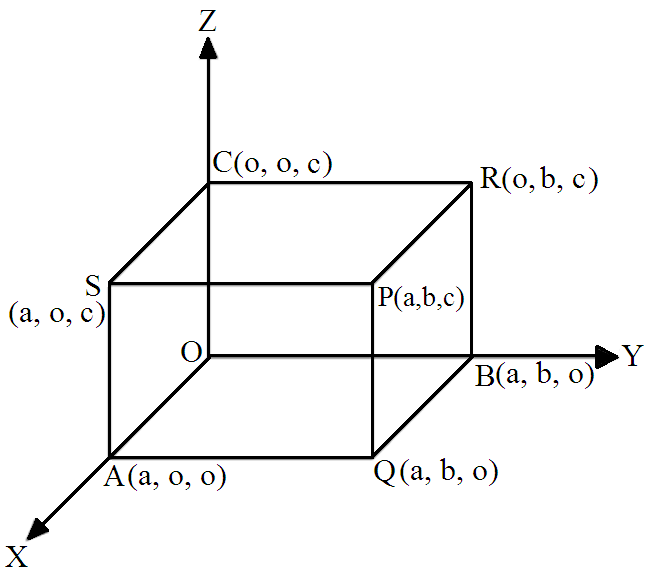
Let a be the length of an edge of the cube and let one corner be at the origin as shown in the figure. Clearly, OP, AR
The direction ratiosm of OP, AR, BS and CQ are
a - 0, a - 0, a - 0, i.e. a, a, a
0 - a, a - 0, a - 0, i.e. -a, a, a
a - 0, 0 - a, a - 0, i.e. a, -a, a
a - 0, a - 0, 0 - a, i.e. a, a, -a
Let the direction ratios of a line be proportional to l, m and n. Suppose this line makes angles $\alpha,\beta,\gamma$ and $\delta$ with OP, AR.
Now, $\alpha$ is the angle between OP and the line whose direction ratios are proportional to l, m and n.
$\cos\alpha=\frac{\text{a}.\text{l}+\text{a}.\text{m}+\text{a}.\text{n}}{\sqrt{\text{a}^2+\text{a}^2+\text{a}^2}\sqrt{\text{l}^2+\text{m}^2+\text{n}^2}}\Rightarrow\cos\alpha=\frac{\text{l}+\text{m}+\text{n}}{\sqrt{3}\sqrt{\text{l}^2+\text{m}^2+\text{n}^2}}$
Since $\beta$ is the angle between AR and the line with direction ratios proportional to l, m and n, we get
$\cos\beta=\frac{-\text{a}.\text{l}+\text{a}.\text{m}+\text{a}.\text{n}}{\sqrt{\text{a}^2+\text{a}^2+\text{a}^2}\sqrt{\text{l}^2+\text{m}^2+\text{n}^2}}\Rightarrow\cos\beta=\frac{-\text{l}+\text{m}+\text{n}}{\sqrt{3}\sqrt{\text{l}^2+\text{m}^2+\text{n}^2}}$
Similarly,
$\cos\gamma=\frac{\text{a}.\text{l}-\text{a}.\text{m}+\text{a}.\text{n}}{\sqrt{\text{a}^2+\text{a}^2+\text{a}^2}\sqrt{\text{l}^2+\text{m}^2+\text{n}^2}}\Rightarrow\cos\gamma=\frac{\text{l}-\text{m}+\text{n}}{\sqrt{3}\sqrt{\text{l}^2+\text{m}^2+\text{n}^2}}$
$\cos\delta=\frac{\text{a}.\text{l}+\text{a}.\text{m}-\text{a}.\text{n}}{\sqrt{\text{a}^2+\text{a}^2+\text{a}^2}\sqrt{\text{l}^2+\text{m}^2+\text{n}^2}}\Rightarrow\cos\delta=\frac{\text{l}+\text{m}-\text{n}}{\sqrt{3}\sqrt{\text{l}^2+\text{m}^2+\text{n}^2}}$
$\cos^2\alpha+\cos^2\beta+\cos^2\gamma+\cos^2\delta$
$=\frac{(\text{l}+\text{m}+\text{n})^2}{3(\text{l}^2+\text{m}^2+\text{n}^2)}+\frac{(-\text{l}+\text{m}+\text{n})^2}{3(\text{l}^2+\text{m}^2+\text{n}^2)}+\frac{(\text{l}-\text{m}+\text{n})^2}{3(\text{l}^2+\text{m}^2+\text{n}^2)}+\frac{(\text{l}+\text{m}-\text{n})^2}{\sqrt{3}\sqrt{\text{l}^2+\text{m}^2+\text{n}^2}}$
$=\frac{1}{3(\text{l}^2+\text{m}^2+\text{n}^2)}\Big\{(\text{l}+\text{m}+\text{n})^2+(-\text{l}+\text{m}+\text{n})^2+(\text{l}-\text{m}+\text{n})^2+(\text{l}+\text{m}-\text{n})^2\Big\}$
$=\frac{1}{3(\text{l}^2+\text{m}^2+\text{n}^2)}4\big(\text{l}^2+\text{m}^2+\text{n}^2\big)=\frac{4}{3}$.
Solution:
$\frac{\text{x}-6}{3}=\frac{\text{y}-7}{2}=\frac{\text{z}-7}{-2}$
Let point (1, 2, 3) be P and the point through which the line passes be Q(6, 7, 7). Also, the line is parallel to the vector $\vec{\text{b}}=3\hat{\text{i}}+2\hat{\text{j}}-2\hat{\text{k}}.$
Now,
$\overrightarrow{\text{PQ}}=5\hat{\text{i}}+5\hat{\text{j}}+4\hat{\text{k}}$
$\therefore\vec{\text{b}}\times\overrightarrow{\text{PQ}} =\begin{vmatrix}\hat{\text{i}}&\hat{\text{j}}&\hat{\text{k}}\\3&2&-2\\5&5&4\end{vmatrix}$
$=18\hat{\text{i}}-22\hat{\text{j}}+5\hat{\text{k}}$
$\Rightarrow\big|\vec{\text{b}}\times\overrightarrow{\text{PQ}}\big|=\sqrt{18^2+(-22)^2+5^2}$
$=\sqrt{324+484+25}$
$=\sqrt{833}$
$\because\text{d}=\frac{\big|\vec{\text{b}}\times\overrightarrow{\text{PQ}}\big|}{\big|\vec{\text{b}}\big|}$
$=\frac{\sqrt{833}}{\sqrt{17}}$
$=\sqrt{49}$
$=7$
Solution:
No, they can not be the direction cosines of any directed line.
As the sum of square of them is not 1.
$\text{As}\Big(\frac{1}{\sqrt{3}}\Big)^2+\Big(\frac{2}{\sqrt{3}}\Big)^2+\Big(\frac{-2}{\sqrt{3}}\Big)^2$
$=\frac{1+4+4}{3}$
$=3$
Solution:
We have
$\frac{\text{x}-1}{1}=\frac{\text{y}-1}{1}=\frac{\text{z}-1}{2}$
$\frac{\text{x}-1}{-\sqrt{3}-1}=\frac{\text{y}-1}{\sqrt{3}-1}=\frac{\text{z}-1}{4}$
The direction ratios of the given lines are proportional to 1, 1, 2 and $-\sqrt{3}-1,\sqrt{3}-1, 4$
The given lines are parallel to vectors $\vec{\text{b}}_1=\hat{\text{i}}+\hat{\text{j}}+2\hat{\text{k}}$ and $\vec{\text{b}}_2=\big(-\sqrt{3}-1\big)\hat{\text{i}}+\big(\sqrt{3}-1\big)\hat{\text{j}}+4\hat{\text{k}}$
Let $\theta$ be the angle between the given lines.
Now,
$\cos\theta=\frac{\vec{\text{b}}_1.\vec{\text{b}}_2}{\big|\vec{\text{b}}_1\big|\big|\vec{\text{b}}_2\big|}$
$=\frac{\big(\hat{\text{i}}+\hat{\text{j}}+2\hat{\text{k}}\big).\big\{\big(-\sqrt{3}-1\big)\hat{\text{i}}+\big(\sqrt{3}-1\big)\hat{\text{j}}+4\hat{\text{k}}\big\}}{\sqrt{1^2+1^2+1^2}\sqrt{\big(-\sqrt{3}-1\big)^2+\big(\sqrt{3}-1\big)^2+4^2}}$
$=\frac{-\sqrt{3}-1+\sqrt{3}-1+8}{\sqrt{3}\sqrt{24}}$
$=\frac{6}{6\sqrt{2}}$
$\frac{1}{\sqrt{2}}$
$\Rightarrow\theta=\frac{\pi}{3}$
Solution:
concept: for any plane ax + by + cz + d =
0, normal vector to this plane is
$\text{a}\hat{\text{i}}+\text{b}\hat{\text{j}}+\text{c}\hat{\text{k}}$the normal vector of the plane 2x + 3y - z = 7 is
$\text{2}\hat{\text{i}}+\text{3}\hat{\text{j}}+\hat{\text{k}}$so the direction ratios of normal to plane are < 2, 3, -1 >
Solution:
The line joining (5, -3, 8) and (6, -1, 6) is given by the vector -i + 2j - 2k.
the direction cosines are given by. l =
$\frac{1}{\sqrt{1^2+2^2+(-2)^2}}=\frac{1}{3}, \text{m}=\frac{2}{\sqrt{1^2+2^2+(-2)^2}}=\frac{2}{3}$
$\text{n}=\frac{-2}{1^2+2^2+(-2)^2}=\frac{-2}{3}$
$\Rightarrow\text{l + m + n}=\frac{1}{3}$
Solution:
Area
$=\frac{1}{2}|1(5-\text{b})+3(\text{b}-2)+0(2-5)|$As points are collinear, so area = 0
$\therefore\frac{1}{2}|1(5-\text{b})+3(\text{b}-2)+0(2-\text{5})|=0$
⇒ 5 − b + 3b − 6 = 0
⇒ = 1 = 2b
$\therefore\text{b}=\frac{1}{2}$