Questions · Page 2 of 3

3 Marks

Question 513 Marks
Find the cartesian equation of the line which passes through the point (-2, 4, -5) and parallel to the line given by $\frac{\text{x}+3}{3}=\frac{\text{y}-4}{5}=\frac{\text{z}+8}{6}.$
Answer
Given: A point on the line is (-2, 4, -5) = (x1, y1, z1)
Equation of the given line in Cartesian form is $\frac{\text{x}+3}{3}=\frac{\text{y}-4}{5}=\frac{\text{z}+8}{6}$
$\therefore$ Direction ratios of the given line are its denominators 3, 5, 6 = a, b, c
$\therefore$ Equation of the required line is $\frac{\text{x}-\text{x}_1}{\text{a}}=\frac{\text{y}-\text{y}_1}{b}=\frac{\text{z}-\text{z}_1}{c}$
$\Rightarrow\ \ \ \frac{\text{x}-(-2)}{3}=\frac{\text{y}-4}{5}=\frac{\text{z}-(-5)}{6}=\frac{\text{x}+2}{3}=\frac{\text{y}-4}{5}=\frac{\text{z}+5}{6}$
View full question & answer
Question 523 Marks
If the lines $\frac{\text{x}-1}{-3}=\frac{\text{y}-2}{2\text{k}}=\frac{\text{z}-3}{2}\ \text{and}\ \frac{\text{x}-1}{3\text{k}}=\frac{\text{y}-1}{1}=\frac{\text{z}-6}{-5}$ are perpendicular, find the value of k.
Answer
The given lines are
$\frac{\text{x}-1}{-3}=\frac{\text{y}-2}{2\text{k}}=\frac{\text{z}-3}{3}$
and $\frac{\text{x}-1}{3\text{k}}=\frac{\text{y}-1}{1}=\frac{\text{z}-6}{-5}$
Direction ratios of two lines are -3, 2k, 2 and 3k, 1, -5
Since the lines are perpendicular
$\therefore$ (-3)(3k) + (2k)(1) + (2)(-5) = 0
$\therefore$ -9k + 2k - 10 = 0
⇒ -7k = 10
$\therefore\ \text{k}=-\frac{10}{7}$
View full question & answer
Question 533 Marks
Find the coordinates of the foot of the perpendicular drawn from the point (5, 4, 2) to the line $\frac{\text{x}+1}{2}=\frac{\text{y}-3}{2}=\frac{\text{z}-1}{-1}.$ Hence, of otherwise, deduce the length of the perpendicular.
Answer
Let M be the foot of the perpendicular of the point P(5, 4, 2) on the line $\frac{\text{x}+1}{2}=\frac{\text{y}-3}{2}=\frac{\text{z}-1}{-1}$
Therefore, its equation is
$\frac{\text{x}+1}{2}=\frac{\text{y}-3}{2}=\frac{\text{z}-1}{-1}=\text{r}$
Then, M is in the form (2r - 1, 3r + 3, -r + 1)
Direction ratios of MP are 2r - 1 - 5, 3r + 3 - 4, -r + 1 - 2 or 2r - 6, 3r - 1, -r - 1.
Since MP is perpendicular to the given line (2, 3, -1), 2 (2r - 6) + 3(3r - 1) -1(-r - 1) = 0 (Because a1, a2, + b1, b2, + c1, c2, = 0)
⇒ 4r - 12 + 9r - 3 + 1 + 1 = 0
⇒ 14r - 14 = 0
⇒ r = 1
So, M = (2r - 1, 3r + 3, -r + 1) = (2 (1) - 1, 3(1) + 3, -1 + 1) = (1, 6, 0)
Length of the perperndicular,
$\text{MP}=\sqrt{(1-5)^2+(6-4)^2+(0-2)^2}\\=\sqrt{16+4+4}=\sqrt{24}=2\sqrt{6}\text{ units}$
View full question & answer
Question 543 Marks
Determine the value of $\lambda$ for which the following planes are perpendicular to other.
$\vec{\text{r}}\cdot(\hat{\text{i}}+2\hat{\text{j}}+3\hat{\text{k}})=7$ and $\vec{\text{r}}\cdot(\lambda\hat{\text{i}}+2\hat{\text{j}}-7\hat{\text{k}})=26$
Answer
We know that the planes $\vec{\text{r}}\cdot\vec{\text{n}}_1=\text{d}_1,\vec{\text{ r}}\cdot\vec{\text{n}}_2=\text{d}_2$ are perpendicular to each other only if $\vec{\text{n}}_1\cdot\vec{\text{n}}_2=0$
Here, $\vec{\text{n}}_1=\hat{\text{i}}+2\hat{\text{j}}+3\hat{\text{k}}, \vec{\text{n}}_2=\lambda\hat{\text{i}}+2\hat{\text{j}}-7\hat{\text{k}}$
The given planes are perpendicular.
$\Rightarrow\vec{\text{n}}_1\cdot\vec{\text{n}}_2=0$
$\Rightarrow(\hat{\text{i}}+2\hat{\text{j}}+3\hat{\text{k}})\cdot(\lambda\hat{\text{i}}+2\hat{\text{j}}-7\hat{\text{k}})=0$
$\Rightarrow\lambda+4-21=0$
$\Rightarrow\lambda-17=0$
$\Rightarrow\lambda=17$
View full question & answer
Question 553 Marks
Write the plane $\vec{\text{r}}.(2\hat{\text{i}}+3\hat{\text{j}}-6\hat{\text{k}})=14$ in normal form.
Answer
The given equation of the plane is
$\vec{\text{r}}.(2\hat{\text{i}}+3\hat{\text{j}}-6\hat{\text{k}})=14$ or $\vec{\text{r}}.\vec{\text{n}}=14$, where $\vec{\text{n}}=2\hat{\text{i}}+3\hat{\text{j}}-6\hat{\text{k}}$
$|\vec{\text{n}}|=\sqrt{4+9+36}=7$
For reducing the given equation to normal form, we need to divide it by $|\vec{\text{n}}|$.
Then, we get $\vec{\text{r}}.\frac{\vec{\text{n}}}{|\vec{\text{n}}|}=\frac{14}{|\vec{\text{n}}|}$
$=\vec{\text{r}}.\Big(\frac{2\hat{\text{i}}+3\hat{\text{j}}-6\hat{\text{k}}}{7}\Big)=\frac{14}{7}$
$\Rightarrow\vec{\text{r}}.\Big(\frac{2}{7}\hat{\text{i}}+\frac{3}{7}\hat{\text{j}}-\frac{6}{7}\hat{\text{k}}\Big)=2,$ which is the required normal form.
View full question & answer
Question 563 Marks
Reduce the equation 2x - 3y - 6z = 14 to the normal form and, hence, find the length of the perpendicular from the origin to the plane. Also, find the direction cosines of the normal to the plane.
Answer
Given equation of plane is,
2x - 3y - 6z = 14
$(\text{x}\hat{\text{i}}+\text{y}\hat{\text{j}}+\text{z}\hat{\text{k}})(2\hat{\text{i}}-3\hat{\text{j}}-6\hat{\text{k}})=14$
Dividing the equation by $\sqrt{(2)^2+(-3)^2+(-6)^2}$
$\vec{\text{r}}\cdot\frac{(2\hat{\text{i}}-3\hat{\text{j}}-6\hat{\text{k}})}{\sqrt{4+9+36}}=\frac{14}{\sqrt{4+9+36}}$
$\vec{\text{r}}\Big(\frac{2}{7}\hat{\text{i}}-\frac{3}{7}\hat{\text{j}}-\frac{6}{7}\hat{\text{k}}\Big)=\frac{14}{7}$
$\vec{\text{r}}\Big(\frac{2}{7}\hat{\text{i}}-\frac{3}{7}\hat{\text{j}}-\frac{6}{7}\hat{\text{k}}\Big)=2\ ...(\text{i})$
We know that the vector equation of a plane with distance d from origin and normal to unit vector $\hat{\text{n}}$ is given by
$\vec{\text{r}}\cdot\vec{\text{n}}=\vec{\text{d}}\ ...(\text{ii})$
Comparing (i) and (ii),
d = 2 and
$\hat{\text{n}}=\frac{2}{7}\hat{\text{i}}-\frac{3}{7}\hat{\text{j}}-\frac{6}{7}\hat{\text{k}}$
So, distance of plane from origin = 2 unit
Direction cosine of normal to plane $=\frac{2}{7},-\frac{3}{7},\frac{6}{7}$
View full question & answer
Question 573 Marks
Find the coordinates of the point where the line through (5, 1, 6) and (3, 4, 1) crosses the:
zx-plane
Answer
Direction ratios of the given line are
(5 - 3, 1 - 4, 6 - 1) = (2, -3, 5)
Hence, equation of the line is
$\frac{\text{x}-5}{2}=\frac{\text{y}-1}{-3}=\frac{\text{z}-6}{5}=\text{r}$
$\Rightarrow\text{x}=2\text{r}+5,\text{ y}=-3\text{r}+1,\text{ z}=5\text{r}+6$
For any point on the zx-plane y = 0
$\Rightarrow-3\text{r}+1=0$
$\Rightarrow\text{r}=\frac{1}{3}$
$\Rightarrow\text{x}=2\Big(\frac{1}{3}\Big)+5=\frac{17}{3}$
$\Rightarrow\text{z}=5\Big(\frac{1}{3}\Big)+6=\frac{23}{3}$
Hence, the corrdinates of the point are $\Big(\frac{17}{3},0,\frac{23}{3}\Big)$
View full question & answer
Question 583 Marks
Write the ratio in which the plane 4x + 5y − 3z = 8 divides the line segment joining the points (−2, 1, 5) and (3, 3, 2).
Answer
We know that the ratio in which the plane ax + by + cz + d = 0 divides the line sebment joining
(x1, y1, z1) and (x2, y2, z2) is $\frac{-(\text{ax}_1+\text{by}_1+\text{cz}_1+\text{d})}{\text{ax}_2+\text{by}_2+\text{cz}_2+\text{d}}$
Here, a = 4,b = 5,c = -3,d = -8,x1 = -2,y1 = 1,z1 = 5,x2 = 3,y2 = 3,z2 = 2
So, the required ratio
$=\frac{-(4(-2)+5(1)-3(5)-8)}{4(3)+5(3)-3(2)-8}$
$=\frac{-(-8+5-15-8)}{12+15-6-8}$
$=\frac{26}{13}$
$=\frac{2}{1}$ or $2 :1.$
View full question & answer
Question 593 Marks
Find the equation of the line which passes through the point (1, 2, 3) and is parallel to the vector $3\hat{\text{i}}+2\hat{\text{j}}-2\hat{\text{k}}.$
Answer
A point on the required line is A(1, 2, 3) = x1, y1, z1
⇒ Positive vector of a point on the required line is
$\vec{\text{a}}=\overrightarrow{\text{OA}}=(1,2,3)=\hat{\text{i}}+2\hat{\text{j}}+3\hat{\text{k}}$
The required line is parallel to the vector $\vec{\text{b}}=3\hat{\text{i}}+2\hat{\text{j}-2\hat{\text{k}}}$
$\therefore$ direction ratios of the required line are coefficient of $\hat{\text{i}},\ \hat{\text{j}},\ \hat{\text{k}}\ \text{in}\ \vec{\text{b}}$ are 3, 2, -2 = a, b, c
$\therefore$ Vector equation of the required line is
$\vec{\text{r}}=\vec{\text{a}}+\lambda\vec{\text{b}}$
$\Rightarrow\ \vec{\text{r}}=\Big(\hat{\text{i}}+2\hat{\text{j}}+3\hat{\text{k}}\Big)+\lambda\Big(3\hat{\text{i}}+2\hat{\text{j}}-2\hat{\text{k}}\Big)$
Where $\lambda$ is a real number.
Cartesian equation of this equation is $\frac{\text{x}-1}{3}=\frac{\text{y}-2}{2}=\frac{\text{z}-3}{-2}.$
View full question & answer
Question 603 Marks
Find the direction cosines of the unit vector perpendicular to the plane $\vec{\text{r}}.\big(6\hat{\text{i}}-3\hat{\text{j}}-2\hat{\text{k}}\big)+1=0$ passing through the origin.
Answer
Given equation of the plane $\vec{\text{r}}.\big(6\hat{\text{i}}-3\hat{\text{j}}-2\hat{\text{k}}\big)+1=0$
Thus, the direction ratios normal to the plane are 6, -3 and -2
Hence, the direction cosines to the normal to the plane are
$=\frac{6}{\sqrt{6^2+(-3)^2+(-2)^2}},\frac{-3}{\sqrt{6^2+(-3)^2+(-2)^2}},\frac{-2}{\sqrt{6^2+(-3)^2+(-2)^2}}$
$=\frac{6}{7},\frac{-3}{7},\frac{-2}{7}$
$=\frac{-6}{7},\frac{3}{7},\frac{2}{7}$
The direction cosines of the unit vector perpendicular to the plane are same as the direction cosines of the normal to the plane.
Thus, the direction cosined of the unit vector perpendicular to the plane are: $\frac{-6}{7},\frac{3}{7},\frac{2}{7}$
View full question & answer
Question 613 Marks
Show that the three lines with direction cosines $\frac{12}{13},\ \frac{-3}{13},\ \frac{-4}{13},\ \frac{4}{13},\ \frac{12}{13},\ \frac{3}{13},\ \frac{3}{13},\ \frac{-4}{13},\ \frac{12}{13}$ are mutually perpendicular.
Answer
Given: Direction cosines of three lines are
$\frac{12}{13},\ \frac{-3}{13},\ \frac{-4}{13}=\text{l}_1,\ \text{m}_1,\ \text{n}_1,$
$\frac{4}{13},\ \frac{12}{13},\ \frac{3}{13}=\text{l}_2,\ \text{m}_2,\ \text{n}_2,$ 
$\frac{3}{13},\ \frac{-4}{13},\ \frac{12}{13}=\text{l}_3,\ \text{m}_3,\ \text{n}_3,$
For first two lines,
$\text{l}_1\text{l}_2+\text{m}_1\text{m}_2+\text{n}_1\text{n}_2=\Big(\frac{12}{13}\Big)\Big(\frac{4}{13}\Big)+\Big(\frac{-3}{13}\Big)\Big(\frac{12}{13}\Big)+\Big(\frac{-4}{13}\Big)\Big(\frac{3}{13}\Big)$
$=\frac{48}{169}-\frac{36}{169}-\frac{12}{169}=\frac{48-36-12}{169}=\frac{0}{169}=0$
Therefore, the first two lines are perpendicular to each other.
For second and third lines,
$\text{l}_2\text{l}_3+\text{m}_2\text{m}_3+\text{n}_2\text{n}_3=\Big(\frac{4}{13}\Big)\Big(\frac{3}{13}\Big)+\Big(\frac{12}{13}\Big)\Big(\frac{-4}{13}\Big)+\Big(\frac{3}{13}\Big)\Big(\frac{12}{13}\Big)$
$=\frac{12}{169}-\frac{48}{169}+\frac{36}{169}=\frac{12-48+36}{169}=\frac{0}{169}=0$
Therefore, second and third lines are perpendicular to each other.
For First and third lines,
$\text{l}_1\text{l}_3+\text{m}_1\text{m}_3+\text{n}_1\text{n}_3=\Big(\frac{12}{13}\Big)\Big(\frac{3}{13}\Big)+\Big(\frac{-3}{13}\Big)\Big(\frac{-4}{13}\Big)+\Big(\frac{-4}{13}\Big)\Big(\frac{12}{13}\Big)$
$=\frac{36}{169}+\frac{12}{169}-\frac{48}{169}=\frac{36+12-48}{169}=\frac{0}{169}=0$
Therefore, first and third lines are also perpendicular to each other.
Hence, given three lines are mutually perpendicular to each other.
View full question & answer
Question 623 Marks
Write the intercepts made by the plane 2x − 3y + 4z = 12 on the coordinate axes.
Answer
The given equation of the plane is
2x − 3y + 4z = 12
Dividing both sides by 12, we get
$\Rightarrow\frac{2\text{x}}{\text{12}}+\frac{-3\text{y}}{\text{12}}+\frac{4\text{z}}{\text{12}}=\frac{12}{12}$
$\Rightarrow\frac{\text{x}}{\text{6}}+\frac{\text{y}}{-\text{4}}+\frac{\text{z}}{\text{3}}=1\ ....(1)$
We know that the equation of the plane whose intercepts on the coordianate axes are a, b and c is
$\frac{\text{x}}{\text{a}}+\frac{\text{y}}{\text{b}}+\frac{\text{z}}{\text{c}}=1\ ....(2)$
Comparing (1) and (2), we get
a = 6, b = -4 and c = 3.
View full question & answer
Question 633 Marks
Find the angle between the lines whose direction ratios are a, b, c and b - c, c - a, a - b.
Answer
Direction ratios of one line are a, b, c
⇒ A vector along this line is $\vec{\text{b}_1}=\text{a}\hat{\text{i}}+\text{b}\hat{\text{j}}+\text{c}\hat{\text{k}}$
Direction ratios of second line are b - c, c - a, a - b
⇒ A vector along second line is $\vec{\text{b}_2}=(\text{b - c})\hat{\text{i}}+(\text{c - a})\hat{\text{j}}+(\text{a - b})\hat{\text{k}}$
Let $\theta$ be the angle between the two lines, then
$\cos\theta=\frac{\big|\vec{\text{b}_1}.\vec{\text{b}_2}\big|}{\big|\vec{\text{b}_1}\big|.\big|\vec{\text{b}_2}\big|}=\frac{\text{a}(\text{b - c})+\text{b}(\text{c - a})+\text{c}(\text{a - b})}{\sqrt{\text{a}^2+\text{b}^2+\text{c}^2}\sqrt{(\text{b - c})^2+(\text{c - a})^2+(\text{a - b})^2}}$
$=\frac{\text{ab - ac}+\text{bc - ab}+\text{ac - bc}}{\sqrt{\text{a}^2+\text{b}^2+\text{c}^2}\sqrt{(\text{b - c})^2+(\text{c - a})^2+(\text{a - b})^2}}=0=\cos90^{\circ}$
$\Rightarrow\ \ \theta=90^{\circ}$
View full question & answer
Question 643 Marks
Show that the following planes are at right angles.
$\vec{\text{r}}\cdot(2\hat{\text{i}}-\hat{\text{j}}+\hat{\text{k}})=5$ and $\vec{\text{r}}\cdot(-\hat{\text{i}}-\hat{\text{j}}+\hat{\text{k}})=3$
Answer
We know that the planes $\vec{\text{r}}\cdot\vec{\text{n}}_1=\text{d}_1,\vec{\text{ r}}\cdot\vec{\text{n}}_2=\text{d}_2$ are perpendicular to each other only if $\vec{\text{n}}_1\cdot\vec{\text{n}}_2=0$
Here, $\vec{\text{n}}_1=2\hat{\text{i}}-\hat{\text{j}}+\hat{\text{k}},\vec{\text{n}}_2=-\hat{\text{i}}-\hat{\text{j}}+\hat{\text{k}}$
Now,
$\vec{\text{n}}_1\cdot\vec{\text{n}}_2=\big(2\hat{\text{i}}-\hat{\text{j}}+\hat{\text{k}}\big)\cdot\big(-\hat{\text{i}}-\hat{\text{j}}+\hat{\text{k}}\big)$
$=-2+1+1=0$
So, the given planes are perpendicular.
View full question & answer
Question 653 Marks
Find the angle between the plane:
2x + y - 2z = 5 and 3x - 6y - 2z = 7
Answer
We know that the angle between the planes,
$\text{a}_1\text{x}+\text{b}_1\text{y}+\text{c}_1\text{z}+\text{d}_1=0$ and $\text{a}_2\text{x}+\text{b}_2\text{y}+\text{c}_2\text{z}+\text{d}_2=0$ is given by
$\cos\theta=\frac{\text{a}_1\text{a}_2+\text{b}_1\text{b}_2+\text{c}_1\text{c}_2}{\sqrt{\text{a}_1^2+\text{b}_1^2+\text{c}_1^2}\sqrt{\text{a}_2^2+\text{b}_2^2+\text{c}^2_2}}$
So, the angle between 2x + y - 2z = 5 and 3x - 6y - 2z = 7 is given by
$\cos\theta=\frac{(2)(3)+(1)(-6)+(-2)(-2)}{\sqrt{2^2+1^2+(-2)^2}\sqrt{3^2+(-6)^2+(-2)^2}}$
$=\frac{6-6+4}{\sqrt{4+1+4}\sqrt{9+36+4}}$
$=\frac{4}{(3)(7)}=\frac{4}{21}$
$\theta=\cos^{-1}\Big(\frac{4}{21}\Big)$
View full question & answer
Question 663 Marks
In the following cases, determine whether the given planes are parallel or perpendicular, and in case they are neither, find the angles between them.
2x + y + 3z - 2 and x - 2y + 5 = 0
Answer
The direction ratios of normal to the plane, L1: a1x + b1y + c1z = 0,
are a1, b1, c1 and L2: a2x + b2y + c2z = 0 are a2, b2, c2
$\text{L}_1||\text{L}_2,\ \text{if }\frac{\text{a}_1}{\text{a}_2}=\frac{\text{b}_1}{\text{b}_2}=\frac{\text{c}_1}{\text{c}_2}$
$\text{L}_1\perp\text{L}_2,\ \text{if}\ \text{a}_1\text{a}_2+\text{b}_1\text{b}_2+\text{c}_1\text{c}_2=0$
The angle between L1 and L2 is given by,
$\text{Q}=\cos^{-1}\Bigg|\frac{\text{a}_1\text{a}_2+\text{b}_1\text{b}_2+\text{c}_1\text{c}_2}{\sqrt{\text{a}_1^2+\text{b}_1^2+\text{c}_1^2}.\sqrt{\text{a}_2^2+\text{b}_2^2+\text{c}_2^2}}$
The equations of the planes are 2x + y + 3z - 2 = 0 and x - 2y + 5 = 0
Here, a1 = 2, b1 = 1, c1 = 3 and a2 = 1, b2 = -2, c2 = 0
$\therefore\ \text{a}_1\text{a}_2+\text{b}_1\text{b}_2+\text{c}_1\text{c}_2=2\times1+1\times(-2)+3\times0=0$
Thus, the given planes are perpendicular to each other.
View full question & answer
Question 673 Marks
Show that the line through points (4, 7, 8) and (2, 3, 4) is parallel to the line throught the points (-1, -2, 1) and (1, 2, 5).
Answer
Suppose the points are A(2, 3, 4), B(-1, -2, 1) and C(5, 8, 7).
We know that the direction ratios of the line passing through the points (x1, y1, z1) and (x2, y2, z2) are x- x1, y- y1, z- z1.
Let the first two points be A(4, 7, 8) and B(2, 3, 4).
Thus, the direction ratios of AB are (2 - 4), (3 - 7), (4 - 8), i.e. -2, -4, -4.
Similarly, Let the other two points be C (-1, -2, 1) and D (1, 2, 5).
Thus, the direction ratios of CD are [1 - (-1)], [2 - (-2)], (5 - 1), i.e. 2, 4, 4.
It can be seen that the direction ratios of CD are -1 times that of AB, i.e. they are proportional. Therefore, AB and CD are parallel lines.
View full question & answer
Question 683 Marks
Find the vector equations of the following planes in scalar product form $(\vec{\text{r}}\cdot\vec{\text{n}}=\text{d}):$
$\vec{\text{r}}=\hat{\text{i}}-\hat{\text{j}}+\lambda(\hat{\text{i}}+\hat{\text{j}}+\hat{\text{k}})+\mu(4\hat{\text{i}}-2\hat{\text{j}}+3\hat{\text{k}})$
Answer
$\vec{\text{r}}=\hat{\text{i}}-\hat{\text{j}}+\lambda(\hat{\text{i}}+\hat{\text{j}}+\hat{\text{k}})+\mu(4\hat{\text{i}}-2\hat{\text{j}}+3\hat{\text{k}})$
Plane is passing through $(\hat{\text{i}}-\hat{\text{j}})$ and parallel to
$\text{b}(\hat{\text{i}}+\hat{\text{j}}+\hat{\text{k}})$ and $\text{c}(4\hat{\text{i}}-2\hat{\text{j}}+3\hat{\text{k}})$
$\vec{\text{n}}=\vec{\text{b}}\times\vec{\text{c}}$
 $=\begin{vmatrix}\hat{\text{i}}&\hat{\text{j}}&\hat{\text{k}}\\1&1&1\\4&-2&3\end{vmatrix}$
$\text{n}=5\hat{\text{i}}+\hat{\text{j}}-6\hat{\text{k}}$
$\vec{\text{r}}\cdot\text{n}=(\hat{\text{i}}-\hat{\text{j}})\cdot(5\hat{\text{i}}+\hat{\text{j}}-6\hat{\text{k}})$
$=5-1=4$
$\text{r}\cdot(5\hat{\text{i}}+\hat{\text{j}}-6\hat{\text{k}})=4$
View full question & answer
Question 693 Marks
Write the normal form of the equation of the plane 2x - 3y + 6z + 14 = 0
Answer
The given equation of the plane is,
2x - 3y + 6z + 14 = 0
2x - 3y + 6z + 14 = 0 ...(i)
Now, $\sqrt{2^2+(-3)^2+(6)^2}$
$=\sqrt{4+9+36}$
$=\sqrt{49}$
$=7$
Dividing (i) by 7, we get
$\frac{2}{7}\text{x}-\frac{3}{7}\text{y}+\frac{6}{7}\text{z}=2$
This is the normal form of the given equation of the plane.
View full question & answer
Question 703 Marks
Find the perpendicular distence of the point (3, -1, 11) from the line $\frac{\text{x}}{2}=\frac{\text{y}-2}{-3}=\frac{\text{z}-3}{4}.$
Answer
Let the point (3, -1, 11) be P and the point through which the line passes be Q (0, 2, 3).
The line is parallel to the vector $\vec{\text{b}}=2\hat{\text{i}}-3\hat{\text{j}}+4\hat{\text{k}}$
Now,
$\therefore\vec{\text{b}}\times\overrightarrow{\text{PQ}}=\begin{vmatrix}\hat{\text{i}}&\hat{\text{j}}&\hat{\text{k}}\\2&-3&4\\-3&3&-8\end{vmatrix}$
$=12\hat{\text{i}}+4\hat{\text{j}}+15\hat{\text{k}}$
$\Rightarrow|\vec{\text{b}}\times\overrightarrow{\text{PQ}}|=\sqrt{12^2+4^2+15^2}$
$=\sqrt{144+16+225}$
$=\sqrt{385}$
$\text{d}=\frac{\big|\vec{\text{b}}\times\overrightarrow{\text{PQ}}\big|}{\big|\vec{\text{b}}\big|}$
$=\frac{\sqrt{385}}{\sqrt{29}}$
View full question & answer
Question 713 Marks
If the coordinates of the points A, B, C, D be (1, 2, 3), (4, 5, 7), (–4, 3, –6) and (2, 9, 2) respectively, then find the angle between the lines AB and CD.
Answer
Given: Points A(1, 2, 3), B(4, 5, 7), C(-4, 3, -6) and D(2, 9, 2).
$\therefore$ Direction ratios of line AB are x2 - x1, y2 - y1, z2 - z1
⇒ 4 - 1, 5 - 2, 7 - 3 = 3, 3, 4 = a1, b1, c1
$\therefore$ A vector along the line AB is $\vec{\text{b}_1}=3\hat{\text{i}}+3\hat{\text{j}}+4\hat{\text{k}}$
Similarly, direction ratios of line CD are x2 - x1, y2 - y1, z2 - z1
⇒ 2 - (-4), 9 - 3, 2 - (-6) = 6, 6, 8 = a1, b1, c1
$\therefore$ A vector along the line AB is $\vec{\text{b}_2}=6\hat{\text{i}}+6\hat{\text{j}}+8\hat{\text{k}}$
Let $\theta$ be the angle between the two lines, then
$\cos\theta=\frac{\Big|\vec{\text{b}_1}.\vec{\text{b}_2}\big|}{\big|\vec{\text{b}_1}\big|.\big|\vec{\text{b}_2}\big|}=\frac{|3(6)+3(6)+4(8)|}{\sqrt{9+9+16}\sqrt{36+36+64}}$
$=\frac{|18+18+32|}{\sqrt{34}\sqrt{136}}=\frac{68}{\sqrt{34\times34\times4}}=\frac{68}{34\times2}=1$
$=\cos0^{\circ}$
$\Rightarrow\ \ \ \theta=0^{\circ}$
Therefore, lines AB and CD are parallel.
View full question & answer
Question 723 Marks
Find the equations of the planes that passes through three points.
(1, 1, 0), (1, 2, 1), (-2, 2, -1)
Answer
The given points are A(1, 1, 0), B(1, 2, 1), and c(-2, 2, -1).
$\begin{vmatrix}1&1&0\\1&2&1\\-2&2&-1\end{vmatrix}$
$= (-2 - 2) - 1(-1 + 2) = -5\neq0$
Therefore, a plane will pass through the points A, B, and C.
It is known that the equation of the plane through the points, (x1, y1, z1), (x2, y2, z2) and (x3, y3, z3) is
$\begin{vmatrix}\text{x}-\text{x}_1&\text{y}-\text{y}_1&\text{z}-\text{z}_1\\\text{x}_2-\text{x}_1&\text{y}_2-\text{y}_1&\text{z}_2-\text{z}_1\\\text{x}_3-\text{x}_1&\text{y}_3-\text{y}_1&\text{z}_3-\text{z}_1\end{vmatrix}=0$
$\Rightarrow\begin{vmatrix}\text{x}-1&\text{y}-1&\text{z}\\0&1&1\\-3&1&-1\end{vmatrix}=0$
⇒ (-2)(x - 1) - 3(y - 1) + 3z = 0
⇒ -2x - 3y + 3z + 2 + 3 = 0
⇒ -2x - 3y + 3z = -5
⇒ 2x + 3y - 3z = 5
This is the Cartesian equation of the required plane.
View full question & answer
Question 733 Marks
Find the angle between two lines, one of which has direction ratios 2, 2, 1 while the other one is obtained by joining the points (3, 1, 4) and (7, 2, 12).
Answer
The direction ratios of the line joining the points (3, 1, 4) and (7, 2, 12) are proportional to 4, 1, 8.
Let $\vec{\text{m}}_1$ and $\vec{\text{m}}_2$ be vectors parallel to the lines having direction ratios proportional to 2, 2, 1 and 4, 1, 8.
Now,
$\vec{\text{b}}_1=2\hat{\text{i}}+2\hat{\text{j}}+\hat{\text{k}}$
$\vec{\text{b}}_2=4\hat{\text{i}}+\hat{\text{j}}+8\hat{\text{k}}$
If $\theta$ is the angle between the given lines, then
$\cos\theta=\frac{\vec{\text{m}}_1.\vec{\text{m}}_2}{|\vec{\text{m}}_1||\vec{\text{m}}_2|}$
$=\frac{\big(2\hat{\text{i}}+2\hat{\text{j}}+\hat{\text{k}}\big).\big(4\hat{\text{i}}+\hat{\text{j}}+8\hat{\text{k}}\big)}{\sqrt{2^2+2^2+1^2}\sqrt{4^2+1^2+8^2}}$
$=\frac{8+2+8}{3\times9}$
$=\frac{2}{3}$
$\Rightarrow\theta=\cos^{-1}\big(\frac{2}{3}\big)$
View full question & answer
Question 743 Marks
If a unit vector $\vec{\text{a}}$ makes an angle $\frac{\pi}{3}$ with $\hat{\text{i}},\frac{\pi}{4}$ with $\hat{\text{j}}$ and an acute angle $\theta$ with $\hat{\text{k}}$, and ,then find the value of $\theta$.
Answer
Scince a unit vector makes an angle of $\frac{\pi}{3}$ with$\hat{\text{i}}$$\frac{\pi}{4}$ with $\hat{\text{j}}$ andan acute angle $\theta$ with $\hat{\text{k}},\text{l}=\cos\frac{\pi}{3}$ or $\frac{\pi}{4}$ or $\frac{1}{\sqrt{2}}$and $\text{n}=\cos\theta$.
We know
$\text{l}^2+\text{m}^2+\text{n}^2=1$
$\Rightarrow\Big(\frac{1}{2}\Big)^2+\Big(\frac{1}{\sqrt{2}}\Big)^2+\cos^2\theta=1$
$\Rightarrow\frac{1}{4}+\frac{1}{2}+\cos^2\theta$
$\Rightarrow\cos^2\theta=\frac{1}{4}$
$\Rightarrow\cos^2\theta=\frac{1}{2}$
$\Rightarrow\frac{\pi}{3}$
Thus, the vector $\vec{\text{a}}$ makes an angle of $\frac{\pi}{3}$ with $\hat{\text{k}}$.
View full question & answer
Question 753 Marks
Find the equation of rthe planes parallel to the plane x + 2y - 2z + 8 = 0 that are at a distance of 2 units from the point (2, 1, 1).
Answer
The equation of the plane parallel to the given plane is
x + 2y - 2z + k = 0 ....(i)
It is given that plane (i) is at a distance of 2 unit from (2, 1, 1).
$\Rightarrow\frac{|2+2-2+\text{k}|}{\sqrt{1^2+2^2+(-2)^2}}=2$
$\Rightarrow\frac{|2+\text{k}|}{3}=2$
$\Rightarrow|2+\text{k}|=6$
$\Rightarrow2+\text{k}=6,{ 2}+\text{k}=-6$
$\Rightarrow\text{k}=4,\text{k}=-8$
Substi9tuting these two values one by one in (i) we get
x + 2y - 2z + 4 = 0 and x + 2y - 2z - 8 = 0, which are the equatioms of the required planes.
View full question & answer
Question 763 Marks
Find the angle between the plane:
x - y + z = 5 and x + 2y + z = 9
Answer
We know that the angle between the planes,
$\text{a}_1\text{x}+\text{b}_1\text{y}+\text{c}_1\text{z}+\text{d}_1=0$ and $\text{a}_2\text{x}+\text{b}_2\text{y}+\text{c}_2\text{z}+\text{d}_2=0$ is given by
$\cos\theta=\frac{\text{a}_1\text{a}_2+\text{b}_1\text{b}_2+\text{c}_1\text{c}_2}{\sqrt{\text{a}_1^2+\text{b}_1^2+\text{c}_1^2}\sqrt{\text{a}_2^2+\text{b}_2^2+\text{c}^2_2}}$
So, the angle between x - y + z = 5 and x + 2y + z = 9 is given by
$\cos\theta=\frac{(1)(1)+(-1)(2)+(1)(1)}{\sqrt{1^2+(-1)^2+1^2}\sqrt{1^2+2^2+1^2}}$
$=\frac{1-2+1}{\sqrt{1+1+1}\sqrt{1+4+1}}$
$=\frac{0}{\sqrt{3}\sqrt{6}}=0$
$\theta=\cos^{-1}(0)=\frac{\pi}{2}$
View full question & answer
Question 773 Marks
If the line drawn from the point (-2, -1, -3) meets a plane at right angle at the point (1, -3, 3), find the equation of the plane.
Answer
Since, the line drawn from the point (-2, -1, -3) meets a plane at right angle at the point (1, -3, 3) so, the plane passes through the point (1, -3, 3).
Also normal to plane is $(-3\hat{\text{i}}+2{\hat{\text{j}}}-6\hat{\text{k}})$
$\Rightarrow\vec{\text{a}}=\hat{\text{i}}-3{\hat{\text{j}}}+3\hat{\text{k}}$
And $\vec{\text{N}}=-3\hat{\text{i}}+2{\hat{\text{j}}}-6\hat{\text{k}}$
So, the equation of required plane is $(\vec{\text{r}}-\vec{\text{a}})\cdot\vec{\text{N}}=0$
$\Rightarrow\Big[(\text{x}\hat{\text{i}}+\text{y}\hat{\text{j}}+\text{z}\hat{\text{k}})-(\hat{\text{i}}-3\hat{\text{j}}+3\hat{\text{k}})\Big]\cdot(3\hat{\text{i}}+2\hat{\text{j}}-6\hat{\text{k}})=0$
$\Rightarrow\Big[(\text{x}-1)\hat{\text{i}}+(\text{y}+3)\hat{\text{j}}+(\text{z}-3)\hat{\text{k}}\Big]\cdot(3\hat{\text{i}}+2\hat{\text{j}}-6\hat{\text{k}})=0$
$\Rightarrow-3\text{x}+3+2\text{y}+6-6\text{z}+18=0$
$\Rightarrow-3\text{x}+2\text{y}-6\text{z}=-27$
$\Rightarrow-3\text{x}+2\text{y}-6\text{z}-27=0$
View full question & answer
Question 783 Marks
The line $\vec{\text{r}}=\hat{\text{i}}+\lambda(2\hat{\text{i}}-\text{m}\hat{\text{j}}-3\hat{\text{k}})$ is parallel to the plane $\vec{\text{r}}\cdot(\text{m}\hat{\text{i}}+3\hat{\text{j}}+\hat{\text{k}})=4.$ Find m.
Answer
The given line is parallel to the vector $\vec{\text{b}}=2\hat{\text{i}}-\text{m}\hat{\text{j}}-3\hat{\text{k}}$ and the given plane is normal to the vector $\vec{\text{n}}=\text{m}\hat{\text{i}}+3\hat{\text{j}}+\hat{\text{k}}$
If the line is parallel to the plane, the normal to the plane is perpendicular to the line.
$\Rightarrow\vec{\text{b}}\perp\vec{\text{n}}$
$\Rightarrow\vec{\text{b}}\cdot\vec{\text{n}}=0$
$\Rightarrow(2\hat{\text{i}}-\text{m}\hat{\text{j}}-3\hat{\text{k}})\cdot(\text{m}\hat{\text{i}}+3\hat{\text{j}}+\hat{\text{k}})=0$
$\Rightarrow2\text{m}-3\text{m}-3=0$
$\Rightarrow-\text{m}-3=0$
$\Rightarrow\text{m}=-3$
View full question & answer
Question 793 Marks
Write the equation of the plane whose intercepts on the coordinate axes are 2, -3 and 4
Answer
Given, intercepts on the coordinate axes are 2, -3 and 4
We know that,
The equation of a plane whose intercept onb the coordinate axes are a, b and c
 $\frac{\text{x}}{\text{a}}+\frac{\text{y}}{\text{b}}+\frac{\text{z}}{\text{c}}=1\ ...(\text{i})$
Here, a = 2, b = -3, c = 4
So,
Equation of required plane is,
$\frac{\text{x}}{2}+\frac{\text{y}}{-3}+\frac{\text{z}}{4}=1$
$\frac{6\text{x}-4\text{y}+3\text{z}}{12}=1$
${6\text{x}-4\text{y}+3\text{z}=}{12}$
View full question & answer
Question 803 Marks
Show that the lines $\frac{\text{x}-5}{7}=\frac{\text{y}+2}{-5}=\frac{\text{z}}{1}\ \text{and}\ \frac{\text{x}}{1}=\frac{\text{y}}{2}=\frac{\text{z}}{3}$ are perpendicular to each other.
Answer
Equation of one line $\frac{\text{x}-5}{7}=\frac{\text{y}+2}{-5}=\frac{\text{z}}{3}$
$\therefore$ Direction ratios of this line are 7, -5, 1 = a1, b1, c1
$\Rightarrow\ \ \vec{\text{b}_1}= 7\hat{\text{i}}-5\hat{\text{j}}+\hat{\text{k}}$
Again equation of another line $\frac{\text{x}}{1}=\frac{\text{y}}{2}=\frac{\text{z}}{3}$
$\therefore$ Direction ratios of this line are 1, 2, 3 = a2, b2, c2
$\Rightarrow\ \ \vec{\text{b}_2}= \hat{\text{i}}+2\hat{\text{j}}+3\hat{\text{k}}$
= 7 × 1 + (-5) × 2 + 1 × 3
= 7 - 10 + 3 = 0
Hence, the given two lines are perpendicular to each other.
View full question & answer
Question 813 Marks
Find the values of p so that the lines $\frac{1-\text{x}}{3}=\frac{7\text{y}-14}{2\text{p}}=\frac{\text{z}-3}{2}\ \text{and}\ \frac{7-7\text{x}}{3\text{p}}=\frac{\text{y}-5}{1}=\frac{6-\text{z}}{5}$ are at right angles.
Answer
Given: Equation of one line $\frac{1-\text{x}}{3}=\frac{7\text{y}-14}{2\text{p}}=\frac{\text{z}-3}{2}$
$\Rightarrow\ \ \frac{-(\text{x}-1)}{3}=\frac{7(\text{y}-2)}{2\text{p}}=\frac{\text{z}-3}{2}$
$\Rightarrow\ \ \frac{-(\text{x}-1)}{3}=\frac{\text{y}-2}{\frac{2\text{p}}{7}}=\frac{\text{z}-3}{2}$
$\therefore$ Direction ratios of this line are $-3,\ \frac{2\text{p}}{7},\ 2=\text{a}_1,\ \text{b}_1,\ \text{c}_1$
Again, equation of another line $\frac{7-7\text{x}}{3\text{p}}=\frac{\text{y}-5}{1}=\frac{6-\text{z}}{5}$
$\Rightarrow\ \ \frac{-7(\text{x}-1)}{3\text{p}}=\frac{\text{y}-5}{1}=\frac{-(\text{z}-6)}{5}$
$\Rightarrow\ \ \frac{\text{x}-1}{\frac{-3\text{p}}{7}}=\frac{\text{y}-5}{1}=\frac{\text{z}-6}{-5}$
$\therefore$ Direction ratios of this line are $\frac{-3\text{p}}{7},\ 1,-5=\text{a}_2,\ \text{b}_2,\ \text{c}_2$
Since, these two lines are perpendicular.
Therefore, a1a2 + b1b2 + c1c2 = 0
$\Rightarrow\ \ (-3)\Big(\frac{-3\text{p}}{7}\Big)+\Big(\frac{2\text{p}}{7}\Big)(1)+(2)(-5)=0$
$\Rightarrow\ \ \frac{9\text{p}}{7}+\frac{2\text{p}}{7}-10=0$
$\Rightarrow\ \ \frac{11\text{p}}{7}=10$
$\Rightarrow\ \ \text{p}=\frac{70}{11}$
View full question & answer
Question 823 Marks
Obtain the equation of the plane passing through the point (1, - 3, -2) and perpendicular to the planes x + 2y + 2z = 5 and 3x + 3y + 2z = 8.
Answer
The equation of any plane passing through (1, -3, -2) is,
a(x - 1) + b(y + 3) + c(z + 2) = 0 ....(i)
It is given that (i) is perpendicular to each of the planes x + 2y + 2z = 5 and 3x + 3y + 2z = 8. Then,
a + 2b + 2c = 0 ....(ii)
3a + 3b + 2c = 0 .....(ii)
Solving (i), (ii) and (iii) we get,
$\begin{vmatrix}\text{x}-1&\text{y}+3&\text{z}+2\\1&2&2\\3&3&2\end{vmatrix}=0$
⇒ -2(x - 1) + 4(y + 3) - 3(z + 2) = 0
⇒ -2x + 2 + 4y + 12 - 3z - 6 = 0
⇒ 2x - 4y + 3z - 8 = 0
View full question & answer
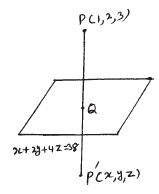
Question 833 Marks
Find the image of the point (1, 2, 3) in the plane x + 2y + 4z = 38.
Answer

Let P' (x, y, z) be the image of P in the given plane.
$\therefore$ Equation of line PP' is $\frac{\text{x - 1}}{1}=\frac{\text{y - 2}}{2}=\frac{\text{z - 3}}{4}.........\text{(i)}$
Any point on this line is ($\lambda$ + 1,  2$\lambda$ + 2,  4$\lambda$ + 3)
If this point is Q, then ($\lambda$ + 1) + 2 (2$\lambda$ + 2) + 4 (4$\lambda$ + 3) = 38
$\Rightarrow$   $\lambda$ = 1    $\Rightarrow$   Q (2, 4, 7)
Q is the mid-point of PP'
$\therefore\text{ }\frac{1+\text{x}}{2}=2\Rightarrow\text{x}=3,\text{ }\frac{2+\text{y}}{2}=4\Rightarrow\text{y}=6,\text{ }\frac{3+\text{z}}{2}=7,\text{ }\Rightarrow\text{z}=11$
$\therefore$ Image (P') is (3, 6, 11).
View full question & answer
Question 843 Marks
Prove that the lines x = py + q, z = ry + s and x = p′y + q′, z = r′y + s′ are perpendicular if pp′ + rr′ + 1 = 0.
Answer
We have line $\text{x}=\text{py}+\text{q},\ \text{z}=\text{ry}+\text{s}$
$\Rightarrow\text{y}=\frac{\text{x}-\text{q}}{\text{p}}$ and $\text{y}=\frac{\text{z}-\text{s}}{\text{r}}$
$\Rightarrow\frac{\text{x}-\text{q}}{\text{p}}=\frac{\text{y}}{1}=\frac{\text{z}-\text{s}}{\text{r}}\ .....(\text{i})$
Similarly line $\text{x}=\text{p}'\text{y}+\text{q}',\ \text{z}=\text{r}'\text{y}+\text{s}'$
$\Rightarrow\frac{\text{x}-\text{q}'}{\text{p}}=\frac{\text{y}}{1}=\frac{\text{z}-\text{s}'}{\text{r}}\ ....(\text{ii})$
Line (i) is parallel tpo the vector $\text{p}\hat{\text{i}}+\hat{\text{j}}+\text{r}\hat{\text{k}}.$
Line (ii) is parallel tpo the vector $\text{p}'\hat{\text{i}}+\hat{\text{j}}+\text{r}'\hat{\text{k}}.$
Line are perpendicular,
$\therefore(\text{p}\hat{\text{i}}+\hat{\text{j}}+\text{r}\hat{\text{k}})\cdot(\text{p}'\hat{\text{i}}+\hat{\text{j}}+\text{r}'\hat{\text{k}})$
$\therefore\text{p}\text{p}'+1+\text{r}'\text{r}=0.$
View full question & answer
Question 853 Marks
Find the equation of the plane passing through the following point:
(-5, 0, -6), (-3, 10, -9) and (-2, 6, -6)
Answer
The equation of the plane passing through points (-5, 0, -6), (-3, 10, -9) and (-2, 6, -6) is given by,
$\begin{vmatrix}\text{x}+5&\text{y}-0&\text{z}+6\\-3+5&10-0&-9+6\\-2+5&6-0&-6+6\end{vmatrix}=0$
$\Rightarrow\begin{vmatrix}\text{x}+5&\text{y}&\text{z}+6\\2&10&-3\\3&6&0\end{vmatrix}=0$
$\Rightarrow18(\text{x}+5)-\text{y}-18(\text{z}+6)=0$
$\Rightarrow2(\text{x}+5)-\text{y}-2(\text{z}+6)=0$
$\Rightarrow2\text{x}+10-\text{y}-2\text{z}-12=0$
$\Rightarrow2\text{x}-\text{y}-2\text{z}-2=0$
View full question & answer
Question 863 Marks
Show that the normals to the following parirs of planes are perpendicular other.
x - y + z - 2 = 0 and 3x + 2y - z + 4 = 0
Answer
Let $\vec{\text{n}_1}$ and $\vec{\text{n}_2}$ be the vectors which are normals to the planes x - y + z = 2 and 3x + 2y - z = -4 respectively.
The given equations of the planes are
x + y + z = 2
3x + 2y - z = -4
$\Rightarrow(\text{x}\hat{\text{i}}+\text{y}\hat{\text{j}}+\text{z}\hat{\text{k}})\cdot(\hat{\text{i}}-\hat{\text{j}}+\hat{\text{k}})=8,$
$\Rightarrow(\text{x}\hat{\text{i}}+\text{y}\hat{\text{j}}+\text{z}\hat{\text{k}})\cdot(3\hat{\text{i}}+2\hat{\text{j}}-\hat{\text{k}})=-4$
$\Rightarrow\vec{\text{n}_1}=\hat{\text{i}}-\hat{\text{j}}+\hat{\text{k}}$
$\Rightarrow\vec{\text{n}_2}=3\hat{\text{i}}+2\hat{\text{j}}-\hat{\text{k}}$
Now, $\vec{\text{n}_1}\cdot\vec{\text{n}_2}=(\hat{\text{i}}-\hat{\text{j}}+\hat{\text{k}})\cdot(3\hat{\text{i}}+2\hat{\text{j}}-\hat{\text{k}})$
$=3-2-1=0$
So, the normals to the given planes are perpendicular to each other.
View full question & answer
Question 873 Marks
Find a unit normal vector to the plane x + 2y + 3z - 6 = 0
Answer
The given equation of the plane is
x + 2y + 3z - 6 = 0
x + 2y + 3z = 6
$\Rightarrow\vec{\text{r}}\cdot(\hat{\text{i}}+2\hat{\text{j}}+3\hat{\text{k}})=6$
Or $\vec{\text{r}}\cdot\vec{\text{n}}=6$
When, $\vec{\text{n}}=\hat{\text{i}}+2\hat{\text{j}}+3\hat{\text{k}}\ ...(\text{i})$
Now, $|\vec{\text{n}}|=\sqrt{1^2+2^2+3^2}$
$=\sqrt{1+4+9}$
$=\sqrt{14}$
Unit vector to the plane, $\hat{\text{n}}=\frac{\vec{\text{n}}}{|\vec{\text{n}}|}$
$=\frac{\hat{\text{i}}+2\hat{\text{j}}+3\hat{\text{k}}}{\sqrt{14}}$
$=\frac{1}{\sqrt{14}}\hat{\text{i}}+\frac{2}{\sqrt{14}}\hat{\text{j}}+\frac{3}{\sqrt{14}}\hat{\text{k}}$
View full question & answer
Question 883 Marks
Find the angle between the line $\frac{\text{x}-2}{3}=\frac{\text{y}+1}{-1}=\frac{\text{z}-3}{2}$ and the plane 3x + 4y + z + 5 = 0
Answer
The given line is parallel to the vector $\vec{\text{b}}=3\hat{\text{i}}-\hat{\text{j}}+2\hat{\text{k}}$ and the given plane id normal to the vector $\vec{\text{n}}=3\hat{\text{i}}+4\hat{\text{j}}+\hat{\text{k}}$
We know that the angle $\theta$ between the line and the plane is given by
$\sin\theta=\frac{\vec{\text{b}}\cdot\vec{\text{n}}}{|\vec{\text{b}}|\vec{|\text{n}}|}$
$=\frac{(3\hat{\text{i}}-\hat{\text{j}}+2\hat{\text{k}})\cdot(3\hat{\text{i}}+4\hat{\text{j}}+\hat{\text{k}})}{|3\hat{\text{i}}-\hat{\text{j}}+2\hat{\text{k}}||3\hat{\text{i}}+4\hat{\text{j}}+\hat{\text{k}}|}$
$=\frac{9-4+2}{\sqrt{9+1+4}\sqrt{9+16+1}}=\frac{7}{\sqrt{14}\sqrt{26}}$
$=\frac{7}{\sqrt{2}\sqrt{7}\sqrt{2}\sqrt{13}}=\frac{\sqrt{7}}{\sqrt{52}}=\sqrt{\frac{7}{52}}$
$\theta=\sin^{-1}\Big(\sqrt{\frac{7}{52}}\Big)$
View full question & answer
Question 893 Marks
Write the angle between the lines whose direction ratios are perportional to 1, -2, 1 and 4, 3, 2.
Answer
The direction ratios of the first line are 1, -2, 1 and the direction ratios of the second line are 4, 3, 2.
Let $\theta$ be the angle between these two lines.
Now,
$\cos\theta =\Bigg|\frac{1(4)+(-2)(3)+1(2)}{\sqrt{(1)^2+(-2)^2+(1)^2}\sqrt{(4)^2+(3)^2+(2)^2}}\Bigg|$
$=\Bigg|\frac{4+6+2}{\sqrt{1+4+1}\sqrt{16+9+4}}\Bigg|$
$=\frac{0}{\sqrt{6}\sqrt{29}}$
$=0$
$\Rightarrow\theta=\frac{\pi}{2}$
Hence, the required angle is$​​​​\frac{\pi}{2}$.
View full question & answer
Question 903 Marks
Find the equation of the plane with intercept 3 on the y-axis and parallel to the ZOX plane.
Answer
The equation of the plane parallel to the plane ZOX is,
y = b ....(i), where b is a constant.
It is given that this plane passes through (0, 3, 0). So,
3 = b
Substituting this value in (i), we get
y = 3, which is the required equation of the plane.
View full question & answer
Question 913 Marks
Show that the following planes are at right angles.
x - 2y + 4z = 10 and 18x + 17y + 4z = 49
Answer
We know that the planes a1x + b1y + c1z + d1 = 0 and a2x + b2y + c2z + d2 = 0 are perperndicular to each other only if
a1a2 + b1b2 + c1c= 0
The given planes are x - 2y + 4z = 10 and 18x + 17y + 4z = 49
⇒ a1 = 1; b1 = -2; c1 = 4; a2 = 18; b2 = 17; c2 = 4
Now,
a1a2 + b1b2 + c1c2
= (1)(18) + (-2)(17) + (4)(4)
= 18 - 34 + 16
= 0
So, the given planes are perpendicular.
View full question & answer
Question 923 Marks
Show that the following point are coplanar:
(0, 4, 3), (-1, -5, -3), (-2, -2, 1) and (1, 1, -1)
Answer
The equation of the plane passing through points (0, 4, 3), (-1, -5, -3), (-2, -2, 1) is,

$\begin{vmatrix}\text{x}-0&\text{y}-4&\text{z}-3\\-1-0&-5-4&-3-3\\-2-0&-2-4&1-3\end{vmatrix}=0$

$\Rightarrow\begin{vmatrix}\text{x}&\text{y}-4&\text{z}-3\\-1&-9&-6\\-2&-6&-2\end{vmatrix}=0$

$\Rightarrow-18\text{x}+10(\text{y}-4)-12(\text{z}-3)=0$

$\Rightarrow9\text{x}-5(\text{y}-4)+6(\text{z}-3)=0$

$\Rightarrow9\text{x}-5\text{y}+\text{z}+2=0$

Substituting the last points (1, 1, -1) (it means x = 1; y = 1; z = -1) in this plane equation, we get

9(1) - 5(1) + 6(-1) + 2 = 0

⇒ 4 - 4 = 0

⇒ 0 = 0

So, the plane equation is satisfied by the points (1, 1, -1)

So, the given pointsa are coplanar.

View full question & answer
Question 933 Marks
Show that the following point are coplanar:
(0, -1, 0), (2, 1, -1), (1, 1, 1) and (3, 3, 0)
Answer
The equation of the plane passing through points (0, -1, 0), (2, 1, -1) and (1, 1, 1) is given by,

$\begin{vmatrix}\text{x}-0&\text{y}+1&\text{z}-0\\2-0&1+1&-1-0\\1-0&1+1&1-0\end{vmatrix}=0$

$\Rightarrow\begin{vmatrix}\text{x}&\text{y}+1&\text{z}\\2&2&-1\\1&2&1\end{vmatrix}=0$

$\Rightarrow4\text{x}-3(\text{y}+1)+2\text{z}=0$

$\Rightarrow4\text{x}-3\text{y}+2\text{z}-3=0$

Substituting the last points (3, 3, 0) (it means x = 3; y = 3; z = 0) in this plane equation, we get

4(3) - 3(3) + 2(0) - 3 = 0

⇒ 12 - 12 = 0

⇒ 0 = 0

So, the plane equation is satisfied by the points (3, 3, 0)

So, the given pointsa are coplanar.

View full question & answer
Question 943 Marks
Find the coordinates of the point where the line through (3, -4, -5) and (2, -3, 1) corsses the plane 2x + y + z = 7.
Answer
The equation of the through the points (3, -4, -5) and (2, -3, 1) is
$\frac{\text{x}-3}{2-3}=\frac{\text{y}+4}{-3+4}=\frac{\text{z}+5}{1+5}$
$\Rightarrow\frac{\text{x}-3}{-1}=\frac{\text{y}+4}{1}=\frac{\text{z}+5}{6}$
The coordinates of any point on this line are of the form
$\frac{\text{x}-3}{-1}=\frac{\text{y}+4}{1}=\frac{\text{z}+5}{6}=\lambda$
$\Rightarrow\text{x}=-\lambda+3,\text{ y}=\lambda-4,\text{ z}=6\lambda-5$
$\Rightarrow5\lambda=10$
$\Rightarrow\lambda=2$
So, the coordinates of the point are
$(-\lambda+3,\lambda-4,6\lambda-5)$
$=(-2+3,2-4,6(2)-5)$
$=(1,-2,7)$
View full question & answer
Question 953 Marks
Find the coordinates of the foot of the perpendicular drawn from the origin.
2x + 3y + 4z - 12 = 0
Answer
Let the coordinates of the foot of perpendicular P from the origin to the plane be (x1, y1, z1).
2x + 3y + 4z - 12 = 0
⇒ 2x + 3y + 4z = 12 .....(1)
The direction ratios of normal are 2, 3, and 4.
$\therefore\ \ \sqrt{(2)^2+(3)^2+(4)^2}=\sqrt{29}$
Dividing both sides of equation (1) by $\sqrt{29},$ we obtain
$\frac{2}{\sqrt{29}}\text{x}+\frac{3}{\sqrt{29}}\text{y}+\frac{4}{\sqrt{29}}\text{z}=\frac{12}{\sqrt{29}}$
This equation is of the form lx + my + nz = d, where l, m, n are the direction cosines of
normal to the plane and d is the distance of normal from the origin.
The coordinates of the foot of the perpendicular are given by
(ld, md, nd).
Therefore, the coordinates of the foot of the perpendicular are
$\Big(\frac{2}{\sqrt{29}}.\frac{12}{\sqrt{29}},\ \frac{3}{\sqrt{29}}.\frac{12}{\sqrt{29}},\ \frac{4}{\sqrt{29}}.\frac{12}{\sqrt{29}}\Big)\ \text{i.e.},\ \Big(\frac{24}{29},\ \frac{36}{29},\ \frac{48}{29}\Big).$
View full question & answer
Question 963 Marks
Find the angle between the plane:
2x - y + z = 4 and x + y + 2z = 3
Answer
We know that the angle between the planes,
$\text{a}_1\text{x}+\text{b}_1\text{y}+\text{c}_1\text{z}+\text{d}_1=0$ and $\text{a}_2\text{x}+\text{b}_2\text{y}+\text{c}_2\text{z}+\text{d}_2=0$ is given by
$\cos\theta=\frac{\text{a}_1\text{a}_2+\text{b}_1\text{b}_2+\text{c}_1\text{c}_2}{\sqrt{\text{a}_1^2+\text{b}_1^2+\text{c}_1^2}\sqrt{\text{a}_2^2+\text{b}_2^2+\text{c}^2_2}}$
So, the angle between 2x - y + z = 4 and x + y + 2z = 3 is given by
$\cos\theta=\frac{(2)(1)+(-1)(1)+(1)(2)}{\sqrt{2^2+(-1)^2+1^2}\sqrt{1^2+1^2+1^2}}$
$=\frac{2-1+2}{\sqrt{4+1+1}\sqrt{1+1+4}}=\frac{3}{\sqrt{6}\sqrt{6}}$
$=\frac{3}{6}=\frac{1}{2}$
$\theta=\cos^{-1}\Big(\frac{1}{2}\Big)=\frac{\pi}{3}$
View full question & answer
Question 973 Marks
Find the vector and cartesian equations of the planes:
That passes through the point (1, 4, 6) and the normal vector to the plane is $\hat{\text{i}}-2\hat{\text{j}}+\hat{\text{k}}.$
Answer
The position vector of point (1, 4, 6) is $\vec{\text{a}}=\hat{\text{i}}+4\hat{\text{j}}+6\hat{\text{k}}$
The normal vector $\vec{\text{N}}$ perpendicular to the plane is $\vec{\text{N}}=\hat{\text{i}}-2\hat{\text{j}}+\hat{\text{k}}$
The vector equation of the plane is given by, $\Big(\vec{\text{r}}-\vec{\text{a}}\Big).\vec{\text{N}}=0$
$\Rightarrow\Big[\vec{\text{r}}-\Big(\hat{\text{i}}+4\hat{\text{j}}+6\hat{\text{k}}\Big)\Big].\Big(\hat{\text{i}}-2\hat{\text{j}}+\hat{\text{k}}\Big)=0\ \ \ ....(1)$
$\vec{\text{r}}$ is the position vector of any point P(x, y, z) in the plane.
$\therefore\ \ \vec{\text{r}}=\text{x}\hat{\text{i}}+\text{y}\hat{\text{j}}+\text{z}\hat{\text{k}}$
Therefore, equation (1) becomes
$\Big[\Big(\text{x}\hat{\text{i}}+\text{y}\hat{\text{j}}+\text{z}\hat{\text{k}}\Big)-\Big(\hat{\text{i}}+4\hat{\text{j}}+6\hat{\text{k}}\Big)\Big].\Big(\hat{\text{i}}-2\hat{\text{j}}+\hat{\text{k}}\Big)=0$
$\Rightarrow\Big[(\text{x}-1)\hat{\text{i}}+(\text{y}-4)\hat{\text{j}}+(\text{z}-6)\hat{\text{k}}\Big].\Big(\hat{\text{i}}-2\hat{\text{j}}+\hat{\text{k}}\Big)=0$
⇒ (x - 1) - 2(y - 4) + (z - 6) = 0
⇒ x - 2y + z +1 = 0
This is the Cartesian equation of the required plane.
View full question & answer
Question 983 Marks
Find the direction cosines of the line passing through two points (-2, 4, -5) and (1, 2, 3).
Answer
The direction consines of the line passing through two points P x1, y1, z1, and Q (x2, y2, z2) are $\frac{\text{x}_2-\text{x}_1}{\text{PQ}},\frac{\text{y}_2-\text{y}_1}{\text{PQ}},\frac{\text{z}_2-\text{z}_1}{\text{PQ}}.$
Here,
$\text{PQ}=\sqrt{(\text{x}_2-\text{x}_1)^2+(\text{y}_2-\text{y}_1)^2+(\text{z}_2-\text{z}_1)^2}$
$\text{P}=2,4,-5$
$\text{Q}=1,2,3$
$\therefore\text{PQ}=1-(-2)^2+(2-4)^2+[3-(-5)]^2=\sqrt{77}$
Thus, the direction cosines of the line joining two points are
$\frac{1-(-2)}{\sqrt{77}},\frac{2-4}{\sqrt{77}},\frac{3-(-5)}{\sqrt{77}},\text{i.e.}\frac{3}{\sqrt{77}}77,\frac{-2}{\sqrt{77}}77,\frac{8}{\sqrt{77}}.$
View full question & answer
Question 993 Marks
Two systems of rectangular axis have the same origin. If a plane cuts them at distances a, b, c and a′, b′, c′, respectively, from the origin, prove that $\frac{1}{\text{a}^2}+\frac{1}{\text{b}^2}+\frac{1}{\text{c}^2}=\frac{1}{\text{a}'^2}+\frac{1}{\text{b}'^2}+\frac{1}{\text{c}'^2}.$
Answer
Consider OX, OY, OZ and ox, oy, oz are two system of rectangular axes. Let their corresponding equation of plane be
$\frac{\text{x}}{\text{a}}+\frac{\text{y}}{\text{b}}+\frac{\text{z}}{\text{c}}=1\ ....(\text{i})$
And $\frac{\text{x}}{\text{a}'}+\frac{\text{y}}{\text{b}'}+\frac{\text{z}}{\text{c}'}=1\ ....(\text{ii})$
Also the length of perpendicular from origin to equations (i) and (ii) must be same.
$\therefore\frac{\frac{0}{\text{a}}+\frac{0}{\text{b}}+\frac{0}{\text{c}}-1}{\sqrt{\frac{1}{\text{a}^2}+\frac{1}{\text{b}^2}+\frac{1}{\text{c}^2}}}=\frac{\frac{0}{\text{a}'}+\frac{0}{\text{b}'}+\frac{0}{\text{c}'}-1}{\sqrt{\frac{1}{\text{a}'^2}+\frac{1}{\text{b}'^2}+\frac{1}{\text{c}'^2}}}$
$\frac{1}{\text{a}^2}+\frac{1}{\text{b}^2}+\frac{1}{\text{c}^2}=\frac{1}{\text{a}'^2}+\frac{1}{\text{b}'^2}+\frac{1}{\text{c}'^2}$
View full question & answer
Question 1003 Marks
Find the vector equation of the line passing through (1, 2, 3) and perpendicular to the plane $\vec{\text{r}}.\Big(\hat{\text{i}}+2\hat{\text{j}}-5\hat{\text{k}}\Big)+9=0.$
Answer
The required line passes through the point P(1, 2, 3).
$\therefore$ Position vector $\vec{\text{a}}$ (say) of point P is (1, 2, 3)
$\Rightarrow\ \ \vec{\text{a}}=\hat{\text{i}}+2\hat{\text{j}}+3\hat{\text{k}}$
Equation of the given plane is $\vec{\text{r}}.\Big(\hat{\text{i}}+2\hat{\text{j}}+3\hat{\text{k}}\Big)+9=0$
$\vec{\text{r}}.\Big(\hat{\text{i}}+2\hat{\text{j}}+3\hat{\text{k}}\Big)=-9$
Comparing with $\vec{\text{r}}.\vec{\text{n}}=\vec{\text{d}},\ \ \ \vec{\text{n}}=\hat{\text{i}}+2\hat{\text{j}}-5\hat{\text{k}}$
Since, the required line is perpendicular to the given plane, therefore, vector $\vec{\text{b}}$ along the required line is $\vec{\text{b}}=\vec{\text{n}}=\hat{\text{i}}+2\hat{\text{j}}+-5\hat{\text{k}}$
$\because$ Equation of the required line is $\vec{\text{r}}=\vec{\text{a}}+\lambda\vec{\text{b}}$
$\therefore\ \ \vec{\text{r}}=\hat{\text{i}}+2\hat{\text{j}}+3\hat{\text{k}}+\lambda\Big(\hat{\text{i}}+2\hat{\text{j}}-5\hat{\text{k}}\Big)$
View full question & answer
3 Marks - Page 2 - Maths STD 12 Science Questions - Vidyadip