Question 1014 Marks
Find the angle between the following pairs of lines:
$\frac{\text{x}+4}{3}=\frac{\text{y}-1}{5}=\frac{\text{z}+3}{4}$ and $\frac{\text{x}+1}{1}=\frac{\text{y}-4}{1}=\frac{\text{z}-5}{2}$
Answer$\frac{\text{x}+4}{3}=\frac{\text{y}-1}{5}=\frac{\text{z}+3}{4}$ and $\frac{\text{x}+1}{1}=\frac{\text{y}-4}{1}=\frac{\text{z}-5}{2}$ Let $\vec{\text{b}}_1$ and $\vec{\text{b}}_2$ be vectors parallel to the given lines. $\vec{\text{b}}_1=3\hat{\text{i}}+5\hat{\text{j}}+4\hat{\text{k}}$ $\vec{\text{b}}_2=\hat{\text{i}}+\hat{\text{j}}+2\hat{\text{k}}$ If $\theta$ is the angle between the given lines, then $\cos\theta=\frac{\vec{\text{b}}_1.\vec{\text{b}}_2}{\big|\vec{\text{b}}_1\big|\big|\vec{\text{b}}_2\big|}$ $=\frac{\big(3\hat{\text{i}}+5\hat{\text{j}}+4\hat{\text{k}}\big).\big(\hat{\text{i}}+\hat{\text{j}}+2\hat{\text{k}}\big)}{\sqrt{3^2+5^2+4^2}\sqrt{1^2+1^2+2^2}}$ $=\frac{3+5+8}{10\sqrt{3}}$ $=\frac{8}{5\sqrt{3}}$ $\Rightarrow\theta=\cos^{-1}\Big(\frac{8}{5\sqrt{3}}\Big )$
View full question & answer→Question 1024 Marks
Find the vector and cartesian equation of the line through the point (5, 2, -4) and which is parallel to the vector $3\hat{\text{i}}+2\hat{\text{j}}-8\hat{\text{k}}.$
AnswerWe know that the vector equation of a line passing through a point with position vector $\vec{\text{a}}$ and parallel to vector $\vec{\text{b}}$ is $\vec{\text{r}}=\vec{\text{a}}+\lambda\vec{\text{b}}.$
Here,
$\vec{\text{a}}=5\hat{\text{i}}+2\hat{\text{j}}-4\hat{\text{k}}$
$\vec{\text{b}}=3\hat{\text{i}}+2\hat{\text{j}}-8\hat{\text{k}}$
Vector equation of the required line is given by
$\vec{\text{r}}=\big(5\hat{\text{i}}+2\hat{\text{j}}-4\hat{\text{k}}\big)+\lambda\big(3\hat{\text{i}}+2\hat{\text{j}}-8\hat{\text{k}}\big)\dots(1)$
Here, $\lambda$ is a parameter.
reducing (1) to cartesian from, we get
$\text{x}\hat{\text{i}}+\text{y}\hat{\text{j}}+\text{z}\hat{\text{k}}=\big(5\hat{\text{i}}+2\hat{\text{j}}-4\hat{\text{k}}\big)+\lambda\big(3\hat{\text{i}}+2\hat{\text{j}}-8\hat{\text{k}}\big)$ $\big[\text{putting }\vec{\text{r}}=\text{x}\hat{\text{i}}+\text{y}\hat{\text{j}}+\text{z}\hat{\text{k}}\text{ in}(1)\big]$
$\Rightarrow\text{x}\hat{\text{i}}+\text{y}\hat{\text{j}}+\text{z}\hat{\text{k}}=(5+3\lambda)\hat{\text{i}}+(2+2\lambda)\hat{\text{j}}+(-4-8\lambda)\hat{\text{k}}$
Comparing the cofficients of $\hat{\text{i}},\hat{\text{j}}$ and $\hat{\text{k}},$ we get
$\text{x}=5+3\lambda,\text{y}=2+2\lambda,\text{z}=-4-8\lambda$
$\Rightarrow\frac{\text{x}-5}{3}=\lambda,\frac{\text{y}-2}{2}=\lambda,\frac{\text{z+4}}{-8}=\lambda$
$\Rightarrow\frac{\text{x}-5}{3}=\frac{\text{y}-2}{2}=\frac{\text{z}+4}{-8}=\lambda$
Hence, the cartesian form of (1) is
$\frac{\text{x}-5}{3}=\frac{\text{y}-2}{2}=\frac{\text{z}+4}{-8}$
View full question & answer→Question 1034 Marks
If the straight lines $\frac{\text{x}-1}{2}=\frac{\text{y}+1}{\text{k}}=\frac{\text{z}}{2}$ and $\frac{\text{x}+1}{2}=\frac{\text{y}+1}{2}=\frac{\text{z}}{\text{k}}$ are coplanar, find the equation of the planes containing them.
AnswerThe lines $\frac{\text{x}-\text{x}_1}{\text{a}_1}=\frac{\text{y}-\text{y}_1}{\text{b}_1}=\frac{\text{z}-\text{z}_1}{\text{c}_1}$ and $\frac{\text{x}-\text{x}_2}{\text{a}_2}=\frac{\text{y}-\text{y}_2}{\text{b}_2}=\frac{\text{z}-\text{z}_2}{\text{c}_2}$ are coplanar if
$\begin{vmatrix}\text{x}_2-\text{x}_1&\text{y}_2-\text{y}_1&\text{z}_2-\text{z}_1\\\text{a}_1&\text{b}_1&\text{c}_1\\\text{a}_2&\text{b}_2&\text{c}_2\end{vmatrix}=0$
The given lines $\frac{\text{x}-1}{2}=\frac{\text{y}+1}{\text{k}}=\frac{\text{z}}{2}$ and $\frac{\text{x}+1}{2}=\frac{\text{y}+1}{2}=\frac{\text{z}}{\text{k}}$ are coplanar.
$\therefore\ \begin{vmatrix} -1-1&-1-(-1)&0-0\\2&\text{k}&2\\2&2&\text{k}\end{vmatrix}=0$
$\Rightarrow\begin{vmatrix} -2&0&0\\2&\text{k}&2\\2&2&\text{k}\end{vmatrix}=0$
$\Rightarrow-2(\text{k}^2-4)-0+0=0$
$\Rightarrow\text{k}^2-4=0$
$\Rightarrow\text{k}=\pm2$
The equation of the plane containing the given lines is $\begin{vmatrix} \text{x}-1&\text{y}+1&\text{z}\\2&\text{k}&2\\2&2&\text{k}\end{vmatrix}=0$
For k = 2, $\begin{vmatrix} \text{x}-1&\text{y}+1&\text{z}\\2&\text{k}&2\\2&2&\text{k}\end{vmatrix}=\begin{vmatrix} \text{x}-1&\text{y}+1&\text{z}\\2&\text{2}&2\\2&2&\text{2}\end{vmatrix}=0$
So, no plane exists for k = 2
For k = -2
$\begin{vmatrix} \text{x}-1&\text{y}+1&\text{z}\\2&\text{k}&2\\2&2&\text{k}\end{vmatrix}=0$
$\Rightarrow\begin{vmatrix} \text{x}-1&\text{y}+1&\text{z}\\2&-\text{2}&2\\2&2&-\text{2}\end{vmatrix}=0$
$\Rightarrow(\text{x})(4-4)-(\text{y}+1)(-4-4)+\text{z}(4+4)=0$
$\Rightarrow8(\text{y}+1)+8\text{z}=0$
$\Rightarrow\text{y}+\text{z}+1=0$
Thus, the equation of the plane containing the given lines is y + z + 1 = 0
View full question & answer→Question 1044 Marks
In the following cases, determine whether the given planes are parallel or perpendicular, and in case they are neither, find the angles between them.
4x + 8y + z - 8 = 0 and y + z - 4 = 0
AnswerThe direction ratios of normal to the plane, L1: a1x + b1y + c1z = 0,
are a1, b1, c1 and L2: a2x + b2y + c2z = 0 are a2, b2, c2
$\text{L}_1||\text{L}_2,\ \text{if }\frac{\text{a}_1}{\text{a}_2}=\frac{\text{b}_1}{\text{b}_2}=\frac{\text{c}_1}{\text{c}_2}$
$\text{L}_1\perp\text{L}_2,\ \text{if}\ \text{a}_1\text{a}_2+\text{b}_1\text{b}_2+\text{c}_1\text{c}_2=0$
The angle between L1 and L2 is given by,
$\text{Q}=\cos^{-1}\Bigg|\frac{\text{a}_1\text{a}_2+\text{b}_1\text{b}_2+\text{c}_1\text{c}_2}{\sqrt{\text{a}_1^2+\text{b}_1^2+\text{c}_1^2}.\sqrt{\text{a}_2^2+\text{b}_2^2+\text{c}_2^2}}$
The equations of the given planes are 4x + 8y + z - 8 = 0 and y + z - 4 = 0
Here, a1 = 4, b1 = 8, c1 = 1 and a2 = 0, b2 = 1, c2 = 1
a1a2 +b1b2 + c1c2 = 4× 0 + 8 × 1 + 1
$=9\neq0$
$\frac{\text{a}_1}{\text{a}_2}=\frac{4}{0},\ \frac{\text{b}_1}{\text{b}_2}=\frac{8}{1}=8\text{ and } \frac{\text{c}_1}{\text{c}_2}=\frac{1}{1}=1$
$\therefore\ \ \frac{\text{a}_1}{\text{a}_2}\neq\frac{\text{b}_1}{\text{b}_2}\neq\frac{\text{c}_1}{\text{c}_2}$
Therefore, the given lines are not parallel to each other.
The angle between the planes is given by,
$\text{Q}=\cos^{-1}\Bigg|\frac{4\times0+8\times1+1\times1}{\sqrt{4^2+8^2+1^2}\times\sqrt{0^2+1^2+1^2}}\Bigg|=\cos^{-1}\Bigg|\frac{9}{9\sqrt{2}}\Bigg|$
$=\cos^{-1}\Big(\frac{1}{\sqrt{2}}\Big)=45^{\circ}.$
View full question & answer→Question 1054 Marks
Show that the lines $\vec{\text{r}}=(2\hat{\text{i}}-3\hat{\text{k}})+\lambda(\hat{\text{i}}+2\hat{\text{j}}+3\hat{\text{k}})$ and $\vec{\text{r}}=(2\hat{\text{i}}+6\hat{\text{j}}+3\hat{\text{k}})+\mu(2\hat{\text{i}}+3\hat{\text{j}}+4\hat{\text{k}})$ are coplanar. Also, find the equation of the plane containing them.
AnswerWe know that the lines $\vec{\text{r}}=\vec{\text{a}}_1+\lambda\vec{\text{b}}_1$ and $\vec{\text{r}}=\vec{\text{a}}_2+\mu\vec{\text{b}}_2$ are coplanar if
$\vec{\text{a}}_1\cdot(\vec{\text{b}}_1\times\vec{\text{b}}_2)=\vec{\text{a}}_2\cdot(\vec{\text{b}}_1\times\vec{\text{b}}_2)$ and the equation of the plane containing them is
$\vec{\text{r}}\cdot(\vec{\text{b}}_1\times\vec{\text{b}}_2)=\vec{\text{a}}_1\cdot(\vec{\text{b}}_1\times\vec{\text{b}}_2)$
Here,
$\vec{\text{a}}_1=0\hat{\text{i}}+2\hat{\text{j}}-3\hat{\text{k}},\vec{\text{b}}_1=\hat{\text{i}}+2\hat{\text{j}}+3\hat{\text{k}}$
$\vec{\text{a}}_2=2\hat{\text{i}}+6\hat{\text{j}}+3\hat{\text{k}},\vec{\text{b}}_2=2\hat{\text{i}}+3\hat{\text{j}}+4\hat{\text{k}}$
$\vec{\text{b}}_1\times\vec{\text{b}}_2=\begin{vmatrix}\hat{\text{i}}&\hat{\text{j}}&\hat{\text{k}}\\1&2&3\\2&3&4\end{vmatrix}$
$=-\hat{\text{i}}+2\hat{\text{j}}-\hat{\text{k}}$
$\vec{\text{a}}_1\cdot(\vec{\text{b}}_1\times\vec{\text{b}}_2)=(0\hat{\text{i}}+2\hat{\text{j}}-3\hat{\text{k}})\cdot(-\hat{\text{i}}+2\hat{\text{j}}-\hat{\text{k}})$
$=0+4+3=7$
$\vec{\text{a}}_2\cdot(\vec{\text{b}}_1\times\vec{\text{b}}_2)=(2\hat{\text{i}}+6\hat{\text{j}}+3\hat{\text{k}})\cdot(-\hat{\text{i}}+2\hat{\text{j}}-\hat{\text{k}})$
$=-2+12-3=7$
Clearly, $\vec{\text{a}}_1\cdot(\vec{\text{b}}_1\times\vec{\text{b}}_2)=\vec{\text{a}}_2\cdot(\vec{\text{b}}_1\times\vec{\text{b}}_2)$
Hence, the given lines are coplanar.
The equation of the plane containing the given lines is
$\vec{\text{r}}\cdot(\vec{\text{b}}_1\times\vec{\text{b}}_2)=\vec{\text{a}}_1\cdot(\vec{\text{b}}_1\times\vec{\text{b}}_2)$
$\Rightarrow\vec{\text{r}}\cdot(-\hat{\text{i}}+2\hat{\text{j}}-\hat{\text{k}})=(0\hat{\text{i}}+2\hat{\text{j}}-3\hat{\text{k}})\cdot(-\hat{\text{i}}+2\hat{\text{j}}-\hat{\text{k}})$
$\Rightarrow\vec{\text{r}}\cdot(-\hat{\text{i}}+2\hat{\text{j}}-\hat{\text{k}})=7$
$\Rightarrow\vec{\text{r}}\cdot(-\hat{\text{i}}+2\hat{\text{j}}-\hat{\text{k}})+7=0$
View full question & answer→Question 1064 Marks
Show that the vectors $\overrightarrow{\text{a}},\overrightarrow{\text{b}} \text{and}{\overrightarrow{\text{c}}}$ are coplanar if $\overrightarrow{\text{a}} +\overrightarrow{\text{b}}, \overrightarrow{\text{b}}+\overrightarrow{\text{c}}\text{and} \overrightarrow{\text{c}} + \overrightarrow{\text{a}}$ are coplanar.
AnswerGiven that $\overrightarrow{\text{a}} +\overrightarrow{\text{b}}, \overrightarrow{\text{b}} + \overrightarrow{\text{c}}, \overrightarrow{\text{c}} + \overrightarrow{\text{a}}$ are coplanar
$\therefore[\overrightarrow{\text{a}} +\overrightarrow{\text{b}}, \overrightarrow{\text{b}} + \overrightarrow{\text{c}}, \overrightarrow{\text{c}} + \overrightarrow{\text{a}}] = 0$
$\text{i.e} \overrightarrow{\text{(a}} +\overrightarrow{\text{b})}, \big\{\overrightarrow{\text{(b}} + \overrightarrow{\text{c})} \times\overrightarrow{\text{(c}} + \overrightarrow{\text{a})}\big\} = 0$
$\overrightarrow{\text{(a}} +\overrightarrow{\text{b})}. \big\{\overrightarrow{\text{(b}} \times \overrightarrow{\text{c}}+ \overrightarrow{\text{b}} \times\overrightarrow{\text{a}}\times\overrightarrow{\text{c}} \times \overrightarrow{\text{a})}\big\} = 0$
$\Rightarrow\overrightarrow{\text{a}}.(\overrightarrow{\text{b}}\times\overrightarrow{\text{c})} + \overrightarrow{\text{a}}.(\overrightarrow{\text{b}}\times\overrightarrow{\text{a})} + \overrightarrow{\text{a}}(\overrightarrow{\text{c}}\times\overrightarrow{\text{a})}+\overrightarrow{\text{b}}. (\overrightarrow{\text{b}}\times\overrightarrow{\text{c})} + \overrightarrow{\text{b}}.(\overrightarrow{\text{b}}\times\overrightarrow{\text{a})} + \overrightarrow{\text{b}}.(\overrightarrow{\text{c}}\times\overrightarrow{\text{a})} = 0$
$\Rightarrow 2 [\overrightarrow{\text{a}}, \overrightarrow{\text{b}}, \overrightarrow{\text{c}}] = \text{0 or} [\overrightarrow{\text{a}},\overrightarrow{\text{b}}, \overrightarrow{\text{c] }} = 0$
$\Rightarrow\overrightarrow{\text{a}}, \overrightarrow{\text{b}}, \overrightarrow{\text{c}}\text{are coplanar}.$
View full question & answer→Question 1074 Marks
Using vectors, find the area of the triangle with vertices A(1, 1, 2), B(2, 3, 5) and C(1, 5, 5).
AnswerArea $\Delta$ ABC = $\frac{1}{2}|\overrightarrow{\text{AB}}\times\overrightarrow{\text{BC}}|$
Here, $\overrightarrow{\text{AB}}$ = $\hat{\text{i}}+2\hat{\text{j}}+3\hat{\text{k}}\text{ and }\overrightarrow{\text{BC}}=-\hat{\text{i}}+2\hat{\text{j}}$
$\overrightarrow{\text{AB}}\times\overrightarrow{\text{BC}}=\begin{vmatrix} \hat{\text{i}} & \hat{\text{j}} & \hat{\text{k}}\\ 1 & 2 & 3\\ -1 & 2 & 0 \end{vmatrix}=-6 \hat{\text{i}}-3 \hat{\text{j}}+4 \hat{\text{k}}$
$\Rightarrow\text{Area}=\frac{1}{2}\sqrt{36+9+16}=\frac{1}{2}\sqrt{61}\text{ sq. units}$
View full question & answer→Question 1084 Marks
Find the vector equation of the plane passing through points $3\hat{\text{i}}+4\hat{\text{j}}+2\hat{\text{k}},2\hat{\text{i}}-2\hat{\text{j}}-\hat{\text{k}}$ and $7\hat{\text{i}}+6\hat{\text{k}}.$
Answer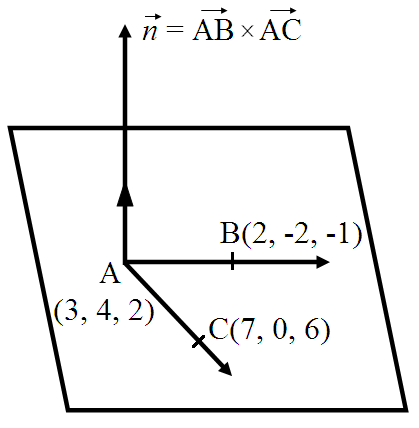 Let A(3, 4, 2), B(2, -2, -1) and C(7, 0, 6) be the points respresented by the given position vectors.
 The required plane passes through the point A(3, 4, 2) whose
position vector is $\vec{\text{a}}=3\hat{\text{i}}+4\hat{\text{j}}+2\hat{\text{k}}$ and is normal to the vector $\vec{\text{n}}$ given by $\vec{\text{n}}=\overrightarrow{\text{AB}}\times\overrightarrow{\text{AC}}$ Clearly, $\overrightarrow{\text{AB}}=\overrightarrow{\text{OB}}-\overrightarrow{\text{OA}}$ $=(2\hat{\text{i}}-2\hat{\text{j}}-\hat{\text{k}})-(3\hat{\text{i}}+4\hat{\text{j}}+2\hat{\text{k}})$ $=-\hat{\text{i}}-6\hat{\text{j}}-3\hat{\text{k}}$ $\overrightarrow{\text{AC}}=\overrightarrow{\text{OC}}-\overrightarrow{\text{OA}}$ $=(7\hat{\text{i}}+0\hat{\text{j}}+6\hat{\text{k}})-(3\hat{\text{i}}+4\hat{\text{j}}+2\hat{\text{k}})$ $=4\hat{\text{i}}-4\hat{\text{j}}+4\hat{\text{k}}$ $\vec{\text{n}}=\overrightarrow{\text{AB}}\times\overrightarrow{\text{AC}}$ $=\begin{vmatrix}\hat{\text{i}}&\hat{\text{j}}&\hat{\text{k}}\\-1&-6&-3\\4&-4&4\end{vmatrix}$ $=-36\hat{\text{i}}-8\hat{\text{j}}+28\hat{\text{k}}$ The vector equation of the required plane is $\vec{\text{r}}\cdot\vec{\text{n}}=\vec{\text{a}}\cdot\vec{\text{n}}$ $\Rightarrow\vec{\text{r}}\cdot(36\hat{\text{i}}-8\hat{\text{j}}+28\hat{\text{k}})=(3\hat{\text{i}}+4\hat{\text{j}}+2\hat{\text{k}})\cdot(36\hat{\text{i}}-8\hat{\text{j}}+28\hat{\text{k}})$ $\Rightarrow\vec{\text{r}}\cdot\Big[-4(9\hat{\text{i}}+2\hat{\text{j}}+7\hat{\text{k}})\Big]=-108-32+56$ $\Rightarrow\vec{\text{r}}\cdot\Big[-4(9\hat{\text{i}}+2\hat{\text{j}}+7\hat{\text{k}})\Big]=-84$ $\Rightarrow\vec{\text{r}}\cdot(9\hat{\text{i}}+2\hat{\text{j}}+7\hat{\text{k}})=21$ View full question & answer→Question 1094 Marks
Reduce the equation $\vec{\text{r}}\cdot(\hat{\text{i}}-2\hat{\text{j}}+2\hat{\text{k}})+6=0$ to the normal form and, hence, find the length of the perpendicular from the origin to the plane.
AnswerThe given equation of the plane is,
$\vec{\text{r}}\cdot(\hat{\text{i}}-2\hat{\text{j}}+2\hat{\text{k}})+6=0$
$\Rightarrow\vec{\text{r}}\cdot(\hat{\text{i}}-2\hat{\text{j}}+2\hat{\text{k}})=-6$ or $\vec{\text{r}}\cdot\vec{\text{n}}=-6,$ where $\vec{\text{n}}=\hat{\text{i}}-2\hat{\text{j}}+2\hat{\text{k}}$
$|\vec{\text{n}}|=\sqrt{1+4+4}=3$
For reducing the given equation to normal form, we need to divide it by $|\vec{\text{n}}|$ Then, we get
$|\vec{\text{r}}|\cdot\frac{\vec{\text{n}}}{|\vec{\text{n}}|}=\frac{-6}{|\vec{\text{n}}|}$
$\Rightarrow\vec{\text{r}}\cdot\Big(\frac{\hat{\text{i}}-2\hat{\text{j}}+2\hat{\text{k}}}{3}\Big)=\frac{-6}{3}$
$\Rightarrow\vec{\text{r}}\cdot\Big(\frac{1}{3}\hat{\text{i}}-\frac{2}{3}\hat{\text{j}}+\frac{2}{3}\hat{\text{k}}\Big)=-2$
Dividing both sides by -1 we get
$\vec{\text{r}}\cdot\Big(-\frac{1}{3}\hat{\text{i}}+\frac{2}{3}\hat{\text{j}}-\frac{2}{3}\hat{\text{k}}\Big)=2\ ...(\text{i})$
The equation of the plane in normal form is
$\vec{\text{r}}\cdot\vec{\text{n}}=\text{d}\ ...(\text{ii})$
(where d is distance of the plane from the origin)
Comparing (i) and (ii)
length of the perpendicular from the origin to the plane = d = 2 units
View full question & answer→Question 1104 Marks
Find the shortest distance between the following pairs of lines whose vector equation are:
$\vec{\text{r}}=3\hat{\text{i}}+8\hat{\text{j}}+3\hat{\text{k}}+\lambda\big(3\hat{\text{i}}-\hat{\text{j}}+\hat{\text{k}}\big)$ and $\vec{\text{r}}=-3\hat{\text{i}}-7\hat{\text{j}}+6\hat{\text{k}}+\mu\big(-3\hat{\text{i}}+2\hat{\text{j}}+4\hat{\text{k}}\big)$
AnswerWe know that, shortest distance betwee lines
$\vec{\text{r}}=\vec{\text{a}}_1+\lambda\vec{\text{b}}_1$ and $\vec{\text{r}}=\vec{\text{a}}_2+\mu\vec{\text{b}}_2$ is given by
$\text{S.D}=\Bigg|\frac{(\vec{\text{a}}_2-\vec{\text{a}}_1).(\vec{\text{b}}_1\times\vec{\text{b}}_2)}{\big|\vec{\text{b}}_1\times\vec{\text{b}}_2\big|}\Bigg|\dots(1)$
Given equation of lines are.
$\vec{\text{r}}=3\hat{\text{i}}+8\hat{\text{j}}+3\hat{\text{k}}+\lambda\big(3\hat{\text{i}}-\hat{\text{j}}+\hat{\text{k}}\big)$
$\vec{\text{r}}=\big(-3\hat{\text{i}}-7\hat{\text{j}}+9\hat{\text{k}}\big)+\mu\big(-3\hat{\text{i}}+2\hat{\text{j}}+4\hat{\text{k}}\big)$
$\Rightarrow\vec{\text{a}}_1=\big(3\hat{\text{i}}+8\hat{\text{j}}+3\hat{\text{k}}\big),\vec{\text{b}}_1=3\hat{\text{i}}-\hat{\text{j}}+\hat{\text{k}}$
$\Rightarrow\vec{\text{a}}_2=\big(-3\hat{\text{i}}-7\hat{\text{j}}+6\hat{\text{k}}\big),\vec{\text{b}}_2=\big(-3\hat{\text{i}}+2\hat{\text{j}}+4\hat{\text{k}}\big)$
Now,
$\vec{\text{a}}_2-\vec{\text{a}}_1=\big(-3\hat{\text{i}}-7\hat{\text{j}}+6\hat{\text{k}}\big)-\big(3\hat{\text{i}}+8\hat{\text{j}}+3\hat{\text{k}}\big)$
$=-3\hat{\text{i}}-7\hat{\text{j}}+6\hat{\text{k}}-3\hat{\text{i}}-8\hat{\text{j}}-3\hat{\text{k}}$
$\big(\vec{\text{a}}_2-\vec{\text{a}}_1\big)=-6\hat{\text{i}}-15\hat{\text{j}}+3\hat{\text{k}}$
$\big(\vec{\text{b}}_1\times\vec{\text{b}}_2\big)=\begin{vmatrix}\hat{\text{i}}&\hat{\text{J}}&\hat{\text{k}}\\3&-1&1\\-3&2&4 \end{vmatrix}$
$=\hat{\text{i}}(-4-2)-\hat{\text{j}}(12+3)+\hat{\text{k}}(6-3)$
$=\big(-6\hat{\text{i}}-15\hat{\text{j}}+3\hat{\text{k}}\big)$
$\big(\vec{\text{a}}_2-\vec{\text{a}}_1\big).\big(\vec{\text{b}}_1-\vec{\text{b}}_2\big)$
$=\big(-6\hat{\text{i}}-15\hat{\text{j}}+3\hat{\text{k}}\big).\big(-6\hat{\text{i}}-15\hat{\text{j}}+3\hat{\text{k}}\big)$
$=(-6)(6)+(-15)(-15)+(3)(3)$
$=36+225+9$
$=270$
$\big|\vec{\text{b}}_1\times\vec{\text{b}}_2\big|=\sqrt{(-6)^2+(-15)^2+(3)^2}$
$=\sqrt{36+25+9}$
$=\sqrt{270}$
Substituting values of $\big|\vec{\text{b}}_1\times\vec{\text{b}}_2\big|$ and $\big(\vec{\text{a}}_2-\vec{\text{a}}_1\big).\big(\vec{\text{b}}_1\times\vec{\text{b}}_2\big)$ in equation (1) to get shortest distance between given lines, so
$\text{S.D.}=\frac{270}{\sqrt{270}}$
$=\sqrt{270}$
$\text{S.D.}=3\sqrt{30}\text{ units}$
View full question & answer→Question 1114 Marks
Let $\overrightarrow{\text{a}} = \hat{\text{i}} + 4\hat{\text{j}} +2\hat{\text{k}}, \overrightarrow{\text{b}} = 3\hat{\text{i}} - 2\hat{\text{j}} +7\hat{\text{k}}$ and $\overrightarrow{\text{c}} = 2\hat{\text{i}} - \hat{\text{j}} + 4\hat{\text{k}}$ Find a vector $\overrightarrow{\text{d}}$ which is perpendicular to both $\overrightarrow{\text{a}} \text{and} \overrightarrow{\text{b}}\text{and} \overrightarrow{\text{c}} . \overrightarrow{\text{d}} = 27.$
Answer$\text{Writing} \overrightarrow{\text{d}} = \lambda\bigg(\overrightarrow{\text{a}}\times\overrightarrow{\text{b}}\bigg)$
$= \lambda \begin{vmatrix} \hat{\text{i}} & \hat{\text{j}} & \hat{\text{k}} \\ 1 & 4 & 2 \\ 3 & -2 & 7 \end{vmatrix} $
$ = \lambda \bigg(32 \hat{\text{i}} - \hat{\text{j}} - 14\hat{\text{k}}\bigg)\dots\dots\dots\dots\text{(1)}$
$\overrightarrow{\text{c}}. \overrightarrow{\text{d}} = 27$
$\bigg(2\hat{\text{i}} - \hat{\text{j}} + 4\hat{\text{k}}\bigg).\lambda\bigg(32\hat{\text{i}} - \hat{\text{j}} + 14\hat{\text{k}}\bigg) = 27$
$9\lambda = 27$
$\lambda = 3$
$\therefore\overrightarrow{\text{d}} = \bigg(96\hat{\text{i}} - \hat{\text{3j}} + 42\hat{\text{k}}\bigg)$
View full question & answer→Question 1124 Marks
If $\hat{\text{i}}+\hat{\text{j}}+\hat{\text{k}},\ 2\hat{\text{i}}+5\hat{\text{j}},\ 3\hat{\text{i}}+2\hat{\text{j}}-3\hat{\text{k}}$ and $\hat{\text{i}}-6\hat{\text{j}}-\hat{\text{k}}$ respectively are the position vectors of points A, B, C and D, then find the angle between the straight lines AB and CD. Find whether $\vec{\text{AB}}$ and $\vec{\text{CD}}$ are collinear or not.
AnswerGiven:
The position vector of A is $\hat{\text{i}}+\hat{\text{j}}+\hat{\text{k}}.$
The position vector of B is $2\hat{\text{i}}+5\hat{\text{j}}.$
Therefore, $\vec{\text{AB}}=(2-1)\hat{\text{i}}+(5-1)\hat{\text{j}}+(0-1)\hat{\text{k}}=\hat{\text{i}}+\hat4{\text{j}}-\hat{\text{k}}$
The position vector of C is $3\hat{\text{i}}+2\hat{\text{j}}-3\hat{\text{k}}$ and
The postion vector of D is $\hat{\text{i}}-6\hat{\text{j}}-\hat{\text{k}}.$
Therefore, $\vec{\text{CD}}=(1-3)\hat{\text{i}}+(-6-2)\hat{\text{j}}\\+(-1+3)\hat{\text{k}}=-2\hat{\text{i}}-\hat8{\text{j}}+2\hat{\text{k}}$
$\cos\theta=\frac{\vec{\text{AB}}.\vec{\text{CD}}}{|\vec{\text{AB}}||\vec{\text{CD}}|}$
$\Rightarrow\cos\theta=\frac{-2-32-2}{\sqrt{18}\sqrt{72}}=-1$
$\Rightarrow\theta=180^\circ$
Since, angle between Line AB and CD is 180°, therefore $\vec{\text{AB}}$ and $\vec{\text{CD}}$ are collinear.
View full question & answer→Question 1134 Marks
Find the vector and Cartesian equations of the line through the point (1, 2, – 4) and perpendicular to the two lines.
$\overrightarrow{\text{r}} = (8\hat{\text{i}} - 19\hat{\text{j}} + 10\hat{\text{k}})+\lambda(3\hat{\text{i}} - 16\hat{\text{j}} + 7\hat{\text{k})}$ and $\overrightarrow{\text{r}} = (15\hat{\text{i}} - 29\hat{\text{j}} + 5\hat{\text{k}})+\mu(3\hat{\text{i}} - 8\hat{\text{j}} + 5\hat{\text{k})}.$
AnswerVector equation of the required line is
$\overrightarrow{\text{r}} = (\hat{\text{i}} + 2\hat{\text{j}} - 4\hat{\text{k}})+\mu[(3\hat{\text{i}} - 16\hat{\text{j}} + 7\hat{\text{k})}\times(3\hat{\text{i}} + 8\hat{\text{j}} - 5\hat{\text{k})]}$
$\Rightarrow\overrightarrow{\text{r}} = (\hat{\text{i}} + 2\hat{\text{j}} - 4\hat{\text{k}})+\lambda[(2\hat{\text{i}} + 3\hat{\text{j}} + 6\hat{\text{k})]}$
in cartesian form, $\frac{\text{x - 1}}{2} = \frac{\text{y - 2}}{3} = \frac{\text{z + 4}}{6}$
View full question & answer→Question 1144 Marks
The two adjacent sides of a parallelogram are $2\hat{i} - 4\hat{j} - 5\hat{k} \text{ and } 2\hat{i} + 2\hat{j} + 3\hat{k}.$ Find the two unit vectors parallel its diagonals. Using the diagonal vectors, find the area of the parallelogram.
Answer$\text{let } \text{d}_{1} \& \text{ d}_{2}$ be the two diagonal vectors:
$\therefore \overrightarrow{\text{d}}_{1} = 4\hat{\text{i}} - 2\hat{\text{j}} - 2\hat{\text{k}}, \overrightarrow{\text{d}}_{2} = -6\hat{\text{j}} - 8\hat{\text{k}}$
$\text{or} \overrightarrow{\text{d}}_{2} = 6\hat{\text{j}} + 8\hat{\text{k}}$
Unit vectors parallel to the diagonals are:
$\overrightarrow{\text{d}}_{1} = \frac{2}{\sqrt{6}}\hat{\text{i}} - \frac{1}{\sqrt{6}}\hat{\text{j}} - \frac{1}{\sqrt{6}}\hat{\text{k}}$
$\overrightarrow{\text{d}}_{2} = \frac{3}{5}\hat{\text{j}} - \frac{4}{5}\hat{\text{k}} \bigg(\overrightarrow{\text{d}}_{2} = \frac{3}{5}\hat{\text{j}} + \frac{4}{5}\hat{\text{k}}\bigg)$
$\overrightarrow{\text{d}}_{1}\times\overrightarrow{\text{d}}_{2} = \begin{vmatrix} \hat{\text{i}} & \hat{\text{j}} & \hat{\text{k}} \\ 4 & -2 & -2 \\ 0 & -6 & -8 \end{vmatrix} = 4\hat{\text{i}} + 32\hat{\text{j}} - 24\hat{\text{k}} $
Area of parallelogram $= \frac{1}{2}|\overrightarrow{\text{d}}_{1}\times\overrightarrow{\text{d}}_{2}| = \sqrt{404} \text{ or } 2\sqrt{101} \text{sq. units}$
View full question & answer→Question 1154 Marks
Find the equation of the plane through the intersection of the planes $\vec{\text{r}}\cdot(\hat{\text{i}}+3\hat{\text{j}})-6=0$ and $\vec{\text{r}}\cdot(3\hat{\text{i}}-\hat{\text{j}}-4\hat{\text{k}})=0,$ whose perpendicular distance from origin is unity.
AnswerGiven planes are $\vec{\text{r}}\cdot(\hat{\text{i}}+3\hat{\text{j}})-6=0$ and $\vec{\text{r}}\cdot(3\hat{\text{i}}-\hat{\text{j}}-4\hat{\text{k}})=0$
Equation of family of planes through intersection of these of these planes is
$\vec{\text{r}}\cdot(\hat{\text{i}}+3\hat{\text{j}})-6+\lambda\big[\vec{\text{r}}\cdot(3\hat{\text{i}}-\hat{\text{j}}-4\hat{\text{k}})\big]=0$
$\Rightarrow\vec{\text{r}}\cdot\big[(1+3\lambda)\hat{\text{i}}+(3-\lambda)\hat{\text{j}}+\hat{\text{k}}(-4\lambda)\big]=6\ ...(\text{i})$
$\Rightarrow\frac{{\text{r}}\cdot\big[(1+3\lambda)\hat{\text{i}}+(3-\lambda)\hat{\text{j}}+\hat{\text{k}}(-4\lambda)\big]}{\sqrt{(1+3\lambda)^2+(3-\lambda)^2+(-4\lambda)^2}}$
$=\frac{6}{\sqrt{(1+3\lambda)^2+(3-\lambda)^2+(-4\lambda)^2}}$
Since, the perpendicular distance from origin is unity.
$\therefore\ \frac{6}{\sqrt{(1+3\lambda)^2+(3-\lambda)^2+(-4\lambda)^2}}=1$
$\Rightarrow(1+3\lambda)^2+(3-\lambda)^2+(-4\lambda)^2=36$
$\Rightarrow1+9\lambda^2+6\lambda+9+\lambda^2-6\lambda+16\lambda^2=36$
$\Rightarrow\lambda^2=1$
$\therefore\lambda=\pm1$
Using Eq. (i) the required equation of plane is
$\vec{\text{r}}\cdot\big[(1\pm3\lambda)\hat{\text{i}}+(3\pm\lambda)\hat{\text{j}}+\hat{\text{k}}(\pm4\lambda)\big]=6$
$\Rightarrow\vec{\text{r}}\cdot(4\hat{\text{i}}+2\hat{\text{j}}-4\hat{\text{k}})=6$ and $\vec{\text{r}}\cdot(2\hat{\text{i}}+4\hat{\text{j}}+4\hat{\text{k}})=6$
Or $4\text{x}+2\text{y}-4\text{z}-6=0$ and $-2\text{x}+4\text{y}+4\text{z}-6=0$
View full question & answer→Question 1164 Marks
If $\hat{\text{i}}+\hat{\text{j}}+\hat{\text{k}},\ 2\hat{\text{i}}+5\hat{\text{j}},\ 3\hat{\text{i}}+2\hat{\text{j}}-3\hat{\text{k}}$ and $\hat{\text{i}}-6\hat{\text{j}}-\hat{\text{k}}$ respectively are the position vectors of points A, B, C and D, then find the angle between the straight lines AB and CD. Find whether $\vec{\text{AB}}$ and $\vec{\text{CD}}$ are collinear or not.
AnswerGiven:
The position vector of A is $\hat{\text{i}}+\hat{\text{j}}+\hat{\text{k}}.$
The position vector of B is $2\hat{\text{i}}+5\hat{\text{j}}.$
Therefore, $\vec{\text{AB}}=(2-1)\hat{\text{i}}+(5-1)\hat{\text{j}}+(0-1)\hat{\text{k}}=\hat{\text{i}}+\hat4{\text{j}}-\hat{\text{k}}$
The position vector of C is $3\hat{\text{i}}+2\hat{\text{j}}-3\hat{\text{k}}$ and
The postion vector of D is $\hat{\text{i}}-6\hat{\text{j}}-\hat{\text{k}}.$
Therefore, $\vec{\text{CD}}=(1-3)\hat{\text{i}}+(-6-2)\hat{\text{j}}\\+(-1+3)\hat{\text{k}}=-2\hat{\text{i}}-\hat8{\text{j}}+2\hat{\text{k}}$
$\cos\theta=\frac{\vec{\text{AB}}.\vec{\text{CD}}}{|\vec{\text{AB}}||\vec{\text{CD}}|}$
$\Rightarrow\cos\theta=\frac{-2-32-2}{\sqrt{18}\sqrt{72}}=-1$
$\Rightarrow\theta=180^\circ$
Since, angle between Line AB and CD is 180°, therefore $\vec{\text{AB}}$ and $\vec{\text{CD}}$ are collinear.
View full question & answer→Question 1174 Marks
Find the distance between the point (-1, -5, -10) and the point of intersection of the line $\frac{x - 2}{3} = \frac{y + 1}{4} = \frac{z - 2}{12}$ and the plane $x - y + z = 5.$
AnswerAny point on the line $\frac{\text{x} - 2}{3} = \frac{\text{y} + 1}{4} = \frac{\text{z} - 2}{12} = \text{is} (3\lambda + 2, 4\lambda - 1, 12\lambda + 2)$
If this is the point of intersection with plane $\text{x - y + z = 5}$
$\text{then 3} \lambda + 2 - 4\lambda + 1 + 12\lambda + 2 - 5 = 0 \Rightarrow \lambda = 0$
$\therefore$ Point of intersection is (2, -1, 2)
Required distance = $\sqrt{(2 + 1)^{2} +(-1 + 5)^{2} + (2 + 10)^{2} } = 13$
View full question & answer→Question 1184 Marks
Find the angle between the lines $\vec{\text{r}}=3\hat{\text{i}}-2{\hat{\text{j}}}+6\hat{\text{k}}+\lambda(2\hat{\text{i}}+{\hat{\text{j}}}+2\hat{\text{k}})$ and $\vec{\text{r}}=(2\hat{\text{i}}-5\hat{\text{k}})+\mu(6\hat{\text{i}}+3{\hat{\text{j}}}+2\hat{\text{k}}).$
AnswerWe have $\vec{\text{r}}=3\hat{\text{i}}-2{\hat{\text{j}}}+6\hat{\text{k}}+\lambda(2\hat{\text{i}}+{\hat{\text{j}}}+2\hat{\text{k}})$
And $\vec{\text{r}}=(2\hat{\text{i}}-5\hat{\text{k}})+\mu(6\hat{\text{i}}+3{\hat{\text{j}}}+2\hat{\text{k}})$
where $\vec{\text{a}_1}=3\hat{\text{i}}-2{\hat{\text{j}}}+6\hat{\text{k}},\ \vec{\text{b}_1}=(2\hat{\text{i}}+{\hat{\text{j}}}+2\hat{\text{k}})$
And $\vec{\text{a}_2}=2\hat{\text{i}}-5\hat{\text{k}},\ \vec{\text{b}_2}=6\hat{\text{i}}+3{\hat{\text{j}}}+2\hat{\text{k}}$
If $\theta$ is angle between the lines, then
$\cos\theta=\frac{|\vec{\text{b}_1}\cdot\vec{\text{b}_2}|}{|\vec{\text{b}_1|}\cdot|\vec{\text{b}_1}|}$
$=\frac{|(2\hat{\text{i}}+{\hat{\text{j}}}+2\hat{\text{k}})\cdot|(6\hat{\text{i}}+3{\hat{\text{j}}}+2\hat{\text{k}})|}{|2\hat{\text{i}}+{\hat{\text{j}}}+2\hat{\text{k}}||6\hat{\text{i}}+3{\hat{\text{j}}}+2\hat{\text{k}}|}$
$=\frac{|12+3+4|}{\sqrt{9}\sqrt{49}}=\frac{19}{21}$
$\theta=\cos^{-1}\frac{19}{21}$
View full question & answer→Question 1194 Marks
Find the equation of a plane which is at a distance $3\sqrt{3}$ units from origin and the normal to which is equally inclined to coordinate axis.
AnswerSince, normal to the plane is equally inclined to the coordinate axis.
Therefore, $\cos\alpha+\cos\beta=\cos\gamma=\frac{1}{\sqrt{3}}$
So, the normal is $\vec{\text{N}}=\frac{1}{\sqrt{3}}\hat{\text{i}}+\frac{1}{\sqrt{3}}\hat{\text{j}}+\frac{1}{\sqrt{3}}\hat{\text{k}}$ and plane is at a distance of $3\sqrt{3}$ units from origin.
The equation of plane is $\vec{\text{r}}\cdot\hat{\text{N}}=3\sqrt{3}$ $\Big[\because\hat{\text{N}}=\frac{\vec{\text{N}}}{|\text{N}|}\Big]$
$[$Since, vector equation of the plane at a distance p from the origin is $\vec{\text{r}}\cdot\hat{\text{N}}=\text{p}]$
$\Rightarrow(\text{x}\hat{\text{i}}+\text{y}\hat{\text{j}}+\text{k}\hat{\text{k}})\cdot\frac{\Big(\frac{1}{\sqrt{3}}\hat{\text{i}}+\frac{1}{\sqrt{3}}\hat{\text{j}}+\frac{1}{\sqrt{3}}\hat{\text{k}}\Big)}{1}=3\sqrt{3}$
$\Rightarrow\frac{\text{x}}{\sqrt{3}}+\frac{\text{y}}{\sqrt{3}}+\frac{\text{z}}{\sqrt{3}}=3\sqrt{3}$
$\therefore\text{x}+\text{y}+\text{z}=3\sqrt{3}\cdot\sqrt{3}=9$
So, the required equation of plane is $\text{x}+\text{y}+\text{z}=9.$
View full question & answer→Question 1204 Marks
Find the position vector of a point A in space such that $\overrightarrow{\text{OA}}$ is is inclined at 60° to OX and at 45° to OY and $|\overrightarrow{\text{OA}}|=10$ units.
AnswerGiven that, $\overrightarrow{\text{OA}}$ is inclined at 60° to OX and at 45° To OY.
Let $\overrightarrow{\text{OA}}$ makes angle a with OZ.
$\therefore\cos^260^\circ+\cos^245^\circ+\cos^2\alpha=1$
$\Rightarrow\Big(\frac{1}{2}\Big)^2+\Big(\frac{1}{\sqrt{2}}\Big)^2+\cos^2\alpha=1$ $[\because\text{l}^2+\text{m}^2+\text{n}^2=1]$
$\Rightarrow\frac{1}{4}+\frac{1}{2}+\cos^2\alpha=1$
$\Rightarrow\cos^2\alpha=1-\Big(\frac{1}{2}+\frac{1}{4}\Big)$
$\Rightarrow\cos^2\alpha=1-\Big(\frac{6}{8}\Big)$
$\Rightarrow\cos^2\alpha=\Big(\frac{1}{4}\Big)$
$\Rightarrow\cos\alpha=\frac{1}{2}=\cos60^\circ$
$\therefore\alpha=60^\circ$
$\therefore\overrightarrow{\text{OA}}=|\overrightarrow{\text{OA}}|\Big(\frac{1}{2}\hat{\text{i}}+\frac{1}{\sqrt{2}}\hat{\text{j}}+\frac{1}{2}\hat{\text{k}}\Big)$
$=10\Big(\frac{1}{2}\hat{\text{i}}+\frac{1}{\sqrt{2}}\hat{\text{j}}+\frac{1}{2}\hat{\text{k}}\Big)$ $[\because|\overrightarrow{\text{AB}}|=10]$
$=5\hat{\text{i}}+5{\sqrt{2}\hat{\text{j}}}+5\hat{\text{k}}$
View full question & answer→Question 1214 Marks
Find the vector equation of the plane which is at a distance of $\frac{6}{\sqrt{29}}$ from the origin and its normal vector from the origin is $2\hat{\text{i}}-3\hat{\text{j}}+4\hat{\text{k}}$ Also, find its cartesian form.
AnswerGiven, normal vector, $\vec{\text{n}}=2\hat{\text{i}}-3\hat{\text{j}}+4\hat{\text{k}}$
Now, $\hat{\text{n}}=\frac{\vec{\text{n}}}{|\vec{\text{n}}|}$
$=\frac{2\hat{\text{i}}-3\hat{\text{j}}+4\hat{\text{k}}}{\sqrt{29}}$
$=\frac{2}{\sqrt{29}}\hat{\text{i}}-\frac{3}{\sqrt{29}}\hat{\text{j}}+\frac{4}{\sqrt{29}}\hat{\text{k}}$
The equation of the plane in normal from is
$\vec{\text{r}}\cdot\hat{\text{n}}={\text{d}}$ (where d is distance of the plane from the origin)
Substituting, $\hat{\text{n}}=\frac{2}{\sqrt{29}}\hat{\text{i}}-\frac{3}{\sqrt{29}}\hat{\text{j}}+\frac{4}{\sqrt{29}}\hat{\text{k}}$ and $\text{d}=\frac{6}{\sqrt{29}}$ here, we get
$\vec{\text{r}}\cdot\Big(\frac{2}{\sqrt{29}}\hat{\text{i}}-\frac{3}{\sqrt{29}}\hat{\text{j}}+\frac{4}{\sqrt{29}}\hat{\text{k}}\Big)=\frac{6}{\sqrt{29}}\ ...(\text{i})$
Cartesian form
For cartesian form, substituting $\vec{\text{r}}=\text{x}\hat{\text{i}}+\text{y}\hat{\text{j}}+\text{z}\hat{\text{k}}$ in (i) we get
$(\text{x}\hat{\text{i}}+\text{y}\hat{\text{j}}+\text{z}\hat{\text{k}})\cdot\Big(\frac{2}{\sqrt{29}}\hat{\text{i}}-\frac{3}{\sqrt{29}}\hat{\text{j}}+\frac{4}{\sqrt{29}}\hat{\text{k}}\Big)=\frac{6}{\sqrt{29}}$
$\Rightarrow\frac{2\text{x}-3\text{y}+4\text{z}}{\sqrt{29}}=\frac{6}{\sqrt{29}}$
$\Rightarrow2\text{x}-3\text{y}+4\text{z}=6$
View full question & answer→Question 1224 Marks
Show that the lines$\frac{\text{X} + 1 }{3} =\frac{\text{y} + 3}{5} = \frac{\text{z} + 5}{7}\text{ and } \frac{\text{x} - 2}{1} =\frac{\text{y} - 4}{3} =\frac{\text{z} - 6 }{5}$ intersect. Also find their point of intersection.
Answerlet $\frac{\text{x} + 1 }{3} =\frac{\text{y} + 3}{5} =\frac{\text{z} + 5}{7} = \text{u};\frac{\text{x} - 2 }{1} = \frac{\text{y} - 4}{3} =\frac{\text{z} - 6}{5} = \text{v}$
General points on the lines are
(3u – 1, 5u – 3, 7u – 5) & (v + 2, 3v + 4, 5v + 6)
lines intersect if
3u – 1 = v + 2, 5u – 3 = 3v + 4, 7u – 5 = 5v + 6 for some u & v
or 3u – v = 3 ........... (1), 5u – 3v = 7 .............. (2), 7u – 5v = 11 ................... (3)
Solving equations (1) and (2),weget $\text{u} = \frac{1}{2},\text{v} = - \frac{3}{2}$
Putting u&v in equation (3), $ 7.\frac{1}{2} - 5 \big(-\frac{3}{2}\big) = 11 \therefore\text{ lines intersect }$
Point of intersection of lines is: $\bigg(\frac{1}{2},-\frac{1}{2}, - \frac{3}{2}\bigg).$
View full question & answer→Question 1234 Marks
Show that the points whose position vectors are $-2\hat{\text{i}}+3\hat{\text{j}},\hat{\text{i}}+2\hat{\text{j}}+3\hat{\text{k}}$ and $7\hat{\text{i}}-\hat{\text{k}}$ are collinear.
AnswerLet the given points be P, Q and R and let their position vectors be $\vec{\text{a}},\vec{\text{b}}$ and $\vec{\text{c}},$ respectively.
$\vec{\text{a}}=-2\hat{\text{i}}+3\hat{\text{j}}$
$\vec{\text{b}}=\hat{\text{i}}+2\hat{\text{j}}+3\hat{\text{k}}$
$\vec{\text{c}}=7\hat{\text{i}}+9\hat{\text{k}}$
Vector equation of line passing through P and Q is
$\vec{\text{r}}=\vec{\text{a}}+\lambda\big(\vec{\text{b}}-\vec{\text{a}}\big)$
$\Rightarrow\vec{\text{r}}=\big(-2\hat{\text{i}}+3\hat{\text{j}}\big)+\lambda\big\{\big(\hat{\text{i}}+2\hat{\text{j}}+3\hat{\text{k}}\big)-\big(-2\hat{\text{i}}+3\hat{\text{j}}\big)\big\}$
$\Rightarrow\vec{\text{r}}=\big(-2\hat{\text{i}}+3\hat{\text{j}}\big)+\lambda\big(3\hat{\text{i}}-\hat{\text{j}}+3\hat{\text{k}}\big)\dots(1)$
If points P, Qand R are collinear, then point R must satisfy (1).
Replacing $\vec{\text{r}}$ by $\vec{\text{c}}=7\hat{\text{i}}+9\hat{\text{k}}$ in (1), we get
$7\hat{\text{i}}+9\hat{\text{k}}=\big(-2\hat{\text{i}}+3\hat{\text{j}}\big)+\lambda\big(3\hat{\text{i}}-\hat{\text{j}}+3\hat{\text{k}}\big)$
Comparing the coefficients of $\hat{\text{i}},\hat{\text{j}}$ and $\hat{\text{k}},$ we get
$7=-2+3\lambda,0=3-\lambda,9=3\lambda$
$\therefore\lambda=3$
These three equations are consistent, i.e. they give the same value of $\lambda.$
Hence, the given three points are colinear.
Disclaimar: The question given in the book has a minor error. The third vectors should be $7\hat{\text{i}}+9\hat{\text{k}}.$
The solution here is created accordingly
View full question & answer→Question 1244 Marks
Find the equation of the sphere passing through the points (0, 0, 0), (a, 0, 0), (0, b, 0) and (0, 0, c).
AnswerLet the equation of sphere be x2 + y2 + z2 + 2ux + 2vy + 2wz + d = 0 ............. (i)
(0,0,0,) lies on it $\therefore$ d = 0 (a,0,0,) lies on it $\Rightarrow$ 2ua + a2 = 0$\Rightarrow$ 2u = – a (0,b,0,) lies on it $\Rightarrow$ 2vb + b2 = 0 $\Rightarrow$ 2v = – b (0,0,c,) lies on it $\Rightarrow$ 2wc + c2 = 0 $\Rightarrow$ 2w = – c $\therefore$ Equation of sphere is x2 + y2 + z2 – ax – by – cz = 0.
View full question & answer→Question 1254 Marks
Find the equation of the plane which bisects the line segment joining the points (-1, 2, 3) and (3, -5, 6) at right angles.
AnswerThe normal is passing through the point A(-1, 2, 3) and B(3, -5, 6) So,
$\overrightarrow{\text{n}}=\overrightarrow{\text{AB}}=\overrightarrow{\text{OB}}-\overrightarrow{\text{OA}}$
$=(3\hat{\text{i}}-5\hat{\text{j}}+6\hat{\text{k}})-(-\hat{\text{i}}+2\hat{\text{j}}+3\hat{\text{k}})$
$=14\hat{\text{i}}-7\hat{\text{j}}+3\hat{\text{k}}$
$\text{Mid}-\text{point of AB} =\Big(\frac{-1+3}{2},\frac{2-5}{2},\frac{3+6}{2}\Big)$
$=\Big(1,\frac{-3}{2},\frac{9}{2}\Big)$
Since the plane passes through $\Big(1,\frac{-3}{2},\frac{9}{2}\Big)$
$\vec{\text{a}}=\hat{\text{i}}-\frac{3}{2}\hat{\text{j}}+\frac{9}{2}\hat{\text{k}}$
We know that the vector equation of the plane passing through a point $\vec{\text{a}}$ and normal to $\vec{\text{n}}$ is,
$\vec{\text{r}}\cdot\vec{\text{n}}=\vec{\text{a}}\cdot\vec{\text{n}}$
Substituting $\vec{\text{a}}=\hat{\text{i}}-\hat{\text{j}}+\hat{\text{k}}$ and $\vec{\text{n}}=4\hat{\text{i}}-7\hat{\text{j}}+3\hat{\text{k}},$ we get
$(\text{x}\hat{\text{i}}+\text{y}\hat{\text{j}}+\text{z}\hat{\text{k}})\cdot(4\hat{\text{i}}-7\hat{\text{j}}+3\hat{\text{k}})=28$
$\Rightarrow4\text{x}-7\text{y}+3\text{z}=28$
$\Rightarrow4\text{x}-7\text{y}+3\text{z}-28=0$
View full question & answer→Question 1264 Marks
Find the equation of the plane passing through the point (2, 3, 1), given that the direction ratios of the normal to the plane are proportional to 5, 3, 2.
AnswerGiven that, the plane is passing throught p(2, 3, 1) having 5, 3, 2 as the direction ratio of the normal to the plane.
We know that,
Equation of a plane passing through a point $\vec{\text{a}}$ and $\vec{\text{n}}$ is a vector normal to the plane, is given by,
$(\vec{\text{r}}-\vec{\text{a}})\vec{\text{n}}=0\ ...(\text{i})$
So, $\vec{\text{a}}=2\hat{\text{i}}+3\hat{\text{j}}+2\hat{\text{k}}$
$\vec{\text{n}}=5\hat{\text{i}}+3\hat{\text{j}}+2\hat{\text{k}}$
Put, $\vec{\text{a}}$ and $\vec{\text{n}}$ in equation (i),
$\Big[\vec{\text{r}}-(2\hat{\text{i}}+\hat{\text{j}}+\hat{\text{k}})\Big](5\hat{\text{i}}+3\hat{\text{j}}+2\hat{\text{k}})=0$
$\vec{\text{r}}(5\hat{\text{i}}+3\hat{\text{j}}+2\hat{\text{k}})-(2\hat{\text{i}}+3\hat{\text{j}}+\hat{\text{k}})(5\hat{\text{i}}+3\hat{\text{j}}+2\hat{\text{k}})=0$
$\vec{\text{r}}(5\hat{\text{i}}+3\hat{\text{j}}+2\hat{\text{k}})-\big[(2)(5)+(3)(3)+(1)(2)\big]=0$
$\vec{\text{r}}(5\hat{\text{i}}+3\hat{\text{j}}+2\hat{\text{k}})-[10+9+2]=0$
$\vec{\text{r}}(5\hat{\text{i}}+3\hat{\text{j}}+2\hat{\text{k}})-21=0$
Put, $\vec{\text{r}}=\text{x}\hat{\text{i}}+\text{y}\hat{\text{j}}+\text{z}\hat{\text{k}}$
$(\text{x}\hat{\text{i}}+\text{y}\hat{\text{j}}+\text{z}\hat{\text{k}})(5\hat{\text{i}}+3\hat{\text{j}}+2\hat{\text{k}})-21=0$
$(\text{x})(5)+(\text{y})(3)+(\text{z})(2)=21$
$5\text{x}+3\text{y}+2\text{z}=21$
View full question & answer→Question 1274 Marks
Find the angle between the vectors whose direction cosines are proportional to 2, 3, -6 and 3, -4, 5.
AnswerLet $\vec{\text{a}}$ be a vector with direction ratios 2, 3, -6.
$\Rightarrow\vec{\text{a}}=2\hat{\text{i}}+3\hat{\text{j}}-6\hat{\text{k}}$
Let $\vec{\text{b}}$ be a vector with direction ratios 3, -4, 5.
$\Rightarrow\vec{\text{b}}=3\hat{\text{i}}-4\hat{\text{j}}+5\hat{\text{k}}$
Let $\theta$ be the angle between the given vectors.
Now,
$\cos\theta=\frac{\vec{\text{a}}.\vec{\text{b}}}{\big|\vec{\text{a}}\big|\big|\vec{\text{b}}\big|}$
$=\frac{(2\hat{\text{i}}+3\hat{\text{j}}-6\hat{\text{k}}).(3\hat{\text{i}}-4\hat{\text{j}}+5\hat{\text{k}})}{\big|2\hat{\text{i}}+3\hat{\text{j}}-6\hat{\text{k}}\big|\big|3\hat{\text{i}}-4\hat{\text{j}}+5\hat{\text{k}}\big|}$
$=\frac{6-12-30}{\sqrt{4+9+36}\sqrt{9+16+25}}$
$=\frac{-36}{\sqrt{49}\sqrt{50}}$
$=\frac{-36}{35\sqrt{2}}$
Rationalising the result, we get
$\cos\theta=-\frac{18\sqrt{2}}{35}$
$\therefore\theta=\cos^{-1}\Big(-\frac{18\sqrt{2}}{35}\Big)$
Thus, the angle between the given vectors measures $\cos^{-1}\Big(-\frac{18\sqrt{2}}{35}\Big)$.
View full question & answer→Question 1284 Marks
Find the angle between the pairs of lines with direction ratios proportional to
5, -12, 13 and -3, 4, 5
AnswerWe know that, angle $(\theta)$ between two lines
$\frac{\text{x}-\text{x}_1}{\text{a}_1}=\frac{\text{y}-\text{y}_1}{\text{b}_1}=\frac{\text{z}-\text{z}_1}{\text{c}_1}$ and $\frac{\text{x}-\text{x}_2}{\text{a}_2}=\frac{\text{y}-\text{y}_2}{\text{b}_2}=\frac{\text{z}-\text{z}_2}{\text{c}_2}$
Is given by,
$\cos\theta=\frac{\text{a}_1\text{a}_2+\text{b}_1\text{b}_2+\text{c}_1\text{c}_2}{\sqrt{{\text{a}_1}^2+{{\text{b}_1}^2}+{{\text{c}_1}^2}}\sqrt{{\text{a}_2}^2+{{\text{b}_2}^2}+{{\text{c}_2}^2}}}\dots(1)$
Here, a1 = 5, b1 = -12, c1 = 13
a2 = -3, b2 = 4, c2 = 5
Let $\theta$ be the required angle, so using equation (1),
$\cos\theta=\frac{(5)(-3)+(-12)(4)+(13)(5)}{\sqrt{(5)^2+(-12)^2+(13)^2}\sqrt{(-3)^2+(4)^2+(5)^2}}$
$=\frac{-15-48+65}{\sqrt{169\times2}\sqrt{25\times2}}$
$=\frac{2}{65\times2}$
$\cos\theta=\frac{1}{65}$
$\theta=\cos^{-1}\Big(\frac{1}{65}\Big)$
View full question & answer→Question 1294 Marks
If a variable line in two adjacent positions has direction cosines l, m, n and $\text{l}+\delta\text{l},\text{m}+\delta\text{m},\text{n}+\delta\text{n},$ show that the small angle $\delta\theta$ between the two positions is given by $\delta\theta^2=\delta\text{l}^2+\delta\text{m}^2+\delta\text{n}^2.$
AnswerWe have l, m, n and $\text{l}+\delta\text{l},\text{m}+\delta\text{m},\text{n}+\delta\text{n}$ as direction cosines of a variable line in two different positions.
$\therefore\text{l}^2+\text{m}^2+\text{n}^2=1\ ....(\text{i})$
and $(\text{l}+\delta\text{l})^2+(\text{m}+\delta\text{m})^2+(\text{n}+\delta)\ ....(\text{ii})$
$\Rightarrow\text{l}^2+\text{m}^2+\text{n}^2+\delta\text{l}^2+\delta\text{m}^2+\delta\text{n}^2+2(\text{l}\delta\text{l}+\text{m}\delta\text{m}+\text{n}\delta\text{n})=1$
$\Rightarrow\delta\text{l}^2+\delta\text{m}^2+\delta\text{n}^2=2(\text{l}\delta\text{l}+\text{m}\delta\text{m}+\text{n}\delta\text{n})$ $[\because\text{l}^2+\text{m}^2+\text{n}^2=1]$
$\Rightarrow\text{l}\delta\text{l}+\text{m}\delta\text{m}+\text{n}\delta\text{n}=\frac{-1}{2}(\delta\text{l}^2+\delta\text{m}^2+\delta\text{n}^2)\ ....(\text{iii})$
Now $\vec{\text{a}}$ and $\vec{\text{b}}$ are unit vectors along a line with direction cosines l, m, n and
$(\text{l}+\delta\text{l}),(\text{m}+\delta\text{m}),(\text{n}+\delta\text{n}),$ respectively.
$\therefore\vec{\text{a}}=\text{l}\hat{\text{i}}+\text{m}\hat{\text{j}}+\text{n}\hat{\text{k}}$ and $\vec{\text{b}}=(\text{l}+\delta\text{l})\hat{\text{i}}+(\text{m}+\delta\text{m})\hat{\text{j}}+(\text{n}+\delta\text{n})\hat{\text{k}}$
$\Rightarrow\cos\delta\theta=\text{l}(\text{l}+\delta\text{l})+\text{m}(\text{m}+\delta\text{m})+\text{n}(\text{n}+\delta\text{n})$
$=(\text{l}^2+\text{m}^2+\text{n}^2)+(\text{l}\delta\text{l}+\text{m}\delta\text{m}+\text{n}\delta\text{n})$
$=1-\frac{1}{2}(\delta\text{l}^2+\delta\text{m}^2+\delta\text{n}^2)$
$\Rightarrow2(1-\cos\delta\theta)=(\delta\text{l}^2+\delta\text{m}^2+\delta\text{n}^2)$
$\Rightarrow2\cdot2\sin^2\frac{\delta\theta}{2}=\delta\text{l}^2+\delta\text{m}^2+\delta\text{n}^2$
$\Rightarrow4\Big(\frac{\delta\theta}{2}\Big)=\delta\text{l}^2+\delta\text{m}^2+\delta\text{n}^2$$\Big[\text{Since}\frac{\delta\theta}{2}\text{is small,}\sin\frac{\delta\theta}{2}=\frac{\delta\theta}{2}\Big]$
$\Rightarrow\delta\theta^2=\delta\text{l}^2+\delta\text{m}^2+\delta\text{n}^2$
View full question & answer→Question 1304 Marks
Find the equation of the plane determined by the intersection of the lines $\frac{\text{x}+3}{3}=\frac{\text{y}}{-2}=\frac{\text{z}-7}{6}$ and $\frac{\text{x}+6}{1}=\frac{\text{y}+5}{-3}=\frac{\text{z}-1}{2}$
AnswerLet $\text{L}_1:=\frac{\text{x}+3}{3}=\frac{\text{y}}{-2}=\frac{\text{z}-7}{6}$ and $\text{L}_2:\frac{\text{x}+6}{1}=\frac{\text{y}+5}{-3}=\frac{\text{z}-1}{2}$ be the equation of two lines.
Let the plane be ax + by + cz + d = 0 ....(i)
Given that the required plane passes through the intersection of the lines L1 and L2
Hence the normal to the plane is perpendicular to the lines L1 and L2
$\therefore$ 3a - 2b + 6c = 0
a - 3b + 2c = 0
Using cross-multiplication we get
$\frac{\text{a}}{-4+18}=\frac{\text{b}}{6-6}=\frac{\text{c}}{-9+2}$
$\Rightarrow\frac{\text{a}}{14}=\frac{\text{b}}{0}=\frac{\text{c}}{-7}$
$\Rightarrow\frac{\text{a}}{2}=\frac{\text{b}}{0}=\frac{\text{c}}{-1}$
View full question & answer→Question 1314 Marks
Find the equation of the plane which is perpendicular to the plane 5x + 3y + 6z + 8 = 0 and which contains the line of intersection of the planes x + 2y + 3z – 4 = 0 and 2x + y – z + 5 = 0.
AnswerThe equation of a plane through the line of intersection of the planes x + 2y + 3z - 4 = 0 and 2x + y - z + 5 = 0.
$(\text{x}+2\text{y}+3\text{z} – 4)+\lambda(2\text{x}+\text{y}- \text{z} + 5) = 0$
$\Rightarrow\text{x}(1+2\lambda)+\text{y}(2+\lambda)+\text{z}(-\lambda+3)-4+5\lambda=0\ .....(\text{i})$
Also, this is perpendicular to the plane $5\text{x}+3\text{y}+6\text{z}+8=0.$
$\therefore5(1+2\lambda)+3(2+\lambda)+6(3-\lambda)=0$ $[\because\text{a}_1\text{a}_2+\text{b}_1\text{b}_2+\text{c}_1\text{c}_1=0]$
$\Rightarrow5+10\lambda+6+3\lambda+18-6\lambda=0$
$\Rightarrow\lambda=-\frac{29}{7}$
Putting this value of $\lambda$ in equation (i), we get
$\text{x}\Big[1+2\Big(\frac{-29}{7}\Big)\Big]+\text{y}\Big(2-\frac{29}{7}\Big)+\Big(\frac{29}{7}+3\Big)-4+5\Big(\frac{-29}{7}\Big)=0\Big]$
$\Rightarrow\text{x}(7-58)+\text{y}(14-29)+\text{z}(29+21)-28-145=0$
$\Rightarrow-51\text{x}-15\text{y}+50\text{z}-173=0$
So, the required equation of plane is $-51\text{x}-15\text{y}+50\text{z}-173=0.$
View full question & answer→Question 1324 Marks
Find the direction cosines of the line $\frac{\text{x}+2}{2}=\frac{2\text{y}-7}{6}=\frac{5-\text{z}}{6}.$ Also, find the vector equation of the line through the point A(-1, 2, 3) and parallel to the given line.
AnswerThe equation of the given line is $\frac{\text{x}+2}{2}=\frac{2\text{y}-7}{6}=\frac{5-\text{z}}{6}.$
The given equation can be re-written as $\frac{\text{x}+2}{2}=\frac{\text{y}-\frac{7}{2}}{3}=\frac{\text{z}-5}{-6.}$
This line passes through the point $\big(-2, \frac{7}{2}, 5\big)$ and has direction ratios proportionl to 2, 3, -6.
So, its direction cosines are
$\frac{2}{\sqrt{2^2+3^2+(-6)^2}},\frac{3}{\sqrt{2^2+3^2+(-6)^2}},\frac{-6}{\sqrt{2^2+3^2+(-6)^2}}$
$\text{or }\frac{2}{7},\frac{3}{7},\frac{-6}{7}$
The required line passes throuth the point having position vector $\vec{\text{a}}=-\hat{\text{i}}+2\hat{\text{j}}+3\hat{\text{k}}$ and is parallel to the vector $\vec{\text{b}}=2\hat{\text{i}}+3\hat{\text{j}}-6\hat{\text{k}}.$
So, its vector equation is
$\vec{\text{r}}=\big(-\hat{\text{i}}+2\hat{\text{j}}+3\hat{\text{k}}\big)+\lambda\big(2\hat{\text{i}}+3\hat{\text{j}}-6\hat{\text{k}}\big)$
View full question & answer→Question 1334 Marks
Find the shortest distance between the following pairs of parallel lines whose equations are:
$\vec{\text{r}}=\big(\hat{\text{i}}+\hat{\text{j}}\big)+\lambda\big(2\hat{\text{i}}-\hat{\text{j}}+\hat{\text{k}}\big)$ and $\vec{\text{r}}=\big(2\hat{\text{i}}+\hat{\text{j}}-\hat{\text{k}}\big)+\mu\big(4\hat{\text{i}}-2\hat{\text{j}}+2\hat{\text{k}}\big)$
Answer$\vec{\text{r}}=\big(\hat{\text{i}}+\hat{\text{j}}\big)+\lambda\big(2\hat{\text{i}}-\hat{\text{j}}+\hat{\text{k}}\big)$ and $\vec{\text{r}}=\big(2\hat{\text{i}}+\hat{\text{j}}-\hat{\text{k}}\big)+\mu\big(4\hat{\text{i}}-2\hat{\text{j}}+2\hat{\text{k}}\big)$ or $\vec{\text{r}}=\big(2\hat{\text{i}}+\hat{\text{j}}-\hat{\text{k}}\big)+2\mu\big(2\hat{\text{i}}-\hat{\text{j}}+\hat{\text{k}}\big)$
These two lines pass through the points having position vectors
$\vec{\text{a}}_1=\hat{\text{i}}+\hat{\text{j}}$ and $\vec{\text{a}}_2=2\hat{\text{i}}+\hat{\text{j}}-\hat{\text{k}}$ and are parallel to the vector $\vec{\text{b}}=2\hat{\text{i}}-\hat{\text{j}}+\hat{\text{k}}.$
Now,
$\vec{\text{a}}_2-\vec{\text{a}}_1=\hat{\text{i}}-\hat{\text{k}}$
and
$\big(\vec{\text{a}}_2-\vec{\text{a}}_1\big)\times\vec{\text{b}}=\big(\hat{\text{i}}-\hat{\text{k}}\big)\times\big(2\hat{\text{i}}-\hat{\text{j}}+\hat{\text{k}}\big)$
$=\begin{vmatrix}\hat{\text{i}}&\hat{\text{j}}&\hat{\text{k}}\\1&0&-1\\2&-1&1 \end{vmatrix}$
$=-\hat{\text{i}}-3\hat{\text{j}}-\hat{\text{k}}$
$\Rightarrow\big|\big(\vec{\text{a}}_2-\vec{\text{a}}_1\big)\times\vec{\text{b}}\big|=\sqrt{(-1)^2+(-3)^2+(-1)^2}$
$=\sqrt{1+9+1}$
$=\sqrt{11}$
The shortest distance between the two lines is given by
$\frac{\big|\big(\vec{\text{a}}_2-\vec{\text{a}}_1\big)\times\vec{\text{b}}\big|}{\big|\vec{\text{b}}}\big|=\frac{\sqrt{11}}{\sqrt{6}}$
View full question & answer→Question 1344 Marks
Find the angle between the lines whose direction cosines are given by the equations
l + 2m + 3n = 0 and 3lm - 4ln + mn = 0
AnswerGiven that,
l + 2m + 3n = 0 .....(1)
3lm - 4ln + mn = 0 .....(2)
From equation (1),
l + 2m + 3n = 0
l = -2m - 3n
Put the value of l in equation (2),
3lm - 4ln + mn = 0
3(-2m - 3n) m - 4(-2m - 3n) n + mn = 0
-6m2 - 9nm + 8mn + 12n2 + mn = 0
-6m2 + 12n2 = 0
m2 = 2n2
$\text{m}=\pm\sqrt{2\text{n}^2}$
$\text{m}=\text{n}\sqrt{2}$ or $\text{m}=-\text{n}\sqrt{2}$
Put $\text{m}=\text{n}\sqrt{2}$ in equation (1)
l + 2m + 3n = 0
$\text{l}+2\big(\text{n}\sqrt{2}\big)+3\text{n}=0$
$\text{l}+\text{n}\big(2\sqrt{2}+3\big)=0$
$\text{l}+-\big(2\sqrt{2}+3\big)\text{n}$
Again, $\text{m}=-\sqrt{2\text{n}}$ in equation (1)
l + 2m + 3n = 0
$\text{l}+2\big(-\sqrt{2\text{n}}\big)+3\text{n}=0$
$\text{l}-2\sqrt{2\text{n}}+3\text{n}=0$
$\text{l}+\text{n}\big(-2\sqrt{2\text{n}}+3\big)=0$
$\text{l}=\big(2\sqrt{2\text{n}}-3\big)\text{n}$
Thus, direction cosines of the lines are given by,
$-\big(2\sqrt{2}+3\big)\text{n},\sqrt{2\text{n}},\text{n}$ or $\big(2\sqrt{2}-3\big)\text{n},\sqrt{2\text{n}},\text{n}$
$-\big(2\sqrt{2}+3\big)\text{n},\sqrt{2},1$ or $\big(2\sqrt{2}-3\big)\text{n},-\sqrt{2},1$
So, vectors parallel to these lines are
$\vec{\text{a}}=-\Big(2\sqrt{2}+3\Big)\hat{\text{i}}+\sqrt{2}\hat{\text{j}}+\hat{\text{k}}$ and $\vec{\text{b}}=\Big(2\sqrt{2}-3\Big)\hat{\text{i}}-\sqrt{2}\hat{\text{j}}+\hat{\text{k}}$ respectively.
Let, $\theta$ be the angle between the lines,
then,
$\cos\theta=\frac{\vec{\text{a}}\times\vec{\text{b}}}{\big|\vec{\text{a}}\big|\times\big|\vec{\text{b}}\big|}$
$=\frac{-\big(2\sqrt{2}+3\big)\times{\big(2\sqrt{2}-3\big)+\big(\sqrt{2}\big)}\times\big(-\sqrt{2}\big)+(1)(1)}{\sqrt{\big(2\sqrt{2}+3\big)^2+\big(-\sqrt{2}\big)^2+(1)^2}\sqrt{\big(2\sqrt{2}-3\big)^2+\big(-\sqrt{2}\big)^2+(1)^2}}$
$=\frac{-(8-9)-2+1}{\sqrt{8+9+12\sqrt{2}+2+1\sqrt{8+9-12\sqrt{2}+2+1}}}$
$=\frac{-(-1)-2+1}{\sqrt{20+12\sqrt{2}}\sqrt{20-12\sqrt{2}}}$
$=\frac{1-2+1}{\sqrt{20+12\sqrt{2}}\sqrt{20-12\sqrt{2}}}$
$\cos\theta=0$
$\theta=\cos^{-1}(0)$
$\theta=\frac{\pi}{2}$
Angle between the lines $=\frac{\pi}{2}$.
View full question & answer→Question 1354 Marks
Find the equation of the plane passing through (a, b, c) and parallel to the plane $\vec{\text{r}}\cdot(\hat{\text{i}}+\hat{\text{j}}+\hat{\text{k}})=2.$
AnswerSubstituting $\vec{\text{r}}=\text{x}\hat{\text{i}}+\text{y}\hat{\text{j}}+\text{z}\hat{\text{k}}$ in the given equation of the plane, we get
$(\text{x}\hat{\text{i}}+\text{y}\hat{\text{j}}+\text{z}\hat{\text{k}})\cdot(\hat{\text{i}}+\hat{\text{j}}+\hat{\text{k}})=2$
x + y + z - 2 = 0 ....(i)
The equation of a plane which is parallel to plane (i) is of the form
x + y + z = k ....(ii)
It is given that plane (ii) is passing through the point (a, b, c). So,
a + b + c = k
Substituting this value of k in (ii) we get
x + y + z = a + b + c, which is the required of the plane.
View full question & answer→Question 1364 Marks
Find the vector equation of the plane passing through the points (1, 1, 1), (1, -1, 1) and (-7, -3, -5)
Answer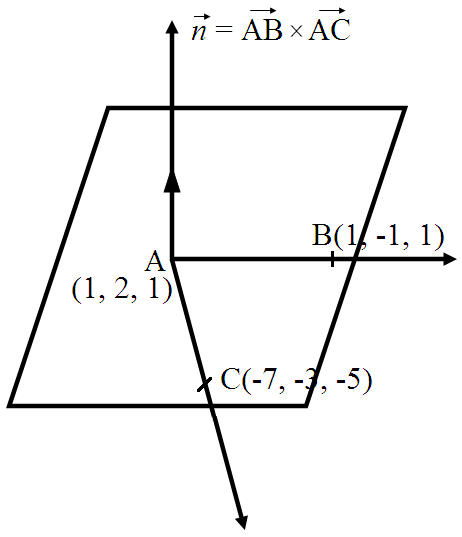
Let A(1, 1, 1), B(1, -1, 1) and C(-7, -3, -5) be the coordinates.
The required plane passes through the point A(1, 1, 1)
Whose position vector is $\vec{\text{a}}=\hat{\text{i}}+\hat{\text{j}}+\hat{\text{k}}$ and is normal to the vector $\vec{\text{n}}$ given by
$\vec{\text{n}}=\overrightarrow{\text{AB}}\times\overrightarrow{\text{AC}}$
Clearly, $\overrightarrow{\text{AB}}=\overrightarrow{\text{OB}}-\overrightarrow{\text{OA}}$
$=(\hat{\text{i}}-\hat{\text{j}}+\hat{\text{k}})-(\hat{\text{i}}+\hat{\text{j}}+\hat{\text{k}})$
$=0\hat{\text{i}}-2\hat{\text{j}}+0\hat{\text{k}}$
$\overrightarrow{\text{AC}}=\overrightarrow{\text{OC}}-\overrightarrow{\text{OA}}$
$=(-7\hat{\text{i}}-3\hat{\text{j}}-5\hat{\text{k}})-(\hat{\text{i}}+\hat{\text{j}}+\hat{\text{k}})$
$=-8\hat{\text{i}}-4\hat{\text{j}}-6\hat{\text{k}}$
$\vec{\text{n}}=\overrightarrow{\text{AB}}\times\overrightarrow{\text{AC}}$
$=\begin{vmatrix}\hat{\text{i}}&\hat{\text{j}}&\hat{\text{k}}\\0&-2&0\\-8&-4&-6\end{vmatrix}$
$=12\hat{\text{i}}+0\hat{\text{j}}-16\hat{\text{k}}$
The vector equation of the required plane is,
$\vec{\text{r}}\cdot\vec{\text{n}}=\vec{\text{a}}\cdot\vec{\text{n}}$
$\Rightarrow\vec{\text{r}}\cdot(12\hat{\text{i}}+0\hat{\text{j}}-16\hat{\text{k}})=(\hat{\text{i}}+\hat{\text{j}}+\hat{\text{k}})(12\hat{\text{i}}+0\hat{\text{j}}-16\hat{\text{k}})$
$\Rightarrow\vec{\text{r}}\cdot\Big[4(3\hat{\text{i}}-4\hat{\text{k}})\Big]=12+0-16$
$\Rightarrow\vec{\text{r}}\cdot\Big[4(3\hat{\text{i}}-4\hat{\text{k}})\Big]=-4$
$\Rightarrow\vec{\text{r}}\cdot(3\hat{\text{i}}-4\hat{\text{k}})=-1$
$\Rightarrow\vec{\text{r}}\cdot(3\hat{\text{i}}-4\hat{\text{k}})+1=0$
View full question & answer→Question 1374 Marks
If the product of the distances of the point (1, 1, 1) from the origin and the plane x - y + z + λ = 0 be 5, find the value of λ.
AnswerWe know that the distance of the point (x1, y1, z1) from the plane ax + by + cz + d = 0 is given by
$\frac{|\text{ax}_1+\text{by}_1+\text{cz}_1+\text{d}|}{\sqrt{\text{a}^2+\text{d}^2+\text{c}^2}}$
Distance of the point (1, 1, 1) from the plane $\text{x}-\text{y}+\text{z}+\lambda=0$
The required distance,
$=\frac{|1-1+1+\lambda|}{\sqrt{1^2+(-1)^2+1^2}}$
$=\frac{|1+\lambda|}{\sqrt{3}}\text{ units}\ ...(\text{i})$
Distance of the point (0, 0, 0) from the plane $\text{x}-\text{y}+\text{z}+\lambda=0$
The required distance,
$=\frac{|0-0+0+\lambda|}{\sqrt{1^2+(-1)^2+1^2}}$
$=\frac{|\lambda|}{\sqrt{3}}\text{ units}\ ...(\text{ii})$
It is given that the product of the distance (i) and (ii) is 5
$\frac{|1+\lambda|}{\sqrt{3}}\times\frac{|\lambda|}{\sqrt{3}}=5$
$\lambda^2+\lambda-15=0$
View full question & answer→Question 1384 Marks
Find the equation of a plane which is at a distance of $3\sqrt{3}\text{ units}$ from the origin and the normal to which is equally inclined to the coordinate axes.
AnswerLet $\alpha,\beta$ and $\gamma$ be the angle made by $\vec{\text{n}}$ with x, y and z-axes, respectively.
It is given that
$\alpha=\beta=\gamma$
$\Rightarrow\cos\alpha=\cos\beta=\cos\gamma$
$\Rightarrow\text{l}=\text{m}=\text{n},$ where l, m, n are direction cosines of $\vec{\text{n}}$
But $\text{l}^2+\text{m}^2+\text{n}^2=1$
$\Rightarrow\text{l}^2+\text{l}^2+\text{l}^2=1$
$\Rightarrow3\text{l}^2=1$
$\Rightarrow\text{l}^2=\frac{1}{3}$
$\Rightarrow\text{l}=\frac{1}{\sqrt{3}}$
So, $\text{l}=\text{m}=\text{n}=\frac{1}{\sqrt{3}}$
It is given that the length of the perpendicular of the plane from the origin, $\text{p}=3\sqrt{3}$
The normal from of the plane is lx + my + nz = p
$\Rightarrow\frac{1}{\sqrt{3}}\text{x}+\frac{1}{\sqrt{3}}\text{y}+\frac{1}{\sqrt{3}}\text{z}=3\sqrt{3}$
$\Rightarrow\text{x}+\text{y}+\text{z}=3\sqrt{3}(\sqrt{3})$
$\Rightarrow\text{x}+\text{y}+\text{z}=9$
View full question & answer→Question 1394 Marks
Let $\overrightarrow{\text{a}} = \hat{\text{i}} + 4\hat{\text{j}} +2\hat{\text{k}}, \overrightarrow{\text{b}} = 3\hat{\text{i}} - 2\hat{\text{j}} +7\hat{\text{k}}$ and $\overrightarrow{\text{c}} = 2\hat{\text{i}} - \hat{\text{j}} + 4\hat{\text{k}}$ Find a vector $\overrightarrow{\text{d}}$ which is perpendicular to both $\overrightarrow{\text{a}} \text{and} \overrightarrow{\text{b}}\text{and} \overrightarrow{\text{c}} . \overrightarrow{\text{d}} = 27.$
Answer$\text{Writing} \overrightarrow{\text{d}} = \lambda\bigg(\overrightarrow{\text{a}}\times\overrightarrow{\text{b}}\bigg)$
$= \lambda \begin{vmatrix} \hat{\text{i}} & \hat{\text{j}} & \hat{\text{k}} \\ 1 & 4 & 2 \\ 3 & -2 & 7 \end{vmatrix} $
$ = \lambda \bigg(32 \hat{\text{i}} - \hat{\text{j}} - 14\hat{\text{k}}\bigg)\dots\dots\dots\dots\text{(1)}$
$\overrightarrow{\text{c}}. \overrightarrow{\text{d}} = 27$
$\bigg(2\hat{\text{i}} - \hat{\text{j}} + 4\hat{\text{k}}\bigg).\lambda\bigg(32\hat{\text{i}} - \hat{\text{j}} + 14\hat{\text{k}}\bigg) = 27$
$9\lambda = 27$
$\lambda = 3$
$\therefore\overrightarrow{\text{d}} = \bigg(96\hat{\text{i}} - \hat{\text{3j}} + 42\hat{\text{k}}\bigg)$
View full question & answer→Question 1404 Marks
The equation of tangent at (2, 3) on the curve $y^{2} = \text{ax}^{3} + \text{b is y = 4x - 5}. $ Find the value of a and b.
View full question & answer→Question 1414 Marks
Show that the points A, B, C with position vectors $2\hat{\text{i}} - \hat{\text{j}} + \hat{\text{k}}, \hat{\text{i}} - 3\hat{\text{j}} - 5\hat{\text{k}} \text{ and } 3\hat{\text{i}} - 4\hat{\text{j}} - 4\hat{\text{k}}$ respectively, are the vertices of a right-angled triangle. Hence find the area of the triangle.
Answer$\vec{\text{AB}} = - \hat{\text{i}} - 2\hat{\text{j}} - 6\hat{\text{k}}, \vec{\text{BC}} = 2\hat{\text{i}} - \hat{\text{j}} + \hat{\text{k}}, \vec{\text{CA}} = -\hat{\text{i}} + 3\hat{\text{j}} + 5\hat{\text{k}}$
Since $\vec{\text{AB}}, \vec{\text{BC}}, \vec{\text{CA}},$ are not parallel vectors, and $\vec{\text{AB}} + \vec{\text{BC}} + \vec{\text{CA}} = \vec{0} \therefore \text{A, B, C}$ form a triangle
$\text{Also} \vec{\text{ BC}}. \vec{\text{CA}} = 0 \text{ }\text{ }\text{ }\text{ }\text{ } \therefore\text{A, B, C}$ form a right triangle
$\text{Area of} \Delta = \frac{1}{2} | \vec{\text{AB}} \times \vec{\text{BC}}| = \frac{1}{2} \sqrt{210}$
View full question & answer→Question 1424 Marks
Find the shortest distance between the lines:
$\vec{\text{r}}=(\hat{\text{i}}+2\hat{\text{j}}+\hat{\text{k}})+\lambda(\hat{\text{i}}-\hat{\text{j}}+\hat{\text{k}})\ \text{and}\ $
$\vec{\text{r}}=2\hat{\text{i}}-\hat{\text{j}}-\hat{\text{k}}+\mu(2\hat{\text{i}}+\hat{\text{j}}+2\hat{\text{k}})$
AnswerComparing the given equations with
$\vec{\text{r}}=\vec{\text{a}_1}+\lambda\vec{\text{b}_1}\ \text{and}\ \vec{\text{r}}=\vec{\text{a}_2}+\lambda\vec{\text{b}_2},$ we get
$\vec{\text{a}_1}=\hat{\text{i}}+2\hat{\text{j}}+\hat{\text{k}},\ \ \vec{\text{b}_1}=\hat{\text{i}}-\hat{\text{j}}+\hat{\text{k}} \ \ \text{and}$
$\vec{\text{a}_2}=2\hat{\text{i}}-\hat{\text{j}}-\hat{\text{k}},\ \ \vec{\text{b}_2}=2\hat{\text{i}}+\hat{\text{j}}+2\hat{\text{k}}$
Since, the shortest distance between the two skew lines is given by
$\text{d}=\frac{\Big|\Big(\vec{\text{a}_2}-\vec{\text{a}_1}\Big).\Big(\vec{\text{b}_1}\times\vec{\text{b}_2}\Big)\Big|}{\Big|\vec{\text{b}_1}\times\vec{\text{b}_2}\Big|}\ \ \ .....(\text{i})$
Here, $\vec{\text{a}_2}-\vec{\text{a}_1}=\Big(2\hat{\text{i}}-\hat{\text{j}}-\hat{\text{k}}\Big)-\Big(\hat{\text{i}}+2\hat{\text{j}}+\hat{\text{k}}\Big)=\hat{\text{i}}-3\hat{\text{j}}-2\hat{\text{k}}$
$\vec{\text{b}_1}\times\vec{\text{b}_2}=\begin{vmatrix}\hat{\text{i}}&\hat{\text{j}}&\hat{\text{k}}\\1&-1&1\\2&1&2\end{vmatrix}$
$=(-2-1)\hat{\text{i}}-(2-2)\hat{\text{j}}+(1+2)\hat{\text{k}}=-3\hat{\text{i}}+3\hat{\text{k}}$
$\Big|\vec{\text{b}_1}\times\vec{\text{b}_2}\Big|=\sqrt{(-3)^2+(0)^2+(3)^2}=\sqrt{18}=3\sqrt{2}$
$\Big(\vec{\text{a}_2}-\vec{\text{a}_1}\Big).\Big(\vec{\text{b}_1}\times\vec{\text{b}_2}\Big)=\Big(\hat{\text{i}}-3\hat{\text{j}}-2\hat{\text{k}}\Big).\Big(-3\hat{\text{i}}+3\hat{\text{k}}\Big)$
=1 × (-3) + (-3 × 0) + (-2 × 3) = -9
Putting these values in eq. (i)
Shortest distance $(\text{d})=\frac{|-9|}{3\sqrt{2}}=\frac{9}{3\sqrt{2}}=\frac{3}{\sqrt{2}}=\frac{3\sqrt{2}}{2}.$
View full question & answer→Question 1434 Marks
Find the vector and Cartesian equations of the line through the point (1, 2, – 4) and perpendicular to the two lines.
$\overrightarrow{\text{r}} = (8\hat{\text{i}} - 19\hat{\text{j}} + 10\hat{\text{k}})+\lambda(3\hat{\text{i}} - 16\hat{\text{j}} + 7\hat{\text{k})}$ and $\overrightarrow{\text{r}} = (15\hat{\text{i}} - 29\hat{\text{j}} + 5\hat{\text{k}})+\mu(3\hat{\text{i}} - 8\hat{\text{j}} + 5\hat{\text{k})}.$
AnswerVector equation of the required line is
$\overrightarrow{\text{r}} = (\hat{\text{i}} + 2\hat{\text{j}} - 4\hat{\text{k}})+\mu[(3\hat{\text{i}} - 16\hat{\text{j}} + 7\hat{\text{k})}\times(3\hat{\text{i}} + 8\hat{\text{j}} - 5\hat{\text{k})]}$
$\Rightarrow\overrightarrow{\text{r}} = (\hat{\text{i}} + 2\hat{\text{j}} - 4\hat{\text{k}})+\lambda[(2\hat{\text{i}} + 3\hat{\text{j}} + 6\hat{\text{k})]}$
in cartesian form, $\frac{\text{x - 1}}{2} = \frac{\text{y - 2}}{3} = \frac{\text{z + 4}}{6}$
View full question & answer→Question 1444 Marks
A line passes through (2, –1, 3) and is perpendicular to the lines$\overrightarrow{\text{r}}= (\hat{\text{i}} + \hat{\text{j}} - \hat{\text{k}}) + \lambda(2 \hat{\text{i}} - 2\hat{\text{j}} + \hat{\text{k}})\text{ and }\overrightarrow{\text{r}} = (2\hat{\text{i}} -\hat{\text{j}} - 3\hat{\text{k}}) + \mu(\hat{\text{i}} + 2 \hat{\text{j}} + 2\hat{\text{k}}).$Obtain its equation in vector and cartesian form.
AnswerThe direction perpendicular to the given lines is given by
$(2\hat{\text{i}} - 2 \hat{\text{j}} +\hat{\text{k}})\times(\hat{\text{i}} + 2\hat{\text{j}} + 2\hat{\text{k}})$
$= \begin{bmatrix} \hat{\text{i}} &\hat{\text{j}}&\hat{\text{k}} \\[0.3em] 2 & -2 & 1 \\[0.3em] 1 & 2& 2 \end{bmatrix} = -6\hat{\text{i}} - 3\hat{\text{j}} + 6\hat{\text{k}}\text{ or }2\hat{\text{i}} +\hat{\text{j}} - 2\hat{\text{k}}$
$\therefore$ Vector equation of required line is
$\overrightarrow{\text{r}} = (2\hat{\text{i}} -\hat{\text{j}} + 3 \hat{\text{k}}) + \lambda(2\hat{\text{i}} + \hat{\text{j}} - 2 \hat{\text{k}})$
and the cartesian form is
$\frac{\text{x} - 2}{2} = \frac{\text{y} + 1 }{1} =\frac{\text{z} - 3}{-2}.$
View full question & answer→Question 1454 Marks
Prove that the line through A(0, –1, –1) and B(4, 5, 1) intersects the line through C(3, 9, 4) and D(–4, 4, 4).
AnswerEquation of line $\vec{\text{AB}}$
$\vec{\text{r}} = (-\hat{\text{j}} - \hat{\text{k}}) + \lambda (4\hat{\text{i}} + 6\hat{\text{j}} + 2\hat{\text{k}})$
Equation of line $\vec{\text{CD}}$
$\vec{\text{r}} = (3\hat{\text{i}} + 9\hat{\text{j}} + 4\hat{\text{k}}) + \mu (-7\hat{\text{i}} - 5\hat{\text{j}})$
$\vec{\text{a}}_{2} - \vec{\text{a}}_{1} = 3\hat{\text{i}} + 10\hat{\text{j}} + 5 \hat{\text{k}}$
$\vec{\text{b}}_{1} \times \vec{\text{b}}_{2} = \begin{vmatrix} \hat{\text{i}} & \hat{\text{j}} & \hat{\text{k}} \\ 4 & 6 & 2 \\ -7 & -5 & 0 \end{vmatrix} = 10\hat{\text{i}} - 14\hat{\text{j}} + 22\hat{\text{k}}$
$(\vec{\text{a}}_{2} - \vec{\text{a}}_{1}). (\vec{\text{b}}_{1} \times \vec{\text{b}}_{2}) = 30 – 140 + 110 = 0$
$\Rightarrow$ Lines intersect.
View full question & answer→Question 1464 Marks
Find the shortest distance between the following lines whose vector equations are: $\overrightarrow{r}=\text{(1 - t)}\hat{\text{i}}+\text{(t - 2)}\hat{\text{j}}+\text{(3 - 2t)}\hat{\text{k}}$ and
$\overrightarrow{r}=\text{(s + 1)}\hat{\text{i}}+\text{(2s - 1)}\hat{\text{j}}-\text{(2s + 1)}\hat{\text{k}}$
AnswerEquations of the lines are,
$\overrightarrow{r}=(\hat{\text{i}}-2\hat{\text{j}}+3\hat{\text{k})}+\text{t}(-\hat{\text{i}}+\hat{\text{j}}-2\hat{\text{k})}\text{ and }$
$\overrightarrow{r}=(\hat{\text{i}}-\hat{\text{j}}-\hat{\text{k})}+\text{s}(\hat{\text{i}}+2\hat{\text{j}}-2\hat{\text{k})}$
shortest distance =$\frac{\Big|(\overrightarrow{\text{a}_{2}}-\overrightarrow{\text{a}_{1}})\cdot(\overrightarrow{\text{b}_{1}}\times\overrightarrow{\text{b}_{2}})\Big|}{\Bigg|\overrightarrow{\text{b}_{1}}\times\overrightarrow{\text{b}_{2}}\Bigg|}$ where
$\overrightarrow{\text{a}_{1}}=\hat{\text{i}}-2\hat{\text{j}}+3\hat{\text{k}},\text{ }\overrightarrow{\text{a}_{2}}=\hat{\text{i}}-\hat{\text{j}}-\hat{\text{k}},\overrightarrow{\text{b}_{1}}=-\hat{\text{i}}+\hat{\text{j}}-2\hat{\text{k}},\text{ }\overrightarrow{\text{b}_{2}}=\hat{\text{i}}+2\hat{\text{j}}-2\hat{\text{k}},$
$\overrightarrow{\text{a}_{2}}-\overrightarrow{\text{a}_{1}}=\hat{\text{j}}-4\hat{\text{k}},\text{ }\overrightarrow{\text{b}_{1}}\times\overrightarrow{\text{b}_{2}}=2\hat{\text{i}}-4\hat{\text{j}}-3\hat{\text{k}}$
$\therefore$ S.D. = $\frac{0-4+12}{\sqrt{29}}=\frac{8}{\sqrt{29}}$.
View full question & answer→Question 1474 Marks
Show that the points $\hat{\text{i}}-\hat{\text{j}}+3\hat{\text{k}}$ and $3\hat{\text{i}}+3\hat{\text{j}}+3\hat{\text{k}}$ are equidistant from the plane $\vec{\text{r}}\cdot(5\hat{\text{i}}+2\hat{\text{j}}-7\hat{\text{k}})+9=0$
AnswerWe know that, distance of a point P of position vector $\vec{\text{a}}$ from the plane $\vec{\text{r}}\cdot\hat{\text{n}}=\text{d}$ is given by
$\text{p}=\frac{\big|\vec{\text{a}}\cdot\vec{\text{n}}-\text{d}\big|}{|\vec{\text{n}}|}\ ...(\text{i})$
Let D1 be the distance of point $(\hat{\text{i}}-\hat{\text{j}}+\hat{\text{k}})$ from the plane $\vec{\text{r}}\cdot(5\hat{\text{i}}+2\hat{\text{j}}-7\hat{\text{k}})+9=0,$ then
$\text{D}_1=\Bigg|\frac{(\hat{\text{i}}-\hat{\text{j}}+3\hat{\text{k}})\cdot(5\hat{\text{i}}+2\hat{\text{j}}-7\hat{\text{k}})+9}{\sqrt{(5)^2+(2)^2+(-7)^2}}\Bigg|$ [Using equation (i)]
$=\Bigg|\frac{(1)(5)+(-1)(2)+(3)(-7)+9}{\sqrt{25+4+49}}\Bigg|$
$=\Big|\frac{5-2-21+9}{\sqrt{78}}\Big|$
$=\Big|-\frac{9}{\sqrt{78}}\Big|$
$\text{D}_1=\frac{9}{\sqrt{78}}\text{ units}\ ...(\text{ii})$
Again, let D2 be the distance of point $(3\hat{\text{i}}-3\hat{\text{j}}+3\hat{\text{k}})$ from the plane $\vec{\text{r}}\cdot(5\hat{\text{i}}+2\hat{\text{j}}-7\hat{\text{k}})+9=0,$ then using equation (i) we get,
$\text{D}_2=\Bigg|\frac{(3\hat{\text{i}}-3\hat{\text{j}}+3\hat{\text{k}})\cdot(5\hat{\text{i}}+2\hat{\text{j}}-7\hat{\text{k}})+9}{\sqrt{(5)^2+(2)^2+(-7)^2}}\Bigg|$
$=\Bigg|\frac{(3)(5)+(3)(2)+(3)(-7)+9}{\sqrt{25+4+49}}\Bigg|$
$=\Big|\frac{15+6-21+9}{\sqrt{78}}\Big|$
$=\Big|\frac{9}{\sqrt{78}}\Big|$
$\text{D}_2=\frac{9}{\sqrt{78}}\text{ units}\ ...(\text{iii})$
From equation (i) and (iii)
$\text{D}_1=\text{D}_2$
Distance of point $(\hat{\text{i}}-\hat{\text{j}}+3\hat{\text{k}})$ from plane $\vec{\text{r}}\cdot(5\hat{\text{i}}+2\hat{\text{j}}-7\hat{\text{k}})+9=0$ = Distance of point $(3\hat{\text{i}}-3\hat{\text{j}}+3\hat{\text{k}})$ from plane $\vec{\text{r}}\cdot(5\hat{\text{i}}+2\hat{\text{j}}-7\hat{\text{k}})+9=0$
View full question & answer→Question 1484 Marks
The coordinates of the foot of the perpendicular drawn from the origin to a plane are (12, -4, 3). Find the equation of the plane.
AnswerThe given equation of the line are
$\frac{\text{x}+3}{3}=\frac{\text{y}}{-2}=\frac{\text{z}-7}{6}\ ....(\text{i})$
$\frac{\text{x}+6}{1}=\frac{\text{y}+5}{-3}=\frac{\text{z}-1}{2}\ ....(\text{ii})$
Let the directions of the plane be proportional to a, b, c.
Since the plane contains line (i), it should pass through (-3, 0, 7)
And is parallel to the line (i)
Equation of the plane through (i) is,
a(x + 3) + b(y) + c(z - 7) = 0 ....(iii)
Where 3a - 2b + 6c = 0 ...(iv)
Since the plane contains line (ii), the plane is parallel to line (ii) also
⇒ a - 3b + 2c = 0 ....(v)
Solving (iv) and (v) using cross-multiplication, we get
$\frac{\text{a}}{14}=\frac{\text{b}}{0}=\frac{\text{c}}{-7}$
Substituting a, b and c in (iii) we get
14(x + 3) + 0(y) - 7(z - 7) = 0
⇒ 2(x + 3) + 0(y) - 1(z - 7) = 0
⇒ 2x - z + 13 = 0
View full question & answer→Question 1494 Marks
Find the equatoion of the passing through the points (1, -1, 2) and (2, -2, 2) and which is perpendicular to the plane 6x - 2y + 2z = 9.
AnswerThe equation of any plane passing through (1, -1, 2) is
a(x - 1) + b(y + 1) + c(z - 2) = 0 ....(i)
It is given that (i) is passing through (2, -2, 2). So,
a(2 - 1) + b(-2 + 1) + c(2 - 2) = 0
⇒ a - b + 0c = 0 ...(ii)
It is given that (i) is perpendicular to the plane 6x - 2y + 2z = 9. So,
6a - 2b + 2c = 0
⇒ 3a - b + c = 0 ...(iii)
Solving (i), (ii) and (iii) we get,
$\begin{vmatrix}\text{x}-1&\text{y}+1&\text{z}-2\\1&-1&0\\3&-1&1\end{vmatrix}=0$
⇒ -1(x - 1) - 1(y + 1) + 2(z - 2) = 0
⇒ -x + 1 - y - 1 + 2z - 4= 0
⇒ x + y - 2z + 4 = 0
View full question & answer→Question 1504 Marks
Let $\overrightarrow{\text{a}} = \hat{\text{i}} + 4\hat{\text{j}} +2\hat{\text{k}}, \overrightarrow{\text{b}} = 3\hat{\text{i}} - 2\hat{\text{j}} +7\hat{\text{k}}$ and $\overrightarrow{\text{c}} = 2\hat{\text{i}} - \hat{\text{j}} + 4\hat{\text{k}}$ Find a vector $\overrightarrow{\text{d}}$ which is perpendicular to both $\overrightarrow{\text{a}} \text{and} \overrightarrow{\text{b}}\text{and} \overrightarrow{\text{c}} . \overrightarrow{\text{d}} = 27.$
Answer$\text{Writing} \overrightarrow{\text{d}} = \lambda\bigg(\overrightarrow{\text{a}}\times\overrightarrow{\text{b}}\bigg)$
$= \lambda \begin{vmatrix} \hat{\text{i}} & \hat{\text{j}} & \hat{\text{k}} \\ 1 & 4 & 2 \\ 3 & -2 & 7 \end{vmatrix} $
$ = \lambda \bigg(32 \hat{\text{i}} - \hat{\text{j}} - 14\hat{\text{k}}\bigg)\dots\dots\dots\dots\text{(1)}$
$\overrightarrow{\text{c}}. \overrightarrow{\text{d}} = 27$
$\bigg(2\hat{\text{i}} - \hat{\text{j}} + 4\hat{\text{k}}\bigg).\lambda\bigg(32\hat{\text{i}} - \hat{\text{j}} + 14\hat{\text{k}}\bigg) = 27$
$9\lambda = 27$
$\lambda = 3$
$\therefore\overrightarrow{\text{d}} = \bigg(96\hat{\text{i}} - \hat{\text{3j}} + 42\hat{\text{k}}\bigg)$
View full question & answer→