Questions

1 Marks Question

Take a timed test

15 questions · self-marked practice — reveal the answer and mark yourself.

Question 11 Mark
Find the projection of the vector $\vec{a}=2 \hat{i}+3 \hat{j}+2 \hat{k}$ on the vector $\vec{b}=\hat{i}+2 \hat{j}+\hat{k}$.
Answer
Projection of $\vec{a}$ or $\vec{b}=\frac{\vec{a} \cdot \vec{b}}{|\vec{b}|}$
$=\frac{(2 \hat{i}+3 \hat{j}+2 \hat{k}) \cdot(\hat{i}+2 \hat{j}+\hat{k})}{\sqrt{(1)^2+(2)^2+(1)^2}}$
$=\frac{2 \cdot 1+3 \cdot 2+2 \cdot 1}{\sqrt{6}}$
$=\frac{2+6+2}{\sqrt{6}}$
$=\frac{10}{\sqrt{6}}$
$=\frac{5}{3} \sqrt{6}$
View full question & answer
Question 21 Mark
Find the position vector of the mid-point of the vector joining the points $P (2,3,4)$ and $Q (4,1,-2)$.
Answer
We know that the position vector of joining two points
$P (\vec{a})$ and $Q (\vec{b})$ is $\frac{\vec{a}+\vec{b}}{2}$. Hence according to question,
$
\begin{aligned}
\vec{a} & =2 \hat{i}+3 \hat{j}+4 \hat{k}, \vec{b}=4 \hat{i}+\hat{j}-2 \hat{k} \\
& =\frac{(2 \hat{i}+3 \hat{j}+4 \hat{k})+(4 \hat{i}+\hat{j}-2 \hat{k})}{2} \\
& =\frac{6 \hat{i}+4 \hat{j}+2 \hat{k}}{2}=3 \hat{i}+2 \hat{j}+\hat{k}
\end{aligned}
$
View full question & answer
Question 31 Mark
The initial point of a vector is $(2,1)$ and the terminal point is $(-5,7)$, find the vectors components of this vector.
Answer
$
\begin{aligned}
\vec{r} & =(-5-2) \hat{i}+(7-1) \hat{j} \\
\vec{r} & =-7 \hat{i}+6 \hat{j}
\end{aligned}
$
Here, $-7 \hat{i}, 6 \hat{j}$ are the vector components of $\vec{r}$ along the coordinate axes.
View full question & answer
Question 41 Mark
The vector directed from A to B and joining the points $A (1,2,2)$ and $B (2,3,1)$ is :
Answer
Vector directed from A towards B
$\begin{aligned}& \overrightarrow{\mathrm{AB}}=(2-1) \hat{i}+(3-2) \hat{j}+(1-2) \hat{k} \\& \overrightarrow{\mathrm{AB}}=\hat{i}+\hat{j}-\hat{k} \end{aligned}$
View full question & answer
Question 51 Mark
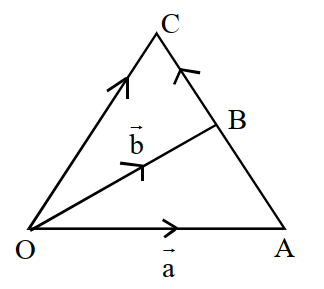
In triangle OAC if B is the mid-point of side AC and $\overrightarrow{ OA }=\vec{a}$ and $\overrightarrow{ OB }=\vec{b}$, then what will be $\overrightarrow{ OC }$ ?
Answer

Image
$\begin{aligned} \overrightarrow{ OA }+\overrightarrow{ AB } & =\overrightarrow{ OB } \\ \therefore \quad \overrightarrow{ AB } & =\overrightarrow{ OB }-\overrightarrow{ OA } \\ =\vec{b}-\vec{a} \\ \therefore \quad \overrightarrow{ AB } & =\overrightarrow{ BC } \\ \therefore \quad \overrightarrow{ BC } & =\vec{b}-\vec{a} \\ \overrightarrow{ OC } & =\overrightarrow{ OB }+\overrightarrow{ BC }\end{aligned}$
$=\vec{b}+\vec{b}-\vec{a}=\overrightarrow{2 b}-\vec{a}$
View full question & answer
Question 61 Mark
If the vectors $a \hat{i}-a \hat{j}+\hat{k}$ and $a \hat{i}+\hat{j}-2 \hat{k}$ are perpendicular to each other, then find the value of $a$.
Answer
$\because a \hat{i}-a \hat{j}+\hat{k}$ and $a \hat{i}+\hat{j}-2 \hat{k}$ are perpendicular to each other.
$
\begin{array}{rlrl}
\therefore (a \hat{i}-a \hat{j}+\hat{k}) \cdot(a \hat{i}+\hat{j}-2 \hat{k}) =0 \\
\Rightarrow a^2-a-2=0 \Rightarrow(a-2)(a+1) & =0 \\
\Rightarrow =2,-1
\end{array}
$
View full question & answer
Question 71 Mark
If the position vector $a$ of the point $(12, n)$ is such that $|\vec{a}|=13$, then find the value of $n$.
Answer
Position vector of the point $(12, n)=12 \hat{i}+n \hat{j}$
$\therefore \vec{a}=12 \hat{i}+n \hat{j}$
$\Rightarrow |\vec{a}|=\sqrt{12^2+n^2} \Rightarrow 13=\sqrt{144+n^2}$
$\Rightarrow 169=144+n^2 \Rightarrow n^2=25$
$\Rightarrow n= \pm 5$
View full question & answer
Question 81 Mark
If the coordinates of points P and Q are $(2,-1,1)$ and $(1,-3,-5)$ respectively, then find the vector $\overrightarrow{ PQ }$.
Answer
Let $O$ be the origin.
$
\begin{aligned}
\therefore \quad \text { Position vector } \overrightarrow{OP} =2 \hat{i}-\hat{j}+\hat{k} \\
\text { Position vector } \overrightarrow{OQ} \quad =\hat{i}-3 \hat{j}-5 \hat{k} \\
\therefore \quad \text {PQ} =\overrightarrow{OQ}-\overrightarrow{OP} \\
=\hat{i}-3 \hat{j}-5 \hat{k}-2 \hat{i}+\hat{j}-\hat{k} \\
=-\hat{i}-2 \hat{j}-6 \hat{k} \quad \text { }
\end{aligned}
$
View full question & answer
Question 91 Mark
If $\vec{a}$ is a vector and $m$ is a scalar quantity and $m \vec{a}=\overrightarrow{0}$ then what alternative values of $\vec{a}$ and $m$ are possible?
Answer
Either $m=0$ or $\vec{a}=0$.
View full question & answer
Question 101 Mark
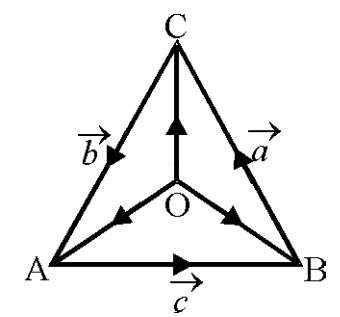
OABC is a tetrahedron. Write the vectors $\overrightarrow{ BC }, \overrightarrow{ CA }, \overrightarrow{ AB }$ in terms of $\overrightarrow{ OA }, \overrightarrow{ OB }$ and $\overrightarrow{ OC }$.
Image
Answer
$\begin{aligned} \overrightarrow{ BC } & =\overrightarrow{ OC }-\overrightarrow{ OB } \\ \overrightarrow{ CA } & =\overrightarrow{ OA }-\overrightarrow{ OC } \\ \overrightarrow{ AB } & =\overrightarrow{ OB }-\overrightarrow{ OA }\end{aligned}$
View full question & answer
Question 111 Mark
Elaborate the unit vector.
Answer
The vector whose magnitude (modulus) is zero, is called zero vector. Its direction is in definite. Those vector whose initial point and terminal point are one and the same, for example $\overrightarrow{ AA }, \overrightarrow{ BB }, \ldots$ etc. always express zero vector. It is shown by $\overrightarrow{0}$ or black zero $(\overrightarrow{0})$.
View full question & answer
Question 121 Mark
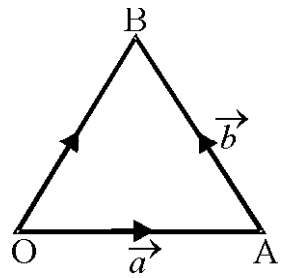
In the adjacent figure, find the value of $\overrightarrow{ OB }$.
Image
Answer
By triangle law of vector addition
$
\begin{aligned}
\overrightarrow{OB} & =\overrightarrow{OA}+\overrightarrow{AB} \\
& =\vec{a}+\vec{b}
\end{aligned}
$
View full question & answer
Question 131 Mark
In $\triangle A B C$, write the sum of three vectors represented by $\overrightarrow{ AB }, \overrightarrow{ BC }, \overrightarrow{ CA }$ respectively.
Answer
$
\begin{aligned}
\overrightarrow{AB}+\overrightarrow{BC}+\overrightarrow{CA} & =(\overrightarrow{AB}+\overrightarrow{BC})+\overrightarrow{CA} \\
& =\overrightarrow{AC}+\overrightarrow{CA} \\
& =\overrightarrow{AC}-\overrightarrow{AC}=\overrightarrow{0}
\end{aligned}
$
View full question & answer
Question 141 Mark
Find the unit vector in the direction of $2 \hat{i}+2 \hat{j}+\hat{k}$.
Answer
$
\begin{aligned}
\text { Unit vector } & =\frac{\text { Vector }}{\mid \text { Vector } \mid} \\
& =\frac{2 \hat{i}+2 \hat{j}+\hat{k}}{\sqrt{(2)^2+(2)^2+(1)^2}} \\
& =\frac{1}{3}(2 \hat{i}+2 \hat{j}+\hat{k})
\end{aligned}
$
View full question & answer
Question 151 Mark
Define position vector.
Answer
Let $\overrightarrow{ OP }$ be a vector whose initial point O is the fixed point or origin. Then $\overrightarrow{ OP }$ is called the position vector of $P$ which express the position of point $P$ with respect to fixed point $O$. Hence by the position vector the position of a variable point $P$ is determined with respect to fixed point (origin) which is expressed by $\overrightarrow{ OP }$.
View full question & answer