Question 11 Mark
Write the position vector of the point which divides the join of points with position vectors $3\overrightarrow{\text{a}} - 2\overrightarrow{\text{b}} \text{and } 2\overrightarrow{\text{a}} + 3\overrightarrow{\text{b}}$ in the ratio $2:1.$
Answer$\frac{2(2\overrightarrow{\text{a}}+3\overrightarrow{\text{b}})+1 (3\overrightarrow{\text{a}} - 2\overrightarrow{\text{b}})}{2 +1} $
$= \frac{7}{3}\overrightarrow{\text{a}} + \frac{4}{3}\overrightarrow{\text{b}}$
View full question & answer→Question 21 Mark
Write the number of vectors of unit length perpendicular to both the vectors $\overrightarrow{\text{a}} = 2\hat{\text{i}} + \hat{j} + 2\hat{\text{k}} \text{ and} \overrightarrow{\text{b}} = \hat{\text{j}} + \hat{\text{k}}.$
View full question & answer→Question 31 Mark
Find a vector of magnitude $\sqrt{171}$ which is perpendicular to both of the vectors $\overrightarrow{\text{a}} = \hat{\text{i}} + 2\hat{\text{j}} - 3\hat{\text{k}}$ $\text{and} \overrightarrow{\text{b}} = 3\hat{\text{i}} - \hat{\text{j}} + 2\hat{\text{k}}.$
AnswerVector Perpendicular to $\overrightarrow{\text{a}} \text{and} \overrightarrow{\text{b}} = \frac{\overrightarrow{\text{a}}\times\overrightarrow{\text{b}}}{\overrightarrow|{\text{a}}\times\overrightarrow{\text{b}}|}$
[Finding using]
Required Vector $ = \hat{\text{i}} - 11\hat{\text{j}} - 7\hat{\text{k}}$
View full question & answer→Question 41 Mark
If $\overrightarrow{\text{a}}$and$\overrightarrow{\text{b}}$ are perpendicular vectors,|$\overrightarrow{\text{a}}$+$\overrightarrow{\text{b}}$|= 13 and |$\overrightarrow{\text{a}}$| = 5 find the value of|$\overrightarrow{\text{b}}$|.
View full question & answer→Question 51 Mark
Write the position vector of the point which divides the join of points with position vectors $3\overrightarrow{\text{a}} - 2\overrightarrow{\text{b}} \text{and } 2\overrightarrow{\text{a}} + 3\overrightarrow{\text{b}}$ in the ratio $2:1.$
Answer$\frac{2(2\overrightarrow{\text{a}}+3\overrightarrow{\text{b}})+1 (3\overrightarrow{\text{a}} - 2\overrightarrow{\text{b}})}{2 +1} $
$= \frac{7}{3}\overrightarrow{\text{a}} + \frac{4}{3}\overrightarrow{\text{b}}$
View full question & answer→Question 61 Mark
Write the number of vectors of unit length perpendicular to both the vectors $\overrightarrow{\text{a}} = 2\hat{\text{i}} + \hat{j} + 2\hat{\text{k}} \text{ and} \overrightarrow{\text{b}} = \hat{\text{j}} + \hat{\text{k}}.$
View full question & answer→Question 71 Mark
Find a vector of magnitude $\sqrt{171}$ which is perpendicular to both of the vectors $\overrightarrow{\text{a}} = \hat{\text{i}} + 2\hat{\text{j}} - 3\hat{\text{k}}$ $\text{and} \overrightarrow{\text{b}} = 3\hat{\text{i}} - \hat{\text{j}} + 2\hat{\text{k}}.$
AnswerVector Perpendicular to $\overrightarrow{\text{a}} \text{and} \overrightarrow{\text{b}} = \frac{\overrightarrow{\text{a}}\times\overrightarrow{\text{b}}}{\overrightarrow|{\text{a}}\times\overrightarrow{\text{b}}|}$
[Finding using]
Required Vector $ = \hat{\text{i}} - 11\hat{\text{j}} - 7\hat{\text{k}}$
View full question & answer→Question 81 Mark
Find a vector$\overrightarrow{\text{a}}$ magnitude,$\frac{5}{\sqrt{2}}$ making an angle of with$\frac{\pi}{4}$ x-axis, $\frac{\pi}{2}$with y-axis and an acute angle $\theta$ with z-axis.
Answer$\overrightarrow{\text{a}}=5\hat{\text{i}}+5\hat{\text{k}}$
View full question & answer→Question 91 Mark
Write the number of vectors of unit length perpendicular to both the vectors $\overrightarrow{\text{a}} = 2\hat{\text{i}} + \hat{j} + 2\hat{\text{k}} \text{ and} \overrightarrow{\text{b}} = \hat{\text{j}} + \hat{\text{k}}.$
View full question & answer→Question 101 Mark
Write the position vector of the point which divides the join of points with position vectors $3\overrightarrow{\text{a}} - 2\overrightarrow{\text{b}} \text{and } 2\overrightarrow{\text{a}} + 3\overrightarrow{\text{b}}$ in the ratio $2:1.$
Answer$\frac{2(2\overrightarrow{\text{a}}+3\overrightarrow{\text{b}})+1 (3\overrightarrow{\text{a}} - 2\overrightarrow{\text{b}})}{2 +1} $
$= \frac{7}{3}\overrightarrow{\text{a}} + \frac{4}{3}\overrightarrow{\text{b}}$
View full question & answer→Question 111 Mark
Find a vector of magnitude $\sqrt{171}$ which is perpendicular to both of the vectors $\overrightarrow{\text{a}} = \hat{\text{i}} + 2\hat{\text{j}} - 3\hat{\text{k}}$ $\text{and} \overrightarrow{\text{b}} = 3\hat{\text{i}} - \hat{\text{j}} + 2\hat{\text{k}}.$
AnswerVector Perpendicular to $\overrightarrow{\text{a}} \text{and} \overrightarrow{\text{b}} = \frac{\overrightarrow{\text{a}}\times\overrightarrow{\text{b}}}{\overrightarrow|{\text{a}}\times\overrightarrow{\text{b}}|}$
[Finding using]
Required Vector $ = \hat{\text{i}} - 11\hat{\text{j}} - 7\hat{\text{k}}$
View full question & answer→Question 121 Mark
Find $|\overrightarrow{\text{x}}|,$ if for a unit vector $\overrightarrow{\text{a}},(\overrightarrow{\text{x}} - \overrightarrow{\text{a}}).(\overrightarrow{\text{x}} + \overrightarrow{\text{a}}) = 15.$
AnswerGiven $(\overrightarrow{\text{x}} - \overrightarrow{\text{a}}).(\overrightarrow{\text{x}} + \overrightarrow{\text{a}})= 15 $
$\Rightarrow(\overrightarrow{\text{x}})^{2} - (\overrightarrow{\text{a}})^{2} = 15 $
$\Rightarrow\overrightarrow{\text{x}}.\overrightarrow{\text{x}} - \overrightarrow{\text{a}}.\overrightarrow{\text{a}} = 15 \Rightarrow|\overrightarrow{\text{x}}|^{2} - |\overrightarrow{\text{a}}|^{2} = 15 $
$\Rightarrow|\overrightarrow{\text{x}}|^{2} - 1 = 15 \Rightarrow|\overrightarrow{\text{x}}|^{2} = 16$
$\Rightarrow|\overrightarrow{\text{x}}| = 4 [\because - \text{ ve value is not acceptable}].$
View full question & answer→Question 131 Mark
P and Q are two points with position vectors 3$\overrightarrow{\text{a}}$ - 2$\overrightarrow{\text{b}}$ and $\overrightarrow{\text{a}} + \overrightarrow{\text{b}}$respectively. Write the position vector of a point R which divides the line segment PQ in the ratio 2:1 externally.
AnswerIf $\overrightarrow{\text{r}}$is the position vector of R then by section formula
$\overrightarrow{\text{r}} = \frac{2(\overrightarrow{\text{a}} + \overrightarrow{\text{b}} )-1.(3\overrightarrow{\text{a}} - 2 \overrightarrow{\text{b}})}{2-1}$

$ = \frac{2\overrightarrow{\text{a}}+ 2\overrightarrow{\text{b}} - 3\overrightarrow{\text{a}} + 2 \overrightarrow{\text{b}}}{1} = 4 \overrightarrow{\text{b}} - \overrightarrow{\text{a}}.$ View full question & answer→Question 141 Mark
Find the scalar components of the vector $\overrightarrow{\text{AB}}$ with initial point A(2, 1) and terminal point B(- 5, 7).
View full question & answer→Question 151 Mark
Write the value of $(\hat{\text{i}}\times\hat{\text{j}})\cdot\hat{\text{k}}+\hat{\text{i}}\cdot\hat{\text{j} }$.
View full question & answer→Question 161 Mark
Write the projection of the vector $\hat{\text{i}}-\hat{\text{j}}$on the vector $\hat{\text{i}}+\hat{\text{j}}$.
View full question & answer→Question 171 Mark
Write a vector of magnitude 9 units in the direction of vector$-2\hat{\text{i}}+\hat{\text{j}}+2\hat{\text{k}}$
Answer$-6\hat{\text{i}}+3\hat{\text{j}}+6\hat{\text{k}}$
View full question & answer→Question 181 Mark
Find the value of p if
$(2\hat{\text{i}}+6\hat{\text{j}}+27\hat{\text{k)}}\times(\hat{\text{i}}+3\hat{\text{j}}+\text{p}\hat{\text{k}})=\vec{0}.$
View full question & answer→Question 191 Mark
If $\vec{\text{p}}$ is a unit vector and $(\vec{\text{x}}-\vec{\text{p}})\cdot(\vec{\text{x}}+\vec{\text{p}})=80,$ then find $|\vec{\text{x}}|.$
View full question & answer→Question 201 Mark
If $\vec{\text{a}}=\hat{\text{i}}+2\hat{\text{j}}-\hat{\text{k}}\text{ and }\vec{\text{b}}=3\hat{\text{i}}+\hat{\text{j}}-5\hat{\text{k}}$ find a unit vector in the direction of $\vec{\text{a}}-\vec{\text{b}}$.
Answer$\vec{\text{a}}-\vec{\text{b}}=-2\hat{\text{i}}+\hat{\text{j}}+4\hat{\text{k}}$
Unit vector in the direction of $(\vec{\text{a}}-\vec{\text{b}})$ $=\frac{1}{\sqrt{21}}[-2\hat{\text{i}}+\hat{\text{j}}+4\hat{\text{k}}]$.
View full question & answer→Question 211 Mark
If $|\vec{\text{a}}|=\sqrt{3},|\vec{\text{b}}|=2\text{ and }\vec{\text{a}}\cdot\vec{\text{b}}=3$find the angle between $\vec{\text{a}}$and $\vec{\text{b}}$.
Answer$\theta=\cos^{-1}\Bigg(\frac{\sqrt{3}} {2}\Bigg)=\frac{\pi}{6}.$
View full question & answer→Question 221 Mark
If $\vec{\text{P}}$ (1, 5, 4) and $\vec{\text{Q}}$ (4, 1, -2), find the direction ratios of $\vec{\text{PQ}}$.
View full question & answer→Question 231 Mark
If $\vec{\text{a}}, \text{ }\vec{\text{b}},\text{ } \vec{\text{c}}$ are unit vectors such that $\vec{\text{a}}, \text{ }\vec{\text{b}}, \text{ }\vec{\text{c}}\text{ }=\vec{0},$ then write the value of $\vec{\text{a}} \text{ . }\vec{\text{b}} + \vec{\text{b}} \text{ . } \text{ }\vec{\text{c}} +\vec{\text{c}} . \vec{\text{a}}\text{ }.$
Answer$(\vec{\text{a}} + \vec{\text{b}} + \vec{\text{c}}) . (\vec{\text{a}} + \vec{\text{b}} + \vec{\text{c}}) = 0$
$\Rightarrow |\vec{\text{a}}|^{2} + |\vec{\text{b}}|^{2} + |\vec{\text{c}}|^{2} + 2 (\vec{\text{a}}.\vec{\text{b}} + \vec{\text{b}}.\vec{\text{c}} + \vec{\text{c}}.\vec{\text{a}}) = 0$
$\Rightarrow \vec{\text{a}}.\vec{\text{b}} + \vec{\text{b}}.\vec{\text{c}} + \vec{\text{c}}.\vec{\text{a}} = -\frac{3}{2}$
View full question & answer→Question 241 Mark
If $\big|\vec{\text{a}} \times \vec{\text{b}}\big|^{2} + \big|\vec{\text{a}} . \vec{\text{b}}\big|^{2} = 400 \text{ and } \big|\vec{\text{a}}\big| = 5,$ then write the value of $\big|\vec{\text{b}}\big|.$
Answer$\text{a}^{2} \text{b}^{2} \sin^{2} \theta + \text{a}^{2} \text{b}^{2} \cos^{2} \theta = 400$
$\Rightarrow |\vec{\text{b}}| = 4$
View full question & answer→Question 251 Mark
If $\vec{\text{a}}, \text{ }\vec{\text{b}},\text{ } \vec{\text{c}}$ are unit vectors such that $\vec{\text{a}}, \text{ }\vec{\text{b}}, \text{ }\vec{\text{c}}\text{ }=\vec{0},$ then write the value of $\vec{\text{a}} \text{ . }\vec{\text{b}} + \vec{\text{b}} \text{ . } \text{ }\vec{\text{c}} +\vec{\text{c}} . \vec{\text{a}}\text{ }.$
Answer$(\vec{\text{a}} + \vec{\text{b}} + \vec{\text{c}}) . (\vec{\text{a}} + \vec{\text{b}} + \vec{\text{c}}) = 0$
$\Rightarrow |\vec{\text{a}}|^{2} + |\vec{\text{b}}|^{2} + |\vec{\text{c}}|^{2} + 2 (\vec{\text{a}}.\vec{\text{b}} + \vec{\text{b}}.\vec{\text{c}} + \vec{\text{c}}.\vec{\text{a}}) = 0$
$\Rightarrow \vec{\text{a}}.\vec{\text{b}} + \vec{\text{b}}.\vec{\text{c}} + \vec{\text{c}}.\vec{\text{a}} = -\frac{3}{2}$
View full question & answer→Question 261 Mark
If $\big|\vec{\text{a}} \times \vec{\text{b}}\big|^{2} + \big|\vec{\text{a}} . \vec{\text{b}}\big|^{2} = 400 \text{ and } \big|\vec{\text{a}}\big| = 5,$ then write the value of $\big|\vec{\text{b}}\big|.$
Answer$\text{a}^{2} \text{b}^{2} \sin^{2} \theta + \text{a}^{2} \text{b}^{2} \cos^{2} \theta = 400$
$\Rightarrow |\vec{\text{b}}| = 4$
View full question & answer→Question 271 Mark
If $\big|\vec{\text{a}} \times \vec{\text{b}}\big|^{2} + \big|\vec{\text{a}} . \vec{\text{b}}\big|^{2} = 400 \text{ and } \big|\vec{\text{a}}\big| = 5,$ then write the value of $\big|\vec{\text{b}}\big|.$
Answer $\text{a}^{2} \text{b}^{2} \sin^{2} \theta + \text{a}^{2} \text{b}^{2} \cos^{2} \theta = 400$
$\Rightarrow |\vec{\text{b}}| = 4$
View full question & answer→Question 281 Mark
If $\vec{\text{a}}, \text{ }\vec{\text{b}},\text{ } \vec{\text{c}}$ are unit vectors such that $\vec{\text{a}}, \text{ }\vec{\text{b}}, \text{ }\vec{\text{c}}\text{ }=\vec{0},$ then write the value of $\vec{\text{a}} \text{ . }\vec{\text{b}} + \vec{\text{b}} \text{ . } \text{ }\vec{\text{c}} +\vec{\text{c}} . \vec{\text{a}}\text{ }.$
Answer$(\vec{\text{a}} + \vec{\text{b}} + \vec{\text{c}}) . (\vec{\text{a}} + \vec{\text{b}} + \vec{\text{c}}) = 0$
$\Rightarrow |\vec{\text{a}}|^{2} + |\vec{\text{b}}|^{2} + |\vec{\text{c}}|^{2} + 2 (\vec{\text{a}}.\vec{\text{b}} + \vec{\text{b}}.\vec{\text{c}} + \vec{\text{c}}.\vec{\text{a}}) = 0$
$\Rightarrow \vec{\text{a}}.\vec{\text{b}} + \vec{\text{b}}.\vec{\text{c}} + \vec{\text{c}}.\vec{\text{a}} = -\frac{3}{2}$
View full question & answer→Question 291 Mark
Find the vector equation of a plane which is at a distance of 5 units from the origin and its normal vector is $2\hat{\text{i}} - 3\hat{\text{j}} + 6\hat{\text{k}}.$
Answer$\overrightarrow{\text{r}}. \frac{(2\hat{\text{i}} - 3\hat{\text{j}} + 6\hat{\text{k})}}{7} = 5$
View full question & answer→Question 301 Mark
Find the position vector of a point which divides the join of points with position vectors $\overrightarrow{\text{a}} - \overrightarrow{\text{2b }} $ and $\overrightarrow{\text{2a}} +\overrightarrow{\text{b}}$externally in the ratio 2:1.
AnswerGetting position vector as $2(\overrightarrow{2\text{a}} +\overrightarrow{\text{b}}) - 1 (\overrightarrow{\text{a}} - 2\overrightarrow{\text{b}})$
$= \overrightarrow{3\text{a}} + \overrightarrow{4\text{b}}$
View full question & answer→Question 311 Mark
The two vectors $\hat{\text{j}} + \hat{\text{k}}$ and $3\hat{\text{i}} - \hat{\text{j}} + 4\hat{\text{k}}$ represent the two sides AB and AC, respectively of a $\triangle \text{ABC},$ Find the length of the median through A.
Answer$\overrightarrow{\text{AD}} = \overrightarrow{\text{AB}} + \frac{1}{2}[\overrightarrow{\text{AC}} - \overrightarrow{\text{AB}}] = \frac{1}{2} (\overrightarrow{\text{AC}} + \overrightarrow{\text{AB}})$
$|\overrightarrow{\text{AD}}| =\frac{1}{2} |3\hat{\text{i}} + 5\hat{\text{k}}| = \frac{1}{2}\sqrt{34}$
View full question & answer→Question 321 Mark
$\text{If} \overrightarrow{\text{a}} = 7\hat{\text{i}} + \hat{\text{j}} - 4\hat{\text{k}}$ and $\overrightarrow{\text{b}} = 2\hat{\text{i}} - 6\hat{\text{j}} + 3\hat{\text{k}},$ then find projection of $\overrightarrow{\text{a}}\text{on} \overrightarrow{\text{b}}.$
Answer$\text{p} = \frac{\overrightarrow{a}. \overrightarrow{b}}{\overrightarrow{|b}|} = \frac{8}{7}$
View full question & answer→Question 331 Mark
Write a unit vector in the direction of the sum of the vectors $\vec{\text{a}}=2\hat{\text{i}}+2\hat{\text{j}}-5\hat{\text{k}}\ \text{and}\ \vec{\text{b}}=2\hat{\text{i}}+\hat{\text{j}}-7\hat{\text{k}}$
AnswerThe given vectors are and $\vec{\text{b}}=2\hat{\text{i}}+\hat{\text{j}}-7\hat{\text{k}}$
Now, $\vec{\text{a}}+\vec{\text{b}}=4\hat{\text{i}}+3\hat{\text{j}}-12\hat{\text{k}}$
$\Rightarrow|\vec{\text{a}}+\vec{\text{b}}|=\sqrt{4^2+3^2+(-12)^2}$
$=\sqrt{16+9+144}=\sqrt{169}=13$
$\therefore$ The unit vector in the direction of $\vec{\text{a}}+\vec{\text{b}} \text{ is}\frac{\vec{\text{a}}+\vec{\text{b}}}{|\vec{\text{a}}+\vec{\text{a}}|}=\frac{1}{13}(4\hat{\text{i}}+3\hat{\text{j}}-12\hat{\text{k}})$
$\frac{4}{13}\hat{\text{i}}+\frac{3}{13}\hat{\text{j}}-\frac{12}{13}\hat{\text{k}}$
View full question & answer→Question 341 Mark
Find the projection of the vector $\hat{\text{i}} + 3\hat{\text{j}} + 7\hat{\text{k}}\text{ on the vector } 2\hat{\text{i}} -3\hat{\text{j}} + 6\hat{\text{k}}.$
View full question & answer→Question 351 Mark
The two vectors $\hat{\text{j}} + \hat{\text{k}}$ and $3\hat{\text{i}} - \hat{\text{j}} + 4\hat{\text{k}}$ represent the two sides AB and AC, respectively of a $\triangle \text{ABC},$ Find the length of the median through A.
Answer$\overrightarrow{\text{AD}} = \overrightarrow{\text{AB}} + \frac{1}{2}[\overrightarrow{\text{AC}} - \overrightarrow{\text{AB}}] = \frac{1}{2} (\overrightarrow{\text{AC}} + \overrightarrow{\text{AB}})$
$|\overrightarrow{\text{AD}}| =\frac{1}{2} |3\hat{\text{i}} + 5\hat{\text{k}}| = \frac{1}{2}\sqrt{34}$
View full question & answer→Question 361 Mark
Find the vector equation of a plane which is at a distance of 5 units from the origin and its normal vector is $2\hat{\text{i}} - 3\hat{\text{j}} + 6\hat{\text{k}}.$
Answer$\overrightarrow{\text{r}}. \frac{(2\hat{\text{i}} - 3\hat{\text{j}} + 6\hat{\text{k})}}{7} = 5$
View full question & answer→Question 371 Mark
Find the position vector of a point which divides the join of points with position vectors $\overrightarrow{\text{a}} - \overrightarrow{\text{2b }} $ and $\overrightarrow{\text{2a}} +\overrightarrow{\text{b}}$externally in the ratio 2:1.
AnswerGetting position vector as $2(\overrightarrow{2\text{a}} +\overrightarrow{\text{b}}) - 1 (\overrightarrow{\text{a}} - 2\overrightarrow{\text{b}})$
$= \overrightarrow{3\text{a}} + \overrightarrow{4\text{b}}$
View full question & answer→Question 381 Mark
$\text{If} \overrightarrow{\text{a}} = 7\hat{\text{i}} + \hat{\text{j}} - 4\hat{\text{k}}$ and $\overrightarrow{\text{b}} = 2\hat{\text{i}} - 6\hat{\text{j}} + 3\hat{\text{k}},$ then find projection of $\overrightarrow{\text{a}}\text{on} \overrightarrow{\text{b}}.$
Answer$\text{p} = \frac{\overrightarrow{a}. \overrightarrow{b}}{\overrightarrow{|b}|} = \frac{8}{7}$
View full question & answer→Question 391 Mark
If vectors $\vec{\text{a}}\ \text{and}\ \vec{\text{b}}$ are such that, $|\vec{\text{a}}|=3,\ |\vec{\text{b}}|=\frac{2}{3}\ \text{and}\ \vec{\text{a}}\times\vec{\text{b}}$ is a unit vector, then write the angle between $\vec{\text{a}}\ \text{and}\ \vec{\text{b}}$.
View full question & answer→Question 401 Mark
Find the projection of the vector $\hat{\text{i}} + 3\hat{\text{j}} + 7\hat{\text{k}}\text{ on the vector } 2\hat{\text{i}} -3\hat{\text{j}} + 6\hat{\text{k}}.$
View full question & answer→Question 411 Mark
The two vectors $\hat{\text{j}} + \hat{\text{k}}$ and $3\hat{\text{i}} - \hat{\text{j}} + 4\hat{\text{k}}$ represent the two sides AB and AC, respectively of a $\triangle \text{ABC},$ Find the length of the median through A.
Answer$\overrightarrow{\text{AD}} = \overrightarrow{\text{AB}} + \frac{1}{2}[\overrightarrow{\text{AC}} - \overrightarrow{\text{AB}}] = \frac{1}{2} (\overrightarrow{\text{AC}} + \overrightarrow{\text{AB}})$
$|\overrightarrow{\text{AD}}| =\frac{1}{2} |3\hat{\text{i}} + 5\hat{\text{k}}| = \frac{1}{2}\sqrt{34}$
View full question & answer→Question 421 Mark
Find the vector equation of a plane which is at a distance of 5 units from the origin and its normal vector is $2\hat{\text{i}} - 3\hat{\text{j}} + 6\hat{\text{k}}.$
Answer$\overrightarrow{\text{r}}. \frac{(2\hat{\text{i}} - 3\hat{\text{j}} + 6\hat{\text{k})}}{7} = 5$
View full question & answer→Question 431 Mark
Find the position vector of a point which divides the join of points with position vectors $\overrightarrow{\text{a}} - \overrightarrow{\text{2b }} $ and $\overrightarrow{\text{2a}} +\overrightarrow{\text{b}}$externally in the ratio 2:1.
AnswerGetting position vector as $2(\overrightarrow{2\text{a}} +\overrightarrow{\text{b}}) - 1 (\overrightarrow{\text{a}} - 2\overrightarrow{\text{b}})$
$= \overrightarrow{3\text{a}} + \overrightarrow{4\text{b}}$
View full question & answer→Question 441 Mark
$\text{If} \overrightarrow{\text{a}} = 7\hat{\text{i}} + \hat{\text{j}} - 4\hat{\text{k}}$ and $\overrightarrow{\text{b}} = 2\hat{\text{i}} - 6\hat{\text{j}} + 3\hat{\text{k}},$ then find projection of $\overrightarrow{\text{a}}\text{on} \overrightarrow{\text{b}}.$
Answer$\text{p} = \frac{\overrightarrow{a}. \overrightarrow{b}}{\overrightarrow{|b}|} = \frac{8}{7}$
View full question & answer→Question 451 Mark
If $\overrightarrow{\text{a}}$and$\overrightarrow{\text{b}}$ are two unit vectors such that $\overrightarrow{\text{a}}$+ $\overrightarrow{\text{b}}$is also a unit vector, then find the angle between $\overrightarrow{\text{a}}$and $\overrightarrow{\text{b}}$.
View full question & answer→Question 461 Mark
Find the projection of the vector $\hat{\text{i}} + 3\hat{\text{j}} + 7\hat{\text{k}}\text{ on the vector } 2\hat{\text{i}} -3\hat{\text{j}} + 6\hat{\text{k}}.$
View full question & answer→Question 471 Mark
If $\overrightarrow{\text{a}} = \text{x}\hat{\text{i}} + 2 \hat{\text{j}} - \text{z}\hat{\text{k}}\text{ and } = \overrightarrow{\text{b}} = 3\hat{\text{i}} - \text{y}\hat{\text{j}} + \hat{\text{k}}$ are two equal vectors, then write the value of x + y + z.
Answer$\because\overrightarrow{\text{a}} = \overrightarrow{\text{b}}$
$\text{x}\hat{\text{i}} + 2\hat{\text{j}} - \text{z}\hat{\text{k}} = 3\hat{\text{i}} - \text{y}\hat{\text{j}} + \hat{\text{k}}$
Equating, we get, x = 3,
$ -\text{y} = 2 \Rightarrow\text{y} = - 2$
$ - \text{z} = 1 \Rightarrow\text{z} = -1$
$\therefore\text{x} + \text{y} +\text{z} = 3-2-1 = 0 .$
View full question & answer→Question 481 Mark
If a unit vector $\overrightarrow{\text{a}}$makes angles $\frac{\pi}{3}$with $\hat{\text{i}},\frac{\pi}{4}$with $\hat{\text{j}}$and an acute angle$\theta$ with $\hat{\text{k}},$ then find the value of $\theta.$
AnswerLet l, m, n, be Direction cosines of $\overrightarrow{\text{a}}$
$\therefore\text{l} =\cos\frac{\pi}{3} =\frac{1}{2};\text{m} = \cos\frac{\pi}{4} = \frac{1}{\sqrt{2}};\text{n} = \cos\theta$
$\because\text{l}^{2} + \text{m}^{2} + \text{n}^{2} = 1 $
$\Rightarrow\bigg(\frac{1}{2}\bigg)^{2} + \bigg(\frac{1}{\sqrt{2}}\bigg)^{2} + \cos^{2}\theta = 1 $
$\Rightarrow\frac{1}{4} + \frac{1}{2} + \cos^{2}\theta = 1 $
$\Rightarrow\cos^{2}\theta = 1 - \bigg(\frac{1}{4} + \frac{1}{2}\bigg) = 1 - \frac{3}{4} = \frac{1}{4}$
$\Rightarrow\cos\theta =\frac{1}{2}\Rightarrow\theta = \frac{\pi}{3}.$
View full question & answer→Question 491 Mark
Find the sum of the vectors $\overrightarrow{a}=\hat{\text{i}}-\hat{\text{2j}}+\hat{\text{k}},\text{ }\overrightarrow{b}=-\hat{\text{2i}}+\hat{\text{4j}}+\hat{\text{5k}}\text{ and }\overrightarrow{c}=\hat{\text{i}}-\hat{\text{6j}}-\hat{\text{7k}}.$
Answer$-\hat{\text{4j}}-\hat{\text{k}}.$
View full question & answer→Question 501 Mark
Find $'\lambda'$ when the projection of $\overrightarrow{a}$ = $\lambda$$\hat{\text{i}}+\hat{\text{j}}+\hat{\text{4k}}$ on $\overrightarrow{b}=\hat{\text{2i}}+\hat{\text{6j}}+\hat{\text{3k}}\text{ is 4 units.}$
View full question & answer→Question 511 Mark
For what value of 'a' the vectors $\hat{\text{2i}}-\hat{\text{3j}}+\hat{\text{4k}}$ and $\hat{\text{ai}}-\hat{\text{6j}}-\hat{\text{8k}}$ are collinear?
View full question & answer→Question 521 Mark
Write a vector of magnitude 15 units in the direction of vector.
Answer$5\hat{\text{i}}-10\hat{\text{j}}+10\hat{\text{k}}$.
View full question & answer→Question 531 Mark
Write the vector equation of the following line: $\frac{\text{x-5}}{3}=\frac{\text{y+4}}{7}=\frac{\text{6-z}}{2}.$
Answer$\overrightarrow{\text{r}}=\Big(5\hat{\text{i}}-4\hat{\text{j}}+6\hat{\text{k}}\Big)+\lambda\ \Big(3\hat{\text{i}}+7\hat{\text{j}}-2\hat{\text{k}}\Big)$
View full question & answer→Question 541 Mark
What is the cosine of the angle which the vector$\sqrt{2}\hat{\text{ i}}+\hat{\text{j}}+\hat{\text{k}}$ .
View full question & answer→Question 551 Mark
Find the projection of a $\overrightarrow{a} \text{on} \overrightarrow{b} \text{if} \overrightarrow{a}. \overrightarrow{b} = 8$ and $\overrightarrow{b} = 2\hat{i} + 6\hat{j} + 3\hat{k}.$
AnswerGiven $\overrightarrow{a}. \overrightarrow{b} = 8$$\overrightarrow{b} = 2\hat{i} + 6\hat{j} + 3\hat{k}$
We know projection of $\overrightarrow{a}$ on $\overrightarrow{b}$ $= \frac{\overrightarrow{a}.\overrightarrow{b}}{|\overrightarrow{b}|}$
$= \frac{8}{\sqrt{4 + 36 + 9}} = \frac{8}{7}$
View full question & answer→Question 561 Mark
Write the value of p for which $\overrightarrow{a} = 3\hat{i} + 2\hat{j} + 9\hat{k}$ and $\overrightarrow{b} = \hat{i} + \text{p}\hat{j} + 3\hat{k}$ are parallel vectors.
AnswerSince $\overrightarrow{a} || \overrightarrow{b}$ therefore $\overrightarrow{a} = \lambda \overrightarrow{b}$$\Rightarrow (3\hat{i} + 2\hat{j} +9\hat{k} )=\lambda(\hat{i} + {p\hat{j} }+ 3\hat{k})$
$\Rightarrow \lambda = 3,\ 2 = \lambda p,\ 9 =3\lambda$
$\text{or} \lambda = 3, p = \frac{2}{3}$
View full question & answer→Question 571 Mark
Write a unit vector in the direction of $\overrightarrow{a} = 2\hat{i} - 6\hat{j} + 3\hat{k}.$
Answer $\frac{2}{7} \hat{i} - \frac{6}{7} \hat{j} + \frac{3}{7} \hat{k}$Unit vector in the direction $\overrightarrow{a} = \frac{\overrightarrow{a}}{|\overrightarrow{b}|} = \hat{a}$
$\Rightarrow \hat{a} = \frac{2\hat{i}- 6\hat{j} + 3\hat{k}}{\sqrt{4 + 36 + 9}}$
$\Rightarrow \hat{a} = \frac{2}{7} \hat{i} - \frac{6}{7} \hat{j} + \frac{3}{7} \hat{k}$
View full question & answer→Question 581 Mark
For what value of $\lambda$ are the vectors $\overrightarrow{a} = 2\hat{i} + \lambda\hat{j} + \hat{k}$ and $\overrightarrow{b} = \hat{i} - 2\hat{j} + 3\hat{k}$ prependicular to each other?
Answer $\overrightarrow{a} \text{and} \overrightarrow{b}$ are prependicular if$\overrightarrow{a}.\overrightarrow{b} = 0$
$\Rightarrow(2\hat{i} + \lambda\hat{j} + \hat{k}) .( \hat{i} - 2\hat{j} + 3\hat{k}) = 0$
$\Rightarrow 2 - 2\lambda + 3 = 0 \Rightarrow \lambda= \frac{5}{2}.$
View full question & answer→Question 591 Mark
Find a unit vector in the direction of $\overrightarrow{a} = 3\hat{i} - 2\hat{j} + 6\hat{k}$
Answer$\overrightarrow{a} = 3\hat{i} - 2\hat{j} + 6\hat{k}$Unit vector in the direction of $\overrightarrow{a} = \frac{\overrightarrow{a}}{\overrightarrow{|a|}}$
$= \frac{3\hat{i} - 2\hat{j} + 6\hat{k}}{\sqrt{3^{2} +(-2)^{2}+ 6^{2}}} = \frac{1}{7}(3\hat{i} - 2\hat{j} + 6\hat{k})$
View full question & answer→Question 601 Mark
Find the angle between the vectors $\overrightarrow{a} = \hat{i} - \hat{j} +\hat{k}$ and $\overrightarrow{b} = \hat{i} + \hat{j} -\hat{k}$
Answer$\overrightarrow{a} = \hat{i} - \hat{j} +\hat{k} \Rightarrow \overrightarrow{|a|} = \sqrt{1^{2} + (-1)^{2} + 1^{2}} = \sqrt{3}$$\overrightarrow{b} = \hat{i} - \hat{j} +\hat{k} \Rightarrow \overrightarrow{|b|} = \sqrt{1^{2} + (1)^{2} + (-1)^{2}} = \sqrt{3}$
$\overrightarrow{a}.\overrightarrow{b} = \overrightarrow{|a|} \overrightarrow{|b|} \cos\Theta$
$\Rightarrow 1-1-1 = \sqrt{3}.\sqrt{3} \cos \theta \Rightarrow -1 = 3 \cos\theta$
$\Rightarrow \cos\theta = -\frac{1}{3} \Rightarrow \theta = \cos^{-1} \bigg(-\frac{1}{3}\bigg)$
View full question & answer→Question 611 Mark
Find the magnitude of each of the two vectors $\vec{\text{a}}\ \text{and}\ \vec{\text{b}},$ having the same magnitude such that the angle between them is 60° and their scalar product is $\frac{9}{2}.$
AnswerMagnitude of two vectors $\vec{\text{a}}\ \&\ \vec{\text{b}}$ are same $|\vec{\text{a}}|=|\vec{\text{b}}|$
$\vec{\text{a}}\cdot\vec{\text{b}}=|\vec{\text{a}}||\vec{\text{b}}|\cos\theta$
$\frac{\text{a}}{2}=|\vec{\text{a}}||\vec{\text{a}}|\cos60^\circ$
$|\vec{\text{a}}|^2=\frac{9}{2}\times2=9$
$|\vec{\text{a}}|=3=|\vec{\text{b}}|$
View full question & answer→Question 621 Mark
Find the magnitude of each of the two vectors $\vec{\text{a}}\ \text{and}\ \vec{\text{b}},$ having the same magnitude such that the angle between them is 60° and their scalar product is $\frac{9}{2}.$
AnswerMagnitude of two vectors $\vec{\text{a}}\ \&\ \vec{\text{b}}$ are same $|\vec{\text{a}}|=|\vec{\text{b}}|$
$\vec{\text{a}}\cdot\vec{\text{b}}=|\vec{\text{a}}||\vec{\text{b}}|\cos\theta$
$\frac{\text{a}}{2}=|\vec{\text{a}}||\vec{\text{a}}|\cos60^\circ$
$|\vec{\text{a}}|^2=\frac{9}{2}\times2=9$
$|\vec{\text{a}}|=3=|\vec{\text{b}}|$
View full question & answer→Question 631 Mark
Find the magnitude of each of the two vectors $\vec{\text{a}}\ \text{and}\ \vec{\text{b}},$ having the same magnitude such that the angle between them is 60° and their scalar product is $\frac{9}{2}.$
AnswerMagnitude of two vectors $\vec{\text{a}}\ \&\ \vec{\text{b}}$ are same $|\vec{\text{a}}|=|\vec{\text{b}}|$
$\vec{\text{a}}\cdot\vec{\text{b}}=|\vec{\text{a}}||\vec{\text{b}}|\cos\theta$
$\frac{\text{a}}{2}=|\vec{\text{a}}||\vec{\text{a}}|\cos60^\circ$
$|\vec{\text{a}}|^2=\frac{9}{2}\times2=9$
$|\vec{\text{a}}|=3=|\vec{\text{b}}|$
View full question & answer→Question 641 Mark
Classify the following measures as scalar and vector:
10 meters south-east.
Answer 10 meters south-east is a vector quantity as it involve direction.
View full question & answer→Question 651 Mark
If $\vec{\text{a}}$ ia a non-zero vector of modulus a and m is a non-zero scalar such that $\text{m}\vec{\text{a}}$ is the unit vector, write the value of m.
Answer Given $\vec{\text{a}}$ is a non-zero vector of modulus a. Also, $\text{m}\vec{\text{a}}$ is the unit vector. Therefore,$|\text{m}\vec{\text{a}}|=1$
$\Rightarrow\ |\text{m}||\vec{\text{a}}|=1$
$\Rightarrow\ |\text{m}|\text{a}=1$
$\Rightarrow\ |\text{m}|=\frac{1}{\text{a}}$
$\Rightarrow\ \text{m}=\pm\frac{1}{\text{a}}$
View full question & answer→Question 661 Mark
Classify the following as scalar and vector quantities:
Acceleration.
Answer Acceleration is a vector quantity because it involves both magnitude as well as direction.
View full question & answer→Question 671 Mark
Classify the following as scalar and vector quantities.
Work done.
Question 681 Mark
Classify the following measures as scalars and vectors.
$10^{-19}$ coulomb
Answer$10^{-19}$ coulomb is a measure of electric charge and it has magnitude only, therefore, it is a scalar.
View full question & answer→Question 691 Mark
Compute the magnitude of the following vectors:
$\vec{a}=\hat{i} + \hat{j}+\hat{k;}$ $ \vec{b}=2\hat{i}-7\hat{j}-3\hat{k};$ $ \vec{c}=\frac{1}{\sqrt{3}}\hat{i}+\frac{1}{\sqrt{3}}\hat{j}-\frac{1}{\sqrt{3}}\hat{k}$
AnswerThe given vectors are:$\vec{a}=\hat{i} + \hat{j}+\hat{k;}$ $ \vec{b}=2\hat{i}-7\hat{j}-3\hat{k};$ $\vec{c}=\frac{1}{\sqrt{3}}\hat{i}+\frac{1}{\sqrt{3}}\hat{j}-\frac{1}{\sqrt{3}}\hat{k};$
$\Big|\vec{a}\Big|=\sqrt{(1)^2+(1)^2+(1)^2}=\sqrt{3}$
$\Big|\vec{b}\Big|=\sqrt{(2)^2+(-7)^2+(-3)^2}$
$=\sqrt{4+49+9}$
$=\sqrt{62}$
$\Big|\vec{c}\Big|=\sqrt{\bigg(\frac{1}{\sqrt{3}}\bigg)^2+\bigg(\frac{1}{\sqrt{3}}\bigg)^2+\bigg(-\frac{1}{\sqrt{3}}\bigg)^2}$
$=\sqrt{\frac{1}{3}+\frac{1}{3}+\frac{1}{3}}=1$
View full question & answer→Question 701 Mark
Classify the following measures as scalars and vectors.
2 meters north-west
Answer 2 meters North-West us a measure of velocity. It has magnitude and direction both and hence it is a vector.
View full question & answer→Question 711 Mark
In Fig 10.6 (a square), identify the following vectors.
Coinitial.
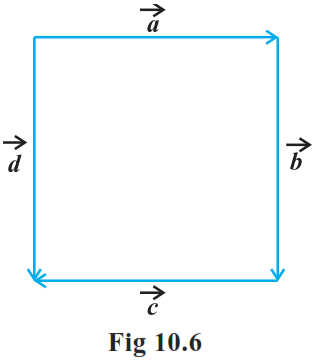
Answer $\vec{a}\ \text{and}\ \vec{b}$ have same initial point and therefore coinitial vectors.
View full question & answer→Question 721 Mark
Write $\overrightarrow{\text{PQ}}+\overrightarrow{\text{RP}}+\overrightarrow{\text{QR}}$ in the simplified form.
Answer We have, $\overrightarrow{\text{PQ}}+\overrightarrow{\text{RP}}+\overrightarrow{\text{QR}}=\overrightarrow{\text{PQ}}+\overrightarrow{\text{QR}}+\overrightarrow{\text{RP}}$$=\overrightarrow{\text{PR}}+\overrightarrow{\text{RP}}$ $\Big[\therefore\ \overrightarrow{\text{PQ}}+\overrightarrow{\text{QR}}=\overrightarrow{\text{PR}}\Big]$
$=\vec0$
View full question & answer→Question 731 Mark
Answer A vector whose initial and terminal point are coincident is called a zero vector or null vector. The null vector is denoted by $\vec0$. The magnitude of null vectors is zero.
View full question & answer→Question 741 Mark
Classify the following as scalar and vector quantities.
Velocity.
Question 751 Mark
Classify the following as scalar and vector quantities:
Displacement.
Answer Displacement is a vector quantity as it involves both magnitude and direction.
View full question & answer→Question 761 Mark
Classify the following measures as scalars and vectors.
10 kg.
Answer 10 kg is a measure of mass, it has no direction, it is magnitude only and therefore it is a scalar.
View full question & answer→Question 771 Mark
Classify the following as scalar and vector quantities:
Time period.
Answer Time period is a scalar quantity as it involves only magnitude.
View full question & answer→Question 781 Mark
In Fig 10.6 (a square), identify the following vectors.
Collinear but not equal.
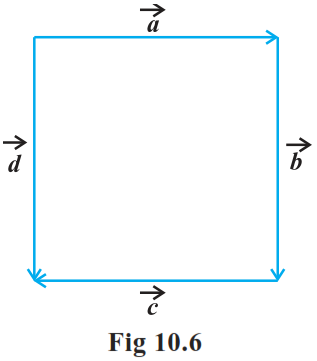
Answer $\vec{a}\ \text{and}\ \vec{c}$ have parallel support, so that they are collinear. Since they have opposite directions, they are not equal. Hence $\vec{a}\ \text{and}\ \vec{c}$ are collinear but not equal.
View full question & answer→Question 791 Mark
Find the direction cosines of the following vector: $2\hat{\text{i}}+2\hat{\text{j}}-\hat{\text{k}}$
Answer We have, $2\hat{\text{i}}+2\hat{\text{j}}-\hat{\text{k}}$ The direction cosines are $\frac{2}{\sqrt{2^2+2^2+(-1)^2}},\frac{2}{\sqrt{2^2+2^2+(-1)^2}},\frac{1}{\sqrt{2^2+2^2+(-1)^2}}$ or, $\frac{2}{3},\frac{2}{3},\frac{-1}{3}$
View full question & answer→Question 801 Mark
Classify the following measures as scalar and vector:
45º
Answer 45º is a scalar quantity as it involves only magnitude.
View full question & answer→Question 811 Mark
Answer A vector whose modulus is unity is called a unit vector. The unit vector in the direction of a vector $\vec{\text{a}}$ is denoted by $\hat{\text{a}}$.
Thus, $|\hat{\text{a}}|=1$
View full question & answer→Question 821 Mark
Classify the following as scalar and vector quantities:
Work.
Answer Work done is a scalar quantity as it involves only magnitude.
View full question & answer→Question 831 Mark
Classify the following measures as scalar and vector:
20kg weight.
Answer20kg weight is a vector quantity as it involves both magnitude and direction.
View full question & answer→Question 841 Mark
Find the direction cosines of the following vectors:
$3\hat{\text{i}}-4\hat{\text{k}}$
Answer We have, $3\hat{\text{i}}-4\hat{\text{k}}$
The direction cosines are $\frac{3}{\sqrt{3^2+0+(-4)^2}},\frac{0}{\sqrt{3^2+0+(-4)^2}},\frac{-4}{\sqrt{3^2+0+(-4)^2}}$ or, $\frac{3}{5},0,\frac{-4}{5}$
View full question & answer→Question 851 Mark
Classify the following as scalar and vector quantities:
Force.
Answer Force is a vector quantity as it involves both magnitude and direction.
View full question & answer→Question 861 Mark
Classify the following measures as scalars and vectors.
$20 m/s^2$
Answer$20 m/sec^2$ is a measure of acceleration. It is a measure of rate of change of velocity, therefore, it is a vector.
View full question & answer→Question 871 Mark
Classify the following measures as scalar and vector:
15kg.
Answer 15kg is a scalar quantity because it involves only mass.
View full question & answer→Question 881 Mark
Show that the vectors $2\hat{i}-3\hat{j}+4\hat{k}\ \text{and}\ -4\hat{i}+6\hat{j}-8\hat{k}$ are collinear.
Answer $\text{Let}\ \vec{a}=2\hat{i}-3\hat{j}+4\hat{k}\ \text{and}\ \vec{b}=-4\hat{i}+6\hat{j}-8\hat{k}.$
It is observed that $ \vec{b}=-4\hat{i}+6\hat{j}-8\hat{k}=-2\Big(2\hat{i}-3\hat{j}+4\hat{k}\Big)=-2\vec{a}$
$\therefore\vec{b}=\lambda\vec{a}$
where,
$\lambda=-2$
Hence, the given vectors are collinear.
View full question & answer→Question 891 Mark
Classify the following as scalar and vector quantities.
Force.
Question 901 Mark
Find the direction cosines of the vector $\hat{i}+2\hat{j}+3\hat{k}.$
Answer$\text{Let}\ \vec{a}=\hat{i}+2\hat{j}+3\hat{k}.$
$\therefore\big|\vec{a}\big|=\sqrt{1^2+2^2+3^2}=\sqrt{1+4+9}=\sqrt{14}$
Hence, the direction cosoines of $\vec{a}\ \text{are}\ \bigg(\frac{1}{\sqrt{14}},\frac{2}{\sqrt{14}},\frac{3}{\sqrt{14}}\bigg).$
View full question & answer→Question 911 Mark
Define position vector of a point.
AnswerA point O is fixed as origin in space (or plane) and P is any point, then $\overrightarrow{\text{OP}}$ is called a position vector of P with reespect to O.
View full question & answer→Question 921 Mark
Represent graphically a displacement of 40 km, 30° east of north.
AnswerDisplacement 40 km, 30° East of North $\Rightarrow$ Displacement vector $\overrightarrow{\text{OA}}$ (say) such that $\bigg|\overrightarrow{\text{OA}}\bigg|$ = 40 (given) and vector $\overrightarrow{\text{OA}}$ makes an angle 30° with North in East-North quadrant.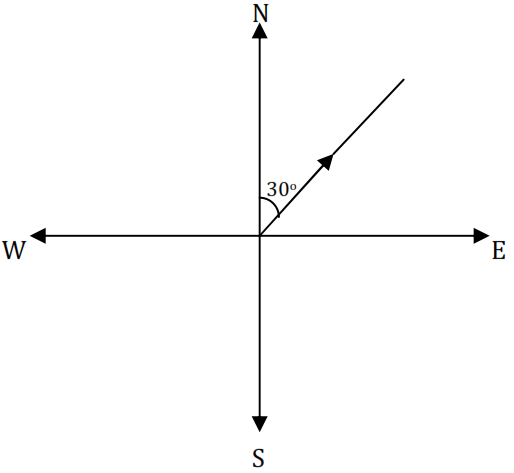
View full question & answer→Question 931 Mark
If $\vec{\text{a}}\text{ and }\vec{\text{b}}$ are two non-collinear vectors such that $\text{x}\vec{\text{a}}+\text{y}\vec{\text{b}}=\vec0$, Then write the values of x and y.
AnswerWe have, $\text{x}\vec{\text{a}}+\text{y}\vec{\text{b}}=\vec0$$\Rightarrow\ \text{x}=0$$$ and $\text{y}=0$ $[\because\ \vec{\text{a}}$ and $\vec{\text{b}}$ are non-collinear vectors$]$
View full question & answer→Question 941 Mark
In Fig 10.6 (a square), identify the following vectors.
Equal.
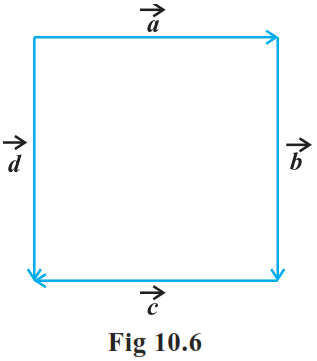
Answer$\vec{b}\ \text{and}\ \vec{d}$ have same direction and same magnitude. Therefore $\vec{b}\ \text{and}\ \vec{d}$ are equal vectors.
View full question & answer→Question 951 Mark
Classify the following as scalar and vector quantities.
Distance.
Question 961 Mark
Classify the following as scalar and vector quantities.
Time period.
Question 971 Mark
Find the direction cosines of the following vector:$6\hat{\text{i}}-2\hat{\text{j}}-3\hat{\text{k}}$
AnswerWe have, $6\hat{\text{i}}-2\hat{\text{j}}-3\hat{\text{k}}$
The direction cosines are $\frac{6}{\sqrt{6^2+(-2)^2+(-3)^2}},\frac{2}{\sqrt{6^2+(-2)^2+(-3)^2}},\frac{-3}{\sqrt{6^2+(-2)^2+(-3)^2}}$ or, $\frac{6}{7},\frac{-2}{7},\frac{-3}{7}$
View full question & answer→Question 981 Mark
Classify the following as scalar and vector quantities:
Distance.
AnswerDistance is a scalar quantity as it involves only magnitude.
View full question & answer→Question 991 Mark
Classify the following measures as scalars and vectors.
40 watt
Answer40 Watt is a measure of power. It has no direction, only magnitude and therefore, it is a scalar.
View full question & answer→Question 1001 Mark
Classify the following as scalar and vector quantities:
Velocity.
AnswerVelocity is a vector quantity as it involves both magnitude as well as direction.
View full question & answer→Question 1011 Mark
Classify the following measures as scalar and vector:
$50m/sec^2$.
Answer$50m/s^2$ is a scalar quantity as it involves magnitude of acceleration.
View full question & answer→Question 1021 Mark
Classify the following measures as scalars and vectors.
40°
Answer40° is a measure of angle. It has no direction, it has magnitude only. Therefore it is a scalar.
View full question & answer→