Questions

1 Marks Question

Take a timed test

47 questions · self-marked practice — reveal the answer and mark yourself.

Question 21 Mark
Write difference between terminal voltage and electromotive force of a cell.
Answer
The potential difference between the terminals of the cell is known as electromotive force. When cell is closed, then potential difference across the terminals of the cell is known as terminal voltage.
View full question & answer
Question 31 Mark
What is internal resistance of a cell?
Answer
The obstruction offered in the flow of charge by the ions of the electrolytes used in the cell is known as internal resistance of the cell.
View full question & answer
Question 41 Mark
Electromotive forces of two cells are $\varepsilon_1$ and $\varepsilon_2$ and their internal resistances are $r_1$ and $r_2$ Both cells are joined in lateral combination. Write equivalent electromotive force of this combination.
Answer
$\varepsilon_{e q}=\frac{\varepsilon_1 r_2+\varepsilon_2 r_1}{r_1+r_2}$
View full question & answer
Question 51 Mark
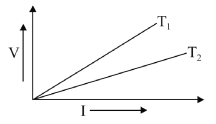
V-I graph of wire of any metal at two different temperatures $T _1$ and $T _2$ are shown in the given figure. Which of the two temperatures is higher and why?
Image
Answer
Slope of V-I graph is $\frac{V}{I}=$ R. It means lesser the slope: more is the magnitude of resistance. Resistance of any metal increases with increase in temperature. Hence, $T_1>T_2$.
View full question & answer
Question 61 Mark
Resistivities of two conductors of same metal shown in the figure are $\rho_1 \Omega m$ and $\rho_2 \Omega m$. Write the ratio of $\rho_1$ and $\rho_2$ will be $1: 1$.
Image
Answer
We know that the resistivity depends on the substance of the conductor. Here both the conductors are of same substance. Hence the ratio of $\rho_1$ and $\rho_2$ will be $1: 1$.
View full question & answer
Question 71 Mark
A current of I ampere is flowing in a conductor. The same current is flowing in a semiconductor also. If temperature of both is increased, what will be effect on the current flowing through them?
Answer
In conductor, the magnitude of current will decrease but in semiconductor it will increase.
View full question & answer
Question 81 Mark
Write corresponding values for X and Y on decreasing the length to half of conductors X and Y where $X =4$ and $Y =4 \Omega$ and $Y =48 \times 10^{-8} \Omega m$.
Answer
We know that resistance is proportional to the length $R \propto l$
When length is reduced to half, magnitude of resistance will also become half which means $X ^{\prime}=2 \Omega$
Resistivity does not depend on length or area of crosssection of wire, hence $Y ^{\prime}=48 \times 10^{-8} \Omega m$.
View full question & answer
Question 91 Mark
A resistor R is joined across a cell of internal resistance r and electromotive force E. Now a potentiometer measures potential difference V across the ends of the cell. Write an expression for r in terms of E, V and R.
Answer
$r=\left[\frac{E}{V}-1\right] R$
View full question & answer
Question 101 Mark
Why there is internal resistance in any cell?
Answer
It is because the motion of ions inside the cell is obstructed by the collisions with the atoms of the electrolyte.
View full question & answer
Question 111 Mark
The algebraic sum of currents at a point in an electric circuit is zero, then what is that point known as?
Answer
Junction
View full question & answer
Question 121 Mark
Under what condition is terminal voltage at the ends of a secondary cell is equal to its electromotive force?
Answer
When cell is in open circuit or when no current is flowing from the cell in the external circuit.
View full question & answer
Question 131 Mark
What is the condition for maximum sensitivity of Wheatstone bridge?
Answer
All the four resistances joined in its four arms should be of same order.
View full question & answer
Question 141 Mark
On what conservation laws are Kirch off's first and second laws based?
Answer
First law on the conservation of law and second law on the conservation of energy.
View full question & answer
Question 151 Mark
We cannot determine the internal resistance of an accumulator cell by Wheatstone bridge. Why?
Answer
The internal resistance of an accumulator cell is less than one ohm, so it cannot be determined with the help of Wheatstone bridge.
View full question & answer
Question 161 Mark
Write mathematical form of Krichhoff's junction rule.
Answer
$\Sigma i=0$ which means that the algebraic sum of all currents meeting at a junction is zero.
View full question & answer
Question 171 Mark
What is the magnitude of electromotive forces of batteries used in any closed electric circuit?
Answer
It is equal to the sum of potential differences produced across the ends of resistors joined in the circuit.
View full question & answer
Question 181 Mark
When Wheatstone bridge is said to be balanced?
Answer
When there is no deflection in cell and galvanometer both on closing the keys of both that is no current flows in its arm, it is said to be balanced.
View full question & answer
Question 201 Mark
Can internal resistance of car batteries be determined with the help of Wheatstone bridge?
Answer
No, because internal resistance of car batteries is very less.
View full question & answer
Question 211 Mark
What is the importance of Kirchhoff's laws related to electric circuit?
Answer
In complex electric circuits where more than one electromotive force sources are present, Ohm's law cannot be applied. In such circuits, only Kirchhoff's laws can be applied.
View full question & answer
Question 221 Mark
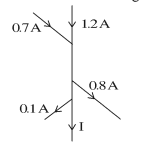
What is the value of I in the given figure?
Image
Answer
According to Kirchhoff's law
$0.7 A+1.2 A=0.1 A+0.8 A+ I$
$\Rightarrow \quad 1.9 A=0.9+ I$
$\Rightarrow \quad I =1.9-0.9$
$\Rightarrow \quad I =1.0 A$ Ans.
View full question & answer
Question 231 Mark
If length of a wire of resistivity p is stretched to three times, then what will be new resistivity?
Answer
The new resistivity p will remain. Since, the resistivity depends on the substance and not on the shape and size.
View full question & answer
Question 241 Mark
What is parallel combination of cells?
Answer
Such a combination of cells in which like terminals of all cells are joined together is known as parallel combination of cells.
View full question & answer
Question 251 Mark
Write the condition when terminal voltage and electromotive force of any battery are equal.
Answer
When the internal resistance of a battery is zero or it is in open circuit which means no current is taken from it.
View full question & answer
Question 261 Mark
What is the effect on specific conductance of any electrolyte with increase in temperature?
Answer
With increase in temperature, due to increase in number of ions in electrolyte and their mobility, its specific conductance will increase due to decrease in its resistivity.
View full question & answer
Question 271 Mark
How does conductance of a semi-conductor changes with increase in temperature?
Answer
Since, resistance of a semiconductor decreases with increase in temperature, so its conductance $\left(\frac{1}{R}\right)$ with increase in temperature.
View full question & answer
Question 281 Mark
What is the effect of increase of temperature on relaxation time? What is the effect on drift velocity of free electron?
Answer
Both relaxation time and drift velocity increases on increasing the temperature.
View full question & answer
Question 291 Mark
If potential difference across the ends of any conductor in increased from V to 3 V, then how will drift velocity of electron change?
Answer
Since, drift velocity,
$v_d=\left(\frac{e \tau}{m l}\right) V$
$\Rightarrow \quad v_d \propto V$times.
On doing V to 3 V , drift velocity will become three
View full question & answer
Question 301 Mark
With increase in temperature, will the drift velocity of free electrons in a metallic conductor increase or decrease?
Answer
$v_d=\frac{e V \tau}{m l}$
$\Rightarrow \quad v_{ d } \propto \tau$ and $\tau=\frac{\lambda}{ V _{ ms }}$
hence drift velocity will increase.
View full question & answer
Question 311 Mark
What is the relation between drift velocity and relaxation time of free electrons in metals?
Answer
$v_d=\left(\frac{e \tau}{m l}\right) V$
View full question & answer
Question 321 Mark
If a graph is drawn between different potential differences applied across the ends of the conductor and their corresponding values of current, then what type of graph is obtained?
Answer
It is obtained in the form of a straight line.
View full question & answer
Question 331 Mark
Drift velocity is inversely proportional to what? and it does not depend on what?
Answer
Drift velocity is inversely proportional to applied potential difference on the conducting rod and drift velocity of electrons in the conductor does not depends on length of the conductor.
View full question & answer
Question 341 Mark
What is mobility? Write its expression also.
Answer
For any conductor, ratio of drift velocity and electric field inside the conductor remains constant at the given temperature. This constant quantity is known as mobility $(\mu)$ of charge carrier (electron)
$ \text { mobility }(\mu)=\frac{\text { drift velocity }}{\text { electric field }}=\frac{e \tau}{m} $
View full question & answer
Question 351 Mark
$\tau$ is known as relaxation time. State factors on which it depends and factors on which it does not depend
Answer
Magnitude of relaxation time depends on the nature of the conducting substance and it does not depend on the magnitude of electric field.
View full question & answer
Question 361 Mark
Define current density. State its unit.
Answer
Magnitude of current flowing in the perpendicular direction of unit area of cross-section is known as current density J.
Current density $J =\frac{ i }{\Delta S }$, where, $\Delta S$ is area of cross-section.
If the direction of flow of charge is inclined at an angle with the perpendicular, then
current density, $J=\frac{i}{\Delta S \cos\theta}$ or $I=\vec{J} \cdot \overrightarrow{\Delta S}$
View full question & answer
Question 371 Mark
Define resistivity. Write its unit.
Answer
Resistance of a conductor of length 1 m and area of cross-section 1 m² is equal to its resistivity. Its unit is ohm metre or ohm cm.
View full question & answer
Question 381 Mark
If temperature of an electric conductor (i) increases (ii) decreases, how the relaxation time of electrons changes in it?
Answer
(1) decreases (ii) increases.
View full question & answer
Question 391 Mark
In metals, what is the order of magnitude of number of free electrons, their thermal velocities, pursuit velocity and relaxation time?
Answer
Number of free electrons $=10^{29}$, thermal velocity $10^5= m / s$, pursuit velocity $=10^{-4} m / s$, relaxation time $=$ $10^{-14} s$
View full question & answer
Question 401 Mark
State Ohm's law
Answer
If physical conditions remain constant, the magnitude of current flowing in a conductor is proportional to the potential difference V across the ends of the conductor.
$V \propto I$
$V = IR$
Where R is a constant.
View full question & answer
Question 411 Mark
What is the necessary condition for Ohm's law to be effective ?
Answer
Physical conditions should remain constant (temperature, length, area of cross-section).
View full question & answer
Question 421 Mark
On joining resistances in parallel, the total resistance of the circuit will increase or decrease?
Answer
Value of total resistance decreases.
View full question & answer
Question 431 Mark
What is the effect on the resistance due to increase in the temperature?
Answer
Due to small change in temperature, there is no change in thermal expansion but for more change in temperature of resistance, ratio of length and area of crosssection will decrease which will affect the resistance.
View full question & answer
Question 441 Mark
What is the effect on the magnitudes of resistance and resistivity of deforming the shape of a substance?
Answer
Resistance will change as it depends on physical condition of the substance. Resistivity will remain the same because it depends on the nature of the substance.
View full question & answer
Question 451 Mark
What is the charge on flowing current in a conducting wire?
Answer
Zero. The amount of charge which enters the wire, same amount of charge moves out of the wire.
View full question & answer
Question 461 Mark
What is the concept of direction of electric current ?
Answer
The direction of electric current in metals is taken opposite to the direction of free electrons. In liquids and gases, the direction is taken in the direction of positive ions or opposite to the direction of negative charge carriers.
View full question & answer
Question 471 Mark
Give definition of ampere in electric current.
Answer
If one coulomb of charge passes through any conductor in one second, then magnitude of current flowing in the conductor is one ampere. 1 A = 1 coulomb/1 second.
View full question & answer