Questions

3 Marks Question

🎯

Test yourself on this topic

16 questions · timed · auto-graded

Question 13 Marks
Obtain essential expression for balanced position of Wheatstone Bridge.###Explain the principle of Wheatstone Bridge. How can we find the resistance of any resistor using this principle?
Answer
SELF
View full question & answer
Question 23 Marks
State Kirchhoff's laws and explain them by giving examples.###Explain that first law of Kirchhoff is equivalent to law of conservation of charge and the second law is a descriptive form of Ohm's law.###For a current carrying conductor, write Kirchhoff's laws of charge and energy conservation.
Answer
SELF
View full question & answer
Question 33 Marks
What is an electric cell? Describe its construction. How many types of electric cells are there? By defining electromotive force of a cell, establish an expression for internal resistance of cell in any circuit and state factors on which internal resistance depends.
Answer
SELF
View full question & answer
Question 43 Marks
(i) What is meant by electric power? Prove that $P=\frac{V^2}{R}$ or $P=I^2 R$. Define one-watt electric power.(ii) Define electric energy. Prove that $P = I ^2 R \Delta t$
Answer
SELF
View full question & answer
Question 53 Marks
Establish an expression for mobility by giving definition of mobility. Establish relation between mobility of free electrons and electric current.
Answer
SELF
View full question & answer
Question 63 Marks
Comment on the following :(i) Electric conductivity.(ii) Dependence of resistivity and resistance on temperature.
Answer
SELF
View full question & answer
Question 73 Marks
Explain Ohm's law. State factors on which the resistance of any conductor depends. Define specific resistance and state its relation with the conductivity.
Answer
SELF
View full question & answer
Question 83 Marks
Prove that the magnitude of electric current in a circuit is proportional to the drift velocity of free electrons. Verify Ohm's law with the help of drift velocity.
Answer
SELF
View full question & answer
Question 93 Marks
Establish a relation between resistance and resistivity of any substance. Explain in detail, the dependence of resistivity on the temperature.
Answer
SELF
View full question & answer
Question 103 Marks
Obtain the Ohm's law $j=\sigma$ E. Using this relation, establish the relation $V=I R$. What are ohmic and non-ohmic devices? Explain by giving examples.
Answer
SELF
View full question & answer
Question 113 Marks
Establish a relationship between electric current and drift velocity. Draw the direction of electron flowing in a circuit by drawing an electric circuit.
Answer
SELF
View full question & answer
Question 123 Marks
What is drift velocity? Explain the dependence of drift velocity and electric field on the mobility.
Answer
SELF
View full question & answer
Question 133 Marks
Define electric current and current density. By giving an example prove that electric current is a scalar quantity but not a vector quantity. Explain electric current in any conductor.
Answer
SELF
View full question & answer
Question 143 Marks
Write first rule of Kirchhoff (junction rule).By drawing circuit diagram of Wheatstone Bridge, obtain condition for zero deflection in the bridge.
Answer
SELF
View full question & answer
Question 153 Marks
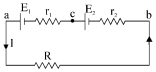
Electromotive forces of two cells are $E_1$ and $E _2$ and their internal resistances are $r_1$ and $r_2$. Find equivalent electromotive force and equivalent internal resistance on joining them in series.
Answer
Image
In the figure given, series combination of two cells $E_1$ and $E_2$ of internal resistances $r_1$ and $r_2$ are shown. Its end points are joined to an external resistance R. If current flowing in the resistance R is I due to combination of cells, then by Ohm's law $V = IR$
The magnitude of potential difference across the end points $a$ and $b$ of the combination will be equal to the sum of the terminal voltage of both cells
$V _{a b}=\left( E _1- I r_1\right)+\left( E _2- I r_2\right)$
Terminal voltage will be equal to developed potential difference across the ends of the resistance R. Therefore,
$E _1- I r_1+ E _2- Ir _2= IR$
$E _1+ E _2= IR + I r_1+ I r_2$
$E _1+ E _2= I \left( R +r_1+r_2\right)$
$I =\frac{ E _1+ E _2}{ R +r_1+r_2}=\frac{ E _o}{ R +r_o}$
Here $E _0= E _1+ E _2$ the magnitude of total electromotive force of the cells and $r_0=r_1+r_2$ the total internal resistance of the cells. It is clear from this
(i) The total magnitude of electromotive force in the combination is equal to the sum of the electromotive forces of the combining cells.
(ii) If n cells of same electromotive force and internal resistance are joined in the combination, then the magnitude of current flowing in the external resistance R is
$I =\frac{n E }{ R +n r}=\frac{ E }{r+\frac{ R }{n}}$
which means that the magnitude of current flowing in the external resistance R is greater than the current obtained from a cell.
(iii) If polarity of one battery in the combination is reversed, then the magnitude of electromotive force obtained is either $\left(E_1-E_2\right)$ or $\left(E_2-E_1\right)$.
View full question & answer
Question 163 Marks
Obtain expression $\vec{J}=\sigma \vec{E}$ of Ohm's law on the basis of drift velocity.
Answer
Let us consider a conductor of length $/$ and whose area is A . Number density per volume is $n$. The number of charge carriers in the conductor will be $n A /$ where $A /$ is the volume of the conductor. If charge on every charge carrier is $e$ and their drift velocity is, then the total charge of charge carriers in the conductor is $\Delta q=n A / e$ which will pass through cross-section of this conductor in time $\Delta t=\frac{l}{v_d}$. The current flowing through the conductor is $I =\frac{\Delta q}{\Delta t}$.
$\Delta q=n Ale$ and $\Delta t=\frac{l}{v_d}$
$I =\frac{\Delta q}{\Delta t}$
$I =\frac{n A l e}{l / v_d}=n A v_{d e}$
We know that current density,
$j=\frac{ I }{ A }=\frac{n A v_d e}{A}$
$j=n v_d$
In vector form, $\vec{j}=-n e \overrightarrow{v_d}$ (charge on electron is $-e$ ) If applied electric field on the conductor is $\vec{E}$ and average time of collision of charge carriers (electrons) is $\vec{\tau}$, then drift velocity.
$v_d=\frac{-e \overrightarrow{ E }}{m} \vec{\tau}$
$\therefore \quad \vec{j}=-n e\left(\frac{-e \overrightarrow{ E }}{m} \vec{\tau}\right)=\left(\frac{n e^2 \vec{\tau}}{m}\right) \overrightarrow{ E }$
$\vec{j}=\sigma \overrightarrow{ E }$
where, $\sigma=\frac{n e^2 \vec{\tau}}{m}$ is called conductivity of the substance. Equation (3) is a form of ohm's law.
View full question & answer
3 Marks Question - Physics STD 12 Science Questions - Vidyadip