Question 12 Marks
A cylindrical surface of radius $r$ and length $l$ contains a thin, straight conducting wire of charge density $\lambda$ of infinite length. The axis of the cylindrical surface coincides with the length of the wire. Find the expression for electric flux through a cylindrical surface.
AnswerElectric field intensity at a distance $r$ due to infinite linear charge
$E =\frac{k \cdot 2 \lambda}{r}=\frac{1}{4 \pi \in_0} \cdot \frac{2 \lambda}{r}$
$E =\frac{\lambda}{2 \pi \in_0 r}$.
The electric field on a cylindrical surface will be perpendicular to it.
Hence, the area vector and electric field will be in the same direction, i.e. the electric flux coming out of the cylindrical surface
$\phi=\int \overrightarrow{ E } \cdot \overrightarrow{\Delta S }= E \cdot S$
$\phi=\frac{\lambda}{2 \pi \in_0 r} \times 2 \pi r l$
$=\frac{\lambda I}{\in_0}$ Volt meter Ans
View full question & answer→Question 22 Marks
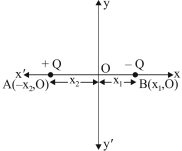
Two electric charges $+Q$ and $-Q(x-y)$ are placed at the points $\left(-x_2, 0\right)$ and $\left(x_1, 0\right)$ respectively in the plane. Find the magnitude and direction of the resultant electric field at the origin $(0,0)$.
AnswerThe positions of the given charges are shown in the figure. The magnitude of the original point intensity $\overrightarrow{ E _1}$ due to $+Q$ charge at point $O$.
$ E_1=\frac{1}{4 \pi \in_0}\left(\frac{Q}{x_2^2}\right) $
Similarly, due to the charge ( $-Q$ ) located at point B , the origin is at O . The magnitude of the electric field intensity $\overrightarrow{ E _2}$.
$ E_2=\frac{1}{4 \pi \in_0}\left(\frac{Q_1}{x_1^2}\right) $
Since $\vec{E}_1$ and $\vec{E}_2$ both have the same direction, hence the magnitude of the resultant electric field $\overrightarrow{ E }$ at O is
$E=E_1+E_2$
$=\frac{ l }{4 \pi \in_0}\left(\frac{ Q }{x_2^2}\right)+\frac{1}{4 \pi \in_0}\left(\frac{ Q }{x_1^2}\right)$
$=\frac{ Q }{4 \pi \in_0}\left[\frac{1}{x_2^2}+\frac{1}{x_1^2}\right]$
or $E =\frac{ Q }{4 \pi \in_0}\left[\frac{1}{x_1^2}+\frac{1}{x_2^2}\right]$ (Direction from O to B )
View full question & answer→Question 32 Marks
Draw the graph of variation of Coulomb force (F) with $(r)$. Where the distance between the two charges of each charge pair is ( $1 \mu C , 2 \mu C$ ) and ( $2 \mu C$, $-3 \mu C$ ). Analyse the graph obtained.
AnswerThe electric force $F$ between the charge pair $(1 \mu C$ and $2 \mu C )$ will be repulsive and the electric force F between the charges of the charge pair $(2 \mu C ,-3 \mu C )$ will be attractive.
$\begin{aligned} \because \quad F _{\text {repulsive }} & =\frac{1}{4 \pi \in_0} \frac{q_1 q_2}{r^2} \\ & =\left[\frac{1}{4 \pi \in_0}(1 \times 2) \times 10^{-6}\right] \frac{1}{r^2}\end{aligned}$
$=2 k \times\left(\frac{1}{r^2}\right)$
Same as $F _{\text {attractive }}=\left[\frac{1}{4 \pi \in_0}(2 \times 3) \times 10^{-6}\right] \frac{1}{r^2}$
$=(6 k) \times \frac{1}{r^2}$
Since from Coulomb's law $F \propto \frac{\mu}{r^2}$,
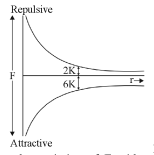
Therefore, the variation of F with $\frac{1}{r^2}$ will be the same as shown in the picture for each pair. View full question & answer→Question 42 Marks
A force F facts on a point charge placed on the axis of an electric dipole. If the distance of a point charge from the dipole is doubled, what will be the force on it? Explain the reason also.
AnswerDue to the electric dipole, the magnitude of the electric field intensity $\overrightarrow{ E }$ at a distance $r$ from it will be E.
Its value $ E=\left(\frac{1}{4 \pi \in_0}\right) \cdot\left(\frac{2 p}{r^3}\right) $
magnitude of the force $\vec{F}$ on a point charge placed at this point will be $ F =q E $
Therefore, $F =\left(\frac{1}{4 \pi \in_0}\right) \cdot\left(\frac{2 p q}{r^3}\right) \Rightarrow F \propto \frac{1}{r^3}$
Hence, on doubling the distance $r$, it will be $\frac{1}{8}$ times i.e. $\frac{F}{8}$
View full question & answer→Question 52 Marks
Two identical metal spheres of exactly equal mass have been taken. One is charged with negative charge say q and the other with the same amount of positive charge. Will there be any difference in the mass of the two spheres? If yes then why?
AnswerThe sphere which has been charged with positive charge must have taken out some electrons and the sphere which has been charged with negative charge must have been given some extra electrons from outside, hence this means that there will be difference in masses of the spheres i.e. the mass of the positively charged sphere will decrease and the mass of the negatively charged sphere will increase. Since both the spheres are charged with a charge of the same magnitude $q$ and $q=n e$ (where $n=$ number of electrons removed or given and $e=$ equivalent charge of electron $=1.6 \times 10^{-19}$ Coulomb). Therefore, whatever be the mass of the positively charged sphere decreases, the same amount of the mass of the negatively charged sphere will increase.
View full question & answer→Question 62 Marks
Electric charge is distributed in a small volume. The electric flux passing through a total charge enclosed by a spherical surface of radius 10 cm is 10 Vm . Then what will be the flux associated with a concentric sphere of radius 20 cm ?
AnswerAccording to Gauss's law, the value of total flux coming out of the surface due to charge $q$ surrounded by a closed surface is
$ \phi=\oint \overrightarrow{E} \cdot d \overrightarrow{S}=\frac{q}{\in_0} $
It is clear from this that the total flux associated with a closed surface depends on the charge located inside the surface and does not depend on the size and shape of the surface
$ \phi=\oint \overrightarrow{E} \cdot d \overrightarrow{S}=\frac{q}{\in_0}=20 Vm $
the charge enclosed by the surface is constant
$\frac{q}{(\in_0)}=constant$
View full question & answer→Question 72 Marks
The electric potential inside a charged spherical ball is given by $\phi=a r^2+b$. Where $r$ is the distance from the centre, $a$ and $b$ are constants. Calculate the charge density inside the ball.
Answer$\phi=a r^2+b$
$E =\frac{d \phi}{d t}=-2 a r$
$\oint \overrightarrow{ E } \cdot d \overrightarrow{ S }=\frac{q}{\in_0}$
$-2 a r \cdot 4 \pi r^2=\frac{q}{\in_0}$
$a=-8 \pi \in_0 a r^3$
charge density $\rho=\frac{q}{\frac{4}{3} \pi r^3}=-\frac{8 \pi \in_0 a r^3}{\frac{4}{3} \pi r^3}$
$\rho=-6 a \in_0$ Ans.
View full question & answer→Question 82 Marks
If an electric dipole is placed at an angle of $30^{\circ}$ to an electric field of intensity $2 \times 10^5 N / C$, a torque of 4 Nm is applied on it. If the length of the dipole is 2 cm , then what will be charge?
Answer $\tau= pE \sin \theta$
$4=p \times 2 \times 10^5 \sin 30^{\circ}$
$p=4 \times 10^{-5} C - m$
$q \times 2 \times 10^{-2}=4 \times 10^{-5}$
$q=2 \times 10^{-3} C$
$\because p=q \times 2 l$
View full question & answer→Question 92 Marks
A sample of HCl gas is placed in an electric field of $3 \times 10^4 N / C$. The dipole moment of each molecule of HCl is $6 \times 10^{-30} C \times m$. What will be the maximum torque acting on the molecule?
AnswerTorque on dipole $\tau= P \times E$
$ \tau=P E \sin \theta $
For maximum value, $\theta=90^{\circ}$
$ \begin{array}{l} \tau_{\max }=6 \times 10^{-30} \times 3 \times 10^4 \sin 90^{\circ} \\
\tau_{\max }=18 \times 10^{-26} Nm \end{array} $
View full question & answer→Question 102 Marks
Two electric dipoles whose dipole moments are $P$ and 64 P are placed on a line at a distance of 25 cm in opposite directions. If the electric field at any point between them is zero, then what will be the distance of this point from the electric potential $P$ ?
AnswerSuppose the neutral point N is obtained at a distance $x$ from the dipole with moment P or at a distance $(25-x)$ from 64 P.
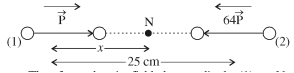
Therefore, electric field due to dipole (1) at $N =$ electric field due to dipole (2)
$\Rightarrow \quad \frac{1}{4 \pi \varepsilon_0} \times \frac{2 P }{x^3}=\frac{1}{4 \pi \varepsilon_0} \times \frac{2 \times 64 P }{(25-x)^3}$
$\Rightarrow \quad \frac{1}{x^3}=\frac{64}{(25-x)^3}$
$\Rightarrow \quad \frac{1}{x}=\frac{4}{25-x}$
$\Rightarrow \quad 25-x=4 x$
$\Rightarrow \quad 25=5 x$
$\Rightarrow \quad x=5 cm$ View full question & answer→Question 112 Marks
Two positive point charges $12 \mu C$ and 5 $\mu C$ are present in air at a distance of 10 cm from each other. Calculate the work required to bring them closer to 4 cm .
AnswerPotential energy of charges $Q _1$ and $Q _2$ located at a distance of 10 cm from each other.
$U _1=\frac{1}{4 \pi \in_0} \times \frac{ Q _1 Q _2}{r}$
$=9 \times 10^9 \times \frac{12 \times 10^{-6} \times 5 \times 10^{-6}}{0.1}$
$=5.4 J$
At $(10-4) cm =6 cm$ of charge. Potential energy
$U _2=\frac{9 \times 10^9 \times 12 \times 10^{-6} \times 5 \times 10^{-6}}{0.1}$ $=9 J$
$\therefore \quad$ Work done $=(9-5.4) J$
$=3.6 J $ Ans.
View full question & answer→Question 122 Marks
The mass of an alpha particle located in a uniform electric field of $1.6 \times 10^5 V / m$ is $6.4 \times 10^{-27}$ Kg and charge is $3.2 \times 10^{-19} C$. What will be the velocity of the particle after travelling a path of $2 \times$ $10^{-2} m$ at rest?
AnswerGiven, mass of $\alpha$ particle $m=6.4 \times 10^{-27} Kg$
Charge of $\alpha$ particle $q=3.2 \times 10^{-9} C$
Electric flux $E =1.6 \times 10^5 V / m$
Force on $\alpha$ particle in uniform electric field E ,
$ \begin{aligned} F & =q E \\ & =3.2 \times 10^{-19} \times 1.6 \times 10^5 N \end{aligned} $
Acceleration of alpha particle
$ \alpha=\frac{F}{m}=\frac{3.2 \times 1.6 \times 10^{-14}}{6.4 \times 10^{-27}} m / s^2 $
Given :
$u=0$
$v^2=2 a s$
$=\frac{2 \times 3.2 \times 1.6 \times 10^{-14}}{6.4 \times 10^{-27}} \times 2 \times 10^{-2}$
$=3.2 \times 10^{11}$
$=32 \times 10^{10}$
$v=4 \sqrt{2} \times 10^5 m / s$ Ans.
View full question & answer→Question 132 Marks
Infinite charges of $1 \mu C$ are placed on the x -axis at the positions $x=1,2,4,8, \ldots \infty$. If a charge of 1 C is situated at the origin, then find the value of the total force applied on it.
AnswerThe charge distribution on the x -axis are shown in the following figure.
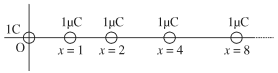
Total force acting on charge 1 C
$\begin{array}{r}F=\frac{1}{4 \pi \in_0}\left[\frac{1 \times 1 \times 10^{-6}}{1^2}+\frac{1 \times 1 \times 10^{-6}}{2^2}+\frac{1 \times 1 \times 10^{-6}}{4^2}\right. \\ \left.+\frac{1 \times 1 \times 10^{-6}}{8^2}+\ldots . . \infty\right]\end{array}$
$=\frac{10^{-6}}{4 \pi \in_0}\left(1+\frac{1}{4}+\frac{1}{16}+\frac{1}{64}+\ldots . . \infty\right)$
$=9 \times 10^9 \times 10^{-6} \times \frac{1}{\left(1-\frac{1}{4}\right)}$
$=9 \times 10^3 \times \frac{1}{3 / 4}$
$=\frac{9 \times 10^3 \times 4}{3}=12000 N$. Ans.
View full question & answer→Question 142 Marks
Draw equipotential surface due to the following :(i) Any electric dipole(ii) Two identical positive charges separated by some distance.
Question 152 Marks
Calculate the electric flux passing through the spheres $S_1$ and $S_2$ shown in the figure. The linear charge density of the wire $A B$ shown in the figure is $\lambda=K x$ where $x=$ distance from the end $A$ of the wire measured along its length.
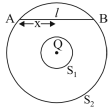
AnswerElectric flux passing through $S _1$
$ E_1(\text { consider })=\frac{Q}{\in_0} $
Total charge on wire AB
$q =\int_0^l \lambda \cdot d x$
$=\int_0^l K x d x= K \left[\frac{x^2}{2}\right]_0^l=\frac{ K l^2}{2}$
Hence, total charge enclosed by sphere $S _2$
$Q ^1= Q +q= Q +\frac{ K l^2}{2}$
Therefore, the electric flux passing through $E _2$ (assumed) $=\frac{ Q +\frac{ K l^2}{2}}{\in_0}$
$E _2=\frac{2 Q + K l^2}{2 \in_0}$ Ans.
View full question & answer→Question 162 Marks
An electron accelerated by 1 kV travels 5 km towards conducting plate of infinite extension is moving in the direction perpendicular to the plate. Calculate the minimum surface charge density on the conducting plate so that the electron cannot collide with the plate.
AnswerElectric field due to charged conducting plate
$E=\frac{\sigma}{\in_0}$
Force on electron $F=(e) E=\frac{e \sigma}{\in_0}$
Kinetic energy of electron when accelerated by 1 kV
$=1 KeV$
$=1000 \times 1,6 \times 10^{-19}$ joule
$=1.6 \times 10^{-16}$ joule
Therefore, $\quad Fd =1.6 \times 10^{-16}$ joule
Since the work done is energy,
or $\frac{e \sigma}{\in_0} d=1.6 \times 10^{-16}$
$\sigma=\frac{\in_0 \times 1.6 \times 10^{-16}}{e d}$
On putting values $\sigma=\frac{8.85 \times 10^{-12} \times 1.6 \times 10^{-16}}{1.6 \times 10^{-19} \times 5 \times 10^{-3}}$
Because $d=5 mm=5 \times 10^{-3}$ meter is given
Therefore, $\quad \sigma=1.77 \times 10^{-6} C / m ^2 \quad$ Ans.
View full question & answer→Question 172 Marks
A small metal sphere with $+Q$ charge is placed in the cavity of a larger uncharged metal sphere. As shown in the Fig. Find the value of electric field intensity at point $P_1$ and $P_2$ from Gauss's law.
AnswerTo imagine a Gaussian surface passing through the point $P _1$, the electric flux passing through it.
$\phi=\oint \overrightarrow{ E } \cdot \vec{d} s=\oint E d s \cos \theta$
$=\oint E d s \cos 0^{\circ}$
$= E \times 4 \pi r_1^2$
$\because \cos 0^{\circ}=1$
According to Gaussian theorem
$\phi=\frac{q}{\in_0}=\frac{ Q }{\in_0}$
$\therefore \quad E \times 4 \pi r_1^2=\frac{ Q }{\in_0}$
$\Rightarrow \quad E =\frac{1}{4 \pi \in_0}\left(\frac{ Q }{r_1^2}\right)$
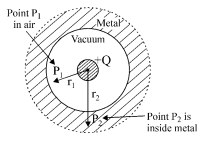
Since the point $P_2$ is inside the metal sphere and the electric field intensity at every point inside a conducting metal is zero. Therefore, electric field intensity at $P _2=$ zero. View full question & answer→Question 182 Marks
An electric dipole is placed inside a closed surface, whose dipole moment is $20 \times 10^{-6}$ coulomb-meter. What will be the electric flux emerging out of this surface?
AnswerThere are charge of equal magnitude and opposite nature at the ends of the electric dipole. Therefore, the total charge $q$ inside the closed surface will be zero.Therefore, according to Gauss' theorem, the electric Therefore, $ \begin{array}{l} \phi=\frac{q}{\in_0}=0 \\ \phi=\text { zero } \end{array} $
View full question & answer→Question 192 Marks
If the distance of the observation point from the central point of the small electric dipole is halved, then how many times will the intensity of the electric field increase?
AnswerElectric field intensity in both axial and nonaxial positions of a small electric dipole is
$ E \propto \frac{1}{r^3} $
Therefore, $\frac{ E _2}{ E _1}=\left(\frac{r_1}{r_2}\right)^3=\left(\frac{r_1}{\frac{1}{2} r_1}\right)^3$
$\frac{E_2}{E_1}=(2)^3=\frac{8}{1}$
Or $\quad E _2=8 E _1$i.e., intensity will become 8 times.
View full question & answer→Question 202 Marks
Write two differences between charge and mass.
Answer(1) Charge can be zero, positive or negative but mass is always positive.
(ii) Electric charge does not depend on the velocity of motion of the particle whereas mass also depends on the velocity of motion of the particle.
View full question & answer→Question 212 Marks
Can the entire charge of a charged object 'A' be transferred to another object 'B'? If yes then how would it be possible, if not then why?
AnswerYes, the total charge of an object A can be transferred to another conducting objeet B. When object A is completely covered by object B and it is connected by a wire. This is possible due to the basic nature of charge because the charge always remains stationary on the outer surface of the conductor.
View full question & answer→Question 222 Marks
Two protons and two electrons are hanging freely at equal distances. Compare the repulsion force between proton and electron.
AnswerThe repulsion forces between two protons and two electrons will be equal because the magnitude of charge on the proton and electron is equal and the distances between them are also equal.
View full question & answer→Question 232 Marks
Two charges are placed in air at some distance:(a) If a glass slab whose dielectric constant is 8 is placed between them, then what will be the change in the magnitude of the force acting between them?(b) What will happen if the piece of brass is kept?
AnswerAt a distance $r$ from each other, the electric forees between charges of magnitude $q_1$ and $q_2$ located in air will be respectively :
In air : $ F=\frac{1}{4 \pi \in_\sigma}\left(\frac{q_1 q_2}{r^2}\right) $
In medium $\quad F ^{\prime}=\frac{1}{4 \pi \in_\rho \in_{ r }}\left(\frac{q_1 q_2}{r^2}\right)$
Therefore $ F^{\prime}=\frac{F}{\in_r} $
(a) Therefore, when a glass slab of dielectric constant $\in_r=8$ is placed between charges, the force will remain $\frac{1}{8}$ of the initial force.
(b) For a piece of brass, $\in_{ r }=\infty$, hence in this case it will be zero.
View full question & answer→Question 242 Marks
An electron is placed in an electric field. If a proton is placed in its place, what will be the relation between the forces experienced by them?
AnswerSince $F =q E$ and the magnitude of charge on each electron and proton is equal and opposite in nature, hence the magnitude of the forces acting on each will be equal but the directions will be opposite
View full question & answer→Question 252 Marks
Do two positively charged balls attract each other?
AnswerYes, when the charge on the first ball is greater than that on the second ball, then due to induction some charge of opposite nature gets induced on the second ball. Therefore, the second ball will experience a force of attraction towards the first ball.
View full question & answer→Question 262 Marks
If we walk barefoot on a nylon mat for some time and touch the metal handle of a door, we get an electric shock. Why does this happen?
AnswerWhile walking, our feet rub on the mat, due to which our body gets charged. When we touch the handle, electric charge from our body flows into it, due to which we
get a shock.
View full question & answer→Question 272 Marks
Two point charges are placed at a distance d from each other. Due to these, the electric field intensity at any point is zero. But the point is not in the middle of these charges although on the line connecting them, write two necessary conditions for this to happen.
Answer(i) Both the charges should be of opposite nature.(ii) The magnitude of the charge located near that point should be less and the magnitude of the other charge should be greater.
View full question & answer→Question 282 Marks
What is the principle of superposition of charges?
AnswerAccording to this principle, in a sytem of charges $q_1, q_2, \ldots q_n$ the foree exerted by $q_2$ on charge $q_1$ is equal to the foree exerted by Coulomb's law, lic., it is not affected by the presence of other charges $q_3, q_4 \ldots q_n$. The total force $\vec{F}_1$ exerted by all charges on charge $q_1$ is equal to the vector
sum of $\vec{F}_{12}, \vec{F}_{13}, \ldots \ldots . . \vec{F}_{1 m}$.
Therefore, $ \begin{aligned} \overrightarrow{F}_1 & =\overrightarrow{F}_{12}+\overrightarrow{F}_{13}+\ldots \ldots+\overrightarrow{F}_{1 n} \\
& =\frac{1}{4 \pi \in_0}\left[\frac{q_1 q_2}{r_{12}^2} \hat{r}_{14}+\frac{q_1 q_3}{r_{13}^2} r_1+\ldots+\frac{q_1 q_n}{r_{1 n}^2} r_{1 n}\right] \end{aligned} $
View full question & answer→Question 292 Marks
The electric foree between two electric charges in a medium is F . The distance between them is $d$. At what distance were they placed from each other
so that the electric foree becomes (i) 3 F (ii) $\frac{ F }{4}$ ?
AnswerFrom Coulomb's law$F \propto \frac{1}{r^2}$
$\Rightarrow$ $\frac{F_1}{F_2}=\left(\frac{r_2}{r_1}\right)^2 \Rightarrow r_2=r_1\left(\frac{F_1}{F_2}\right)^{\frac{1}{2}}$ $\therefore$
(i) $r_2=d\left(\frac{F}{3 F}\right)^{\frac{1}{2}}=\frac{d}{\sqrt{3}}$
(ii) $r_2=d\left(\frac{F}{ F / 4}\right)^{\frac{1}{2}}=d \sqrt{4}=2 d$
View full question & answer→Question 302 Marks
What is quantization of charge?
AnswerNo matter what may be the reason for the origin of charge on any charged object, the charge is always an absolute multiple of the charge of the electron, not a fractional multiple. In mathematical form $q= \pm$ ne where $n=$ integer multiple number $i . e . n =0,1,2,3, \ldots$
View full question & answer→Question 312 Marks
Write the law of conservation of electric charge
AnswerThe total algebraic sum of charges in any isolated system remains unchanged. Mathematically, $q=q,+q=$ constant, that is, charges can neither be produced nor destroyed, but they can be transferred from one objoct to another.
View full question & answer→Question 322 Marks
The volume charge density in the space between two conocentric spheres of radii $a$ and $b$ is $\rho=\frac{A}{r}$, where $A$ is a constant and $r$ is the distance. There is a point charge $Q$ at the centre of the sphere. Find the value of A such that there is a uniform electric field in the space between the spheres.
Answer
$\in \times 4 \pi r^2=\frac{ Q +\int_a^r \frac{A}{r} \times 4 \pi r^2 d r}{\in_0}$
$\in \times 4 \pi r^2=\frac{ Q +\frac{4 \pi A}{2}\left(r^2-a^2\right)}{\in_0}$
$\in=\frac{ Q }{4 \pi \in_0 r^2}+\frac{ A }{2 \in_0 r^2}\left(r^2-a^2\right)$
$\in=\frac{ Q }{4 \pi \in_0 r^2}+\frac{ A }{2 \in_0}-\frac{ A a^2}{2 \in_0 r^2}$
$\Rightarrow \frac{ Q }{4 \pi \in_0 r^2}=\frac{ A a^2}{2 \in_0 r^2}$
$\Rightarrow \quad \frac{ Q }{4 \pi \in_0}=\frac{ A a^2}{2 \in_0}$
$\Rightarrow \quad A =\frac{ Q }{2 \pi r^2}$
View full question & answer→Question 332 Marks
A square surface of side L meter is kept in the plane of the paper. A uniform elecrtric field $\overrightarrow{ E }$ is also present in the plane of the paper and it is limited to the lower half of the page as shown in the figure. What will be the electric flux bound to the surface?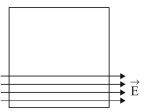
AnswerWe know, the electric flux passing through a plane $ \phi=\oint \overrightarrow{E} \cdot \vec{d} s $
Here, there is no electric field in the upper plane of the square surface. Therefore, since $E = O$, no electric flux will pass through this part. The area vector $\vec{d} s$ in the bottom half of the square surface will be perpendicular to the electric field $\overrightarrow{ E }$.
Therefore $ \overrightarrow{E} \cdot \overrightarrow{d s}=Eds \cos 90^{\circ}=0 $
Hence no electric flux will pass through the lower plane of the square surface, i.e. the electric flux will be zero. Hence the electric flux bound to the entire square surface will be zero.
View full question & answer→