Current in a circuit falls from 5.0A to 0.0A in 0.1s. If an average emf of 200V induced, give an estimate of the self-inductance of the circuit.
Question types
Electromagnetic Induction question types
312 questions across 7 question groups — pick any mix to generate a Physics paper with step-by-step answer keys.
312
Questions
7
Question groups
5
Question types
01
2 Marks Questions
19 Q→023 Marks Question
37 Q→031 Marks Question
29 Q→044 Marks Questions
10 Q→05M.C.Q (1 Marks)
171 Q→06Assertion (A) & Reason (B) MCQ
14 Q→075 Marks Questions
32 Q→Sample Questions
Electromagnetic Induction questions
One sample from each question group in this chapter. Select any group above to see the full set with answer keys.
View full solution →
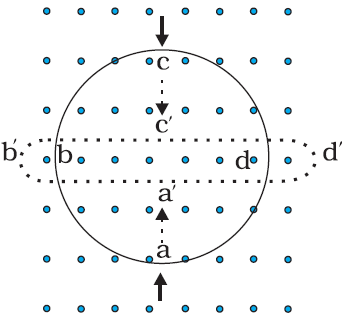
Use Lenz’s law to determine the direction of induced current in the situations described by Fig.
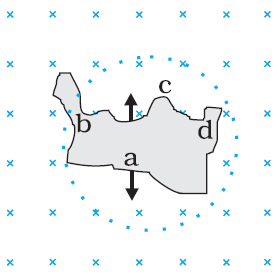
- A wire of irregular shape turning into a circular shape;
- A circular loop being deformed into a narrow straight wire.
A 1.0m long metallic rod is rotated with an angular frequency of 400 rad s–1 about an axis normal to the rod passing through its one end. The other end of the rod is in contact with a circular metallic ring. A constant and uniform magnetic field of 0.5T parallel to the axis exists everywhere. Calculate the emf developed between the centre and the ring.
Consider Experiment 6.2. (a) What would you do to obtain a large deflection of the galvanometer? (b) How would you demonstrate the presence of an induced current in the absence of a galvanometer?
State the underlying principle of a transformer.How is the large scale transmission of electric energy over long distances done with the use of transformers?
A horizontal straight wire 10m long extending from east to west is falling with a speed of 5.0ms–1, at right angles to the horizontal component of the earth’s magnetic field, 0.30 × 10⁻⁴Wbm–2.
- What is the instantaneous value of the emf induced in the wire?
- What is the direction of the emf?
- Which end of the wire is at the higher electrical potential?
A rectangular wire loop of sides 8cm and 2cm with a small cut is moving out of a region of uniform magnetic field of magnitude 0.3T directed normal to the loop. What is the emf developed across the cut if the velocity of the loop is 1 cms–1 in a direction normal to the:
- Longer side,
- shorter side of the loop?
For how long does the induced voltage last in each case?
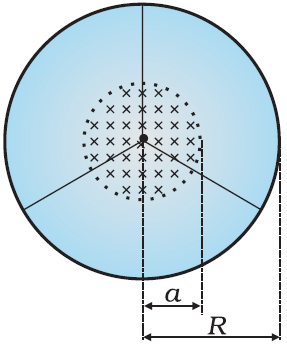
A line charge $\lambda$ per unit length is lodged uniformly onto the rim of a wheel of mass M and radius R. The wheel has light non-conducting spokes and is free to rotate without friction about its axis (Fig.). A uniform magnetic field extends over a circular region within the rim. It is given by,
B = – B0k (r ≤ a; a < R)
= 0 (otherwise)
What is the angular velocity of the wheel after the field is suddenly switched off?
View full solution →B = – B0k (r ≤ a; a < R)
= 0 (otherwise)
What is the angular velocity of the wheel after the field is suddenly switched off?
An air-cored solenoid with length 30cm, area of cross-section 25cm2 and number of turns 500, carries a current of 2.5A. The current is suddenly switched off in a brief time of 10–3s. How much is the average back emf induced across the ends of the open switch in the circuit? Ignore the variation in magnetic field near the ends of the solenoid.
A circular coil of radius 8.0cm and 20 turns is rotated about its vertical diameter with an angular speed of 50rad s–1 in a uniform horizontal magnetic field of magnitude 3.0 × 10⁻²T. Obtain the maximum and average emf induced in the coil. If the coil forms a closed loop of resistance 10Ω, calculate the maximum value of current in the coil. Calculate the average power loss due to Joule heating. Where does this power come from?
A long straight current carrying wire passes normally through the centre of circular loop. If the current through the wire increases, will there be an induced emf in the loop? Justify.
A wheel with 10 metallic spokes each $0.5 m$ long is rotated with a speed of $120 rev / min$ in a plane normal to the horizontal component of earth's magnetic field $H_E$ at a place. If $H_E=0.4 G$ at the place, what is the induced emf between the axle and the rim of the wheel? Note that $1 G =10^{-4} T$.
View full solution →Kamla peddles a stationary bicycle. The pedals of the bicycle are attached to a 100 turn coil of area $0.10 m ^2$. The coil rotates at half a revolution per second and it is placed in a uniform magnetic field of $0.01 T$ perpendicular to the axis of rotation of the coil. What is the maximum voltage generated in the coil?
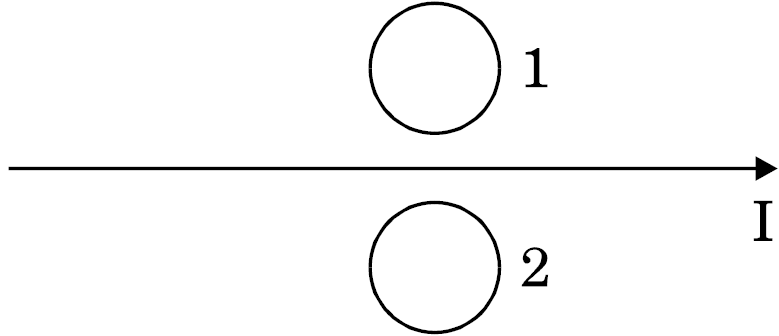
View full solution →What is the direction of induced currents in metal rings 1 and 2 when current I in the wire is increasing steadily?
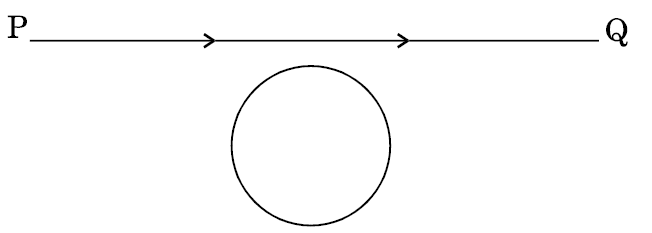
A conducting loop is held below a current carrying wire PQ as shown. Predict the direction of the induced current in the loop when the current in the wire is constantly increasing.
Sunita and her friends visited an exhibition. The policeman asked them to pass through a metal detector. Sunita’s friends were initially scared of it. Sunita, however, explained to them the purpose and working of the metal detector.
Answer the following questions:
Answer the following questions:
- On what principle does a metal detector work?
- Why does the detector emit sound when a person carrying any metallic object walks through it?
- State any two qualities which Sunita displayed while explaining the purpose of walking through the detector.
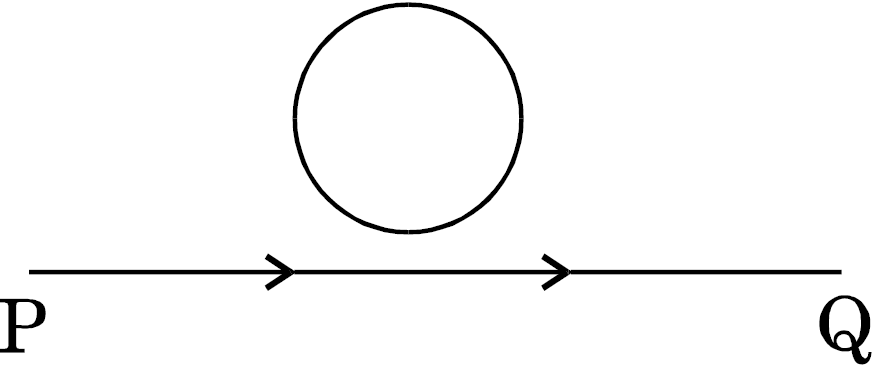
A conducting loop is held above a current carrying wire ‘PQ’ as shown in the figure. Depict the direction of the current induced in the loop when the current in the wire PQ is constantly increasing.
Ram is a student of class X in a village school. His uncle gifted him a bicycle with a dynamo fitted in it. He was very excited to get it. While cycling during night, he could light the bulb and see the objects on the road. He however, did not know this device works. He asked this question to his teacher. the teacher considered it an opportunity to explain the working to the whole class.
Answer the following question:
Answer the following question:
- State the principle and working of a dynamo.
- Write two values each displayed by Ram and his school teacher.
The emf induced across the ends of a conductor due to its motion in a magnetic field is called motional emf. It is produced due to the magnetic Lorentz force acting on the free electrons of the conductor. For a circuit shown in figure, if a conductor of length l moves with velocity v in a magnetic field B perpendicular to both its length and the direction of the magnetic field, then all the induced parametres are possible in the circuit.
View full solution →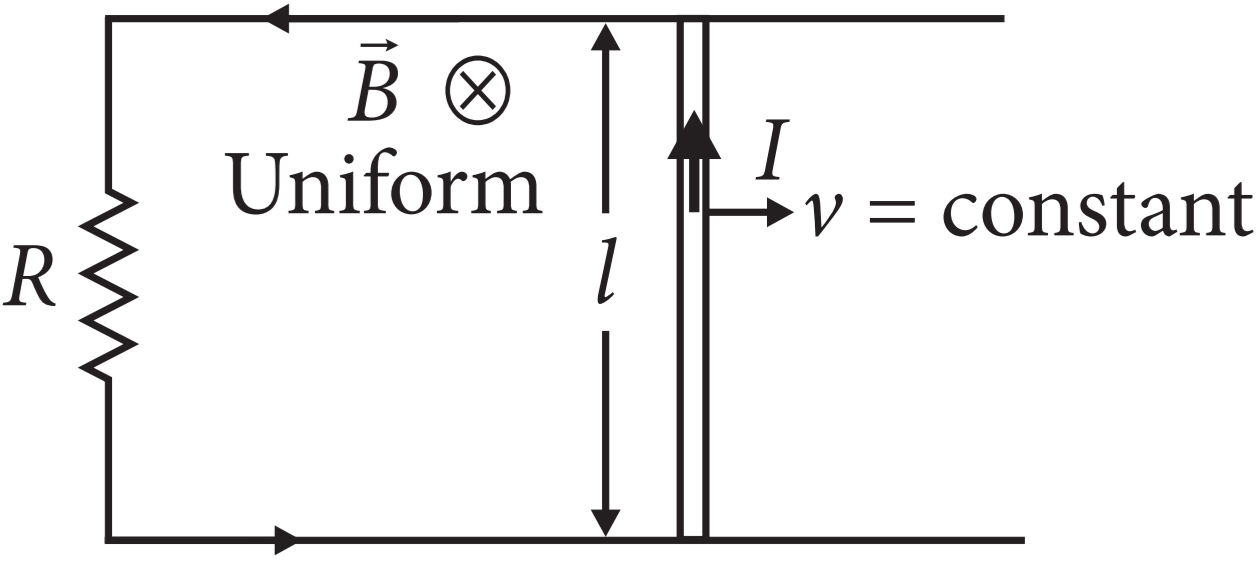
- Direction of current induced in a wire moving in a magnetic field is found using
- Fleming's left hand rule.
- Fleming's right hand rule.
- Ampere's rule.
- Right hand clasp rule.
- A conducting rod of length l is moving in a transverse magnetic field of strength B with velocity v. The resistance of the rod is R. The current in the rod is:
- $\frac{\text{Blv}}{R}$
- $\frac{\text{B}^2\text{v}^2\text{l}^2}{\text{R}}$
- Blv
- Zero
- A 0.1m long conductor carrying a current of SO A is held perpendicular to a magnetic field of 1.25mT. The mechanical power required to move the conductor with a speed of I m s-1 is:
- 62.5 mW
- 625 mW
- 6.25 mW
- 12.5 mW
- A bicycle generator creates 1.5 Vat 15km/ hr. The EMF generated at 10km/ hr is:
- 1.5 volts
- 2 volts
- 0.5 volts
- 1 volt
- The dimensional formula for emf E in MKS system will be:
- [ML2T-3A-1]
- [ML2T-1A]
- [ML2A]
- [MLT-3A-1]
In year 1820 Oersted discovered the magnetic effect of current. Faraday gave the thought that reverse of this phenomenon is also possible i.e., current can also be produced by magnetic field. Faraday showed that when we move a magnet towards the coil which is connected by a sensitive galvanometer. The galvanometer gives instantaneous deflection showing that there is an electric current in the loop. Whenever relative motion between coil and magnet takes place an emf induced in coil. If coil is in closed circuit then current is also induced in the circuit. This phenomenon is called electromagnetic induction.
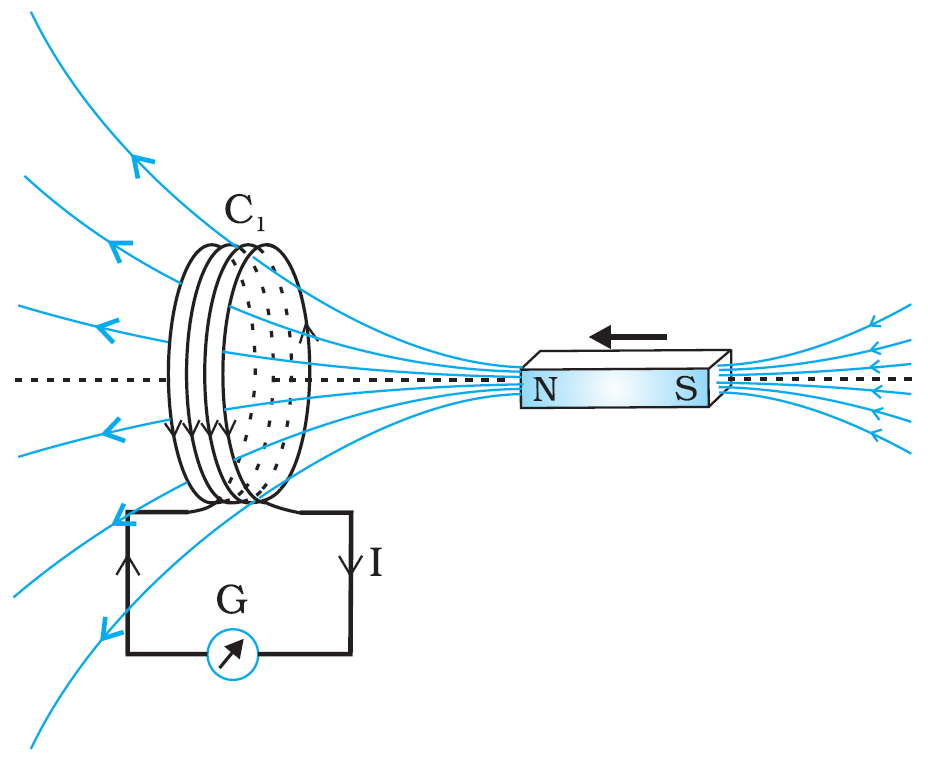
- The north pole of a long bar magnet was pushed slowly into a short solenoid connected to a galvanometer. The magnet was held stationary for a few seconds with the north pole in the middle of the solenoid and then withdrawn rapidly. The maximum deflection of the galvanometer was observed when the magnet was:
- Moving towards the solenoid.
- Moving into the solenoid.
- At rest inside the solenoid.
- Moving out of the solenoid.
- Two similar circular loops carry equal currents in the same direction. On moving the coils further apart, the electric current will.
- Remain unaltered.
- Increases in one and decreases in the second.
- Increase in both.
- Decrease in both.
- A closed iron ring is held horizontally and a bar magnet is dropped through the ring with its length along the axis of the ring. The acceleration of the falling magnet is.
- Equal to g.
- Less than g.
- More than g.
- Depends on the diameter of the ring and length of magnet.
- Whenever there is a relative motion between a coil and a magnet, the magnitude of induced emf set up in the coil does not depend upon the:
- Relative speed between the coil and magnet.
- Magnetic moment of the coil.
- Resistance of the coil.
- Number of turns in the coil.
- A coil of metal wire is kept stationary in a non-uniform magnetic field:
- A n emf and current both are induced in the coil.
- A current but no emf is induced in the coil.
- An emf but no current is induced in the coil.
- Neither emf nor current is induced in the coil.
A tank containing a liquid has turns of wire wrapped around it, causing it to act as an inductor. The liquid content of the tank can be measured by using its inductance to determine the height of the liquid level in the tank. The inductance of the tank changes from a value of Lo corresponding to a relative permeability of 1 when the tank is empty to value Lf corresponding to a relative permeability Xm (relative permeability of liquid) when the tank is full. The appropriate electronic circuit can determine the inductance correct upto 5 significant figures and thus the effective relative permeability of the combined air and liquid within the rectangular has height D. The height of the liquid level in the tank is d. Ignore the fringing effects. Assume tank is fitted with HgXHg = 2.9 × 10⁵.
Express d as a function of L, inductance corresponding to a certain liquid height L0,Lf and D.
Express d as a function of L, inductance corresponding to a certain liquid height L0,Lf and D.
- A$\text{d}=\frac{(\text{L - L})_0\text{D}}{\text{L}_\text{f}-\text{L}_0}$
- B$\text{d}=\frac{\text{L}\text{D}}{\text{L}_\text{f}-\text{L}_0}$
- C$\text{d}=\frac{(\text{L - L})_0\text{D}}{\text{L}_\text{f}}$
- D$\text{None of these}$
Complete the following statement. For electromagnetic induction to occur:
- Aa magnet must be at rest within a coil of wire
- Ba coil of wire must be at rest relative to the magnet.
- Ca magnet must move through a coil of wire.
- Da magnet and a coil must have the same velocity.
The self induction takes place when magnetic flux through a coil:
- ARemains steady
- BDecreases
- CIncreases
- DEither (B) or (C)
In one second, a current of 10 A changes through a coil. The induced emf is 10V, then, self-inductance of the coil is
- A2H
- B5H
- C1H
- D0.5H
Two conducting circular loops F and G are kept in a plane on either side of a straight current-carrying wire as shown in the figure below. If the current in the wire decreases in magnitude, the induced current in the loops will be.
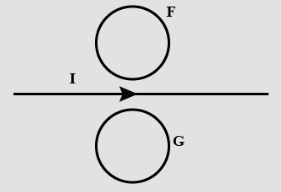
- Aclockwise in F and clockwise in G.
- Banti-clockwise in F and clockwise in G.
- Cclockwise in F and anti-clockwise in G.
- Danti-clockwise in F and anti-clockwise in G.
Two statements are given-one labelled Assertion (A) and the other labelled Reason (R). Select the correct answer to these questions from the codes (a), (b ), (c) and (d) as given below.
Reason (R): Induced current is more in wire having less resistance.
- Both A and R are true and R is the correct explanation of A.
- Both A and Rare true but R is NOT the correct explanation of A.
- A is true but R is false.
- A is false and R is also false.
Reason (R): Induced current is more in wire having less resistance.
Two statements are given-one labelled Assertion (A) and the other labelled Reason (R). Select the correct answer to these questions from the codes (a), (b ), (c) and (d) as given below.
Reason (R): Coefficient of self inductance is proportional to the square of number of turns.
- Both A and R are true and R is the correct explanation of A.
- Both A and Rare true but R is NOT the correct explanation of A.
- A is true but R is false.
- A is false and R is also false.
Reason (R): Coefficient of self inductance is proportional to the square of number of turns.
Two statements are given-one labelled Assertion (A) and the other labelled Reason (R). Select the correct answer to these questions from the codes (a), (b ), (c) and (d) as given below.
Reason (R): The current will be induced only when the speed of satellite is more than 8km/ sec.
- Both A and R are true and R is the correct explanation of A.
- Both A and Rare true but R is NOT the correct explanation of A.
- A is true but R is false.
- A is false and R is also false.
Reason (R): The current will be induced only when the speed of satellite is more than 8km/ sec.
Two statements are given-one labelled Assertion (A) and the other labelled Reason (R). Select the correct answer to these questions from the codes (a), (b ), (c) and (d) as given below.
Reason (R): An induced current develop in a conductor moved in a direction parallel to the magnetic field.
- Both A and R are true and R is the correct explanation of A.
- Both A and Rare true but R is NOT the correct explanation of A.
- A is true but R is false.
- A is false and R is also false.
Reason (R): An induced current develop in a conductor moved in a direction parallel to the magnetic field.
Two statements are given-one labelled Assertion (A) and the other labelled Reason (R). Select the correct answer to these questions from the codes (a), (b ), (c) and (d) as given below.
Reason (R): Faraday established induced e.m.f. experimentally.
- Both A and R are true and R is the correct explanation of A.
- Both A and Rare true but R is NOT the correct explanation of A.
- A is true but R is false.
- A is false and R is also false.
Reason (R): Faraday established induced e.m.f. experimentally.
Figure shows a metal rod PQ resting on the smooth rails AB and positioned between the poles of a permanent magnet. The rails, the rod, and the magnetic field are in three mutual perpendicular directions. A galvanometer G connects the rails through a switch K. Length of the rod = 15cm, B = 0.50T, resistance of the closed loop containing the rod = 9.0mΩ. Assume the field to be uniform.
- Suppose K is open and the rod is moved with a speed of 12cms-1 in the direction shown. Give the polarity and magnitude of the induced emf.
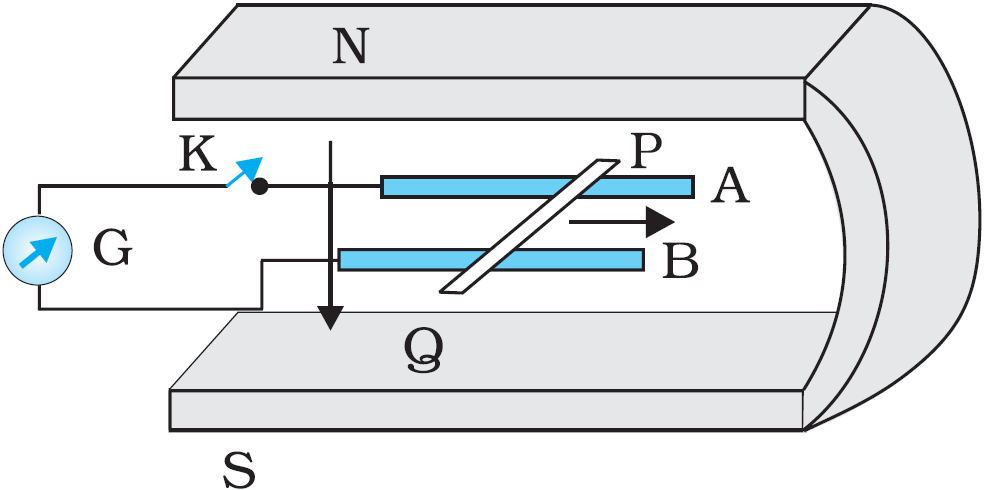
- Is there an excess charge built up at the ends of the rods when K is open? What if K is closed?
- With K open and the rod moving uniformly, there is no net force on the electrons in the rod PQ even though they do experience magnetic force due to the motion of the rod. Explain.
- What is the retarding force on the rod when K is closed?
- How much power is required (by an external agent) to keep the rod moving at the same speed (= 12cms–1) when K is closed? How much power is required when K is open?\
- How much power is dissipated as heat in the closed circuit? What is the source of this power?
- What is the induced emf in the moving rod if the magnetic field is parallel to the rails instead of being perpendicular?
Suppose the loop in Exercise 6.4 is stationary but the current feeding the electromagnet that produces the magnetic field is gradually reduced so that the field decreases from its initial value of 0.3T at the rate of 0.02T s–1. If the cut is joined and the loop has a resistance of 1.6Ω, how much power is dissipated by the loop as heat? What is the source of this power?
It is desired to measure the magnitude of field between the poles of a powerful loud speaker magnet. A small flat search coil of area 2cm2 with 25 closely wound turns, is positioned normal to the field direction, and then quickly snatched out of the field region. Equivalently, one can give it a quick 90º turn to bring its plane parallel to the field direction). The total charge flown in the coil (measured by a ballistic galvanometer connected to coil) is 7.5mC. The combined resistance of the coil and the galvanometer is 0.50Ω. Estimate the field strength of magnet.
A long solenoid with 15 turns per cm has a small loop of area 2.0 cm2 placed inside the solenoid normal to its axis. If the current carried by the solenoid changes steadily from 2.0A to 4.0A in 0.1s, what is the induced emf in the loop while the current is changing?
A square loop of side 12cm with its sides parallel to X and Y axes is moved with a velocity of 8cms–1 in the positive x-direction in an environment containing a magnetic field in the positive z-direction. The field is neither uniform in space nor constant in time. It has a gradient of 10–3T cm–1 along the negative x-direction (that is it increases by 10–3T cm–1 as one moves in the negative x-direction), and it is decreasing in time at the rate of 10 –3T s–1. Determine the direction and magnitude of the induced current in the loop if its resistance is 4.50 mΩ.
Generate a Electromagnetic Induction paper free
Pick question groups from the list above, set marks and difficulty, and export a branded PDF with step-by-step answer keys. First 3 chapters free — no signup.