Question 12 Marks
Write characteristics of electro magnetic waves.
Answer
View full question & answer→Characteristics of EM waves are as follows :
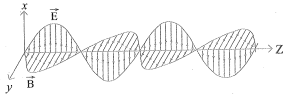
(1) In EM wave, the electric field, magnetic field and direction of wave propogation are mutually perpendicular.
(2) Relationship between the values / magnitudes of electric field and magnetic field in EM wave is :
$\frac{ E _0}{B_0}=c \text { or } \frac{ E _{ rms }}{ B _{ rms }}=c$
(3) EM waves are transverse and non-mechanical waves.
(4) Velocity of EM waves in vacuum, $c=\frac{1}{\sqrt{\mu_0 \varepsilon_0}}$
where, $\mu_0$ - permeability of free space
$\varepsilon_0$ - permittivity of free space
→Velocity of EM waves in medium, $v=\frac{1}{\sqrt{\mu \varepsilon}}$ where, $\mu$ - permeability of medium $\varepsilon$ - permittivity of medium
(5) As demonstrated by scientist Hertz, the EM waves experience diffraction, refraction and polarisation.
(6) EM waves are polarized.
(7) EM waves possess and carry energy, which is known as radiation energy.
(8) When an EM wave strikes (/ is incident) on a surface, it exerts pressure, which is called radiation pressure.
(9) Direction of $\vec{E} \times \vec{B}$ shows the direction of propogation of wave.
(10) In the region of space far from the source, the oscillations of electric field and magnetic field vectors are in phase.
(11) Energy density in EM wave, $\varrho=\varepsilon_0 E _{\text {rms }}^2$ and $\varrho=\frac{ B _{\text {rms }}^2}{\mu_0}$.
(1) In EM wave, the electric field, magnetic field and direction of wave propogation are mutually perpendicular.
(2) Relationship between the values / magnitudes of electric field and magnetic field in EM wave is :
$\frac{ E _0}{B_0}=c \text { or } \frac{ E _{ rms }}{ B _{ rms }}=c$
(3) EM waves are transverse and non-mechanical waves.
(4) Velocity of EM waves in vacuum, $c=\frac{1}{\sqrt{\mu_0 \varepsilon_0}}$
where, $\mu_0$ - permeability of free space
$\varepsilon_0$ - permittivity of free space
→Velocity of EM waves in medium, $v=\frac{1}{\sqrt{\mu \varepsilon}}$ where, $\mu$ - permeability of medium $\varepsilon$ - permittivity of medium
(5) As demonstrated by scientist Hertz, the EM waves experience diffraction, refraction and polarisation.
(6) EM waves are polarized.
(7) EM waves possess and carry energy, which is known as radiation energy.
(8) When an EM wave strikes (/ is incident) on a surface, it exerts pressure, which is called radiation pressure.
(9) Direction of $\vec{E} \times \vec{B}$ shows the direction of propogation of wave.
(10) In the region of space far from the source, the oscillations of electric field and magnetic field vectors are in phase.
(11) Energy density in EM wave, $\varrho=\varepsilon_0 E _{\text {rms }}^2$ and $\varrho=\frac{ B _{\text {rms }}^2}{\mu_0}$.