Questions · Page 4 of 4

M.C.Q (1 Marks)

MCQ 1511 Mark
Assume you are sitting in sun for 2.5 hours. The area of your body exposed normally to sun rays 1.3m2. The intensity of sun rays is $\frac{1.1 \text{Kilowatt}}{\text{m}^2}$ If your body completely absorbs the sun rays then the momentum transferred to your body will be (in Kg - $\frac{\text{m}}{\text{s}}$):
  • A
    0.043
  • B
    0.037
  • C
    0.61
  • D
    -0.91
Answer
  1. 0.043

Explanation:

Power = intensity × area

Intensity and area are given,

Power = 1.3 × 1.1KW

Energy = power × time

Time is 2.5hr

Energy = 1300 × 1.1 × 2.5 × 3600J

= 12870000J

$\text{Momentum}=\frac{\text{energy}}{\text{c}}$

$=\frac{12870000}{3\times10^8}$

$=0.043$
View full question & answer
MCQ 1521 Mark
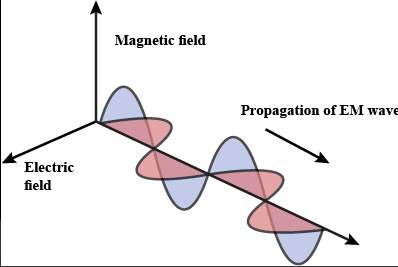
In the propagation of electromagnetic waves the angle between the direction of propagation and the plane of vibration is ________
  • A
    $\pi$
  • B
    $\frac{\pi}{2}$
  • C
    $\frac{\pi}{4}$
  • D
    $0$
Answer
  1. $\frac{\pi}{2}$

Explanation:

Axis of propagation always lie perpendicular to the plane of vibrations, therefor angle between them is $\frac{\pi}{2}$

View full question & answer
MCQ 1531 Mark
 Which of the following statement is false for the properties of em waves?
  • A
    The energy of em wave is divided equally between electric and magnetic fields.
  • B
    Both electric and magnetic field vectors are parallel to each and perpendicular to the direction of propagation of wave.
  • C
    These waves do not require any material medium for propagation.
  • D
    Both electric and magnetic field vectors attain the maximum and minimum at the same place and same time.
Answer
  1. Both electric and magnetic field vectors are parallel to each and perpendicular to the direction of propagation of wave.
View full question & answer
MCQ 1541 Mark
Which of the following statement is false for the properties of electromagnetic waves?
  • A
    Both electric and magnetic field vectors attain the maxima and minima at the same place and same time.
  • B
    The energy in electromagnetic waves is divided equally between electric and magnetic field vectors.
  • C
    Both electric and magnetic field vectors are parallel to each other and perpendicular to the direction of propagation of wave.
  • D
    These waves do not require any material medium for propagation.
Answer
  1. Both electric and magnetic field vectors are parallel to each other and perpendicular to the direction of propagation of wave.
View full question & answer
MCQ 1561 Mark
A compass needle is placed in the gap of a parallel plate capacitor. The capacitor is connected to a battery through a resistance. The compass needle:
  • A
    Does not deflect.
  • B
    Deflects for a very short time and then comes back to the original position.
  • C
    Deflects and remains deflected as long as the battery is connected.
  • D
    Deflects and gradually comes to the original position in a time that is large compared to the time constant.
Answer
  1. Deflects and gradually comes to the original position in a time that is large compared to the time constant.

Explanation:

The compass needle deflects due to the presence of the magnetic field. Inside the capacitor, a magnetic field is produced when there is a changing electric field inside it. As the capacitor is connected across the battery, the charge on its plates at a certain time tis given by,

$\text{Q}=\text{CV}\Big(1-\text{e}^{-\tau/\text{RC}}\Big),$

Q = Charge developed on the plates of the capacitor.

R = Resistance of the resistor connected in series with the capacitor.

C = Capacitance of the capacitor.

V = Potential difference of the battery.

The time constant of the capacitor is given, $\tau=\text{RC}$

The capacitor keeps on charging up to the time $\tau$. The development of charge on the plates will be gradual after $​​\tau=\text{RC}$ The change in electric field will be up to the time the charge is developing on the plates of the capacitor. Thus, the compass needle deflects and gradually comes to the original position in a time that is large compared to the time constant.

View full question & answer
MCQ 1571 Mark
If E and B represent electric and magnetic field vectors of the electromagnetic wave, the direction of propagation of electromagnetic wave is along,
  • A
    E.
  • B
    B.
  • C
    B × E.
  • D
    E × B.
Answer
  1. E × B.

Solution:

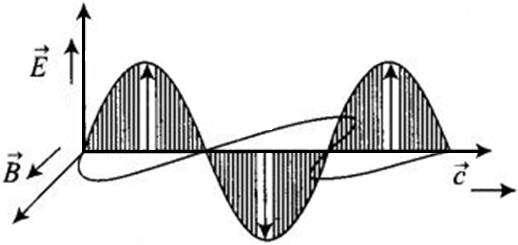
Key concept: A changing electric field produces a changing magnetic field and vice versa which gives rise to a transverse wave known as electromagnetic wave. The time varying electric and magnetic field are mutually perpendicular to each other and also perpendicular to the direction of propagation of this wave. The electric vector is responsible for the optical effects of an EM wave and is called the light vector.

The direction of propagation of electromagnetic wave is perpendicular to both electric field vector $(\vec{\text{E}})$ and $\vec{\text{B}}$ magnetic field vector B, i.e., in the direction of $\vec{\text{E}}\times\vec{\text{B}}$.

Here, elecromagnetic wave is along the z-direction which is given by the cross product of E and B.

View full question & answer
MCQ 1581 Mark
The period of the wave will be.
  • A
    $2.5\mu\text{s}$
  • B
    $0.25\mu\text{s}$
  • C
    $0.025\mu\text{s}$
  • D
    $\text{None of these}$
Answer
  1. $0.025\mu\text{s}$

Explanation:

Time period, $\text{T}=\frac{1}{\text{v}}$

$\text{T}=\frac{1}{40\times10^6}$

$\Rightarrow\text{T}=0.25\mu\text{s}$

View full question & answer
MCQ 1591 Mark
A free electron is placed in the path of a plane electromagnetic wave. The electron will start moving:
  • A
    Along the electric field.
  • B
    Along the magnetic field.
  • C
    Along the direction of propagation of the wave.
  • D
    In a plane containing the magnetic field and the direction of propagation.
Answer
  1. Along the electric field.

Explanation:

As the electron is at rest initially, only the electric field will exert force on it. There will be no magnetic force on the electron in the stating. Hence, the electron will start moving along the electric field.

View full question & answer
MCQ 1601 Mark
Pick out the electromagnetic wave which is highly harmful to humans.
  • A
    Radio waves
  • B
    Ultraviolet Rays
  • C
    Microwaves
  • D
    Infrared Waves
Answer
  1. Ultraviolet Rays

Explanation:

Ultraviolet (UV) radiations in large quantities are highly harmful to humans. These rays in solar radiation on reaching earth are absorbed by the ozone layer in the atmosphere. UV rays are produced by special lamps such as mercury and from arc lamps and by very hot bodies like the sun.

View full question & answer
MCQ 1611 Mark
 Maxwell in his famous equations of electromagnetism introduced the concept of:
  • A
    Ac current
  • B
    Displacement current
  • C
    Impedance
  • D
    Reactance
Answer
  1. Displacement current
View full question & answer
MCQ 1621 Mark
Choose the correct answer from the alternatives given. Electromagnetic wave consists of periodically oscillating electric and magnetic vectors:
  • A
    In mutually perpendicular planes but vibrating with a phase difference of $\pi$
  • B
    In mutually perpendicular planes but vibrating with a phase difference of $2\pi$
  • C
    In randomly oriented planes but vibrating in phase
  • D
    In mutually perpendicular planes but vibrating in phase
Answer
  1. In mutually perpendicular planes but vibrating in phase

Explanation:

The Electromagnetic wave consists of the two mutually perpendicular electric and magnetic fields present in the medium and also both being perpendicular to the direction of propagation of the wave. The two fields are in same phase as they obtain their peaks at the same instant.

An electromagnetic wave consists of periodically oscillating electric and the magnetic vector in mutually perpendicular planes but vibrating in phase.

View full question & answer
MCQ 1631 Mark
 What is the full form of UHF?
  • A
    Under heavy frequency
  • B
    Ultra-high frequency
  • C
    Ultra heavy frequency
  • D
    Under high frequency
Answer
  1. Ultra-high frequency

Explanation:

UHF stands for Ultra high frequency. Cellular phones used radio waves to transmit voice communication in the Ultra high-frequency Band. The UHF band extends from 900 MHz to 5 x 10⁹ Hz or 5000 MHz. Radio waves are produced by oscillating circuits having an inductor and capacitor.

View full question & answer
MCQ 1641 Mark
The source of electromagnetic waves can be a charge:
  • A
    Moving with a constant velocity.
  • B
    Moving in a circular orbit.
  • C
    At rest.
  • D
    Falling in an electric field.
Answer
  1. Moving in a circular orbit.
  1. falling in an electric field.

Solution:

Key concept:

  1. An electromagnetic wave can be produced by accelerated or oscillating charge.
  2. An oscillating charge is accelerating continuously, it will radiate electromagnetic waves continuously.
  3. Electromagnetic waves are also produced when fast moving electrons are suddenly stopped by a metal target of high atomic number.

Here, in option (b) charge is moving in a circular orbit.
In circular motion, the direction of the motion of charge is changing continuously, thus it is an accelerated motion and this option is correct.

In option (d), the charge is falling in electric field. If a charged particle is moving in electric field it experiences a force or we can say it accelerates. We know an accelerating charge particle radiates electromagnetic waves. Hence option (d) is also correct.

Also, we know that a charge starts accelerating when it falls in an electric field.

Important points:

  1. In an atom an electron is circulating around the nucleus in a stable orbit, although accelerating does not emit electromagnetic waves; it does so only when it jumps from a higher energy orbit to a lower energy orbit.
  2. A simple LC oscillator and energy source can produce waves of desired frequency
View full question & answer
MCQ 1651 Mark
Electromagnetic waves are transverse in nature is evident by.
  • A
    polarization
  • B
    interference
  • C
    reflection
  • D
    diffraction
Answer
  1. polarization
View full question & answer
MCQ 1661 Mark
The conduction current is same as displacement current when source is:
  • A
    Ac only
  • B
    Dc only
  • C
    Either ac or dc
  • D
    Neither dc nor ac
Answer
  1. Either ac or dc
View full question & answer
MCQ 1671 Mark
The pressure exerted by an electromagnetic wave of intensity I$\Big(\frac{\text{watt}}{\text{m}^2}\Big)$ on a non-reflecting surface is : [c is the velocity of light].
  • A
    $\text{Ic}$
  • B
    $\text{Ic}^2$
  • C
    $\frac{\text{I}}{\text{c}}$
  • D
    $\frac{\text{I}}{\text{c}^2}$
Answer
  1. $\frac{\text{I}}{\text{c}}$

Explanation:

Momentum of a photon

$=\frac{\text{h}}{\lambda}=\frac{\text{h}}{\frac{\text{c}}{\text{v}}}=\frac{\text{hv}}{\text{c}}=\frac{\text{E}}{\text{c}}$

Momentum over unit area

$=\frac{\text{E}}{\text{Ac}}=\frac{\text{I}}{\text{c}}\Big[\text{I}=\frac{\text{E}}{\text{A}}\text{ For wave}\Big]$

Since surface is non reflecting, final momentum of photon = 0, change in momentum $=\frac{\text{I}}{\text{c}}$

So, force per unit area $=\frac{\text{I}}{\text{c}}$

Pressure of radiation $=\frac{\text{I}}{\text{c}}$

View full question & answer
MCQ 1681 Mark
Maxwell's equation describe the fundamental laws of.
  • A
    electricity
  • B
    magnetism
  • C
    mechanics
  • D
    both (A) and (B)
Answer
  1. both (A) and (B)

Explanation:

Maxwell's equation describe the fundamental laws of electricity and magnetism. His equations describe how electric and magnetic fields are generated and altered by each other and by charges and currents.

View full question & answer
MCQ 1691 Mark
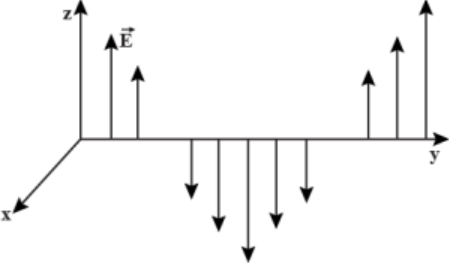
The electric field for a plane, electomagnetic wave travelling in the +y direction is shown in figure.If the electric field of the wave $\overline{\text{E}}$ is in the Z direction , then the $\overline{\text{B}}$ field is.
Image
  • A
    In the x direction and in phase with the $\overline{\text{E}}$ field
  • B
    In the x direction and out of phase with the $\overline{\text{E}}$ field
  • C
    In the z direction and in phase with the $\overline{\text{E}}$ field
  • D
    In the z direction and one fourth of a cycle out of phase with the $\overline{\text{E}}$ field
Answer
  1. In the x direction and in phase with the $\overline{\text{E}}$ field

Explanation:

The wave equation for a plane electric wave traveling in the x direction in space is

$\frac{\delta^2\text{E}}{\delta^2\text{y}}=\frac{1}{\text{c}^2}\frac{\delta^2\text{E}}{\delta\text{t}^2}$

with the same form applying to the magnetic field wave in a plane perpendicular the electric field. Both the electric field and the magnetic field are perpendicular to the direction of travel y.

View full question & answer
MCQ 1701 Mark
A parallel plate capacitor is charged to $60\mu\text{c}$ Due to a radioactive source, the plate loses charge at the rate of $1.8\times10^{-8}\frac{\text{C}}{\text{s}}$ The magnitude of displacement current is:
  • A
    $1.8\times10^{-8}\frac{\text{C}}{\text{s}}$
  • B
    $3.6\times10^{-8}\frac{\text{C}}{\text{s}}$
  • C
    $1.8\times10^{-8}\frac{\text{C}}{\text{s}}$
  • D
    $5.7\times10^{-12}\frac{\text{C}}{\text{s}}$
Answer
  1. $1.8\times10^{-8}\frac{\text{C}}{\text{s}}$

Explanation:

The displacement current is that current which comes into play in the region in which the electric field and hence the electric flux is changing with time.
Maxwell found that conduction current (I) and displacement current (Id​) together have the property of continuity, although individually they may not be continuous. Maxwell also predicted that this current produces the same magnetic field as a conduction current can produce.
Displacement current is given by 

$\text{I}_\text{d}=\frac{\text{dq}}{\text{dt}}=1.8\times10^{-8}\frac{\text{C}}{\text{s}}$

View full question & answer
MCQ 1711 Mark
The concept of displacement current introduced by Maxwell removes asymmetry between.
  • A
    Gauss's law in electrostatics and Gauss's law in magnetism
  • B
    Faraday's law and Ampere' law
  • C
    Gauss's law and Ampere's law
  • D
    Gauss's law and Faraday's law
Answer
  1. Faraday's law and Ampere' law

Explanation:

Maxwell added the concept of displacement current in AMpere Circuit Law which governs the conduction in the wire of conduction current. After the deviation compass between capacitor Maxwell thought of magnetic lines which would be the result of varying current known as displacement current. So by continuing the displacement in Amperes law, Maxwell was able to show the result of Amperes conduction in circuit moving electrons and also the result of faraday generation of ME waves.

View full question & answer
MCQ 1721 Mark
Consider the following two statements regarding a linearly polarised, plane electromagnetic wave:
  1. The electric field and the magnetic field have equal average values.
  2. The electric energy and the magnetic energy have equal average values.
    • A
      Both A and B are true.
    • B
      A is false but B is true.
    • C
      B is false but A is true
    • D
      Both A and B are false.
    Answer
    1. Both A and B are true.

    Explanation:

    For a linearly polarised, plane electromagnetic wave,

    $\text{E}=\text{E}_0\sin\omega\Big(\text{t}-\frac{\text{x}}{\text{c}}\Big)$

    $\text{B}=\text{B}_0\sin\omega\Big(\text{t}-\frac{\text{x}}{\text{c}}\Big)$

    The average value of either E or Bover a cycle is zero (average of $\sin(\theta)$ over a cycle is zero).

    Also the electric energy density (UE) and magnetic energy density (UB)are equal.

    $\text{u}_\text{E}=\frac{1}{2}\in_0\text{E}^2=\frac{\text{B}^2}{2\mu_0}=\text{u}_\text{B}$

    Energy can be found out by integrating energy density over the entire volume of full space. As the energy of the electromagnetic wave is equally shared between electric and magnetic field so their average values will also be equal.

    View full question & answer
    MCQ 1731 Mark
     Identify the electromagnetic wave which is also known as heatwaves.
    • A
      Radio Waves
    • B
      Gamma Waves
    • C
      X-Rays
    • D
      Infrared Waves
    Answer
    1. Infrared Waves

    Explanation:

    Infrared waves are heat radiations also known as heatwaves. These waves are produced by hot bodies and molecules. They do heating because water molecules present in most of the materials readily absorb infrared waves and their thermal motion increases, so they heat themselves and also heat their surroundings.

    View full question & answer
    MCQ 1741 Mark
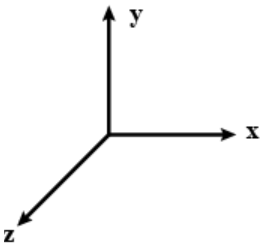
    Light wave is travelling along y - direction. If the corresponding E vector at any time along the x - axis, the direction of B vector at that time is along.
    Image
    • A
      y - axis
    • B
      x - axis
    • C
      z - axis
    • D
      -z - axis
    Answer
    1. z - axis

    Explanation:

    Light wave is an electromagnetic wave in which E and B are at right angles to each other as well as at right angles to the direction of wave propagation. So from the given information in the question, the direction of B vector is in positive z direction.

    View full question & answer
    MCQ 1751 Mark
    If the frequency of EM radiations is halved then the energy of EM radiation will become:
    • A
      Double
    • B
      Remains unchanged
    • C
      Becomes half
    • D
      Becomes one fourth
    Answer
    1. Becomes half
    View full question & answer
    MCQ 1761 Mark
    Ultraviolet rays coming from sun are absorbed by:
    • A
      Troposphere
    • B
      Ionosphere
    • C
      Stratosphere
    • D
      Mesosphere
    Answer
    1. Ionosphere
    View full question & answer
    MCQ 1771 Mark
    The angular frequency of emf wave will be (in $\frac{\text{rad}}{\text{s}}$)
    • A
      8p × 107
    • B
      4p × 106
    • C
      2p × 105
    • D
      $\pi$ × 104
    Answer
    1. 8p × 107

    Explanation:

    Frequency of wave f = 40 × 106 Hz

    Angular frequency, $\omega=2\pi\text{v}$

    $\omega=2\pi\times40\times10^6$

    $\Rightarrow\omega=8\pi\times10^7\frac{\text{rad}}{\text{s}}$

    View full question & answer
    MCQ 1781 Mark
    Which one of the following has the shortest wavelength?
    • A
      Infrared rays
    • B
      Ultraviolet rays
    • C
      Microwaves
    • D
      Gamma rays
    Answer
    1. Gamma rays
    View full question & answer