Questions · Page 2 of 2

5 Marks Questions

Question 515 Marks
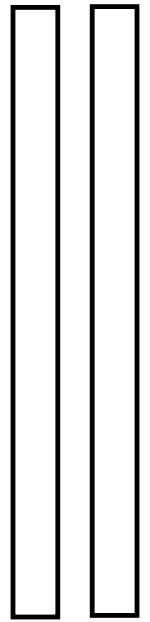
A parallel-plate capacitor has plate area 25.0cm2 and a separation of 2.00mm between the plates. The capacitor is connected to a battery of 12.0V:
  1. Find the charge on the capacitor.
  2. The plate separation is decreased to 1.00mm. Find the extra charge given by the battery to the positive plate.
Answer

Plate area A = 25cm2 = 2.5 × 10⁻³m

Separation d = 2mm = 2 × 10⁻³m

Potential v = 12v

  1. We know

$\text{C}=\frac{\in_0\text{A}}{\text{d}}$

$=\frac{8.85\times10^{-12}\times2.5\times10^{-3}}{2\times10^{-3}}$

$=11.06\times10^{-12}\text{F}$

$\text{C}=\frac{\text{q}}{\text{v}}$

$\Rightarrow11.06\times10^{-12}=\frac{\text{q}}{12}$

$\Rightarrow\text{q}_1=1.32\times10^{-10}\text{C}.$

  1. Then d = decreased to 1mm

$\therefore\ \text{d}=1\text{mm}=1\times10^{-3}\text{m}$

$\text{C}=\frac{\in_0\text{A}}{\text{d}}=\frac{\text{q}}{\text{v}}$

$=\frac{8.85\times10^{-12}\times2.5\times10^{-3}}{1\times10^{-3}}=\frac{2}{12}$

$\Rightarrow\text{q}_2=8.85\times2.5\times12\times10^{-12}$

$\Rightarrow\text{q}_2=2.65\times10^{-10}\text{C}.$

$\therefore$ The extra charge given to plate = (2.65 - 1.32) × 10-10 = 1.33 × 10⁻¹⁰C.
View full question & answer
Question 525 Marks
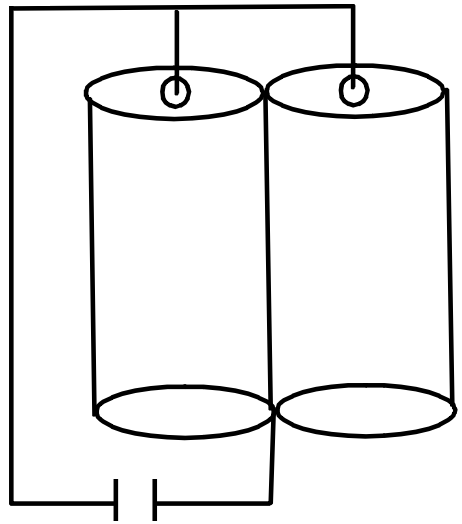
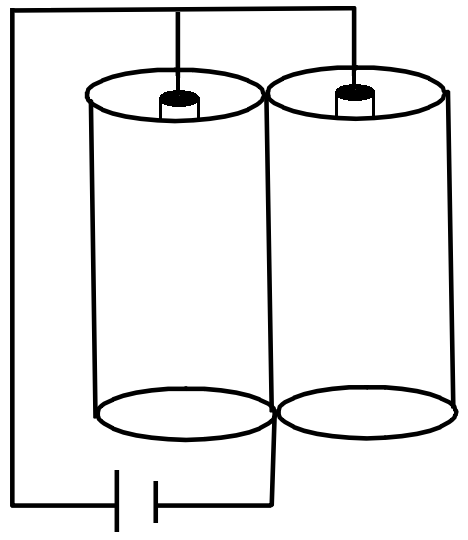
The outer cylinders of two cylindrical capacitors of capacitance $2.2\mu\text{F}$ each, are kept in contact and the inner cylinders are connected through a wire. A battery of emf 10V is connected as shown in figure. Find the total charge supplied by the battery to the inner cylinders.

Answer

The capacitance of the outer sphere $=2.2\mu\text{F}$

$\text{C}=2.2\mu\text{F}$

Potential, V = 10v

Let the charge given to individual cylinder = q.

$\text{C}=\frac{\text{q}}{\text{V}}$

$\Rightarrow\text{q}=\text{CV}=2.2\times10=22\mu\text{F}$

$\therefore$ The total charge given to the inner cylinder $=22+22=44\mu\text{F}$

View full question & answer
Question 535 Marks
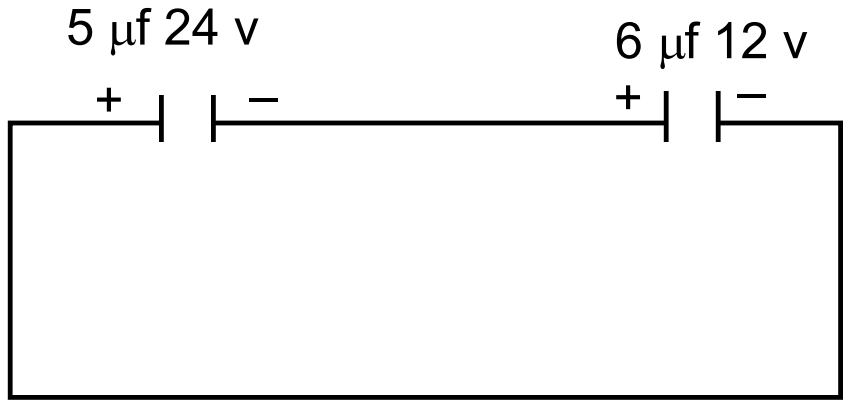
A capacitor of capacitance $5.00\mu\text{F}$ is charged to 24.0V and another capacitor of capacitance $6.0\mu\text{F}$ is charged to 12.0V:
  1. Find the energy stored in each capacitor.
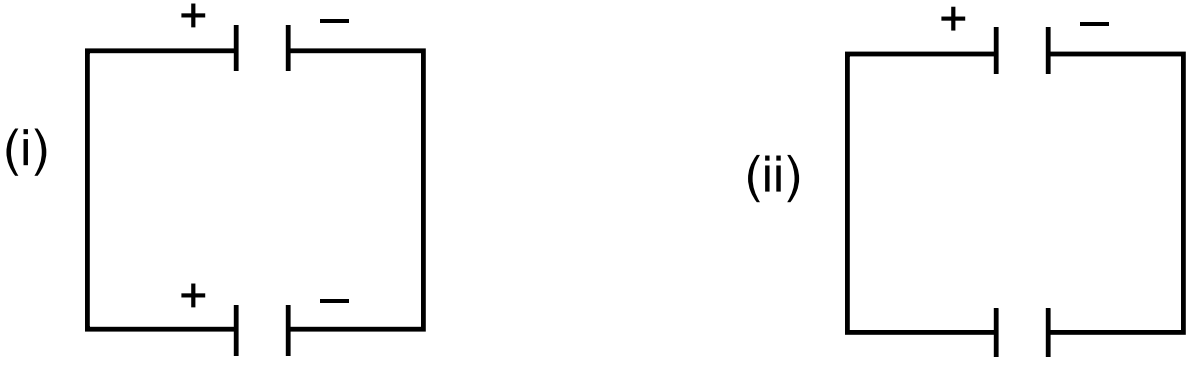
  2. The positive plate of the first capacitor is now connected to the negative plate of the second and vice versa. Find the new charges on the capacitors.
  3. Find the loss of electrostatic energy during the process.
  4. Where does this energy go?
Answer
  1. $\text{C}_1=5\mu\text{f}$

$\text{V}_1=24\text{V}$

$\text{q}_1=\text{C}_1\text{V}_1=5\times24=120\mu\text{c}$

and $\text{C}_2=6\mu\text{f}$

$\text{V}_2=\text{R}$

$\text{q}_2=\text{C}_2\text{V}_2=6\times12=72$

$\therefore$ Energy stored on first capacitor

$\text{E}_1=\frac{1}2{}\frac{\text{q}_1^2}{\text{C}_1}=\frac{1}{2}\times\frac{(120)^2}{2}=1440\text{J}=1.44\text{mJ}$

Energy stored on 2nd capacitor

$\text{E}_2=\frac{1}2{}\frac{\text{q}_2^2}{\text{C}_1}=\frac{1}{2}\times\frac{(72)^2}{6}=432\text{J}=4.32\text{mJ}$

  1. C1V1

C2V2

Let the effective potential = V

$\text{V}=\frac{\text{C}_1\text{V}_1-\text{C}_2\text{V}_2}{\text{C}_1+\text{C}_2}=\frac{120-72}{5+6}=4.36$

The new charge $\text{C}_1\text{V}=5\times4.36=21.8\mu\text{c}$

and $\text{C}_2\text{V}=6\times4.36=26.2\mu\text{c}$

  1. $\text{U}_1=\Big(\frac{1}{2}\Big)\text{C}_1\text{V}^2$

$\text{U}_2=\Big(\frac{1}{2}\Big)\text{C}_2\text{V}^2$

$\text{U}_{\text{f}}=\Big(\frac{1}{2}\Big)\text{V}^2(\text{C}_1+\text{C}_2)$

$=\Big(\frac{1}{2}\Big)(4.36)^2(5+6)$

$=104.5\times10^{-6}\text{J}=0.1045\text{mJ}$

But $\text{U}_{\text{i}}=1.44+0.433=1.873$

$\therefore$ The loss in KE = 1.873 - 0.1045 = 1.7687 = 1.77mJ

View full question & answer
Question 545 Marks
A $5.0\mu\text{F}$ capacitor is charged to 12V. The positive plate of this capacitor is now connected to the negative terminal of a 12V battery and vice versa. Calculate the heat developed in the connecting wires.
Answer

When the capacitor is connected to the battery, a charge Q = CE appears on one plate and -Q on the other. When the polarity is reversed, a charge -Q appears on the first plate and +Q on the second. A charge 2Q, therefore passes through the battery from the negative to the positive terminal.

The battery does a work.

W = Q × E = 2QE = 2CE2

In this process. The energy stored in the capacitor is the same in the two cases. Thus the workdone by battery appears as heat in the connecting wires. The heat produced is therefore,

2CE2 = 2 × 5 × 10-6 × 144 = 144 × 10-5J = 1.44mJ [have C = 5μf, V = E = 12V]

View full question & answer
Question 555 Marks
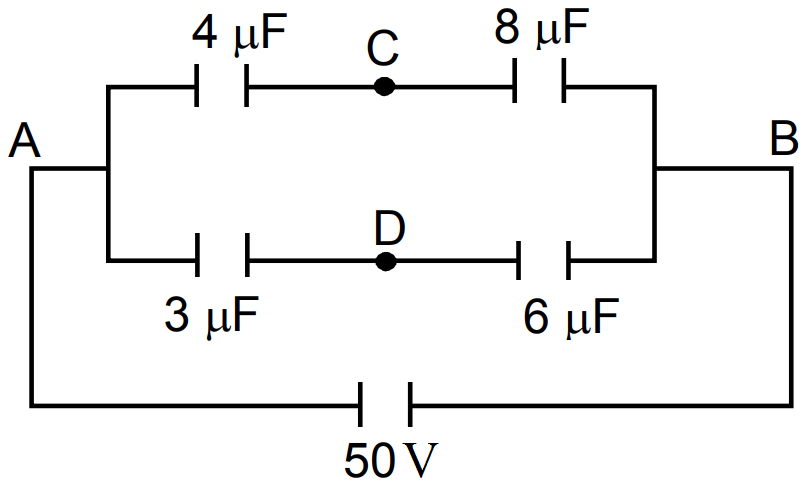
Take the potential of the point B in figure to be zero:
  1. Find the potentials at the points C and D.
  2. If a capacitor is connected between C and D, what charge will appear on this capacitor?

Answer

  1. Capacitor $=\frac{4\times8}{4+8}=\frac{8}{3}\mu\text{F}$

and $=\frac{6\times3}{6+3}=2\mu\text{F}$

  1. The charge on the capacitance $\frac{8}{3}\mu\text{F}$

$\therefore\text{Q}=\frac{8}{3}\times50=\frac{400}{3}$

$\therefore$ The potential at $4\mu\text{F}=\frac{400}{3\times4}=\frac{100}{3}$

at $8\mu\text{F}=\frac{400}{3\times8}=\frac{100}{6}$

The Potential difference $=\frac{100}{3}-\frac{100}{6}=\frac{50}{3}\mu\text{V}$

  1. Hence the effective charge at $2\mu\text{F}=50\times2=100\mu\text{F}$

$\therefore$ Potential at $3\mu\text{F}=\frac{100}{3};$ Potential at $6\mu\text{F}=\frac{100}{6}$

$\therefore$ Difference $=\frac{100}{3}-\frac{100}{6}=\frac{50}{3}\mu\text{V}$

$\therefore$ The potential at C & D is $\frac{50}{3}\mu\text{V}$

  1. $\therefore\frac{\text{P}}{\text{Q}}=\frac{\text{R}}{\text{S}}=\frac{1}2{}=\frac{1}{2}=$ It is balanced. So, from it is cleared that the wheat star bridge balanced.

So, the potential at the point C & D are same. So, no current flow through the point C & D.

So, if we connect another capacitor at the point C & D the charge on the capacitor is zero.

View full question & answer
Question 565 Marks
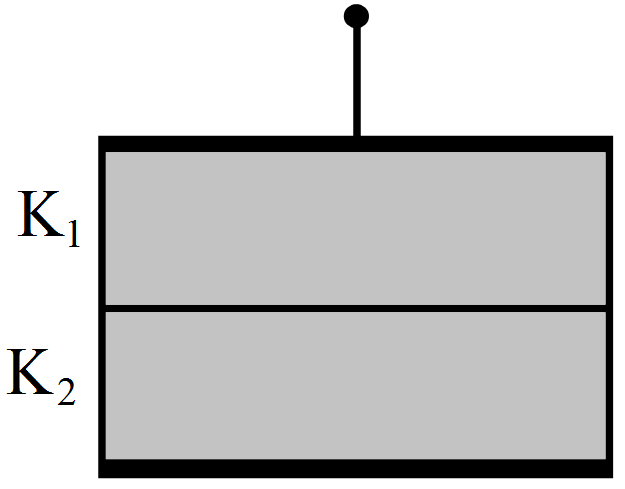
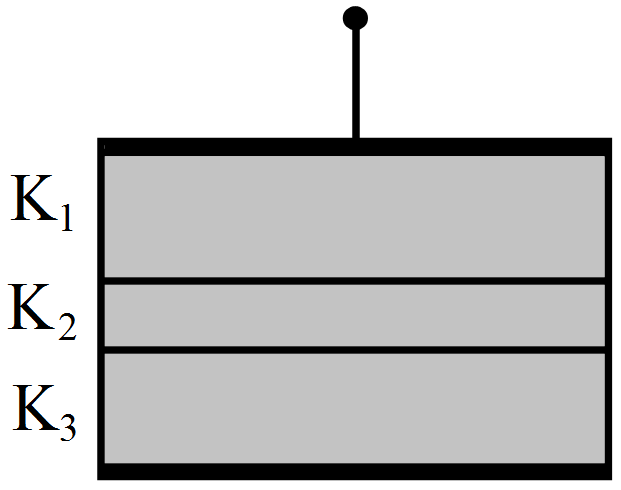
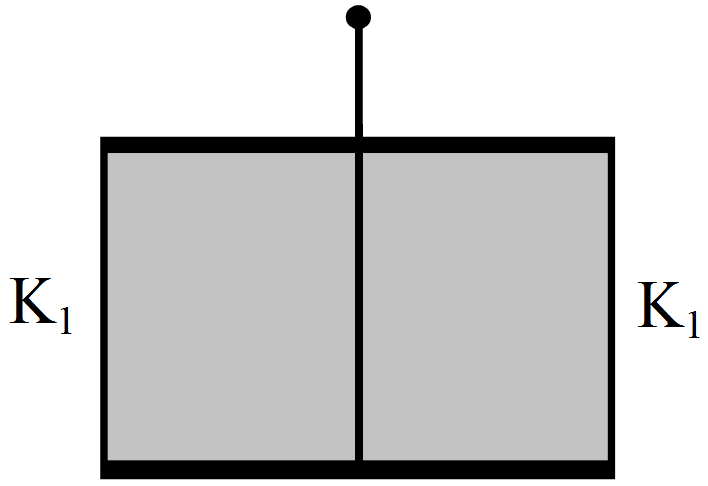
Find the capacitances of the capacitors shown in figure. The plate area is A and the separation between the plates is d. Different dielectric slabs in a particular part of the figure are of the same thickness and the entire gap between the plates is filled with the dielectric slabs.


Answer
  1. Area = A

Separation = d

$\text{C}_1=\frac{\in_0\text{Ak}_1}{\frac{\text{d}}{2}}$

$\text{C}_2=\frac{\in_0\text{Ak}_2}{\frac{\text{d}}{2}}$

$\text{C}=\frac{\text{C}_1\text{C}_2}{\text{C}_1+\text{C}_2}=\frac{\frac{2\in_0\text{Ak}_1}{\text{d}}\times\frac{2\in_0\text{Ak}_2}{\text{d}}}{\frac{2\in_0\text{Ak}_1}{\text{d}}+\frac{2\in_0\text{Ak}_2}{\text{d}}}$

$=\frac{\frac{(2\in_0\text{A})^2\text{k}_1\text{k}_2}{\text{d}^2}}{(2\in_0\text{A})\frac{\text{k}_1\text{d+}\text{k}_2\text{d}}{\text{d}^2}}=\frac{2\text{k}_1\text{k}_2\in_0\text{A}}{\text{d}(\text{k}_1+\text{k}_2)}$

  1. $\frac{1}{\text{C}}=\frac{1}{\text{C}_1}+\frac{1}{\text{C}_2}+\frac{1}{\text{C}_3}$

$=\frac{1}{\frac{3\in_0\text{Ak}_1}{\text{d}}}+\frac{1}{\frac{3\in_0\text{Ak}_2}{\text{d}}}+\frac{1}{\frac{3\in_0\text{Ak}_3}{\text{d}}}$

$=\frac{\text{d}}{3\in_0\text{A}}\Big[\frac{1}{\text{k}_1}+\frac{1}{\text{k}_2}+\frac{1}{\text{k}_3}\Big]$

$=\frac{\text{d}}{3\in_0\text{A}}\Big[\frac{\text{k}_2\text{k}_3+\text{k}_1\text{k}_3+\text{k}_1\text{k}_2}{\text{k}_1\text{k}_2\text{k}_3}\Big]$

$\therefore\text{C}=\frac{3\in_0\text{A}\text{k}_1\text{k}_2\text{k}_3}{\text{d}(\text{k}_1\text{k}_2+\text{k}_2\text{k}_3+\text{k}_1\text{k}_3)}$

  1. $\text{C}=\text{C}_1+\text{C}_2$

$=\frac{\in_0\frac{\text{A}}{2}\text{k}_1}{\text{d}}+\frac{\in_0\frac{\text{A}}{2}\text{k}_2}{\text{d}}=\frac{\in_0\text{A}}{2\text{d}}(\text{k}_1+\text{k}_2)$

View full question & answer
Question 575 Marks
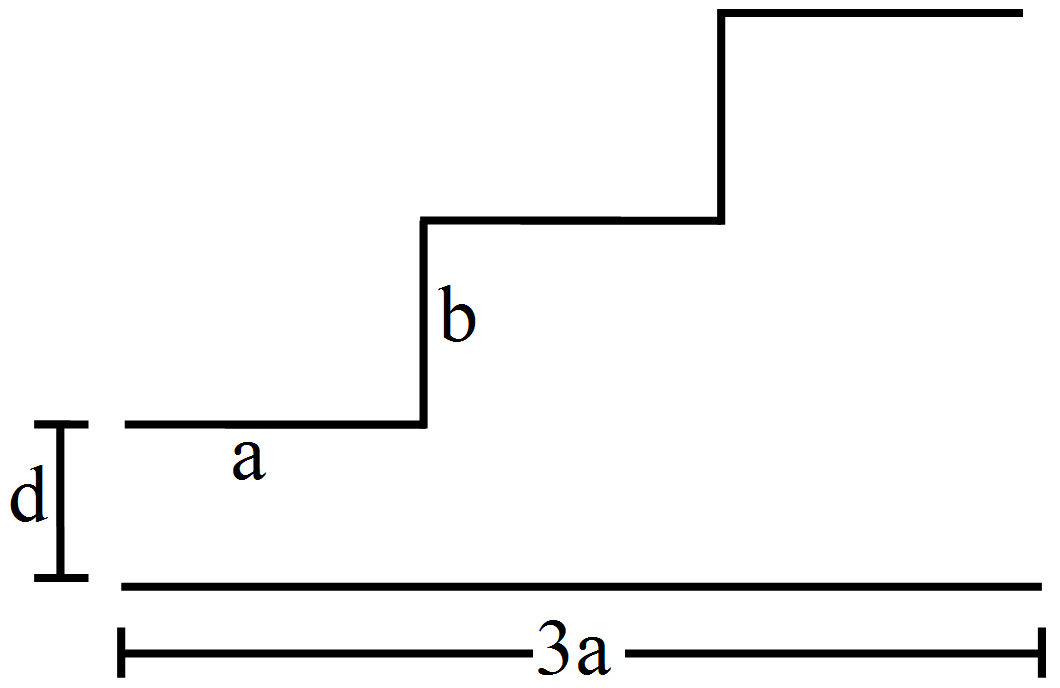
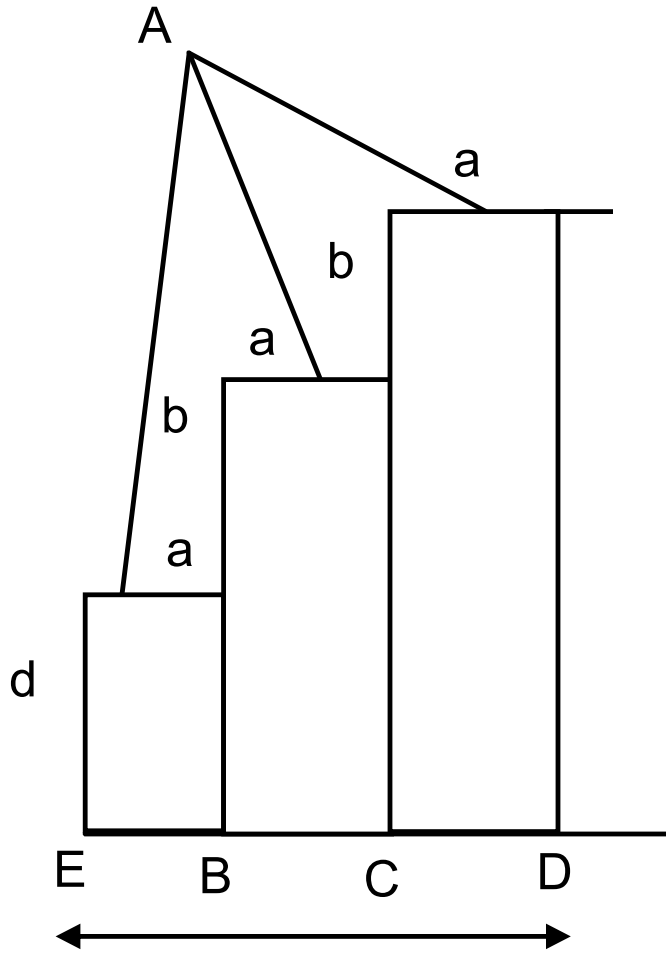
A capacitor is made of a flat plate of area A and a second plate having a stair-like structure as shown in figure. The width of each stair is a and the height is b. Find the capacitance of the assembly.

Answer

In the figure the three capacitors are arranged in parallel.

All have same surface area $=\text{a}=\frac{\text{A}}{3}$

First capacitance $\text{C}_1=\frac{\in_0\text{A}}{3\text{d}}$

Second capacitance $\text{C}_2=\frac{\in_0\text{A}}{3(\text{b}+\text{d})}$

Third capacitance $\text{C}_3=\frac{\in_0\text{A}}{3(2\text{b}+\text{d})}$

$\text{C}_{\text{eq}}=\text{C}_1+\text{C}_2+\text{C}_3$

$=\frac{\in_0\text{A}}{3\text{d}}+\frac{\in_0\text{A}}{3(\text{b}+\text{d})}+\frac{\in_0\text{A}}{3(2\text{b}+\text{d})}$

$=\frac{\in_0\text{A}}{3}\Big(\frac{1}{\text{d}}+\frac{1}{\text{b}+\text{d}}+\frac{2}{\text{2b}+\text{d}}\Big)$

$=\frac{\in_0\text{A}}{3}\Big(\frac{(\text{b}+\text{d})(2\text{b}+\text{d})+(2\text{b}+\text{d})\text{d}+(\text{b}+\text{d})\text{d}}{\text{d}(\text{b}+\text{d})(2\text{b}+\text{d})}\Big)$

$=\frac{\in_0\text{A}\big(3\text{d}^2+6\text{bd}+2\text{b}^2\big)}{3\text{d}(\text{b}+\text{d})(2\text{b}+\text{d})}$

View full question & answer
Question 585 Marks
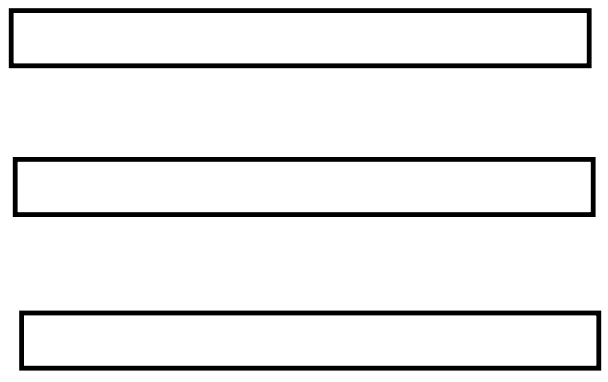
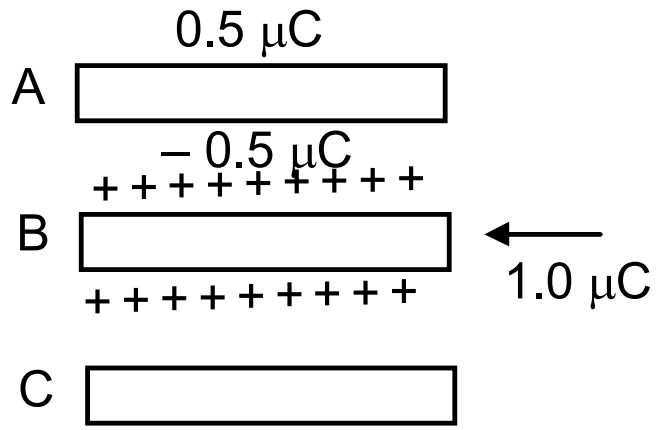
The capacitance between the adjacent plates shown in figure is 50nF. A charge of $1.0\mu\text{C}$ is placed on the middle plate:

  1. What will be the charge on the outer surface of the upper plate?
  2. Find the potential difference developed between the upper and the middle plates.
Answer

  1. When charge of $1\mu\text{C}$ is introduced to the B plate, we also get $0.5\mu\text{C}$ charge on the upper surface of Plate ‘A’.
  2. Given $\text{C}=50\mu\text{F}=50\times10^{-9}\text{F}=5\times10^{-8}\text{F}$

Now charge $=0.5\times10^{-6}\text{C}$

$\text{V}=\frac{\text{q}}{\text{C}}=\frac{5\times10^{-7}\text{C}}{5\times10^{-8}\text{F}}=10\text{V}$

View full question & answer
Question 595 Marks
A capacitor having a capacitance of $100\mu\text{F}$ is charged to a potential difference of 24V. The charging battery is disconnected and the capacitor is connected to another battery of emf 12V with the positive plate of the capacitor joined with the positive terminal of the battery:
  1. Find the charges on the capacitor before and after the reconnection.
  2. Find the charge flown through the 12V battery.
  3. Is work done by the battery or is it done on the battery? Find its magnitude.
  4. Find the decrease in electrostatic field energy.
  5. Find the heat developed during the flow of charge after reconnection.
Answer
  1. Before reconnection

$\text{C}=100\mu\text{f}$

$\text{V}=24\text{V}$

$\text{q}=\text{CV}=2400\mu\text{C}$ (Before reconnection)

After connection

When $\text{C}=100\mu\text{f}$

$\text{V}=12\text{V}$

$\text{q}=\text{CV}=1200\mu\text{C}$ (After connection)

  1. C = 100, V = 12V

$\therefore$ q = CV = 1200v

  1. We know $\text{V}=\frac{\text{W}}{\text{q}}$

W = vq = 12 × 1200 = 14400 J = 14.4 mJ

The work done on the battery.

  1. Initial electrostatic field energy $\text{U}_{\text{i}}=\Big(\frac{1}{2}\Big)\text{CV}_1^2$

Final Electrostatic field energy $\text{U}_{\text{f}}=\Big(\frac{1}{2}\Big)\text{CV}_2^2$

$\therefore$ Decrease in Electrostatic

Field energy $=\Big(\frac{1}2{}\Big)\text{CV}_1^2-\Big(\frac{1}2{}\Big)\text{CV}_2^2$

$=\Big(\frac{1}{2}\Big)\text{C}(\text{V}_1^2-\text{V}_2^2)$

$=\Big(\frac{1}{2}\Big)\times100(576-144)=21600\text{J}$

$\therefore$ Energy = 21600j = 21.6mJ

  1. After reconnection

$\text{C}=100\mu\text{c},\ \text{V}=12\text{v}$

$\therefore$ The energy appeared $=\Big(\frac{1}{2}\Big)\times100\times144$

$=7200\text{J}=7.2\text{mJ}$ 

This amount of energy is developed as heat when the charge flow through the capacitor.

View full question & answer
Question 605 Marks
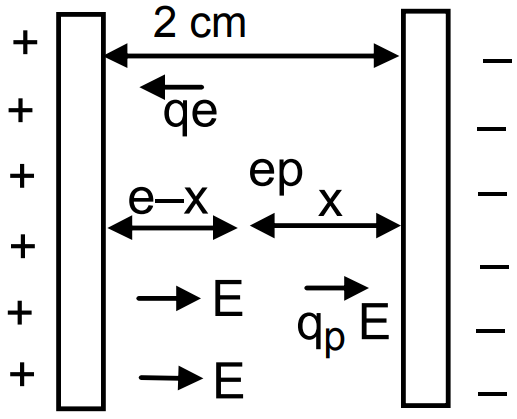
The plates of a capacitor are 2.00cm apart. An electronproton pair is released somewhere in the gap between the plates and it is found that the proton reaches the negative plate at the same time as the electron reaches the positive plate. At what distance from the negative plate was the pair released?
Answer

The acceleration of electron $\text{a}_{\text{e}}=\frac{\text{qeme}}{\text{Me}}$

The acceleration of proton $=\frac{\text{qpe}}{\text{Mp}}=\text{ap}$

The distance travelled by proton $\text{X}=\frac{1}{2}\text{apt}^2\ \dots(1)$

The distance travelled by electron ...(2)

From (1) and (2)

$\Rightarrow2-\text{X}=\frac{1}{2}\text{a}_{\text{c}}\text{t}^2$

$\text{x}=\frac{1}{2}\text{a}_{\text{c}}\text{t}^2$

$\Rightarrow\frac{\text{x}}{2-\text{x}}=\frac{\text{a}_{\text{p}}}{\text{a}_{\text{c}}}=\frac{\big(\frac{\text{q}_{\text{p}\text{E}}}{\text{M}_{\text{p}}}\big)}{\big(\frac{\text{q}_{\text{c}\text{F}}}{\text{M}_{\text{c}}}\big)}$

$=\frac{\text{x}}{2-\text{x}}=\frac{\text{M}_{\text{c}}}{\text{M}_{\text{p}}}=\frac{9.1\times10^{-31}}{1.67\times10^{-27}}$

$=\frac{9.1}{1.67}\times10^{-4}=5.449\times10^{-4}$

$\Rightarrow\text{x}=10.898\times10^{-4}-5.449\times10^{-4}\text{x}$

$\Rightarrow\text{x}=\frac{10.898\times10^{-4}}{1.0005449}=0.001089226$

View full question & answer
Question 615 Marks
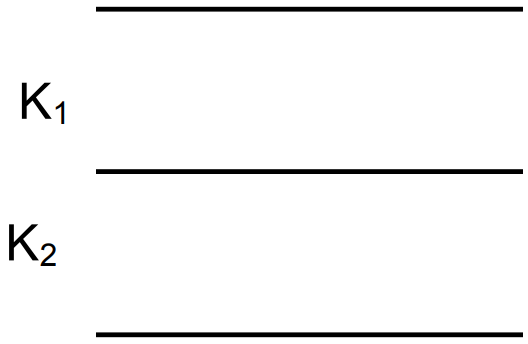
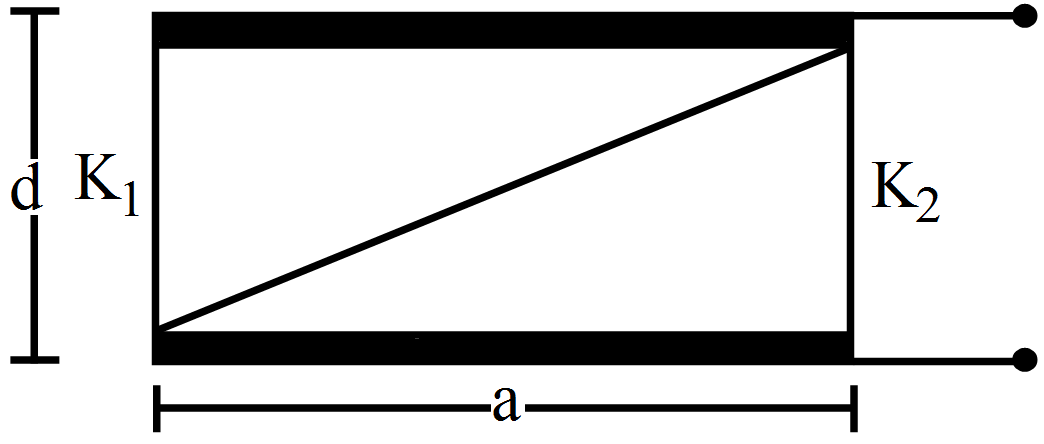
A capacitor is formed by two square metal-plates of edge a, separated by a distance d. Dielectrics of dielectric constants K1 and K2 are filled in the gap as shown in figure. Find the capacitance.

Answer

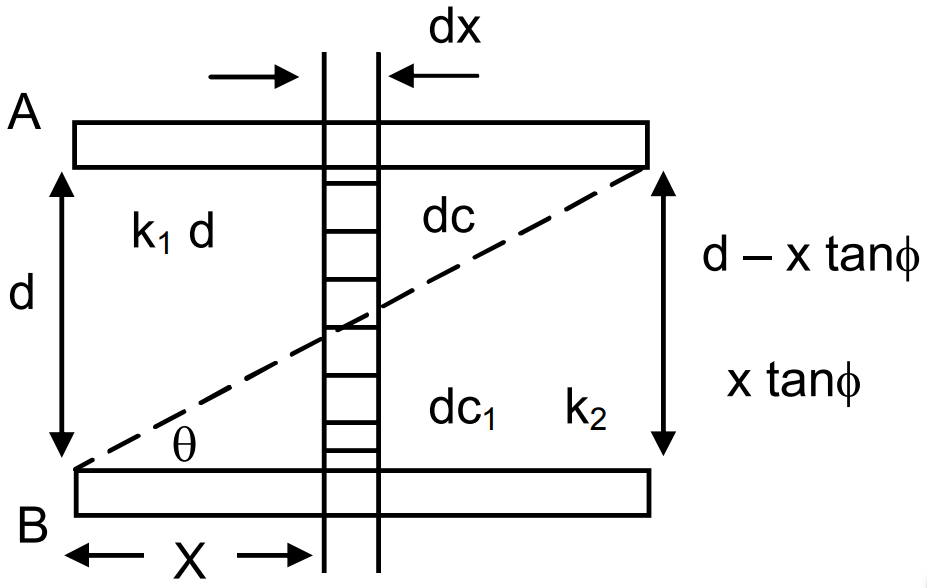
Consider an elemental capacitor of with dx our at a distance ‘x’ from one end. It is constituted of two capacitor elements of dielectric constants k1 and k2 with plate separation $\text{x}\tan\phi$ and $\text{d}-\text{x}\tan\phi$ respectively in series.

$\frac{1}{\text{dcR}}=\frac{1}{\text{dc}_1}+\frac{1}{\text{dc}_2}=\frac{\text{x}\tan\phi}{\in_0\text{k}_2(\text{bdx})}+\frac{\text{d}-\text{x}\tan\phi}{\in_0\text{k}_1(\text{bdx})}$

$\text{dcR}=\frac{\in_0\text{bdx}}{\frac{\text{x}\tan\phi}{\text{k}_2}+\frac{(\text{d}-\text{x}\tan\phi)}{\text{k}_1}}$

$\text{C}_{\text{R}}=\in_0\text{bk}_1\text{k}_2\int\frac{\text{dx}}{\text{k}_2\text{d}+(\text{k}_1+\text{k}_2)\text{x}\tan\phi}$

$=\frac{\in_0\text{bk}_1\text{k}_2}{\tan\phi(\text{k}_1-\text{k}_2)}[\log_{\text{e}}\text{k}_2\text{d}+(\text{k}_1+\text{k}_2)\text{x}\tan\phi]\text{a}$

$=\frac{\in_0\text{bk}_1\text{k}_2}{\tan\phi(\text{k}_1-\text{k}_2)}[\log_{\text{e}}\text{k}_2\text{d}+(\text{k}_1+\text{k}_2)\text{a}\tan\phi-\log_{\text{e}}\text{k}_2\text{d}]$

$\therefore\tan\phi=\frac{\text{c}}{\text{a}}$ and $\text{A}=\text{a}\times\text{a}$

$\text{C}_{\text{R}}=\frac{\in_0\text{ak}_1\text{k}_2}{\frac{\text{d}}{\text{a}}(\text{k}_1-\text{k}_2)}$ $\Big[\log_{\text{e}}\Big(\frac{\text{k}_1}{\text{k}_2}\Big)\Big]$

$\text{C}_{\text{R}}=\frac{\in_0\text{a}^2\text{k}_1\text{k}_2}{\text{d}(\text{k}_1-\text{k}_2)}$ $\Big[\log_{\text{e}}\Big(\frac{\text{k}_1}{\text{k}_2}\Big)\Big]$

$\text{C}_{\text{R}}=\frac{\in_0\text{a}^2\text{k}_1\text{k}_2}{\text{d}(\text{k}_1-\text{k}_2)}$ $\text{ln}\frac{\text{k}_1}{\text{k}_2}$

View full question & answer
Question 625 Marks
Consider the situation of the previous problem. A charges of -2.0 × 10-4C is moved from the point A to the point B. Find the change in electrical potential energy UB - UA for the cases (a), (b) and (c).
Answer
  1. The Electric field is along x-direction

Thus potential difference between,

$\text{A}=(0, 0);\ \text{B}=(4, 2)$

$\Rightarrow\delta\text{V}=-\text{E}\times\delta\text{x}$

$=-20\times(40)$

$=-80\text{V}$

Potential energy (UB - UA) between the points $=\delta\text{V}\times\text{q}$

$=-80\times(-2)\times10^{-4}$

$=160\times10^{-4}$

$=0.016\text{J}$

  1. $\text{A}=(4\text{m},2\text{m});\ \text{B}=(6\text{m},5\text{m})$

$\Rightarrow\delta\text{V}=-\text{E}\times\delta\text{x}$

$=-20\times2$

$=-40\text{V}$

Potential energy (UB - UA) between the points $=\delta\text{V}\times\text{q}$

$=-40\times(-2)\times10^{-4})$

$=80\times10^{-4}$

$=0.008\text{J}$

  1. $\text{A}=(0,0);\ \text{B}=(6\text{m}, 5\text{m})$

$\Rightarrow\delta\text{V}=-\text{E}\times\delta\text{x}$

$=-20\times6$

$=-120\text{V}$

Potential energy (UB - UA) between the points A and B

$\Rightarrow\delta\text{V}\times\text{q}$

$=-120\times(-2\times10^{-4})$

$=240\times10^{-4}$

$=0.024\text{J}$

View full question & answer