You are standing with your bag in your hands, on the ice in the middle of a pond. The ice is so slippery that it can offer no friction. How can you come out of the ice?
Question types
Friction question types
57 questions across 6 question groups — pick any mix to generate a Physics paper with step-by-step answer keys.
57
Questions
6
Question groups
5
Question types
01
2 Marks Questions
8 Q→023 Marks Question
2 Q→031 Marks Question
6 Q→044 Marks Questions
4 Q→05M.C.Q (1 Marks)
15 Q→065 Marks Questions
22 Q→Sample Questions
Friction questions
One sample from each question group in this chapter. Select any group above to see the full set with answer keys.
View full solution →
When two surfaces are polished, the friction coefficient between them decreases. But the friction coefficient increases and becomes very large if the surfaces are made highly smooth. Explain.
A block of mass m is kept on a horizontal table. If the static friction coefficient is $\mu,$ find the frictional force acting on the block.
View full solution →A body slipping on a rough horizontal plane moves with a deceleration of 4.0m/s2. What is the coefficient of kinetic friction between the block and the plane?
A classroom demonstration of Newton's first law is as follows: A glass is covered with a plastic card and a coin is placed on the card. The card is given a quick strike and the coin falls in the glass.
- Should the friction coefficient between the card and the coin be small or large?
- Should the coin be light or heavy?
- Why does the experiment fail if the card is gently pushed?
A block is projected along a rough horizontal road with a speed of 10m/s. If the coefficient of kinetic friction is 0.10, how far will it travel before coming to rest?
A person (40kg) is managing to be at rest between two vertical walls by pressing one wall A by his hands and feet and the other wall B by his back. Assume that the friction coefficient between his body and the walls is 0.8 and that limiting friction acts at all the contacts.
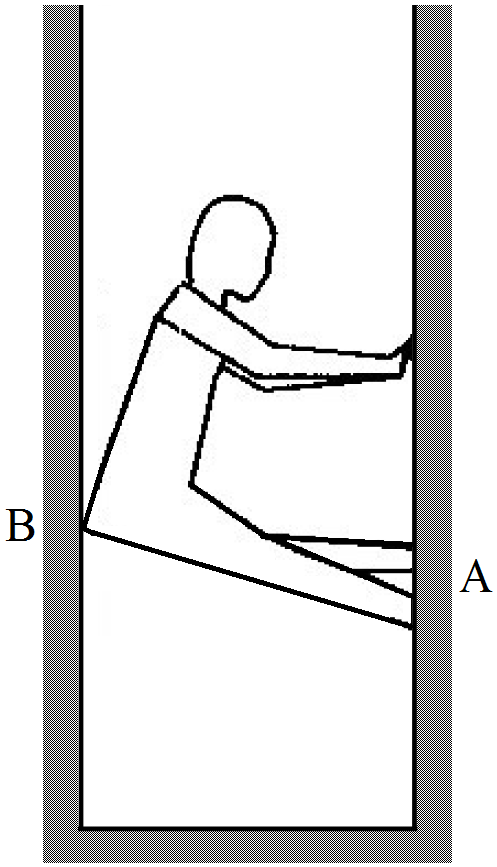
- Show that the person pushes the two walls with equal force.
- Find the normal force exerted by either wall on the person. Take g = 10m/s2.
Why is it easier to push a heavy block from behind than to press it on the top and push?
Can you accelerate a car on a frictionless horizontal road by putting more petrol in the engine? Can you stop a car going on a frictionless horizontal road by applying brakes?
For most of the surfaces used in daily life, the friction coefficient is less than 1. Is it always necessary that the friction coefficient is less than 1?
What is the average friction force when a person has a usual 1km walk?
Why is it difficult to walk on solid ice?
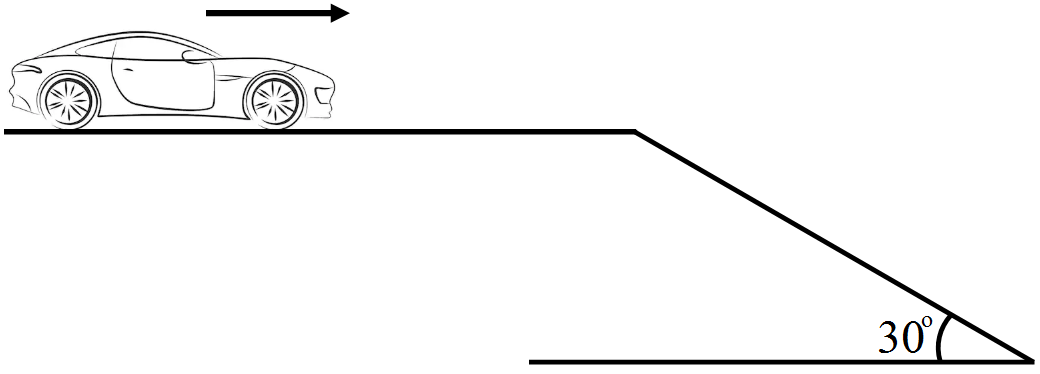
A car is going at a speed of 21.6km/hr when it encounters a 12.8m long slope of angle 30°. The friction coefficient between the road and the tyre is $\frac{1}{2\sqrt{3}}.$ Show that no matter how hard the driver applies the brakes, the car will reach the bottom with a speed greater than 36km/hr. Take g = 10m/s2.
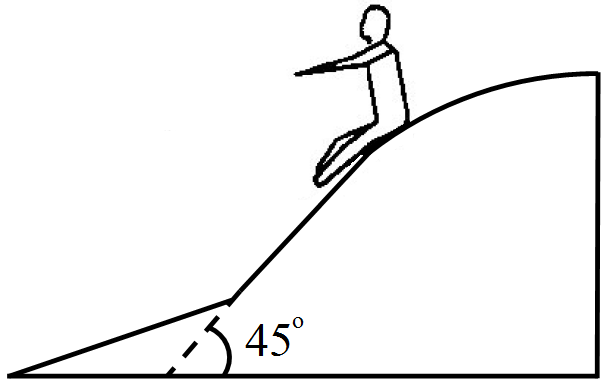
View full solution →In a children-park an inclined plane is constructed with an angle of incline 45° in the middle part. Find the acceleration of a boy sliding on it if the friction coefficient between the cloth of the boy and the incline is 0.6 and g = 10m/s2.
The friction coefficient between an athelete's shoes and the ground is 0.90. Suppose a superman wears these shoes and races for 50m. There is no upper limit on his capacity of running at high speeds.
- Find the minimum time that he will have to take in completing the 50m starting from rest.
- Suppose he takes exactly this minimum time to complete the 50m, what minimum time will he take to stop?
A car starts from rest on a half kilometer long bridge. The coefficient of friction between the tyre and the road is 1.0. Show that one cannot drive through the bridge in less than 10s.
Consider a vehicle going on a horizontal road towards east. Neglect any force by the air. The frictional forces on the vehicle by the road:
- Is towards east if the vehicle is accelerating.
- Is zero if the vehicle is moving with a uniform velocity.
- Must be towards east.
- Must be towards west.
A block A kept on an inclined surface just begins to slide if the inclination is 30°. The block is replaced by another block B and it is found that it just begins to slide if the inclination is 40°:
- Mass of A > mass of B.
- Mass of A < mass of B.
- Mass of A = mass of B.
- All the three are possible.
Mark the correct statements about the friction between two bodies:
- Static friction is always greater than the kinetic friction.
- Coefficient of static friction is always greater than the coefficient of kinetic friction.
- Limiting friction is always greater than the kinetic friction.
- Limiting friction is never less than static friction.
Suppose all the surfaces in the previous problem are rough. The direction of friction on B due to A:
- Is upward.
- Is downward.
- Is zero.
- Depends on the masses of A and B.
A block is placed on a rough floor and a horizontal force F is applied on it. The force of friction f by the floor on the block is measured for different values of F and a graph is plotted between them.
- The graph is a straight line of slope 45°.
- The graph is a straight line parallel to the F-axis.
- The graph is a straight line of slope 45° for small F and a straight line parallel to the F-axis for large F.
- There is a small kink on the graph.
Find the acceleration of the block of mass M in the situation of figure. The coefficient of friction between the two blocks is $\mu_1$ and that between the bigger block and the ground is $\mu_2.$
View full solution →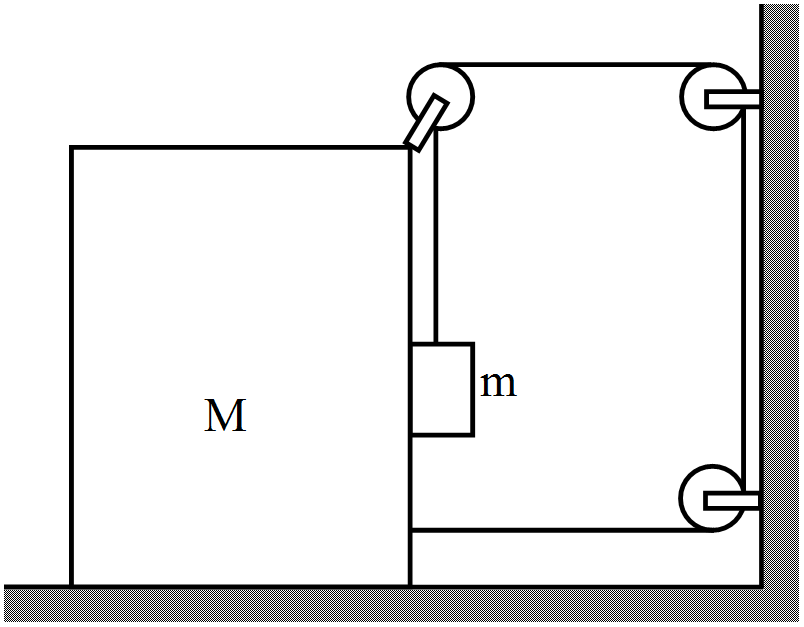
The friction coefficient between the two blocks shown in figure is $\mu$ but the floor is smooth.
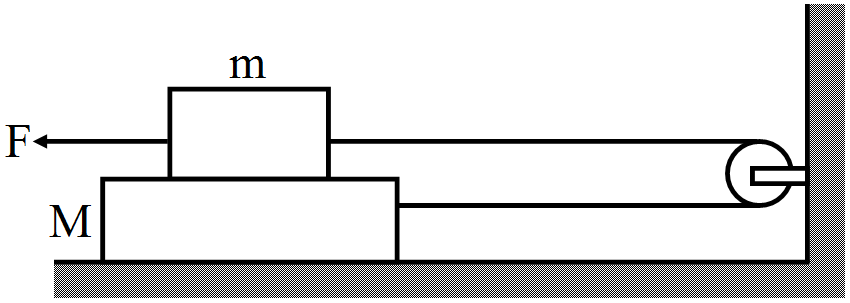
View full solution →- What maximum horizontal force F can be applied without disturbing the equilibrium of the system?
- Suppose the horizontal force applied is double of that found in part (a). Find the accelerations of the two masses.
A block of mass m slips on a rough horizontal table under the action of a horizontal force applied to it. The coefficient of friction between the block and the table is $\mu.$ The table does not move on the floor. Find the total frictional force applied by the floor on the legs of the table. Do you need the friction coefficient between the table and the floor or the mass of the table?
View full solution →A body starts slipping down an incline and moves half meter in half second. How long will it take to move the next half meter?
A body of mass 2kg is lying on a rough inclined plane of inclination 30°. Find the magnitude of the force parallel to the incline needed to make the block move:
- Up the incline
- Down the incline. Coefficient of static friction = 0.2.
Generate a Friction paper free
Pick question groups from the list above, set marks and difficulty, and export a branded PDF with step-by-step answer keys. First 3 chapters free — no signup.