Questions

4 Marks Questions

Take a timed test

6 questions · self-marked practice — reveal the answer and mark yourself.

Question 14 Marks
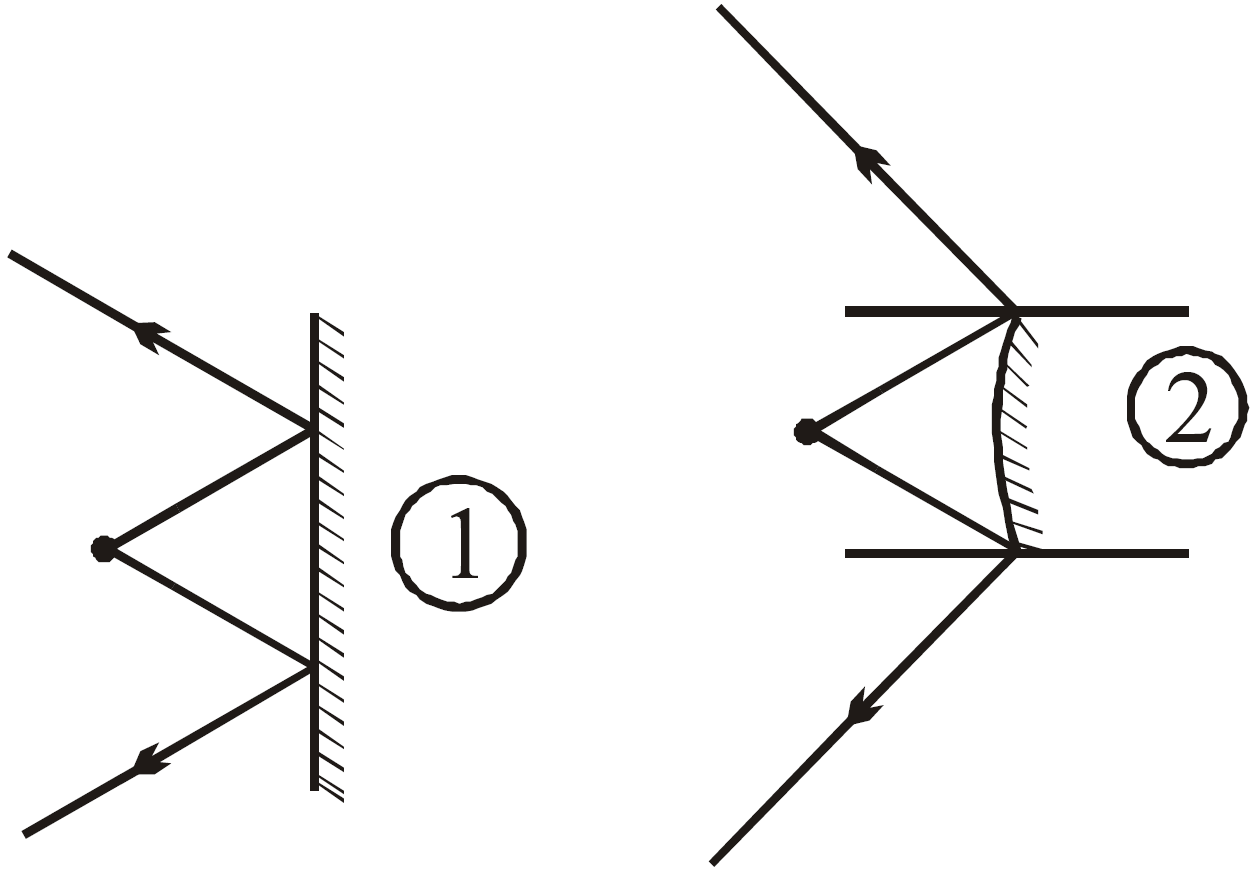
In motor vehicles, a convex mirror is attached near the driver's seat to give him the view of the traffic behind. What is the special function of this convex mirror which a plane mirror can not do?
Answer
Field of view is large.
Field of view is more for mirror 2

View full question & answer
Question 24 Marks
Suppose you are inside the water in a swimming pool near an edge. A friend is standing on the edge. Do you find your friend taller or shorter than his usual height?
Answer
Taller, When view from outside water, the height is x2 - x1; but when viewed from inside water, the height is $\mu(\text{x}_2-\text{x}_1).$
View full question & answer
Question 34 Marks
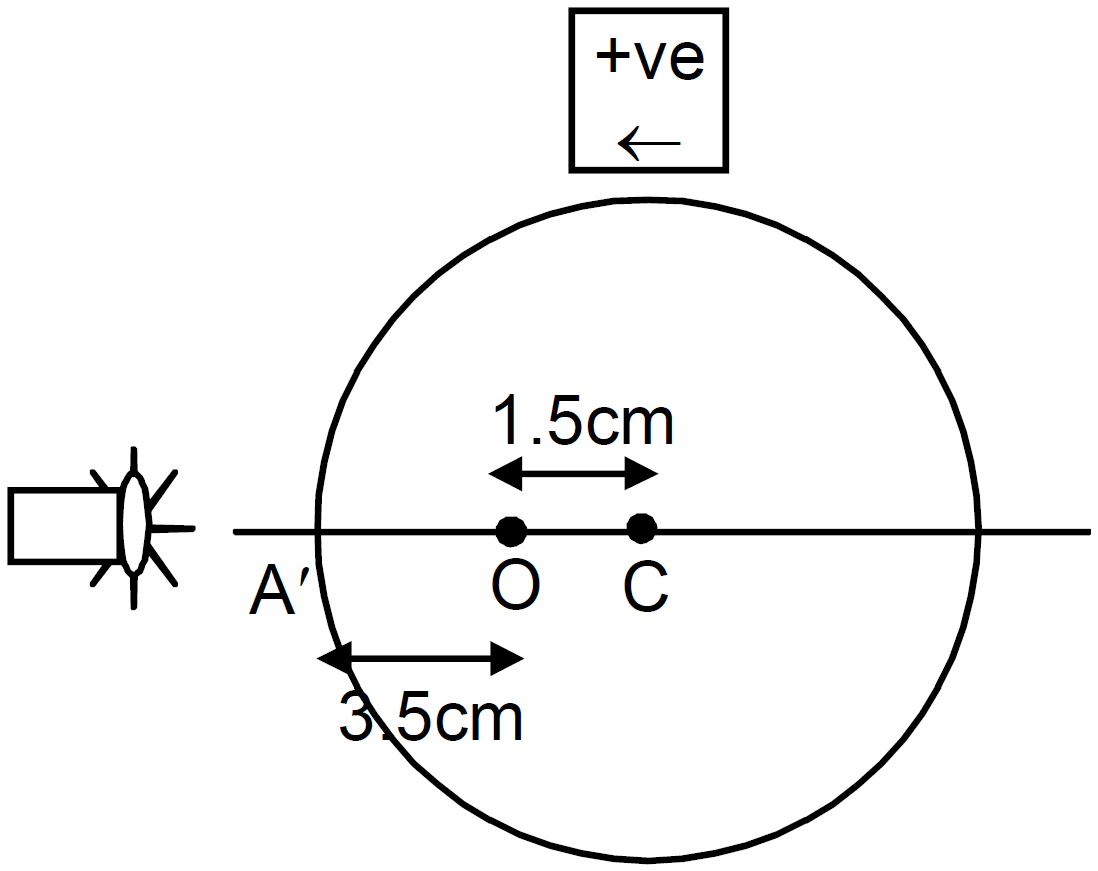
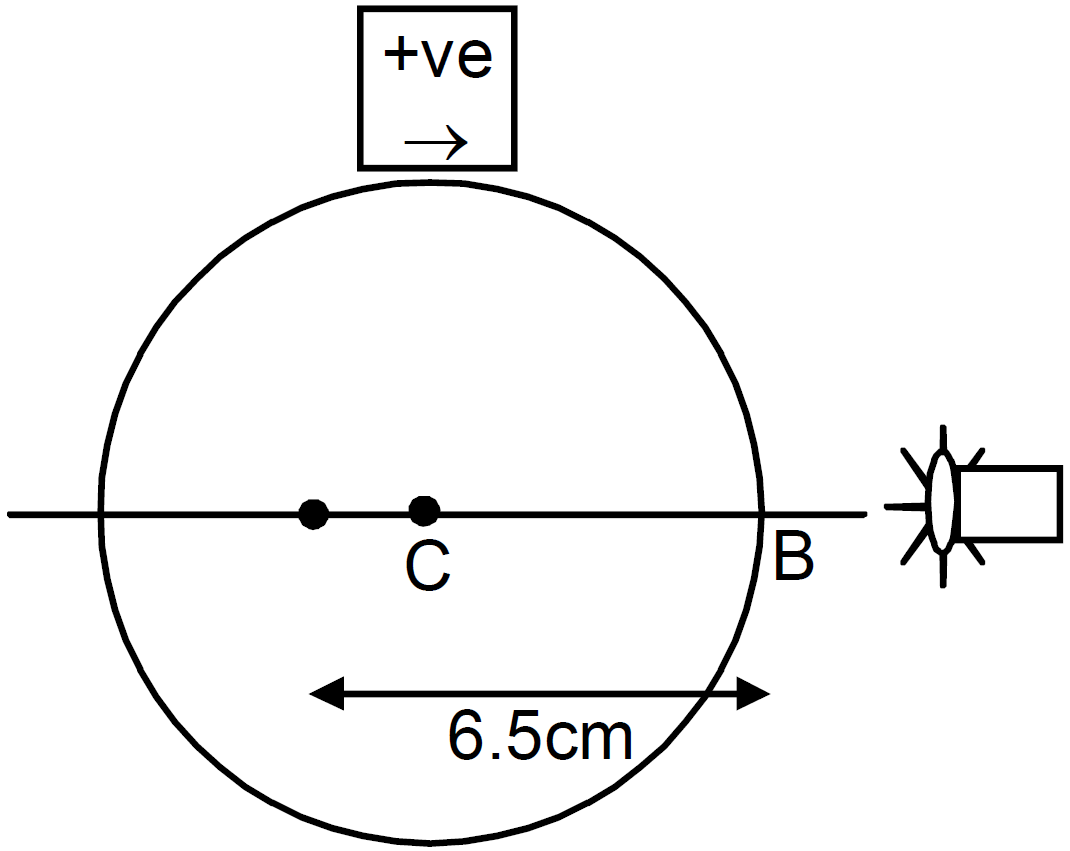
A small object is embedded in a glass sphere $(\mu=1.5)$ of radius 5.0cm at a distance 1.5cm left to the centre. Locate the image of the object as seen by an observer standing.
  1. To the left of the sphere.
  2. To the right of the sphere.
Answer

  1. Image seen from left:

u = (5 - 15) = -3.5cm

R = -5cm

$\therefore \ \frac{\mu_2}{\text{v}}-\frac{\mu_1}{\text{u}}=\frac{\mu_2-\mu_1}{\text{R}}$

$\Rightarrow\frac{1}{\text{v}}+\frac{1.5}{3.5}=-\frac{1-1.5}{5}$

$\Rightarrow\frac{1}{\text{v}}=\frac{1}{10}-\frac{3}{7}\Rightarrow\text{v}=\frac{-70}{23}=-3\text{cm}$ (inside the sphere).

$\Rightarrow$ Image will be formed, 2cm left to centre.


  1. Image seen from right:

u = -(5 + 1.5) = -6.5cm

R = -5cm

$\therefore \ \frac{\mu_2}{\text{v}}-\frac{\mu_1}{\text{u}}=\frac{\mu_2-\mu_1}{\text{R}}$

$\Rightarrow\frac{1}{\text{v}}+\frac{1.5}{6.5}=\frac{1-1.5}{-5}$

$\Rightarrow\frac{1}{\text{v}}=\frac{1}{10}-\frac{3}{13}$

$\Rightarrow \frac{13-30}{130}$

$\Rightarrow\text{v}=\frac{-130}{17}=-7.65\text{cm}$ (inside the sphere).

$\Rightarrow$ Image will be formed, 2.65cm left to centre.

View full question & answer
Question 44 Marks
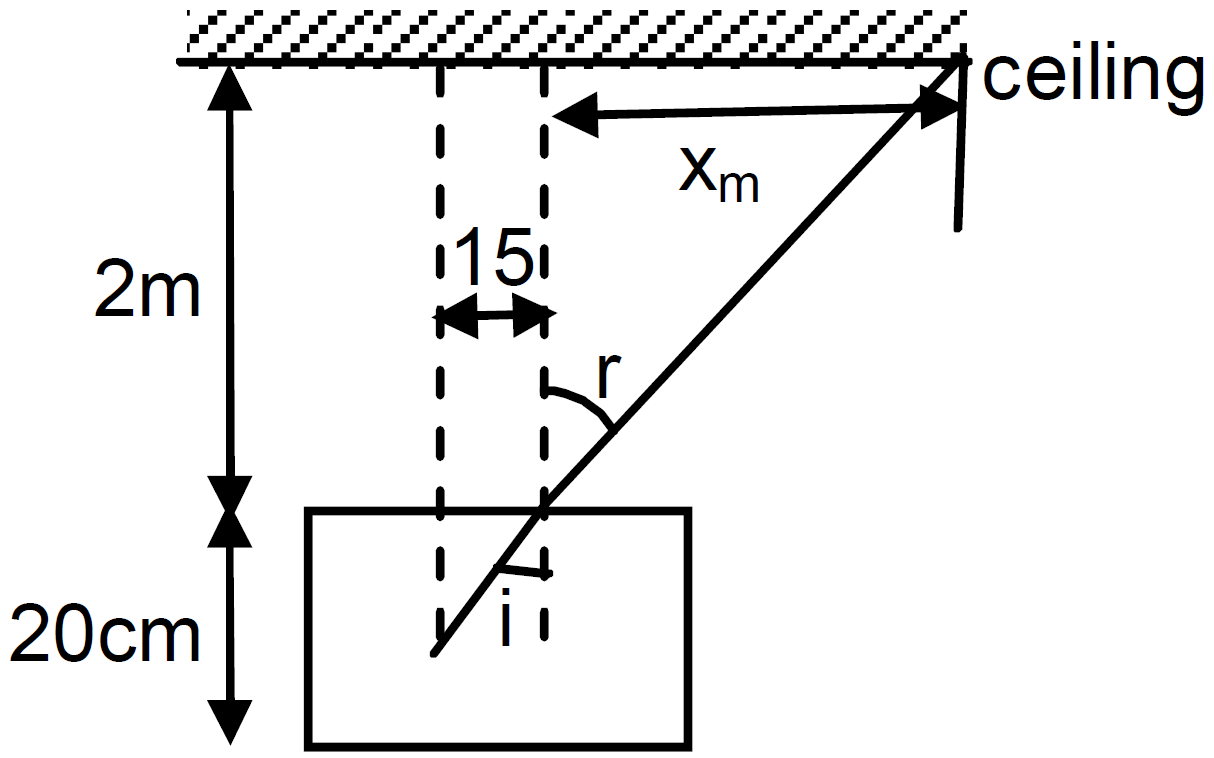
A container contains water upto a height of 20cm and there is a point source at the centre of the bottom of the container. A rubber ring of radius r floats centrally on the water. The ceiling of the room is 2.0m above the water surface.
  1. Find the radius of the shadow of the ring formed on the ceiling if r = 15cm.
  2. Find the maximum value of r for which the shadow of the ring is formed on the ceiling. Refractive index of water $\frac{4}{3}.$
Answer

  1. As shown in the figure, $\sin\text{i}=\frac{15}{25}$

So, $\frac{\sin\text{i}}{\sin\text{r}}=\frac{1}{\mu}=\frac{3}{4}$

$\Rightarrow\sin\text{r}=\frac{4}{5}$

Again, $\frac{\text{x}}{2}=\tan\text{r}$ (from figure)

So, $\sin\text{r}=\frac{\tan\text{r}}{\sqrt{1+\tan^2\text{r}}}=\frac{\frac{\text{x}}{2}}{\sqrt{1+\frac{\text{x}^2}{4}}}$

$\Rightarrow\frac{\text{x}}{\sqrt{{4}+\text{x}^2}}=\frac{4}{5}$

$\Rightarrow25\text{x}^2=16(4+\text{x}^2)\Rightarrow9\text{x}^2=64\Rightarrow\text{x}=\frac{8}{3}\text{m}$

$\therefore$ Total radius of shadow $=\frac{8}{3}+0.15=2.81\text{m}$

  1. For maximum size of the ring, i = critical angle = C

Let, R = maximum radius

$\Rightarrow\sin\theta_\text{C}=\frac{\sin\theta_\text{C}}{\sin\text{r}}=\frac{\sin\text{R}}{\sqrt{20^2+\sin\text{R}^2}}=\frac{3}{4}$(since, sin r = 1)

$\Rightarrow16\text{R}^2=9\text{R}^2+9\times400$

$\Rightarrow7\text{R}^2=9\times400$

$\Rightarrow\text{R}=22.67\text{cm.}$
View full question & answer
Question 54 Marks
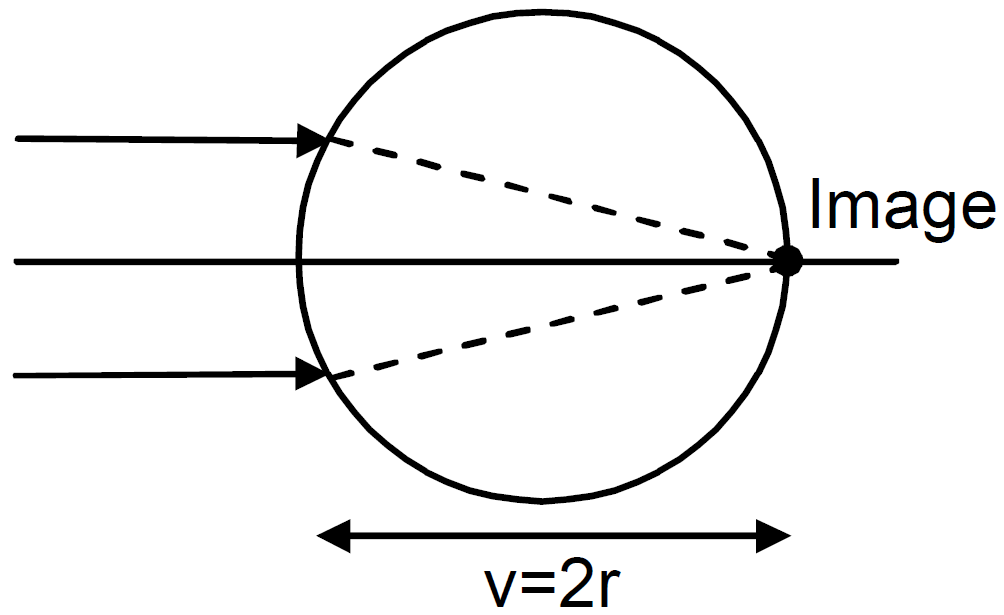
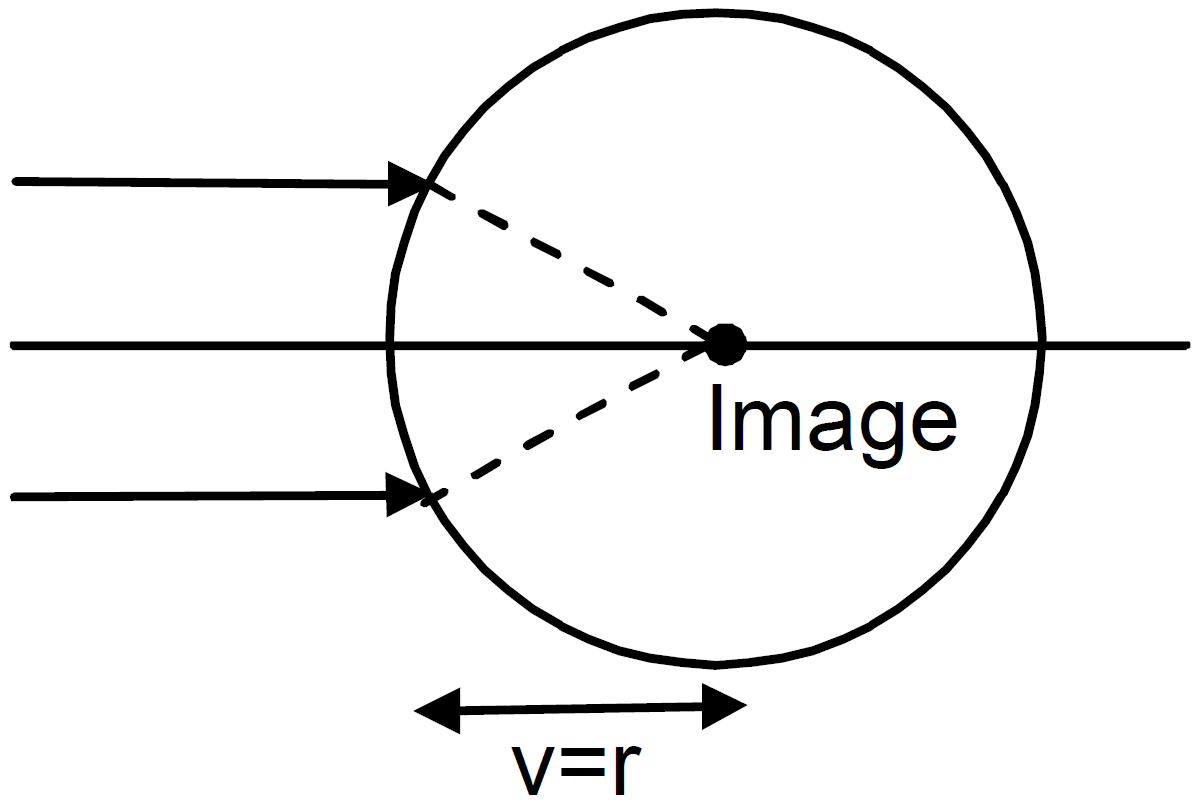
A narrow pencil of parallel light is incident normally on a solid transparent sphere of radius r. What should be the refractive index if the pencil is to he focused.
  1. At the surface of the sphere.
  2. At the centre of the sphere.
Answer
For the refraction at convex surface A.

$\mu=-\infty, \ \mu_1=1, \ \mu_2=?$

  1. When focused on the surface, v = 2r, R = r

So, $\frac{\mu_2}{\text{v}}-\frac{\mu_1}{\text{u}}=\frac{\mu_2-\mu_1}{\text{R}}$

$\Rightarrow\frac{\mu_2}{2\text{r}}=\frac{\mu_2-1}{\text{r}}$

$\Rightarrow \frac{\mu_2}{2\text{r}}-\Big(\frac{1}{-\infty}\Big)=\frac{\mu_2-1}{\text{r}}$

$\Rightarrow\mu_2=2\mu_2-2\Rightarrow\mu_2=2$


  1. When focused at centre, u = r1, R = r

So, $\frac{\mu_2}{\text{v}}-\frac{\mu_1}{\text{u}}=\frac{\mu_2-\mu_1}{\text{R}}$

$\Rightarrow\frac{\mu_2}{\text{R}}=\frac{\mu_2-1}{\text{r}}\Rightarrow\mu_2=\mu_2-1.$

This is not possible.

So, it cannot focus at the centre

View full question & answer
Question 64 Marks
A slide projector has to project a 35mm slide (35mm × 23mm) on a 2m × 2m screen at a distance of 10m from the lens. What should be the focal length of the lens in the projector?
Answer
For the projector the magnification required is given by

$\text{m}=\frac{\text{v}}{\text{u}}=\frac{200}{3.5}\Rightarrow\text{u}=17.5\text{cm}$

[35 mm > 23mm, so the magnification is calculated taking object size 35mm]

Now, from lens formula,

$\Rightarrow\frac{1}{\text{v}}-\frac{1}{\text{u}}=\frac{1}{\text{f}}​​$

$\Rightarrow\frac{1}{\text{v}}-\frac{1}{-\text{u}}=\frac{1}{\text{f}}​​\Rightarrow \frac{1}{1000}+\frac{1}{17.5}=\frac{1}{\text{f}}$

$\Rightarrow\text{f}=17.19\text{cm}.$

View full question & answer