Questions

2 Marks Questions

🎯

Test yourself on this topic

17 questions · timed · auto-graded

Question 12 Marks
A gas thermometer measures the temperature from the variation of pressure of a sample of gas. If the pressure measured at the melting point of lead is 2.20 times the pressure measured at the triple point of water, find the melting point of lead.
Answer
Pressure Measured at M.P = 2.2 × Pressure at Triple Point
$\text{T}=\frac{\text{P}}{\text{P}_\text{tr}}\times273.16$
$=\frac{2.2\times\text{P}_\text{tr}}{\text{P}_\text{tr}}\times273.16$
$=600.952\text{K}\approx601\text{K}$
View full question & answer
Question 22 Marks
A tightly closed metal lid of a glass bottle can be opened more easily if it is put in hot water for some time. Explain.
Answer
When a bottle with a tightly-closed metal lid is put in hot water for sometime, its lid can be opened easily because metals have greater coefficient of expansion than glass. Therefore, when the metal lid comes in contact with hot water, it'll expand more than the glass container. As a result, it will be easier to open the bottle.
View full question & answer
Question 32 Marks
A steel ball initially at a pressure of $1.0 \times 10^5Pa$ is heated from $20^\circ C$ to $120^\circ C$ keeping its volume constant. Find the pressure inside the ball. Coefficient of linear expansion of steel $= 12 \times 10^{-6}$$ ^\circ C^{-1}$ and bulk modulus of steel $= 1.6 \times 10^{11}Nm^{-2}.$
Answer
The ball tries to expand its volume. But it is kept in the same volume. So it is kept at a constant volume.
So the stress arises
$\frac{P}{\Big(\frac{\Delta\text{V}}{\text{V}}\Big)}=\text{B}$
$\Rightarrow\text{P}=\text{B}\frac{\Delta\text{V}}{\text{V}}=\text{B}\times\gamma\Delta\theta$
$=\text{B}\times3\alpha\Delta\theta=1.6\times10^{11}\times10^{-6}\times3\times12\times10^{-6}\times(120-20)$
$=57.6\times19^7\approx5.8\times10^8\text{pa}.$
View full question & answer
Question 42 Marks
In a Callender's compensated constant pressure air thermometer, the volume of the bulb is 1800 cc. When the bulb is kept immersed in a vessel, 200 cc of mercury has to be poured out. Calculate the temperature of the vessel.
Answer
$\text{T}'=\frac{\text{V}}{\text{V}-\text{V}'}\text{T}_0$
$\text{T}_0=273,$
$\text{V}=1800\ \text{CC},$
$\text{V'}=200\ \text{CC}$
$\text{T'}=\frac{1800}{1600}\times273=307.125\approx307$
View full question & answer
Question 52 Marks
A steel rod is clamped at its two ends and rests on a fixed horizontal base. The rod is unstrained at $20^\circ C$. Find the longitudinal strain developed in the rod if the temperature rises to $50^\circ C$. Coefficient of linear expansion of steel $= 1.2 \times 10^{-5} $$^\circ C^{-1}.$
Answer
$\theta_1=20^\circ\text{C},$$\theta_2=50^\circ\text{C}$
$\alpha_\text{steel}=1.2\times10^{-5}\ /^\circ\text{C}$
Longitudinal stain = ?
Stain $=\frac{\Delta\text{L}}{\text{L}}=\frac{\text{L}\alpha\Delta\theta}{\text{L}}=\alpha\Delta\theta$
$=1.2\times10^{-5}\times(50-20)=3.6\times10^{-4}$
View full question & answer
Question 62 Marks
A platinum resistance thermometer reads $0^\circ$ when its resistance is $80\Omega$ and $100^\circ$ when its resistance is $90\Omega$. Find the temperature at the platinum scale at which the resistance is $86\Omega$.
Answer
$\text{R}_\text{t}=86\Omega;$
$\text{R}_{0^\circ}=80\Omega;$
$\text{R}_{100^\circ}=90\Omega$
$\text{t}=\frac{\text{R}_1-\text{R}_0}{\text{R}_{100}-\text{R}_0}\times100$
$=\frac{86-80}{90-80}\times100$
$\text{t}=\frac{6}{10}\times100$
$=60^\circ$
View full question & answer
Question 72 Marks
A spherical shell is heated. The volume change according to the equation $\text{V}_\theta=\text{V}_\theta(1+\gamma\theta)$. Does the volume refer to the volume enclosed by the shell or the volume of the material making up the shell?
Answer
When a spherical shell is heated, its volume changes according to the equation, $\text{V}_\theta=\text{V}_0(1+\gamma\triangle\theta)$. The volume referred to here is the volume of the material used to make up the shell, as its volume expands with the rise of temperature with coefficient of expansion of volume $\gamma.$
View full question & answer
Question 82 Marks
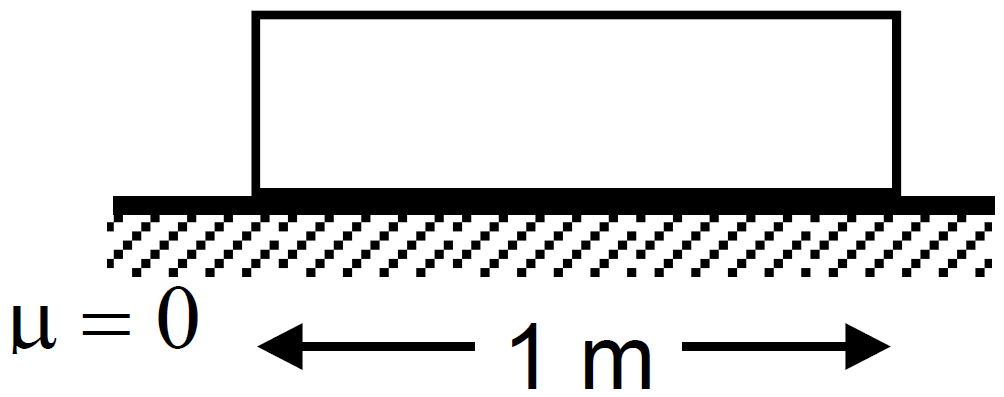
A steel rod of length 1m rests on a smooth horizontal base. If it is heated from $0^\circ C$ to $100^\circ C,$ what is the longitudinal strain developed?
Answer

$\Delta\text{L}=100^\circ\text{C}$
A longitudinal strain develops if and only if, there is an opposition to the expansion.
Since there is no opposition in this case, hence the longitudinal stain here = Zero.
View full question & answer
Question 92 Marks
If two bodies are in thermal equilibrium in one frame, will they be in thermal equilibrium in all frames?
Answer
If two bodies are in thermal equilibrium in one frame, they will be in thermal equilibrium in all the frames. In case there is any change in temperature of one body due to change in frame, the same change will be acquired by the other body.
View full question & answer
Question 102 Marks
A constant volume thermometer registers a pressure of $1.500 \times 10^4Pa$ at the triple point of water and a pressure of $2.050 \times 10^4Pa $ at the normal boiling point. What is the temperature at the normal boiling point?
Answer
$P_{tr} = 1.500 \times 10^4Pa\ P = 2.050 \times 10^4Pa$ We know, For constant volume gas Thermometer $\text{T}=\frac{\text{P}}{\text{P}_\text{tr}}\times273.16\text{K}$ $=\frac{2.050\times10^4}{1.500\times10^4}\times273.16$$=373.31$
View full question & answer
Question 112 Marks
The pressures of the gas in a constant volume gas thermometer are 80cm, 90cm and 100cm of mercury at the ice point, the steam point and in a heated wax bath, respectively. Find the temperature of the wax bath.
Answer
$\text{P}_\text{ice point}=\text{P}_{0^\circ}=80\text{cm of Hg}$$\text{P}_\text{steam point}=\text{P}_{100^\circ}90\text{cm of Hg}$
$\text{P}_0=100\text{cm}$
$\text{t}=\frac{\text{P}-\text{P}_0}{\text{P}_{100}-\text{P}_0}\times100^\circ$$=\frac{80-100}{90-100}\times100$
$=200^\circ\text{C}$
View full question & answer
Question 122 Marks
The density of water at 4°C is supposed to be $1000kg\ m^3$. Is it same at sea level and at high altitude?
Answer
At sea level, the pressure is around 1 atmosphere and at high altitude, the density of air reduces.
Pressure of liquid,
$\text{P} =\text{h}\rho\text{g},$
where $\rho=\text{density of fluid}$
The above equation shows that pressure depends on density. Therefore at $4^{o​}C,$  the density of water will be less at high altitude, compared to the density at sea level.
View full question & answer
Question 132 Marks
It is heard sometime that mercury is used in defining the temperature scale because it expands uniformly with temperature. If the temperature scale is not yet defined, is it logical to say that a substance expands uniformly with temperature?
Answer
It is not illogical to say that mercury expands uniformly before temperature scale was defined. It's uniform expansion can be studied by comparing the expansion of mercury with expansion of other substances (like alcohol water etc).
View full question & answer
Question 142 Marks
The steam point and the ice point of a mercury thermometer are marked as $80^\circ$ and $20^\circ$. What will be the temperature on a centigrade mercury scale when this thermometer reads $32^\circ?$
Answer
Ice point $= 20^\circ (L_0) L_1 = 32^\circ$
Steam point $= 80^\circ (L_{100})$
$\text{T}=\frac{\text{L}_1-\text{L}_0}{\text{L}_{100}-\text{L}_0}\times100$
$=\frac{32-20}{80-20}\times100=20^\circ\text{C}$
View full question & answer
Question 152 Marks
A gas thermometer measures the temperature from the variation of pressure of a sample of gas. If the pressure measured at the melting point of lead is 2.20 times the pressure measured at the triple point of water, find the melting point of lead.
Answer
Given:
In a gas thermometer, the pressure measured at the melting point of lead, P = 2.20 × Pressure at triple point$(P_{​tr})$
So the melting point of lead,(T) is given as:
$\text{T}=\frac{\text{P}}{\text{P}_\text{tr}}\times273.16\text{K}$
$\Rightarrow\text{T}=\frac{2.20\times\text{P}_\text{tr}}{\text{P}_\text{tr}}\times273.16\text{k}$
$\Rightarrow\text{T}=2.20\times273.16\text{k}$
$\Rightarrow\text{T}=600.952\text{K}$
$\Rightarrow\text{T}\simeq601\text{K}$
Therefore, the melting point of lead is 601K.
View full question & answer
Question 162 Marks
The pressure of the gas in a constant volume gas thermometer is 70kPa at the ice point. Find the pressure at the steam point.
Answer
$P_1= 70K$ Pa,
$P_2= ?$
$T_1 = 273K,$
$T_2 = 373K$
$\text{T}=\frac{\text{P}_1}{\text{P}_\text{tr}}\times273.16$
$\Rightarrow273=\frac{70\times10^3}{\text{P}_\text{tr}}\times273.16$
$\Rightarrow\text{P}_\text{tr}=\frac{70\times273.16\times10^3}{273}$
$\text{T}_2=\frac{\text{P}_2}{\text{P}_\text{tr}}\times273.16$
$\Rightarrow373=\frac{\text{P}_2\times273}{70\times273.16\times10^3}$
$\Rightarrow\text{P}_2=\frac{373\times70\times10^3}{273}=95.6\text{K}\ \text{Pa}$
View full question & answer
Question 172 Marks
The pressure measured by a constant volume gas thermometer is 40kPa at the triple point of water. What will be the pressure measured at the boiling point of water (100°C)?
Answer
$P_{tr} = 40 \times 10^3Pa,$
$P = ?$
$T = 100°C = 373K$
$\text{T}=\frac{\text{P}}{\text{P}_\text{tr}}\times273.16$
$\Rightarrow\text{P}=\frac{\text{T}\times\text{P}_\text{tr}}{273.16}$
$=\frac{373\times49\times10^3}{273.16}$
$=54620\text{Pa}$
$=5.42\times10^3\text{Pa}\approx55\text{K}\ \text{Pa}$
View full question & answer